
- Home
- »
- Homecare & Decor
- »
-
U.S. Action Figures Market Size, Share, Industry Report 2033GVR Report cover

U.S. Action Figures Market (2026 - 2033) Size, Share & Trends Analysis Report By Consumer Type (Collector, Playline), By Collector Product (Superhero/Comics, Anime & Cartoon), By Collector Product Tier (Stylized), By Distribution Channel, By Price Point, And Segment Forecasts
Revenue, 2025 (US$B)$2.0Forecast, 2033 (US$B)$3.1CAGR, 2026 - 20335.6%U.S. Action Figures Market Summary
The U.S. action figures market size was estimated at USD 2.0 billion in 2025 and is projected to reach USD 3.1 billion by 2033, growing at a CAGR of 5.6% from 2026 to 2033. The industry is evolving stably and predictably, supported by consistent demand from both collectors and younger consumers.
Key Market Trends & Insights
- By consumer type, the collector segment accounted for a market share of 34.1% in 2025.
- By collector product, superhero/comics figures led with a 37.7% share in 2025.
- By collector product tier, stylized figures held the largest share of 47.8% in 2025.
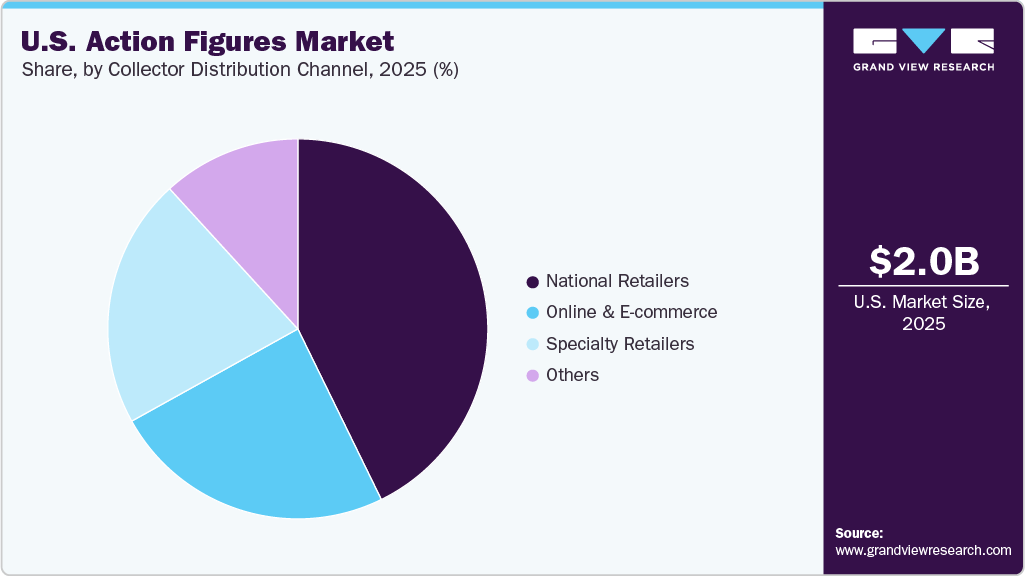
- By collector distribution channel, national retailers remained the largest channel with a 42.8% share in 2025.
Market Size & Forecast
- 2025 Market Size: USD 2.0 Billion
- 2033 Projected Market Size: USD 3.1 Billion
- CAGR (2026-2033): 5.6%
Three ways to get this report
Buy it, customize it, or ask a question.Ask an Analyst
A direct answer, usually in 1 working day
- AccessReport author, directly
- Reply timeWithin 1 working day
- No sales callDirect answer only
- FormatEmail reply
- CostFree, no cost
Get the Full Report
What the study covers
- FormatsPDF · Excel · Dashboard
- Timeline2026–2033 annual, 2025 base
- Coverage20+ countries, 5 regions
- Companies10+ key players profiled
Customize the Report
20% free customization
- IncludeCountries, segments, points
- TailorTo your product definition
- ExtendDeeper competitor detail
- OrA fully bespoke study
- Turnaround5–10 working days
Growth is increasingly shaped by the continued strength of licensed intellectual properties (IP) and the rapid expansion of the adult collector segment. Traditionally seen as a children’s toy category, the market has evolved significantly over the past decade. Today, adult collectors play a much more influential role.A key driver of this growth is the industry’s strong dependence on entertainment-driven product cycles. Companies like Hasbro regularly launch new product lines that align with movie releases, series, and fan events. Similarly, McFarlane Toys has been strengthening its position in the collectibles space through relaunches and licensing expansions, catering to a growing base of adult collectors.
 Source: Grand View Research, IR Documents, Primary Interviews, Paid DatabasesTo learn more about this report,
 Download Free Sample Report
 New figure releases tied to popular franchises often lead to short-term surges in demand, particularly among dedicated fan communities who actively follow these launches. The market is clearly moving toward higher-value products. Companies such as Mattel and Funko have already indicated price adjustments in response to rising costs, which are gradually increasing average selling prices. This shift suggests that future growth will rely less on selling higher volumes and more on offering premium, collectible-focused products.
A noticeable trend across the industry is the move toward premiumization, where consumers are choosing fewer but more valuable products. This is supported by the rise of online platforms, pre-order systems, and limited-edition drops, which create a sense of urgency and excitement, especially among collectors.
The industry is gradually shifting from being purely toy-driven to becoming more fan and collectible-focused. While the playline segment continues to provide scale and stability, the collector segment is increasingly shaping the market’s growth, profitability, and future direction.
Brand Market Share Insights
The industry is highly competitive and moderately consolidated, driven by a mix of global toy manufacturers, licensing-driven companies, and collector-focused brands. Leading players such as Hasbro, Mattel, and Bandai Namco Holdings collectively account for a significant share of the market, supported by strong portfolios of licensed intellectual properties and long-standing retail distribution networks. These companies dominate key categories such as superhero/comics and anime figures, leveraging partnerships with major franchises to maintain consistent demand.
 To learn more about this report, Download Free Sample Report
 At the same time, companies like JAKKS Pacific and Spin Master compete primarily in the mid-tier segment, focusing on affordability and mass-market appeal through partnerships with entertainment and gaming brands. In parallel, Funko has established a strong position in the collector-driven segment, capitalizing on stylized, pop culture-inspired figures and a highly engaged fan base, making it a key player in value-driven growth. A key factor influencing market share is access to licensed intellectual property, with Walt Disney Company playing a central role as a licensor of major franchises.
Consumer Insights
Gen Z consumers are becoming highly active in the action figures industry, especially in categories like anime, gaming, and pop culture. Their buying behavior is strongly influenced by social media, online communities, and trending content. They tend to make quick purchase decisions, particularly when it comes to limited-edition drops or popular franchise releases. For many in this group, buying action figures is not just about ownership; it’s about being part of a trend or fan community.
 To learn more about this report, Download Free Sample Report
 Millennials remain the most important spending group in the market, largely driven by nostalgia and stronger purchasing power. Having grown up with major franchises, they are more willing to spend on premium and high-quality figures, often treating them as collectibles rather than toys. Unlike Gen Z, their purchases are more planned and intentional, with a focus on building collections over time. Younger consumers are driving trends and demand spikes, while older consumers support steady, higher-value purchases. This combination is helping shape the market into one that is increasingly collector-focused and experience-driven, rather than purely toy-based.
Consumer Type Insights
The U.S. action figure industry continues to be anchored by the playline segment, which accounted for 65.9% of total revenue in 2025. This segment remains the foundation of the market, supported by steady demand from children, gifting occasions, and seasonal peaks such as holidays. While it continues to lead in volume, its growth is projected to be relatively stable and closely tied to new character releases, movie tie-ins, and retail promotions. In many ways, the playline segment reflects the traditional side of the market, where accessibility and affordability drive consistent sales.
At the same time, the collector segment is gaining strong momentum. This shift is being driven by adult consumers who are increasingly purchasing action figures not for play, but for display, nostalgia, and personal interest. These buyers are more willing to invest in premium, licensed, and limited-edition products, often focusing on quality and authenticity. As a result, even though this segment is smaller in size, it plays a significant role in driving higher value per purchase.
Collector Product Tier Insights
The market is witnessing a clear shift toward premiumization, where higher-value segments are growing faster than traditional mass-market offerings. Stylized figures continue to hold the largest share, accounting for 47.8% in 2025. This reflects their continued importance in driving volume, particularly among casual buyers and younger consumers, but also indicates a gradual shift in consumer preference toward more premium offerings.
 To learn more about this report, Download Free Sample Report
 The ultra-premium segment is the fastest-growing category, projected to expand at a CAGR of 7.9% from 2026 to 2033, driven by a niche but highly engaged consumer base seeking high-end, limited-edition figures. This segment reflects the rising influence of the kidult economy, where consumers view action figures as display pieces and long-term collectibles.
Collector Product Insights
The growth is largely driven by how closely the market is tied to popular entertainment content, where new movie releases, series, and character launches quickly translate into spikes in product demand. A large part of the market is concentrated in a few key categories. Superhero and comics-based figures continue to dominate, holding a 37.7% share in 2025. This reflects how strongly consumers connect with well-known characters, especially as new content keeps these franchises relevant and visible.
At the same time, anime and cartoon figures are emerging as one of the fastest-growing segments. Their share is also increasing, which shows how anime is becoming more mainstream in the U.S., supported by strong fan communities and global content access. On the other hand, film and TV-based figures are growing more steadily, but their overall share is slightly declining, suggesting that consumers are gradually shifting toward more niche or fandom-driven categories.
One important change in the market is how people are spending. Growth is no longer just about selling more units; it’s increasingly about selling higher-value products. Consumers, especially collectors, are willing to pay more for better quality, detailed designs, and limited-edition figures. This shift toward premium products is playing a key role in overall market expansion.
Today, online platforms, social media, and fan communities play a big role in driving sales. When a new figure is launched, especially one linked to a popular franchise, it often creates a sudden surge in demand within a short time, like how big events drive spikes in other industries.
Collector Distribution Channel Insights
The market continues to be anchored by national retailers, which accounted for 42.8% of total revenue in 2025. These outlets remain the primary channel for mass-market and playline products, benefiting from high footfall, strong brand visibility, and widespread geographic reach.
This shift is most visible in the rapid rise of online and e-commerce channels, which are projected to grow at the fastest rate. Consumers, particularly collectors, are increasingly turning to online platforms for a wider assortment, convenience, and access to exclusive or limited-edition releases. Pre-orders, direct-to-consumer launches, and digital fan communities are further accelerating this trend, making online channels a key driver of high-intensity, event-like demand spikes.
 To learn more about this report, Download Free Sample Report
 At the same time, specialty retailers are carving out a strong niche, especially among enthusiasts and collectors. Growing at a CAGR of 7.6%, these stores appeal to consumers looking for curated selections, premium products, and a more personalized shopping experience, which is particularly important in the collector segment.
The market is clearly moving toward an omnichannel buying behavior. While families and casual buyers still rely on physical retail for convenience and immediate purchase, collectors increasingly prefer online platforms and specialty stores for authenticity, exclusivity, and product variety. Demand is also becoming more time-sensitive and release-driven, with new product drops creating short bursts of high sales, especially in digital channels.
Key U.S. Action Figures Companies:
- Hasbro, Inc
- Mattel, Inc.
- JAKKS Pacific, Inc.
- Bandai Namco Holdings Inc
- Spin Master Corp.
- Funko, Inc
- TOMY Company, Ltd
- VTech Holdings Limited
- Build-A-Bear Workshop, Inc.
- Walt Disney Company
Recent Developments
-
In February 2026, McFarlane Toys announced a strategic partnership with Quantum Mechanix (QMx) to relaunch its Q-Figs collectible line, positioning it within the growing stylized action figures segment. Under this collaboration, McFarlane Toys will oversee product development, manufacturing, and global distribution, while leveraging QMx’s established portfolio of licensed characters across film, television, and gaming. The relaunch focuses on delivering affordable, display-oriented figures that bridge the gap between mass-market toys and premium collectibles. This development reflects the industry’s shift toward collector-driven demand, IP-led product expansion, and mid-tier pricing strategies, enabling companies to capture both casual consumers and dedicated fans within the evolving market.
-
In January 2026, Hasbro expanded its ActionVerse portfolio with new playline action figure launches based on Marvel and Star Wars franchises. The launch focuses on introducing new characters and variants aligned with ongoing entertainment releases, strengthening Hasbro’s position in the mass-market segment. This development highlights the continued importance of licensed IP-driven product cycles and playline volume growth, where new content releases directly translate into increased product demand and retail activity in the market.
U.S. Action Figures Market Report Scope
Report Attribute
Details
Market size value in 2026
USD 2.09 billion
Revenue forecast in 2033
USD 3.1 billion
Growth rate
CAGR of 5.6% from 2026 to 2033
Base year for estimation
2025
Historical data
2021 - 2024
Forecast period
2026 - 2033
Quantitative units
Revenue in USD million/billion and CAGR from 2026 to 2033
Report coverage
Revenue forecast, company ranking, competitive landscape, growth factors, and trends
Segments covered
Consumer type, collector product, collector product tier, collector price point, collector distribution channel
Country scope
U.S.
Key companies profiled
Hasbro, Inc; Mattel, Inc; JAKKS Pacific, Inc; Bandai Namco Holdings Inc; Spin Master Corp.; Funko, Inc; TOMY Company, Ltd; Vtech Holdings Limited; Build-A-Bear Workshop, Inc; Walt Disney Company
Customization scope
Free report customization (equivalent up to 8 analysts working days) with purchase. Addition or alteration to country, regional & segment scope.
Pricing and purchase options
Avail customized purchase options to meet your exact research needs. Explore purchase options
U.S. Action Figures Market Report Segmentation
This report forecasts revenue growth at the country level and provides an analysis of the latest trends and opportunities in each of the sub-segments from 2021 to 2033. For this study, Grand View Research has segmented the U.S. action figures market report based on collector product, collector product tier, consumer type, collector price point, and collector distribution channel:
-
Consumer Type Outlook (Revenue, USD Billion, 2021 - 2033)
-
Collector
-
Playline
-
-
Collector Product Outlook (Revenue, USD Billion, 2021 - 2033)
-
Superhero/Comics
-
Anime & Cartoon
-
Film & TV
-
Gaming/Video Games
-
Sports/Athletes
-
Other/Original IP
-
-
Collector Product Tier Outlook (Revenue, USD Billion, 2021 - 2033)
-
Stylized
-
Collector Grade
-
Ultra Premium
-
-
Collector Price Point Outlook (Revenue, USD Billion, 2021 - 2033)
-
Below $20
-
$20-$30
-
$30-$100
-
Above$100
-
-
Collector Distribution Channel Outlook (Revenue, USD Billion, 2021 - 2033)
-
National Retailers
-
Specialty Retailers
-
Online & E-commerce
-
Others
-
Frequently Asked Questions About This Report
Key factors driving the U.S. action figures market growth include rising demand for collectible merchandise, franchise-driven popularity, advancements in design and technology, and expanding consumer demographics across age groups.
The U.S. action figures market was estimated at USD 2.00 billion in 2025 and is expected to reach USD 2.09 billion in 2026.
The superhero action figures industry accounted for 37.7% of the market share in 2025. The growing influence of superhero movies and TV shows drives the growth of superhero action figures.
Some key players operating in the U.S. action figures market include Hasbro, The LEGO Group, Playmates Toys Ltd., JAKKS Pacific, Inc., Mattel, Bandai Namco Holdings Inc., Diamond Select Toys, Good Smile Company, Inc., Spin Master, and McFarlane Toys.
The U.S. action figures market is expected to grow at a compound annual growth rate of 5.6% from 2026 to 2033, reaching USD 3.1 billion by 2033.
About the Author(s)
Homecare & Decor Research Team
Consumer Goods · Homecare & DecorThis report was authored by the homecare & decor research team at Grand View Research - comprising two research analysts, one senior research analyst, and one industry expert - with specialized expertise in the homecare & decor segment of the consumer goods industry. All findings are based on proprietary consumer goods databases, executive interviews, and regulatory analysis, subject to internal peer review prior to publication.
Last Updated:
Speak to Analyst

Customize this report to your needs - add regions, segments, or data points, with 20% free customization.
Or view our licence options:


ISO 9001:2015 & 27001:2022 Certified
We are GDPR and CCPA compliant! Your transaction & personal information is safe and secure. For more details, please read our privacy policy.


