
- Home
- »
- Power Generation & Storage
- »
-
U.S. Aftermarket Battery Market Size Report, 2026-2033GVR Report cover

U.S. Aftermarket Battery Market (2026 - 2033)
Size, Share & Trends Analysis Report By Application (Mobile Battery, Stationary Battery), By Product (Lead Acid, Lithium-ion, Nickel-based, Sodium-ion, Small Sealed Lead-acid Battery), And Segment Forecasts
Market Size, 2025
$27.1BMarket Estimate, 2026
$28.2BMarket Forecast, 2033
$37.7BCAGR, 2026–2033
4.2%U.S. Aftermarket Battery Market Summary
The U.S. aftermarket battery market size was valued at USD 27.1 billion in 2025 and is projected to grow from USD 28.2 billion in 2026 to USD 37.7 billion by 2033, at a CAGR of 4.2% from 2026 to 2033. The market is driven by an aging U.S. vehicle fleet, longer vehicle ownership periods, increasing vehicle miles traveled, and recurring battery replacement needs, supported by the growing penetration of start-stop systems and demand for reliable replacement batteries.
Key Market Trends & Insights
- By product: Lead acid batteries segment held the largest revenue share of 82.1% in 2025.
- By application: Mobile battery applications segment held the largest revenue share of 81.0% in 2025.
Market Size & Forecast
- Market size in 2025: USD 27.1 Billion
- Estimated market size in 2026: USD 28.2 Billion
- Projected market size by 2033: USD 37.7 Billion
- CAGR (2026-2033): 4.2%
GVR research-powered AIAsk Prism AI about the U.S. aftermarket battery marketGet cited answers from GVR research on market growth, segments, regulations and forecasts.Start with✓ Source-linked answers ✓ Market-specific context ✓ Traceable figuresExplore Prism AI ↗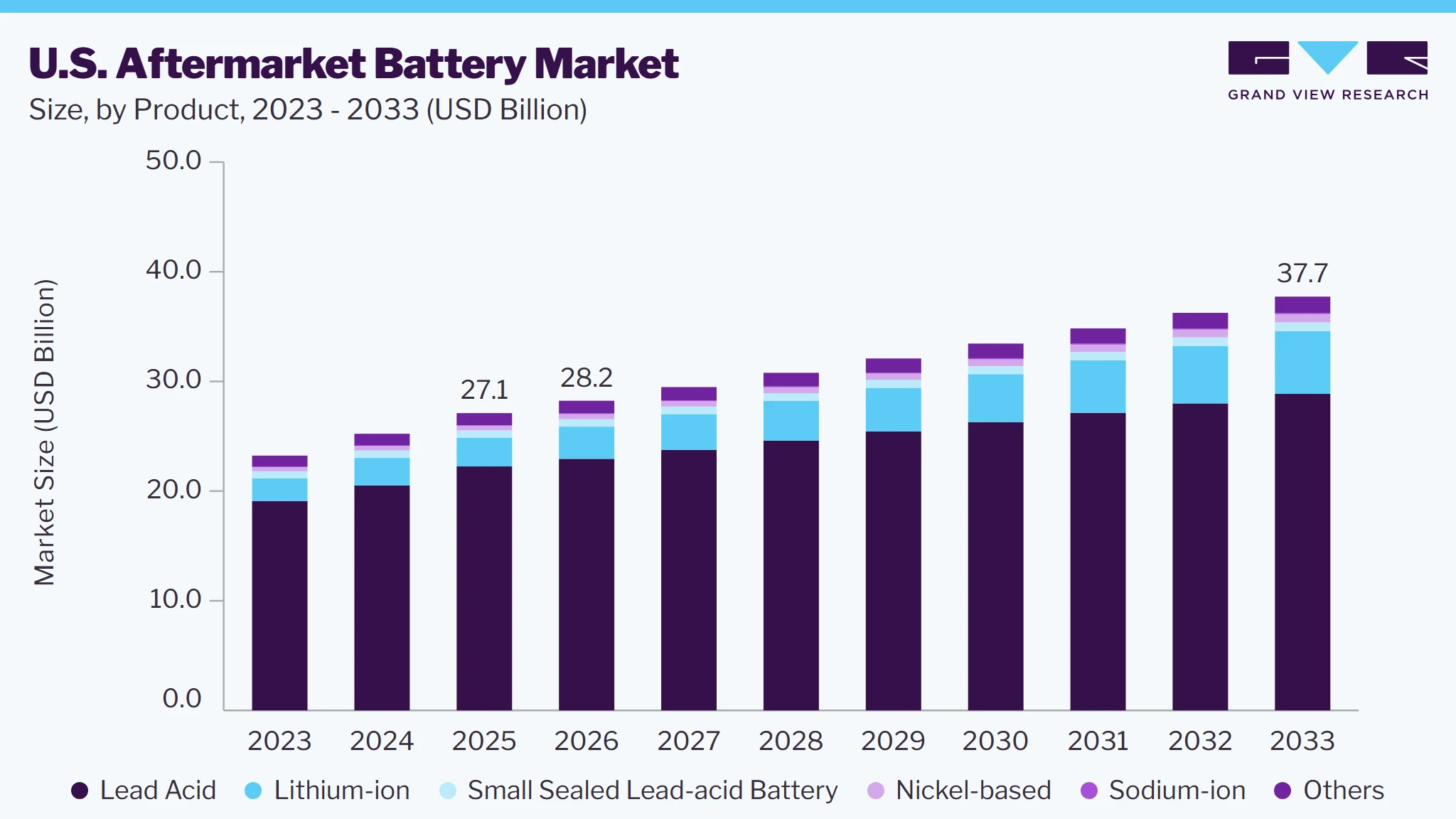 Source: Grand View Research, IR Documents, Primary Interviews, Paid DatabasesTo learn more about this report,
 Download Free Sample Report
Market Dynamics
The U.S. market is driven by technological shifts toward AGM and EFB batteries, growing lithium-ion adoption, and increasing demand for battery diagnostics and replacement services. Raw material price movements, particularly for lead and lithium, continue to influence battery costs and replacement economics. Regulatory emphasis on battery recycling, domestic manufacturing, and safety is strengthening sustainable battery supply chains. Meanwhile, buyers increasingly prioritize application-specific batteries, reliability, rapid availability, and integrated maintenance services.
The large and aging U.S. vehicle fleet provides a fundamental and recurring demand base for the market. Unlike OEM battery demand, which is primarily linked to new vehicle production, aftermarket demand is generated by batteries already installed in vehicles and their eventual replacement due to degradation, failure, or maintenance requirements. The U.S. had approximately 297.5 million registered motor vehicles in 2024, up from 284.6 million in 2023, underscoring the scale of the vehicle population that requires ongoing maintenance and component replacement.
The age profile of the vehicle fleet further strengthens the replacement opportunity. According to the U.S. Department of Energy, pickup trucks had an average age of 13.1 years in 2023, followed by heavy trucks at 12.1 years, while cars and vans averaged 11.9 and 11.8 years, respectively. A mature vehicle fleet increases the need for recurring maintenance and component replacement, including automotive batteries. Continued vehicle operation also sustains replacement activity as batteries are subjected to repeated starting cycles, temperature variations, vibration, and electrical loads.
Advancements in battery technology and improvements in product durability are extending replacement cycles across several market segments. Higher-performance technologies, including AGM, EFB, and lithium-ion batteries, are designed to offer improved cycle life, reliability, and operating performance compared with conventional battery technologies in their respective applications. A longer operating life can reduce the frequency of battery replacements, thereby moderating demand for aftermarket units.
An emerging business opportunity in the U.S. market is battery diagnostics, refurbishment, and remanufacturing services, particularly for hybrid and electric vehicle batteries. As the installed base of advanced batteries expands, specialized providers can assess battery state of health, identify defective modules, replace or regenerate components, and return refurbished packs to the aftermarket, reducing the need for complete battery replacement. The U.S. Department of Energy is supporting technologies for battery-life extension, repair, reuse, and remanufacturing, indicating a growing scope for specialized aftermarket service providers.
Analyst Perspective
The market is undergoing a gradual shift from volume-driven replacement demand toward technology-led value growth. An aging vehicle parc provides a stable replacement base, while rising electrical loads, start-stop systems, and advanced onboard electronics are encouraging consumers and service providers to adopt higher-performance AGM and EFB batteries. This premiumization is creating opportunities for manufacturers and distributors to improve revenue per replacement, while battery diagnostics and registration requirements are increasing the role of professional installers. At the same time, the growing presence of hybrid and electric vehicles is gradually expanding the aftermarket toward battery health assessment, refurbishment, and lifecycle services, making service capabilities an increasingly important competitive differentiator.
Product Insights
Lead-acid batteries dominated the U.S. market, accounting for 82.1% of revenue in 2025. They continue to represent the foundation of the U.S. aftermarket battery ecosystem because of their established installed base, comparatively low acquisition cost, mature distribution infrastructure, and highly developed recycling network. Their presence spans automotive starting applications, industrial motive equipment, telecommunications, backup power, generators, and other stationary applications. Within the aftermarket, technology benefits from predictable replacement cycles and broad compatibility with existing electrical systems.
The lithium-ion batteries segment is anticipated to register the fastest CAGR of 10.0% from 2026 to 2033. Its higher energy density, lower weight, longer cycle life, and ability to support higher power requirements make it increasingly attractive for applications ranging from drones and golf cars to motive equipment, UPS systems, data centers, and advanced automotive auxiliary systems. The technology is also benefiting from the expansion of U.S. manufacturing capacity and a growing domestic ecosystem for materials processing, cell production, battery pack manufacturing, and recycling. DOE has identified domestic lithium-ion manufacturing and supply chain development as strategic priorities, with substantial federal investment directed toward cell manufacturing and materials infrastructure.
Application Insights
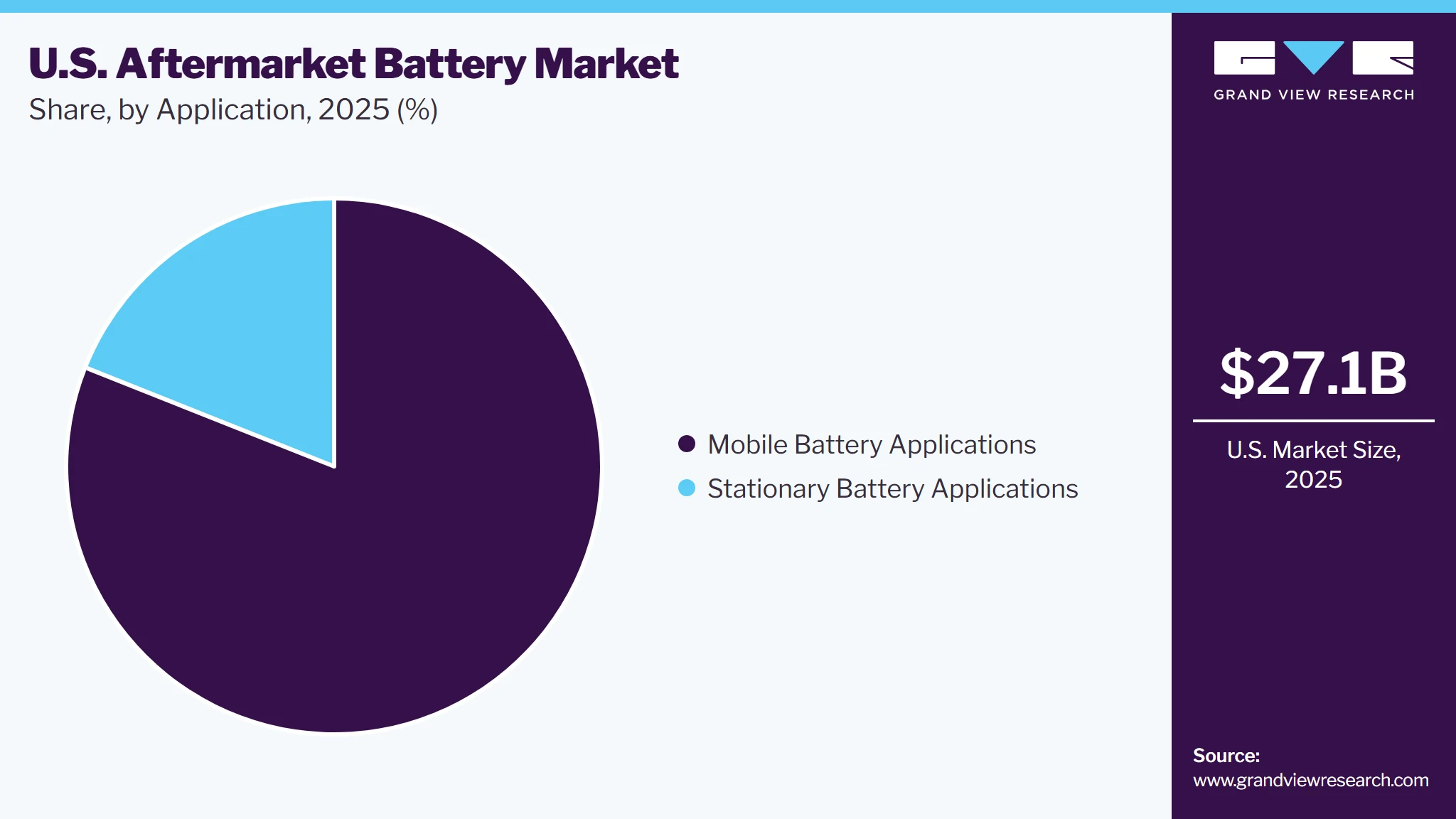
Mobile battery applications accounted for the largest revenue share, at 81.0% in 2025, supported by the extensive installed base of automobiles, heavy-duty vehicles, powersports equipment, motive equipment, drones, golf cars, and other mobile platforms. Demand is largely replacement-driven, as batteries require periodic replacement due to aging, usage intensity, operating conditions, and maintenance requirements. The broad presence of aftermarket retailers, distributors, repair shops, and service outlets further facilitates battery availability and supports recurring replacement demand.
 To learn more about this report, Download Free Sample Report
The stationary battery applications segment is expected to grow at the fastest CAGR of 4.9% from 2026 to 2033. This growth is driven by increasing requirements for reliable backup power, power quality, and energy resilience across commercial, industrial, and residential environments. Key applications include data centers and UPS systems, generators, fire and security systems, commercial backup power, and other stationary equipment, with demand supported by battery replacement cycles and the growing need for uninterrupted power supply.
Key U.S. Aftermarket Battery Company Insights
Some of the key players in the U.S. market include Clarios and East Penn Manufacturing Company.
-
Clarios is a prominent player in the U.S. market, offering a broad portfolio of low-voltage battery technologies for passenger vehicles, commercial vehicles, powersports, and other mobility applications. Its portfolio includes flooded, AGM, EFB, lithium-ion, and sodium-ion technologies, with products supplied under brands such as OPTIMA and private-label offerings. The company operates 16 manufacturing and distribution centers across the U.S. and Canada, supporting broad aftermarket coverage. Its combination of advanced battery technologies, strong aftermarket orientation, and extensive distribution infrastructure positions Clarios as a key participant in the U.S. market.
-
East Penn Manufacturing Company is an established battery manufacturer and aftermarket supplier in the U.S., offering lead-acid and lithium-ion battery technologies for automotive, commercial, marine, powersports, and other transportation applications. Its Deka portfolio includes flooded, AGM, gel, and EFB batteries designed for diverse replacement requirements. The company operates more than 90 warehouses and distribution centers across North America, supporting store-door and direct-delivery programs for aftermarket customers. Its broad automotive portfolio, manufacturing capabilities, and established distribution network position East Penn as a significant participant in the U.S. market.
Key U.S. Aftermarket Battery Companies
-
Clarios
-
East Penn Manufacturing Company
-
EnerSys
-
Stryten Energy
-
Continental Battery Systems
-
C&D Technologies (Trojan)
-
U.S. Battery Manufacturing Co.
-
Duracell Inc.
-
Energizer Holdings, Inc.
-
Panasonic Energy Co., Ltd.
-
Interstate Batteries
-
Power-Sonic
Competitive Benchmarking
Category
Operating Strategies
Competitive Edge
Weakness
Established Players (Clarios, East Penn Manufacturing Company, EnerSys, C&D Technologies (Trojan), Duracell Inc., Energizer Holdings, Inc., Panasonic Energy Co., Ltd., Interstate Batteries)
- Expanding battery manufacturing and distribution capacity across major markets.
- Leveraging established manufacturing, recycling, and distribution networks to strengthen market reach.
- Strengthening partnerships with OEMs, distributors, retailers, and automotive service providers.
- Leveraging strong brands, extensive product portfolios, and established customer relationships.
- Utilizing large-scale manufacturing and distribution networks to ensure broad product availability.
- Benefiting from established R&D, recycling capabilities, and long-standing industry expertise.
- Facing higher operating complexity due to large manufacturing and distribution networks.
- Managing technology transition challenges as demand shifts toward advanced battery chemistries.
- Facing pricing pressure from intense competition across established battery product categories.
Emerging Players (U.S. Battery Manufacturing Co., Stryten Energy, Continental Battery Systems, Power-Sonic)
- Expanding specialized battery portfolios across automotive, industrial, and energy-storage applications.
- Leveraging advanced battery technologies to target specialized and higher-growth applications.
- Strengthening distributor partnerships and specialty channels to expand market penetration.
- Offering specialized battery solutions tailored to specific application and performance requirements.
- Leveraging flexible operations to respond quickly to emerging battery technology opportunities.
- Expanding across adjacent energy-storage applications to diversify revenue opportunities.
- Offering specialized battery solutions tailored to specific application and performance requirements.
- Leveraging flexible operations to respond quickly to emerging battery technology opportunities.
- Expanding across adjacent energy-storage applications to diversify revenue opportunities.
Recent Developments
- In July 2026, Stryten Energy announced a definitive agreement to acquire C&D Technologies and Trojan Battery Company (C&D Trojan), creating a larger battery manufacturing platform across transportation, industrial, and essential power applications. The transaction is expected to expand Stryten’s U.S. manufacturing footprint to 15 facilities, increase AGM battery manufacturing capacity, broaden its lead- and lithium-based battery portfolio, and strengthen its position in the U.S. battery market.
U.S. Aftermarket Battery Market Report Scope
Report Attribute
Details
Market Definition
The market represents the revenue generated from the sale of batteries used as replacement or retrofit products for existing vehicles, equipment, systems, and devices in the U.S.
Market size in 2025
USD 27.1 billion
Estimated market size in 2026
USD 28.2 billion
Projected market size by 2033
USD 37.7 billion
Growth rate
CAGR of 4.2% from 2026 to 2033
Historical data
2021 - 2025
Forecast period
2026 - 2033
Quantitative Units
Volume in million units, revenue in USD billion, and CAGR from 2026 to 2033
Report coverage
Revenue forecast, competitive landscape, growth factors, and trends
Segments covered
Product, application
Country scope
U.S.
Key companies profiled
Clarios; East Penn Manufacturing Company; EnerSys; Stryten Energy; Continental Battery Systems; C&D Technologies (Trojan); U.S. Battery Manufacturing Co.; Duracell Inc.; Energizer Holdings, Inc.; Panasonic Energy Co., Ltd.; Interstate Batteries; Power-Sonic
Customization scope
Free report customization (equivalent up to 8 analysts working days) with purchase. Addition or alteration to country, regional & segment scope.
Pricing and purchase options
Avail customized purchase options to meet your exact research needs. Explore purchase options
U.S. Aftermarket Battery Market Report Segmentation
This report forecasts revenue growth at the country level and provides an analysis of the latest industry trends in each of the sub-segments from 2021 to 2033. For this study, Grand View Research has segmented the U.S. aftermarket battery market report based on product and application:
-
Product Outlook (Volume, Million Units; Revenue, USD Billion, 2021 - 2033)
-
Lead Acid
-
SLI
-
Stationary
-
Motive
-
-
Lithium-ion
-
Nickel-based
-
Sodium-ion
-
Small Sealed Lead-acid Battery
-
Others
-
-
Application Outlook (Volume, Million Units; Revenue, USD Billion, 2021 - 2033)
-
Mobile Battery Applications
-
Automotive
-
Heavy-duty Vehicles
-
Powersports
-
Motive Equipment
-
Drones
-
Golf Cars
-
Other Mobile Applications
-
-
Stationary Battery Applications
-
Fire & Security Systems
-
Generators
-
Data centers / UPS
-
Alkaline / Small-cell Batteries
-
Commercial UPS & Critical Power
-
Other Stationary Applications
-
-
Research Methodology
The U.S. aftermarket battery market figures in this report are based on a proven research process that combines executive interviews with secondary research from proprietary databases, company filings, and recognized regulatory and institutional sources. Market size is built through value-chain sizing—reconciling supply-side and demand-side estimates—and triangulated with bottom-up and top-down approaches. Every estimate passes multiple levels of expert validation before publication, with each U.S. aftermarket battery segment quantified using the revenue-capture definitions in the table below.
Segment Definition
Segment - Product
Revenue capture definition
Lead Acid
Revenue generated from the sale of aftermarket lead-acid batteries using lead and lead dioxide electrodes with sulfuric acid electrolytes, including automotive, industrial, motive, and stationary power batteries.
Lithium-ion
Revenue generated from the sale of rechargeable aftermarket lithium-ion batteries used in mobile, industrial, motive, backup-power, and other applications.
Nickel-based
Revenue generated from the sale of rechargeable aftermarket batteries based on nickel chemistries, including NiMH batteries used in automotive, industrial, and specialized applications.
Sodium-ion
Revenue generated from the sale of rechargeable aftermarket sodium-ion battery modules or packs, measured on the basis of 2 kWh per unit, used primarily in stationary energy storage, mobility, and other applications.
Small Sealed Lead-acid Battery
Revenue generated from the sale of compact sealed or valve-regulated lead-acid batteries used for standby and backup power applications, including security systems, emergency equipment, small UPS systems, and telecommunications.
Others
Revenue generated from aftermarket battery technologies and types not separately classified under lead acid, lithium-ion, nickel-based, sodium-ion, or small sealed lead-acid batteries, including other primary, secondary, and specialized small-format batteries.
Segment - Application
Revenue capture definition
Mobile
Revenue generated from the sale of aftermarket batteries used in portable or mobile equipment requiring on-board power for propulsion, starting, operation, or auxiliary functions, including automotive, heavy-duty vehicles, powersports, motive equipment, drones, and golf cars.
Stationary
Revenue generated from the sale of aftermarket batteries installed at fixed locations for backup power, energy storage, or continuous power supply, including fire and security systems, generators, data centers/UPS, commercial power systems, and small-cell/alkaline applications.
Estimation Model
Layer Name
Key Question
Description
Demand Layer
Which factors generate demand for U.S. aftermarket batteries?
Assess replacement demand from the existing vehicle, equipment, and stationary battery base in the U.S. based on battery replacement cycles and growth in battery-dependent applications.
Product Layer
Which battery products generate market revenue?
Estimate revenue across Lead Acid, Lithium-ion, Nickel-based, Sodium-ion, Small Sealed Lead-acid Battery, and Others. Lead Acid is further segmented into SLI, Stationary, and Motive.
Application Layer
Where are aftermarket batteries used?
Estimate revenue across Mobile Applications and Stationary Applications, with further segmentation into the specified automotive, heavy-duty, powersports, motive equipment, drones, golf cars, fire & security, generators, data centers/UPS, alkaline/small-cell, commercial UPS & critical power, and other applications.
Revenue Layer
How is market revenue generated?
Market revenue represents the sales value of replacement batteries sold through U.S. aftermarket channels. Revenue is calculated based on the volume of replacement batteries sold and their average selling price, excluding batteries supplied as part of original equipment.
Delivered Customizations
This report has been delivered with the following In-depth customizations
Client Request
Customization Delivered
Value Adds
Trade Outlook
Conducted an analysis of U.S. battery imports and exports under HS Code 8507, including major source countries for imports and major destination countries for exports.
Helps the client assess import dependency, supply-side exposure, key trading partners, and cross-border battery flows relevant to the U.S. aftermarket.
End User Opportunity Assessment
Assessed Commercial/B2B and Consumer/Retail end users based on battery replacement requirements, purchasing patterns, application demand, and distribution channels.
Enables identification of high-potential customer groups, attractive sales channels, and opportunities for market expansion.
Competitive Benchmarking
Conducted a detailed assessment of established and emerging U.S. aftermarket battery companies based on product portfolio, battery technologies, application coverage, U.S. manufacturing presence, distribution reach, strategic developments, and overall market positioning.
Helps the client understand competitive strengths, portfolio gaps, market positioning, and areas of differentiation against key aftermarket battery participants.
Frequently Asked Questions About This Report
The U.S. aftermarket battery market size was estimated at USD 27.1 billion in 2025 and is expected to reach USD 28.2 billion in 2026.
The U.S. aftermarket battery market is expected to grow at a CAGR of 4.2% from 2026 to 2033 to reach USD 37.7 billion by 2033.
The U.S. aftermarket battery market is driven by an aging vehicle fleet, recurring battery replacement demand, increasing vehicle electrification, and rising demand for reliable backup and stationary power applications.
Based on product, the lead acid segment accounted for largest revenue share of 82.1% in 2025.
Based on product, lithium-ion batteries are anticipated to register the fastest CAGR of 10.0% during the forecast period.
Based on application, the mobile battery applications segment accounted for largest revenue share of 81.0% in 2025.
Based on application, stationary battery applications segment is expected to register the fastest CAGR of 4.9% over the forecast period.
The key players operating in the U.S. aftermarket battery market are Clarios, East Penn Manufacturing Company, EnerSys, Stryten Energy, Continental Battery Systems, C&D Technologies (Trojan), U.S. Battery Manufacturing Co., Duracell Inc., Energizer Holdings, Inc., Panasonic Energy Co., Ltd., Interstate Batteries, Power-Sonic, and others.
The U.S. aftermarket battery market is highly competitive, with major suppliers operating across automotive, industrial, commercial, marine, powersports, and specialty battery applications.
About the Author(s)
Power Generation & Storage Research Team
Energy & Power · Power Generation & StorageThis report was authored by the power generation & storage research team at Grand View Research - comprising two research analysts, one senior research analyst, and one industry expert - with specialized expertise in the power generation & storage segment of the energy & power industry. All findings are based on proprietary energy & power databases, executive interviews, and regulatory analysis, subject to internal peer review prior to publication.
Last Updated:
Speak to Analyst

Customize this report to your needs - add regions, segments, or data points, with 20% free customization.
Or view our licence options:


ISO 9001:2015 & 27001:2022 Certified
We are GDPR and CCPA compliant! Your transaction & personal information is safe and secure. For more details, please read our privacy policy.


