
- Home
- »
- Network Security
- »
-
U.S. Agentic AI Security Market Size & Share Report, 2033GVR Report cover
![U.S. Agentic AI Security Market (2026 - 2033)Report]()
U.S. Agentic AI Security Market (2026 - 2033)
Size, Share & Trends Analysis Report By Component (Solutions, Services), By Deployment (Cloud, Hybrid, On-Premises), By Organization Size, By End-use (BFSI, Healthcare, IT & Telecom, Retail), By Region, And Segment Forecasts
Market Size, 2025
$456.2MMarket Estimate, 2026
$603.4MMarket Forecast, 2033
$5,836.9MCAGR, 2026–2033
38.3%U.S. Agentic AI Security Market Summary
The U.S. agentic AI security market size was valued at USD 456.2 million in 2025 and is projected to grow from USD 603.4 million in 2026 to USD 5,836.9 million by 2033, at a CAGR of 38.3% from 2026 to 2033, driven by the rapid adoption of autonomous AI agents across industries such as BFSI, healthcare, IT & telecommunications, government, retail, and manufacturing.
Key Market Trends & Insights
- By component: Solutions segment held the largest market share of 75.9% in 2025.
- By deployment: Cloud segment held the largest market share of 57.5% in 2025.
- By organization size: Large enterprises segment accounted for the largest revenue share of 77.5% in 2025.
- By end-use: IT & telecom segment dominated the market with the largest revenue share of 24.8% in 2025.
Market Size & Forecast
- Market size in 2025: USD 456.2 Million
- Estimated market size in 2026: USD 603.4 Million
- Projected market size by 2033: USD 5,836.9 Million
- CAGR (2026-2033): 38.3%
As enterprises increasingly deploy AI agents capable of independently accessing enterprise systems, interacting with applications, and executing complex tasks, the demand for specialized security solutions has grown significantly.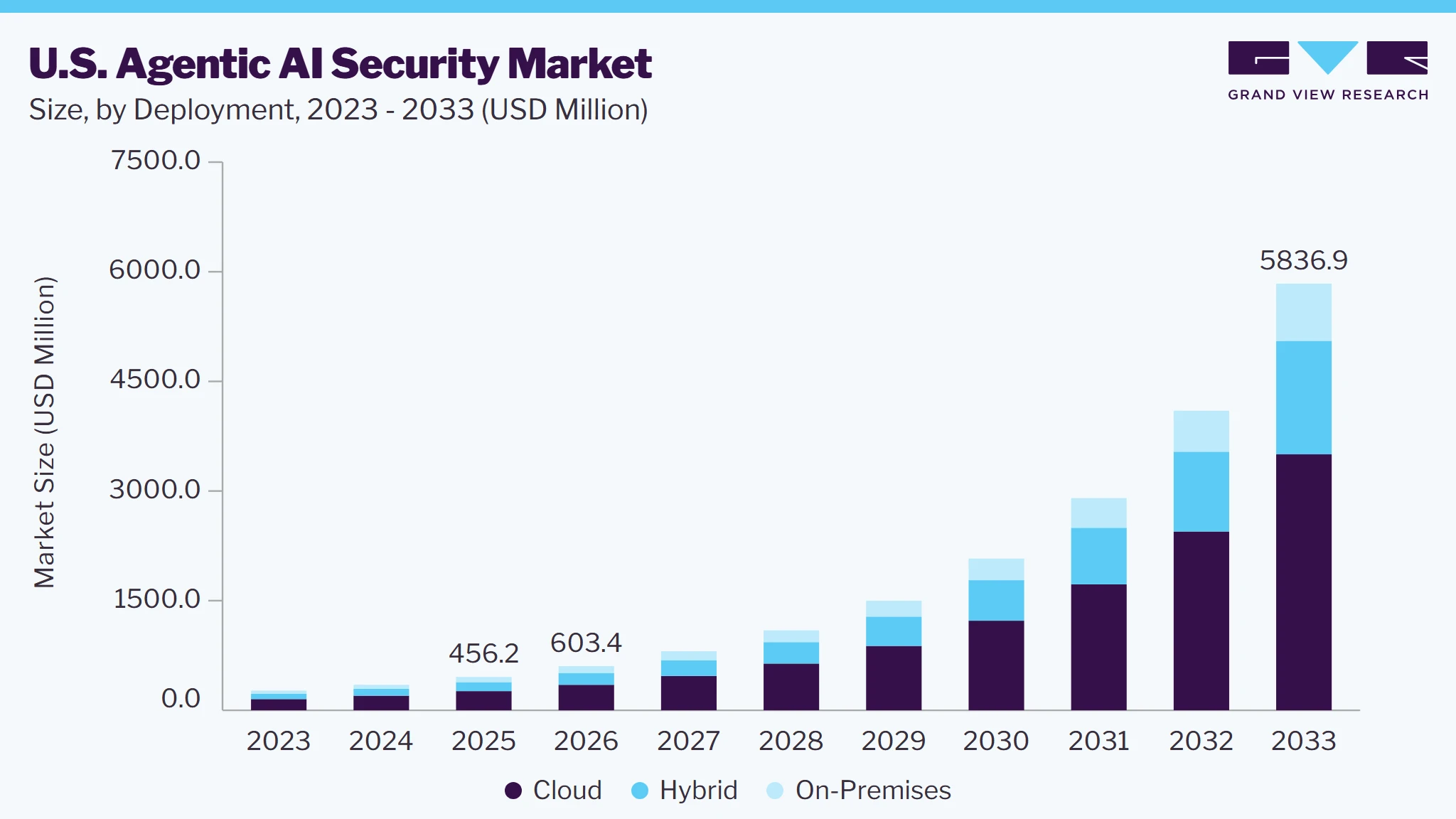
Organizations are investing in agent identity and access management, runtime security, AI governance, data protection, and continuous monitoring to mitigate risks associated with unauthorized agent actions, prompt injection attacks, model manipulation, and sensitive data exposure. The strong presence of leading AI developers, hyperscale cloud providers, and global cybersecurity vendors further strengthens the country's leadership in the market.
The market is also being driven by increasing enterprise investments in responsible AI adoption and the need to comply with evolving AI governance and cybersecurity frameworks. Organizations are moving beyond securing AI models alone and are focusing on protecting the entire lifecycle of autonomous AI agents through policy enforcement, behavioral analytics, automated threat detection, and audit capabilities. Strategic product launches by major cybersecurity vendors, growing adoption of Zero Trust architectures, and the integration of AI security into enterprise cybersecurity platforms are further accelerating market expansion. In addition, increasing collaborations between AI platform providers and cybersecurity companies are fostering the development of comprehensive agentic AI security ecosystems.
Therefore, the U.S. is expected to remain the largest market for agentic AI security owing to its advanced AI ecosystem, early adoption of enterprise AI technologies, and continued investments in AI innovation. As organizations transition from AI copilots to fully autonomous multi-agent environments, the need for scalable, AI-native security platforms will continue to increase. Vendors offering integrated capabilities spanning agent governance, runtime protection, identity security, compliance management, and AI threat intelligence are expected to gain a competitive advantage, positioning the U.S. as a key hub for innovation and commercialization in the U.S. agentic AI security industry.
Market Dynamics
The U.S. agentic AI security industry is being driven by the rapid adoption of autonomous AI agents by enterprises across software development, customer service, cybersecurity operations, financial services, healthcare, and government. Organizations are increasingly integrating AI agents into mission-critical workflows to automate complex tasks and improve productivity, creating new security requirements around agent identity, privileged access management, runtime protection, and AI governance. Growing concerns over AI-specific attack vectors, including prompt injection, unauthorized agent actions, data leakage, model manipulation, and malicious tool usage, are accelerating investments in purpose-built agentic AI security platforms. In addition, leading U.S. cybersecurity vendors are embedding AI security capabilities into Zero Trust, cloud security, and identity security platforms, further driving market adoption.
The market is also benefiting from the increasing emphasis on responsible AI deployment and evolving regulatory expectations surrounding AI governance, transparency, and risk management. Enterprises are moving beyond traditional cybersecurity approaches by implementing continuous monitoring, policy enforcement, behavioral analytics, AI red teaming, and automated threat detection to secure autonomous AI ecosystems. Strategic partnerships between AI platform providers, hyperscale cloud vendors, and cybersecurity companies are fostering the development of integrated AI security solutions that protect AI agents throughout their lifecycle. As enterprises continue transitioning from AI copilots to multi-agent autonomous environments, demand for scalable agentic AI security platforms is expected to accelerate significantly, reinforcing the U.S.'s position as the leading market for AI security innovation.
The rapid deployment of autonomous AI agents across U.S. enterprises is a key driver for the agentic AI security industry. Organizations are integrating AI agents into software development, cybersecurity operations, customer service, financial services, and healthcare to automate complex workflows and improve operational efficiency. As these agents gain access to enterprise systems, sensitive data, and external tools, organizations are increasingly investing in agent identity management, runtime security, AI governance, and continuous monitoring solutions to mitigate AI-specific security risks.
The dynamic nature of AI-specific cyber threats and the absence of universally accepted security standards present a significant challenge for the U.S. market. Organizations must address emerging risks such as prompt injection, unauthorized agent actions, model manipulation, and data leakage as they adapt to rapidly evolving AI technologies. In addition, integrating specialized AI security controls into existing enterprise cybersecurity infrastructures can increase deployment complexity and implementation costs.
The increasing focus on responsible AI adoption and enterprise AI governance is creating substantial opportunities for the U.S. agentic AI security industry. Organizations are investing in AI-native security platforms that provide agent governance, policy enforcement, behavioral analytics, runtime protection, and automated threat detection to securely scale autonomous AI deployments. Furthermore, collaborations between AI platform providers, cloud service providers, and cybersecurity vendors are accelerating the development of integrated security solutions, creating significant growth opportunities for vendors offering end-to-end protection across the AI agent lifecycle.
Market Concentration & Characteristics
The U.S. agentic AI security industry is currently fragmented to moderately concentrated, with a combination of established cybersecurity providers, AI infrastructure companies, and specialized AI security startups competing to capture emerging market opportunities. Leading players such as Palo Alto Networks, Microsoft, Cisco, IBM, NVIDIA, CrowdStrike, and specialized AI security vendors are strengthening their market position by integrating AI security capabilities into existing cybersecurity platforms and developing solutions focused on AI governance, agent runtime protection, identity management, and threat monitoring. At the same time, emerging vendors are gaining traction by offering specialized capabilities such as AI red teaming, LLM security, agent behavior monitoring, and AI application protection tailored to enterprises adopting autonomous AI systems.
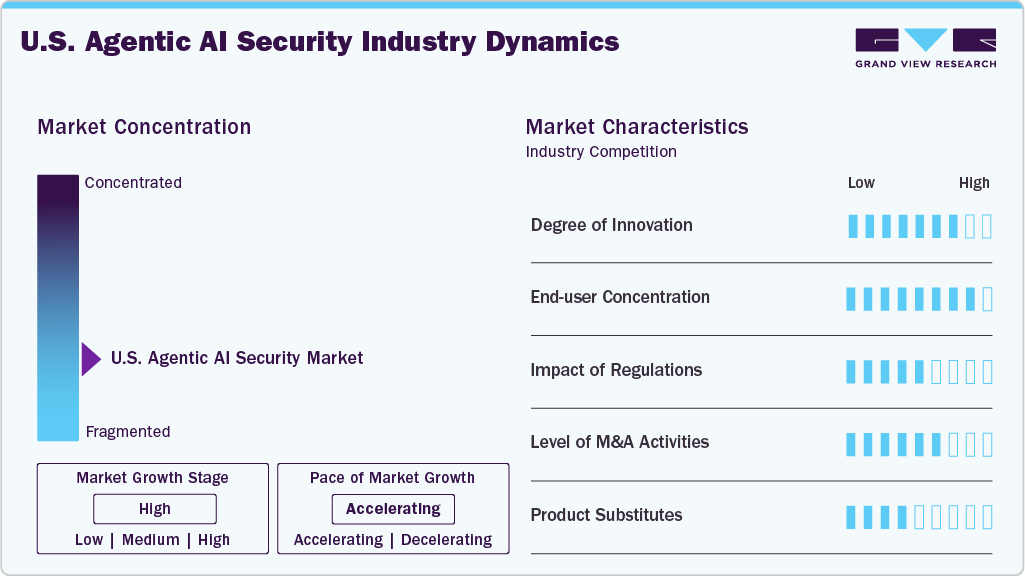
The U.S. agentic AI security industry is highly innovative due to the evolving nature of AI-driven threats and the growing deployment of autonomous AI agents across business functions. Companies are focusing on AI-native security solutions, including agent identity and access management, runtime security, AI governance frameworks, automated threat detection, and continuous monitoring to address risks associated with autonomous decision-making and tool usage. The market is witnessing increased strategic activities, including partnerships, acquisitions, and product integrations, as cybersecurity providers aim to expand their AI security portfolios. In addition, growing enterprise demand for secure AI adoption, regulatory compliance, and responsible AI governance is expected to drive further advancements and competitive expansion in the market.
Analyst Perspective
The U.S. agentic AI security market is expected to remain at the forefront of global growth as enterprises rapidly transition from AI copilots to autonomous AI agents capable of executing complex tasks across business functions. From an analyst perspective, the market is shifting toward comprehensive AI-native security platforms that address emerging risks associated with agent autonomy, including identity management, unauthorized actions, data exposure, model manipulation, and runtime vulnerabilities. The strong presence of leading cybersecurity vendors, hyperscale cloud providers, and AI technology companies in the U.S. is accelerating innovation in agent governance, AI threat detection, Zero Trust security, and continuous monitoring capabilities. Furthermore, increasing enterprise investments in responsible AI adoption, regulatory compliance, and secure AI infrastructure are expected to drive sustained demand for agentic AI security solutions, positioning the U.S. as a key hub for market innovation and commercialization through 2033.
Component Insights
The solutions segment led the market with the largest revenue share of 75.9% in 2025 and is anticipated to grow at the fastest CAGR during the forecast period, driven by the increasing deployment of autonomous AI agents across enterprise environments and the growing need for purpose-built security platforms. Organizations are prioritizing investments in agent identity and access management, runtime security, AI governance, threat detection and response, data security, and testing and validation solutions to mitigate AI-specific risks, including prompt injection, unauthorized agent actions, model manipulation, and sensitive data exposure. In addition, the availability of integrated AI security capabilities from leading cybersecurity vendors, coupled with rising enterprise adoption of Zero Trust architectures and cloud-native AI platforms, has further strengthened demand for agentic AI security solutions across the U.S. market.
The services segment is expected to grow at a significant CAGR from 2026 to 2033, driven by the increasing need for specialized expertise to securely deploy, integrate, govern, and manage autonomous AI agents across enterprise environments. As organizations expand AI agent adoption, demand is rising for AI security consulting, implementation, managed security services, AI risk assessments, red teaming, compliance advisory, and continuous monitoring to address evolving AI-specific threats. In addition, the shortage of in-house AI security expertise, coupled with the growing complexity of securing multi-agent ecosystems and meeting regulatory requirements, is encouraging enterprises to partner with cybersecurity service providers for ongoing governance, threat detection, incident response, and lifecycle management of agentic AI systems.
Deployment Insights
The cloud segment led the market with the largest revenue share of 57.5% in 2025 and is anticipated to grow at the fastest CAGR during the forecast period, due to the widespread deployment of cloud-based AI platforms, large language models (LLMs), and autonomous AI agents across enterprise environments. Organizations increasingly prefer cloud-native agentic AI security solutions because they provide scalable deployment, centralized policy enforcement, real-time threat monitoring, automated updates, and seamless integration with hyperscale cloud platforms and AI services. The growing adoption of Software-as-a-Service (SaaS) applications, multi-cloud architectures, and AI-powered business automation has further accelerated demand for cloud-based security solutions that offer agent identity management, runtime protection, AI governance, and continuous monitoring. In addition, subscription-based delivery models and faster implementation timelines have made cloud deployments the preferred choice for enterprises seeking to securely scale AI agent deployments while reducing infrastructure complexity.
The hybrid segment is projected to grow at a notable CAGR during the forecast period, driven by the increasing need for organizations to secure autonomous AI agents that operate across both on-premises infrastructure and cloud environments. Large enterprises, particularly in regulated sectors such as BFSI, healthcare, and government, are adopting hybrid deployment models to balance data sovereignty, regulatory compliance, and operational flexibility while leveraging cloud-based AI capabilities. This is driving demand for unified agentic AI security platforms that provide centralized governance, consistent policy enforcement, identity management, runtime protection, and continuous threat monitoring across distributed AI environments. In addition, the growing adoption of multi-cloud strategies and enterprise AI ecosystems is expected to further accelerate the demand for hybrid agentic AI security solutions.
Organization Size Insights
The large enterprises segment led the market with the largest revenue share of 77.5% in 2025, driven by the rapid deployment of autonomous AI agents across complex business operations, large-scale digital transformation initiatives, and higher cybersecurity spending. Large organizations are increasingly integrating AI agents into mission-critical functions such as software development, customer service, cybersecurity operations, finance, and supply chain management, creating a greater need for comprehensive agentic AI security solutions. These enterprises are investing in agent identity and access management, AI governance, runtime protection, continuous monitoring, and compliance platforms to mitigate AI-specific risks and ensure secure, responsible AI adoption across distributed enterprise environments. In addition, their established IT infrastructure and greater financial resources enable them to implement advanced AI security technologies more quickly than smaller organizations.
The small & medium-sized enterprises (SMEs) segment is expected to grow at the fastest CAGR from 2026 to 2033, driven by the increasing accessibility of cloud-based AI technologies and the growing adoption of autonomous AI agents to automate customer support, marketing, software development, and business operations. As SMEs expand their use of AI-powered applications, they are becoming more vulnerable to AI-specific threats such as prompt injection, unauthorized agent actions, and data leakage, prompting greater investment in cost-effective agentic AI security solutions. Furthermore, the availability of subscription-based AI security platforms, managed security services, and AI governance tools enables SMEs to implement enterprise-grade protection without significant upfront infrastructure investments, accelerating adoption across the segment.
End-use Insights
The IT & telecom segment led the market with the largest revenue share of 24.8% in 2025 and is anticipated to grow at the fastest CAGR during the forecast period, driven by the rapid adoption of autonomous AI agents across software development, cloud operations, network management, IT service management, customer support, and cybersecurity workflows. Technology companies and telecommunications providers have been early adopters of large language models (LLMs) and AI-powered automation, creating a strong demand for agentic AI security solutions that provide agent identity management, runtime protection, AI governance, and continuous threat monitoring. Furthermore, the widespread deployment of cloud-native AI platforms, DevSecOps practices, and AI-enabled enterprise applications, coupled with growing concerns about AI-specific threats such as prompt injection, unauthorized tool use, and sensitive data exposure, has accelerated investment in comprehensive AI security platforms across the IT & telecom sector.
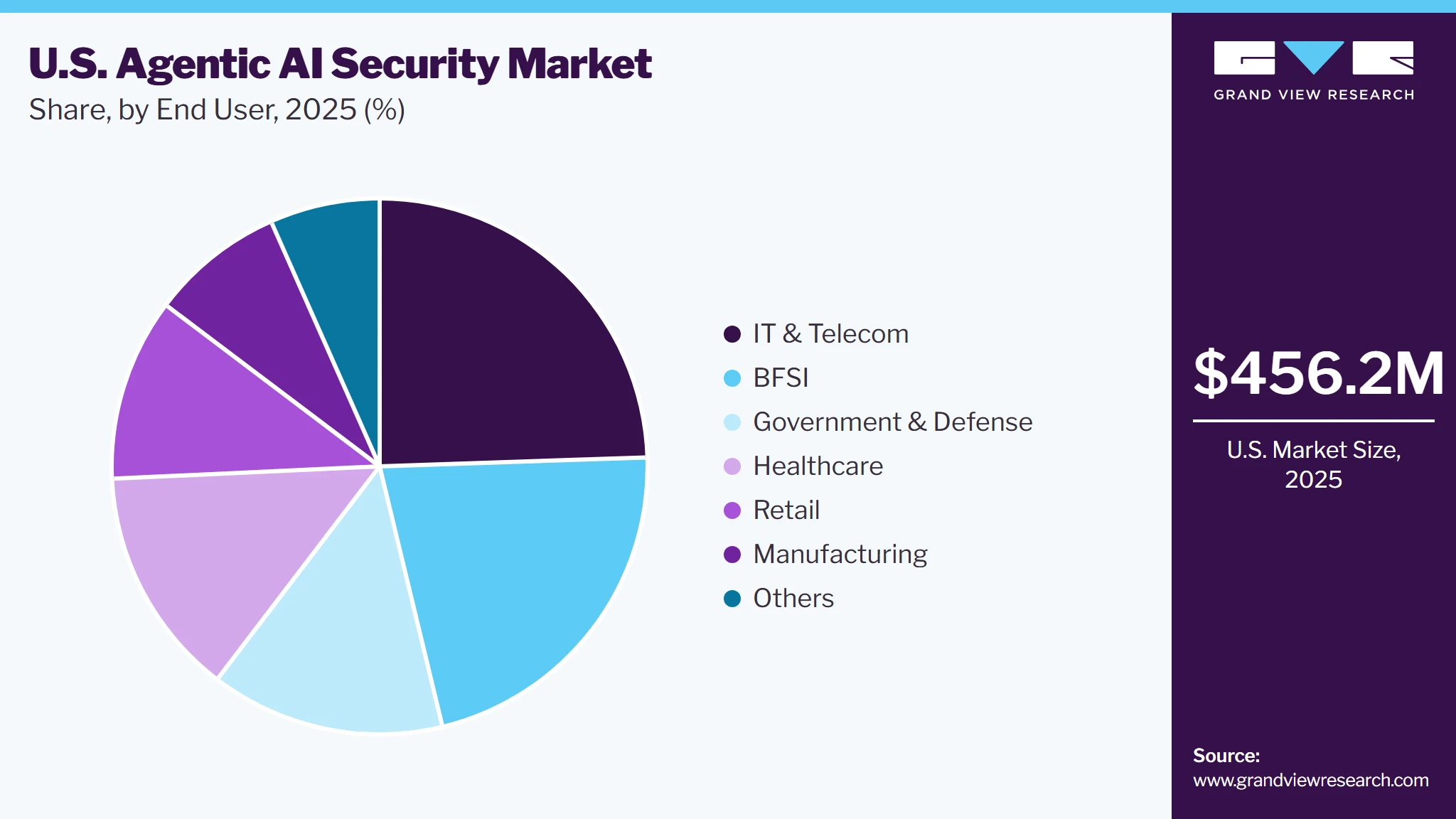
The government & defense segment is expected to grow at a significant CAGR during the forecast period, driven by the increasing adoption of autonomous AI systems for mission-critical applications, including intelligence analysis, defense operations, public services, and cybersecurity functions. Government agencies and defense organizations are increasingly deploying AI agents to automate complex workflows, analyze large volumes of data, enhance decision-making, and improve operational efficiency, creating a strong need for secure AI agent environments. In addition, rising concerns around protecting sensitive government data, preventing adversarial AI attacks, ensuring AI model integrity, and maintaining regulatory compliance are accelerating investments in agentic AI security solutions. The growing focus on sovereign AI capabilities, secure AI infrastructure, and partnerships between government institutions and cybersecurity providers is further expected to support segment growth throughout the forecast period.
Key U.S. Agentic AI Security Company Insights
Some of the key companies operating in the agentic AI security industry include Broadcom Inc., Check Point Software Technologies Ltd., Cisco Systems, Inc., among others. These companies are some of the leading participants in the U.S. market.
Key U.S. Agentic AI Security Companies:
-
Broadcom Inc.
-
Check Point Software Technologies Ltd.
-
Cisco Systems, Inc.
-
CrowdStrike Holdings, Inc.
-
Google LLC
-
IBM Corporation
-
Microsoft Corporation
-
NVIDIA Corporation
-
Okta, Inc.
-
Palo Alto Networks, Inc.
-
Protect AI
-
SentinelOne, Inc.
-
Trend Micro Incorporated
-
Wiz, Inc.
-
Zscaler, Inc.
Competitive Benchmarking
Operating Strategies
Competitive Edge
Weaknesses
Mature Players: Microsoft; IBM; Cisco Systems; Broadcom (Symantec); Palo Alto Networks; Check Point Software Technologies; Trend Micro; Fortinet; Zscaler; CrowdStrike
- Integrating U.S. Agentic AI Security capabilities into broad cybersecurity portfolios, including AI governance, identity security, cloud security, endpoint protection, and zero-trust platforms to provide end-to-end protection for enterprise AI environments.
- Developing AI-native security frameworks focused on agent discovery, identity management, runtime monitoring, policy enforcement, and compliance management to secure autonomous AI agents across enterprise workflows.
- Ability to combine decades of cybersecurity expertise with large-scale AI infrastructure, enabling comprehensive protection across endpoints, networks, cloud environments, and AI applications.
- Extensive global customer base and ecosystem partnerships with cloud providers, enterprises, and technology platforms, allowing rapid deployment of AI security solutions across complex IT environments.
- Large cybersecurity platforms may require significant integration efforts to integrate legacy security architectures for rapidly evolving agentic AI environments.
- Broad product portfolios can result in complex deployment and management processes, requiring specialized expertise for enterprises implementing AI security frameworks.
Emerging Players: Protect AI; Wiz; Okta; SentinelOne
- Focusing on specialized AI security solutions designed specifically for protecting AI models, LLM applications, and autonomous AI agents through AI posture management, AI red teaming, runtime monitoring, and agent behavior analysis.
- Providing lightweight, cloud-native platforms that enable organizations to secure AI workloads without extensive changes to existing cybersecurity infrastructure.
- Deep specialization in AI-specific risks enables faster innovation and development of purpose-built U.S. Agentic AI Security capabilities.
- Ability to deliver flexible, cloud-native solutions that integrate easily with modern application development environments and AI deployment pipelines.
- Limited market presence and smaller customer ecosystems compared with established cybersecurity vendors.
- Dependence on partnerships with major cloud, AI, and cybersecurity platforms to expand distribution and enterprise adoption.
Recent Developments
-
In June 2026, Zscaler unveiled new innovations to extend its Zero Trust Exchange platform for securing autonomous AI agents, introducing capabilities such as AI Broker, Agent Registry, Endpoint AI Security, and AI asset management to control how AI agents access data, communicate, and operate across enterprise environments.
-
In March 2026, Check Point launched its AI Defense Plane, a unified security platform designed to secure enterprise AI agents by providing agent discovery, governance, runtime protection, and continuous monitoring. The launch highlights the growing industry focus on U.S. Agentic AI Security, helping organizations manage risks associated with autonomous AI agents that can access data, invoke tools, and execute business workflows independently.
-
In March 2026, Cisco introduced new security innovations to secure the agentic AI workforce, extending Zero Trust security principles to AI agents through capabilities such as agent identity management, agent discovery, adaptive access controls, MCP policy enforcement, and runtime protection.
U.S. Agentic AI Security Market Report Scope
Report Attribute
Details
Market size in 2025
USD 456.2 million
Estimated market size in 2026
USD 603.4 million
Projected market size by 2033
USD 5,836.9 million
Growth rate
CAGR of 38.3% from 2026 to 2033
Base year for estimation
2025
Historical data
2021 - 2024
Forecast period
2026 - 2033
Quantitative units
Revenue in USD million/billion, and CAGR from 2026 to 2033
Report coverage
Revenue forecast, company share, competitive landscape, growth factors, and trends
Segments covered
Component, deployment, organization size, end-use
Country scope
U.S.
Key companies profiled
Broadcom Inc.; Check Point Software Technologies Ltd.; Cisco Systems, Inc.; CrowdStrike Holdings, Inc.; Google LLC; IBM Corporation; Microsoft Corporation; NVIDIA Corporation; Okta, Inc.; Palo Alto Networks, Inc.; Protect AI; SentinelOne, Inc.; Trend Micro Incorporated; Wiz, Inc.; Zscaler, Inc.
Customization scope
Free report customization (equivalent to 8 analysts working days) with purchase. Addition or alteration to country, regional & segment scope.
Pricing and purchase options
Avail customized purchase options to meet your exact research needs. Explore purchase options
U.S. Agentic AI Security Market Report Segmentation
This report forecasts revenue growth at the country levels and provides an analysis of the latest trends across sub-segments from 2021 to 2033. For this study, Grand View Research has segmented the U.S. agentic AI security market report based on component, deployment, organization size, and end-use:
-
Component Outlook (Revenue, USD Million, 2021 - 2033)
-
Solutions
-
Agent Identity & Access Security
-
Agent Runtime Security
-
Agent Governance & Compliance
-
Agent Data Security
-
Agent Threat Detection & Response
-
Agent Testing & Validation
-
-
Services
-
-
Deployment Outlook (Revenue, USD Million, 2021 - 2033)
-
On-Premises
-
Cloud
-
Hybrid
-
-
Organization Size Outlook (Revenue, USD Million, 2021 - 2033)
-
Large Enterprises
-
Small & Medium-Sized Enterprises (SMEs)
-
-
End-use Outlook (Revenue, USD Million, 2021 - 2033)
-
BFSI
-
Healthcare
-
IT & Telecom
-
Government & Defense
-
Retail
-
Manufacturing
-
Others
-
Research Methodology
The U.S. agentic AI security marketfigures in this report are based on a proven research process that combines executive interviews with secondary research from proprietary databases, company filings, and recognized regulatory and institutional sources. Market size is built through value-chain sizing—reconciling supply-side and demand-side estimates—and triangulated with bottom-up and top-down approaches. Every estimate passes multiple levels of expert validation before publication, with eachU.S. agentic AI segment quantified using the revenue-capture definitions in the table below.
Segment Definition
Segment – Component
Revenue Capture Definition
Solutions
Revenue generated from software platforms and security technologies designed to protect autonomous AI agents, AI models, large language model (LLM)-based applications, and agentic AI ecosystems. Includes agent identity and access security, agent runtime security, AI governance and compliance, AI data security, threat detection and response, AI testing and validation, AI posture management, prompt security, model protection, AI application security, and AI risk management solutions delivered through on-premises, cloud, or hybrid environments.
Services
Revenue generated from professional and managed services supporting the deployment, integration, governance, monitoring, and ongoing management of U.S. Agentic AI Security solutions. Includes consulting, AI security assessments, AI governance implementation, red teaming, penetration testing, compliance advisory, system integration, managed AI security services, incident response, security monitoring, employee training, technical support, and maintenance services.
Segment – Deployment
Revenue Capture Definition
On-Premises
Revenue generated from U.S. Agentic AI Security solutions deployed within customer-owned infrastructure to secure internally hosted AI agents, LLMs, enterprise AI applications, and sensitive business data. Includes on-premises governance platforms, runtime protection, identity management, AI monitoring, and security management software installed in enterprise data centers.
Cloud
Revenue generated from cloud-delivered U.S. Agentic AI Security platforms offered through SaaS, PaaS, or cloud-native deployment models. Includes AI security platforms protecting cloud-hosted AI agents, generative AI applications, APIs, enterprise copilots, AI workloads, and multi-cloud environments through subscription-based services.
Hybrid
Revenue generated from U.S. Agentic AI Security solutions deployed across both on-premises and cloud environments. Includes unified security platforms that provide centralized governance, policy enforcement, identity management, runtime monitoring, and threat detection for AI agents operating across hybrid enterprise infrastructures.
Segment – Organization Size
Revenue Capture Definition
Large Enterprises
Revenue generated from U.S. Agentic AI Security solutions adopted by large organizations operating complex AI ecosystems, multiple business units, and large-scale autonomous AI deployments. Includes enterprise-wide AI governance platforms, agent identity management, runtime protection, managed AI security services, regulatory compliance solutions, and AI threat detection deployed across global operations.
Small & Medium-Sized Enterprises (SMEs)
Revenue generated from U.S. Agentic AI Security solutions adopted by SMEs seeking scalable and cost-effective protection for AI applications and autonomous agents. Includes cloud-native AI security platforms, managed security services, AI governance tools, identity management, runtime protection, and monitoring solutions designed for organizations with limited cybersecurity resources.
Segment – End User
Revenue Capture Definition
BFSI
Revenue generated from U.S. Agentic AI Security solutions deployed by banks, financial institutions, insurance companies, capital markets firms, and fintech organizations to secure autonomous AI agents used in fraud detection, customer service, risk management, compliance, and financial operations.
Healthcare
Revenue generated from U.S. Agentic AI Security solutions protecting AI agents used in clinical decision support, medical imaging, hospital operations, patient engagement, healthcare administration, and digital health platforms while ensuring patient data privacy and regulatory compliance.
IT & Telecom
Revenue generated from U.S. Agentic AI Security solutions adopted by technology companies, cloud service providers, software vendors, telecommunications operators, and managed service providers to secure AI-powered software development, network operations, customer support, and enterprise automation platforms.
Government & Defense
Revenue generated from U.S. Agentic AI Security solutions deployed by government agencies, defense organizations, public sector institutions, and intelligence organizations to secure AI-driven public services, defense systems, mission-critical operations, and sensitive government data.
Retail
Revenue generated from U.S. Agentic AI Security solutions used by retailers, e-commerce companies, and consumer businesses to secure AI agents supporting personalized shopping, customer engagement, inventory management, supply chain optimization, and payment processing systems.
Manufacturing
Revenue generated from U.S. Agentic AI Security solutions deployed by manufacturing organizations to protect AI agents used for industrial automation, predictive maintenance, production optimization, quality control, robotics, and smart factory operations.
Others
Revenue generated from U.S. Agentic AI Security solutions adopted across industries including energy & utilities, transportation & logistics, education, media & entertainment, legal services, life sciences, professional services, hospitality, and other sectors utilizing autonomous AI agents for business operations, decision-making, and workflow automation.
Estimation Model
Layer
Question
Analysis
Enterprise AI Adoption Layer (TAM)
Who might require U.S. Agentic AI Security solutions?
All organizations developing, deploying, or planning to deploy artificial intelligence applications, large language models (LLMs), AI copilots, and autonomous AI agents. This includes enterprises across BFSI, healthcare, IT & telecommunications, government, retail, manufacturing, and other industries leveraging AI for automation, decision-making, customer engagement, software development, and business operations.
Agentic AI Deployment Layer (SAM)
Who can technically adopt U.S. Agentic AI Security solutions?
Organizations that have integrated autonomous AI agents into enterprise workflows through AI orchestration platforms, enterprise copilots, LLM-powered applications, multi-agent systems, AI automation platforms, cloud AI services, and API-connected business applications. These organizations require solutions for agent identity management, AI governance, runtime security, policy enforcement, data protection, and AI threat detection.
Active U.S. Agentic AI Security Adoption Layer (SOM)
Who actively deploys U.S. Agentic AI Security solutions today?
Organizations actively implementing AI security platforms, agent runtime protection, AI governance frameworks, AI posture management, agent identity and access security, prompt and model protection, AI red teaming, continuous monitoring, compliance management, and AI threat detection solutions to secure production-scale autonomous AI deployments.
Revenue Realization Layer
How is revenue generated?
Revenue is generated through the licensing and subscription of U.S. Agentic AI Security software platforms, AI governance and compliance solutions, agent identity and runtime security products, AI threat detection and monitoring tools, AI testing and validation platforms, as well as professional services including consulting, implementation, AI security assessments, managed AI security services, incident response, training, technical support, and maintenance contracts.
Delivered Customizations
This report has been delivered with the following In-depth customizations
Client Request
Customization Delivered
Value Adds
U.S. Agentic AI Security strategy and risk assessment framework for an enterprise adopting autonomous AI agents
- Comprehensive assessment of enterprise AI agent adoption maturity, including transition from traditional AI assistants and copilots toward autonomous agent-based workflows across business functions.
- Evaluation of security requirements across the agent lifecycle, including agent identity management, access governance, runtime monitoring, data protection, and compliance controls.
- Developed an AI security roadmap to enable secure scaling of autonomous agents while minimizing risks associated with unauthorized actions, data exposure, and agent misuse.
- Established governance recommendations for continuous monitoring, policy enforcement, and responsible AI deployment across enterprise environments.
AI agent governance and security architecture benchmarking for a global technology and financial services organization
- Comparative analysis of AI security architectures, including AI posture management, agent runtime protection, zero-trust controls, and AI application security frameworks.
- Benchmarking of leading security approaches for protecting AI agents interacting with enterprise applications, APIs, cloud platforms, and sensitive data environments.
- Provided a structured framework for selecting and implementing U.S. Agentic AI Security solutions aligned with enterprise cybersecurity strategies.
- Identified opportunities to improve visibility, control, and threat response capabilities across rapidly expanding AI agent ecosystems.
Emerging AI threat landscape and regulatory compliance assessment for a multinational enterprise
- Analysis of evolving AI-specific threats, including prompt injection, indirect attacks, model manipulation, unauthorized tool usage, and sensitive data leakage through autonomous agents.
- Assessment of AI governance and regulatory trends, including requirements around transparency, accountability, risk management, and secure AI adoption.
- Delivered recommendations for strengthening AI risk management frameworks and ensuring compliance with emerging AI regulations.
- Supported proactive security planning through identification of critical control areas such as agent authentication, behavioral monitoring, auditability, and automated threat response.
Frequently Asked Questions About This Report
The U.S. agentic AI security market is expected to grow at a CAGR of 38.3% from 2026 to 2033 to reach USD 5,836.9 million by 2033.
Key factors include rapid adoption of autonomous AI agents across industries such as BFSI, healthcare, IT & telecommunications, government, retail, and manufacturing.
Key players operating in the U.S. agentic AI security market include Broadcom Inc.; Check Point Software Technologies Ltd.; Cisco Systems, Inc.; CrowdStrike Holdings, Inc.; Google LLC; IBM Corporation; Microsoft Corporation; NVIDIA Corporation; Okta, Inc.; Palo Alto Networks, Inc.; Protect AI; SentinelOne, Inc.; Trend Micro Incorporated; Wiz, Inc.; Zscaler, Inc., and Others.
The Large Enterprises segment held the largest share of 77.5% in 2025, while Small & Medium-Sized Enterprises (SMEs) segment is the fastest-growing segment.
The U.S. agentic AI security market size was valued at USD 456.2 million in 2025 and is expected to reach USD 603.4 million in 2026.
The solutions segment held the largest share of 75.9% in 2025 and is also the fastest-growing segment.
The IT & telecom segment led the market with the largest revenue share of 24.8% in 2025 and is also the fastest-growing segment.
The cloud segment held the largest share of 57.5% in 2025 and is also the fastest-growing segment.
About the Author(s)
Network Security Research Team
Technology · Network SecurityThis report was authored by the network security research team at Grand View Research - comprising two research analysts, one senior research analyst, and one industry expert - with specialized expertise in the network security segment of the technology industry. All findings are based on proprietary technology databases, executive interviews, and regulatory analysis, subject to internal peer review prior to publication.
Last Updated:
Speak to Analyst

Customize this report to your needs — add regions, segments, or data points, with 20% free customization.
Or view our licence options:


ISO 9001:2015 & 27001:2022 Certified
We are GDPR and CCPA compliant! Your transaction & personal information is safe and secure. For more details, please read our privacy policy.












