
- Home
- »
- Healthcare IT
- »
-
U.S. Artificial Intelligence In Healthcare Market Report, 2033GVR Report cover

U.S. Artificial Intelligence In Healthcare Market (2026 - 2033) Size, Share & Trends Analysis Report By Component (Software Solutions, Services), By Application (Robot Assisted Surgery, Clinical Trials), By Technology, By End Use, And Segment Forecasts
U.S. Artificial Intelligence In Healthcare Market Summary
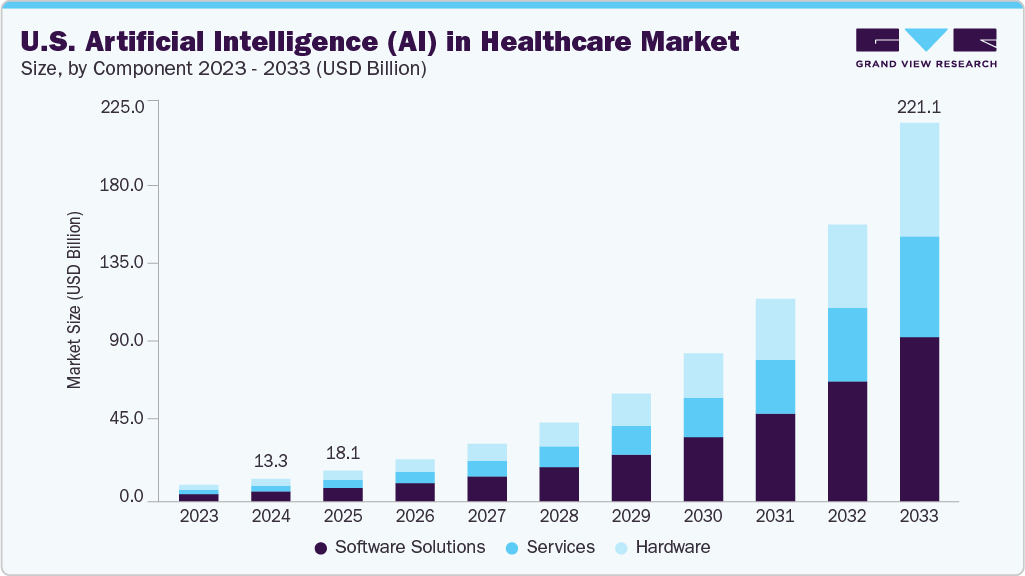
The U.S. artificial Intelligence in healthcare market size was estimated at USD 18.1 billion in 2025 and is projected to reach USD 222.9 billion by 2033, growing at a CAGR of 36.9% from 2026 to 2033. Robust digital health infrastructure and investments in AI technology, the growing prevalence of chronic diseases, and the increasing demand for personalized and remote healthcare solutions are factors driving market growth.
Key Market Trends & Insights
- By component, the software solution segment held the largest market share of 44.3% in 2025.
- By technology, the machine learning segment held the largest market share of 35.8% in 2025.
- By application, the robot assisted surgery segment held the largest market share in 2025.
- By end use, the pharmaceutical & biotechnology companies segment held the largest market share in 2025.
Market Size & Forecast
- 2025 Market Size: USD 18.1 Billion
- 2033 Projected Market Size: USD 222.9 Billion
- CAGR (2026-2033): 36.9%
Three ways to get this report
Buy it, customize it, or ask a question.Ask an Analyst
Analyst response in 1 business day
- AccessReport author, directly
- Reply timeWithin 1 working day
- No sales callDirect answer only
- FormatEmail reply
- CostFree, no cost
Get the Full Report
What the study covers
- FormatsPDF · Excel · Dashboard
- Timeline2026–2033 annual, 2025 base
- Coverage20+ countries, 5 regions
- Companies10+ key players profiled
Customize the Report
20% free customization
- IncludeCountries, segments, points
- TailorTo your product definition
- ExtendDeeper competitor detail
- OrA fully bespoke study
- Turnaround5–10 working days
 Source: Grand View Research, IR Documents, Primary Interviews, Paid DatabasesTo learn more about this report,
 Download Free Sample Report
In addition, supportive government initiatives, a shortage of healthcare professionals, and the growing need for operational efficiency are some other factors propelling market growth further. For instance, in October 2024, Amazon One Medical launched AI tools integrated into its proprietary electronic health record system, 1Life, to enhance patient care and reduce clinician administrative burden.Market Drivers And Dynamics
Increasing Prevalence of Chronic Disease
The increasing prevalence of chronic diseases such as diabetes, cardiovascular conditions, and cancer, coupled with a rapidly aging population, is significantly driving the demand for AI-enabled healthcare solutions in the United States. For instance, according to the CDC, 6 in 10 Americans are affected with at least one chronic disease. In addition, the aging demographic is projected to grow substantially, with the Population Reference Bureau estimating that by 2050, the population aged 65 or older is expected to be 82 million. This demographic shift presents an opportunity to enhance long-term care, continuous health monitoring, and effective disease management, where AI is potentially significant.
Rapid Healthcare Digitalization
The country's healthcare infrastructure is characterized by an advanced digital health ecosystem, widespread adoption of electronic health records (EHR), extensive data repositories, and cutting-edge health IT systems. Major health tech firms have made significant investments in healthcare AI solutions, while startups continue to attract substantial venture capital funding. For instance, in February 2025, Harrison.ai, a global health tech company, expanded its U.S. footprint with USD 112 million in Series C funding to advance its AI-powered medical diagnostic and workflow solutions.
Increasing Adoption of Telehealth
The increasing adoption of telehealth solutions for remote patient monitoring drives market growth further. AI systems enhance virtual care by automating patient data analysis, facilitating real-time decision-making, and improving patient engagement outside traditional clinical settings. For instance, in December 2024, VSee Health, anAI-powered telehealth platform provider, partnered with Tele911 to create the first virtual emergency department. The aim is to reduce ER overcrowding and address emergency medical services (EMS) staffing shortages. Such initiatives enable healthcare delivery to be more accessible and convenient, especially for patients in remote or underserved areas. Thus, they increase the demand for AI-powered telehealth solutions and contribute to market growth.
Recent Developments in the U.S. AI in Healthcare Market Landscape
Area
Institute / Company
Month & Year
Initiative
Drug Discovery & Development
Ginkgo Datapoints
Nov - 25
Ginkgo Datapoints launched the Virtual Cell Pharmacology Initiative (VCPI), an open-source platform for standardized virtual cell modeling in AI drug discovery.
Renovaro Inc.
May -25
Renovaro Inc. launched Augusta, an AI-powered Precision Neurology Platform to enhance patient stratification, biomarker discovery, and drug validation. Utilizing multiomics and advanced data analytics, Augusta addresses challenges in diagnosing neurological disorders, significantly accelerating drug discovery processes.
Icahn School of Medicine, Mount Sinai
Apr-25
The Icahn School of Medicine at Mount Sinai launched the AI Small Molecule Drug Discovery Center to revolutionize drug discovery by integrating AI with traditional methods. The center focuses on designing novel molecules, optimizing compounds, and predicting drug-target interactions, aiming to accelerate new treatments for diseases like cancer and neurodegenerative disorders.
Google
Mar -25
Google launched TxGemma, a suite of open AI models for drug discovery that analyze proteins, chemicals, and text to predict therapeutic properties.
“The development of therapeutic drugs from concept to approved use is a long and expensive process, so we’re working with the wider research community to find new ways to make this development more efficient."
-Karen DeSalvo, chief health officer at GooglePatient Monitoring
Cleveland Clinic, Oracle Health, and G42
May -25
Cleveland Clinic, Oracle Health, and G42 collaborated to develop a health AI platform to improve care delivery and quality. The platform is likely to form an AI-driven healthcare hub, combining Oracle's cloud infrastructure and AI data platform with Cleveland Clinic's expertise and G42's AI capabilities
Validic
Feb -25
Validic launched a generative AI-powered digital remote patient monitoring assistant as part of its Validic Impact solution. This tool directly analyzes and summarizes complex patient data trends, such as blood glucose, blood pressure, and medication adherence, within Epic and Oracle Health EHRs.
Practice Management Solutions
Tebra
Jun -25
Tebra launched AI Note Assist, a HIPAA-compliant ambient documentation tool that reduces clinical note-taking time by up to 50% for independent practices.
Adit
May -25
Adit introduced an orthodontic-specific version of its all-in-one practice management platform, enhancing treatment tracking, scheduling, communication, and payment processing.
Medical Imaging
Philips and NVIDIA
May -25
Philips partnered with NVIDIA to enhance MRI technology using AI. This collaboration aims to develop a foundational model that improves image quality, accelerates scan times, and streamlines diagnostic workflows.
“Our AI-powered MRI solutions are already enabling healthcare providers to deliver better care to more people. By partnering with NVIDIA to build an MR Foundational Model, we’re pioneering a new frontier for medical imaging, one that has the potential to transform the role of MR in the diagnosis and treatment of a wide range of diseases. The benefits for patients and healthcare providers could be enormous.”
- Dr. Ioannis Panagiotelis, Business Leader of MRI at PhilipsNVIDIA and GE HealthCare
Mar -25
NVIDIA and GE HealthCare collaborated to enhance autonomous diagnostic imaging through Physical AI. This partnership focuses on developing autonomous X-ray and ultrasound technologies, utilizing the NVIDIA Isaac for Healthcare platform for simulation.
“We look forward to taking advantage of physical AI for autonomous imaging systems with NVIDIA technology to improve patient access and address the challenges of growing workloads and staffing shortages in healthcare.”
- Roland Rott, president and CEO of Imaging at GE HealthCareMarket Concentration & Characteristics
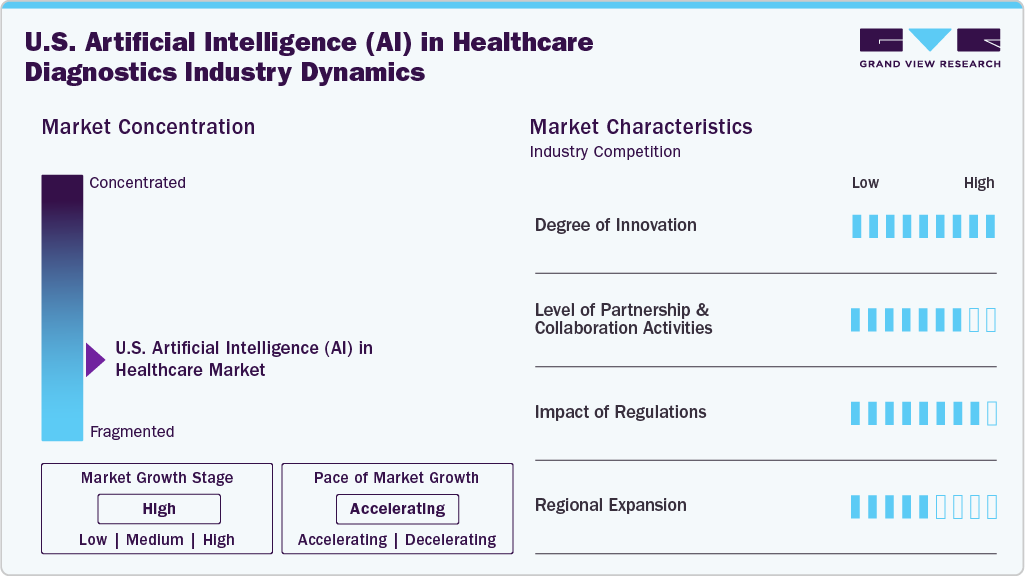
The chart below illustrates the relationship between industry concentration, industry characteristics, and industry participants. The X-axis represents the level of market concentration, ranging from low to high. The Y-axis represents various market characteristics, including industry competition, degree of innovation, level of mergers & acquisition activities, regulatory impact, and regional expansion. The U.S. artificial intelligence (AI) in healthcare industry is fragmented, with the presence of several emerging solution providers dominating the market. The degree of innovation, the level of partnerships & collaborations, and the impact of regulations on industry is high. The regional expansion of the industry is moderate.
The degree of innovation in the U.S. AI in healthcare industry is high, driven by rapid advancements in machine learning, natural language processing, and cloud-based AI tools. Companies continuously develop intelligent solutions for diagnostics, clinical decision support, drug discovery, personalized treatments, and workflow automation. Significant innovations include predictive analytics for disease detection and virtual health platforms integrated with AI algorithms. For instance, in June 2024, Florida-based CCS launched PropheSee, an AI-powered predictive model designed to improve therapy adherence for people with diabetes who use continuous glucose monitors (CGMs).
 To learn more about this report, Download Free Sample Report
 The industry is experiencing a high level of partnerships & collaborations undertaken by several key players. This is due to the desire to gain a competitive advantage in the industry, enhance technological capabilities, and consolidate in a rapidly growing market. For instance, in January 2025, NVIDIA partnered with IQVIA, Illumina, Mayo Clinic, and Arc Institute to enhance drug discovery, advance genomic research, and drive innovation in healthcare through agentic and generative AI.
Regulations, such as the HIPAA, establish standards for safeguarding patient data privacy and security. Compliance with these regulations is crucial for AI applications in healthcare to ensure the safe and secure handling of patient information, reducing the risk of data breaches and unauthorized access. Supportive policies from agencies such as the FDA, including accelerated approvals for AI-based medical devices and software, encourage innovation while ensuring patient safety.
The level of regional expansion in the industry is moderate, driven by an increasing customer base for solutions to streamline healthcare operations, especially in the rural areas. The increasing prevalence of diseases exerts pressure on healthcare providers, diagnostic centers, and pharmacies, creating opportunities for enhanced patient engagement solutions to reduce administrative burden.
Component Insights
Based on component, the software solution segment dominated the market with the largest revenue share of 44.3% in 2025. This growth is attributed to the increasing demand for advanced AI-based platforms that support clinical decision-making, medical imaging, predictive analytics, and workflow automation. In addition, ongoing innovation in cloud-based AI tools, NLP, and machine learning algorithms tailored for U.S. healthcare regulations and infrastructure further strengthens the software segment’s dominance in the market. For instance, in February 2024, SpinSci Technologies, a cloud patient engagement solutions provider, partnered with Webex by Cisco, a prominent collaboration technology provider, to create a comprehensive patient engagement platform tailored for Webex Contact Center and Webex Connect.
The services segment is anticipated to grow at the fastest CAGR during the forecast period due to the rising demand for AI integration, deployment, training, and maintenance across U.S. healthcare institutions. As hospitals and clinics adopt complex AI systems, they increasingly rely on specialized service providers to ensure smooth implementation and ongoing technical support. In addition, the shift towards value-based care and digital transformation requires continuous upgrades and customization, boosting demand for consulting and managed services.
Application Insights
Based on application, the robot-assisted surgery segment dominated the market with the largest revenue share of 13.6% in 2025. The rising adoption of AI-powered robotic systems that enhance surgical precision, reduce complications, and improve patient outcomes drives the segment's growth. Moreover, increasing number of minimally invasive procedures, coupled with a growing geriatric population requiring complex surgeries, has accelerated the use of robotic assistance.
For instance, in July 2024, Medtronic launched Touch Surgery Live Stream technology, an AI-powered robotic and laparoscopic surgery platform. The platform features 14 new AI algorithms that enhance post-operative analysis by providing surgical workflow, instrument, and anatomy detection, delivering actionable insights from surgical videos.
The fraud detection segment is anticipated to grow at the fastest CAGR over the forecast period. The increasing penetration of health insurance and the rising number of fraud cases in the healthcare industry are factors driving segment growth. In addition, the growing focus on curbing healthcare costs and the technological advancements to launch advanced analytical techniques are also expected to fuel segment growth.
Technology Insights
Based on technology, the machine learning segment dominated the market with the largest revenue share of 35.8% in 2025. Machine learning algorithms are extensively used for disease prediction, medical imaging analysis, patient risk assessment, and treatment recommendation systems. The increasing availability of large healthcare datasets and advancements in computing power and cloud infrastructure have accelerated the deployment of ML models in healthcare. The growing investments in precision medicine and clinical research further support the adoption of machine learning.
The context-aware computing segment is projected to grow at the fastest CAGR over the forecast period. This growth is attributed to its ability to deliver personalized and adaptive healthcare solutions by analyzing real-time contextual data such as patient location, behavior, medical history, and environment. The increasing focus on patient-centric care, remote monitoring, and smart healthcare infrastructure is driving demand for context-aware technologies. These systems enhance clinical decision-making, reduce errors, and improve patient engagement.
End Use Insights
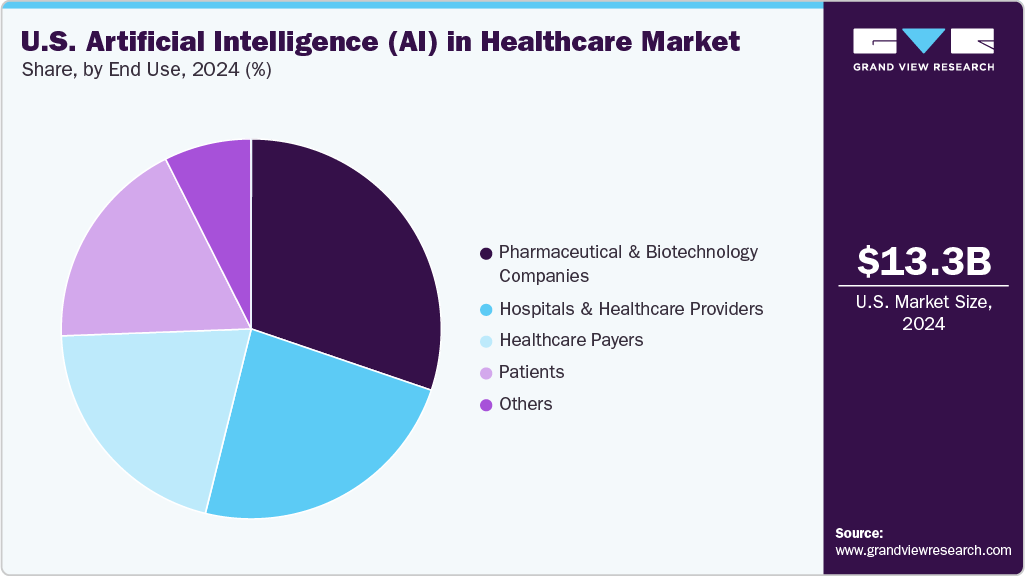
Based on end use, the pharmaceutical & biotechnology companies segment dominated the market with a share of 30.3% in 2025. This growth is attributed to the increasing use of AI in drug discovery, clinical trial optimization, and personalized medicine development. U.S.-based pharma and biotech firms are leveraging AI to accelerate R&D, reduce time-to-market, and improve the accuracy of candidate drug identification.
 To learn more about this report, Download Free Sample Report
 The patients segment is expected to grow at the fastest CAGR during the forecast period, driven by the increasing adoption of AI-powered tools that enhance patient engagement, self-care, and health monitoring. In addition, the growing awareness of digital health technologies, coupled with the widespread utilization of smartphones, wearable devices, and health applications, empowers patients to take a more proactive role in managing their health. AI-driven chatbots, virtual assistants, and personalized health insights improve access to chronic disease management and mental health support, driving rapid growth in this segment.
Key U.S. Artificial Intelligence In Healthcare Company Insights
Key companies in the U.S. AI in healthcare industry are actively leveraging strategic collaborations, cutting-edge product innovations, and acquisitions to strengthen their market position. These initiatives aim to meet the rising demand for AI-driven solutions that boost early diagnosis, optimize clinical workflows, reduce operational costs, and improve the overall quality of patient care amid a growing need for scalable and value-based healthcare services.
Key U.S. Artificial Intelligence In Healthcare Companies:
- Merative
- Microsoft Corporation
- Google Health
- NVIDIA Corporation
- Amazon Web Services (AWS)
- Tempus AI
- Aidoc
- Eko Health Inc.
- Hinge Health
- Abridge
Recent Developments
-
In June 2025, Eko Health secured USD 41 million in funding in the U.S. to scale its AI-driven technology for early detection of heart and lung diseases, aiming to improve diagnostic accuracy and patient care.
"Eko harnesses AI to unlock universal access to expert-level cardiac and pulmonary disease detection for patients everywhere. Just as Ring transformed doorbells into home security systems, Eko has reinvented the world’s most ubiquitous medical tool into a powerful early disease detection platform, creating the world’s largest install base of professional AI-enabled cardiology devices."
-Connor Landgraf, CEO and co-founder of Eko Health.
-
In April 2025, BD launched the HemoSphere Alta system, an advanced surgical monitoring platform featuring AI-powered programs to predict blood pressure changes during critical procedures.
-
In March 2025, athenahealth expanded its AI documentation technology in the U.S. by partnering with Abridge to enhance clinical note accuracy and streamline healthcare provider workflows.
“Writing notes is something that has been a pain point for physicians since time began. Artificial intelligence has gotten to the point now where it can listen to a provider-patient conversation and generate a note for the physician.”
-Paul Brient, chief product officer at Athenahealth
-
In March 2025, Microsoft launched Dragon Copilot in the U.S., the healthcare industry’s first unified voice AI assistant that streamlined clinical documentation, automated tasks, and enhanced clinician information access.
“At Microsoft, we have long believed that AI has the incredible potential to free clinicians from much of the administrative burden in healthcare and enable them to refocus on taking care of patients. With the launch of our new Dragon Copilot, we are introducing the first unified voice AI experience to the market, drawing on our trusted, decades-long expertise that has consistently enhanced provider wellness and improved clinical and financial outcomes for provider organizations and the patients they serve.”
-Joe Petro, corporate vice president of Microsoft Health and Life Sciences Solutions and Platforms.
-
In January 2025, General Catalyst and LinkedIn cofounder Reid Hoffman launched Manas AI, an AI-driven drug discovery platform. The platform uses proprietary AI, computational chemistry, and molecular docking to accelerate drug discovery, initially targeting aggressive cancers. Manas AI partners with Microsoft Azure for scalable cloud-based drug development.
-
In September 2024, EDAP TMS S.A. and Avenda Health launched an AI-assisted Focal One robotic HIFU procedure for prostate cancer treatment. Utilizing Avenda's FDA-cleared Unfold AI technology, these procedures enable personalized, patient-specific cancer care by creating 3D cancer maps, enhancing surgical precision, and minimizing damage to healthy tissue.
U.S. Artificial Intelligence In Healthcare Market Report Scope
Report Attribute
Details
The revenue forecast in 2033
USD 222.9 billion
Growth rate
CAGR of 36.9% from 2026 to 2033
Historical data
2021 - 2024
Forecast period
2026 - 2033
Quantitative units
Revenue in USD million/billion and CAGR from 2026 to 2033
Segments covered
Component, application, technology, end use, region
Country scope
U.S.
Key companies profiled
Merative (formerly IBM Watson Health); Microsoft Corporation; Google Health; NVIDIA Corporation; Amazon Web Services (AWS); Tempus AI; Aidoc; Eko Health Inc.; Hinge Health; Abridge
Customization scope
Free report customization (equivalent up to 8 analysts working days) with purchase. Addition or alteration to country, regional & segment scope.
Pricing and purchase options
Avail customized purchase options to meet your exact research needs. Explore purchase options
U.S. Artificial Intelligence In Healthcare Market Report Segmentation
This report forecasts revenue growth at country-level and provides an analysis of industry trends in each of the sub segments from 2021 to 2033. For this study, Grand View Research, Inc. has segmented the U.S. artificial intelligence in healthcare market report based on component, application, technology, end use, and region:
-
Component Outlook (Revenue, USD Million, 2021 - 2033)
-
Software Solutions
-
AI platform
-
Application Program Interface (API)
-
Machine Learning Framework
-
-
AI Solutions
-
On premise
-
Cloud based
-
-
-
Hardware
-
Processor
-
MPU (memory protection unit)
-
FPGA (Field-programmable gate array)
-
GPU (Graphics processing unit)
-
ASIC (Application-specific integrated circuit)
-
-
Memory (RAM ROM)
-
Network
-
Adapter
-
Interconnect
-
Switch
-
-
-
Services
-
Deployment & Integration
-
Support & Maintenance
-
Others
-
-
-
Application Outlook (Revenue, USD Million, 2021 - 2033)
-
Robot Assisted Surgery
-
Virtual Assistants
-
Administrative Workflow Assistants
-
Connected Medical devices
-
Medical Imaging & Diagnostics
-
Clinical Trials
-
Fraud Detection
-
Cybersecurity
-
Dosage Error Reduction
-
Precision medicine
-
Drug discovery & development
-
Lifestyle management & remote patient monitoring
-
Wearables
-
Others
-
-
Technology Outlook (Revenue, USD Million, 2021 - 2033)
-
Machine Learning
-
Deep learning
-
Supervised
-
Unsupervised
-
Others
-
-
NLP
-
Smart Assistance
-
OCR (Optical Character Recognition)
-
Auto Coding
-
Text analytics
-
Speech analytics
-
Classification and categorization
-
-
Computer Vision
-
Context-Aware Computing'
-
-
End Use Outlook (Revenue, USD Million, 2021 - 2033)
-
Hospitals & Healthcare providers
-
Healthcare payers
-
Pharmaceutical & Biotechnology Companies
-
Patients
-
Others
-
Frequently Asked Questions About This Report
The U.S. AI in healthcare market size was estimated at USD 18.1 billion in 2025 and is expected to reach USD 24.7 in 2025.
Some key players operating in the U.S. AI in healthcare market include IBM Watson Health; Microsoft Corporation; Google Health; NVIDIA Corporation; Amazon Web Services (AWS); Tempus AI; Aidoc; Eko Health Inc.; Hinge Health; and Abridge.
Key factors that are driving the U.S. AI in healthcare market are robust digital health infrastructure and investments in AI technology, the growing prevalence of chronic diseases, and the increasing demand for personalized and remote healthcare solutions.
The U.S. AI in healthcare market is expected to grow at a compound annual growth rate of 36.9% from 2026 to 2033 to reach USD 222.9 billion by 2033.
The software solutions segment held the largest market share of 44.3% in 2025.
About the Author(s)
Healthcare IT Research Team
Healthcare · Healthcare ITThis report was authored by the healthcare it research team at Grand View Research - comprising two research analysts, one senior research analyst, and one industry expert - with specialized expertise in the healthcare it segment of the healthcare industry. All findings are based on proprietary healthcare databases, executive interviews, and regulatory analysis, subject to internal peer review prior to publication.
Last Updated:
Speak to Analyst

Customize this report to your needs - add regions, segments, or data points, with 20% free customization.
Or view our licence options:


ISO 9001:2015 & 27001:2022 Certified
We are GDPR and CCPA compliant! Your transaction & personal information is safe and secure. For more details, please read our privacy policy.


