
- Home
- »
- Clinical Diagnostics
- »
-
U.S. Blood Testing Market Size, Share, Industry Report 2033GVR Report cover

U.S. Blood Testing Market (2025 - 2033) Size, Share & Trends Analysis Report By Test Type (Glucose, A1C, Direct LDL, Lipid Pane, Prostate-specific Antigen, COVID-19, BUN, Vitamin D, Thyroid-stimulating Hormone, Serum Nicotine/Cotinine, High sensitivity CRP), And Segment Forecasts
U.S. Blood Testing Market Summary
The U.S. blood testing market size was valued at USD 35.90 billion in 2024 and is projected to reach USD 71.41 billion by 2033, growing at a CAGR of 8.1% from 2025 to 2033. The market is primarily driven by the rising prevalence of chronic diseases such as diabetes, cardiovascular conditions, and cancer, which necessitate frequent diagnostic testing and monitoring for effective management.
Key Market Trends & Insights
- In terms of test type, glucose testing accounted for a revenue share of 16.7% in 2024.
- A1C testing is expected to grow at a CAGR of 9.2% over the forecast period.
Market Size & Forecast
- 2024 Market Size: USD 35.90 Billion
- 2033 Projected Market Size: USD 71.41 Billion
- CAGR (2025-2033): 8.1%
Three ways to get this report
Buy it, customize it, or ask a question.Ask an Analyst
A direct answer, usually in 1 working day
- AccessReport author, directly
- Reply timeWithin 1 working day
- No sales callDirect answer only
- FormatEmail reply
- CostFree, no cost
Get the Full Report
What the study covers
- FormatsPDF · Excel · Dashboard
- Timeline2025–2033 annual, 2024 base
- Coverage20+ countries, 5 regions
- Companies10+ key players profiled
Customize the Report
20% free customization
- IncludeCountries, segments, points
- TailorTo your product definition
- ExtendDeeper competitor detail
- OrA fully bespoke study
- Turnaround5–10 working days
Growing public awareness and a shift toward preventive healthcare, encouraging routine check-ups and early disease detection screening, are the major drivers for this market. In 2024, the Centers for Disease Control and Prevention (CDC) strengthened its core laboratory capabilities to detect and respond to high-priority pathogens. Recent technological innovations are a major catalyst for the market's expansion, improving the accessibility and efficiency of blood testing. For instance, in June 2024, the FDA granted marketing authorization for the first point-of-care Hepatitis C virus (HCV) RNA test, which enables single-visit testing and treatment using a fingertip blood sample.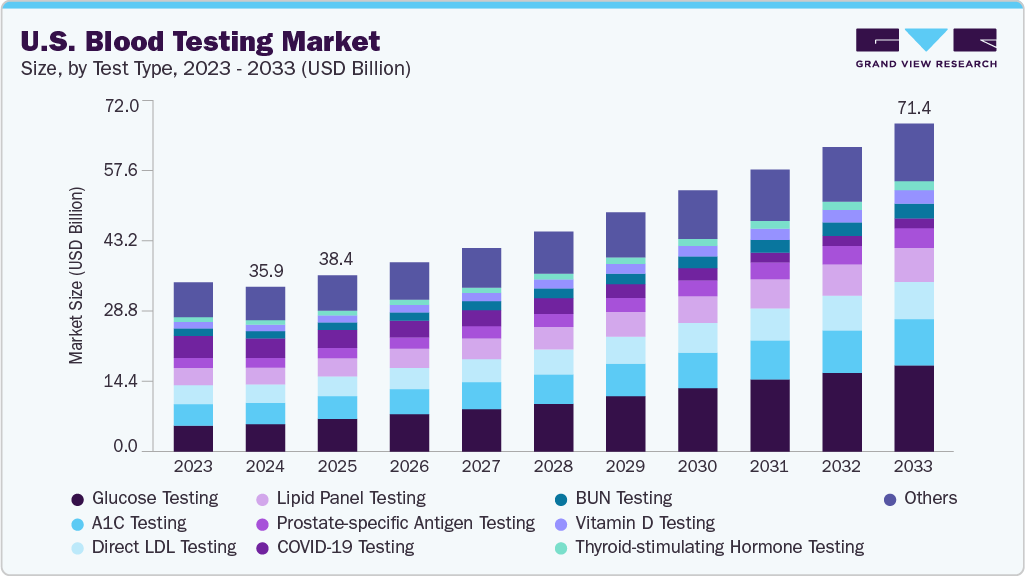 Source: Grand View Research, IR Documents, Primary Interviews, Paid DatabasesTo learn more about this report,
 Download Free Sample Report
 Other key technological advances that are expected to impact this market are:
-
Artificial Intelligence Integration: AI and machine learning were pivotal in interpreting complex blood test data, enabling earlier disease detection, automation of smear analysis, improved biomarker identification, and reduced diagnostic errors. These systems accelerated result delivery and matched or exceeded clinical gold standards in sensitivity and specificity.
-
Lab-on-a-Chip Technology: Miniaturized devices capable of processing multiple blood tests on a single drop dramatically reduce laboratory demands, increasing access in remote and resource-limited regions while supporting rapid point-of-care diagnostics.
-
Wearable Biosensors: Smart devices (e.g., glucose and hemoglobin trackers) became possible for monitoring real-time, continuous blood composition. These are integrated with telemedicine platforms, improving chronic disease management, patient engagement, and rapid response to changes in health.
-
Molecular Diagnostics & Liquid Biopsy: Advanced molecular testing-especially for oncology and infectious diseases-enabled more specific, sensitive, and earlier detection. Liquid biopsy techniques facilitated noninvasive cancer diagnostics and recurrence monitoring months before clinical symptoms appeared.
- Home-Based and Minimally Invasive Testing: Technologies such as fingertip blood collection (BD’s MiniDraw™, Babson Diagnostics) and photonic chips (SiPhox) allowed patients and clinicians to collect and analyze blood samples at home or outside traditional phlebotomy settings, making blood testing less invasive and more accessible.
Major companies and startups expanded R&D into AI, miniaturized analytics, and patient-centric platforms, collaborating with healthcare systems for early disease detection and personalized prevention services.
The pace of innovation fostered rapid result availability (often bedside or same day), more reliable chronic disease management, and improved patient monitoring through wearables and cloud-connected diagnostic tools.
These transformative innovations positioned the U.S. blood testing market at the forefront of global diagnostics, with continuous advances in digital health, smart devices, and clinical laboratory processes throughout 2024.
Test Type Insights
The glucose testing segment dominated the market with a revenue share of 16.7% in 2024. The segment is driven by the soaring prevalence of diabetes and prediabetes, and the increasing demand for continuous monitoring and at-home solutions. According to the CDC's 2024 National Diabetes Statistics Report, over 38 million Americans have diabetes, with another 97 million adults having prediabetes, creating a vast and ongoing need for testing and management. Technological innovation is a major catalyst in the U.S. blood testing industry. For instance, in June 2024, two new over-the-counter continuous monitoring systems received FDA clearance, broadening access to glucose tracking for people with Type 2 diabetes who do not use insulin. In addition, in September 2024, the FDA approved the first long-term implantable CGM sensor designed to last a full year, reducing the need for frequent sensor replacements for patients.
The A1C testing segment is expected to grow at a CAGR of 9.2% over the forecast period. It is a blood test that measures the average amount of glucose (sugar) attached to hemoglobin in red blood cells over the past two to three months. As red blood cells have a lifespan of about three months, the test provides a reliable, long-term snapshot of blood sugar control. The A1C test is used to diagnose prediabetes and type 2 diabetes and monitor diabetes management in individuals already living with the condition. Recent instances and data points highlight the ongoing importance of this test. According to the NIH report covering August 2021-August 2023, the prevalence of total diabetes in adults was 15.8%. Furthermore, technological innovation is also a major driver in the U.S. blood testing industry.
Key U.S. Blood Testing Company Insights
Some key companies in the U.S. blood testing industry include Abbott, F. Hoffmann-La Roche Ltd, and others.
- BIOMÉRIEUX is a leader in in-vitro diagnostics and offers immunoassay and microbiology systems often used in blood culture and quality-control testing.
Key U.S. Blood Testing Companies:
- Abbott
- F. Hoffmann-La Roche Ltd
- Bio-Rad Laboratories, Inc.
- BIOMÉRIEUX
- Biomerica
- BD
- Quest Diagnostics Incorporated
- Siemens Healthineers AG
- Danaher Corporation
- Trinity Biotech Plc
Recent Developments
- In June 2025, BIOMÉRIEUX announced the strategic acquisition of Day Zero Diagnostics' next-generation sequencing assets to accelerate rapid, genome-based infectious disease and blood-infection testing.
U.S. Blood Testing Market Report Scope
Report Attribute
Details
Market size value in 2025
USD 38.37 billion
Revenue forecast in 2033
USD 71.41 billion
Growth rate
CAGR of 8.1% from 2025 to 2033
Base year for estimation
2024
Historical data
2021 - 2023
Forecast period
2025 - 2033
Quantitative units
Revenue in USD million/billion, and CAGR from 2025 to 2033
Report coverage
Revenue forecast, company ranking, competitive landscape, growth factors, and trends
Segments covered
Test type
Key companies profiled
Abbott; F. Hoffmann-La Roche Ltd; Bio-Rad Laboratories, Inc.; BIOMÉRIEUX; Biomerica; BD; Quest Diagnostics Incorporated; Siemens Healthineers AG; Danaher Corporation; Trinity Biotech Plc
Customization scope
Free report customization (equivalent up to 8 analysts working days) with purchase. Addition or alteration to country & segment scope.
Pricing and purchase options
Avail customized purchase options to meet your exact research needs. Explore purchase options
U.S. Blood Testing Market Report Segmentation
This report forecasts revenue growth at the country level and provides an analysis of the latest industry trends in each of the sub-segments from 2021 to 2033. For this study, Grand View Research has segmented the U.S. blood testing market report based on test type:
-
Test Type Outlook (Revenue, USD Billion, 2021 - 2033)
-
Glucose Testing
-
A1C Testing
-
Direct LDL testing
-
Lipid panel testing
-
Prostate-specific antigen testing
-
COVID-19 testing
-
BUN testing
-
Vitamin D testing
-
Thyroid-stimulating hormone testing
-
Serum Nicotine / Cotinine testing
-
High sensitivity CRP testing
-
Testosterone testing
-
ALT testing
-
Cortisol testing
-
Creatinine testing
-
AST testing
-
Other blood tests
-
About the Author(s)
Clinical Diagnostics Research Team
Healthcare · Clinical DiagnosticsThis report was authored by the clinical diagnostics research team at Grand View Research - comprising two research analysts, one senior research analyst, and one industry expert - with specialized expertise in the clinical diagnostics segment of the healthcare industry. All findings are based on proprietary healthcare databases, executive interviews, and regulatory analysis, subject to internal peer review prior to publication.
Last Updated:
Speak to Analyst

Customize this report to your needs - add regions, segments, or data points, with 20% free customization.
Or view our licence options:


ISO 9001:2015 & 27001:2022 Certified
We are GDPR and CCPA compliant! Your transaction & personal information is safe and secure. For more details, please read our privacy policy.


