
- Home
- »
- Next Generation Technologies
- »
-
U.S. Commercial Printing Market Size, Industry Report, 2033GVR Report cover

U.S. Commercial Printing Market (2026 - 2033) Size, Share & Trends Analysis Report By Printing Technology (Digital Printing, Lithography Printing, , Flexographic, Screen Printing, Gravure Printing), By Application, By Enterprise, By Product, And Segment Forecasts
U.S. Commercial Printing Market Summary
The U.S. commercial printing market size was estimated at USD 129.21 billion in 2025 and is projected to reach USD 169.49 billion by 2033, growing at a CAGR of 3.6% from 2026 to 2033. The surge in popularity of print-on-demand (POD) services has had a transformative, positive influence on the commercial printing sector.
Key Market Trends & Insights
- By printing technology, the lithography printing segment led the market with the largest revenue share of 44.9% in 2025.
- By application, the packaging segment accounted for the largest market revenue share in 2025.
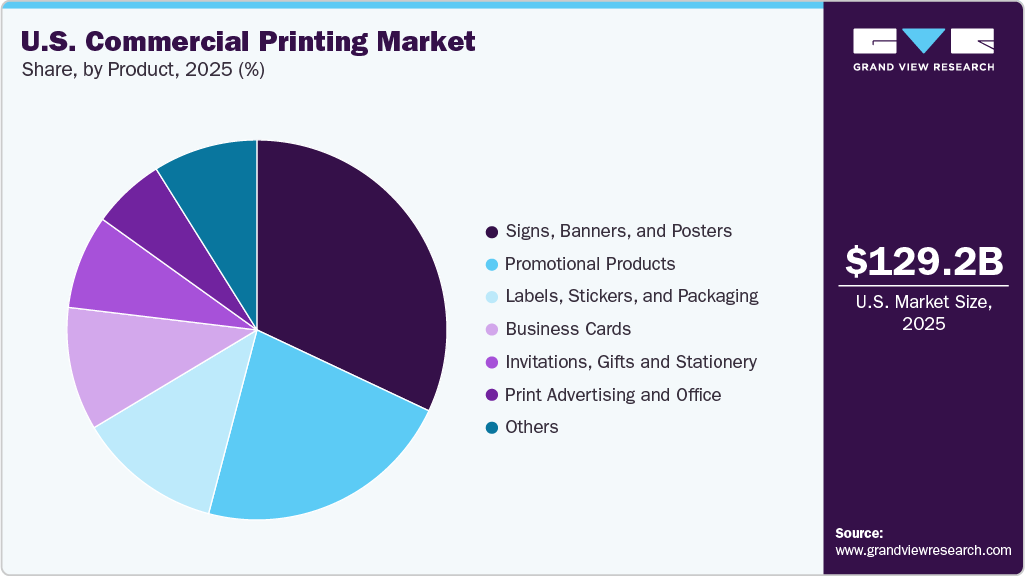
- By product, the signs, banners, and posters segment accounted for the largest market revenue share in 2025.
Market Size & Forecast
- 2025 Market Size: USD 129.21 Billion
- 2033 Projected Market Size: USD 169.49 Billion
- CAGR (2026-2033): 3.6%
Three ways to get this report
Buy it, customize it, or ask a question.Ask an Analyst
Analyst response in 1 business day
- AccessReport author, directly
- Reply timeWithin 1 working day
- No sales callDirect answer only
- FormatEmail reply
- CostFree, no cost
Get the Full Report
What the study covers
- FormatsPDF · Excel · Dashboard
- Timeline2023–2033 annual, 2022 base
- Coverage20+ countries, 5 regions
- Companies10+ key players profiled
Customize the Report
20% free customization
- IncludeCountries, segments, points
- TailorTo your product definition
- ExtendDeeper competitor detail
- OrA fully bespoke study
- Turnaround5–10 working days
This modern approach to production, where items are created discretely as per customer orders, has revolutionized how businesses manage their printing needs. Traditionally, commercial printing involved large print runs to attain cost efficiencies. However, this approach led to challenges, including excessive inventory and storage costs. With the introduction of print-on-demand, a paradigm shift that has redefined inventory management, businesses no longer need to pre-produce large items, which is expected to reduce the financial burden of unused stock and the resources required to manage it.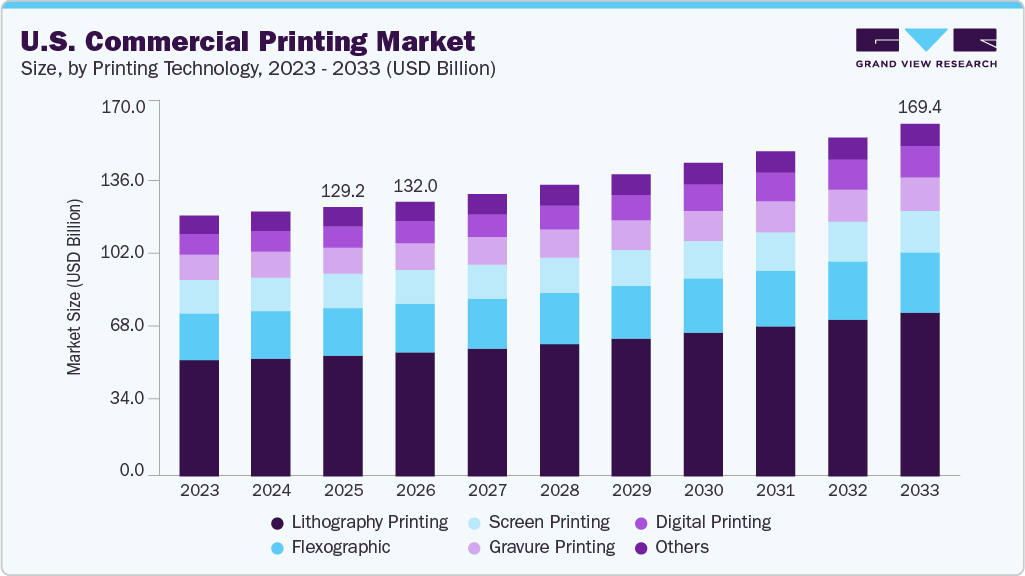 Source: Grand View Research, IR Documents, Primary Interviews, Paid DatabasesTo learn more about this report,
 Download Free Sample Report
 The rising demand for custom printing for producing customized clothing, such as t-shirts, jerseys, and sweatshirts, with promotional materials such as banners, posters, and signage, is expected to drive the growth of the market in the coming years. The other factors driving the market growth include the increasing use of customized t-shirts for advertising and branding by companies and the rising preference of people for wearing fashionable, custom-printed clothes.
The increasing advertising requirements of enterprises have significantly contributed to the market growth. As businesses strive to implement compelling marketing campaigns and effectively connect with their target demographics, the reliance on a diverse array of printed materials has significantly increased. These materials, including brochures, flyers, catalogs, and promotional items, serve as vital mediums for conveying critical information regarding products, services, and brand identity. The amplification of marketing initiatives has propelled the demand for professionally designed and executed printed collateral, thereby fueling the market growth.
The escalating demand for packaging solutions across various industries such as food & beverage, healthcare & pharmaceuticals, cosmetics and personal care, and more fuels the growth of the commercial printing market. This surge in demand directly translates into higher print volumes, creating an avenue for increased revenue and enhanced business activity in the commercial printing sector. As packaging materials such as labels, boxes, and wrappers experience increasing demand, commercial printers benefit from a higher workload, fostering growth and profitability. This trend also propels the diversification of services offered by commercial printing companies.
As various industries, such as fast-moving consumer goods (FMCG), consumer electronics, and more, seek distinctive packaging solutions to align with their branding and product specifications, printing companies can utilize this opportunity to expand their service repertoire. This diversification bolsters their competitive edge and paves the way for introducing new revenue streams by catering to the unique packaging needs of various industries.
The rapid and widespread adoption of digital media has significantly impacted the growth of the commercial printing industry. This has introduced a range of challenges that have reshaped the market’s landscape. One of the notable challenges is a decline in the demand for traditional print materials. As more information, advertisements, and communication channels migrate to digital platforms, the need for physical materials such as newspapers, magazines, brochures, and catalogs has dropped. Businesses and individuals can reach wider audiences at lower cost through online channels, reducing the need for large-scale commercial printing.
Printing Technology Insights
The lithography printing segment led the market with the largest revenue share of 44.9% in 2025. The economies of scale offered by lithographic printing can potentially support high-volume printing, as initial setup costs are spread across the print run, which means the cost per unit continues to plummet as the quantity increases. On the other hand, efficient ink utilization minimizes waste, while rapid press speeds help meet tight deadlines. Lithography's adaptability to diverse substrates without compromising uniformity and its precision in reproducing intricate details and maintaining vibrant colors throughout high-volume runs particularly ensure consistent quality across prints, thereby upholding the brand image.
The digital printing segment is expected to register at the fastest CAGR of 5.0% over the forecast period. Digital printing typically eliminates the laborious process of creating printing plates, thereby saving significant time and money for projects involving smaller print runs. Digital printing can allow businesses to efficiently produce brochures, flyers, business cards, and even personalized marketing collateral in required quantities without incurring the high setup costs associated with conventional offset printing.
Application Insights
The packaging segment accounted for the largest market revenue share in 2025 and is expected to grow at the fastest CAGR during the forecast period. Commercial printing is a versatile and cost-effective way to create packaging materials, including labels, boxes, bags, and other containers. It can be used to create a wide range of designs and prints on various substrates. Hence, it can be an ideal option for businesses of all sizes. Commercial printing for packaging applications involves printing labels for various products, such as food, beverages, cosmetics, and pharmaceuticals, to provide essential information about the product, such as its ingredients, nutritional content, and expiration date. These labels can also play a potent role in driving visual appeal through an eye-catching design that helps sell the product.
The publishing segment is expected to experience a significant CAGR over the forecast period. Publishers place strong emphasis on precise printing, binding, and finishing to produce visually appealing, long-lasting, high-quality publications that cater to a wide range of readers. Collaborating with commercial printing companies can typically help publishers toward this end. The publishing segment is further segmented into books, newspapers, magazines, and other categories.
Enterprise Insights
The large enterprise segment led the market with the largest revenue share of 55% in 2025. Large enterprises heavily rely on commercial printing services to support their extensive marketing and advertising campaigns. Despite the growing influence of digital media, printed materials such as brochures, flyers, catalogs, direct mailers, and posters remain essential for brand promotion and customer engagement. These materials help businesses reinforce their brand identity, communicate key messages, and drive sales.
The SMEs segment is expected to register at the fastest CAGR of 4.2% over the forecast period. Advancements in digital printing technology-such as improved speed, quality, and cost-effectiveness-are enabling SMEs to access high-quality printing solutions at affordable prices. This trend is contributing to the expansion of the commercial printing market by allowing SMEs to produce customized products without incurring high costs or committing to large volumes.
Product Insights
The signs, banners, and posters segment accounted for the largest market revenue share in 2025. The increasing reliance on printed signs, banners, and posters for marketing and branding purposes is driving growth in the U.S. commercial printing industry. Businesses across various industries, including retail, real estate, and entertainment, use large-format printed materials to enhance visibility and attract customers. Outdoor advertising, such as billboards, transit ads, and storefront banners, remains a critical tool for companies looking to reach a broad audience.
 To learn more about this report, Download Free Sample Report
 The promotional products segment is expected to grow at the fastest CAGR over the forecast period. Promotional products have become an essential part of brand marketing strategies, driving significant growth in the commercial printing market. Businesses across industries, including retail, healthcare, finance, and hospitality, use printed promotional items to increase brand awareness and customer engagement. Items such as custom-branded pens, tote bags, mugs, T-shirts, and calendars serve as effective advertising tools that keep a company’s name and logo visible to potential customers over an extended period.
Key U.S. Commercial Printing Company Insights
Some of the leading players in the U.S. commercial printing industry include Quad, Cimpress, Transcontinental Inc., and R.R. Donnelley & Sons Company. These companies are increasingly focusing on strategies such as differentiating their services, offering personalized and customized printing solutions, and enhancing customer support to remain competitive in a rapidly evolving market landscape.
-
Founded in 1971, headquartered in Wisconsin, U.S.; Quad primarily operates in the commercial printing market, offering comprehensive printing and marketing solutions to multiple verticals, including those in retail, publishing, consumer packaged goods, financial services, healthcare, and direct-to-consumer industries. The company operates in two segments: United States Print and Related Services, and International.
-
Founded in 1864 and headquartered in Illinois, U.S., R.R. Donnelley & Sons Company is a multichannel business communications services and marketing solutions provider for industries such as consumer and retail, education, healthcare, finance and professional services, travel, hospitality, and leisure. Its services and solutions are primarily related to marketing, packaging, print, and supply chain.
Key U.S. Commercial Printing Companies:
The following key companies have been profiled for this study on the U.S. commercial printing market
- Quad
- Acme Printing (Allegra and Image 360)
- R.R. Donnelley & Sons Company
- Transcontinental Inc.
- LSC Communications LLC
- Gorham Printing, Inc.
- Cimpress
- Sterling Printing
- GotPrint
- ABC Printing Company
Recent Developments
-
In January 2025, Quad launched At-Home Connect, an automated direct-mail platform that combines email-style personalization with printing, mail sorting, and in-home delivery.
-
In January 2025, R.R. Donnelley & Sons Company (RRD) finalized its acquisition of Williams Lea to strengthen its business services offering.
-
In December 2024, R.R. Donnelley & Sons Company launched a newly designed marketing and e-commerce platform, ConnectOne Storefront. The company aims to attain operational efficiencies and reduce costs by ensuring hassle-free ordering, fulfillment, content customization, and direct mail campaign management capabilities.
U.S. Commercial Printing Market Report Scope
Report Attribute
Details
Market size value in 2026
USD 132.03 billion
Revenue forecast in 2033
USD 169.49 billion
Growth rate
CAGR of 3.6% from 2026 to 2033
Base year for estimation
2025
Historical data
2021 - 2024
Forecast period
2026 - 2033
Quantitative units
Revenue in USD million/billion, and CAGR from 2026 to 2033
Report coverage
Revenue forecast, company market share, competitive landscape, growth factors, and trends
Segments covered
Printing technology, application, enterprise, product
Country scope
U.S.
Key companies profiled
Quad; Acme Printing (Allegra and Image 360); R.R. Donnelley & Sons Company, Transcontinental Inc.; LSC Communications LLC; Gorham Printing, Inc.; Cimpress; Sterling Printing; GotPrint; ABC Printing Company
Customization scope
Free report customization (equivalent up to 8 analysts working days) with purchase. Addition or alteration to country, regional & segment scope.
Pricing and purchase options
Avail customized purchase options to meet your exact research needs. Explore purchase options
U.S. Commercial Printing Market Report Segmentation
This report forecasts revenue growth at country level and provides an analysis of the latest industry trends in each of the sub-segments from 2021 to 2033. For this study, Grand View Research has segmented the U.S. commercial printing market report based on printing technology, application, enterprise, andproduct.
-
Printing Technology Outlook (Revenue, USD Billion, 2021 - 2033)
-
Digital Printing
-
Lithography Printing
-
Flexographic
-
Screen Printing
-
Gravure Printing
-
Others
-
-
Application Outlook (Revenue, USD Billion, 2021 - 2033)
-
Packaging
-
Advertising
-
Publishing
-
Books
-
Newspaper
-
Magazines
-
Others
-
-
-
Enterprise Outlook (Revenue, USD Billion, 2021 - 2033)
-
SMEs
-
Large Enterprise
-
-
Product Outlook (Revenue, USD Billion, 2021 - 2033)
-
Business Cards
-
Invitations, Gifts and Stationery
-
Print Advertising and Office
-
Promotional Products
-
Signs, Banners, and Posters
-
Labels, Stickers, and Packaging
-
Others
-
Frequently Asked Questions About This Report
The U.S. commercial printing market size was estimated at USD 129.21 billion in 2025 and is expected to reach USD 132.03 billion in 2026.
The U.S. commercial printing market is expected to grow at a compound annual growth rate of 3.6% from 2026 to 2033 to reach USD 169.49 billion by 2033.
Some key players operating in the U.S. commercial printing include Quad, Acme Printing (Allegra and Image 360), R.R. Donnelley & Sons Company, Transcontinental Inc., LSC Communications LLC, Gorham Printing, Inc., Cimpress, Sterling Printing, GotPrint, and ABC Printing Company.
The U.S. commercial printing market is driven by increasing demand for digital and personalized printing, the rise of e-commerce fueling packaging needs, and the resurgence of direct mail as part of omnichannel marketing. Technological advancements like automation and web-to-print services enhance efficiency and customization, while growing emphasis on sustainability encourages the use of eco-friendly materials and practices.
The large enterprise segment held the largest share of 55% in 2025. This dominance can be attributed to the significant printing demands of large organizations across various sectors, including retail, publishing, packaging, and advertising. These enterprises often require high-volume, high-quality printing solutions to support their extensive marketing and operational needs.
About the Author(s)
Next Generation Technologies Research Team
Technology · Next Generation TechnologiesThis report was authored by the next generation technologies research team at Grand View Research - comprising two research analysts, one senior research analyst, and one industry expert - with specialized expertise in the next generation technologies segment of the technology industry. All findings are based on proprietary technology databases, executive interviews, and regulatory analysis, subject to internal peer review prior to publication.
Last Updated:
Speak to Analyst

Customize this report to your needs - add regions, segments, or data points, with 20% free customization.
Or view our licence options:


ISO 9001:2015 & 27001:2022 Certified
We are GDPR and CCPA compliant! Your transaction & personal information is safe and secure. For more details, please read our privacy policy.


