
- Home
- »
- Consumer F&B
- »
-
U.S. Cordial Drink Market Size & Share Report, 2026-2033GVR Report cover

U.S. Cordial Drink Market (2026 - 2033)
Size, Share & Trends Analysis Report By Product (Fruit Cordials, Vegetable Cordials, Herbs & Spices Cordials), By Distribution Channel (Supermarkets & Hypermarkets, Convenience Stores, Foodservice/HoReCa), And Segment Forecasts
Market Size, 2025
$544.4MMarket Estimate, 2026
$561.9MMarket Forecast, 2033
$745.1MCAGR, 2026–2033
4.1%U.S. Cordial Drink Market Summary
The U.S. cordial drink market size was valued at USD 544.4 million in 2025 and is projected to grow from USD 561.9 million in 2026 to USD 745.1 million in 2033, at a CAGR of 4.1% from 2026 to 2033. The market is primarily driven by the growing demand for refreshing, flavorful, and convenient beverages. Increasing consumer interest in premium, natural, and low-sugar drinks is further supporting market growth.
Key Market Trends & Insights
- By product: The fruit cordial drinks market held the largest share of 75.6% in 2025.
- By product: The herbs & spices cordials market is projected to grow at a CAGR of 4.5% during the forecast period.
- By distribution channel: The supermarkets & hypermarkets segment held the largest share of 51.7% in 2025.
Market Size & Forecast
- Market size in 2025: USD 544.4 Million
- Estimated market size in 2026: USD 561.9 Million
- Projected market size in 2033: USD 745.1 Million
- CAGR (2026-2033): 4.1%
Prism AI by Grand View Research Free to tryAsk a question about the U.S. cordial drink marketTry asking✓Every figure cited from GVR research Prefer the report? Download free sample →
Rising health awareness and the popularity of at-home beverage preparation are also contributing to the expansion of the market. The market is also supported by the strong presence of established beverage brands and diverse retail channels, including supermarkets, convenience stores, and online platforms. This growth is further supported by rising consumer preference for non-alcoholic and convenient beverage options, as consumers increasingly seek flavorful and versatile alternatives to alcoholic drinks. According to SPINS data published in May 2024, non-alcoholic beverages gained 2.2 percentage points in market share over the previous two years, while the “Bitter & Syrups & Others” category recorded 8% growth. These trends indicate growing consumer interest in versatile, flavor-enhancing beverage options and support the adoption of cordial-based beverages across everyday consumption and social occasions.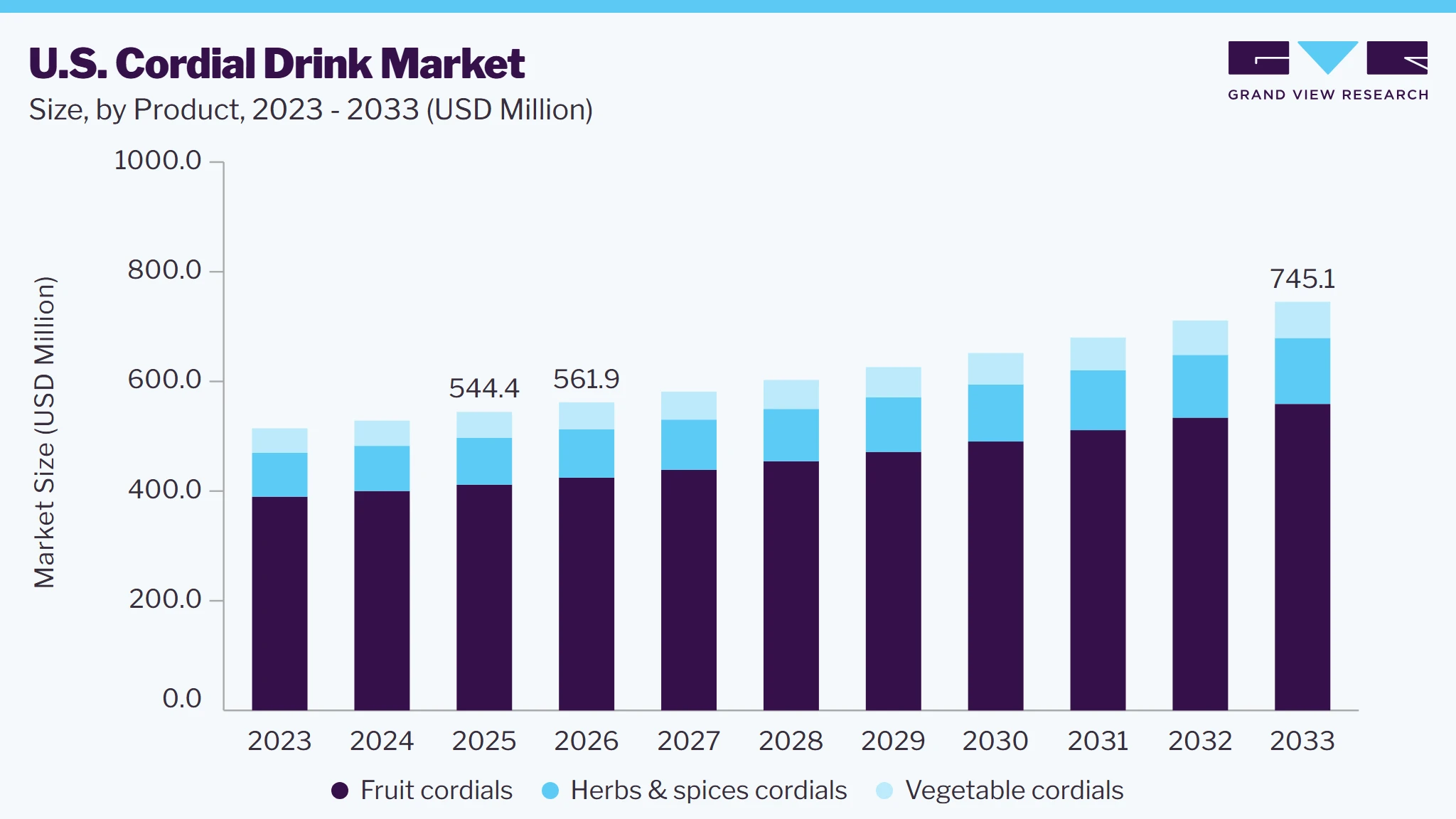 Source: Grand View Research, IR Documents, Primary Interviews, Paid DatabasesTo learn more about this report,
 Download Free Sample Report
Moreover, changing lifestyles and the popularity of social gatherings are encouraging consumers to explore versatile drink options for everyday and special occasions. Regional preferences and the growing availability of innovative flavors are further strengthening product adoption across different consumer segments. In May 2026, Welch’s launched Sparkling Blueberry, a limited-edition, non-alcoholic carbonated juice cocktail positioned as a festive, family-friendly summer drink.
In the U.S., product innovation is playing an important role in shaping the market, with manufacturers introducing new flavor combinations and convenient packaging formats. The growing multicultural population is also creating demand for a wider variety of fruit-inspired and culturally influenced beverage options. In addition, seasonal consumption patterns, particularly during warmer months, continue to create opportunities for cordial drinks across the country.
Market Dynamics
The growing focus on mindful consumption is encouraging U.S. consumers to explore alternatives to alcoholic drinks. Cordials can serve as versatile bases for creating flavorful beverages without alcohol. This appeal is particularly relevant among consumers seeking suitable options for social occasions and everyday refreshment. The category can benefit from broader changes in beverage consumption habits. As non-alcoholic choices become more widely accepted, cordials can gain greater visibility within the beverage landscape. According to the YouGov PLC data published in September 2025, about 40% Americans are health-conscious, while 24% prefer the taste of non-alcoholic beverage alternatives.
Restraint: Competition from a wide range of ready-to-drink beverages and flavored drink alternatives
Cordials face competition from a broad range of beverage formats available across the U.S. market, including ready-to-drink beverages, flavored waters, juices, functional beverages, and soft drinks. Ready-to-drink formats offer convenience by eliminating the need for preparation, while other beverage categories provide consumers with diverse flavor profiles and consumption occasions. This wide range of alternatives increases competition for consumer attention and retail shelf space, making it more challenging for cordial brands to establish clear differentiation. As a result, brands face pressure to maintain distinctive product positioning, appealing flavor profiles, and relevant value propositions, which can increase marketing and product-development requirements and, in turn, restrain market growth.
The diverse U.S. consumer base creates opportunities for cordial brands to develop products inspired by a wide range of cultural flavor preferences. Manufacturers can explore distinctive fruit profiles, botanical ingredients, and globally influenced flavor combinations to appeal to specific consumer groups while expanding their broader consumer base. Growing interest in global and adventurous flavors further supports opportunities for product innovation, with combinations such as tropical fruits, Latin American-inspired flavors, and Asian botanicals offering potential avenues for differentiation. Limited-edition, seasonal, and regionally inspired cordials can further encourage trial and attract consumers seeking novel beverage experiences, thereby supporting market expansion.
Analyst Perspective
The market is evolving as consumers seek more sophisticated, customizable, and better-for-you beverage experiences. Demand is being supported by interest in natural ingredients, reduced-sugar formulations, botanical flavors, and globally inspired taste profiles, while the growth of mocktails and at-home mixology is expanding usage occasions. Brands are increasingly differentiating through premium positioning, innovative flavor combinations, clean-label formulations, and convenient formats, with foodservice and digital channels providing additional routes to consumers. Overall, the market is moving beyond traditional fruit concentrates toward versatile flavor solutions suited to cocktails, mocktails, specialty beverages, and everyday consumption.
Product Insights
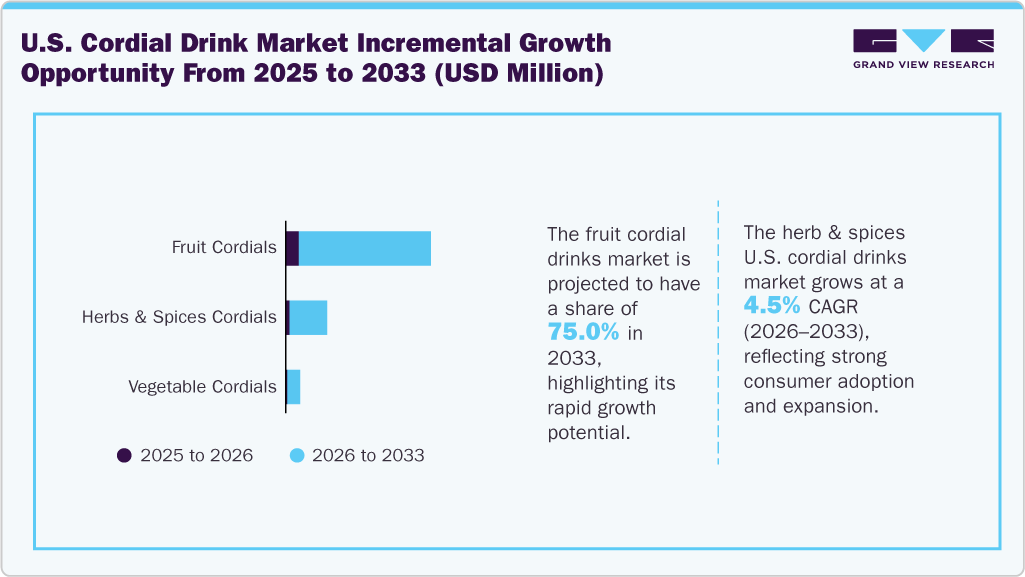
The fruit cordial drink accounted for the largest share of 75.6% of the revenue in 2025. Fruit cordials benefit from the established consumer familiarity with fruit-based beverage flavors in the U.S. market. Mango, orange, and strawberry are specifically identified as key fruit-cordial subsegments in U.S. market coverage. The broad availability of these familiar flavor profiles can make fruit cordials easier for consumers to recognize and incorporate into regular beverage choices. Product variety also allows manufacturers to address different taste preferences without moving away from the established fruit-cordial format. This gives fruit cordials a strong foundation within the U.S. product landscape.
 To learn more about this report, Download Free Sample Report
The U.S. herb & spice cordial drinks market is projected to expand at a CAGR of 4.5% from 2026 to 2033. Demand for herb- and spice-based cordials is supported by the growing presence of botanical and distinctive flavor profiles within the U.S. cordial market. Herbs and spices are increasingly recognized as a distinct product category within cordial offerings, reflecting their relevance to the market structure. Their differentiated flavor profiles provide manufacturers with opportunities to position these products beyond conventional fruit-based formulations, while ingredients such as ginger and mint offer familiar botanical profiles for product innovation and differentiation.
Distribution Channel Insights
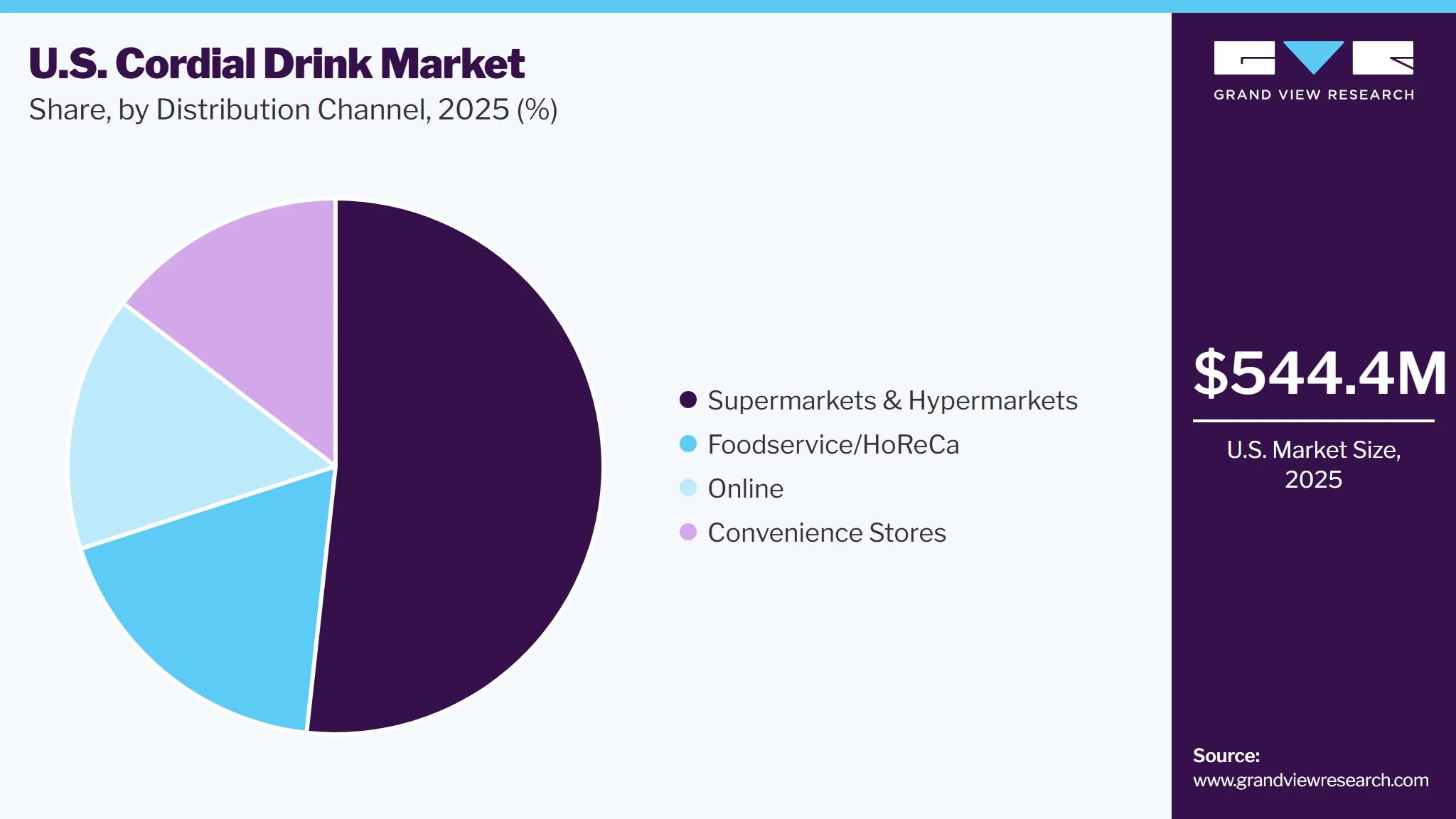
The supermarkets and hypermarkets channel in the U.S. cordial drink market accounts for the largest share of 51.7% of the revenue in 2025. Supermarkets and hypermarkets provide cordial brands with extensive physical shelf space and broad geographic reach across the U.S. Their established grocery infrastructure allows consumers to encounter cordials alongside other beverage and mixer products during routine shopping trips. These outlets also support product visibility through in-store promotions, displays, and seasonal merchandising. The ability to compare multiple brands and flavors in one location can encourage trial among consumers unfamiliar with cordials. Consequently, large-format grocery retailers remain an important distribution route for cordial products in the U.S. market.
 To learn more about this report, Download Free Sample Report
The online channel is projected to grow at the fastest CAGR of 4.5% from 2026 to 2033. Online retail is gaining importance as U.S. consumers increasingly use e-commerce platforms for grocery and beverage purchases. The U.S. Census Bureau reports that Q2 2026 retail e-commerce sales reached USD 340.2 billion, up 3.8% from Q1 and 12.2% year-over-year. For cordial brands, online channels can provide access to products that may have limited availability in conventional stores. Digital platforms also make it easier for consumers to discover niche flavors and compare products before purchasing. This channel, therefore, offers cordial manufacturers greater reach beyond traditional physical retail locations.
Key U.S. Cordial Drink Company Insights
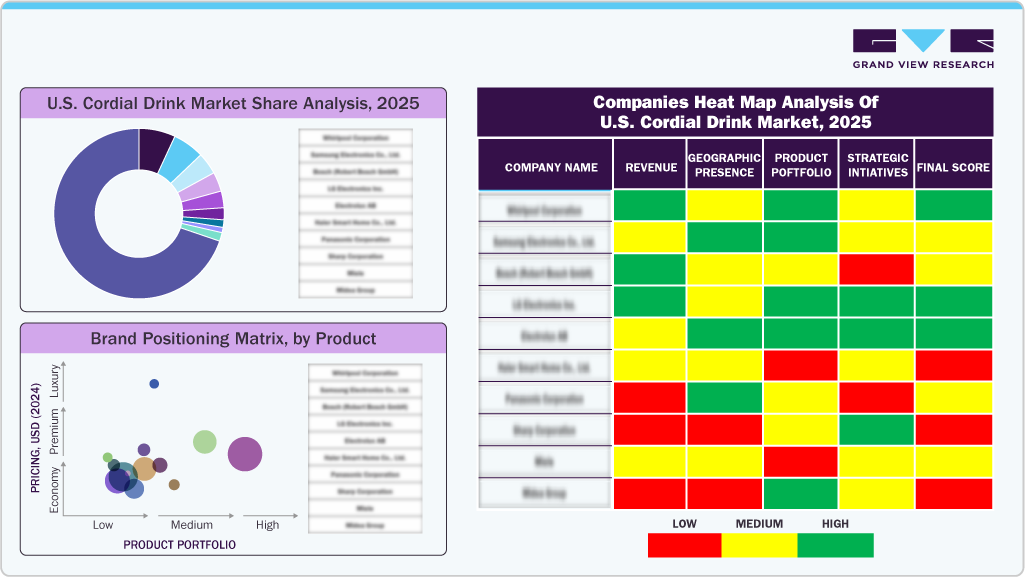
The market is characterized by a mix of established beverage companies and specialized cordial manufacturers competing across different product categories. Key companies include The Coca-Cola Company, Britvic plc, Bickford’s, Monin, and Nichols. Competition is shaped by product innovation, flavor diversification, distribution reach, and brand positioning. The market remains competitive, with companies using new product launches and portfolio expansion to strengthen their presence. U.S. market research also provides company-level revenue-share and competitive benchmarking analysis, although detailed individual market-share percentages are generally available only in proprietary reports.
 To learn more about this report, Download Free Sample Report
Key U.S. Cordial Drink Companies
-
R. Torre & Company
-
DaVinci Gourmet
-
The Coca-Cola Company
-
Ocean Spray Cranberries, Inc.
-
Liber & Co.
-
Belvoir Farm Ingredients
-
Pioma Industries
-
Keurig Dr. Pepper, Inc.
-
Sonoma Syrup Co.
-
Monin Incorporated
Recent Developments
-
In March 2025, Monin launched Yuzu Pineapple Syrup, combining tart yuzu and tropical pineapple while using fruit from its own sustainable orchard. The launch highlights U.S. cordial/drink-market trends toward globally inspired flavors, sustainable sourcing, and premium, visually appealing beverage experiences.
-
In April 2024, Torani launched its Dragon Fruit syrup, reflecting rising demand for bold, customizable flavors across the U.S. cordial/drink market. The launch also caters to Gen Z’s growing preference for trend-driven, visually appealing, and personalized beverages across sodas, teas, coffees, and cocktails.
Competitive Benchmarking
Category
Operating Strategies
Competitive Edge
Weakness
Established Players (Torani, Monin)
- Expand flavor innovation, zero-sugar lines, and foodservice partnerships.
- High brand recognition, extensive flavor ranges, strong café & foodservice presence.
- Intense price competition and pressure from private labels.
Emerging Players (Liber & Co., Sonoma Syrup Co)
- Build premium positioning through natural ingredients, small-batch products, and DTC sales.
- Authentic brand stories, agile innovation, and strong appeal among specialty consumers.
- Smaller distribution footprint and limited mainstream awareness.
U.S. Cordial Drink Market Report Scope
Report Attribute
Details
Market size in 2025
USD 544.4 million
Estimated market size in 2026
USD 561.9 million
Projected market size in 2033
USD 745.1 million
Growth rate (revenue)
CAGR of 4.1% from 2026 to 2033
Actuals
2021 - 2025
Forecast period
2026 - 2033
Quantitative (Revenue) units
Revenue in USD million, and CAGR from 2026 to 2033
Report coverage
Revenue forecast, company ranking, competitive landscape, growth factors, and trends
Segments covered
Product, distribution channel
Key companies profiled
R. Torre & Company; DaVinci Gourmet; The Coca-Cola Company; Ocean Spray Cranberries, Inc.; Liber & Co.; Belvoir Farm Ingredients; Pioma Industries; Keurig Dr. Pepper, Inc.; Sonoma Syrup Co.; Monin Incorporated
Customization scope
Free report customization (equivalent up to 8 analysts’ working days) with purchase. Addition or alteration to country, regional & segment scope.
Pricing and purchase options
Avail customized purchase options to meet your exact research needs. Explore purchase options
U.S. Cordial Drink Market Report Segmentation
This report forecasts revenue growth at the regional and country levels and provides an analysis of the latest industry trends and opportunities in each of the sub-segments from 2021 to 2033. For this study, Grand View Research has segmented the U.S. cordial drink market report based on product, and distribution channel:
-
Product Outlook (Revenue, USD Million, 2021 - 2033)
-
Fruit Cordials
-
Vegetable Cordials
-
Herbs & Spices Cordials
-
-
Distribution Channel Outlook (Revenue, USD Million, 2021 - 2033)
-
Supermarkets & Hypermarkets
-
Convenience Stores
-
Foodservice/HoReCa
-
Online
-
Research Methodology
The U.S. cordial drink market figures in this report are based on a proven research process that combines executive interviews with secondary research from proprietary databases, company filings, and recognized regulatory and institutional sources. Market size is built through value-chain sizing-reconciling supply-side and demand-side estimates-and triangulated with bottom-up and top-down approaches. Every estimate passes multiple levels of expert validation before publication, with each U.S. cordial drink segment quantified using the revenue-capture definitions in the table below.
Segment Definition
Segment - Product
Revenue capture definition
Fruit cordials
Fruit cordials generate revenue in the U.S. through the sale of concentrated fruit-based drink mixes designed for dilution or beverage preparation. Revenue is captured through grocery retailers, mass merchandisers, specialty beverage stores, food-service establishments, and online marketplaces. Flavor variety, pack formats, and premium fruit formulations allow brands to address different consumption occasions and price tiers.
Vegetable cordials
Vegetable cordials generate revenue through specialized drink formulations using vegetable-based ingredients and blends for U.S. consumers seeking less conventional beverage choices. Sales are captured through specialty grocery stores, natural-food retailers, food-service outlets, and digital commerce channels. Niche positioning, ingredient combinations, and differentiated formulations can support higher-value products within this segment.
Herbs & spices cordials
Herbs and spices cordials generate revenue through concentrated beverages featuring botanical, herbal, and spice-based flavor profiles. In the U.S., sales can be generated through specialty retailers, gourmet food outlets, beverage-focused stores, hospitality businesses, and e-commerce platforms. Distinctive flavor profiles and premium ingredient positioning enable brands to differentiate products and capture value from consumers seeking more specialized beverage experiences.
Estimation Model
Layer Name
Key Question
Description
Consumption Profile Layer
Who buys cordial drinks?
Health-conscious households, young adults, and families seeking convenient, customizable beverages with lower-sugar options.
Market Reach Layer
Where are cordial drinks available in the U.S.?
Primarily through supermarkets, mass retailers, specialty stores, e-commerce, and food-service channels.
Purchase & Retention Layer
What encourages repeat purchases of cordial drinks?
Flavor variety, affordability, easy preparation, trusted brands, and functional or reduced-sugar formulations.
Value Generation Layer
How is revenue generated from cordial drinks consumers?
Through premium concentrates, differentiated flavors, multipacks, functional formulations, and higher-value specialty products.
Delivered Customizations
This report has been delivered with the following In-depth customizations
Client Request
Customization Delivered
Value Adds
U.S. Cordial Drink Market Sizing & Growth Outlook
Assessed market value, historical performance, forecast trajectory, category maturity, and key growth drivers shaping the US cordial drink landscape.
Establishes the market opportunity, growth potential, and investment attractiveness to support strategic planning.
U.S. Cordial Drink Regulatory & Claims Assessment
Reviewed applicable US requirements around ingredients, labeling, nutritional claims, health-related positioning, and product compliance considerations.
Identifies regulatory risks and claim opportunities, helping brands develop compliant and credible market propositions.
U.S. Cordial Drink Brand Positioning & White-Space Assessment
Mapped leading brand propositions, consumer-facing messaging, premiumization strategies, and emerging positioning territories across the category.
Reveals underserved positioning spaces and differentiation opportunities for stronger brand strategy and market entry.
Frequently Asked Questions About This Report
The U.S. cordial drink market size was valued at USD 544.4 million in 2025 and is estimated at USD 561.9 million for 2026.
The U.S. cordial drink market is expected to grow at a CAGR of 4.1% from 2026 to 2033, reaching USD 745.1 million.
Key factors driving the U.S. cordial drink market include rising consumer demand for flavorful, convenient, and customizable beverages, particularly among younger consumers. Growing interest in low-sugar, natural, and fruit-based drink options is encouraging product innovation and expanding the consumer base.
The fruit cordial drink market led with a 75.6% revenue share in 2025.
The herbs & spices cordial drink market is projected to grow at the fastest CAGR of 4.5% from 2026 to 2033.
The sale of cordial drinks through supermarkets & hypermarkets accounted for the largest share of 51.7% of the revenue in 2025.
The sale of cordial drinks through online channels is projected to grow at a CAGR of 4.5% from 2026 to 2033.
Key players include R. Torre & Company, DaVinci Gourmet, The Coca-Cola Company, Ocean Spray Cranberries, Inc., Liber & Co., Belvoir Farm, Pioma Industries, Keurig Dr Pepper, Inc., Sonoma Syrup Co., and Monin Incorporated.
About the Author(s)
Consumer F&B Research Team
Consumer Goods · Consumer F&BThis report was authored by the consumer f&b research team at Grand View Research - comprising two research analysts, one senior research analyst, and one industry expert - with specialized expertise in the consumer f&b segment of the consumer goods industry. All findings are based on proprietary consumer goods databases, executive interviews, and regulatory analysis, subject to internal peer review prior to publication.
Last Updated:
Speak to Analyst

Customize this report to your needs - add regions, segments, or data points, with 20% free customization.
Or view our licence options:


ISO 9001:2015 & 27001:2022 Certified
We are GDPR and CCPA compliant! Your transaction & personal information is safe and secure. For more details, please read our privacy policy.


