
- Home
- »
- Consumer F&B
- »
-
U.S. Dehydrated Potato Market Size & Share Report, 2033GVR Report cover

U.S. Dehydrated Potato Market (2026 - 2033)
Size, Share & Trends Analysis Report By Product (Potato Flakes, Potato Powder, Shredded Potatoes), By Distribution Channel (B2B, B2C), Consumer Behavior, Key Companies, Competitive Analysis, And Segment Forecasts
Market Size, 2025
$1.2BMarket Estimate, 2026
$1.3BMarket Forecast, 2033
$1.9BCAGR, 2026–2033
5.8%U.S. Dehydrated Potato Market Summary
The U.S. dehydrated potato market size was valued at USD 1.2 billion in 2025 and is projected to grow from USD 1.3 billion in 2026 to USD 1.9 billion by 2033, at a CAGR of 5.8% from 2026 to 2033. The growth of the U.S. dehydrated potato industry is primarily driven by rising demand for convenient, shelf-stable, and easy-to-prepare food products. Growing consumption of processed foods, including instant mashed potatoes, soups, snacks, and ready-to-eat meals, further supports market growth.
Key Market Trends & Insights
- By product: Potato flakes held the largest revenue share of 43.4% in 2025
- By distribution channel: B2B channel held the largest revenue share of 75.6% in 2025
Market Size & Forecast
- Market Size in 2025: USD 1.2 billion
- Estimated Market Size in 2026: USD 1.3 billion
- Projected Market Size by 2033: USD 1.9 billion
- CAGR (2026-2033): 5.8%
Three ways to get this report
Buy it, customize it, or ask a question.Ask an Analyst
A direct answer, usually in 1 working day
- AccessReport author, directly
- Reply timeWithin 1 working day
- No sales callDirect answer only
- FormatEmail reply
- CostFree, no cost
Get the Full Report
What the study covers
- FormatsPDF · Excel · Dashboard
- Timeline2026–2033 annual, 2025 base
- Coverage20+ countries, 5 regions
- Companies10+ key players profiled
Customize the Report
20% free customization
- IncludeCountries, segments, points
- TailorTo your product definition
- ExtendDeeper competitor detail
- OrA fully bespoke study
- Turnaround5–10 working days
The U.S. dehydrated potato market is also supported by advancements in dehydration technologies that help preserve potato quality, flavor, and nutritional value. Strong potato production and an established agricultural supply chain in the U.S. ensure consistent raw material availability. In addition, manufacturers are expanding product varieties and applications to meet evolving consumer preferences and industry requirements. According to the USDA 2024 Summary, strong U.S. potato production and higher stock levels ensure consistent availability of raw materials for the dehydrated potato market. In 2023-24, approximately 1.52 million tons of potatoes were processed into dehydrated products, marking the highest level in three years.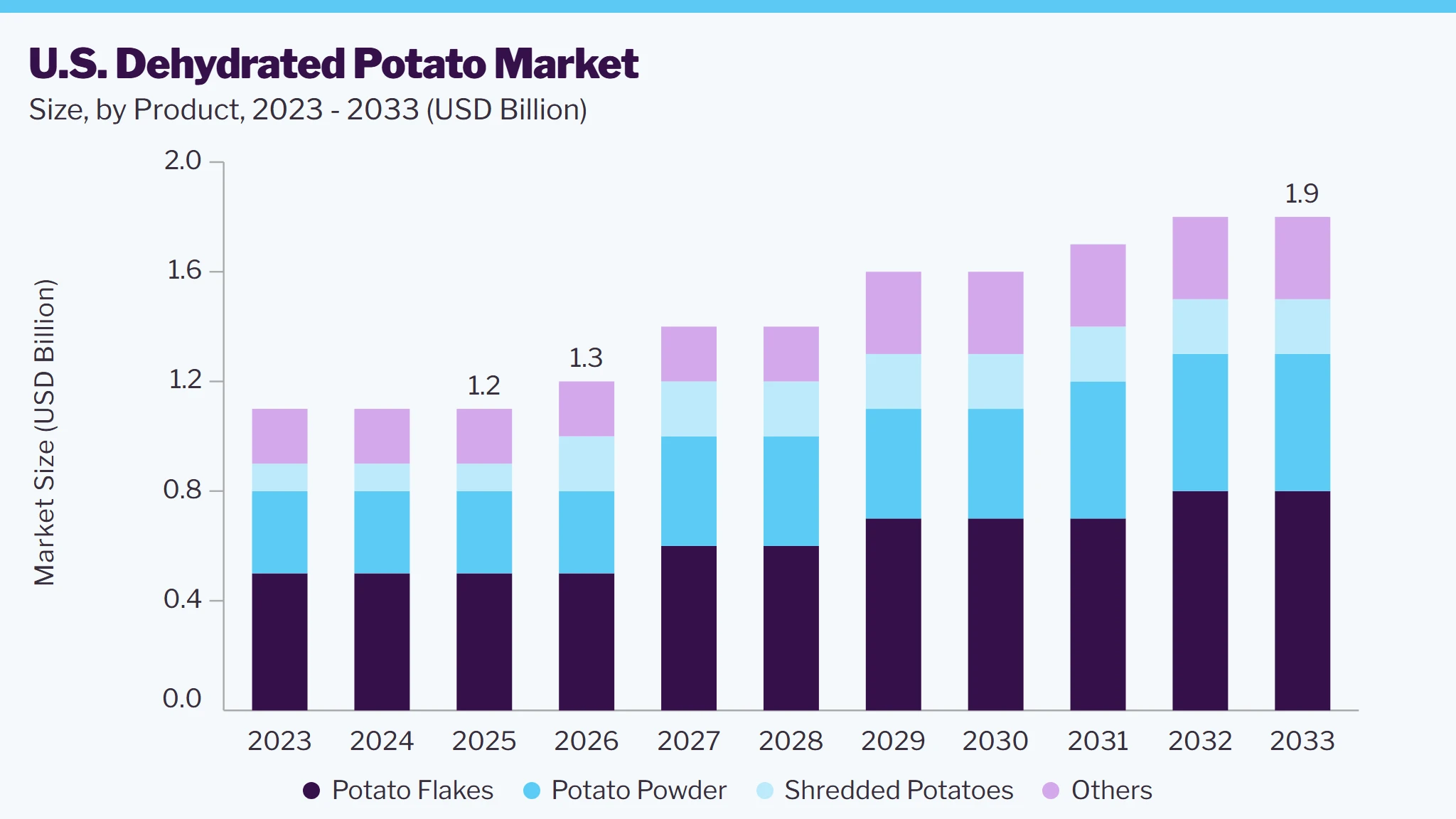 Source: Grand View Research, IR Documents, Primary Interviews, Paid DatabasesTo learn more about this report,
 Download Free Sample Report
 Moreover, the increasing adoption of dehydrated potatoes in institutional catering and commercial kitchens is creating new growth opportunities. Longer storage life and reduced transportation and handling requirements make these products attractive to large-scale buyers. Product innovation, including customized cuts, flakes, granules, and powders, is further broadening their use across different food applications.
Consumers in the U.S. are increasingly attracted to dehydrated potato products that offer practical meal preparation and easy storage. Demand is supported by interest in instant meals, prepared foods, and potato-based snacks that fit busy lifestyles. Consumers also value products that provide a familiar potato taste and texture while requiring less preparation time. Clean-label ingredients and perceived nutritional value are becoming more influential in purchasing decisions. Online grocery shopping and wider retail availability are further improving consumer access to dehydrated potato products.
Market Dynamics
The growing preference for convenient food solutions is supporting demand for dehydrated potatoes in the U.S. Consumers increasingly seek products that require minimal preparation and can be stored for longer periods. Dehydrated potato products offer flexibility across household and commercial food preparation. According to data published in June 2025, Americans are increasingly cooking at home and seeking affordable, convenient food options, driving stronger demand for products such as soups and broths. Their ease of handling also supports efficient meal preparation for busy consumers. This shift toward convenience is strengthening overall market demand.
Fluctuations in raw potato prices can create cost pressures for dehydrated potato manufacturers. Changes in farm-level prices may affect procurement expenses and production margins. Weather conditions, crop yields, and seasonal supply variations can contribute to price instability. According to AgWest Farm Credit data published in August 2026, U.S. potato markets face price and margin pressure, with weak demand, oversupply, and rising production costs affecting growers. These fluctuations in potato prices and input costs can increase procurement costs and squeeze profit margins for U.S. dehydrated potato manufacturers. Manufacturers may face challenges in maintaining consistent production costs during periods of volatility.
The expanding use of dehydrated potatoes in foodservice and institutional catering presents a significant growth opportunity. Restaurants, catering businesses, schools, and healthcare facilities require ingredients that support efficient large-scale preparation. Dehydrated formats can simplify storage, handling, and portion management in such operations. Suppliers can develop tailored products suited to specific commercial cooking requirements. This wider adoption can create new demand channels beyond traditional retail applications. According to the data published by Goodrich Cereals, potato flakes are a cost-effective alternative to fresh potatoes, reducing preparation time, labor, waste, and storage costs. With a 12-month shelf life and versatile applications across snacks, bakery, soups, and ready-to-eat foods, they offer operational efficiency and consistent quality.
Analyst Perspective
The U.S. dehydrated potato market is positioned for steady expansion, supported by its established food-processing infrastructure and broad industrial applications. Demand is increasingly influenced by manufacturers seeking consistent, versatile potato ingredients for large-scale production. Product innovation and improvements in dehydration technology are enabling wider use across food categories. Strong integration with foodservice and packaged-food production is expected to sustain market momentum. Overall, the market presents attractive opportunities for processors that can deliver quality, customization, and reliable supply.
Product Insights
The potato flakes market segment accounted for the largest revenue share of 43.4% in 2025. Potato flakes are gaining traction due to their ability to deliver consistent texture and quality in food preparation. They are widely suitable for applications such as mashed potato products, bakery formulations, and prepared foods. Their quick rehydration properties support efficient processing in commercial food manufacturing. Manufacturers also value flakes for their ease of blending with other ingredients. Increasing product development using potato-based formulations support the demand.
The potato powder segment of the U.S. dehydrated potato industry is projected to grow significantly at a CAGR of 5.9% from 2026 to 2033. Potato powder is driven by its versatility as an ingredient across sauces, soups, seasonings, bakery products, and snack formulations. Its fine particle size allows easy incorporation into dry mixes and processed food recipes. The ingredient can also contribute to thickening, binding, and flavor characteristics in various formulations. Food manufacturers benefit from its compatibility with automated production processes. Expanding experimentation with multifunctional potato ingredients is creating additional demand for potato powder.
Distribution Channel Insights
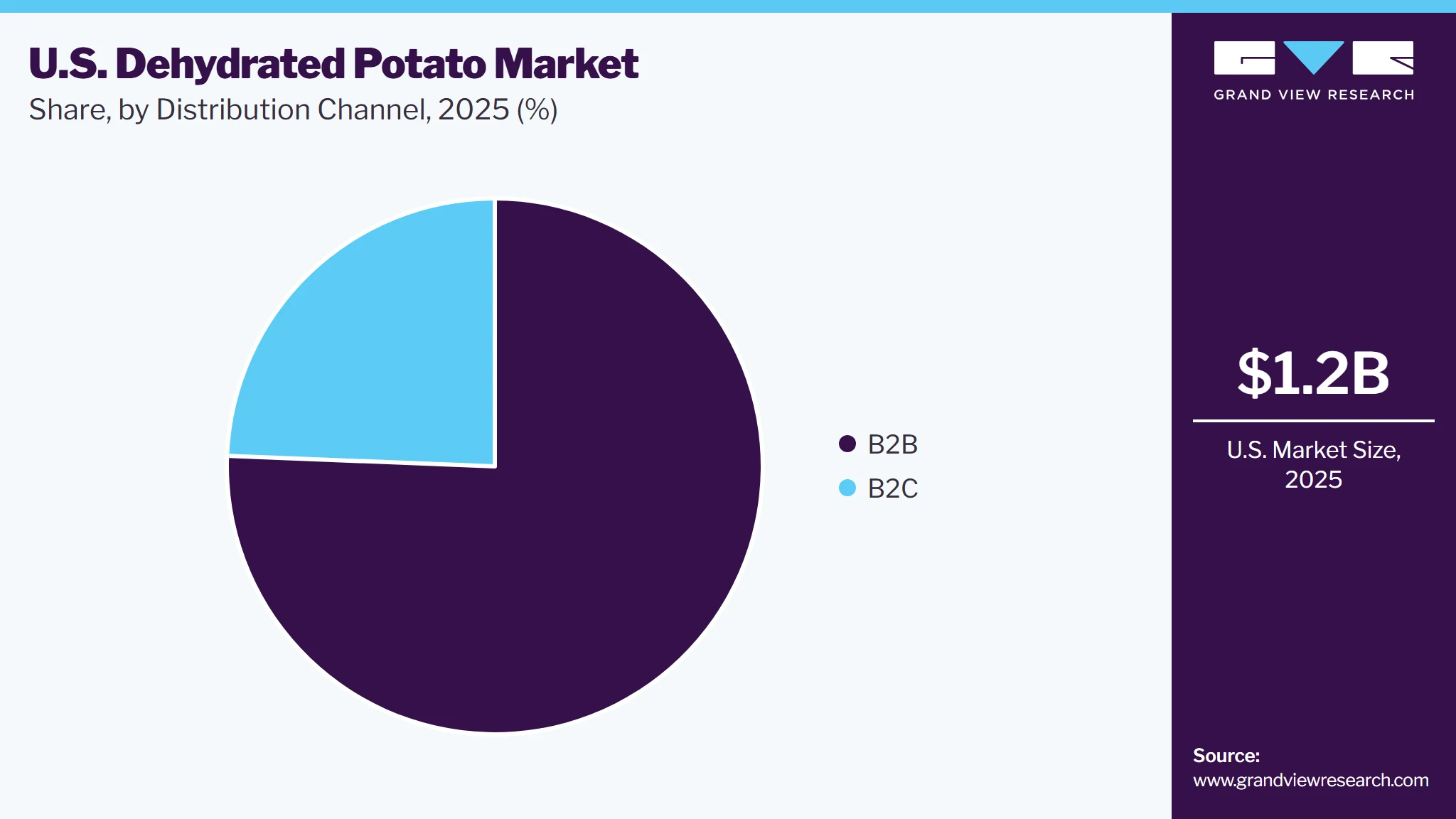
The dehydrated potato sales through the B2B channel accounted for the largest revenue share of 75.6% in 2025. The B2B channel segment of the U.S. dehydrated potato market is driven by the increasing use of dehydrated potatoes as functional ingredients by food manufacturers and commercial food processors. Their consistent specifications support standardized production across large-scale operations. Demand is also supported by applications in prepared meals, soups, snacks, bakery products, and foodservice formulations. Bulk purchasing enables businesses to streamline ingredient sourcing and production planning. Growing product development within the processed food industry is further supporting B2B adoption.
 To learn more about this report, Download Free Sample Report
 The dehydrated potato sale through the B2C channel is projected to grow at the fastest CAGR of 6.0% from 2026 to 2033. The B2C segment of the U.S. dehydrated potato market is supported by consumer interest in convenient potato products that are easy to incorporate into home cooking. Dehydrated potato formats appeal to households seeking practical alternatives for meal preparation and pantry storage. Retail availability through supermarkets, grocery stores, and online channels is helping improve consumer access. Smaller package formats also allow manufacturers to target different household requirements. Increasing awareness of versatile dehydrated potato products is contributing to consumer-level demand.
Country Insights
The U.S. dehydrated potato market is supported by the growing demand for ingredients that streamline food manufacturing and preparation. The increasing adoption of processed potato ingredients across diverse food formulations is driving steady commercial demand. Improvements in processing and dehydration methods are enabling manufacturers to offer products with more consistent characteristics. Rising investments in food product innovation are also encouraging broader applications of dehydrated potato ingredients. In November 2025, Idahoan Foods, one of the largest U.S. producers of dehydrated and value-added potato products, replaced frequently failing rubber belts with Intralox’s S1750 modular belt, achieving zero unplanned downtime. The belt delivers up to three years of service life and achieves full payback within one year, significantly reducing maintenance costs and stoppages.
Key U.S. Dehydrated Potato Company Insights
The U.S. dehydrated potato industry features established potato processors and food ingredient manufacturers competing across multiple application segments. Companies focus on product consistency, processing efficiency, supply reliability, and the ability to meet specific customer requirements. Portfolios commonly include flakes, powders, granules, and other formats tailored to food manufacturing and foodservice applications. Access to domestic potato supplies and efficient processing infrastructure supports competitive positioning among market participants. Product innovation, customized solutions, and strengthening distribution networks remain key areas of competition.
Key U.S. Dehydrated Potato Companies
-
McCain Foods Limited
-
Lamb Weston Holdings, Inc.
-
J.R. Simplot Company
-
Basic American Foods
-
Idaho Pacific Corporation
-
Idahoan Foods, LLC
-
Idaho Supreme Potatoes, Inc.
-
Gem State Processing
-
Oregon Potato Company
-
Augason Farms (Blue Chip Group)
Competitive Benchmarking
Category
Operating Strategies
Competitive Edge
Weakness
Established Players (McCain Foods, Lamb Weston, J.R. Simplot)
Expand processing capacity, improve sourcing efficiency, and strengthen dehydrated potato portfolios.
Large-scale processing, strong distribution networks, established foodservice/retail relationships.
High capital requirements; exposure to potato, labor, and energy costs.
Emerging Players (Idaho Supreme Potatoes, Inc.)
Focus on specialty formats, customized products, niche applications, and regional customers.
Faster customization, specialized processing capabilities, customer responsiveness.
Smaller production scale, limited geographic reach, lower brand recognition.
Recent Development
- In November 2025, Idahoan Foods, one of the largest U.S. producers of dehydrated and value-added potato products, replaced frequently failing rubber belts with Intralox’s S1750 modular belt, achieving zero unplanned downtime. The belt delivers up to three years of service life and achieves full payback within one year, significantly reducing maintenance costs and stoppages.
U.S. Dehydrated Potato Market Report Scope
Report Attribute
Details
Market size in 2025
USD 1.2 billion
Estimated market size in 2026
USD 1.3 billion
Projected market size by 2033
USD 1.9 billion
Growth rate
CAGR of 5.8% from 2026 to 2033
Actuals
2021 - 2025
Forecast period
2026 - 2033
Quantitative units
Revenue in USD million/billion and CAGR from 2026 to 2033
Report coverage
Revenue forecast, company ranking, competitive landscape, growth factors, and trends
Segments covered
Product and distribution channel
Country scope
U.S.
Key companies profiled
McCain Foods Limited; Lamb Weston Holdings, Inc.; J.R. Simplot Company; Basic American Foods; Idaho Pacific Corporation; Idahoan Foods, LLC; Idaho Supreme Potatoes, Inc.; Gem State Processing; Oregon Potato Company; Augason Farms (Blue Chip Group)
Customization scope
Free report customization (equivalent up to 8 analysts’ working days) with purchase. Addition or alteration to country, regional & segment scope.
Pricing and purchase options
Avail customized purchase options to meet your exact research needs. Explore purchase options
U.S. Dehydrated Potato Market Report Segmentation
This report forecasts revenue growth at the country level and provides an analysis of the latest industry trends and opportunities in each of the sub-segments from 2021 to 2033. For the purpose of this study, Grand View Research has segmented the U.S. dehydrated potato market report based on product and distribution channel:
-
Product Outlook (Revenue, USD Million/Billion, 2021 - 2033)
-
Potato Flakes
-
Potato Powder
-
Shredded Potatoes
-
Online
-
-
Distribution Channel Outlook (Revenue, USD Million/Billion, 2021 - 2033)
-
B2B
-
Food Manufacturers / Food Processors
-
QSRs
-
Restaurants & Hotels
-
-
B2C
-
Supermarkets & Hypermarkets
-
Convenience Stores
-
Specialty Stores
-
Online
-
-
Research Methodology
The U.S. dehydrated potato market figures in this report are based on a proven research process that combines executive interviews with secondary research from proprietary databases, company filings, and recognized regulatory and institutional sources. Market size is built through value-chain sizing - reconciling supply-side and demand-side estimates - and triangulated with bottom-up and top-down approaches. Every estimate passes multiple levels of expert validation before publication, with each U.S. dehydrated potato segment quantified using the revenue-capture definitions in the table below.
Segment Definition
Product
Revenue capture definition
Potato Flakes
U.S. manufacturers generate revenue by supplying potato flakes to food processors, foodservice operators, and retail brands for mashed potato products, prepared foods, and snack formulations. Sales are supported by bulk ingredient contracts as well as packaged products sold through grocery and institutional channels. Flake specifications can be adjusted to meet requirements for texture, color, and rehydration performance. Large-volume supply agreements with U.S. food manufacturers provide opportunities for recurring revenue. Private-label and customized formulations can further strengthen supplier relationships.
Potato Powder
In the U.S. market, potato powder generates revenue through applications in soups, sauces, bakery products, seasonings, and processed food formulations. Suppliers serve food manufacturers, restaurant operators, and institutional buyers through bulk and smaller commercial packaging. Product characteristics such as particle size, moisture content, and functional performance influence purchasing decisions. Customized powder grades can address specific formulation and processing requirements.
Shredded Potatoes
U.S. suppliers generate revenue from shredded dehydrated potato products used in prepared meals, breakfast foods, snack formulations, and commercial food preparation. Different shred sizes and processing specifications allow manufacturers to serve varied requirements across food processing applications. Bulk purchasing by food manufacturers and foodservice distributors represents an important revenue channel. Suppliers can develop application-specific products for customers requiring consistent cooking and rehydration performance. Long-term contracts and repeat industrial orders can provide stable revenue streams.
Others
The U.S. market also generates revenue from dehydrated potato formats such as granules, diced potatoes, slices, and pellets. These products serve specialized requirements across food manufacturing, foodservice, and institutional applications. Manufacturers can differentiate offerings through variations in size, shape, moisture content, and processing characteristics. Specialty formats can command additional value when designed for specific production or preparation processes. Customized products and niche applications provide opportunities for U.S. suppliers to diversify revenue beyond flakes and powder.
Estimation Model
Layer Name
Key Question
Description
End-Use & Application Layer
Who uses dehydrated potato products?
Food manufacturers, foodservice operators, snack producers, and household consumers.
Procurement & Supply Layer
How are dehydrated potato products sourced and supplied?
Direct sourcing, ingredient suppliers, distributors, and contract procurement.
Product Specification Layer
What drives product choice?
Quality, functionality, shelf life, rehydration performance, price, and format.
Value Generation Layer
Where is value created in the U.S. Dehydrated Potato Market?
Processing efficiency, customized formats, functional ingredients, private label, and value-added products.
Customization Table
Client Request
Customization Delivered
Value Adds
U.S. Dehydrated Potato Market Size & Growth Assessment
Quantified the U.S. market across major product formats, customer segments, and sales channels. Assessed historical performance, current market dynamics, and forward growth potential using relevant industry indicators.
Establishes the addressable market, identifies the fastest-growing pockets of demand, and supports investment and expansion decisions.
U.S. Dehydrated Potato Competitive Landscape & Benchmarking
Mapped leading domestic and international suppliers, comparing product portfolios, market positioning, customer focus, geographic presence, and differentiation strategies. Assessed competitive intensity across key market segments.
Reveals competitive gaps, whitespace opportunities, and potential differentiation levers to strengthen market positioning.
U.S. Dehydrated Potato Customer & Channel Opportunity Analysis
Segmented demand across food manufacturers, foodservice operators, institutional buyers, retailers, and other commercial users. Evaluated purchasing priorities, specification requirements, sourcing preferences, and channel dynamics.
Identifies the most attractive customer pools and routes to market, enabling focused commercial targeting and customer acquisition strategies.
Frequently Asked Questions About This Report
Key factors driving the U.S. dehydrated potato market include growing demand for convenient, shelf-stable food products, increasing consumption of processed and ready-to-eat meals, and rising demand from foodservice and quick-service restaurants.
The potato flakes segment led with a 43.4% revenue share in 2025.
The potato flakes market is projected to grow significantly at a CAGR of 6.1% from 2026 to 2033.
The sales of dehydrated potatoes through the B2B channels accounted for the largest share of 75.6% of the revenue in 2025.
The sales of dehydrated potatoes through the B2C channels are projected to grow at a CAGR of 6.0% from 2026 to 2033.
Key players include McCain Foods Limited, Lamb Weston Holdings, Inc., J.R. Simplot Company, Basic American Foods, Idaho Pacific Corporation, Idahoan Foods, LLC, Idaho Supreme Potatoes, Inc., Gem State Processing, Oregon Potato Company, and Augason Farms (Blue Chip Group).
The U.S. dehydrated potato market size was valued at USD 1.2 billion in 2025 and is estimated at USD 1.3 billion for 2026.
The U.S. dehydrated potato market is expected to grow at a CAGR of 5.8% from 2026 to 2033, reaching USD 1.9 billion by 2033.
About the Author(s)
Consumer F&B Research Team
Consumer Goods · Consumer F&BThis report was authored by the consumer f&b research team at Grand View Research - comprising two research analysts, one senior research analyst, and one industry expert - with specialized expertise in the consumer f&b segment of the consumer goods industry. All findings are based on proprietary consumer goods databases, executive interviews, and regulatory analysis, subject to internal peer review prior to publication.
Last Updated:
Speak to Analyst

Customize this report to your needs - add regions, segments, or data points, with 20% free customization.
Or view our licence options:


ISO 9001:2015 & 27001:2022 Certified
We are GDPR and CCPA compliant! Your transaction & personal information is safe and secure. For more details, please read our privacy policy.


