
- Home
- »
- Next Generation Technologies
- »
-
U.S. Federated Learning Market Size Report, 2026-2033GVR Report cover

U.S. Federated Learning Market (2026 - 2033)
Size, Share & Trends Analysis Report By Organization Size (Large Enterprises, SEMs), By Industry Vertical (BFSI, Automotive), By Application (Drug Discovery, Industrial internet of things), And Segment Forecasts
Market Size, 2025
$32.7MMarket Estimate, 2026
$36.5MMarket Forecast, 2033
$127.8MCAGR, 2026–2033
19.6%U.S. Federated Learning Market Summary
The U.S. federated learning market size was valued at USD 32.7 million in 2025 and is projected to grow from USD 36.5 million in 2026 to USD 127.8 million by 2033, at a CAGR of 19.6% from 2026 to 2033. The market is growing as enterprises increasingly deploy AI models across distributed devices while combining federated learning with secure aggregation, differential privacy, and edge MLOps to improve data security, model governance, and real-time AI performance without centralizing sensitive data.
Key Market Trends & Insights
- By organization size: The large enterprises segment dominated the market, with a revenue share of 63.4% in 2025.
- By application: The industrial internet of things segment held the largest market share of 25.3% in 2025.
- By industry vertical: The IT & telecommunications segment held the largest market share of 27.8% in 2025.
Market Size & Forecast
- Market size in 2025: USD 32.7 Million
- Estimated market size in 2026: USD 36.5 Million
- Projected market size by 2033: USD 127.8 Million
- CAGR (2026-2033): 19.6%
Three ways to get this report
Buy it, customize it, or ask a question.Ask an Analyst
Analyst response in 1 business day
- AccessReport author, directly
- Reply timeWithin 1 working day
- No sales callDirect answer only
- FormatEmail reply
- CostFree, no cost
Get the Full Report
What the study covers
- FormatsPDF · Excel · Dashboard
- Timeline2026–2033 annual, 2025 base
- Coverage20+ countries, 5 regions
- Companies10+ key players profiled
Customize the Report
20% free customization
- IncludeCountries, segments, points
- TailorTo your product definition
- ExtendDeeper competitor detail
- OrA fully bespoke study
- Turnaround5–10 working days
The growing emphasis on data privacy is a major market driver. Organizations across healthcare & life sciences, banking, insurance, and government sectors are required to comply with strict regulations regarding the storage and sharing of sensitive data. Federated learning enables AI models to be trained without transferring raw data from local devices or servers, helping organizations maintain data security while complying with regulatory requirements. This approach reduces the risk of data breaches and supports the adoption of AI in industries where privacy is a key concern. As a result, enterprises are increasingly investing in federated learning solutions to develop secure and compliant AI applications. Source: Grand View Research, IR Documents, Primary Interviews, Paid DatabasesTo learn more about this report,
 Download Free Sample Report
 The rapid adoption of artificial intelligence across industries such as Healthcare & Life Sciences, BFSI, manufacturing, and telecommunications is driving demand for federated learning in the U.S. Organizations are increasingly using AI for applications including disease diagnosis, fraud detection, predictive maintenance, and customer service. Since valuable data is often stored across multiple locations, federated learning enables organizations to collaboratively train AI models without centralizing their datasets. This improves model accuracy while protecting sensitive business and customer information. The growing deployment of AI-powered solutions across enterprises is therefore creating strong demand for federated learning technologies.
The expansion of edge computing infrastructure and the increasing number of connected devices are significantly contributing to market growth. Smartphones, IoT devices, autonomous vehicles, wearable devices, and industrial sensors continuously generate large volumes of data at the network edge. Federated learning allows AI models to be trained directly on these devices, reducing the need to transfer large datasets to centralized cloud platforms. This improves response times, lowers network bandwidth requirements, and enhances data security. As businesses continue investing in edge AI and distributed computing environments, the adoption of federated learning is expected to increase steadily.
Market Dynamics
The increasing focus on data privacy and regulatory compliance is a major market driver. Organizations across Healthcare & Life Sciences, banking, insurance, and government sectors handle large volumes of sensitive data and must comply with strict privacy regulations. Federated learning enables AI models to be trained locally while keeping raw data within the organization's environment, reducing the need to share confidential information with centralized servers. This approach helps minimize the risk of data breaches while supporting secure collaboration between multiple organizations and devices. As enterprises continue to prioritize privacy-preserving AI and regulatory compliance, the adoption of federated learning solutions is increasing across the U.S. market.
The implementation of federated learning is often complex because it requires multiple organizations and devices to collaborate while using different IT systems, data formats, and computing environments. Integrating these diverse infrastructures requires significant technical expertise, longer deployment timelines, and higher implementation costs. In addition, the lack of widely adopted standards for model training, communication protocols, and interoperability makes it difficult to ensure seamless collaboration between participants. Organizations also face challenges in maintaining consistent model performance across distributed networks with varying device capabilities and data quality. These technical and operational barriers can slow enterprise adoption, particularly among small and medium-sized organizations with limited AI infrastructure and expertise.
The Healthcare & Life Sciences sector presents a significant market growth opportunity as organizations increasingly adopt AI while maintaining strict patient data privacy. Hospitals, pharmaceutical companies, research institutions, and diagnostic centers generate large volumes of sensitive medical data that cannot be easily shared due to regulatory requirements. Federated learning enables these organizations to collaboratively develop AI models without transferring patient records, improving the accuracy of disease diagnosis, drug discovery, medical imaging, and clinical research. The increasing adoption of digital health platforms, wearable devices, and remote patient monitoring is further creating demand for secure decentralized AI solutions. As Healthcare & Life Sciences providers continue investing in AI-driven innovation while complying with privacy regulations, the adoption of federated learning is expected to create substantial market opportunities over the coming years.
Market Concentration & Characteristics
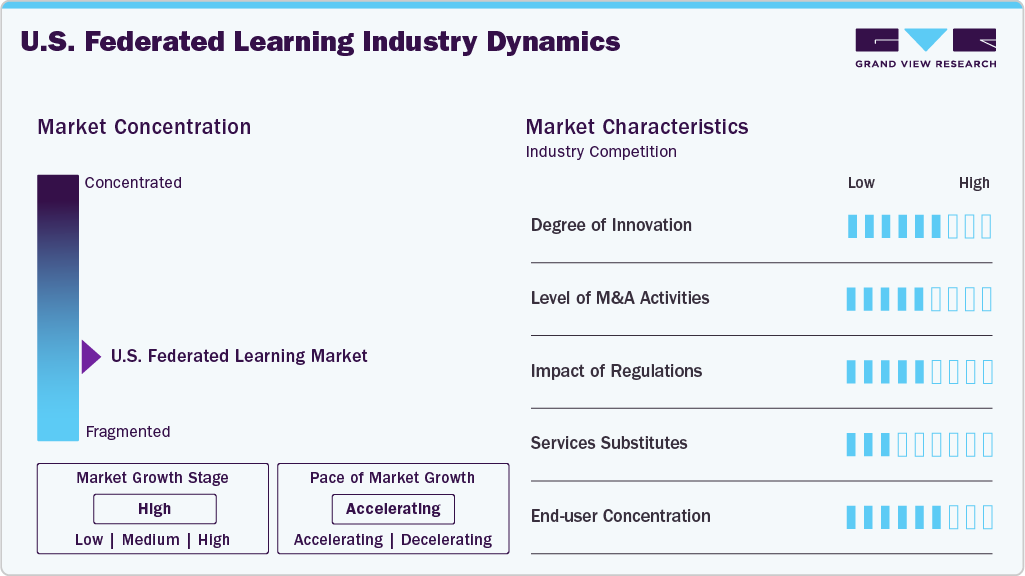
Merger and acquisition activity in the U.S. federated learning industry remains moderate, as companies primarily focus on strategic partnerships, technology collaborations, and selective acquisitions to strengthen their AI capabilities. Large technology vendors are acquiring niche AI and privacy technology firms to expand their product portfolios and enhance federated learning capabilities. However, the market continues to witness significant investment in internal research and platform development, reducing dependence on frequent acquisitions. This balanced approach keeps M&A activity at a medium level while supporting steady market expansion.
 To learn more about this report, Download Free Sample Report
 The threat of service substitutes in the U.S. federated learning industry is relatively low because few technologies provide the same combination of decentralized AI model training and strong data privacy. Traditional centralized machine learning requires organizations to transfer sensitive data to central servers, making it less suitable for industries with strict privacy requirements. Federated learning offers a unique approach that enables secure collaboration while keeping data on local devices or servers. As a result, organizations with privacy-sensitive applications have limited alternative solutions that provide comparable functionality.
Analyst Perspective
The market is entering a phase where competitive differentiation depends less on AI model performance alone and more on the ability to enable secure collaboration across distributed data environments without compromising privacy. Growth is supported by expanding enterprise AI adoption, stricter data governance requirements, and increasing deployment of edge computing across healthcare, BFSI, telecommunications, and industrial sectors. The strongest competitive advantage is expected to reside with vendors that combine federated learning with privacy-enhancing technologies, scalable MLOps, and seamless integration into existing enterprise AI ecosystems. As organizations transition from isolated AI pilots to production-scale deployments, platforms offering interoperable, secure, and industry-specific federated learning capabilities are positioned to capture a larger share of enterprise AI investments.
Organization Size Insights
The large enterprises segment accounted for the largest market share in 2025, representing 63.4% of total revenue, owing to the growing adoption of enterprise AI and the need to manage sensitive data across multiple business locations. Large organizations increasingly deploy federated learning to enable secure collaboration between distributed teams while complying with data privacy regulations. Their substantial investments in AI infrastructure, cloud platforms, and edge computing also support the deployment of federated learning at scale. The increasing use of AI for fraud detection, predictive analytics, and personalized services continues to support demand within this segment.
The SMEs segment is projected to register the fastest growth during the forecast period, experiencing steady growth as cloud-based AI platforms and managed federated learning solutions reduce deployment complexity and implementation costs. Small and medium-sized businesses are adopting federated learning to improve AI capabilities while maintaining data privacy and minimizing cybersecurity risks. The growing availability of scalable AI services enables SMEs to implement decentralized machine learning without extensive in-house infrastructure. Increasing digital transformation across sectors is further supporting the adoption of federated learning among smaller enterprises.
Application Insights
The industrial internet of things segment accounted for the largest revenue share of 25.3% in 2025. This dominance is driven by the increasing deployment of connected sensors, industrial automation systems, and edge computing across manufacturing facilities in the U.S. Federated learning enables AI models to be trained across distributed industrial devices without transferring operational data, improving data security, and reducing network traffic. This approach supports predictive maintenance, equipment monitoring, quality inspection, and process optimization while protecting proprietary manufacturing information. The growing adoption of Industry 4.0 technologies and smart factories continues to support demand for federated learning in industrial environments.
The drug discovery segment is expected to register a significant CAGR during the forecast period, driven by the increasing need for collaborative AI model development among pharmaceutical companies, research organizations, and healthcare & life sciences institutions, while maintaining data confidentiality. Federated learning enables organizations to analyze distributed clinical, genomic, and molecular datasets without sharing sensitive research data or intellectual property. This improves AI-driven target identification, biomarker discovery, and compound screening while supporting regulatory compliance. Growing investment in precision medicine and AI-based pharmaceutical research continues to accelerate the adoption of federated learning in drug discovery.
Industry Vertical Insights
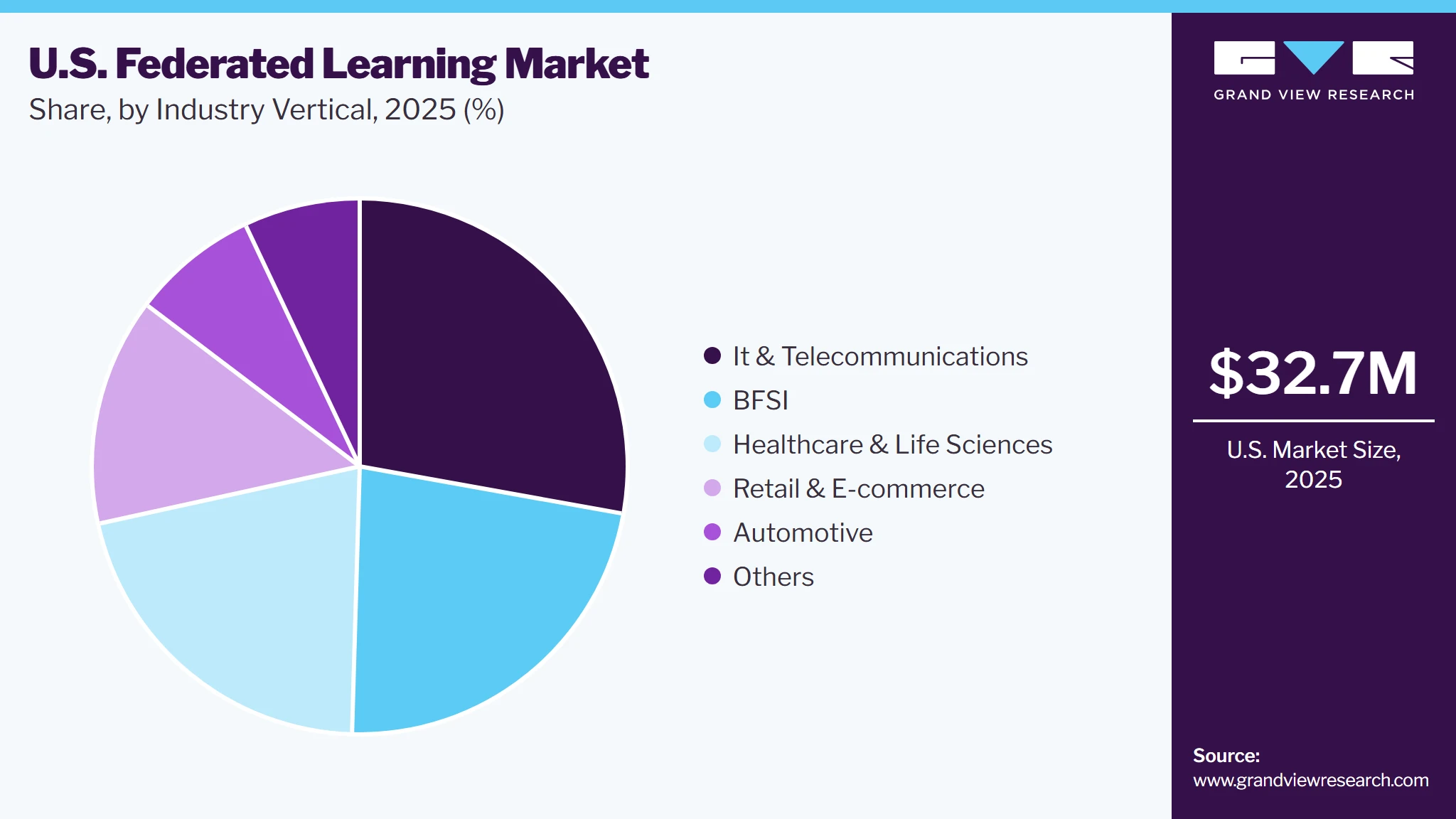
The IT & telecommunications segment accounted for the largest revenue share of 27.8% in 2025, driven by the growing deployment of edge computing, 5G networks, and distributed AI infrastructure across the U.S. telecom ecosystem. Federated learning enables service providers to train AI models across geographically distributed networks without transferring sensitive user data to centralized servers. The technology also supports network optimization, anomaly detection, cybersecurity, and predictive maintenance while maintaining data privacy. Rising investment in intelligent network management and privacy-preserving AI continues to drive adoption across this industry vertical.
 To learn more about this report, Download Free Sample Report
 The healthcare & life sciences segment is anticipated to register the fastest CAGR over the forecast period, driven by the increasing need for secure AI model development using patient data distributed across hospitals, research institutions, and diagnostic centers. Federated learning enables collaborative AI training while keeping sensitive medical records within individual organizations, supporting compliance with healthcare privacy regulations. The technology is gaining adoption in medical imaging, clinical decision support, drug discovery, and disease prediction to improve model accuracy without compromising patient confidentiality. Growing investments in digital healthcare and collaborative medical research are further supporting demand for federated learning solutions.
Key U.S. Federated Learning Company Insights
Some key players in the market include Google LLC, FedML Inc., IBM Corporation, Enveil Inc., and others.
• Google LLC develops federated learning technologies through its AI ecosystem, enabling organizations to build machine learning models while keeping data on local devices. Its TensorFlow Federated framework supports privacy-preserving AI applications across healthcare, financial services, mobile devices, and enterprise environments. The company continues to expand capabilities in edge AI, distributed computing, and secure model training. Its broad AI portfolio supports scalable deployment across diverse industry applications.
• FedML Inc. develops an open-source federated learning platform that enables organizations to deploy and manage distributed AI models across cloud and edge environments. The platform supports major machine learning frameworks and simplifies collaborative model training without centralizing sensitive data. Its solutions serve enterprises, research institutions, and developers across multiple industries. The company also focuses on improving scalability, security, and deployment efficiency for federated AI applications.
Key U.S. Federated Learning Companies
-
Google LLC
-
IBM Corporation
-
NVIDIA Corporation
-
Intel Corporation
-
FedML Inc.
-
Owkin Inc.
-
Acuratio Inc.
-
Cloudera Inc.
-
Edge Delta Inc.
-
Enveil Inc.
Recent Developments
-
In January 2025, Owkin announced Owkin K1.0 Turbigo, an AI operating system designed to support drug discovery and diagnostics using multimodal patient data from its federated patient data network. The platform integrates advanced AI models with decentralized healthcare datasets to generate biological insights while maintaining data privacy. The solution supports collaborative research across healthcare institutions without requiring centralized access to sensitive patient information.
-
In December 2024, Google Cloud partnered with Swift to develop an AI-based fraud-detection solution for cross-border payments that uses federated learning and privacy-enhancing technologies. The collaboration enables financial institutions to train AI models on decentralized data while keeping sensitive transaction information within their own environments. The initiative also includes a sandbox program with global financial institutions to evaluate secure, collaborative fraud detection using federated learning.
-
In March 2023, FedML secured USD 6 million in seed and pre-seed funding led by Camford Capital to expand its collaborative AI platform for large-scale AI training, deployment, and customization. The investment supported the development of its federated learning-based MLOps platform, enabling organizations to train AI models across distributed edge and cloud environments while preserving data privacy.
Competitive Benchmarking
Category
Operating Strategies
Competitive Edge
Weakness
Established Players (Google LLC; IBM Corporation; NVIDIA Corporation; Intel Corporation; Cloudera Inc.)
- Focus on expanding federated learning through AI platforms, cloud infrastructure, and enterprise software ecosystems.
- Emphasize strategic partnerships, continuous R&D investment, and integration of privacy-preserving AI capabilities across multiple industry verticals.
- Extensive enterprise customer base and established AI infrastructure enable large-scale deployment across cloud and edge environments.
- Broad technology portfolios combining AI software, hardware, cybersecurity, and data management provide end-to-end federated learning solutions.
- Complex product portfolios often increase deployment time and implementation costs for enterprise customers.
- Large organizational structures may slow product customization and the adoption of specialized federated learning use cases.
Emerging Players (FedML Inc.; Owkin Inc.; Acuratio Inc.; Edge Delta Inc.; Enveil Inc.)
- Focus on developing specialized federated learning platforms for privacy-preserving AI, healthcare, secure analytics, and edge computing.
- Expand market presence through technology innovation, research collaborations, pilot deployments, and industry-specific solutions.
- Specialized expertise in decentralized AI enables faster innovation and solutions designed for specific industry requirements.
- Flexible platforms and focused product development support quicker implementation and customization for enterprise applications.
- Limited financial resources and smaller customer bases reduce their ability to compete with diversified technology vendors.
- Lower global brand recognition and narrower sales networks can slow enterprise adoption and market expansion.
U.S. Federated Learning Market Report Scope
Report Attribute
Details
Market size in 2025
USD 32.7 million
Estimated market size in 2026
USD 36.5 million
Projected market size by 2033
USD 127.8 million
Growth rate
CAGR of 19.6% from 2026 to 2033
Actual data
2021 - 2025
Forecast period
2026 - 2033
Quantitative units
Revenue in USD million and CAGR from 2026 to 2033
Report coverage
Revenue forecast, company ranking, competitive landscape, growth factors, and trends
Segments covered
Organization size, application, industry vertical
Key companies profiled
Google LLC; IBM Corporation; NVIDIA Corporation; Intel Corporation; FedML Inc.; Owkin Inc.; Acuratio Inc.; Cloudera Inc.; Edge Delta Inc.; Enveil Inc.
Customization scope
Free report customization (equivalent up to 8 analysts working days) with purchase. Addition or alteration to country, regional & segment scope.
Pricing and purchase options
Avail customized purchase options to meet your exact research needs. Explore purchase options
U.S. Federated Learning Market Report Segmentation
This report forecasts revenue growth at the country level and provides an analysis of the latest industry trends in each of the sub-segments from 2021 to 2033. For this study, Grand View Research has segmented the U.S. federated learning market report based on organization size, application, and industry vertical:
-
Organization Size Outlook (Revenue, USD Million, 2021 - 2033)
-
SMEs
-
Large Enterprises
-
-
Application Outlook (Revenue, USD Million, 2021 - 2033)
-
Drug Discovery
-
Industrial internet of things
-
Risk Management
-
Augmented and Virtual Reality
-
Data Privacy Management
-
Others
-
-
Industry Vertical Outlook (Revenue, USD Million, 2021 - 2033)
-
BFSI
-
Retail & E-commerce
-
IT & Telecommunication
-
Healthcare & Life Sciences
-
Automotive
-
Others
-
Research Methodology
The U.S. federated learning market figures in this report are based on a proven research process that combines executive interviews with secondary research from proprietary databases, company filings, and recognized regulatory and institutional sources. Market size is built through value-chain sizing-reconciling supply-side and demand-side estimates-and triangulated with bottom-up and top-down approaches. Every estimate passes multiple levels of expert validation before publication, with each U.S. federated learning segment quantified using the revenue-capture definitions in the table below.
Segment Definition
Organization Size
Revenue capture definition
Large Enterprises
Large enterprises account for the highest revenue share in the U.S. federated learning market due to their extensive AI infrastructure, distributed data environments, and higher investment in privacy-preserving technologies. Their adoption is supported by large-scale AI deployments across multiple business units while meeting regulatory and data security requirements.
SMEs
SMEs are steadily increasing their adoption of federated learning through cloud-based platforms and open-source frameworks that reduce implementation costs. Revenue contribution is supported by the growing need for secure AI model development, enabling smaller organizations to improve analytics without centralizing sensitive business data.
Application
Revenue capture definition
Industrial Internet of Things
This segment captures revenue generated from federated learning solutions used for predictive maintenance, process automation, quality inspection, and industrial asset monitoring across connected manufacturing environments. The technology enables AI model training across distributed industrial devices while maintaining operational data privacy.
Drug Discovery
Revenue in this segment is generated from federated learning applications that enable pharmaceutical companies and research institutions to develop AI models using decentralized clinical and biomedical datasets. This approach supports collaborative drug research while protecting patient information and proprietary research data.
Risk Management
This segment includes revenue from federated learning solutions used for fraud detection, financial risk assessment, cybersecurity, and operational risk analysis across distributed data environments. Organizations apply these models to improve decision-making while keeping confidential business and customer information within local systems.
Augmented and Virtual Reality
Revenue is generated from the use of federated learning in AR and VR platforms to improve personalization, user interaction, and real-time AI processing without transferring user-generated data to centralized servers. The technology supports immersive digital experiences while maintaining privacy across connected devices.
Data Privacy Management
This segment captures revenue from federated learning platforms designed to enable secure AI training without exposing sensitive personal or enterprise data. Adoption is driven by organizations seeking compliance with data protection regulations while maintaining efficient AI model development.
Others
The others segment includes applications across smart cities, autonomous vehicles, retail analytics, energy management, agriculture, and public sector services. Federated learning supports collaborative AI development in these areas by enabling decentralized model training across multiple data sources.
Industry Vertical
Revenue capture definition
It & Telecommunications
Revenue is generated from federated learning platforms used for network optimization, cybersecurity, traffic management, and edge AI across telecom infrastructure. Adoption includes software, cloud services, integration, and AI model management for distributed communication networks.
Healthcare & Life Sciences
Revenue includes federated learning solutions deployed for medical imaging, clinical research, disease prediction, drug discovery, and patient data analytics. It covers AI software, implementation services, and secure collaboration platforms used by hospitals, laboratories, and research organizations.
BFSI
Revenue comprises federated learning deployments for fraud detection, credit risk assessment, anti-money laundering, and customer analytics while maintaining data privacy. The segment includes AI platforms, security software, and enterprise services adopted by banks, insurers, and financial institutions.
Retail & E-commerce
Revenue is derived from federated learning applications supporting personalized recommendations, demand forecasting, inventory optimization, and customer behavior analysis. It also includes AI platforms and analytics solutions that enable privacy-preserving use of consumer data.
Automotive
Revenue covers federated learning solutions used for autonomous driving, connected vehicle intelligence, predictive maintenance, and fleet data analytics. The segment includes AI software and edge computing technologies deployed across vehicle manufacturers and mobility providers.
Others
Revenue includes federated learning deployments across government, education, energy, manufacturing, media, and other industries requiring secure AI model training on distributed datasets. The segment covers software platforms, consulting, deployment, and managed AI services.
Estimation Model
Layer No.
Layer Name
Key Questions
Description
01
Enterprise Layer
Who can adopt federated learning?
Identify U.S. enterprises across industries such as IT & telecommunications, healthcare, BFSI, retail, automotive, manufacturing, and government that manage distributed and privacy-sensitive data. This establishes the total addressable enterprise base for federated learning solutions.
02
AI Adoption Layer
How many enterprises deploy AI?
Apply enterprise AI adoption rates to estimate the number of organizations using machine learning and advanced analytics. This converts the enterprise base into the potential customer base for privacy-preserving AI technologies.
03
Federated Learning Deployment Layer
How many AI users adopt federated learning?
Estimate the proportion of AI-enabled organizations implementing federated learning based on privacy regulations, distributed data environments, edge AI adoption, and industry-specific requirements. This identifies the active user base for federated learning platforms and services.
04
Monetization Layer
How much revenue is generated?
Apply the average annual spending on federated learning software, cloud platforms, integration, deployment, consulting, and managed services across enterprises. Aggregating these expenditures provides the total U.S. federated learning market revenue.
Delivered Customizations
This report has been delivered with the following In-depth customizations
Client Request
Customization Delivered
Value Adds
Market Entry & Expansion Assessment
Regional demand sizing and forecasting
Customer segmentation and buying behavior analysis
Competitive landscape benchmarking
Regulatory and distribution channel assessment
Identified high-growth market opportunities
Supported go-to-market strategy development
Highlighted investment priorities and risks
Enabled data-driven expansion planning
Technology & Innovation Assessment
Emerging technology trend analysis
Innovation pipeline
Technology adoption readiness assessment
Ecosystem and partnership mapping
Identified future growth areas
Supported innovation roadmap planning
Evaluated commercialization potential
Strengthened strategic partnership decisions
Customer & End-User Insights Study
Consumer awareness and adoption analysis
Purchase decision journey mapping
Satisfaction and loyalty assessment
Usage pattern and pain-point evaluation
Revealed key adoption drivers and barriers
Supported customer-centric product development
Improved targeting and engagement strategy
Identified opportunities for retention and upselling
Frequently Asked Questions About This Report
The global U.S. federated learning market size was estimated at USD 32.7 million in 2025 and is projected to grow from USD 36.5 million in 2026
The global U.S. Federated learning market is expected to grow at a compound annual growth rate of 19.6% from 2026 to 2033 to reach USD 127.8 million by 2033.
The industrial internet of things segment held the largest market share of 25.3% in 2025.
Large enterprises segment dominated the market, with a revenue share of 63.4% in 2025 while SMEs segment is second fastest growing market
The U.S. Federated learning market is growing as enterprises increasingly deploy AI models across distributed devices while combining federated learning with secure aggregation, differential privacy, and edge MLOps to improve data security, model governance, and real-time AI performance without centralizing sensitive data.
Key players include Google LLC; IBM Corporation; NVIDIA Corporation; Intel Corporation; FedML Inc.; Owkin Inc.; Acuratio Inc.; Cloudera Inc.; Edge Delta Inc.; Enveil Inc.
The IT & telecommunications segment accounted for the largest revenue share of 27.8% in 2025, driven by the growing deployment of edge computing, 5G networks, and distributed AI infrastructure across the U.S. telecom ecosystem.
About the Author(s)
Next Generation Technologies Research Team
Technology · Next Generation TechnologiesThis report was authored by the next generation technologies research team at Grand View Research - comprising two research analysts, one senior research analyst, and one industry expert - with specialized expertise in the next generation technologies segment of the technology industry. All findings are based on proprietary technology databases, executive interviews, and regulatory analysis, subject to internal peer review prior to publication.
Last Updated:
Speak to Analyst

Customize this report to your needs - add regions, segments, or data points, with 20% free customization.
Or view our licence options:


ISO 9001:2015 & 27001:2022 Certified
We are GDPR and CCPA compliant! Your transaction & personal information is safe and secure. For more details, please read our privacy policy.


