
- Home
- »
- Medical Devices
- »
-
U.S. Fertility Diagnostic Market Size, Industry Report, 2033GVR Report cover

U.S. Fertility Diagnostic Market (2026 - 2033) Size, Share & Trends Analysis Report By Procedure Type (X-ray-Based Tubal Patency Testing, Structural & Morphologic Imaging), By Technology Type, By Clinical Setting, By Region, And Segment Forecasts
U.S. Fertility Diagnostic Market Summary
The U.S. fertility diagnostic market size was valued at USD 1.07 billion in 2025 and is projected to reach USD 1.92 billion by 2033, growing at a CAGR of 7.6% from 2026 to 2033. The rise in infertility and high rate of identifiable causes are key factors driving the U.S. market for fertility diagnostics.
Key Market Trends & Insights
- By procedure type: Ultrasound-based tubal patency testing segment dominated the market, accounting for 35.1% of the market in 2025.
- By technology type: Ultrasound-based technologies segment accounted for the largest share at 47.7% in 2025.
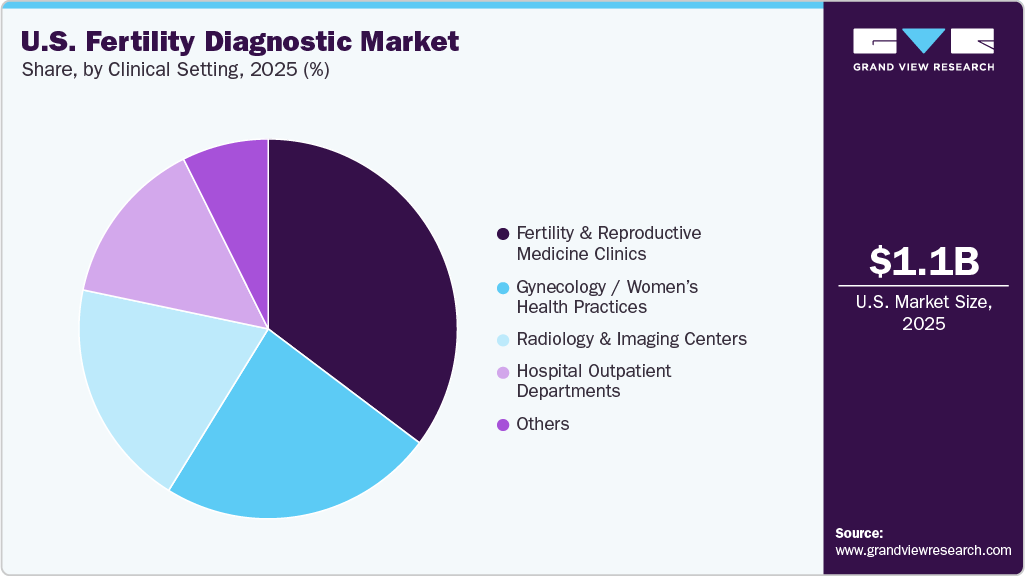
- By clinical setting: Fertility & reproductive medicine clinics segment dominated the market, accounting for the largest share at 35.3% in 2025.
Market Size & Forecast
- 2025 Market Size: USD 1.07 Billion
- 2033 Projected Market Size: USD 1.92 Billion
- CAGR (2026-2033): 7.6%
GVR research-powered AIAsk Prism AI about the U.S. fertility diagnostic marketGet cited answers from GVR research on market growth, segments, regulations and forecasts.Start with✓ Source-linked answers ✓ Market-specific context ✓ Traceable figuresExplore Prism AI ↗
In addition, the increasing emphasis on comprehensive diagnostic evaluations is supporting the continued growth and technological advancement of fertility diagnostic solutions. The section below outlines key market factors such as research and development and trends shaping the fertility diagnostic market. It reflects technological advancements, the impact of demographics, and other factors that are strengthening diagnostic capabilities, improving early infertility detection, and expanding access to advanced fertility testing solutions across the U.S.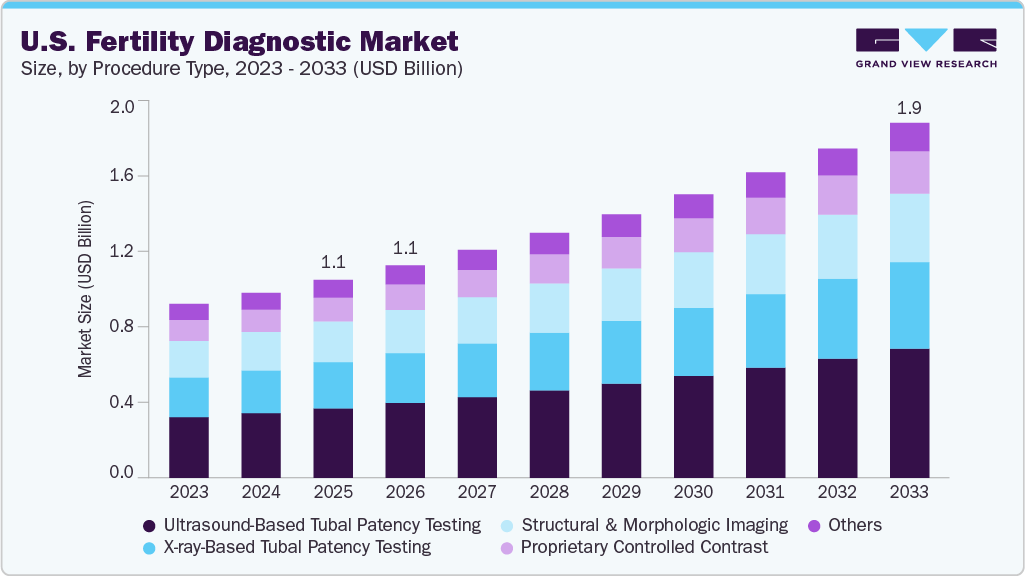 Source: Grand View Research, IR Documents, Primary Interviews, Paid DatabasesTo learn more about this report,
 Download Free Sample Report
Market Drivers
Delayed Parenthood and Changing Demographics:
The rising postponement of parenthood, along with developing demographic patterns, is a key driver of market growth. An increasing number of individuals and couples are postponing family formation and planning due to factors such as gaining higher education, career progression, financial considerations, and financial stability, and getting married at a later age. For instance, according to an article published by the Centers for Disease Control and Prevention in June 2025, the average age of first birth for mothers increased from 26.6 years in 2016 to 27.5 years in 2023. Also, a similar upward trend is observed for second and third births. This steady progression signals a long-term demographic transformation instead of a short-term fluctuation, which is directly influencing the growth path of the market.
Rising prevalence of infertility
The rise in the rates of infertility among men as well as women is a significant factor that is driving the growth of the market. According to a Johns Hopkins Bloomberg School of Public Health article published in January 2026, the U.S. recorded its lowest fertility rate to date, at 1.6 births per woman in 2024, and is continuing a steady decline that began in the early 2000s. This level is below the replacement-rate threshold of 2.1 births per woman, which is required to maintain a stable population without immigration. The trend reflects broader demographic shifts, which include delayed childbearing, changing family preferences, economic pressures, and expanded access to education and contraceptives.
Growth of Assisted Reproductive Technologies (ART):
ART procedures, such as In-Vitro Fertilization, intracytoplasmic sperm injection (ICSI), and embryo transfer, require detailed pre-treatment evaluations, including hormonal assays, ovarian reserve testing, semen analysis, genetic screening, and high-resolution imaging, to optimize treatment outcomes. According to an update published by the American Society of Reproductive Medicine (ASRM) in April 2025, during National Infertility Awareness Week, the Society for Assisted Reproductive Technology (SART) released its latest annual national and clinic-specific data on ART, including in IVF, highlighting sustained growth in both treatment utilization and success rates across the U.S.
Market Characteristics & Concentration
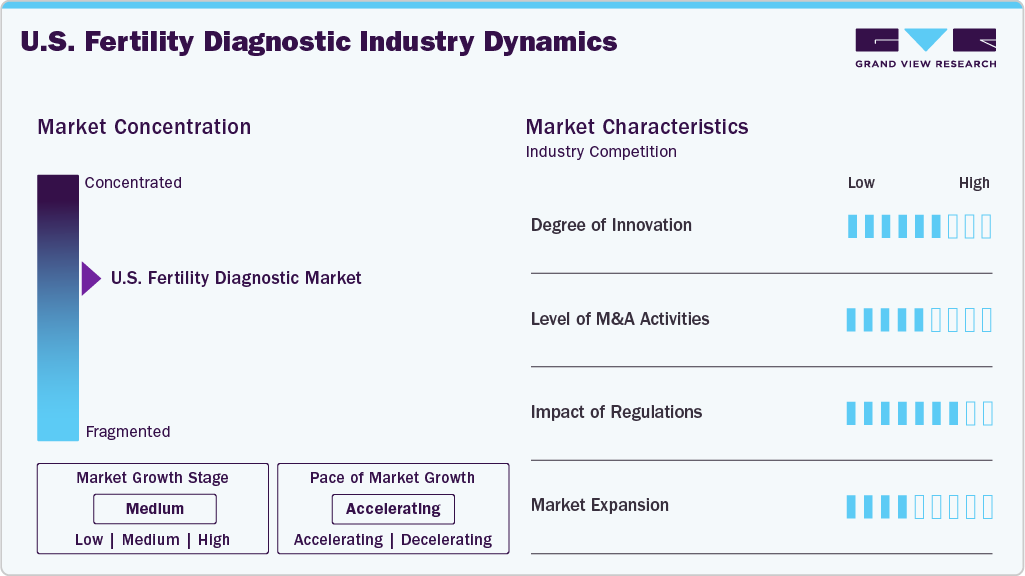
The chart below illustrates the relationships among industry concentration, industry characteristics, and industry participants. There is a moderate degree of innovation, a moderate level of merger & acquisition activity, a high impact of regulations, and a moderate expansion of the industry.
The industry is moderately concentrated, with many players entering the market and launching new innovative products. The degree of innovation is medium, and the level of merger & acquisition activities is medium. The impact of regulations on the market is high, and the market expansion of players is medium.
 To learn more about this report, Download Free Sample Report
Innovations include advancements in proprietary fertility diagnostic solutions. In September 2024, FemChec from Femasys Inc. received FDA clearance as a contrast-generating diagnostic tool designed to confirm fallopian tube status using ultrasound-based evaluation. The system supports in-office fertility diagnostics by enabling clinicians to assess tubal patency without referring patients to radiology departments.
The industry shows notable consolidation as larger companies aim to expand their reach, capabilities, and market presence. In August 2025, Ultrahuman acquired viO HealthTech, a medical technology company known for its OvuSense fertility tracking technology. This acquisition allows Ultrahuman to integrate viO’s clinically validated temperature-based ovulation algorithm and long-term cycle data into its own health-tracking ecosystem.
The impact of regulations on the fertility diagnostic industry in the U.S. is significant. Regulatory complexity and approval delays continue to pose a major challenge for the market as key products must navigate the stringent oversight of the U.S. FDA. For instance, ongoing debates over the FDA’s oversight of laboratory-developed tests (LDTs), which many reproductive health labs use for genetic and hormone assays, have created uncertainty and potential compliance burdens; a controversial rule to subject many LDTs to full device regulation was recently rescinded after legal challenges, illustrating the regulatory turbulence in this space.
The industry is experiencing significant geographical expansion, which is driven by various factors, including increasing investments, facility launches, and innovation. For instance, in October 2025, Samsung Healthcare entered into a strategic partnership with the High-Risk Pregnancy Center (HRPC), which is a leading maternal-fetal medicine practice in Nevada. This alliance aims to bring advanced ultrasound technology to care for women facing complex pregnancies. Under this collaboration, HRPC will deploy Samsung’s latest Z20 ultrasound systems across its clinics in Las Vegas, Henderson, and Reno, giving clinicians access to high-resolution, Artificial Intelligence-enhanced imaging, which can reveal critical details in high-risk pregnancies and support better clinical decision-making.
Procedure Type Insights
On the basis of procedure type, ultrasound-based tubal patency testing dominated the market with the largest 35.1% share in 2025. Ultrasound-based techniques such as Hysterosalpingo-Contrast Sonography (HyCoSy) and Hysterosalpingo-Foam Sonography (HyFoSy) are gaining popularity among clinicians as they provide real-time visualization of fallopian tube patency without exposure to ionizing radiation. This makes the procedure type-safe, unlike traditional X-ray procedures such as Hysterosalpingography. These procedure types are also faster, more comfortable for patients, and safer. It is often performed in outpatient or fertility clinics and reduces the need for hospital-based imaging.
The X-ray-based tubal patency testing segment is expected to grow at the fastest CAGR of 8.3% over the forecast period. This segment is experiencing demand, which is driven by the increasing importance of assessing fallopian tube functionality, as tubal blockages are a major cause of female infertility. The advancements in techniques such as digital radiography and contrast imaging are providing improved diagnostic accuracy and precision. This technique is non-invasive and patient-safety- and comfort-friendly. This leads to the wider adoption of these techniques among fertility clinics and diagnostic centers.
Technology Type Insights
By technology type, the ultrasound-based technologies segment accounted for the largest share at 47.7% in 2025. Ultrasound imaging plays a critical role in assessing ovarian reserve, monitoring follicular development, detecting uterine abnormalities, and evaluating tubal patency, making it an essential tool in fertility assessments. In addition to technological advancements such as high-resolution transvaginal ultrasound, 3D/4D imaging, and contrast-enhanced techniques such as HyCoSy, which have improved diagnostic accuracy and procedural efficiency, this segment is further strengthened by recent technological advancements. These techniques allow clinicians to capture detailed images of ovarian follicles and endometrial lining, improving timing for interventions such as ovulation induction or egg retrieval. Rising prevalence of infertility, increasing awareness among patients, and growing adoption of assisted reproductive technologies (ART) are increasing the demand for advanced ultrasound-based diagnostic tools, making this segment dominant in the fertility diagnostic market.
The X-ray-based technologies segment is expected to grow at the fastest CAGR of 8.0% over the forecast period. Advancements in the X-ray-based diagnostic techniques have improved image clarity, procedural efficiency, and patient safety. Modern digital radiography is used for high-resolution imaging along with reduced radiation exposure. These techniques are making the procedure safer and more acceptable for patients. The use of contrast agents also enhances the visibility and enables precise identification of blockages, adhesions, and structural anomalies. The rising awareness of infertility treatment and increasing preference for minimally invasive options are also fueling the demand for X-ray-based technologies.
Clinical Setting Insights
The fertility & reproductive medicine clinics segment dominated the market, accounting for the largest share of 35.3% in 2025. This segment's growth is due to the reliance of these specialized centers on diagnostic tests to evaluate infertility and guide treatment decisions. The increasing number of couples experiencing infertility is often linked to delayed parenthood, lifestyle factors, and underlying reproductive disorders, which have led to higher patient volumes at fertility clinics. These clinics offer a wide range of procedures and provide comprehensive fertility evaluations. The rising adoption of assisted reproductive technologies (ART), such as In Vitro Fertilization (IVF), has further strengthened the role of fertility clinics, as these procedure types require pre-treatment and diagnostic monitoring. The success rate for these procedure types in clinics is attributed to accurate and timely diagnostics and improved treatment.
 To learn more about this report, Download Free Sample Report
The radiology and imaging centers segment is anticipated to grow at a significant CAGR during the forecast period. Facilities performing diagnostic imaging such as ultrasounds, hysterosalpingography (HSG), and other scans critical for evaluating reproductive anatomy and tubal patency are leading the growth in this segment. These centers play a crucial role in performing specialized scans to assess ovarian reserve, identify uterine abnormalities, and evaluate fallopian tube patency. This segment is also growing due to the increasing trend of fertility clinics and hospitals outsourcing diagnostic imaging services to specialized radiology centers.
Region Insights
The Southeast region dominated the U.S. fertility diagnostic market. The growth in this region is driven by the development of healthcare facilities and services, increasing investments in services related to women's health, and the strengthening partnerships among hospitals, research institutions, and diagnostic providers. Regions such as Florida, Georgia, and North Carolina are experiencing an increased need for fertility diagnostics due to shifting lifestyles and rising infertility rates. For instance, in June 2025, Femasys, Inc. (a leading biomedical innovator addressing significant unmet needs in women’s health) announced a partnership with Carolinas Fertility Institute (CFI). Carolinas Fertility Institute provides the Company’s FemaSeed intratubal insemination product to patients throughout its North Carolina network as an infertility treatment option.
“Our partnership with Carolinas Fertility Institute reflects the growing momentum behind FemaSeed as a meaningful first-line fertility solution. By offering a less invasive and cost-effective option before IVF, we’re helping practices expand their treatment offerings while supporting patients earlier in their fertility journey.”
- Kathy Lee-Sepsick, CEO and Founder of Femasys
“At Carolinas Fertility Institute, we are always looking for innovative ways to make fertility care more accessible, effective, and patient-friendly. FemaSeed offers an exciting new first-line treatment optionthat complements our mission to provide advanced, yet affordable and less invasive care.”
-Dr. Tamer Yalcinkaya, Founder and Medical Director of CFI
The Southwest region is expected to grow at the fastest CAGR, driven by advanced healthcare infrastructure, prominent fertility clinics, and expanding reproductive health networks in states including Texas, Arizona, and Southern California. The area is supported by a strong network of diagnostic laboratories and specialized reproductive health facilities that provide services including hormone testing, ovulation tracking, the introduction of new protocols, and genetic screening. For instance, in August 2025, Shady Grove Fertility in Clear Lake is leading the way with a new IVF approach named "Fertilo," which shortens the length of hormone injections from 9 to 12 days to merely two to three days, decreasing stress and health risks. This advancement aims to reduce the need for hormone injections and enhance egg maturation through lab-based methods.
Key U.S. Fertility Diagnostic Companies Insights
Key players in the U.S. fertility diagnostic market are undertaking initiatives to strengthen their presence and expand the reach of their products and services. Strategies such as expansion activities and partnerships are key in propelling the market growth.
Key U.S. Fertility Diagnostic Companies:
- Gedeon Richter
- Femvue (Femasys Inc.)
- Thomas Medical (MedGyn)
- Koninklijke Philips N.V.
- GE HealthCare
- Samsung Healthcare (Samsung Electronics Co., Ltd.)
- Cooper Surgical, Inc.
- Mindray DS USA, Inc.
- Ultrahuman (viO HealthTech Inc.)
- FUJIFILM Sonosite, Inc.
- Olympus
- Canon Medical Systems
- Stryker
Recent Developments
-
In November 2025, Mindray unveiled its ultra-premium Resona A20 Ultrasound System at the Radiological Society of North America (RSNA) 2025 meeting, positioning it as its most advanced radiology-focused imaging platform to date. The Resona A20 is designed to push the boundaries of diagnostic ultrasound through enhanced image clarity, intelligent automation, and streamlined workflow tools.
-
In November 2025, Samsung announced the introduction of its R20 ultrasound system at the Radiological Society of North America (RSNA) 2025, positioning the platform as a next-generation solution designed to elevate imaging performance and diagnostic precision.
“Driven by close collaboration with clinicians, the R20’s technologies are designed as practical tools that make a real difference in how clinicians work and patients are cared for. With the R20, we’re moving from a fast follower to a true technology leader, driving innovation at a pace that’s reshaping ultrasound.”
- Tracy Bury, Chief Commercial Officer of Samsung Healthcare in the USA and Vice President of Global Growth Initiatives.
-
In August 2025, Ultrahuman acquired viO HealthTech, a medical technology company known for its OvuSense fertility tracking technology. This acquisition enables Ultrahuman to integrate viO’s clinically validated temperature-based ovulation algorithm and long-term cycle data into its own health-tracking ecosystem.
“Wearables will shape the future of health.” “We’re delighted to be able to bring OvuSense women’s health insights to a significantly wider audience via the Ultrahuman Ring AIR.”
- Rob Milnes, CEO of viO HealthTech
U.S. Fertility Diagnostic Market Report Scope
Report Attribute
Details
Market size in 2026
USD 1.15 billion
Revenue forecast in 2033
USD 1.92 billion
Growth rate
CAGR 7.6% from 2026 to 2033
Actual data
2021 - 2025
Forecast data
2026 - 2033
Quantitative units
Revenue in USD million/billion, and CAGR from 2026 to 2033
Report coverage
Revenue forecast, company ranking, competitive landscape, growth factors, and trends
Segments covered
Procedure type, technology type, clinical setting, region
Country scope
U.S.
Key companies profiled
Gedeon Richter; Femvue (Femasys Inc.); Thomas Medical (MedGyn); Koninklijke Philips N.V.; GE HealthCare; Samsung Healthcare (Samsung Electronics Co., Ltd.); Cooper Surgical, Inc.; Mindray DS USA, Inc.; Ultrahuman (viO HealthTech Inc.); FUJIFILM Sonosite; Inc.; Olympus; Canon Medical Systems; Stryker
Customization scope
Free report customization (equivalent to up to 8 analysts working days) with purchase. Addition or alteration to country, regional & segment scope.
Pricing and purchase options
Avail customized purchase options to meet your exact research needs. Explore purchase options
U.S. Fertility Diagnostic Market Report Segmentation
This report forecasts revenue growth at the country level and provides an analysis of the latest industry trends in each of the sub-segments from 2021 to 2033. For this study, Grand View Research has segmented the U.S. fertility diagnostic market report based on procedure type, technology, clinical setting, and region.
-
Procedure Type Outlook (Revenue, USD Billion, 2021 - 2033)
-
X-ray-Based Tubal Patency Testing
-
Ultrasound-Based Tubal Patency Testing
-
HyCoSy (Hysterosalpingo-Contrast Sonography)
-
HyFoSy (Hysterosalpingo-Foam Sonography)
-
Others
-
-
Proprietary Controlled Contrast Systems Subdermal Implants
-
Structural & Morphologic Imaging
-
Others
-
-
Technology Outlook (Revenue, USD Billion, 2021 - 2033)
-
X-Ray-Based Technologies
-
Ultrasound-Based Technologies
-
Proprietary Diagnostic Devices
-
-
Clinical Setting Outlook (Revenue, USD Billion, 2021 - 2033)
-
Fertility & Reproductive Medicine Clinics
-
Gynecology / Women’s Health Practices
-
Radiology & Imaging Centers
-
Hospital Outpatient Departments
-
Others
-
-
Region Outlook (Revenue, USD Million, 2021 - 2033)
-
West
-
Southwest
-
Southeast
-
Midwest
-
Northeast
-
Frequently Asked Questions About This Report
The U.S. fertility diagnostic market is projected to grow at a 7.6% CAGR from 2026 to 2033, reaching USD 1.92 billion by 2033.
The ultrasound-based tubal patency testing dominated the market with the largest 35.1% share in 2025. Ultrasound-based techniques such as Hysterosalpingo-Contrast Sonography (HyCoSy) and Hysterosalpingo-Foam Sonography (HyFoSy) are gaining popularity among clinicians as they provide real-time visualization of fallopian tube patency without exposure to ionizing radiation.
The key players in the market include Gedeon Richter, Femvue (Femasys Inc.), Thomas Medical (MedGyn), Koninklijke Philips N.V., GE HealthCare, Samsung Healthcare (Samsung Electronics Co., Ltd.), Cooper Surgical, Inc., Mindray DS USA, Inc., Ultrahuman (viO HealthTech Inc.), FUJIFILM Sonosite, Inc., Olympus, Canon Medical Systems, and Stryker.
The rise in infertility and high rate of identifiable causes are key factors driving the U.S. market growth for fertility and diagnostic markets. In addition, the increasing emphasis on comprehensive diagnostic evaluations is supporting the continued growth and technological advancement of fertility diagnostic solutions.
The U.S. fertility diagnostic market was valued at USD 1.07 billion in 2025 and is expected to reach USD 1.15 billion in 2026.
About the Author(s)
Medical Devices Research Team
Healthcare · Medical DevicesThis report was authored by the medical devices research team at Grand View Research - comprising two research analysts, one senior research analyst, and one industry expert - with specialized expertise in the medical devices segment of the healthcare industry. All findings are based on proprietary healthcare databases, executive interviews, and regulatory analysis, subject to internal peer review prior to publication.
Last Updated:
Speak to Analyst

Customize this report to your needs - add regions, segments, or data points, with 20% free customization.
Or view our licence options:


ISO 9001:2015 & 27001:2022 Certified
We are GDPR and CCPA compliant! Your transaction & personal information is safe and secure. For more details, please read our privacy policy.


