
- Home
- »
- Consumer F&B
- »
-
U.S. Frozen Meat, Poultry & Seafood Market Report, 2033GVR Report cover
![U.S. Frozen Meat, Poultry & Seafood Market Size, Share & Trend Report]()
U.S. Frozen Meat, Poultry & Seafood Market (2026 - 2033) Size, Share & Trend Analysis Report By Product (Seafood, Processed Poultry), By Distribution Channel (Traditional Grocery Stores, Hypermarkets & Supermarkets, Club Stores), By Region, And Segment Forecasts
- Report ID: GVR-4-68040-867-8
- Number of Report Pages: 109
- Format: PDF
- Historical Range: 2021 - 2025
- Forecast Period: 2026 - 2033
- Industry: Consumer Goods
- Report Summary
- Table of Contents
- Segmentation
- Methodology
- Download FREE Sample
-
 Download Sample Report
U.S. Frozen Meat, Poultry & Seafood Market Summary
The U.S. frozen meat, poultry & seafood market size was valued at USD 21.16 billion in 2025 and is projected to reach USD 31.01 billion by 2033, growing at a CAGR of 4.9% from 2026 to 2033. The market growth is primarily driven by the rising demand for convenient, longer shelf-life protein options that align with busy consumer lifestyles.
Key Market Trends & Insights
- The Northeast region accounted for the largest revenue share of 16.59% in 2025.
- The South Central region is growing at the fastest CAGR of 7.5% during the forecast period.
- Based on product, the frozen seafood segment held the largest revenue market share of 43.84% in 2025.
- Based on the distribution channel, the U.S. frozen meat, poultry & seafood sold through the online channel is expected to grow at a CAGR of 9.0% during the forecast period of 2026 to 2033.
Market Size & Forecast
- 2025 Market Size: USD 21.16 Billion
- 2033 Projected Market Size: USD 31.01 Billion
- CAGR (2026-2033): 4.9%
Growing consumer interest in high-protein diets, ready-to-cook meal solutions, and value-based bulk purchasing is also driving the increased adoption of frozen protein products across the U.S. retail and foodservice sectors. Moreover, the expanding presence of private label offerings, premium seafood selections, and marinated or pre-seasoned frozen meats is enhancing product variety and attracting a wider consumer base.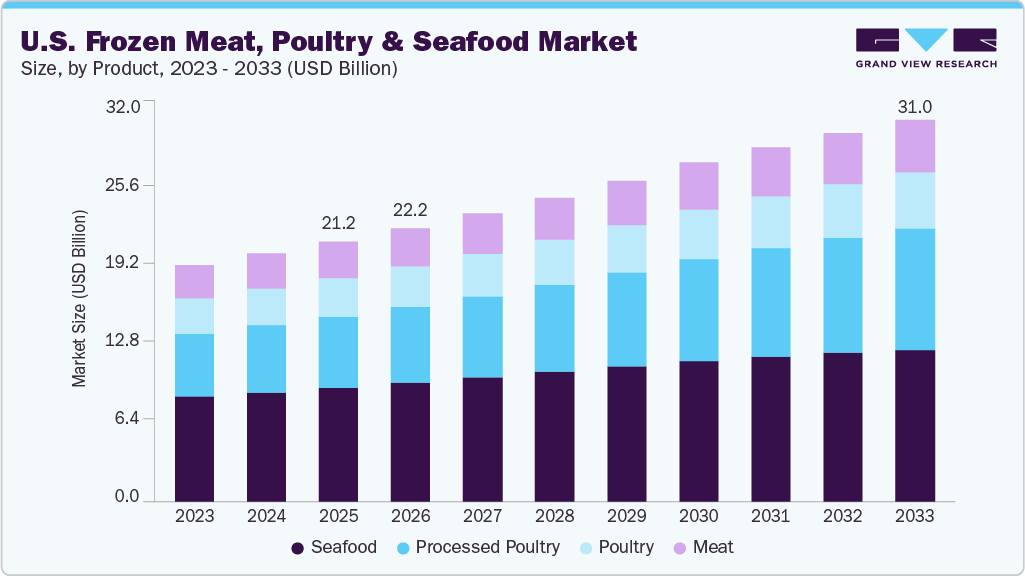
As lifestyles grow busier, consumers increasingly prefer products that are quick to prepare yet nutritionally substantial. Within the U.S. meat, poultry & seafood market, frozen products, particularly ready-to-cook and pre-seasoned meat and poultry, effectively meet this demand by offering convenience, extended shelf life, and minimal preparation time.
Additionally, per capita meat consumption in the U.S. has been steadily increasing, particularly for poultry, reflecting sustained demand for high-protein food options that align with modern dietary preferences. These consumption trends continue to support the U.S. meat, poultry & seafood market, as frozen formats offer longer shelf life, reduced food waste, and greater ease of use, making them an attractive option for both households and foodservice operators.
Consumer lifestyle trends in the United States are strongly skewing toward convenience and high-protein diets. Dual-income households and busier daily schedules have increased the preference for frozen products that require minimal preparation while providing essential nutrients. Ready-to-cook and ready-to-eat frozen meat, poultry, and seafood fit these needs, boosting demand across retail and foodservice channels.
The U.S. foodservice industry (restaurants, quick service outlets, catering) contributes significantly to frozen protein demand due to operational efficiencies. Frozen meat and seafood simplify inventory management, reduce waste, and provide consistent quality, attributes highly valued by food operators. The foodservice channel accounted for a large portion of frozen meat and fish in 2025, further fueling overall growth.
Growth in cold chain infrastructure and retail penetration has significantly supported the frozen proteins market. Efficient cold storage and transportation systems allow fresh-quality frozen products to reach broad geographic markets, ensuring product safety and shelf stability.
Improvements in freezing technologies (e.g., blast freezing, vacuum sealing) contribute to greater product quality, preserving texture and taste closer to fresh products. Advanced packaging solutions also extend shelf life and reduce food waste. These innovations increase consumer confidence and help frozen offerings compete with fresh-food alternatives. As technology investment grows, product appeal increases across both retail and foodservice segments.
E-commerce adoption is expanding access to frozen meat, poultry, and seafood products. Online retail platforms allow consumers to order frozen foods with home delivery, supported by temperature-controlled logistics. This digital shift broadens market reach beyond brick-and-mortar locations and supports a growing share of direct-to-consumer sales, an important growth vector particularly since 2020.
Shifts in consumer preferences toward premium and sustainably sourced products are increasingly shaping the market. Frozen meat and seafood producers are responding with higher-quality offerings, such as grass-fed, antibiotic-free, or sustainably certified products, to meet health and ethical concerns. Sustainable practices also appeal to environmentally conscious buyers and enhance brand value.
Consumer Insights for U.S. Frozen Meat, Poultry & Seafood Market:
American consumers are increasingly health-conscious and seek high-quality lean proteins. Poultry, particularly chicken, plays a central role in this trend. National supply data show that poultry consumption (especially chicken) continues to outpace other meats, reinforcing demand for frozen poultry offerings. Widely available lean protein options encourage market consumption, even amid economic pressures.
Frozen meat, poultry, and seafood products are increasingly offered as ready-to-cook, pre-marinated, and flavored options, catering to consumers who want convenience without sacrificing taste. Innovation in product offerings (such as global flavors, spicy profiles, and smaller portion formats) resonates particularly with younger demographics like Gen Z and millennials.
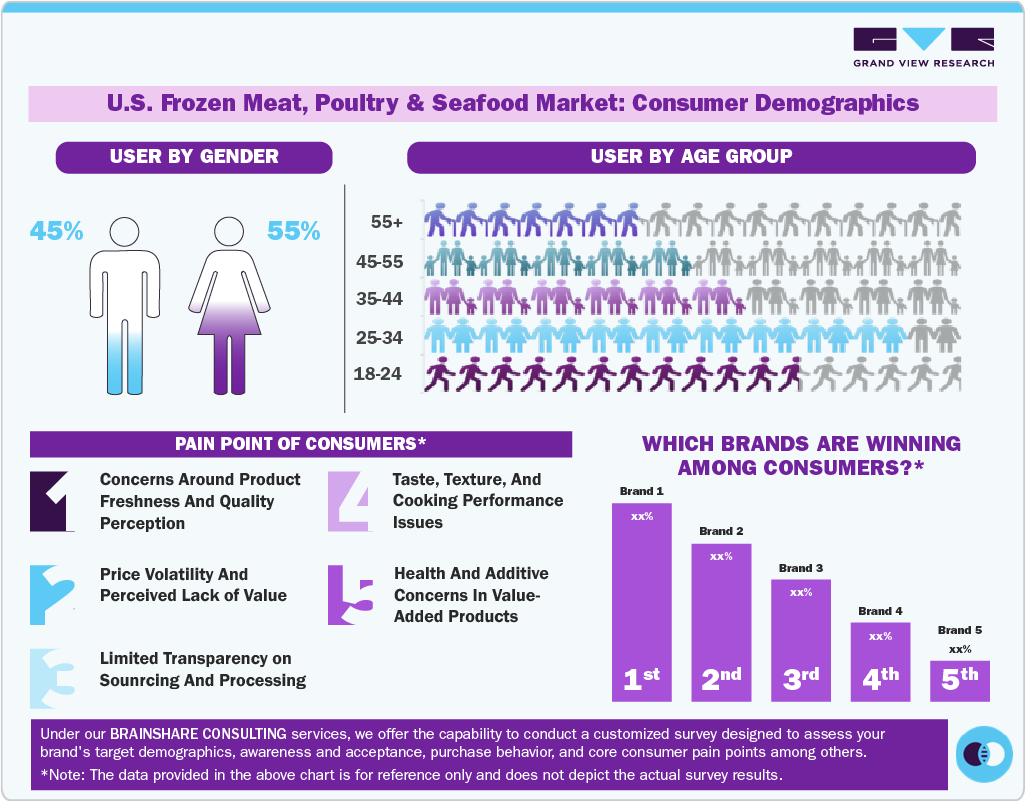
Consumers in the United States continue to prioritize convenience due to increasingly busy lifestyles, dual-income households, and reduced time for meal preparation. A significant portion of buyers prefer frozen products because they offer longer shelf life and easier, quicker preparation compared to fresh alternatives, making them attractive for frequent meal planning and busy schedules. This convenience factor is one of the core consumer drivers behind frozen protein purchases,
Product Insights
The frozen seafood market accounted for a share of 43.84% of the U.S. revenue in 2025, driven by rising demand for high-protein and convenient seafood options, particularly among health-conscious consumers. Seafood like shrimp, salmon, and other fish varieties are perceived as nutritious due to beneficial nutrients (such as omega-3 fatty acids), which support consumption in homes seeking both health and convenience. The preference for lean proteins aligns with broader shifts toward protein-rich diets and ready-to-cook seafood products, boosting frozen seafood sales across retail and foodservice channels. Improvements in cold chain logistics and freezing technologies further preserve quality and flavor, reducing spoilage and reinforcing consumer confidence in frozen seafood offerings.
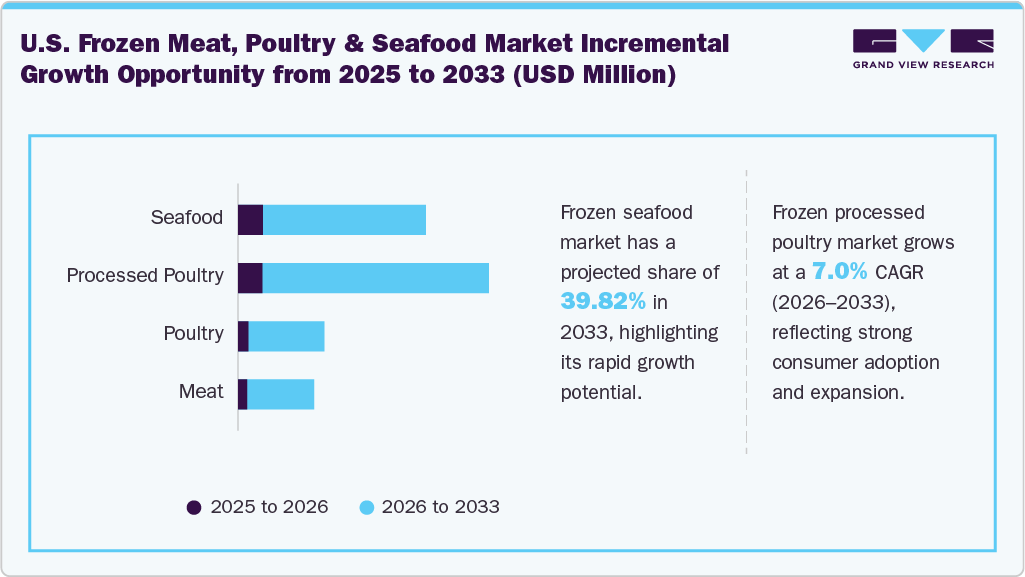
The frozen processed poultry market segment is projected to grow at a CAGR of 7.0% from 2026 to 2033, driven by shifting lifestyle patterns and convenience trends, where consumers increasingly seek quick-to-prepare, pre-seasoned poultry products. Ready-to-cook processed poultry saves preparation time for busy households and aligns with demand for consistent portion control and meal planning solutions. Urbanization and higher participation of working adults have strengthened the appeal of processed poultry, which also benefits from continuous innovation in freezing and packaging methods that extend shelf life and maintain product quality. These factors collectively support market expansion for processed poultry over the forecast period.
Distribution Channel Insights
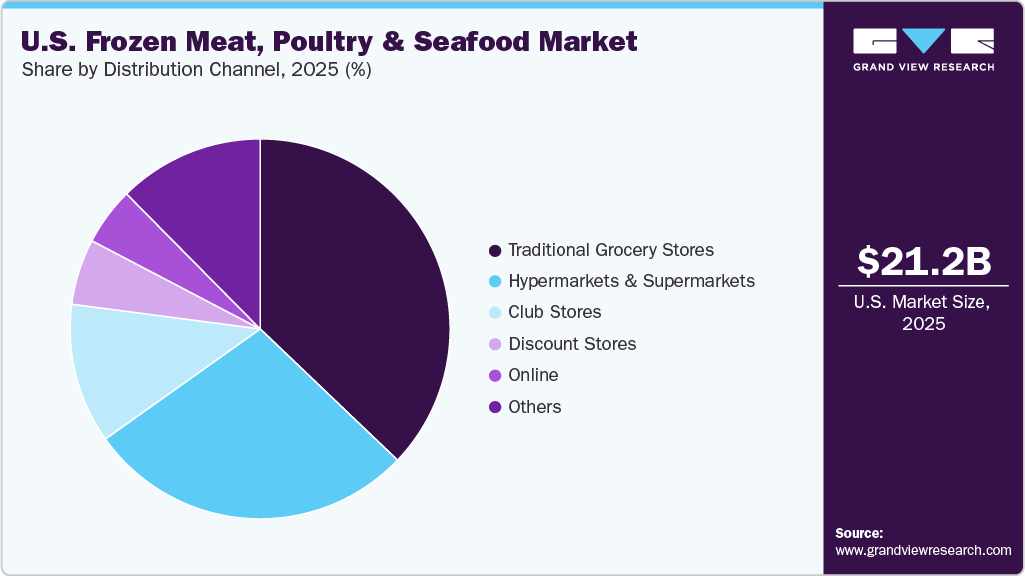
Sales of frozen meat, poultry & seafood through traditional grocery stores accounted for a revenue share of 37.14% in 2025 because of their wide geographic footprint and frequent shopper traffic, which enable extensive frozen product exposure and distribution. These stores typically maintain large freezer sections with diverse frozen offerings, driving repeat purchases through in-store visibility and promotional activities that appeal to a broad consumer base. Additionally, grocery chains leverage loyalty programs, weekly deals, and private-label products to retain shoppers who rely on one-stop trips for both fresh and frozen items. The scale and convenience of these physical locations continue to attract consumers who value immediate product availability without the need for delivery logistics.
Sales of frozen meat, poultry & seafood through online retail channels are expected to grow at a significant CAGR of 9.0% over the forecast period, propelled by expanding e-commerce adoption and enhancements in cold-chain delivery infrastructure that make it easier for consumers to order frozen foods from home. With increasing smartphone penetration, digital payment options, and user-friendly grocery apps, more consumers are turning to online platforms for convenience, time savings, and access to a wider product assortment. The ability to receive frozen meat, poultry, and seafood directly at the doorstep, often with flexible delivery windows and real-time tracking, addresses modern lifestyle demands, particularly among urban and younger shoppers. Investments by major online grocers to integrate perishable delivery and optimize last-mile logistics are also reinforcing this segment’s strong projected growth trajectory.
Regional Insights
The Northeast U.S. frozen meat, poultry & seafood market accounted for a share of 16.59% of the U.S. revenue in 2025. The Northeast market share reflects a combination of dense urban populations, strong retail infrastructure, and cultural consumption patterns that favor diverse protein choices, including seafood. Northeastern states have historically high seafood consumption relative to inland regions because of proximity to Atlantic seafood supply chains and entrenched coastal dietary habits; many consumers in this region seek seafood as a year-round staple, which supports strong sales of frozen varieties that offer convenience and extended shelf life.
A significant majority of U.S. consumers eat seafood, though frequency varies by region and demographic factors such as proximity to coastlines and income levels, which tend to be higher in the Northeast compared with national averages. Large metropolitan centers such as New York City and Boston generate heavy foot traffic and drive demand for ready-to-cook or pre-seasoned frozen products that fit busy urban lifestyles, mirroring broader U.S. frozen food trends where convenience and long shelf life are key growth factors.
South Central U.S. Frozen Meat, Poultry & Seafood Market Trend
The South Central U.S. frozen meat, poultry & seafood market is projected to grow at a CAGR of 7.5% from 2026 to 2033. The South Central U.S. is poised for stronger growth than the national average, driven by dynamic population growth, economic expansion, and rising consumer demand for convenient protein solutions. Agriculture and food production play a central role in the South Central economy, providing a local supply base for meat and poultry products that can be channeled into regional processing and distribution systems. This proximate supply advantage supports competitive pricing and steady availability of frozen products, which in turn encourages both retail and foodservice procurement of frozen meat, poultry, and seafood.
Further, retail diversification and expansion of modern grocery formats (supermarkets, club stores, and online grocery penetration) are increasing access to frozen categories. As e-commerce and club stores expand offerings of frozen meat, poultry, and seafood, South Central consumers benefit from broader choices that fuel higher consumption and support the projected growth.
Key U.S. Frozen Meat, Poultry & Seafood Company Insights
The U.S. frozen meat, poultry, and seafood market features a mix of large multinational processors, diversified protein producers, and specialized regional firms, resulting in a moderately concentrated competitive structure with strong rivalry among established brands. Dominant firms such as Tyson Foods, Inc. and JBS USA Holdings, Inc. maintain significant market influence through broad product portfolios that span frozen and value-added meats, poultry, and seafood items, supported by vast distribution networks reaching thousands of retail and foodservice outlets nationwide. These players leverage vertical integration across supply chains and invest heavily in automation to improve efficiency and lower production costs, enabling them to defend market share and respond quickly to demand shifts.
Other leading competitors include Cargill, Incorporated, and Hormel Foods Corporation, which compete by emphasizing product diversification and branded offerings that cater to specific consumer preferences, such as lean proteins and prepared frozen meals. Global players like BRF S.A. and multinational seafood firms, such as Thai Union and Mowi ASA, also exert influence, particularly in the seafood segment, by leveraging international sourcing capabilities and specialized product lines.
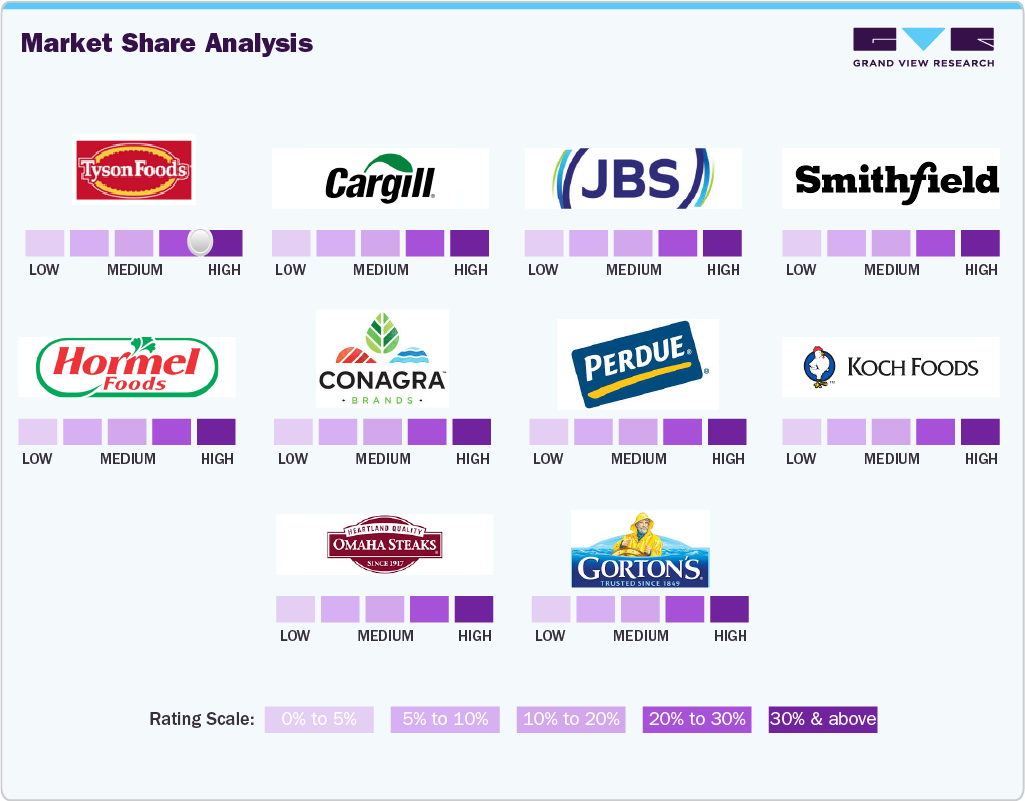
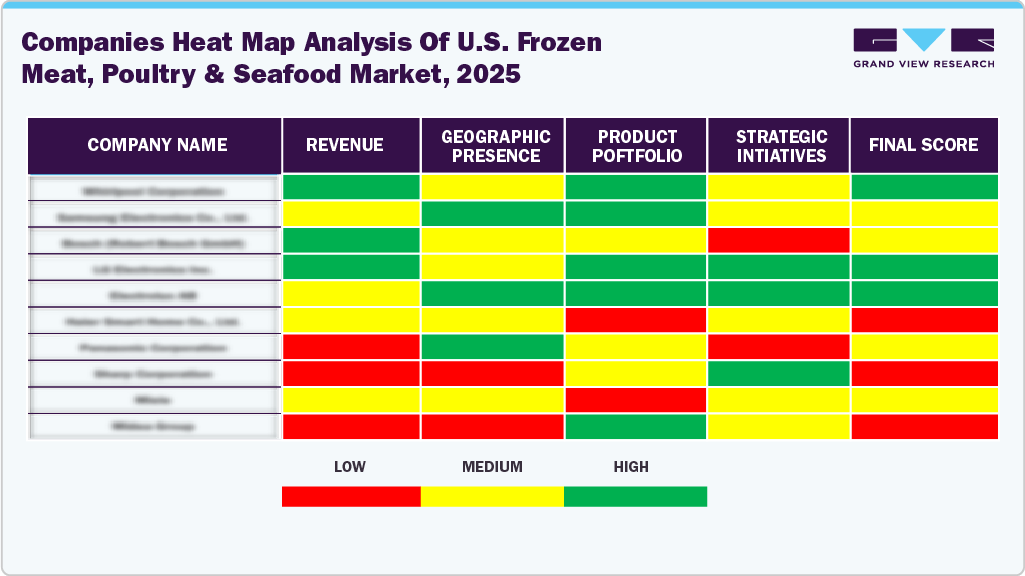
Key U.S. Frozen Meat, Poultry & Seafood Companies:
- Tyson Foods, Inc.
- Cargill, Incorporated
- JBS USA Holdings, Inc.
- Smithfield Foods, Inc.
- Hormel Foods Corporation
- Conagra Brands, Inc.
- Perdue Farms, Inc.
- Koch Foods
- Omaha Steaks
- Gorton’s of Gloucester
Recent Developments
-
In May 2025, Wildtype became the first company to receive FDA approval for a cultivated seafood product in the U.S., clearing its sushi-grade cultivated salmon for sale. The product debuted on menus at high-end restaurants (starting with Kann in Portland, Oregon) and began expanding to additional venues, marking a milestone in alternative protein commercialization.
-
In early 2025, UMAMI Bioworks unveiled cultivated caviar, a lab-grown luxury seafood product that targets sustainability and ethical consumption trends. This launch represents a novel entry in the premium tier of frozen protein alternatives, addressing pressure on wild sturgeon populations and responding to consumer interest in sustainable gourmet foods.
U.S. Frozen Meat, Poultry & Seafood Market Report Scope
Report Attribute
Details
Market value size in 2026
USD 22.23 billion
Revenue Forecast in 2033
USD 31.01 billion
Growth rate
CAGR of 4.9% from 2026 to 2033
Actual data
2021 - 2025
Forecast period
2026 - 2033
Quantitative units
Revenue in USD million/billion, and CAGR from 2026 to 2033
Report coverage
Revenue forecast, company ranking, competitive landscape, growth factors, and trends
Segments covered
Product, distribution channel, region
Regional Scope
Southeast, Northeast, Great Lakes, Mid-South, South Central, West, California, Plains
Country scope
U.S.
Key companies profiled
Tyson Foods, Inc.; Cargill, Incorporated; JBS USA Holdings, Inc.; Smithfield Foods, Inc.; Hormel Foods Corporation; Conagra Brands, Inc.; Perdue Farms, Inc.; Koch Foods; Omaha Steaks; Gorton’s of Gloucester
Customization scope
Free report customization (equivalent up to 8 analysts’ working days) with purchase. Addition or alteration to country, regional & segment scope.
Pricing and purchase options
Avail customized purchase options to meet your exact research needs. Explore purchase options
U.S. Frozen Meat, Poultry & Seafood Market Report Segmentation
This report forecasts revenue growth at the regional and country levels and provides an analysis of the latest industry trends and opportunities in each of the sub-segments from 2021 to 2033. For the purpose of this study, Grand View Research has segmented the U.S. frozen meat, poultry & seafood market report on the basis of product, distribution channel, and region.
-
Product Outlook (Revenue, USD Million, 2021 - 2033)
-
Seafood
-
Processed Poultry
-
Poultry
-
Meat
-
-
Distribution Channel Outlook (Revenue, USD Million, 2021 - 2033)
-
Traditional Grocery Stores
-
Hypermarkets & Supermarkets
-
Club Stores
-
Discount Stores
-
Online
-
Others
-
-
Regional Outlook (Revenue, USD Million, 2021 - 2033)
-
Southeast
-
Northeast
-
Great Lakes
-
Mid-South
-
South Central
-
West
-
California
- Plains
-
Frequently Asked Questions About This Report
b. The U.S. frozen meat, poultry & seafood market was valued at USD 21,158.1 million in 2025 and is expected to reach USD 22,233.7 million by 2026.
b. The U.S. frozen meat, poultry & seafood market is expected to reach USD 31,012.6 million by 2033 and is expected to grow at a compound annual growth rate (CAGR) of 4.9% from 2026 to 2033.
b. Frozen seafood accounted for a share of 43.84% of the U.S. revenue in 2025, driven by rising demand for high-protein and convenient seafood options, particularly among health-conscious consumers.
b. Tyson Foods, Inc.; Cargill, Incorporated; JBS USA Holdings, Inc.; Smithfield Foods, Inc.; Hormel Foods Corporation; Conagra Brands, Inc.; Perdue Farms, Inc.; Koch Foods; Omaha Steaks; Gorton’s of Gloucester
b. Convenience continues to be a major driver for frozen meat, poultry, and seafood consumption in the U.S. As lifestyles grow busier, consumers increasingly prefer products that are quick to prepare yet nutritionally substantial.


Share this report with your colleague or friend.
Need a Tailored Report?
Customize this report to your needs — add regions, segments, or data points, with 20% free customization.


ISO 9001:2015 & 27001:2022 Certified
We are GDPR and CCPA compliant! Your transaction & personal information is safe and secure. For more details, please read our privacy policy.
Trusted market insights - try a free sample
See how our reports are structured and why industry leaders rely on Grand View Research. Get a free sample or ask us to tailor this report to your needs.













