
- Home
- »
- Electronic & Electrical
- »
-
U.S. Greeting Cards Market Size, Industry Report, 2033GVR Report cover

U.S. Greeting Cards Market (2026 - 2033) Size, Share & Trends Analysis Report By Type (Personalized cards, Stationery Cards), By Price Range (Mid-Range, Premium/Luxury), By Distribution Channel (Online, Offline), And Segment Forecasts
U.S. Greeting Cards Market Summary
The U.S. greeting cards market size was valued at USD 7.12 billion in 2025 and is projected to reach USD 8.07 billion by 2033, growing at a CAGR of 1.6% from 2026 to 2033. The market is growing modestly due to its mature nature, with demand supported by strong gifting traditions, personalization, and premium pricing, while growth is limited by digital substitutes and stable usage volumes, resulting in steady but low CAGR expansion.
Key Market Trends & Insights
- By type, stationery cards led the market with a share of 65.30% in 2025.
- By price range, mid-range held a market share of 54.12% in 2025.
- By distribution channel, the offline sales accounted for a market share of 71.55% in 2025.
Market Size & Forecast
- 2025 Market Size: USD 7.12 Billion
- 2033 Projected Market Size: USD 8.07 Billion
- CAGR (2026-2033): 1.6%
Three ways to get this report
Buy it, customize it, or ask a question.Ask an Analyst
Analyst response in 1 business day
- AccessReport author, directly
- Reply timeWithin 1 working day
- No sales callDirect answer only
- FormatEmail reply
- CostFree, no cost
Get the Full Report
What the study covers
- FormatsPDF · Excel · Dashboard
- Timeline2026–2033 annual, 2025 base
- Coverage20+ countries, 5 regions
- Companies10+ key players profiled
Customize the Report
20% free customization
- IncludeCountries, segments, points
- TailorTo your product definition
- ExtendDeeper competitor detail
- OrA fully bespoke study
- Turnaround5–10 working days
Emotional and social factors drive the U.S. greeting cards industry, as consumers increasingly seek meaningful ways to connect with family, friends, and colleagues. Rising awareness of mental health and emotional well-being has led to an increase in purchases of cards for encouragement, gratitude, and support, extending beyond traditional holidays.In the U.S., greeting card sales are strongly driven by calendar-locked consumer behavior rather than discretionary gifting. Major holidays like Christmas, Valentine’s Day, Mother’s Day, and Father’s Day are commercially structured events, with retailers allocating fixed shelf space months in advance and consumers buying cards as part of a routine shopping trip.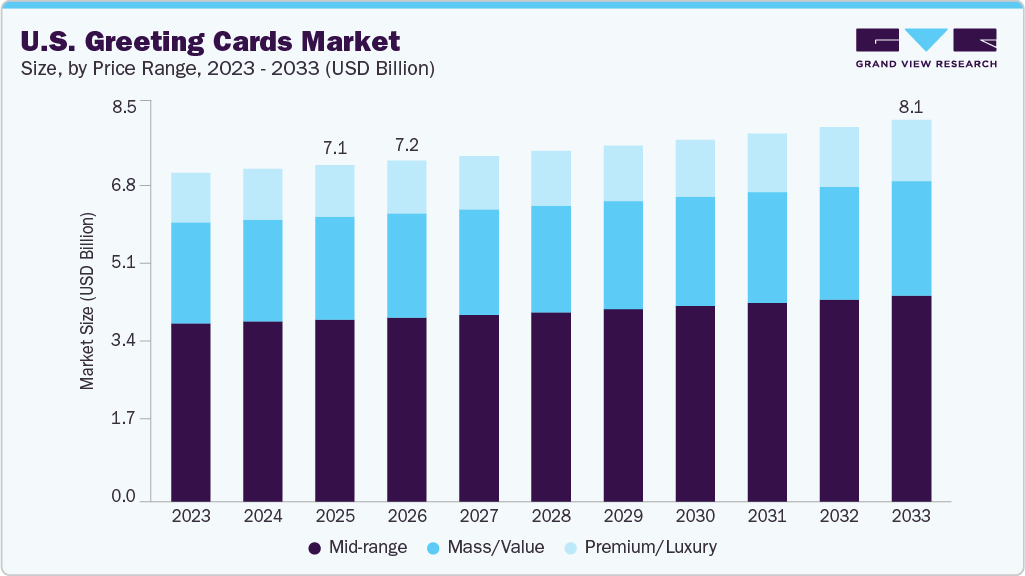 Source: Grand View Research, IR Documents, Primary Interviews, Paid DatabasesTo learn more about this report,
 Download Free Sample Report
 Cards are frequently purchased during grocery or pharmacy runs at chains like Walmart, Target, CVS, and Kroger, often minutes before an event. This last-minute buying behavior is a key reason physical cards remain relevant in the U.S., where convenience and immediacy take precedence over long-term planning. According to the U.S. Chamber of Commerce data published in March 2025, about 6.5 million greeting cards are purchased annually in the U.S.
In addition, greeting cards often serve as emotional anchors during significant or sensitive moments. In times when words are difficult to express, such as during loss, gratitude, or reconciliation, cards provide a socially accepted and emotionally safe way to communicate sentiment, making them increasingly relevant despite digital alternatives. For instance, according to the data published in November 2023, in a survey of 2,000 Americans, 55% preferred to receive a personalized message rather than an AI-generated message.
Consumer Insights
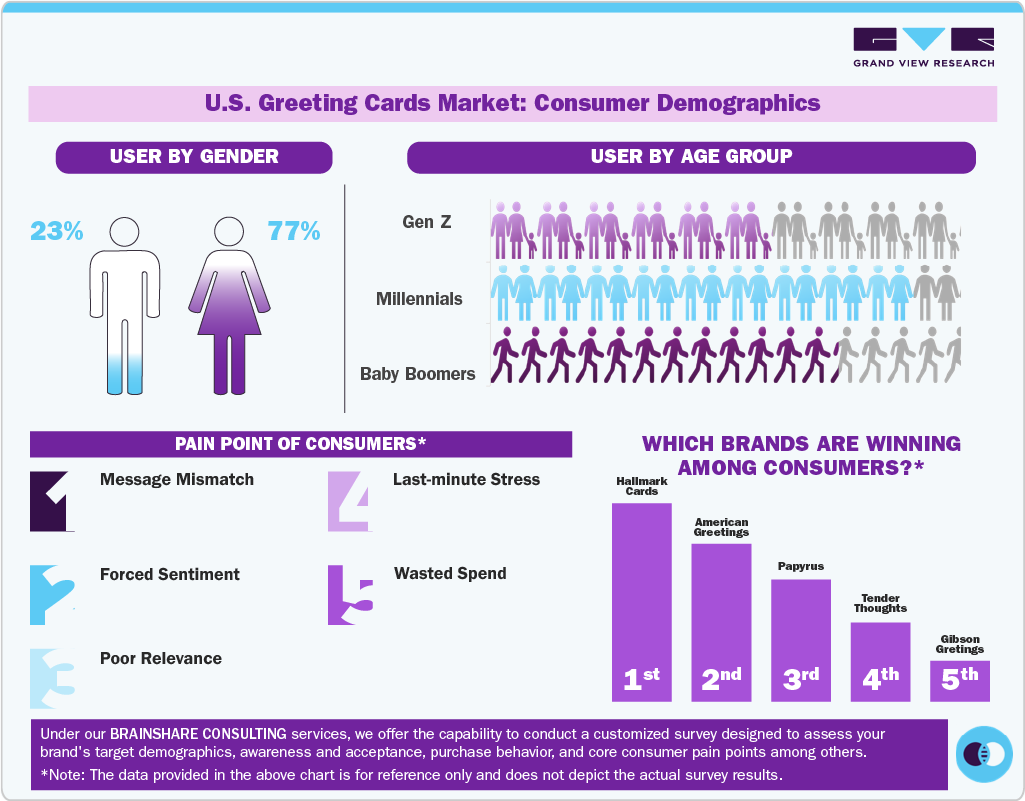
The U.S. greeting cards market is heavily female-driven, with women accounting for roughly three-quarters of users. This reflects real household behavior in the U.S., where women are more often responsible for maintaining social and family connections, remembering occasions, and purchasing cards alongside gifts during routine retail trips to grocery and drug stores.
 To learn more about this report, Download Free Sample Report
 In the U.S. greeting cards industry,
-
Millennials make up the largest user base because they are juggling multiple social and family roles that create frequent, obligation-driven occasions such as children’s birthdays, weddings, school events, and family celebrations.
-
Baby Boomers, although fewer in number, buy cards more consistently per person and are less likely to skip traditional occasions, such as holidays, anniversaries, and sympathy events, making them highly important from a revenue stability perspective.
-
Gen Z remains a smaller, selective segment, typically purchasing cards only for specific moments such as Valentine’s Day or birthdays, often driven by social expectation rather than habit, which limits their overall contribution to sustained demand.
Key consumer pain points in greeting card purchases are practical and situational rather than emotional. Buyers often struggle with message mismatch, where cards are close but not exact in wording, and forced sentiment, especially for modern or non-traditional relationships. Last-minute stress is common due to reliance on physical stores, and wasted spending reflects frustration over paying premium prices for single-use items. Poor relevance further limits choice, particularly outside major holidays.
In terms of brands, Hallmark clearly dominates in preference, benefiting from an unmatched retail presence and broad coverage of occasions. American Greetings follows with strong mass-market distribution, while Papyrus wins in premium and design-focused segments. Tender Thoughts and Gibson Greetings hold smaller but stable positions, mainly through value pricing and selective retail placements. Overall, brand success in the U.S. is closely tied to shelf visibility, pricing tiers, and how well messages align with everyday American relationships and occasions.
Seasonality Trends
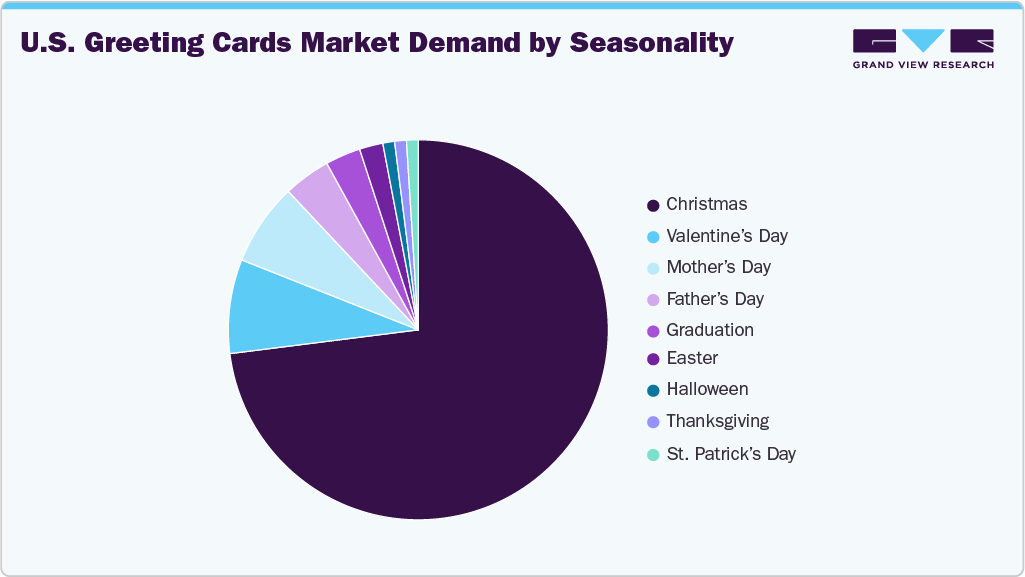
The greeting-card market in the U.S. continues to be strongly shaped by seasonal peaks tied to major occasions such as Christmas/New Year, Valentine’s Day, Mother’s Day, Father’s Day, and graduations. For example, while Christmas remains the highest-volume occasion, other holidays also register significant card-sentiment waves: around 59 million cards are exchanged for graduation and roughly 40 million for Easter. Consequently, industry players time product launches, marketing campaigns, in-store display rollouts, and stocking logistics around these periods to capture the surge in demand.
 To learn more about this report, Download Free Sample Report
 Seasonality plays a significant role in the demand for greeting cards in the U.S., with key holidays driving the bulk of sales each year. As per the Greeting Card Association, Christmas was the dominant occasion, which accounted for 73.4% of greeting card demand in 2023. This makes it the most significant season for the greeting card industry as people purchase cards for family and friends as well as for colleagues, clients, and acquaintances.
Other holidays, such as Valentine’s Day (8.2%), Mother’s Day (6.4%), and Father’s Day (4.1%), also played a crucial role in the seasonal greeting card market. These occasions reflect personal expressions of love, appreciation, and gratitude, leading to a high demand for cards with heartfelt, intimate messages. Theme-based greeting cards are popular for holidays such as Halloween (1.1%), Thanksgiving (0.9%), and St. Patrick’s Day (0.4%). On these occasions, people prefer using such cards as fun, light-hearted gestures rather than for deeper emotional expression.
For the spring window leading up to Mother’s Day, Father’s Day, and graduations, there is an observable rise in demand for personalized, eco-friendly materials and niche-design greeting cards. Retailers report deploying end-aisle displays and relocating card fixtures into flower, gift, and checkout zones ahead of these occasions. During major gift-giving holidays, the tradition of sending physical cards remains a strong one.
Type Insights
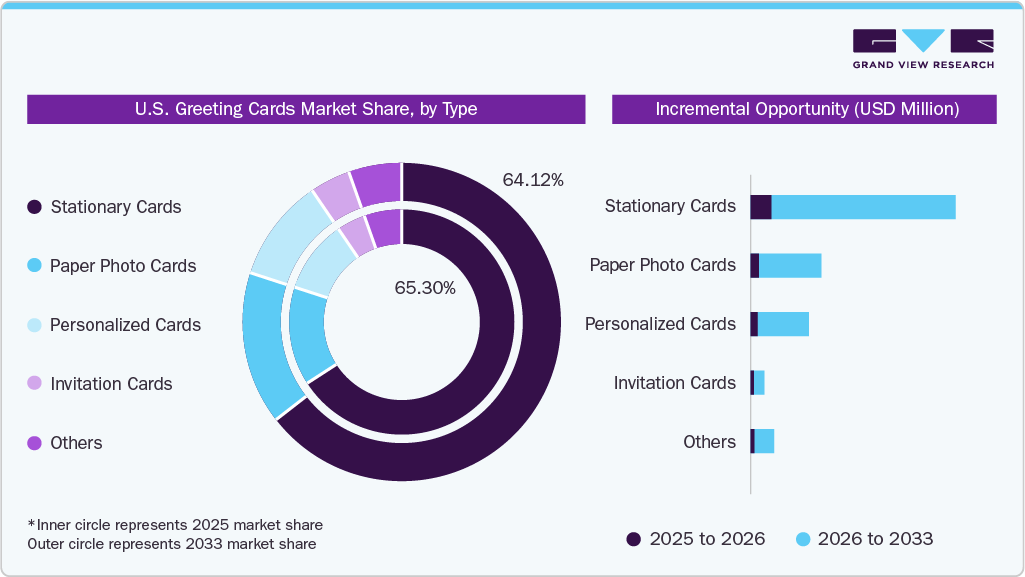
Stationery cards held a market share of 65.30% in 2025, due to their broad everyday usage across birthdays, anniversaries, sympathy, and seasonal occasions, along with wide availability, lower price points, and continued consumer preference for handwritten messages over digital alternatives for personal and formal communication.
 To learn more about this report, Download Free Sample Report
 The personalized cards segment is anticipated to witness a CAGR of 2.4% from 2026 to 2033, due to strong demand for customization, photo-based designs, and premium, emotionally driven gifting. A survey highlighted in a Shutterfly press release found that more than half of surveyed consumers (55%) expressed a preference for unique, personalized messages over generic or AI-generated greetings.
Price Range Insights
Mid-range greeting cards in the U.S. held a market share of 54.12% in 2025, supported by their optimal balance of design quality, messaging variety, and price accessibility. These cards appeal to a broad consumer base, making them a popular choice for both everyday use and seasonal gifting occasions, where consumers seek attractive designs without premium pricing. Their wide availability across offline and online retail channels further reinforced their leading position in the market.
Premium/Luxury greeting cards are anticipated to witness a CAGR of 2.2% from 2026 to 2033, as mass-market racks are crowded and uninspiring. Hence, consumers increasingly turn to specialty stores, boutiques, and online platforms for unique designs, higher-quality materials, and distinctive artwork. These cards appeal to buyers who want their gesture to stand out on important occasions, and the willingness to pay extra is reinforced by the perception that a premium card signals thoughtfulness and care, especially when sending to friends and family who are farther away or hold a special place in one's life.
Distribution Channel Insights
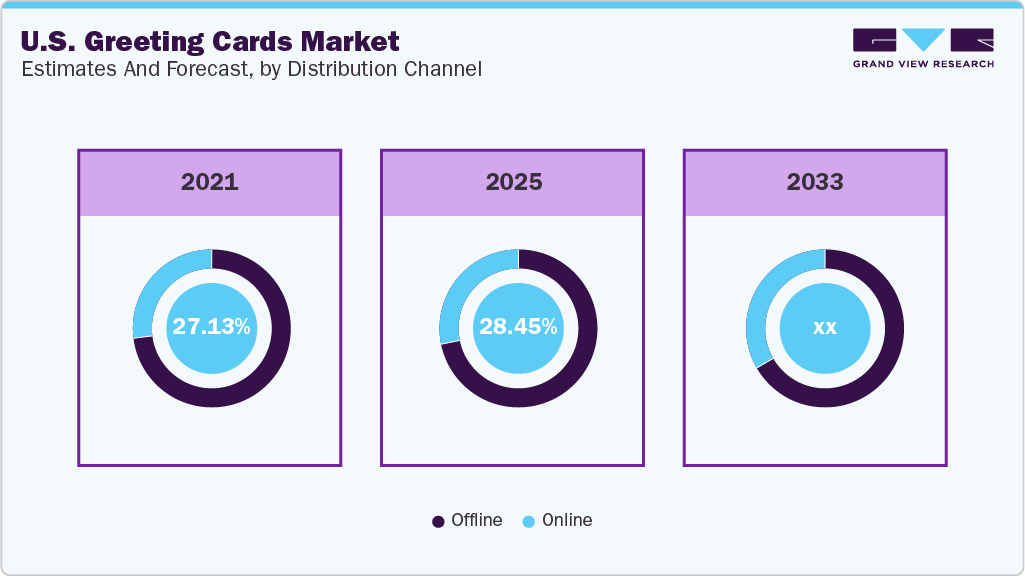
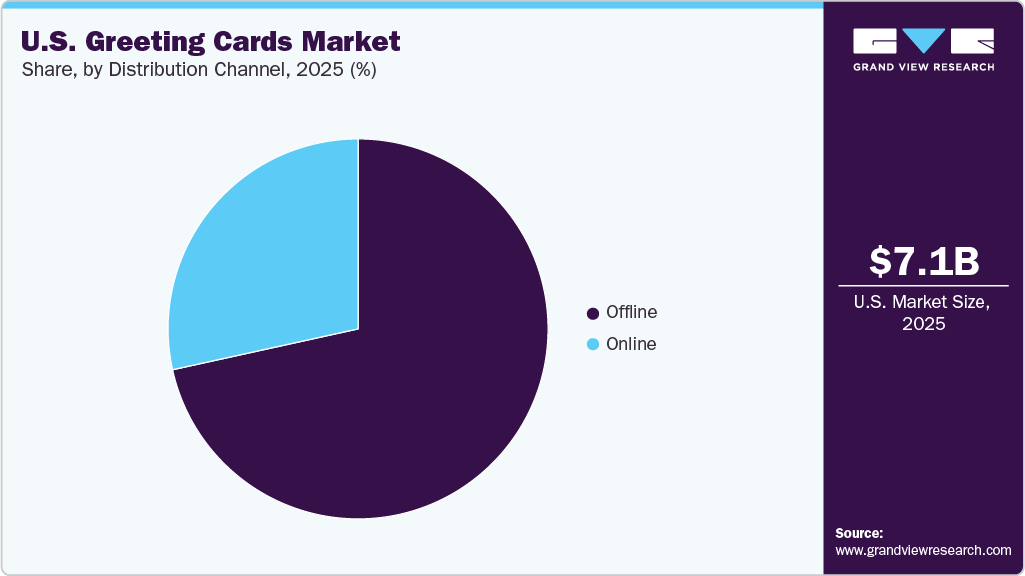
The sale of greeting cards through offline channels accounted for 71.55% share of the U.S. market in 2025, due to widespread retail availability, in-store gifting occasions, and consumer preference for tactile, physically browseable cards. Offline channels benefit from impulse buying linked to gift-giving occasions and seasonal events, while many consumers continue to prefer tactile, in-store card browsing to evaluate design, message, and quality before making a purchase.
 To learn more about this report, Download Free Sample Report
 For instance, in December 2025, Minted, a design-focused brand known for working with independent artists, started offering its artist-designed greeting cards in Whole Foods Market stores across the U.S., making them available in more than 520 locations nationwide.
 To learn more about this report, Download Free Sample Report
 The sale of greeting cards through the online channel is expected to grow at a CAGR of 3.6% from 2026 to 2033. Online platforms enable buyers to browse extensive selections from multiple brands, often from the comfort of their own homes or on mobile devices, without geographical limitations. This ease of access eliminates the need to visit multiple brick-and-mortar stores in search of the right design, message, or price point, making it especially appealing for busy individuals or those planning for special occasions.
Key U.S. Greeting Cards Company Insights
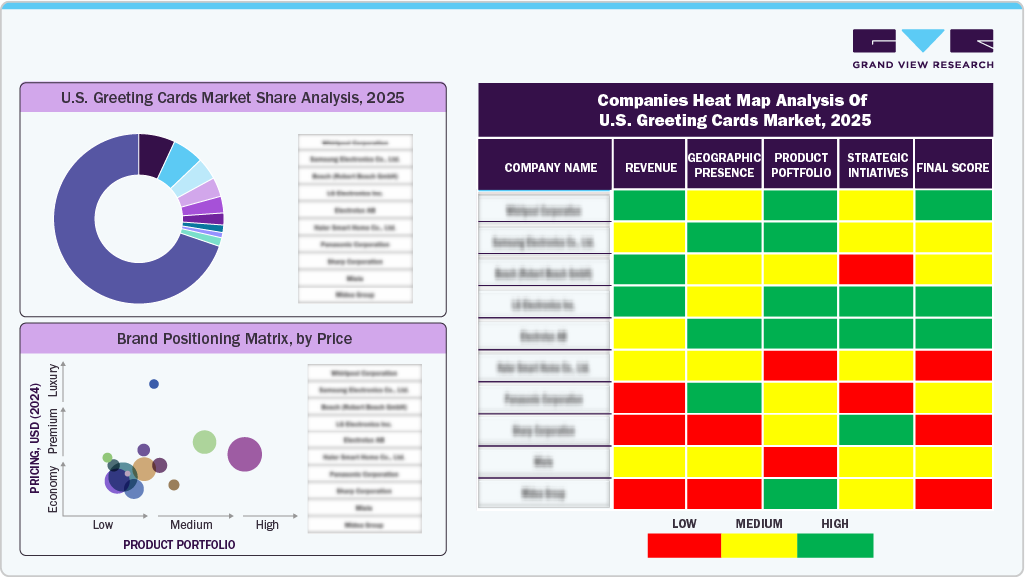
The greeting cards industry is shaped by a mix of long-standing brands and emerging designers who continue to innovate in themes, formats, and sustainability to suit evolving consumer preferences.
Leading companies focus on delivering high-quality designs, premium materials, and emotionally resonant messages, while also integrating elements such as personalization, multimedia features, and eco-friendly production methods.
By partnering with large retail chains, supermarkets, bookstores, and specialty gift shops, as well as expanding through online marketplaces and customizable card platforms, these players are ensuring strong omnichannel accessibility and a greater market reach.
 To learn more about this report, Download Free Sample Report
 Key U.S. Greeting Cards Companies:
- Hallmark Cards, Inc.
- American Greeting Corporation
- Paper Source
- Shutterfly
- Canva
- Vistaprint
- IG Design Group Plc
- Minted
- Crane & Co.
- Etsy
- Avanti Press Inc.
- Carlton Cards Ltd.
- Zazzle
- The Knot
- Papier
- Card Factory plc
- Zola
- Budget Greeting Cards Ltd.
- Galison Publishing LLC
- Archies Limited
Recent Developments
-
In October 2025, Engage2Excel entered into a new partnership with American Greetings to bring enhanced employee recognition offerings to workplaces through its engagement and reward platforms. The collaboration combines Engage2Excel’s expertise in workforce recognition with American Greetings’ creative eCards and messaging tools, enabling organizations to celebrate and appreciate employees more easily.
-
In February 2025, American Greetings broadened its digital gifting options on its website, enabling people to attach a wider range of virtual gifts to online greeting cards for occasions throughout the year. In addition to retail gift cards, senders can now include items such as custom songs, travel experience vouchers, and even cash with their digital cards, making the service more versatile and appealing.
-
In January 2025, Hallmark launched Gift Card Greetings, combining a traditional card with a digital gift. Shoppers select a design, choose a gift from over 100 brands, add an amount, and write a message. Recipients scan a code and enter a PIN to redeem the digital gift, merging a personal touch with digital convenience.
-
In September 2024, KORBLE is transforming how people send greetings by launching NFC-embedded smart greeting cards that blend traditional paper cards with digital interactivity. These cards utilize near-field communication technology to enable recipients to view a personalized 15-second video message by simply tapping their smartphone on the card, without requiring any special app or subscription.
U.S. Greeting Cards Market Report Scope
Report Attribute
Details
Market size value in 2026
USD 7.21 billion
Revenue forecast in 2033
USD 8.07 billion
Growth rate
CAGR of 1.6% from 2026 to 2033
Actual data
2021 - 2025
Forecast period
2026 - 2033
Quantitative units
Revenue in USD million/ billion, and CAGR from 2026 to 2033
Report coverage
Revenue forecast, company ranking, competitive landscape, growth factors, and trends
Segments covered
Type, price range, distribution channel
Key companies profiled
Hallmark Cards, Inc.; American Greeting Corporation; Paper Source; Shutterfly; Canva; Vistaprint; IG Design Group Plc; Minted; Crane & Co.; Etsy; Avanti Press Inc.; Carlton Cards Ltd.; Zazzle; The Knot; Papier; Card Factory plc; Zola; Budget Greeting Cards Ltd.; Galison Publishing LLC; Archies Limited
Customization scope
Free report customization (equivalent up to 8 analysts working days) with purchase. Addition or alteration to country, regional & segment scope.
Pricing and purchase options
Avail customized purchase options to meet your exact research needs. Explore purchase options U.S. Greeting Cards Market Report Segmentation
This report forecasts revenue growth at the country level and provides an analysis of the latest industry trends and opportunities in each of the sub-segments from 2021 to 2033. For the purpose of this study, Grand View Research has segmented the U.S. greeting cards market report on the basis of type, price range, and distribution channel:
-
Type Outlook (Revenue, USD Million, 2021 - 2033)
-
Paper Photo Cards
-
Personalized cards
-
Invitation Cards
-
Stationery Cards
-
Others
-
-
Price Range Outlook (Revenue, USD Million, 2021 - 2033)
-
Mass/Value
-
Mid-Range
-
Premium/Luxury
-
-
Distribution Channel (Revenue, USD Million, 2021 - 2033)
-
Offline
-
Hypermarkets & Supermarkets
-
Convenience Stores
-
Stationery Stores
-
Others
-
-
Online
-
Frequently Asked Questions About This Report
Key factors that are driving the U.S. greeting cards market growth include changing consumer preferences towards personalized and unique cards, increasing demand for cards for non-traditional occasions, and the rise in popularity of e-cards.
Some key players operating in the U.S. greeting cards market include Hallmark Cards, Inc.; American Greeting Corporation; Paper Source; Shutterfly; Canva; Vistaprint; IG Design Group Plc; Minted; Crane & Co.; Etsy; Avanti Press Inc.; Carlton Cards Ltd.; Zazzle; The Knot; Papier; Card Factory plc; Zola; Budget Greeting Cards Ltd.; Galison Publishing LLC; Archies Limited
Stationery cards held a market share of 65.30% in 2025, due to their broad everyday usage across birthdays, anniversaries, sympathy, and seasonal occasions, along with wide availability, lower price points, and continued consumer preference for handwritten messages over digital alternatives for personal and formal communication.
The U.S. greeting cards market size was estimated at USD 7.12 billion in 2025 and is expected to reach USD 7.21 billion in 2026.
The U.S. greeting cards market is expected to grow at a compound annual growth rate of 1.6% from 2026 to 2033 to reach USD 8.07 billion by 2033.
About the Author(s)
Electronic & Electrical Research Team
Consumer Goods · Electronic & ElectricalThis report was authored by the electronic & electrical research team at Grand View Research - comprising two research analysts, one senior research analyst, and one industry expert - with specialized expertise in the electronic & electrical segment of the consumer goods industry. All findings are based on proprietary consumer goods databases, executive interviews, and regulatory analysis, subject to internal peer review prior to publication.
Last Updated:
Speak to Analyst

Customize this report to your needs - add regions, segments, or data points, with 20% free customization.
Or view our licence options:


ISO 9001:2015 & 27001:2022 Certified
We are GDPR and CCPA compliant! Your transaction & personal information is safe and secure. For more details, please read our privacy policy.


