
- Home
- »
- Beauty & Personal Care
- »
-
U.S. Hair Color Products Market Size & Share Report, 2033GVR Report cover

U.S. Hair Color Products Market (2026 - 2033)
Size, Share & Trends Analysis Report By Product (Permanent, Demi-Permanent, Semi-Permanent, Temporary), By Format (Cream, Liquid, Gel, Foam/Mousse), By End Use, By Distribution Channel, And Segment Forecasts
Market Size, 2025
$3.5BMarket Estimate, 2026
$3.7BMarket Forecast, 2033
$4.9BCAGR, 2026–2033
4.2%U.S. Hair Color Products Market Summary
The U.S. hair color products market size was valued at USD 3.5 billion in 2025 and is projected to grow from USD 3.7 billion in 2026 to USD 4.9 billion by 2033, at a CAGR of 4.2% from 2026 to 2033. The U.S. market has achieved maturity in the overall beauty and personal care industry, supported by widespread consumer adoption of permanent, semi-permanent, temporary, and other colorant products for gray coverage, appearance enhancement, and fashion-led experimentation. Demand spans both at-home and professional applications, with established brands such as L’Oréal, Clairol, Revlon, Garnier, Madison Reed, and Schwarzkopf offering products across mass, mid-range, and premium price tiers.
Key Market Trends & Insights
- By product: Permanent hair color segment held the largest market share of 51.5% in 2025.
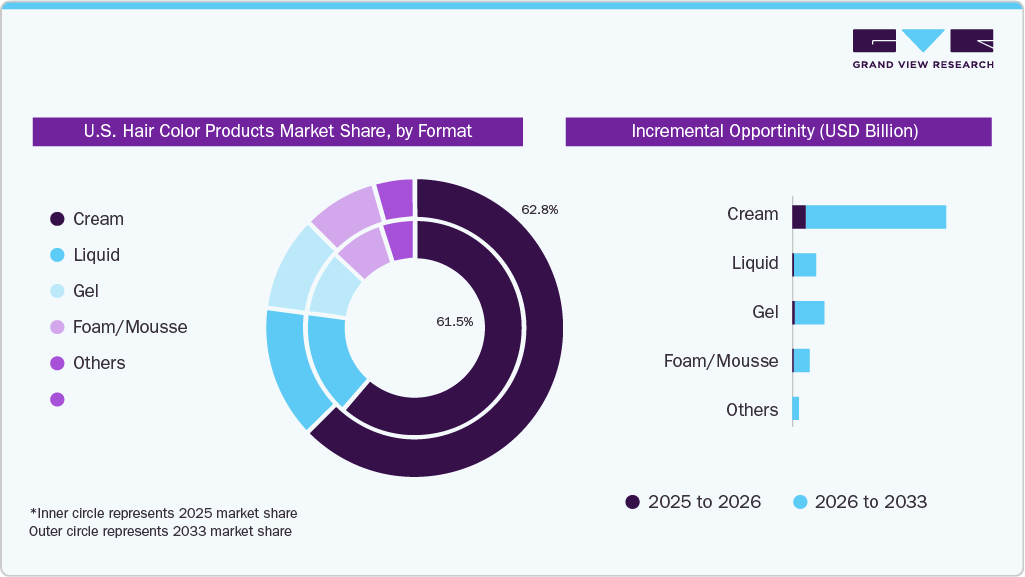
- By format: Cream segment held the largest market share of 61.5% in 2025.
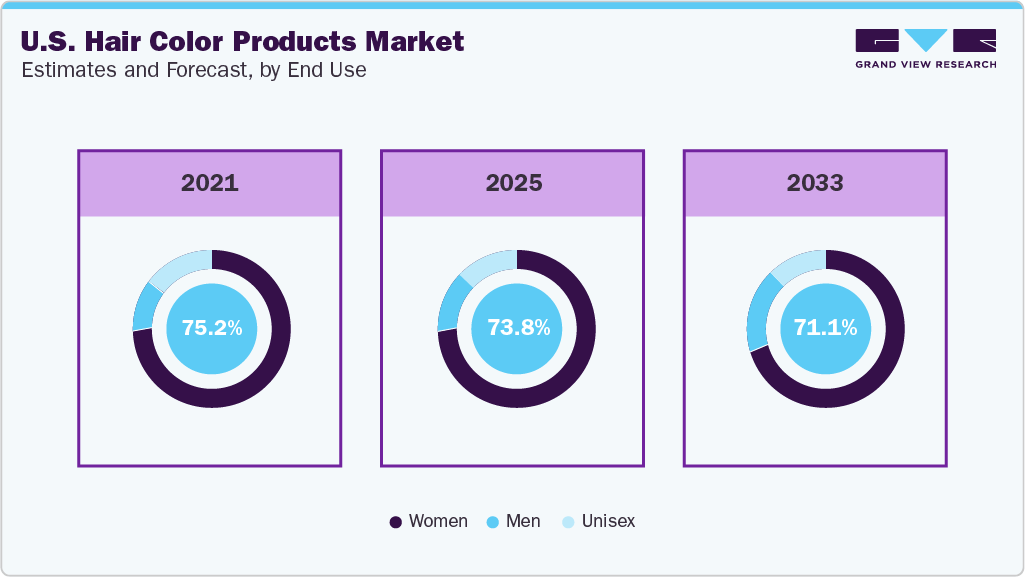
- By end use: Women segment held the largest market share of 73.8% in 2025.
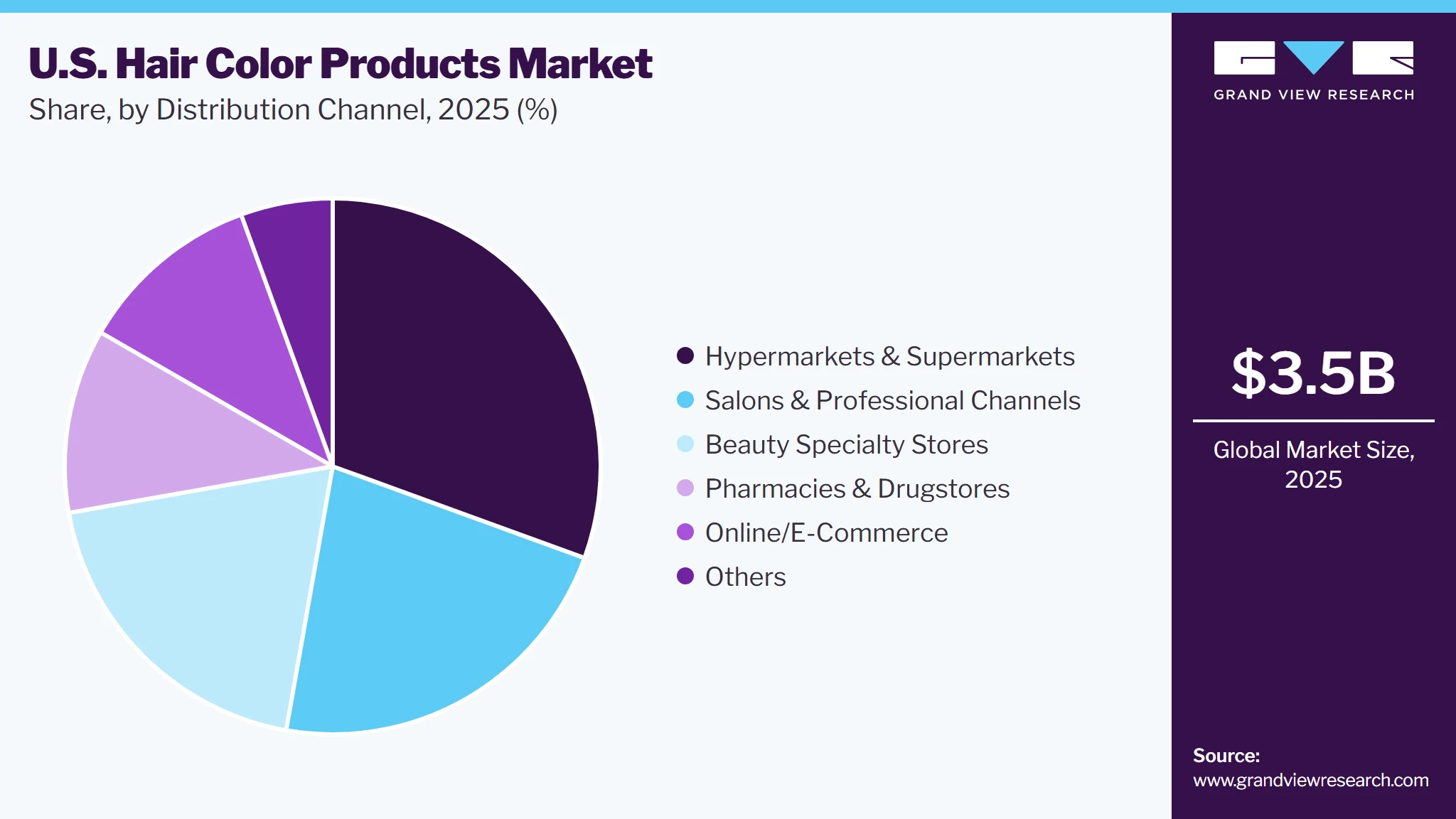
- By distribution channel: Hypermarkets & supermarkets segment held the largest market share of 30.5% in 2025.
Market Size & Forecast
- Market size in 2025: USD 3.5 Billion
- Estimated market size in 2026: USD 3.7 Billion
- Projected market size by 2033: USD 4.9 Billion
- CAGR (2026-2033): 4.2%
Prism AI by Grand View Research Free to tryAsk a question about the U.S. hair color products marketTry asking✓Every figure cited from GVR research Prefer the report? Download free sample →
The U.S. hair color products industry is also supported by the continued need for gray coverage and the growing role of hair color as a form of personal expression, particularly as consumers experiment with a broader range of shades and coloring techniques. Industry activity is increasingly extending beyond conventional box dyes toward ammonia-free, conditioning, plant-derived, and customized formulations.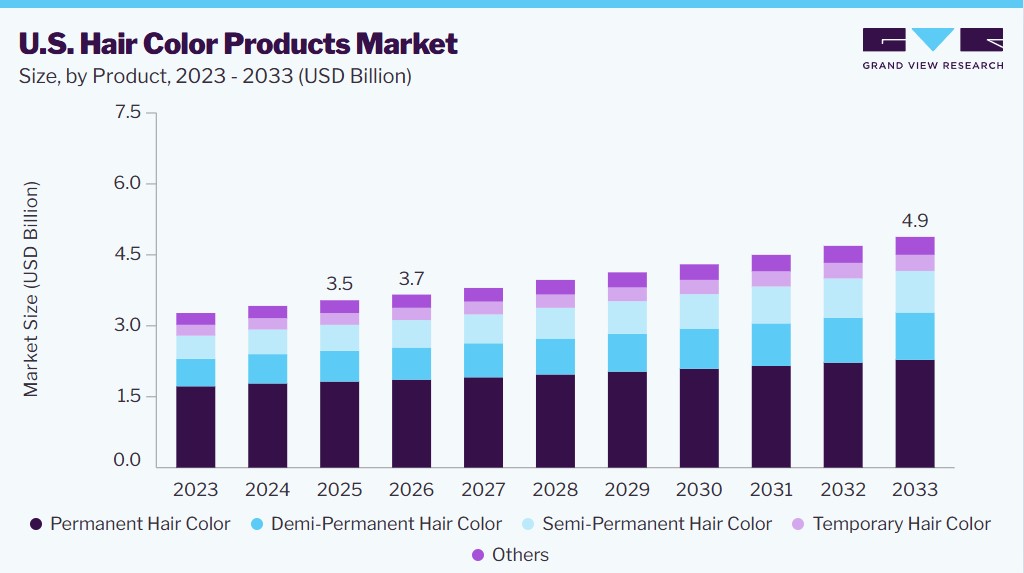 Source: Grand View Research, IR Documents, Primary Interviews, Paid DatabasesTo learn more about this report,
 Download Free Sample Report
Product innovation is further reshaping the U.S. hair color landscape as companies seek to make coloring more convenient, precise, and compatible with changing consumer preferences. L’Oréal's Colorsonic, for example, uses automated color mixing and controlled dispensing to simplify at-home application, while Garnier and Madison Reed have incorporated virtual hair-color try-on tools that allow consumers to preview shades digitally before purchasing. At the formulation level, the market is also influenced by safety and ingredient considerations. The U.S. FDA notes that permanent, semi-permanent, and temporary hair dyes commonly fall under the category of coal-tar hair dyes and require specific cautionary labeling and preliminary skin-test directions. The American Academy of Dermatology likewise recommends testing store-bought hair color before use because some dyes can cause allergic reactions. These factors are encouraging manufacturers to differentiate through gentler colorants, ammonia-free formulations, conditioning benefits, digital shade matching, and easier application formats, while retailers and brands increasingly combine physical and online channels to expand access to DIY hair-color products.
A key development in the U.S. hair color products market is the shift toward convenient, faster, and more accessible at-home coloring as consumers seek salon-like results without the time and recurring cost associated with professional appointments. Innovation is increasingly focused on reducing the complexity of application rather than simply expanding shade portfolios. In January 2026, Clairol introduced Nice’n Easy10, a permanent colorant designed to process in 10 minutes and provide 100% gray coverage, alongside its Color Pro three-step preparation and finishing system. The product incorporates a dedicated comb to facilitate application, demonstrating how established brands are redesigning traditional box-color formats around speed and ease of use. Consumer hesitation nevertheless remains an important addressable need: Clairol's 2026 survey of 2,000 women found that 66% said at-home hair color boosts their confidence, while nearly half remained hesitant to try it. The company's subsequent AI-powered “Dare Textline” illustrates how brands are combining digital engagement with product innovation to encourage experimentation.
The broadening of hair color from conventional gray coverage toward self-expression, temporary experimentation, and lower-maintenance color management. Consumers are increasingly using colorants to refresh, enhance, blend, or change their appearance rather than relying exclusively on permanent all-over coloring. This is creating opportunities for semi-permanent and temporary formats, color-depositing products, root touch-ups, and professional-inspired techniques. Keracolor, for example, expanded its at-home temporary color portfolio and national retail presence in 2026, including an expanded collection at Target, reflecting the movement of salon-inspired color into everyday consumer channels. At the opposite end of the spectrum, gray acceptance is also influencing coloring behavior: Yelp reported a 905% increase in searches for gray-blending services in 2025, as consumers increasingly sought techniques that incorporate natural gray rather than completely conceal it. This creates demand for products supporting both gray coverage and gray blending, while highlighting a broader market shift toward personalized, lower-maintenance color outcomes.
The market is also becoming increasingly omnichannel and digitally assisted, with brands combining e-commerce, social media, virtual consultations, and retail expansion to shorten the path from color discovery to purchase. Madison Reed has positioned itself around an affordable-luxury proposition, combining at-home color with professional-style consultation, while Garnier and other mass-market brands use virtual shade-selection tools to help consumers choose colorants before purchase. Meanwhile, regulatory and ingredient transparency are becoming increasingly relevant following the implementation of the Modernization of Cosmetics Regulation Act (MoCRA), which is encouraging greater attention to product safety, ingredient information, and manufacturing controls. The FDA also notes that hair dyes can cause allergic reactions and recommends following product-specific precautionary directions, including skin testing where applicable. This environment encourages brands to differentiate through gentler formulations, conditioning benefits, transparent ingredient communication, and technology-enabled shade selection, rather than competing solely on color variety and price.
The U.S. hair color products industry is evolving from a traditional gray-coverage category into a broader beauty, self-expression, and personalized color ecosystem. Demand is being supported by continued at-home adoption, growing experimentation with temporary and semi-permanent color, and consumer interest in convenient solutions that reduce application complexity. Brands are responding through faster-processing colorants, conditioning and gentler formulations, root-touch-up products, and digital shade-selection technologies. The expansion of salon-inspired products into mass retail and e-commerce is also making more specialized color options accessible to consumers. At the same time, growing interest in gray blending and lower-maintenance coloring is creating opportunities beyond complete gray coverage. These shifts are encouraging manufacturers to compete through convenience, personalization, formulation innovation, and technology-enabled consumer experiences.
Major Trends in the U.S. Hair Color Products Market
Trends
Description Hair-health positioning is becoming increasingly important alongside color performance
Hair-color innovation is increasingly moving beyond pigment delivery toward products that help minimize the perceived damage associated with chemical processing. Revlon ColorSilk with Bond Repair Complex + Vegan Keratin Fillers claims up to 98% less breakage, 94% silkier hair, and 9X more shine, while retaining 100% gray coverage and an ammonia-free formulation. Schwarzkopf Keratin Color similarly uses its Bond Enforcing System and claims up to 80% less breakage versus untreated hair. This reflects a broader shift toward treating hair color as both a coloring and hair-care product.
Ammonia-free and gentler formulations are gaining prominence in consumer hair color Formulation development is increasingly addressing consumer concerns around strong odors, hair condition, and scalp comfort. Revlon ColorSilk offers permanent color without added ammonia, while its portfolio now extends into Tone + Gloss + Care, after-color shampoo, conditioner, hair mask, and serum, creating a broader post-color care ecosystem. Madison Reed has similarly built its permanent color proposition around formulas without ammonia, resorcinol, parabens, PPD, phthalates, and gluten. These developments are strengthening the positioning of hair color around gentleness and ingredient-conscious purchasing rather than color outcome alone.
Root touch-ups and shorter-duration solutions are expanding maintenance occasions Consumers are increasingly able to address visible regrowth without undertaking a complete full-head coloring process. Schwarzkopf Keratin Root Permanent Color and Keratin Root Temporary Color & Thickening Spray were voted innovative beauty products by 40,000 U.S. shoppers in the 2025 Product of the Year program. L'Oréal Paris' Colorsonic also supports multiple applications from a single cartridge-up to three root touch-ups-demonstrating how brands are adapting products around more frequent and targeted maintenance. This trend supports recurring consumption through convenient solutions between full-color applications.
Personalized and trend-led shades are broadening hair color beyond traditional gray coverage Hair color is increasingly being used for personalization, seasonal changes, and fashion experimentation. Wella's 2025 U.S. trend outlook identified 12 prominent directions, including mocha mousse brown, jewel tones, elevated red, cherry cola, platinum cashmere blonde, blurred roots, chunky highlights, and cobalt blue. At the consumer-brand level, Revlon ColorSilk Digitones offers five vivid shades-electric blue, silver, blue, purple, pink, and peach-using HD Color Technology and an ammonia-free formula. This widening shade spectrum is creating additional consumption occasions beyond conventional black, brown, blonde, and gray coverage colors.
At-home professionalization is increasing through tools, technology, and expert-led guidance Brands are increasingly attempting to reproduce salon-style precision within consumer applications. L'Oréal Paris Colorsonic uses a device that parts and saturates strands, with bristles moving 300 times per minute, while its 20-shade system is designed to provide more controlled application. Henkel has also expanded Schwarzkopf's U.S. positioning through celebrity colorists and professional educators, including Tracey Cunningham as U.S. Creative Director of Color & Technique and Jacob Schwartz as Hair Color Trend Ambassador. The result is a convergence between professional expertise and DIY consumption, with consumers gaining greater access to sophisticated color techniques and guidance.
Accessible hair color is being reinforced through premiumization within the mass category The market is increasingly combining accessible pricing with higher-value claims around technology, care, and salon-quality performance. L'Oréal reported that its Consumer Products Division grew 2.3% like-for-like in Q1 2025, with hair-color growth powered by the rollout of Garnier Good and Color Sensation. By September 2025, L'Oréal reported that hair color remained resilient, supported by the sustained success of Garnier's accessible Color Sensation offer, while North America benefited from the company's broader innovation strategy. This indicates that consumers can trade up on formulation benefits and performance while still seeking accessible mass-market price points.
These trends indicate that the U.S. hair color/colorant products market is evolving from a conventional gray-coverage and color-maintenance category toward a more diversified, hair-health-conscious, personalized, and convenience-oriented beauty ecosystem. Brands are increasingly combining color performance with bond repair, conditioning, ammonia-free formulations, easier application, root-touch-up functionality, and broader shade customization. At the same time, the expansion of permanent, demi-permanent, semi-permanent, temporary, glossing, and fashion-color formats is creating more frequent and varied consumption occasions. Companies such as Revlon, L’Oréal, Henkel, Clairol, Madison Reed, and Wella are increasingly differentiating through formulation technology, application experience, hair-care benefits, and personalization, allowing consumers to balance reliable color results with hair health, convenience, experimentation, and self-expression.
Market Dynamics
Social-media platforms, particularly TikTok and Instagram, are shortening hair-color trend cycles while making experimental looks more visible and easier to replicate at home. Unlike traditional hair-color advertising, short-form videos allow consumers to see complete transformations, shade combinations, application techniques, and before-and-after results, reducing the perceived complexity of trying unconventional colors. Evidence from U.S. beauty-search activity illustrates this shift: in Q3 2024, searches for “hair dye & hair color products” increased 6% year over year, while searches for “hair gloss” rose 716%, and searches for “shades of purple” increased 156%. These rapidly emerging searches indicate that consumers are moving beyond conventional blonde, brunette, and gray coverage toward trend-led experimentation involving glosses, reds, purples, burgundy, and other personalized effects. L’Oréal Paris itself described TikTok as a key source of emerging hair-color trends, highlighting the 2025 “calico hair” trend, which combines multiple contrasting shades such as red, blonde, and brunette for a deliberately unconventional appearance.
The influence of social platforms is also encouraging brands to design hair-color products around creativity, DIY application, and shareable transformations. Arctic Fox, for example, has built its positioning around semi-permanent, mixable colors and consumer experimentation; its TikTok Shop listings currently show thousands of purchases for individual shades, including more than 2,700 units for its core semi-permanent hair color. L’Oréal has similarly expanded its digital engagement strategy in the U.S., stating that it has launched select brands and innovations through social commerce platforms and has used culturally relevant activations to engage younger consumers. This environment encourages consumers to treat hair color as a form of visual self-expression rather than an infrequent functional purchase, supporting demand for semi-permanent dyes, temporary colors, color-depositing formats, glosses, multi-shade kits, and at-home experimentation products.
Health and allergy concerns associated with chemical ingredients are emerging as a restraint for the U.S. hair color products market, particularly for permanent and darker-shade formulations that rely on oxidative dye chemistry. The U.S. Food and Drug Administration (FDA) identifies p-phenylenediamine (PPD) as a prominent hair-dye allergen and notes that repeated exposure can cause sensitization, meaning consumers may develop a reaction even after previously using hair color without problems. Reported reactions can range from itching, rashes, irritation, flaking, and swelling to more severe allergic responses. The FDA also states that hair dyes can cause skin, hair, and eye injuries when used improperly and recommends a 48-hour patch test before every application. These safety considerations can discourage frequent coloring and prompt consumers with sensitive skin or a history of reactions to seek alternative formulations, thereby creating friction with repeat purchases.
The concern also affects major mass-market brands because allergy testing has become an explicit part of the consumer-use process. For example, Clairol’s Nice’n Easy products instruct users to conduct a skin allergy test 48 hours before coloring, while L’Oréal Paris similarly requires a 48-hour allergy test and advises consumers not to color their hair if redness, burning, itching, swelling, or irritation occurs. This requirement introduces a two-day preparation period for at-home coloring and highlights the perceived health risk associated with chemical exposure. In addition, the FDA notes that PPD can produce cross-sensitization through exposure to related products such as certain textile dyes, temporary “black henna” tattoos, and some anesthetics. As consumers become more ingredient-conscious, concerns about PPD and other dye chemicals can shift demand toward PPD-free, lower-irritant, plant-derived, and semi-permanent alternatives, while increasing formulation, testing, labeling, and consumer education requirements for manufacturers.
At-home convenience is creating an opportunity for hair-color companies to overcome two major barriers to DIY coloring: application complexity and uncertainty about the final shade. L’Oréal’s Colorsonic addresses the application challenge through automated mixing and controlled dispensing, designed to make home coloring more consistent and less messy. Beyond L’Oréal, Garnier has developed a complementary digital ecosystem around at-home coloring. Its U.S. Virtual Hair Color Try-On currently enables consumers to test more than 80 shades using a live camera or uploaded selfie and then directly shop their selected shade. Garnier previously reported that its digital hair-color services, including virtual try-on and personalized shade selection, reached more than 3 million users globally between January and November 2020, demonstrating consumer engagement with technology-assisted DIY coloring. Madison Reed similarly introduced virtual try-on technology, allowing consumers to preview more than 40 shades, supported by AR, AI, and color-matching technology developed with Perfect Corp.
These developments indicate that technology can shift hair-color purchasing from a trial-and-error decision toward a guided, confidence-led process, particularly as consumers increasingly purchase color online without physically testing shades. L’Oréal Paris’ U.S. virtual hair-color tool, for example, offers more than 200 shades and reports average rendering accuracy of 88%, while providing recommendations based on the user's current hair color. For brands, integrating AR shade visualization, AI-based shade recommendations, digital consultations, and easier application devices can therefore support online conversion, shade discovery, repeat touch-ups, and reduced dissatisfaction from unsuitable color choices. The opportunity extends beyond premium technology: mass-market brands such as Garnier can use digital tools to make DIY coloring more approachable, while digitally native brands such as Madison Reed can combine virtual consultation with direct-to-consumer purchasing. This creates scope for U.S. hair-color companies to differentiate through “see-before-you-buy” experiences and technology-assisted application, rather than competing solely on formulation, shade breadth, or price.
Analyst Perspective
The U.S. hair color products market is driven by recurring gray coverage, at-home color maintenance, and demand for personalized shade options across permanent, demi-permanent, semi-permanent, and temporary products. Permanent color remains central to the category, particularly for gray coverage and significant shade changes, while demi-permanent and semi-permanent products support lower-commitment color refreshes and toning. Cream-based formats dominate at-home applications because of their controlled application and compatibility with boxed coloring systems, while sprays, mousses, and other temporary formats serve quick touch-up needs. Drugstores, mass retailers, beauty specialty stores, and e-commerce provide broad consumer access, with digital channels particularly relevant for shade discovery, customized color recommendations, and direct-to-consumer brands.
Consumer Insights
 To learn more about this report, Download Free Sample Report
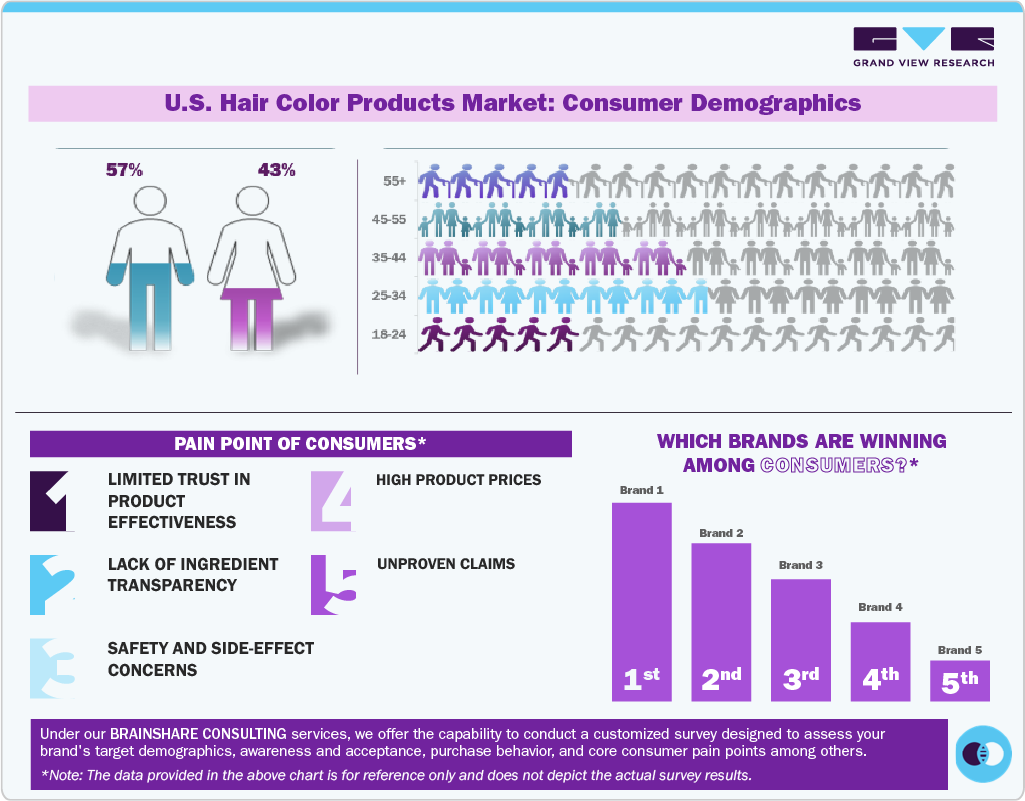
U.S. hair color consumption is increasingly shaped by a combination of self-expression, at-home convenience, value consciousness, hair-health concerns, and demand for predictable results. Consumers are using color not only for gray coverage but also to refresh appearance, experiment with shades, and express personal identity. At-home products remain important because they offer greater control and lower costs, while product innovation increasingly attempts to replicate salon-quality results through easier application, gentler formulas, customized shades, and conditioning benefits. According to a consumer survey conducted in partnership with Sensient Beauty, ingredient safety, color longevity, and ease of use are important considerations for U.S. at-home hair color consumers. The survey found that 68% of respondents were concerned about the safety of ingredients in hair color and dye products, while 80% considered both long-lasting color and ease of use important when selecting an at-home hair color brand.
-
Women remain a major consumer group, with hair color serving both maintenance and appearance-enhancement needs: A February 2024 Better Natured survey of 1,500 U.S. women aged 25-60 found that 53% of women who use hair color identified improving confidence and mood as the leading motivation, while almost half valued gray coverage. The same survey found that 90% of women who color their hair do so at home, highlighting the importance of women in the at-home segment. Brands including L'Oréal Paris, Garnier, Clairol, Madison Reed, and Revlon maintain extensive women's hair-color portfolios spanning permanent color, root touch-ups, highlights, and fashion shades.
-
Gray coverage creates recurring, maintenance-oriented consumption: The American Academy of Dermatology states that gray hair commonly begins appearing during the 30s and 40s, although timing varies considerably between individuals. For consumers choosing to cover gray, regrowth creates an ongoing maintenance requirement rather than a one-time purchase. Clairol explicitly separates all-over gray coverage from root-maintenance occasions, with its Root Touch-Up range offering permanent coverage in 10 minutes, while its temporary sprays and powders are designed for quick interim coverage. L'Oréal Paris Excellence and Garnier Nutrisse similarly emphasize gray coverage within their permanent-color portfolios.
 To learn more about this report, Download Free Sample Report
-
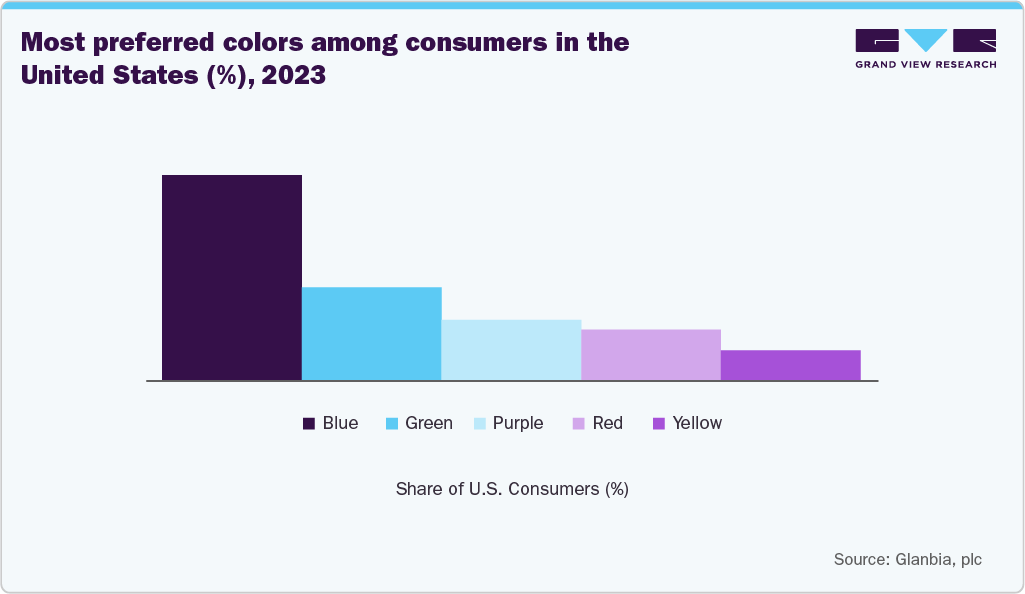
Convenience is encouraging a wider range of at-home and quick-touch-up behaviors: Consumers can now choose among permanent, demi-permanent, temporary, spray, powder, shampoo, and other color formats depending on the desired commitment and occasion. The FDA itself classifies U.S. hair-color preparations across hair dyes/colors, tints, coloring rinses, coloring shampoos, color sprays, lighteners with color, and bleaches, demonstrating the breadth of formats available to consumers. Clairol's portfolio illustrates this behavioral segmentation: its temporary root sprays are designed for immediate coverage until the next shampoo, while its permanent Root Touch-Up targets longer-lasting regrowth management.
-
Hair and scalp health increasingly influence product choice and usage behavior: Hair-color consumers face concerns around dryness, damage, and potential allergic reactions. The AAD notes that coloring can make hair dry and brittle, particularly when substantial lightening is involved, while the FDA recommends a 48-hour skin test before every hair-dye application because sensitivity can develop even after previous uneventful use. This has encouraged brands to combine color performance with conditioning and gentler positioning. Clairol Natural Instincts, for example, uses ammonia-free positioning and conditioning ingredients, while L'Oréal continues to develop hair-color products emphasizing both color performance and hair condition.
-
Consumers are increasingly using color for experimentation and personalization beyond gray coverage: Hair color is expanding from a predominantly maintenance-oriented purchase toward a broader self-expression category. Clairol's current portfolio spans conventional brunette, blonde, black, and red shades, as well as products designed for temporary color changes and varying levels of permanence. The FDA's classification of temporary sprays, tints, coloring shampoos, and other formats also reflects the availability of lower-commitment options. At the company level, L'Oréal reported that hair-color growth was supported by Garnier's Good and Color Sensation, while its 2025 reporting highlighted continued resilience in hair color from Garnier's accessible Color Sensation offering. This indicates that innovation and accessible shade portfolios remain important mechanisms for stimulating color experimentation and repeat consumption.
The U.S. hair color consumption is shifting from a predominantly gray-coverage and maintenance-driven category toward a broader beauty and self-expression proposition, while functional needs remain important. Women continue to represent a major consumer base due to the integration of hair coloring with appearance-maintenance routines, whereas recurring gray regrowth supports repeat purchases among mature consumers. At-home convenience, quick root touch-ups, shade experimentation, and lower-commitment formats are broadening usage occasions, while concerns around dryness, hair damage, scalp sensitivity, color longevity, and application complexity are increasing expectations for gentler, easier-to-use, and longer-lasting products.
Product Insights
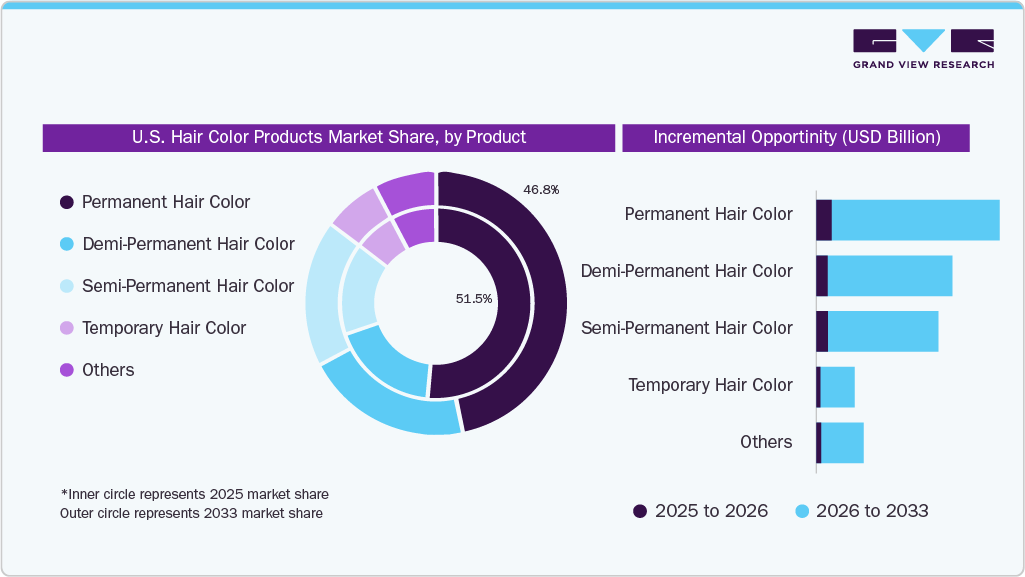
Permanent hair color dominated the U.S. hair color products industry, accounting for a revenue share of 51.5% in 2025, reflecting the segment’s established role in long-lasting color transformation, gray coverage, and recurring root-maintenance needs. The category is strongly supported by the positioning of leading at-home colorants around gray coverage: L’Oréal Paris Excellence Crème provides 100% gray coverage and recommends reapplication when visible grays return, typically every 4-8 weeks, while Revlon ColorSilk also provides 100% gray coverage and up to eight weeks of color. L’Oréal further extends the permanent-color proposition through Excellence Universal Nudes, which combines 100% gray coverage with an ammonia-free formulation, while its broader permanent portfolio includes Feria, Superior Preference, Excellence Age Perfect, and Excellence Cool Supreme, demonstrating the breadth of shade, care, and gray-coverage occasions addressed within the category.
 To learn more about this report, Download Free Sample Report
Semi-permanent hair color is projected to grow at the fastest CAGR of 6.2% from 2026 to 2033, driven by increasing demand for lower-commitment colorants that allow consumers to refresh, experiment with, or modify their hair color without the longer-lasting commitment of permanent formulations. The growth opportunity is reinforced by the broader availability of colorants designed around flexibility and experimentation, including L’Oréal Colorista, Clairol Color Gloss Up, and Revlon ColorSilk Tone + Gloss + Care, which address color refreshing, tonal enhancement, and shorter-duration color occasions. This shift is consistent with the wider expansion of lower-commitment coloring options, as consumers can use such products to refresh existing shades, experiment with different tones, and extend the visual appeal of color between permanent applications.
Format Insights
The cream segment dominated the U.S. hair color products industry, accounting for a revenue share of 61.5% in 2025, reflecting the format’s strong suitability for at-home application, full-head coverage, and gray coverage. Cream-based colorants provide a thicker, non-drip consistency that allows consumers to distribute the product evenly and maintain greater control during application. L’Oréal Paris describes its Excellence Crème as a non-drip formula that is easy to spread and designed for full gray coverage, while Clairol Nice ’N Easy combines a permanent color cream with an activator and conditioning treatment. This format is therefore particularly well-suited to mainstream permanent and demi-permanent colorants, where consumers prioritize controlled application and consistent coverage.
 To learn more about this report, Download Free Sample Report
The gel segment is projected to grow at the fastest CAGR of 5.1% from 2026 to 2033, driven by increasing interest in easier, more targeted, and lower-commitment color application. Gel formulations can provide greater control over pigment deposition and are particularly well-suited to semi-permanent and creative color applications. For example, Manic Panic’s Inter-GEL-Actic introduced a semi-permanent gel formula in 2026 that uses a semi-translucent texture designed to minimize bleeding and keep pigment where applied, while requiring no developer. The emergence of such specialized gel colorants illustrates how the format is expanding beyond conventional boxed color toward experimentation, creative coloring, and more controlled DIY application.
End Use Insights
Women dominated the U.S. hair color products market, accounting for a revenue share of 73.8% in 2025, reflecting their established participation in at-home hair coloring for gray coverage, shade maintenance, color transformation, and root touch-ups. The segment is supported by extensive women-focused colorant portfolios from L’Oréal Paris, Garnier, Clairol, Revlon, and Schwarzkopf, covering permanent, demi-permanent, semi-permanent, and root-maintenance needs. The broad availability of products across mass-market and premium price points also makes hair coloring accessible across different consumer preferences and coloring routines.
 To learn more about this report, Download Free Sample Report
The men segment is projected to grow at the fastest CAGR of 6.7% from 2026 to 2033. The growth is supported by increasing product availability, specifically addressing male gray coverage and natural-looking color, as well as simpler, faster application options. Just For Men offers targeted gray-reduction and full-color solutions, while Schwarzkopf, Clairol, and L’Oréal provide additional colorant options that can appeal to male consumers seeking gray blending or color maintenance. The expansion of quick-application and natural-result positioning is helping broaden hair color consumption beyond traditional women-oriented use occasions.
Distribution Channel Insights
Hypermarkets & supermarkets dominated with 30.5% revenue share of the U.S. hair color products market in 2025, reflecting the importance of widespread physical availability for established mass-market colorants. These outlets provide consumers with convenient access to frequently purchased products across multiple brands, shades, and price points, with L’Oréal Paris, Garnier, Clairol, Revlon, and Schwarzkopf maintaining a broad retail presence. The ability to purchase colorants during routine grocery and household shopping also supports the channel’s continued relevance for permanent color, gray coverage, and root-touch-up products.
 To learn more about this report, Download Free Sample Report
The online/e-commerce segment is projected to grow at the fastest CAGR of 7.0% from 2026 to 2033. Digital channels are supported by wider shade assortments, customer reviews, application tutorials, shade-selection tools, and direct-to-consumer purchasing, which are particularly useful for consumers choosing colorants without in-store assistance. Madison Reed, dpHUE, Manic Panic, and Lime Crime have leveraged online distribution to reach consumers seeking specialized, premium, creative, and semi-permanent colorants, while established mass-market brands increasingly complement physical retail with online availability through retailer websites and their own digital channels.
Cross Segmentation Analysis
The study provides a detailed cross-segmentation analysis of the U.S. hair color products market to assess how demand varies across permanent, demi-permanent, semi-permanent, temporary, and other hair colorants by cream, liquid, gel, foam/mousse, and other formats. The analysis further evaluates women, men, and unisex products across product types and formats to identify differences in coloring needs and usage patterns. In addition, product types and formats are assessed across hypermarkets & supermarkets, beauty specialty stores, pharmacies & drugstores, online/e-commerce, salons & professional channels, and other channels, providing insights into channel-specific demand and digital adoption. Further cross-segmentation of end users across distribution channels highlights differences in purchasing behavior and channel preferences. These cross-segment insights help identify opportunities in format innovation, gray coverage, and root touch-up colorants, gender-specific products, premiumization, and omnichannel expansion.
Key U.S. Hair Color Products Company Insights
 To learn more about this report, Download Free Sample Report
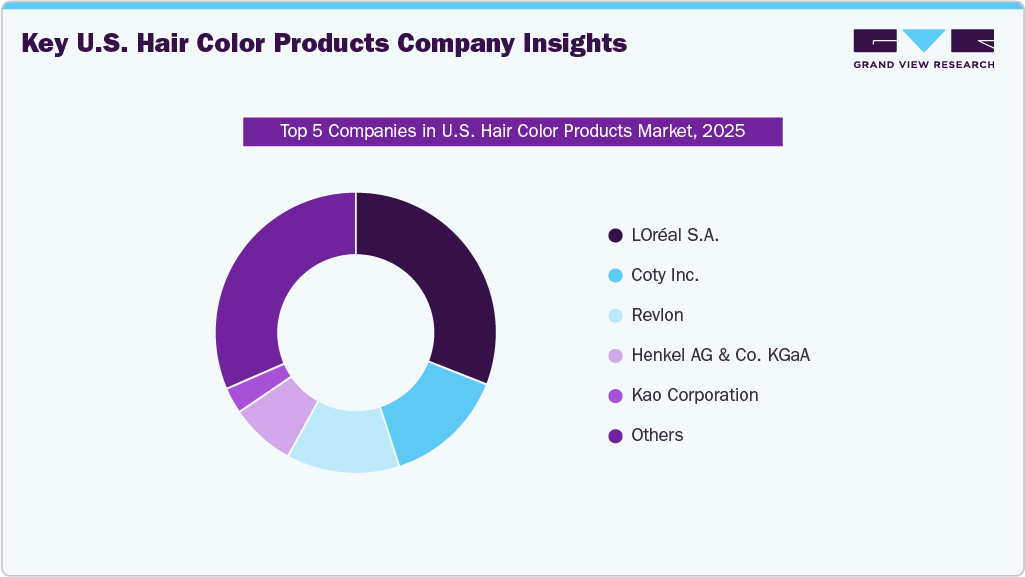
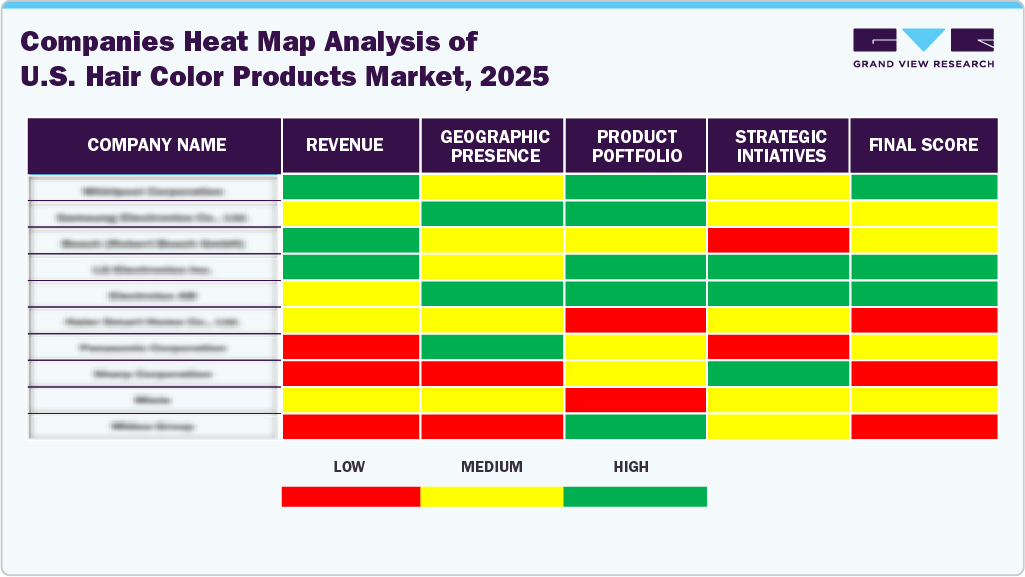
The U.S. hair color products industry is characterized by competition among large beauty and consumer-goods companies with established mass-market hair-color franchises, supported by strong brand recognition, broad shade portfolios, gray-coverage performance, affordable price points, and extensive retail distribution. L'Oréal competes through L'Oréal Paris and Garnier, with Excellence, Nutrisse, Color Sensation, and other consumer colorant franchises providing broad coverage across permanent and other at-home coloring needs. Clairol, owned by Coty Inc., remains a major U.S. retail competitor, while Revlon competes strongly through ColorSilk. Henkel participates through Schwarzkopf and Keratin Color, and Kao through consumer brands including John Frieda. Competition is increasingly shifting from basic color coverage toward bond repair, hair-health benefits, ammonia-free formulations, root touch-ups, easier application, wider shade ranges, and digital/omnichannel discovery. Mintel identifies L'Oréal as the dominant player in the market and notes that Revlon gained share specifically within the at-home color segment.
-
Portfolio Diversification Across Permanent, Demi-Permanent, Temporary & Root Colorants: Leading companies are expanding their portfolios across different levels of color commitment rather than relying exclusively on permanent hair dye. This enables brands to capture full-color transformations, gray coverage, root maintenance, color refreshes, and experimentation. L'Oréal addresses permanent coloration through Excellence and Nutrisse, Coty's Clairol spans Nice 'N Easy, Natural Instincts, and Root Touch-Up; Revlon offers ColorSilk alongside Tone + Gloss + Care and Root Erase; Henkel covers permanent and temporary root color through Keratin Color; Kao's John Frieda participates through Precision Foam Color; and Madison Reed offers permanent color alongside targeted root and gloss products. The increasing breadth of these portfolios demonstrates how manufacturers are creating multiple purchase occasions within the at-home colorant category.
-
Gray Coverage Remains the Core Volume Opportunity: Gray coverage continues to underpin the U.S. consumer colorant market, particularly among mature consumers, while brands are competing on coverage reliability, natural-looking results, longevity, and ease of application. Revlon ColorSilk offers 100% gray coverage; L'Oréal Paris Excellence is positioned around 100% gray coverage and triple-care technology; Clairol Nice 'N Easy provides permanent gray coverage across a broad shade range; Schwarzkopf Keratin Color targets gray coverage with K-Bond Plex technology; Madison Reed Radiant Hair Color provides full gray coverage; and Godrej Expert Rich Crème similarly targets gray coverage within its consumer color portfolio. The breadth of these propositions indicates that gray coverage is not being addressed through a single product format but through multiple colorant technologies and price points.
-
Root Maintenance Is Creating Higher-Frequency Colorant Consumption: While full-head permanent color remains important, root regrowth creates a recurring maintenance requirement and provides manufacturers with an opportunity to increase purchase frequency. Clairol Root Touch-Up, L'Oréal Magic Root Rescue, Revlon Root Erase, Schwarzkopf Keratin Root, Madison Reed Root Perfection, and Kao/John Frieda Root Blur address this specific use case through faster application, targeted coverage, and smaller product quantities. The development of these products shifts the category from an occasional full-color purchase toward a broader color-maintenance cycle, particularly among consumers who regularly cover gray or visible regrowth.
-
Ammonia-Free & Gentler Colorants Are Expanding Consumer Choice: Formulation preferences are creating differentiation between conventional permanent dyes and products positioned around gentler coloring experiences. Revlon ColorSilk is ammonia-free; Garnier Olia uses an oil-powered, ammonia-free colorant system; Clairol Natural Instincts offers a demi-permanent option; Madison Reed positions its color around a formula free of ammonia, parabens, and resorcinol; and John Frieda Precision Foam Color emphasizes easy application and conditioning. These formulations help companies appeal to consumers who may be reluctant to use traditional permanent colorants due to concerns about odor, scalp sensitivity, dryness, or hair damage.
-
Mass-Market and Specialist Brands Are Targeting Different Consumer Segments: Competition is becoming more segmented by consumer need and purchasing behavior. L'Oréal Paris, Garnier, Clairol, and Revlon have extensive mass-market distribution and accessible price points, while Madison Reed has built a more specialized direct-to-consumer and premium at-home positioning. Henkel's Schwarzkopf combines mass-market accessibility with professional-inspired technology, while Kao's John Frieda occupies a more premium mass-market position. Hoyu participates through brands such as Bigen, particularly in ethnic and gray-covering colorants. This creates a market in which competitive differentiation depends increasingly on consumer segment and use case, rather than simply company size.
-
Digital-First Models Are Increasing Competition Beyond Traditional Mass Retail: E-commerce is allowing specialist brands to compete with established mass-market manufacturers by providing shade-selection tools, personalized recommendations, subscription/replenishment models, and educational content. Madison Reed is a prominent example, having built its U.S. proposition around personalized at-home hair color, online shade guidance, and direct-to-consumer engagement. Established companies are also strengthening digital capabilities: L'Oréal distributes its consumer colorant brands through major e-commerce platforms, while Clairol, Revlon, John Frieda, and Schwarzkopf have expanded online product discovery and education. This means digital visibility can increasingly influence consideration before the consumer reaches the physical retail shelf.
-
Professionalization of At-Home Color Is Raising the Technology Bar: At-home colorants are increasingly borrowing technology, terminology, and application approaches traditionally associated with professional hair coloring. Schwarzkopf Keratin Color uses K-Bond Plex technology; Revlon ColorSilk positions itself as bond-repair; L'Oréal Excellence combines color with a multi-step care system; Madison Reed emphasizes salon-inspired color results; and Kao's John Frieda leverages the brand's established professional haircare heritage. The shift allows mass-market products to compete increasingly on performance, hair integrity, and sophistication, rather than competing primarily through low prices.
-
Affordable Premiumization Is Increasing Perceived Value Within At-Home Colorants: Consumers can increasingly access advanced coloring technologies without moving entirely into salon services. L'Oréal Excellence, Garnier Olia, Revlon ColorSilk, Schwarzkopf Keratin Color, John Frieda Precision Foam Color, and Madison Reed Radiant Hair Color all incorporate combinations of conditioning, oils, keratin, bond repair, reduced-damage claims, or application improvements. As a result, premiumization in U.S. at-home color is occurring through added functionality and treatment benefits, rather than only through higher prices.
-
Omnichannel Distribution Remains a Structural Competitive Advantage: Large manufacturers continue to benefit from extensive physical distribution across mass merchants, drugstores, supermarkets, and beauty retailers, while specialist companies increasingly supplement physical distribution with direct-to-consumer and marketplace channels. L'Oréal, Clairol, Revlon, Henkel, and Kao have broad retail availability, whereas Madison Reed provides a stronger example of the specialist DTC model. Walmart, Target, CVS, Walgreens, Ulta Beauty, and Amazon provide key points of access for consumer colorants, enabling brands to combine in-store availability with online purchasing and replenishment. This makes retail reach particularly important for products such as permanent colorants and root-touch-up products that consumers often purchase when the need arises.
The U.S. hair color products market is therefore evolving from competition primarily around shade range, gray coverage, and price toward a broader contest involving hair health, formulation attributes, application convenience, color longevity, root maintenance, and professional-inspired performance. L'Oréal benefits from a broad consumer colorant portfolio spanning L'Oréal Paris and Garnier; Clairol combines a long-established U.S. at-home position with permanent, demi-permanent, and root-retouch formats; Revlon is extending ColorSilk from conventional permanent color into bond repair and lower-commitment demi-permanent color; and Henkel is using Schwarzkopf and Keratin Color to bring bonding technology and targeted root solutions into mass retail. Kao's John Frieda also adds consumer colorant exposure through products such as Precision Foam Color. The resulting competitive environment is increasingly defined by colorant performance, hair care, convenience, and omnichannel accessibility, rather than coloration alone.
 To learn more about this report, Download Free Sample Report
Key U.S. Hair Color Products Companies
The following key companies have been profiled for this study of the U.S. hair color products market.
-
Henkel AG & Co. KGaA
-
L’Oréal S.A
-
COTY INC.
-
Kao Corporation
-
Revlon
-
Mandom Corp.
-
The Estée Lauder Companies Inc. (Aveda)
-
Godrej Consumer Products Limited
-
Madison Reed, Inc.
-
Hoyu Co., Ltd.
Competitive Benchmarking
Category
Operating Strategies
Competitive Edge
Weakness
Established Players (Henkel AG & Co. KGaA; L'Oréal S.A.; COTY INC.; Kao Corporation; Revlon; The Estée Lauder Companies Inc. (Aveda))
- Expand portfolios across permanent, demi-permanent, semi-permanent, and specialty hair color products while strengthening presence across mass retail, beauty specialty stores, pharmacies, e-commerce, and salon channels. Invest in formulation innovation, shade expansion, hair-care benefits, premiumization, and omnichannel marketing to address diverse consumer needs and strengthen brand loyalty.
- Strong brand recognition, extensive shade portfolios, established retail and distribution networks, and significant R&D and marketing capabilities. Broad portfolios spanning mass-market, premium, professional, and prestige positioning enable these companies to address multiple consumer segments and price points.
- Large-scale organizations may face longer product development and decision-making cycles, while extensive portfolios and established positioning can make rapid adaptation to emerging color trends and niche consumer preferences more challenging.
Other Emerging & Specialized Players (Mandom Corp.; Godrej Consumer Products Limited; Madison Reed, Inc.; Hoyu Co., Ltd.)
- Focus on specialized formulations, direct-to-consumer and e-commerce channels, personalized color solutions, clean-label positioning, at-home coloring convenience, and targeted consumer segments. Leverage digital marketing, social media, virtual shade-selection tools, and innovative product formats to build brand awareness and compete with established players.
- Greater flexibility in responding to emerging consumer preferences, digital-first purchasing behavior, personalization, and demand for convenient at-home hair-color solutions. Specialized positioning can support stronger engagement within targeted consumer niches.
- Comparatively smaller brand recognition, distribution reach, marketing resources, and retail presence can limit scale relative to established multinational competitors. Greater reliance on digital acquisition, niche positioning, and discretionary consumer spending can increase exposure to competitive pressure and changing consumer preferences.
Recent Developments
-
In September 2026, Yellow Professional, the Italian professional haircare brand backed by ALFAPARF MILANO Group, made its nationwide U.S. retail debut through Sally Beauty stores and SallyBeauty.com. The partnership expands Yellow Professional beyond the salon channel into U.S. retail, with an assortment that includes color-care and tone-correction products designed to protect and maintain color-treated hair.
-
In September 2026, dpHUE expanded its U.S. retail presence through a launch at Target Beauty Studio, available in more than 600 stores nationwide and on Target.com. The brand introduced a curated assortment of its hair-color maintenance franchises, including Gloss+, Glossy Glaze, and Camo+, emphasizing low-commitment, at-home solutions to refresh color and cover roots between salon visits.
-
In July 2026, Clairol launched its “Clairol Dared Me” campaign in the U.S., combining at-home hair color with an AI-powered Dare Textline. The initiative uses personalized hair-color and lifestyle suggestions to reduce hesitation around DIY coloring and promote hair color as a form of self-expression, extending Clairol’s consumer engagement beyond traditional product marketing.
-
In March 2026, Keracolor introduced a brand refresh and expanded its national retail presence in the U.S., including an enlarged Target assortment. The expansion introduced High Shine Tinted Glosses and the new Root Touch-up and Tame product, while the company also expanded influencer and social media activation to strengthen its positioning in temporary, low-commitment at-home hair color.
-
In January 2026, Clairol launched Nice’n Easy10 and Color Pro in the U.S., introducing faster and more guided at-home hair-color solutions. Nice’n Easy10 provides permanent color and 100% gray coverage with a 10-minute processing time, while Color Pro adds a three-step preparation and finishing system designed to improve application and post-color results.
U.S. Hair Color Products Market Report Scope
Report Attribute
Details
Market size in 2025
USD 3.5 billion
Estimated market size in 2026
USD 3.7 billion
Projected market size by 2033
USD 4.9 billion
Growth rate
CAGR of 4.2% from 2026 to 2033
Base year
2025
Actuals
2021 - 2025
Forecast period
2026 - 2033
Quantitative units
Revenue in USD billion and CAGR from 2026 to 2033
Report coverage
Revenue forecast, company ranking, competitive landscape, growth factors, and trends
Segments covered
Product, format, end use, and distribution channel
Country scope
U.S.
Key companies profiled
Henkel AG & Co. KGaA; L’Oréal S.A.; COTY INC.; Kao Corporation; Revlon; Mandom Corp.; The Estée Lauder Companies Inc. (Aveda); Godrej Consumer Products Limited; Madison Reed, Inc.; Hoyu Co., Ltd.
Customization scope
Free report customization (equivalent up to 8 analysts’ working days) with purchase. Addition or alteration to country, regional & segment scope.
Pricing and purchase options
Avail customized purchase options to meet your exact research needs. Explore purchase options
U.S. Hair Color Products Market Report Segmentation
This report forecasts revenue growth at the country level and provides an analysis of the latest trends and opportunities in each of the sub-segments from 2026 to 2033. For this study, Grand View Research has segmented the U.S. hair color products market report based on product, format, end use, and distribution channel:
-
Product Outlook (Revenue, USD Billion, 2021 - 2033)
-
Permanent Hair Color
-
Demi-Permanent Hair Color
-
Semi-Permanent Hair Color
-
Temporary Hair Color
-
Others
-
-
Format Outlook (Revenue, USD Billion, 2021 - 2033)
-
Cream
-
Liquid
-
Gel
-
Foam/Mousse
-
Others
-
-
End Use Outlook (Revenue, USD Billion, 2021 - 2033)
-
Women
-
Men
-
Unisex
-
-
Distribution Channel Outlook (Revenue, USD Billion, 2021 - 2033)
-
Hypermarkets & Supermarkets
-
Beauty Specialty Stores
-
Pharmacies & Drugstores
-
Online/E-Commerce
-
Salons & Professional Channels
-
Others
-
-
Product by End Use Outlook (Revenue, USD Billion, 2021 - 2033)
-
Permanent Hair Color
-
Women
-
Men
-
Unisex
-
-
Demi-Permanent Hair Color
-
Women
-
Men
-
Unisex
-
-
Semi-Permanent Hair Color
-
Women
-
Men
-
Unisex
-
-
Temporary Hair Color
-
Women
-
Men
-
Unisex
-
-
Other products
-
Women
-
Men
-
Unisex
-
-
-
Product by Distribution Channel Outlook (Revenue, USD Billion, 2021 - 2033)
-
Permanent Hair Color
-
Hypermarkets & Supermarkets
-
Beauty Specialty Stores
-
Pharmacies & Drugstores
-
Online/E-Commerce
-
Salons & Professional Channels
-
Others
-
-
Demi-Permanent Hair Color
-
Hypermarkets & Supermarkets
-
Beauty Specialty Stores
-
Pharmacies & Drugstores
-
Online/E-Commerce
-
Salons & Professional Channels
-
Others
-
-
Semi-Permanent Hair Color
-
Hypermarkets & Supermarkets
-
Beauty Specialty Stores
-
Pharmacies & Drugstores
-
Online/E-Commerce
-
Salons & Professional Channels
-
Others
-
-
Temporary Hair Color
-
Hypermarkets & Supermarkets
-
Beauty Specialty Stores
-
Pharmacies & Drugstores
-
Online/E-Commerce
-
Salons & Professional Channels
-
Others
-
-
Other Products
-
Hypermarkets & Supermarkets
-
Beauty Specialty Stores
-
Pharmacies & Drugstores
-
Online/E-Commerce
-
Salons & Professional Channels
-
Others
-
-
Research Methodology
The U.S. hair color products market figures in this report are based on a proven research process that combines executive interviews with secondary research from proprietary databases, company filings, and recognized regulatory and institutional sources. Market size is built through value-chain sizing-reconciling supply-side and demand-side estimates-and triangulated with bottom-up and top-down approaches. Every estimate passes multiple levels of expert validation before publication, with each U.S. hair color products segment quantified using the revenue-capture definitions in the table below.
Segment Definition
Product
Revenue capture definition
Permanent Hair Color
The scope includes oxidative hair color products designed to provide long-lasting color until new hair growth occurs. It encompasses permanent color creams, liquids, gels, and other formulations used for gray coverage, complete color changes, root touch-ups, and at-home or professional applications.
Demi-Permanent Hair Color
The scope includes hair color products formulated to provide longer-lasting color than semi-permanent products while gradually fading with repeated washing. These hair colors include formulations using an alkaline agent other than ammonia and a developer with a lower hydrogen peroxide concentration than permanent color. These products deposit color without significantly lifting natural pigment and are used for gray blending, tonal enhancement, color refreshing, and less noticeable regrowth.
Semi-Permanent Hair Color
The scope includes non-permanent hair color products that deposit color onto or near the hair surface without permanently altering the natural hair structure. These hair colors include formulations that generally do not require ammonia or a developer and primarily deposit color within or around the hair cuticle. Color typically fades after several washes and includes natural, fashion, and refreshing shades. It encompasses direct-dye formulations offered in creams, liquids, gels, foams, and other formats for color enhancement, fashion shades, refreshing, and short-term color changes.
Temporary Hair Color
The scope includes hair color products intended to provide short-duration color that is generally removed through shampooing or limited washing cycles. It encompasses sprays, rinses, powders, mascaras, chalks, and similar formulations designed for instant color changes, special occasions, root coverage, highlights, and fashion applications.
Others
The scope includes hair color products that do not fall within permanent, demi-permanent, semi-permanent, or temporary classifications. It encompasses specialized and hybrid coloring products with distinct formulation or performance characteristics, including products combining color-depositing, treatment-integrated, or application-specific functions for hair coloring.
Format
Revenue capture definition
Cream
The scope includes hair color products supplied primarily in cream-based formulations with a thick or emulsified consistency for controlled application. It encompasses permanent, demi-permanent, semi-permanent, and other cream formulations packaged for at-home or professional use, including full-head coloring, root touch-ups, targeted applications, and coloring kits.
Liquid
The scope includes hair color products supplied in liquid or fluid formulations that can be applied directly or mixed with other components before use. It encompasses permanent, demi-permanent, semi-permanent, and temporary liquid products, including liquid colorants, rinses, and developers supplied within hair coloring systems.
Gel
The scope includes hair color products formulated with gel-based textures that provide a structured consistency during application. It encompasses permanent, demi-permanent, semi-permanent, and temporary gel colorants intended for full-head coloring, targeted applications, root touch-ups, highlights, and other controlled hair coloring applications.
Foam/Mousse
The scope includes hair color products delivered as foams or mousses with lightweight, aerated formulations designed to spread easily through the hair. It encompasses permanent, semi-permanent, temporary, and other coloring products supplied in these formats for full-head application, root coverage, color refreshing, and targeted coloring.
Others
The scope includes hair color products supplied in formats other than creams, liquids, gels, or foams/mousses. It encompasses sprays, powders, sticks, mascaras, crayons, chalks, and other specialized application formats used across permanent, semi-permanent, temporary, and other hair coloring product categories.
Estimation Mode
Layer Name
Key Question
Description
Hair Color User Base Layer
Who represents the potential consumer base for hair coloring?
Assess the U.S. population with hair-coloring potential using adult demographics, age distribution, gray-hair prevalence, beauty and grooming participation, and consumer use of hair-color products. Particular relevance can be established for mature consumers seeking gray coverage and younger consumers using color for fashion, highlighting, and appearance enhancement.
Coloring Need & Usage Layer
Which consumers have a recurring hair-coloring need?
Evaluate the incidence of gray coverage, fashion and shade changes, root touch-ups, highlights/lightening, and other recurring coloring occasions. Home coloring and professional salon usage can be addressed separately, supported by consumer surveys, salon-industry data, and product-category information. FDA recognizes both consumer and salon-professional use of hair dyes and maintains dedicated resources for salon professionals.
Product Adoption & Purchase Layer
Which consumers actively purchase hair color products?
Assess penetration and purchase behavior across permanent, demi-permanent, semi-permanent, temporary, and other hair-color products. Purchase frequency can reflect gray-root maintenance, seasonal or occasion-based coloring, experimentation with fashion shades, and repeat use.
Monetisation Layer
How much is spent on Hair Color products?
Evaluate consumer and professional product spending using product-level price points, purchase frequency, premiumization, and channel mix. Revenue coverage can encompass mass-market and premium products sold through beauty specialty stores, pharmacies and drugstores, hypermarkets & supermarkets, online/e-commerce, and professional channels, consistent with the market's retail and professional structure.
Delivered Customizations
This report has been delivered with the following In-depth customizations
Client Request
Customization Delivered
Value Adds
Cross-Segmentation Analysis of Hair Color Products Across Consumer and Purchase Channels
Detailed cross-segmentation analysis of the U.S. hair color market across Permanent, Demi-Permanent, Semi-Permanent, and Temporary Hair Color by Women, Men, and Unisex end uses and across Hypermarkets & Supermarkets, Beauty Specialty Stores, Pharmacies & Drugstores, Online/E-Commerce, and Salons & Professional Channels. The analysis can further identify how product types vary between at-home retail purchases and professional salon services.
Identifies where demand is concentrated across color longevity, consumer gender, and purchase channel, highlighting the role of permanent color in long-lasting coverage, demi-/semi-permanent products in lower-commitment coloring, and temporary products in maintenance and experimentation. It also helps identify channel-specific opportunities, particularly the interaction between at-home coloring and professional salon services.
At-Home vs. Professional Hair Color Market Mapping
Comparative analysis of at-home hair coloring versus salon/professional coloring, covering product type, application format, price positioning, service requirements, and consumer use occasions. The analysis maps retail kits, root-touch-up products, glosses, and temporary products against professional systems such as Wella's permanent and demi-permanent color ranges. Wella, for example, offers professional permanent, demi-permanent, and semi-permanent systems with different coverage and longevity characteristics.
Helps quantify and understand the substitution and coexistence between DIY and salon coloring. It highlights where convenience, lower cost, maintenance, and quick application support at-home adoption, while personalization, complex color services, gray blending, and professional application support salon demand.
Formulation & Hair-Health Attribute Benchmarking
Benchmarking of major U.S. hair color portfolios based on formulation and performance attributes such as ammonia-free, peroxide-free, vegan, bond protection, damage reduction, shine, conditioning, metal protection, gray coverage, and low-commitment color. Current professional and consumer portfolios provide multiple examples: Wella's Color Touch is ammonia-free, while its Pure Perfection permanent color emphasizes reduced signs of damage; Revlon's ColorSilk Tone Gloss Care combines demi-permanent color with ammonia-free positioning.
Identifies the shift from color performance alone toward hair-conditioning and formulation attributes. It enables benchmarking of how brands differentiate products around damage mitigation, gentler formulations, shine, conditioning, and ingredient/claim positioning rather than relying only on shade and permanence.
Frequently Asked Questions About This Report
The U.S. hair color products market size was valued at USD 3.5 billion in 2025 and is estimated at USD 3.7 billion for 2026.
Key players include Henkel AG & Co. KGaA; L’Oréal S.A.; COTY INC.; Kao Corporation; Revlon; Mandom Corp.; The Estée Lauder Companies Inc. (Aveda); Godrej Consumer Products Limited; Madison Reed, Inc.; Hoyu Co., Ltd.
Hypermarkets & Supermarkets held the largest revenue share of 30.5% in 2025, while the online/e-commerce segment is the fastest-growing.
The U.S. hair color products market is expected to grow at a CAGR of 4.2% from 2026 to 2033, reaching USD 4.9 billion by 2033.
The Permanent Hair Color segment dominated the U.S. hair color products market with a 51.5% revenue share in 2025.
The Semi-Permanent Hair Color segment is projected to be the fastest-growing product segment, registering a 6.2% CAGR from 2026 to 2033.
Key factors include rising demand for at-home hair coloring, increasing consumer focus on gray coverage and color maintenance, growing interest in demi-permanent and semi-permanent formulations, increasing adoption of convenient application formats, and expanding online and e-commerce availability.
The Cream segment held the largest revenue share of 61.5% in 2025, while Gel is projected to be the fastest-growing format segment, with a 5.1% CAGR from 2026 to 2033.
The Women segment held the largest revenue share of 73.8% in 2025, while the Men segment is projected to be the fastest-growing end-use segment, with a 6.7% CAGR from 2026 to 2033.
About the Author(s)
Beauty & Personal Care Research Team
Consumer Goods · Beauty & Personal CareThis report was authored by the beauty & personal care research team at Grand View Research - comprising two research analysts, one senior research analyst, and one industry expert - with specialized expertise in the beauty & personal care segment of the consumer goods industry. All findings are based on proprietary consumer goods databases, executive interviews, and regulatory analysis, subject to internal peer review prior to publication.
Last Updated:
Speak to Analyst

Customize this report to your needs - add regions, segments, or data points, with 20% free customization.
Or view our licence options:


ISO 9001:2015 & 27001:2022 Certified
We are GDPR and CCPA compliant! Your transaction & personal information is safe and secure. For more details, please read our privacy policy.


