
- Home
- »
- Next Generation Technologies
- »
-
U.S. Internet Of Things Market Size, Industry Report, 2030GVR Report cover

U.S. Internet Of Things Market (2025 - 2030) Size, Share & Trends Analysis Report By Component (Hardware, Software, Services), By Deployment (On-premise, Cloud), By Connectivity (Zigbee, Bluetooth, Z-Wave), By End Use, And Segment Forecasts
U.S. Internet Of Things Market Size & Trends
The U.S. internet of things market size was estimated at USD 413.22 billion in 2024 and is projected to grow at a CAGR of 7.6% from 2025 to 2030. The market is primarily driven by increasing demand for smart devices, widespread adoption of Industrial IoT (IIoT) in manufacturing, and growing government initiatives supporting smart cities and infrastructure. Additionally, sectors such as retail, healthcare, and agriculture are rapidly integrating IoT solutions, supported by the presence of major technology players in the U.S., thereby driving the U.S. internet of things (IoT) industry expansion in the coming years.
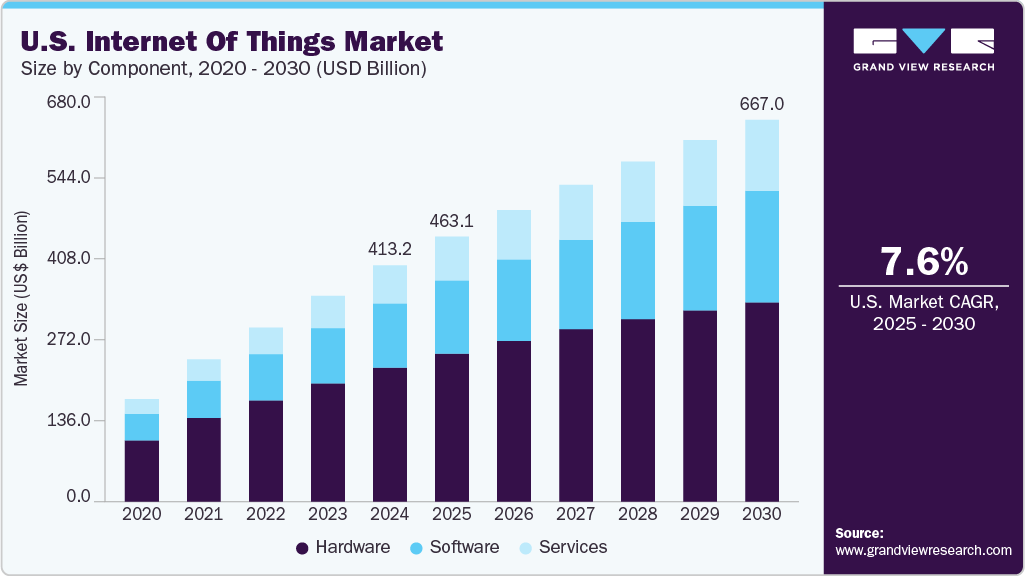 Source: Grand View Research, IR Documents, Primary Interviews, Paid DatabasesTo learn more about this report,
 Download Free Sample Report
A key driver of the U.S. IoT industry is the integration of artificial intelligence (AI) and cloud/edge computing, which enables real-time analytics, automation, and scalable IoT deployments. This shift toward software-centric IoT solutions is transforming traditional hardware-heavy models and accelerating digital transformation across industries. By leveraging AI algorithms, IoT systems can interpret massive volumes of sensor data to make intelligent, autonomous decisions, enhancing predictive maintenance, improving operational efficiency, and enabling proactive interventions in sectors such as healthcare, logistics, and manufacturing.
The proliferation of 5G networks and low-power wide-area networks (LPWAN) such as LTE-M and NB-IoT are some of the critical trends enhancing IoT device connectivity in the U.S. These technologies offer low latency, extended coverage, and energy efficiency, enabling new use cases in smart cities, connected vehicles, and industrial automation. The expansion of private 5G networks and multi-profile eSIM solutions further supports scalable and secure IoT deployments, thereby accelerating the U.S. internet of things industry growth.
Furthermore, with the growing number of connected devices, IoT security has become a major focus in the U.S. market. Trends include the adoption of stronger encryption protocols, multi-factor authentication, blockchain, and AI-driven threat detection to safeguard IoT ecosystems. These advancements address increasing concerns over data privacy and cyber threats, which are crucial for accelerating enterprise and consumer IoT adoption. Such advancements are expected to drive the segmental growth in the coming years.
Moreover, U.S. companies are investing heavily in 5G and edge computing technologies to enhance connectivity, security, and real-time data processing. Emphasizing vertical-specific IoT solutions, U.S. firms tailor offerings to industry needs such as manufacturing, smart infrastructure, and healthcare, while optimizing channel partnerships and ecosystem collaborations to expand market reach and improve operational efficiency. Such strategies by key companies are expected to drive the U.S. internet of things industry expansion in the coming years.
Component Insights
The hardware segment registered the largest market shareof over 56% in 2024. The proliferation of 5G connectivity and edge computing is revolutionizing the IoT hardware landscape in the U.S. 5G's ultra-low latency and high-speed data transfer capabilities enable real-time communication among IoT devices, essential for applications like autonomous vehicles and smart manufacturing. Combined with edge computing, which processes data closer to the source, these technologies enhance responsiveness and reduce reliance on centralized data centers. This synergy is particularly impactful in sectors requiring immediate data processing and decision-making, such as healthcare and industrial automation. These factors are expected to drive segmental growth in the coming years.
The services segment is expected to grow at the fastest CAGR of over 10% from 2025 to 2030, owing to increased integration of AI, cloud, and edge computing, which provide scalable, secure IoT management and analytics solutions. Enterprises are adopting software-as-a-service (SaaS) and infrastructure-as-a-service (IaaS) models to accelerate deployment and improve operational efficiency. Sustainability initiatives and regulatory compliance are also driving demand for sophisticated IoT services in sectors such as energy, utilities, and smart infrastructure, thereby driving the segmental growth.
Deployment Insights
The on-premises segment registered the largest market share in 2024, driven by the need for stringent data privacy, low latency, and compliance with regulatory requirements, especially in sectors like manufacturing, healthcare, aerospace, and defense. Organizations prefer on-premises deployments to maintain full control over sensitive data and ensure real-time processing without dependence on cloud connectivity. This approach supports mission-critical applications where immediate response and high security are paramount. Key trends include integrating IoT with existing enterprise systems, leveraging edge computing to process data locally, and hybrid models that combine on-premises control with cloud scalability to optimize operational efficiency and innovation, thereby driving the segmental growth.
The cloud segment is expected to register a significant CAGR from 2025 to 2030. This growth is driven by their scalability, flexibility, and cost-effectiveness, making them popular across industries such as consumer electronics, retail, smart cities, and logistics. The cloud enables centralized device management, big data analytics, AI integration, and seamless software updates, accelerating IoT adoption. Trends include rapid growth in small- and mid-sized enterprises (SMEs) adopting affordable, easy-to-deploy cloud IoT solutions, increasing use of AI-powered analytics for real-time insights, and expanding hybrid cloud-edge architectures, which are driving the segment’s growth.
Connectivity Insights
The Wi-Fi segment registered the largest revenue share in 2024, owingto its widespread infrastructure and growing investments in advanced smart technologies and digitization. It provides seamless, high-speed communication and connectivity for a wide range of IoT devices, enhancing performance and reliability across applications. The increasing adoption of Wi-Fi-enabled consumer electronics, such as wearables, streaming devices, and smart home management systems, is a key driver. Additionally, Wi-Fi’s ability to support large data volumes and real-time communication makes it essential for IoT projects in both residential and commercial sectors, thereby driving the segmental growth.
 To learn more about this report, Download Free Sample Report
The Z-wave segment is anticipated to witness significant growth from 2025 to 2030, driven primarily by the rising demand for smart home automation solutions. Z-Wave’s low power consumption, long-range capabilities, and mesh network architecture make it ideal for smart thermostats, locks, lighting, and sensors. Its strong presence in home automation, security systems, and smart city infrastructure supports efficient and reliable device communication. The growth is further fueled by increasing adoption of IoT in residential and commercial buildings, government support for smart city initiatives, and consumer preference for energy-efficient, interoperable smart devices.
End Use Insights
The consumer electronics segment in the market registered the largest share in 2024, driven by rising demand for smart, connected devices that enhance convenience, security, and lifestyle quality. Key factors include widespread adoption of smart home technologies such as thermostats, security cameras, and voice assistants, along with growth in wearables like smartwatches and fitness trackers that support health monitoring. Advances in AI, cloud computing, and 5G connectivity further fuel adoption by enabling smarter, more responsive devices. Additionally, increasing consumer focus on energy efficiency and sustainability through IoT-enabled appliances contributes to market growth.
The aerospace and defense segment is anticipated to record the fastest growth from 2025-2030.This surge is primarily driven by the need for enhanced operational efficiency, real-time asset tracking, predictive maintenance, and improved safety through IoT technologies. The integration of IoT with AI, edge computing, and secure connectivity enables better monitoring of aircraft systems, supply chains, and defense infrastructure. Growing investments in smart manufacturing, autonomous systems, and cybersecurity drive IoT adoption in this sector, supporting mission-critical operations and compliance with stringent regulatory standards. These factors collectively position aerospace and defense as key growth areas within the broader U.S. industrial IoT market.
Key U.S. Internet Of Things Company Insights
Some of the key players operating in the market include Amazon.com, Inc, and Siemens AG among others.
-
Amazon.com, Inc. offers a robust suite of IoT services through AWS IoT, enabling U.S. businesses to efficiently build, manage, and analyze IoT applications at scale. The platform provides device software, connectivity, control, and advanced analytics with a strong emphasis on multi-layered security and AI integration. AWS IoT supports massive device deployments and high message volumes, helping organizations reduce development costs and scale their IoT platforms to meet growing demands.
-
Cisco Systems Inc. delivers comprehensive IoT solutions tailored for the U.S. market, including platforms and software that ensure secure connectivity, data processing, and analytics across industries such as industrial, transportation, and smart cities. The company’s industrial networking and automation tools extend connectivity to harsh environments, offering enhanced visibility and control over complex networks. Their solutions streamline data flow from edge devices to multicloud environments, enabling real-time insights, accelerating business outcomes, and supporting scalable, flexible IoT deployments.
AT&T and Celona, Inc. are some of the emerging market participants in the U.S. Internet of Things (IoT) market.
-
AT&T specializes in secure and reliable IoT connectivity and comprehensive solutions that enable organizations to connect, manage, and optimize devices and applications across industries such as manufacturing, transportation, and healthcare. Its IoT platform includes advanced management tools, edge computing solutions, and a large catalog of pre-certified devices, supporting real-time decision-making and operational efficiency.
-
Celona, Inc. is an emerging U.S.-based company specializing in private 5G solutions tailored for IoT applications requiring reliable, secure, and low-latency wireless connectivity. The company offers turnkey private 5G networks that enable enterprises to deploy wireless infrastructure optimized for industrial automation, smart buildings, and other IoT use cases. Celona’s technology supports seamless integration with existing IT environments and provides enhanced network control, security, and performance.
Key U.S. Internet Of Things Companies:
- AT&T
- Celona, Inc.
- SAP SE
- PTC Inc.
- Cisco Systems, Inc.
- IBM Corporation
- Microsoft Corporation
- Intel Corporation
- Siemens AG
- Amazon Web Services (AWS)
- Oracle Corporation
- General Electric Company (GE)
Three ways to get this report
Buy it, customize it, or ask a question.Ask an Analyst
Analyst response in 1 business day
- AccessReport author, directly
- Reply timeWithin 1 working day
- No sales callDirect answer only
- FormatEmail reply
- CostFree, no cost
Get the Full Report
What the study covers
- FormatsPDF · Excel · Dashboard
- Timeline2025–2030 annual, 2024 base
- Coverage20+ countries, 5 regions
- Companies10+ key players profiled
Customize the Report
20% free customization
- IncludeCountries, segments, points
- TailorTo your product definition
- ExtendDeeper competitor detail
- OrA fully bespoke study
- Turnaround5–10 working days
Recent Developments
-
In May 2025, Cisco Jasper (Cisco Systems, Inc.) expanded its IoT platform, Control Center 7.0, by adding support for low-power wide-area network (LPWAN) standards such as narrowband IoT (NB-IoT) and LTE-M, addressing the growing need for scalable and manageable IoT deployments.
-
In April 2025, IBM Corporation announced a USD 150 billion investment in America over the next five years to accelerate technological advancement and reinforce its leadership in computing and artificial intelligence. The investment aims to drive economic growth, create jobs, and maintain IBM’s pivotal role in powering critical industries and national infrastructure.
-
In March 2025, Alcatel-Lucent Enterprise (ALE) launched an innovative Private 5G solution powered by Celona, aimed at expanding IoT connectivity in complex industrial environments. This turnkey solution integrates seamlessly with ALE’s existing networking portfolio, including OmniVista, OmniSwitch, and OmniAccess Stellar, to provide secure, high-quality wireless coverage across large outdoor spaces and challenging settings such as manufacturing plants, refineries, logistics warehouses, ports, and airport apron areas.
U.S. Internet Of Things Market Report Scope
Report Attribute
Details
Market size value in 2025
USD 463.10 billion
Revenue forecast in 2030
USD 667.01 billion
Growth rate
CAGR of 7.6% from 2025 to 2030
Actual data
2018 - 2024
Forecast period
2025 - 2030
Quantitative units
Revenue in USD million/billion and CAGR from 2025 to 2030
Report Deployment
Revenue forecast, company ranking, competitive landscape, growth factors, and trends
Segments covered
Component, deployment, connectivity, end use
Country scope
U.S.
Key companies profiled
AT&T; Celona Inc.; SAP SE; PTC Inc.; Cisco Systems Inc.; IBM Corporation; Microsoft Corporation; Intel Corporation; Siemens AG; Amazon Web Services (AWS); Oracle Corporation; and General Electric Company (GE).
Customization scope
Free report customization (equivalent to up to 8 analysts working days) with purchase. Addition or alteration to country, regional & segment scope.
Pricing and purchase options
Avail customized purchase options to meet your exact research needs. Explore purchase options
U.S. Internet Of Things Market Report Segmentation
This report forecasts revenue growth at the country level and provides an analysis of the latest industry trends in each of the sub-segments from 2018 to 2030. For this study, Grand View Research has segmented the U.S. internet of things market report based on component, deployment, connectivity, and end use:
-
Component Outlook (Revenue, USD Billion, 2018 - 2030)
-
Hardware
-
Software
-
Services
-
-
Deployment Outlook (Revenue, USD Billion, 2018 - 2030)
-
On-premise
-
Cloud
-
-
Connectivity Outlook (Revenue, USD Billion, 2018 - 2030)
-
Zigbee
-
Bluetooth
-
Z-Wave
-
Others
-
-
End Use Outlook (Revenue, USD Billion, 2018 - 2030)
-
Consumer Electronics
-
Wearable Devices
-
Automotive & Transportation
-
BFSI
-
Healthcare
-
Retail
-
Building Automation
-
Oil & Gas
-
Agriculture
-
Aerospace & Defense
-
Others
-
Frequently Asked Questions About This Report
The U.S. internet of things market size was estimated at USD 413.22 billion in 2024 and is expected to reach USD 463.10 billion in 2025.
The U.S. internet of things market is expected to grow at a compound annual growth rate of 7.6% from 2025 to 2030 to reach USD 667.01 billion by 2030.
The hardware segment accounted for the largest market share of over 56% in 2024, owing to the growing proliferation of 5G connectivity and edge computing.
Some key players operating in the U.S. IoT market include AT&T, Celona, Inc., SAP SE, PTC Inc., Cisco Systems, Inc., IBM Corporation, Microsoft Corporation, Intel Corporation, Siemens AG, Amazon Web Services (AWS), Oracle Corporation, and General Electric Company (GE).
Key factors driving the market growth include the increasing demand for smart devices, widespread adoption of Industrial IoT (IIoT) in manufacturing, and growing government initiatives supporting smart cities and infrastructure.
About the Author(s)
Next Generation Technologies Research Team
Technology · Next Generation TechnologiesThis report was authored by the next generation technologies research team at Grand View Research - comprising two research analysts, one senior research analyst, and one industry expert - with specialized expertise in the next generation technologies segment of the technology industry. All findings are based on proprietary technology databases, executive interviews, and regulatory analysis, subject to internal peer review prior to publication.
Last Updated:
Speak to Analyst -

Customize this report to your needs - add regions, segments, or data points, with 20% free customization.
Or view our licence options:


ISO 9001:2015 & 27001:2022 Certified
We are GDPR and CCPA compliant! Your transaction & personal information is safe and secure. For more details, please read our privacy policy.


