
- Home
- »
- Clothing, Footwear & Accessories
- »
-
U.S. Jewelry Market Size, Share & Trends Report 2026-2033GVR Report cover

U.S. Jewelry Market (2026 - 2033)
Size, Share & Trends Analysis Report By Product (Women's Jewelry, Men's Jewelry), By Jewelry Type (Fine Jewelry, Demi-Fine Jewelry), By Surface Finish Type, By Distribution Channel, And Segment Forecasts
Market Size, 2025
$71.5BMarket Estimate, 2026
$75.9BMarket Forecast, 2033
$108.9BCAGR, 2026–2033
5.3%U.S. Jewelry Market Summary
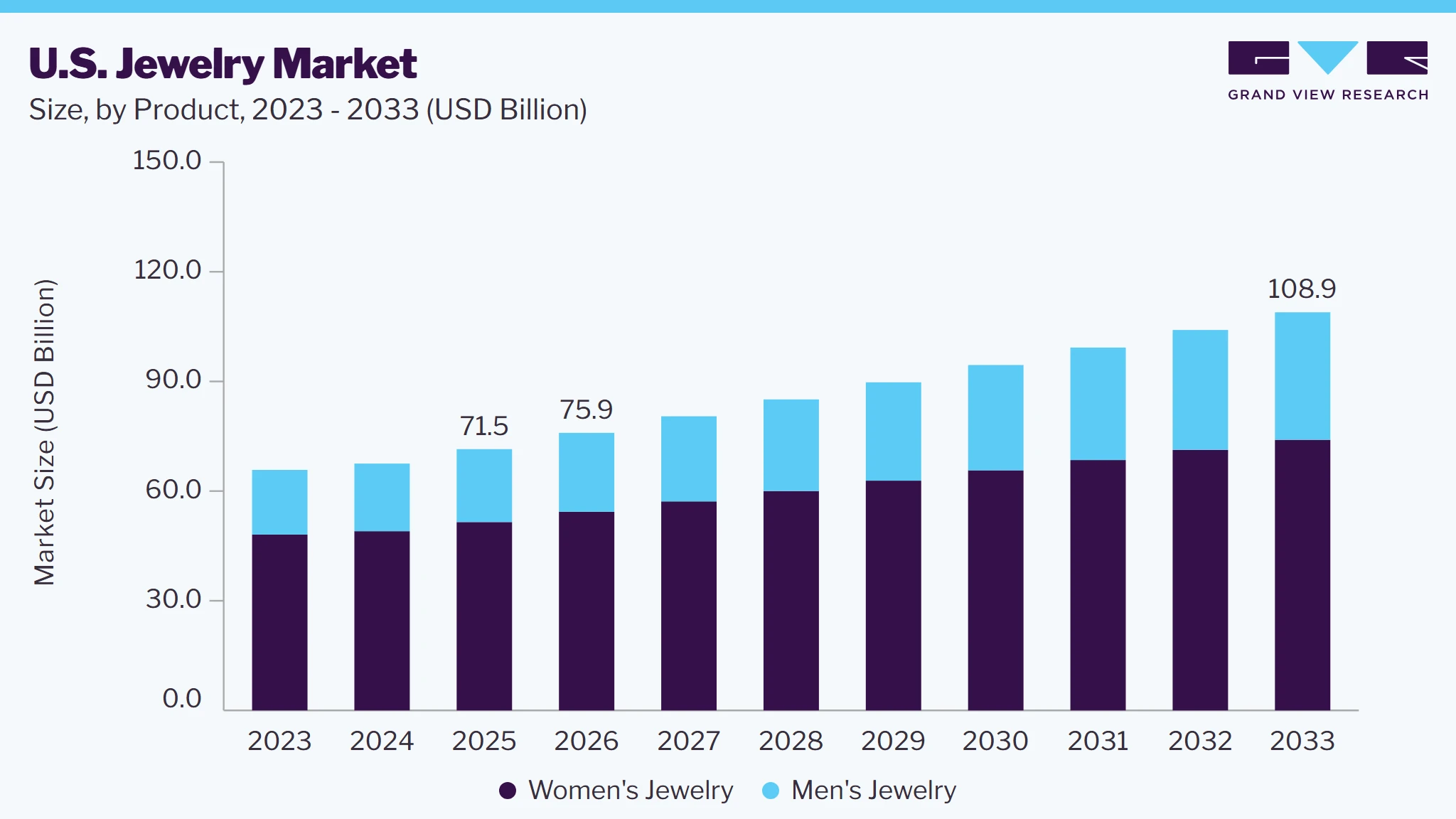
The U.S. jewelry market size was valued at USD 71.5 billion in 2025 and is projected to grow from USD 75.9 billion in 2026 to USD 108.9 billion in 2033, at a CAGR of 5.3% from 2026 to 2033. The market growth is driven by rising demand for premium and personalized jewelry, increasing consumer preference for high-quality craftsmanship and branded products, and sustained purchases for gifting, engagements, weddings, and other milestone occasions.
Key Market Trends & Insights
- By product: Women's jewelry held the largest revenue share of 72.1% in 2025.
- By jewelry type: Fine jewelry held the largest revenue share of 90.1% in 2025.
- By surface finish type: Polished/high polished held the largest revenue share of 44.5% in 2025.
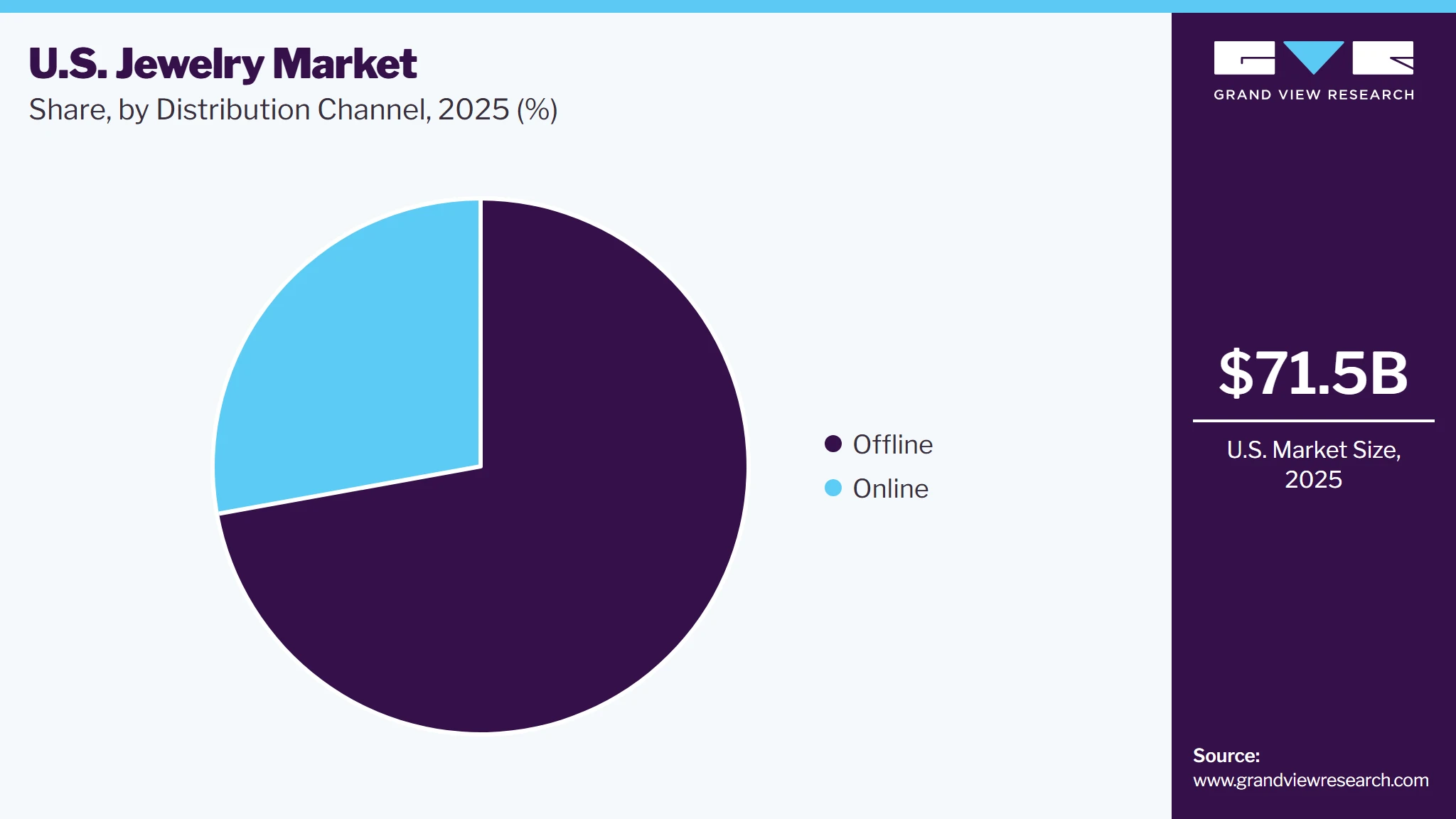
- By distribution channel: Sales through offline held the largest revenue share of 72.2% in 2025.
Market Size & Forecast
- Market Size in 2025: USD 71.5 billion
- Estimated market size in 2026: USD 75.9 billion
- Projected market size by 2033: USD 108.9 billion
- CAGR (2026-2033): 5.3%
Three ways to get this report
Buy it, customize it, or ask a question.Ask an Analyst
Analyst response in 1 business day
- AccessReport author, directly
- Reply timeWithin 1 working day
- No sales callDirect answer only
- FormatEmail reply
- CostFree, no cost
Get the Full Report
What the study covers
- FormatsPDF · Excel · Dashboard
- Timeline2026–2033 annual, 2025 base
- Coverage20+ countries, 5 regions
- Companies10+ key players profiled
Customize the Report
20% free customization
- IncludeCountries, segments, points
- TailorTo your product definition
- ExtendDeeper competitor detail
- OrA fully bespoke study
- Turnaround5–10 working days
Rising U.S. consumer spending on gifting, celebrations, and milestone occasions is driving demand for jewelry across bridal, fashion, and personal-use categories. According to the National Retail Federation (NRF), U.S. consumers were expected to spend a record USD 27.5 billion on Valentine’s Day in 2025, including USD 6.5 billion on jewelry, highlighting the importance of occasion-based purchases in jewelry demand.
 Source: Grand View Research, IR Documents, Primary Interviews, Paid DatabasesTo learn more about this report,
 Download Free Sample Report
This spending trend is strengthening demand for rings, necklaces, earrings, and bracelets as consumers increasingly purchase jewelry for engagements, weddings, anniversaries, holidays, and personal gifting. The continued role of jewelry in major gifting occasions is expanding purchase frequency beyond traditional bridal demand and supporting sales across both fine and fashion jewelry categories.
The shift toward self-expression and personalization is creating additional demand for differentiated jewelry products. Consumers are increasingly seeking pieces featuring customized names, dates, initials, birthstones, distinctive designs, and stackable formats that reflect individual identity and personal milestones. Industry supplier Stuller identified personalization and lab-grown diamond jewelry as two major jewelry trends for 2025, noting that customization allows consumers to create pieces that reflect personal stories and individual preferences.
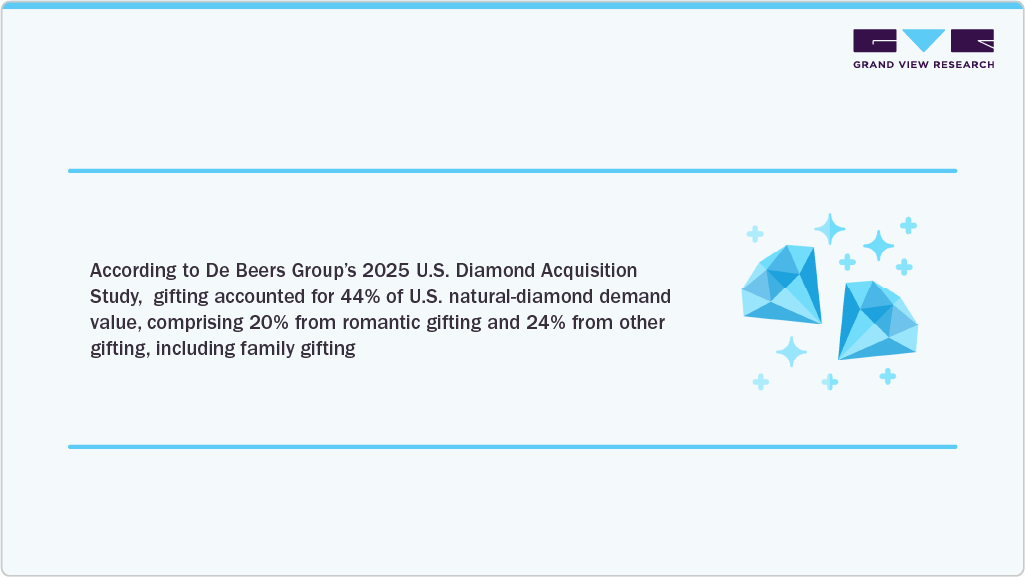
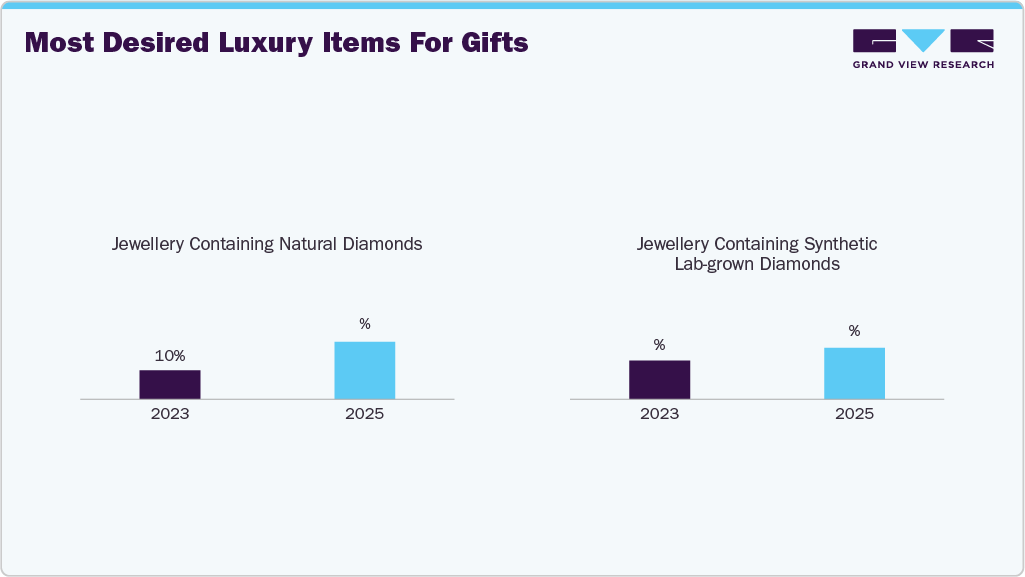
The broader importance of gifting within jewelry demand is further reflected in U.S. diamond purchasing behavior.
 To learn more about this report, Download Free Sample Report
 To learn more about this report, Download Free Sample Report
The shift toward self-expression and personalization is creating additional demand for differentiated jewelry products. Consumers are increasingly seeking pieces featuring customized names, dates, initials, birthstones, distinctive designs, and stackable formats that reflect individual identity and personal milestones. Industry supplier Stuller identified personalization and lab-grown diamond jewelry as two major jewelry trends for 2025, noting that customization allows consumers to create pieces that reflect personal stories and individual preferences.
This trend is expanding jewelry consumption beyond traditional gifting and bridal occasions toward self-purchase and everyday wear. Consumers are increasingly purchasing gold chains, stacking rings, earrings, bracelets, and diamond-studded pieces for personal styling, enabling jewelry brands to capture demand across a broader range of purchase occasions. The growing importance of self-purchase is also evident in the U.S. diamond market, where non-bridal purchases, including gifting and self-purchase, represented 75% of natural diamond demand by value in 2025, according to reporting based on De Beers' U.S. Diamond Acquisition Study.
Market Dynamics
Rising U.S. consumer spending on gifting, celebrations, and milestone occasions is driving demand for jewelry across bridal, fashion, and personal-use categories. During the 2025 Thanksgiving-to-Cyber Monday period, 202.9 million U.S. consumers shopped, with average spending reaching USD 338 per shopper, of which 67% was allocated to gifts. Jewelry was purchased by 14% of shoppers, while 18% planned to give jewelry as a holiday gift and 19% expected to receive jewelry, highlighting the established role of jewelry within the U.S. gifting market. This sustained spending on gifting occasions is supporting demand for rings, necklaces, earrings, and bracelets while expanding jewelry purchases beyond traditional bridal occasions into holiday gifting and personal consumption.
The scale of these relationship-driven occasions is evident in major U.S. gifting events. According to the National Retail Federation (NRF):
Valentine's Day represents a significant romantic-gifting occasion, with 25% of consumers planning to purchase jewelry in 2026, and jewelry spending expected to reach USD 7.0 billion.
Similarly, Mother's Day demonstrates the scale of family-oriented gifting, with USD 7.5 billion expected to be spent on jewelry in 2026, making it the largest spending category for the occasion.
Elevated gold prices are increasing jewelry costs and creating affordability pressures for U.S. consumers, particularly in the mass and mid-priced segments. According to the World Gold Council, U.S. gold jewelry demand declined 11.1% in volume to 117.3 tonnes in 2025 from 131.9 tonnes in 2024, as higher gold prices weighed on purchases.
The impact is also evident among independent jewelers, with JCK reporting a 16% decline in gold jewelry unit sales in 2025, while gold prices increased by approximately 66% during the year. Higher prices are encouraging consumers to opt for lighter-weight pieces or lower-priced alternatives, while potentially delaying discretionary purchases, thereby constraining unit demand in the U.S. jewelry market.
The growing acceptance of lab-grown diamonds presents an opportunity for brands in the U.S. jewelry market to expand their consumer base by offering diamond jewelry at more accessible price points. A 2025 Plumb Club consumer survey found that 74% of respondents were open to receiving a lab-grown diamond engagement ring, while 83% were open to receiving lab-grown diamond fashion jewelry, indicating growing consumer acceptance beyond traditional bridal purchases.
The expanding acceptance of lab-grown diamonds also enables the jewelry industry to introduce larger stones, personalized designs, and fashion-oriented products at comparatively lower price points. As consumers increasingly consider lab-grown diamonds for both engagement and everyday jewelry, brands and retailers can leverage the category to broaden their product assortments, attract younger and value-conscious consumers, and create additional growth opportunities in the jewelry market.
Consumer Insights
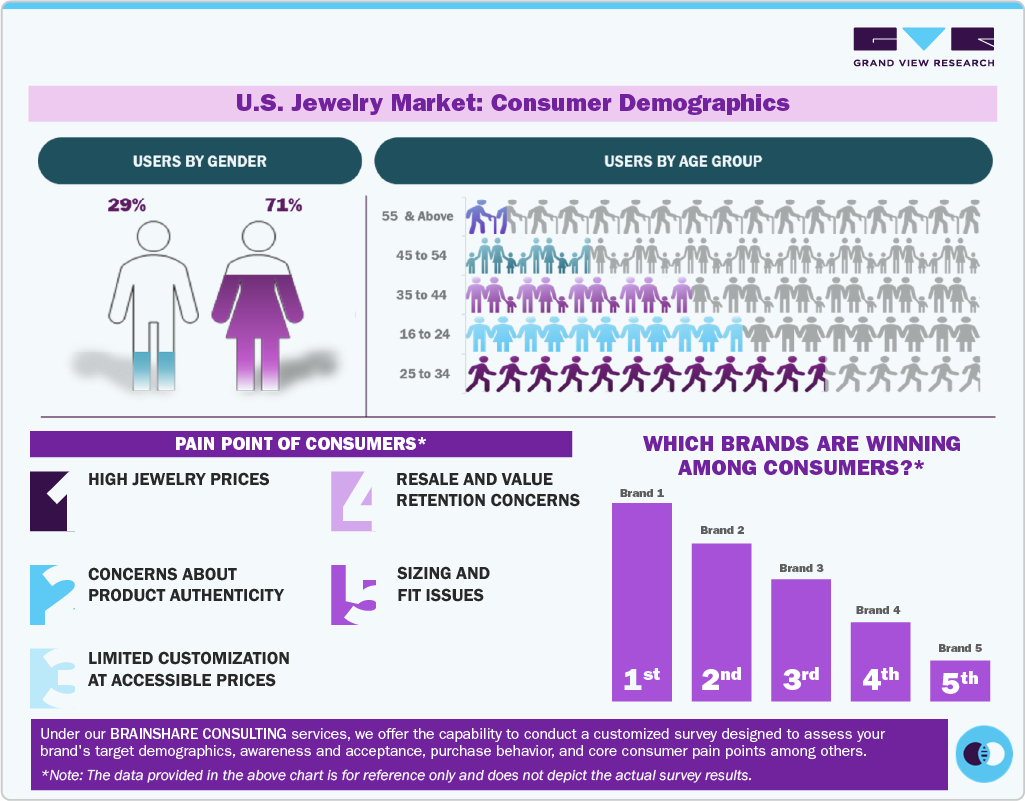
The U.S. jewelry industry serves consumers across genders and age groups, with purchasing behavior influenced by gifting occasions, personal preferences, lifestyle, and spending capacity. The consumer base shows broad participation across demographic groups, supporting demand for a range of jewelry products, from everyday and fashion pieces to bridal and premium pieces.
 To learn more about this report, Download Free Sample Report
Users by Gender:
-
Women accounted for 71% of the U.S. jewelry market revenue in 2025, reflecting strong demand for jewelry across categories such as rings, earrings, necklaces, and bracelets. Purchases are supported by fashion trends, personal adornment, gifting, and demand for fine and fashion jewelry.
-
Men accounted for 29% of the U.S. jewelry industry revenue in 2025, supported by increasing demand for products such as rings, chains, bracelets, and other jewelry accessories. Growing interest in personal styling and premium jewelry is also contributing to demand within this segment.
Users by Age Group:
Consumers aged 25-34 represent the largest user group in the U.S. jewelry market, supported by demand for engagement rings, fashion jewelry, personalized products, and self-purchase. Consumers aged 16-24 form an important segment, with demand primarily driven by affordable fashion jewelry, personalized pieces, and trend-oriented products influenced by digital platforms and social media. Consumers aged 35-44 contribute to demand for fine jewelry, bridal products, gifting, and premium pieces, supported by increasing purchasing power. Consumers aged 45-54 show demand for premium jewelry, gifting, and celebration-related purchases. Meanwhile, consumers aged 55 and above contribute to demand for fine jewelry, premium products, and occasion-based purchases, with greater emphasis on quality, craftsmanship, and value retention.
Consumers in the U.S. jewelry industry commonly face several challenges when purchasing jewelry:
-
High jewelry prices can limit affordability, particularly for gold, diamond, and other precious metal jewelry.
-
Concerns about product authenticity can make consumers cautious about the quality and authenticity of diamonds, gemstones, and precious metals.
-
Limited customization at accessible prices can restrict demand for personalized jewelry among price-sensitive consumers.
-
Resale and value-retention concerns can influence purchasing decisions, particularly for high-value jewelry.
-
Sizing and fit issues can create challenges when purchasing rings, bracelets, and other jewelry, particularly through online channels.
Consumer Preferences:
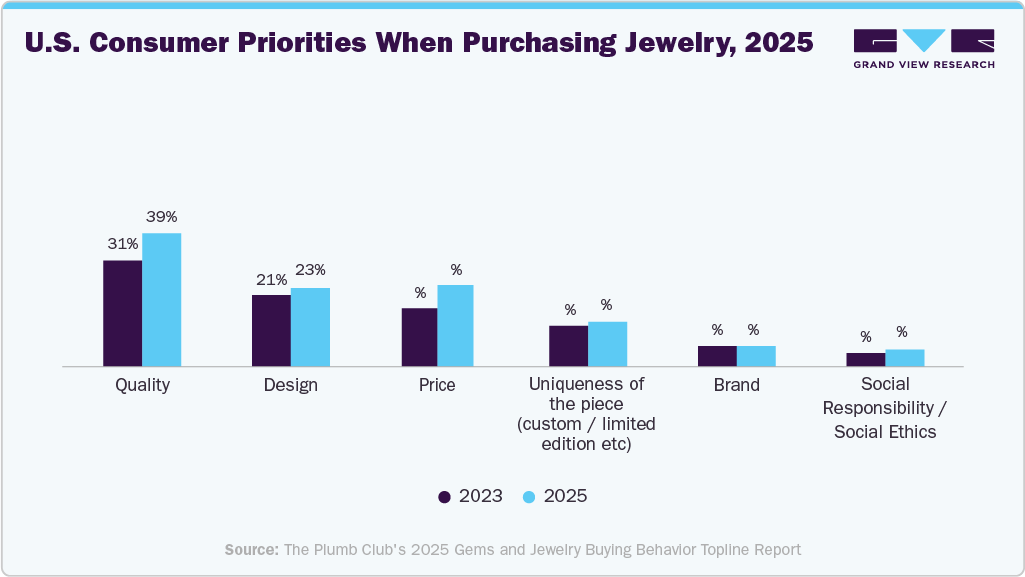 To learn more about this report, Download Free Sample Report
Quality
Design
Price
Brand
Quality is the leading purchase priority:
Design and uniqueness add a strong layer of differentiation:
Price remains an important consideration
Brand and responsible sourcing remain secondary but relevant considerations
In 2025, 39% of consumers ranked quality as the most important jewelry attribute, well ahead of design at 21% and price at 17%.
Design accounted for 21% of consumer priorities, while 13% cited uniqueness, including custom and limited-edition pieces with unique gemstones.
24% of consumers identified price as the most important element when purchasing new jewelry, making it the second-ranked consideration after quality.
Brand was identified by 6% of consumers as the most important purchase factor, while social responsibility/social ethics accounted for only 5%.
This reinforces that product quality remains the primary basis for jewelry selection.
This indicates that consumers evaluate jewelry not only on quality but also on its visual appeal and distinctiveness.
This indicates that price remains relevant to purchase decisions, but ranks behind core product attributes.
This suggests that brand and responsible sourcing complement core product attributes, but are less prominent as primary purchase priorities.
Analyst Perspective
The U.S. jewelry market is evolving toward more personalized, versatile, and experience-driven purchasing, with consumers increasingly viewing jewelry as a form of self-expression, gifting, and personal celebration. Demand is supported by interest in fine jewelry, accessible luxury, personalized designs, and lab-grown diamonds, as well as the continued importance of bridal and milestone purchases. Retailers are expanding product assortments, omnichannel capabilities, customization services, and digital shopping experiences while offering products across a broader range of price points to address changing consumer preferences.
Product Insights
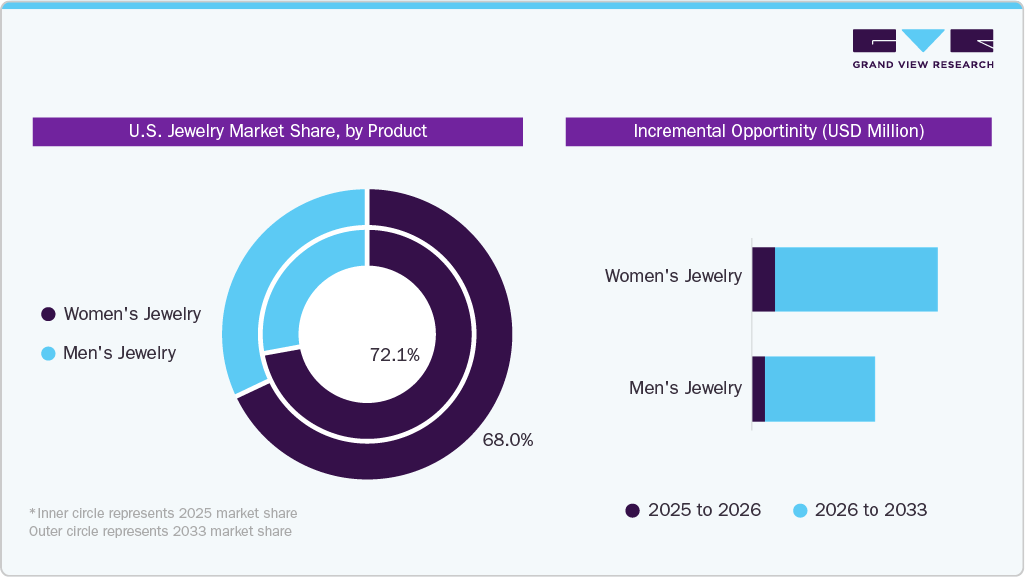
The women's jewelry segment dominated the U.S. jewelry market, accounting for a revenue share of 72.1% in 2025, reflecting its broad consumer appeal and diverse applications across everyday wear, gifting, celebrations, and personal expression. The category includes earrings, rings, bracelets, anklets, chains, necklaces, and other jewelry formats, enabling brands across the market to cater to varied styles, occasions, and price points. Self-purchasing is also contributing to sustained demand for women’s jewelry beyond traditional gifting occasions. According to Jewelers Mutual’s self-purchaser research, 32% of female respondents purchased jewelry for themselves less than once a year, 36% once a year, and 23% two to three times a year, indicating a meaningful level of recurring self-purchase. This behavior reinforces the role of jewelry as a product for personal celebration, self-expression, and everyday styling, supporting continued demand within the jewelry market and creating opportunities for the jewelry industry to expand collections targeting personal purchases.
 To learn more about this report, Download Free Sample Report
Men's Jewelry is expected to grow at a CAGR of 7.1% from 2026 to 2033, supported by growing consumer interest in self-expression, personalized styling, and jewelry as an everyday accessory. Men are increasingly incorporating chains, bracelets, rings, watches, and mixed-material designs into their personal styles, encouraging retailers to expand assortments and develop collections for different lifestyles and occasions. This shift is also reflected in retail expansion. At Kay Jewelers, units sold in the men’s jewelry category increased 9% from fiscal 2025 to fiscal 2026, prompting the retailer to roll out dedicated men’s jewelry and watch shops across approximately 200 locations. The expansion reflects growing retail focus on men’s jewelry and increasing demand for versatile designs centered on individuality and everyday styling. Self-purchasing is further supporting demand in the U.S. market, with watches, necklaces, and rings among the products commonly purchased by men for themselves. Consumer purchasing patterns indicate that 68% of men purchased a watch, 65% purchased a necklace, and 62% purchased a ring for themselves, highlighting demand across both traditional and contemporary accessories. This trend creates opportunities for the jewelry industry to expand collections featuring personalization, versatile designs, premium materials, and products suited to different lifestyles and occasions.
Jewelry Type Insights
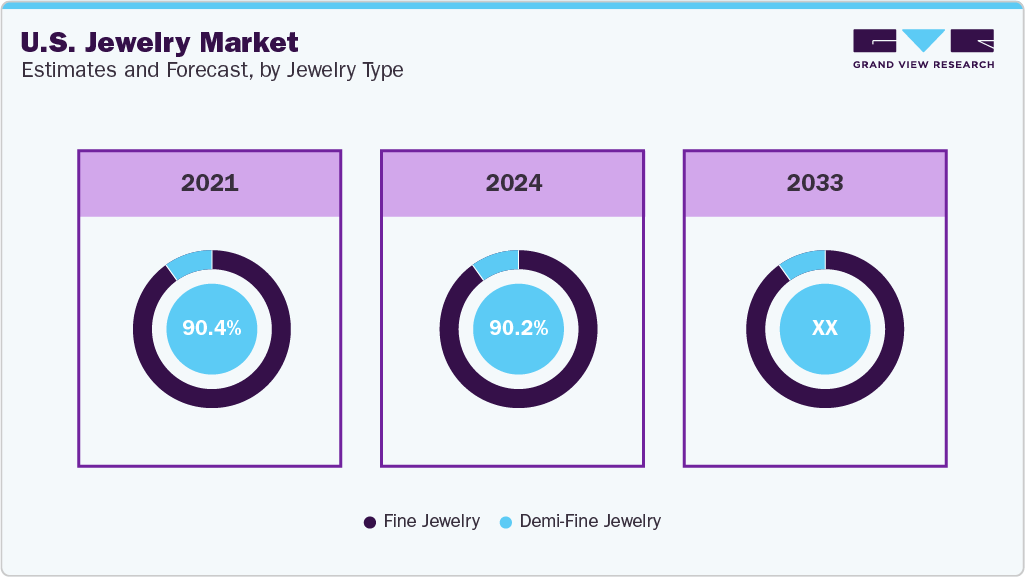
Fine Jewelry dominated the U.S. jewelry industry, accounting for a revenue share of 90.1% in 2025, reflecting its widespread adoption across gifting, bridal, milestone, and self-purchase occasions. Self-purchasing is increasingly supporting demand as consumers view fine jewelry as a form of personal expression, self-reward, and celebration rather than limiting purchases to traditional gifting occasions. According to a December 2025 BriteCo survey, 80% of American adults aged 18 and above reported purchasing fine jewelry for themselves, highlighting the growing importance of self-purchase in the market.
 To learn more about this report, Download Free Sample Report
This behavior is further supported by the finding that 17% of respondents do not always require a specific reason to purchase fine jewelry for themselves, while other self-purchases are associated with life achievements, milestones, and self-appreciation. The shift is broadening demand beyond traditional gifting and relationship-driven purchases, creating opportunities for the jewelry industry to position fine jewelry as an accessible form of personal celebration and everyday luxury. Brands and retailers can capitalize on this trend through personalized collections, achievement-focused campaigns, and versatile designs suited to work, social occasions, and milestone moments.
Demi-fine jewelry is expected to grow at a CAGR of 6.1% from 2026 to 2033, supported by rising consumer interest in accessible luxury, contemporary designs, and durable jewelry priced below traditional fine jewelry. Demi-fine jewelry occupies a position between fine jewelry and lower-priced fashion or costume jewelry, commonly using materials such as gold-plated silver or bronze, gold vermeil, sterling silver, semi-precious gemstones, cubic zirconia, and lab-grown diamonds. The category is gaining relevance as consumers seek trend-oriented pieces without the higher cost of solid gold or platinum, while elevated gold prices are further encouraging consumers to consider comparatively affordable alternatives for everyday wear.
The growing relevance of demi-fine jewelry is also reflected in expanding company offerings. Michael Hill’s pure-play Medley business recorded 31% year-over-year sales growth and continued testing new products in the demi-fine jewelry category, highlighting efforts to reach broader consumer segments and expand its product offerings. In addition, Stuller expanded its demi-fine jewelry assortment in June 2026 with sterling silver, 18-karat gold-plated, 14-karat gold-filled, and vermeil pieces, targeting consumers seeking attainable luxury and versatile everyday styling. These developments demonstrate how the jewelry industry is expanding demi-fine collections across accessible materials and contemporary designs, creating additional opportunities within the market.
Surface Finish Type Insights
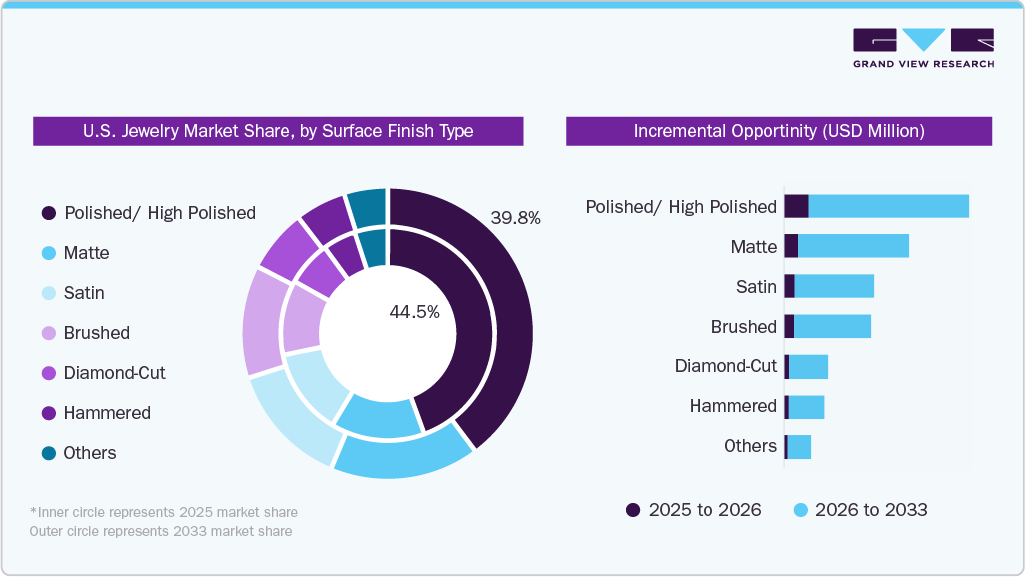
Polished/high-polished surface finish accounted for the largest revenue share of 44.5% in 2025, reflecting its widespread use in jewelry designs and its ability to enhance the appearance of precious metals and gemstones with a smooth, reflective surface. Its versatility across rings, necklaces, earrings, bracelets, and wedding jewelry supports its prominence in the U.S. jewelry market. In April 2026, U.S. retailer Robinson’s Jewelers identified the combination of high-polish and matte finishes as a notable design trend in the jewelry market. High-polish surfaces are used to capture and reflect light, while matte and satin finishes add texture and visual contrast. The combination is being incorporated into wedding bands, engagement rings, necklaces, earrings, and bracelets, including designs with high-polish edges and matte or satin centers. This design approach enables the jewelry industry to offer products with greater visual depth and differentiation while maintaining versatility for everyday wear.
 To learn more about this report, Download Free Sample Report
Matte surface finish is expected to grow at a CAGR of 7.2% from 2026 to 2033, driven by growing interest in understated textures, contemporary designs, and distinctive surface treatments within the market. Matte finishes provide a softer, less reflective appearance than polished surfaces, making them suitable for minimalist, organic, and sculptural jewelry designs. This trend is reflected in Satomi Kawakita Jewelry’s Autumn/Winter 2025 collection, which includes the 3.8mm Lithe Band and Terra Band in 18K yellow gold with textured matte finishes. Similarly, Loni Paul Jewelry offers a Matte Gold Lariat Necklace featuring a matte finish and flat rectangular links. These offerings demonstrate how the jewelry industry is incorporating matte surfaces across rings and necklaces to create subdued visual effects while emphasizing contemporary shapes and tactile detailing. This expanding use of matte finishes is broadening design options within the jewelry market.
Distribution Channel Insights
Offline distribution channel dominated the U.S. jewelry industry, accounting for a revenue share of 72.2% in 2025, reflecting the continued importance of physical retail in the market, where consumers can examine jewelry in person, assess craftsmanship and materials, determine fit, and access services such as customization, resizing, cleaning, repairs, and personal consultations. The offline channel includes specialized jewelry stores, mass merchandisers, department stores, brand-owned stores, and other physical retail formats such as gift shops, specialty boutiques, craft and artisan stores, independent specialty retailers, and antique jewelry dealers. The breadth of this retail network is reflected in the 27,638 retail and wholesale jewelry businesses operating in the U.S. in 2023, employing 147,539 people, according to data cited by Jewelers of America from the U.S. Bureau of Labor Statistics. Independent specialty retailers also remain an important part of the jewelry industry, particularly outside the leading national sellers, supporting the continued role of physical stores within the jewelry market.
 To learn more about this report, Download Free Sample Report
The online distribution channel segment is expected to grow at a CAGR of 7.4% from 2026 to 2033, supported by increasing consumer adoption of digital shopping and the expanding online presence of major retailers in the U.S. jewelry market. Online platforms provide consumers with access to broader product assortments, convenient product comparison, and flexible purchasing options without requiring visits to physical stores. The growing importance of online distribution is also reflected in the digital operations of Signet Jewelers, which operates online platforms across brands including Kay, Zales, Jared, Diamonds Direct, Banter by Piercing Pagoda, Rocksbox, James Allen, and Blue Nile. In fiscal 2026, virtual inventory accounted for approximately 51% of North American segment e-commerce sales, enabling supplier merchandise to be displayed on Signet’s websites without the company physically holding it. This model enables the jewelry industry to expand digital assortments, improve product availability, and provide consumers with greater choice within the jewelry market.
Key U.S. Jewelry Brand & Company Insights
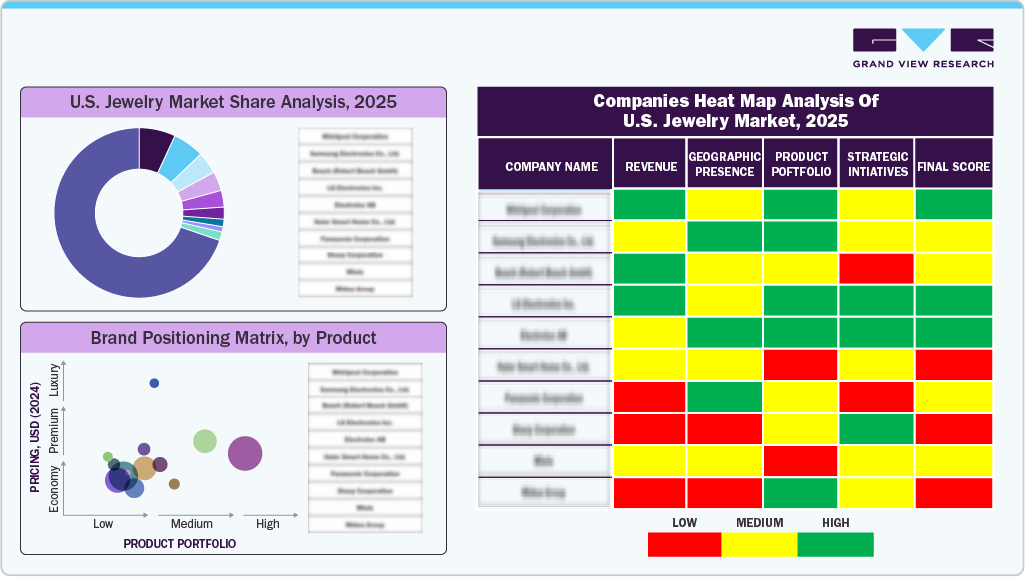
The U.S. jewelry market is characterized by competition among luxury jewelry houses, established jewelry retailers, branded lifestyle jewelry companies, and accessible fashion jewelry brands. Competition is primarily shaped by brand heritage, product design, material quality, pricing, retail presence, brand exclusivity, and the ability to attract consumers across gifting, self-purchase, and occasion-based purchases. Companies differentiate themselves through distinctive collections, personalized shopping experiences, omnichannel retail strategies, and product offerings spanning fine jewelry, fashion jewelry, watches, and accessories.
-
Luxury Jewelry Houses: Tiffany & Co, Cartier International SNC, Bulgari S.p.A., and David Yurman Enterprises LLC compete in the premium segment through distinctive designs, craftsmanship, brand heritage, and high-value product collections. Tiffany emphasizes diamond jewelry, engagement rings, and iconic collections, while Cartier leverages signature designs and heritage-led positioning across fine jewelry and watches. Bulgari differentiates itself through bold designs, colored gemstones, and Italian luxury aesthetics, whereas David Yurman combines sculptural designs with recognizable cable-inspired jewelry, attracting consumers seeking distinctive luxury accessories.
-
Established Jewelry Retailers: Kay Jewelers competes through a broad assortment of engagement rings, wedding bands, diamond jewelry, and everyday jewelry across multiple price points. Its established retail presence and focus on milestone purchases, gifting, financing options, and in-store customer service support its position in the U.S. Jewelry Market. The brand also serves consumers seeking accessible fine jewelry and personalized assistance when purchasing products for engagements, anniversaries, and other special occasions.
-
Branded Fashion & Lifestyle Jewelry Companies: Pandora A/S, Swarovski AG, and Alex and Ani, LLC compete through recognizable brand identities, gift-oriented collections, and products that appeal to consumers seeking expressive and accessible jewelry. Pandora focuses on customizable charm bracelets, rings, necklaces, and other personal jewelry, while Swarovski combines crystal craftsmanship with fashion-led jewelry and accessories. Alex and Ani differentiates itself through symbolic designs, charm bracelets, and personalization-focused collections, appealing to consumers seeking jewelry with personal meaning and for gifting.
-
Contemporary & Accessible Jewelry Brands: Gorjana & Griffin, Inc. and Anne Klein & Brand target consumers seeking versatile jewelry designs suitable for everyday wear, gifting, and styling across different occasions. Gorjana emphasizes minimalist, layered gold jewelry and contemporary designs, while Anne Klein leverages its fashion heritage through accessible jewelry and coordinated accessories. These brands compete through design versatility, accessible price positioning, brand recognition, and product collections aligned with changing fashion preferences.
 To learn more about this report, Download Free Sample Report
Key U.S. Jewelry Companies
-
Tiffany & Co
-
Cartier International SNC
-
Kay Jewelers
-
David Yurman Enterprises LLC
-
Bulgari S.p.A.
-
Pandora A/S
-
Swarovski AG
-
Alex and Ani, LLC
-
Anne Klein & Brand
-
Gorjana & Griffin, Inc.
Competitive Benchmarking
Category
Operating Strategies
Competitive Edge
Key Challenges
Established Players (Tiffany & Co; Cartier International SNC; Kay Jewelers; David Yurman Enterprises LLC; Bulgari S.p.A.)
- Focus on strengthening brand positioning through fine jewelry collections, signature designs, premium materials, and craftsmanship. Luxury brands invest in exclusive retail experiences, personalized services, and heritage-led marketing, while Kay Jewelers focuses on bridal jewelry, gifting, and accessible fine jewelry across multiple price points.
- Strong brand recognition, established customer relationships, distinctive product designs, and consumer trust. Luxury players benefit from heritage and exclusivity, while Kay Jewelers leverages its retail presence, broad product assortment, and focus on engagement rings and milestone purchases.
- High product prices can limit the consumer base for luxury brands, while changing discretionary spending affects jewelry purchases. Players must also manage inventory costs, counterfeiting risks, evolving consumer preferences, and competition from online retailers and emerging jewelry brands.
Fashion & Lifestyle Jewelry Players (Pandora A/S; Swarovski AG; Alex and Ani, LLC)
- Focus on recognizable designs, personalization, gifting-oriented collections, and fashion-led product development. These companies introduce seasonal collections, expand product assortments, and use brand storytelling and omnichannel retail strategies to reach consumers seeking expressive jewelry and accessories.
- Strong brand identities, distinctive design elements, gifting appeal, and products suited to everyday styling. Customizable jewelry, crystal-based designs, and symbolic accessories help differentiate their offerings and attract consumers across different purchasing occasions.
- Changing fashion trends require continuous product innovation and effective inventory management. Competition from affordable jewelry alternatives, fluctuating discretionary spending, and the need to maintain brand relevance can affect customer retention and sales performance.
Recent Developments
-
In August 2026, TOTWOO launched its AI-enabled Smart Locket in the U.S., combining jewelry with digital memories and generative AI experiences. The locket is available in amethyst, gold-plated, and sterling-silver versions, with prices starting at USD 149.
-
In June 2026, Tiffany & Co. launched its Blue Book 2026: Hidden Garden Summer Expression high-jewelry collection, featuring sculptural designs inspired by birds, flowers, tropical forms, and nature. The collection incorporates diamonds, yellow gold, platinum, and colored gemstones.
-
In March 2026, Angara launched the Lee Harris x Angara fine-jewelry collection in collaboration with celebrity stylist Lee Harris. The 76-piece collection includes statement earrings, sculptural rings, tennis bracelets, ear cuffs, gemstone bracelets, long necklaces, and deco-inspired studs, with styles starting below USD 1,000. The collection emphasizes bold gemstone shapes, unexpected color combinations, and architectural designs, including emerald cuts paired with cushion cuts, baguettes with round stones, and multi-shape clusters. Two primary color stories feature blue gemstones such as aquamarine and London blue topaz accented with pink tourmaline and amethyst, alongside a warm palette combining citrine, peridot, aquamarine, and amethyst.
U.S. Jewelry Market Report Scope
Report Attribute
Details
Market size in 2026
USD 71.5 billion
Estimated market size in 2026
USD 75.9 billion
Projected market size by 2033
USD 108.9 billion
Growth rate
CAGR of 5.3% from 2026 to 2033
Base year
2025
Actuals
2021 - 2025
Forecast period
2026 - 2033
Quantitative units
Revenue in USD million/billion and CAGR from 2026 to 2033
Report coverage
Revenue forecast, company ranking, competitive landscape, growth factors, and trends
Segments covered
Product, jewelry type, surface finish type, and distribution channel
Key retailers profiled
Tiffany & Co; Cartier International SNC; Kay Jewelers; David Yurman Enterprises LLC; Bulgari S.p.A.; Pandora A/S; Swarovski AG; Alex and Ani, LLC; Anne Klein & Brand; Gorjana & Griffin, Inc.
Customization scope
Free report customization (equivalent up to 8 analysts’ working days) with purchase. Addition or alteration to country, regional & segment scope.
Pricing and purchase options
Avail customized purchase options to meet your exact research needs. Explore purchase options
U.S. Jewelry Market Report Segmentation
This report forecasts revenue growth at the country level and provides an analysis of the latest trends and opportunities in each of the sub-segments from 2021 to 2033. For this study, Grand View Research has segmented the U.S. jewelry market report based on product, jewelry type, surface finish type, and distribution channel.
-
Product Outlook (Revenue, USD Million/Billion, 2021 - 2033)
-
Women's Jewelry
-
Earrings
-
Rings
-
Bracelets
-
Anklets
-
Chains & Necklaces
-
Others
-
-
Men's Jewelry
-
Rings
-
Bracelets
-
Chains & Necklaces
-
Earrings
-
Others
-
-
-
Jewelry Type Outlook (Revenue, USD Million/Billion, 2021 - 2033)
-
Fine Jewelry
-
Gold
-
10K Gold
-
14K Gold
-
18K Gold
-
22K Gold
-
-
Platinum
-
Diamond
-
Natural Diamond
-
Lab-Grown Diamond
-
-
Silver
-
Others
-
-
Demi-Fine Jewelry
-
Sterling Silver
-
Gold Vermeil
-
Gold-Plated Sterling Silver
-
Gold-Filled
-
Stainless Steel
-
Semi-Precious Gemstones
-
Freshwater & Cultured Pearls
-
Lab-Grown Gemstones
-
Others
-
-
-
Surface Finish Type Outlook (Revenue, USD Million/Billion, 2021 - 2033)
-
Polished/ High Polished
-
Matte
-
Satin
-
Brushed
-
Hammered
-
Diamond-Cut
-
Others
-
-
Distribution Channel Outlook (Revenue, USD Million/Billion, 2021 - 2033)
-
Offline
-
Jewelry Stores
-
Mass Merchandisers
-
Department Stores
-
Brand-owned Stores
-
Others
-
-
Online
-
Brand-owned Websites
-
E-commerce Marketplaces & Retailers
-
-
Research Methodology
The U.S. jewelry market figures in this report are based on a proven research process that combines executive interviews with secondary research from proprietary databases, company filings, and recognized regulatory and institutional sources. Market size is built through value-chain sizing-reconciling supply-side and demand-side estimates-and triangulated with bottom-up and top-down approaches. Every estimate passes multiple levels of expert validation before publication, with each U.S. jewelry segment quantified using the revenue-capture definitions in the table below.
Segment Definition
Segment - Product
Revenue capture definition
Women’s Jewelry
This segment covers revenues generated through the sale of jewelry designed primarily for women, including rings, necklaces, earrings, bracelets, anklets, pendants, chains, and other personal adornments. Products include fine jewelry, fashion jewelry, bridal jewelry, personalized jewelry, and everyday wear pieces across different materials, designs, and price points. Revenue is captured from purchases made through offline and online retail channels, including specialized jewelry stores, department stores, brand-owned stores, mass retailers, and e-commerce platforms. The segment includes jewelry purchased for self-use, gifting, celebrations, bridal occasions, and personal expression.
Men’s Jewelry
This segment covers revenues generated through the sale of jewelry designed primarily for men, including rings, chains, necklaces, bracelets, pendants, cufflinks, earrings, and other accessories. Products range from traditional fine jewelry and wedding bands to fashion-oriented and personalized pieces using materials such as gold, silver, platinum, diamonds, gemstones, and alternative materials. Revenue is captured through specialized jewelry retailers, department stores, luxury stores, mass retailers, brand-owned stores, and online platforms. The segment includes purchases for self-use, gifting, weddings, celebrations, and everyday styling, with growing demand for jewelry as a personal fashion and self-expression accessory.
Estimation Model
Target Consumer Layer
Market Accessibility Layer
Purchase Behavior Layer
Monetization Layer
Who purchases jewelry?
Who can access jewelry products?
Who actively purchases jewelry?
How much revenue is generated?
Identify consumers who purchase jewelry for self-use, gifting, weddings, engagements, anniversaries, milestones, celebrations, fashion, and personal expression. The target pool includes women, men, younger consumers, working professionals, couples, gift purchasers, and high-income consumers seeking fine and luxury jewelry.
Filter the target population based on access to specialized jewelry stores, department stores, luxury boutiques, mass retailers, brand-owned stores, e-commerce platforms, marketplaces, and direct-to-consumer websites. Consider geographic availability, product assortment, price points, and accessibility of different retail formats.
Apply purchase-adoption rates based on income, gifting and milestone occasions, self-purchase behavior, fashion preferences, personalization, and demand for fine, fashion, bridal, and everyday jewelry. Consider purchase frequency and seasonal promotions when estimating active buyers.
Estimate market revenue by multiplying the number of active jewelry buyers by the average selling price (ASP), incorporating purchase frequency and differences in spending across fine, fashion, bridal, and luxury jewelry. The calculation also considers product mix, material value, gifting occasions, self-purchase, premiumization, and repeat purchases.
Delivered Customizations
This report has been delivered with the following In-depth customizations
CLIENT REQUEST
CUSTOMIZATION DELIVERED
VALUE ADDS
U.S. Jewelry Market Demand, Product Preferences & Consumer Behavior Analysis
Conducted a detailed assessment of jewelry demand across fine, fashion, bridal, luxury, and everyday-wear categories, including consumer preferences for personalization, craftsmanship, quality, and versatile designs.
Helps identify the key consumer preferences shaping purchasing decisions and supports product positioning across different jewelry categories and customer segments.
U.S. Jewelry Market Product Innovation, Design Trends, and Consumer Experience Analysis
Evaluated emerging jewelry design and product trends, including personalized jewelry, stackable and minimalist designs, lab-grown diamonds, mixed surface finishes, and digitally enabled shopping experiences. The analysis also considers the growing role of online research, virtual try-on, customization, and omnichannel services.
Provides insights into evolving product expectations and identifies areas where retailers and brands can differentiate through design innovation, customization, digital tools, and enhanced shopping experiences.
U.S. Jewelry Market Retail Distribution & Market Opportunity Assessment
Assessed growth opportunities across offline and online retail formats, including specialized jewelry stores, department stores, mass retailers, luxury retailers, direct-to-consumer platforms, and e-commerce marketplaces. The analysis considers physical product evaluation, personalized consultations, digital discovery, broader assortments, and flexible purchasing options.
Supports investment and expansion decisions by identifying channel-specific opportunities, changing consumer purchasing behavior, and the complementary role of physical and digital retail in jewelry purchasing.
Frequently Asked Questions About This Report
The U.S. jewelry market size was estimated at USD 78.40 billion in 2025 and is expected to reach USD 81.32 billion in 2026.
The U.S. jewelry market is expected to grow at a compound annual growth rate (CAGR) of 5.0% from 2026 to 2033 to reach USD 114.11 billion by 2033.
The diamond jewelry segment dominated the U.S. jewelry market, accounting for approximately 63.32% of total revenue in 2025, driven by strong consumer demand for premium, high-value jewelry products.
Some key players in the U.S. jewelry market include Tiffany & Co; Signet Jewelers; Vrai & Oro, LLC; Aether Diamonds; Brilliant Earth, LLC; HSternare; Swarovski AG; Harry Winston; CHANEL; Richemont
The U.S. jewelry market is driven by strong consumer demand for premium and fashion-forward accessories, supported by high brand consciousness and gifting culture. In addition, rising preference for personalized and luxury jewelry products is further sustaining market growth.
About the Author(s)
Clothing, Footwear & Accessories Research Team
Consumer Goods · Clothing, Footwear & AccessoriesThis report was authored by the clothing, footwear & accessories research team at Grand View Research - comprising two research analysts, one senior research analyst, and one industry expert - with specialized expertise in the clothing, footwear & accessories segment of the consumer goods industry. All findings are based on proprietary consumer goods databases, executive interviews, and regulatory analysis, subject to internal peer review prior to publication.
Last Updated:
Speak to Analyst

Customize this report to your needs - add regions, segments, or data points, with 20% free customization.
Or view our licence options:


ISO 9001:2015 & 27001:2022 Certified
We are GDPR and CCPA compliant! Your transaction & personal information is safe and secure. For more details, please read our privacy policy.


