
- Home
- »
- Digital Media
- »
-
U.S. Live Streaming Infrastructure Market Size Report, 2033GVR Report cover

U.S. Live Streaming Infrastructure Market (2026 - 2033)
Size, Share & Trends Analysis Report By Infrastructure Component (Cloud-Based Solutions, Content Delivery Network), By Deployment, By End-use (Media & Entertainment, Sports, Gaming, Education), And Segment Forecasts
Market Size, 2025
$6.4BMarket Estimate, 2026
$7.3BMarket Forecast, 2033
$19.1BCAGR, 2026–2033
14.7%U.S. Live Streaming Infrastructure Market Summary
The U.S. live streaming infrastructure market size was valued at USD 6.4 billion in 2025 and is projected to grow from USD 7.3 billion in 2026 to USD 19.1 billion by 2033, at a CAGR of 14.7% from 2026 to 2033. The market is increasingly adopting hybrid streaming architectures that combine cloud, on-premises, and edge infrastructure. This approach provides greater flexibility to manage varying workloads, latency requirements, and streaming traffic. It also helps providers optimize infrastructure costs while maintaining reliable content delivery.
Key Market Trends & Insights
- By infrastructure component: Content Delivery Network (CDN) segment held the largest share of 30.1% in 2025
- By deployment: Cloud segment held the largest revenue share of 55.1% in 2025
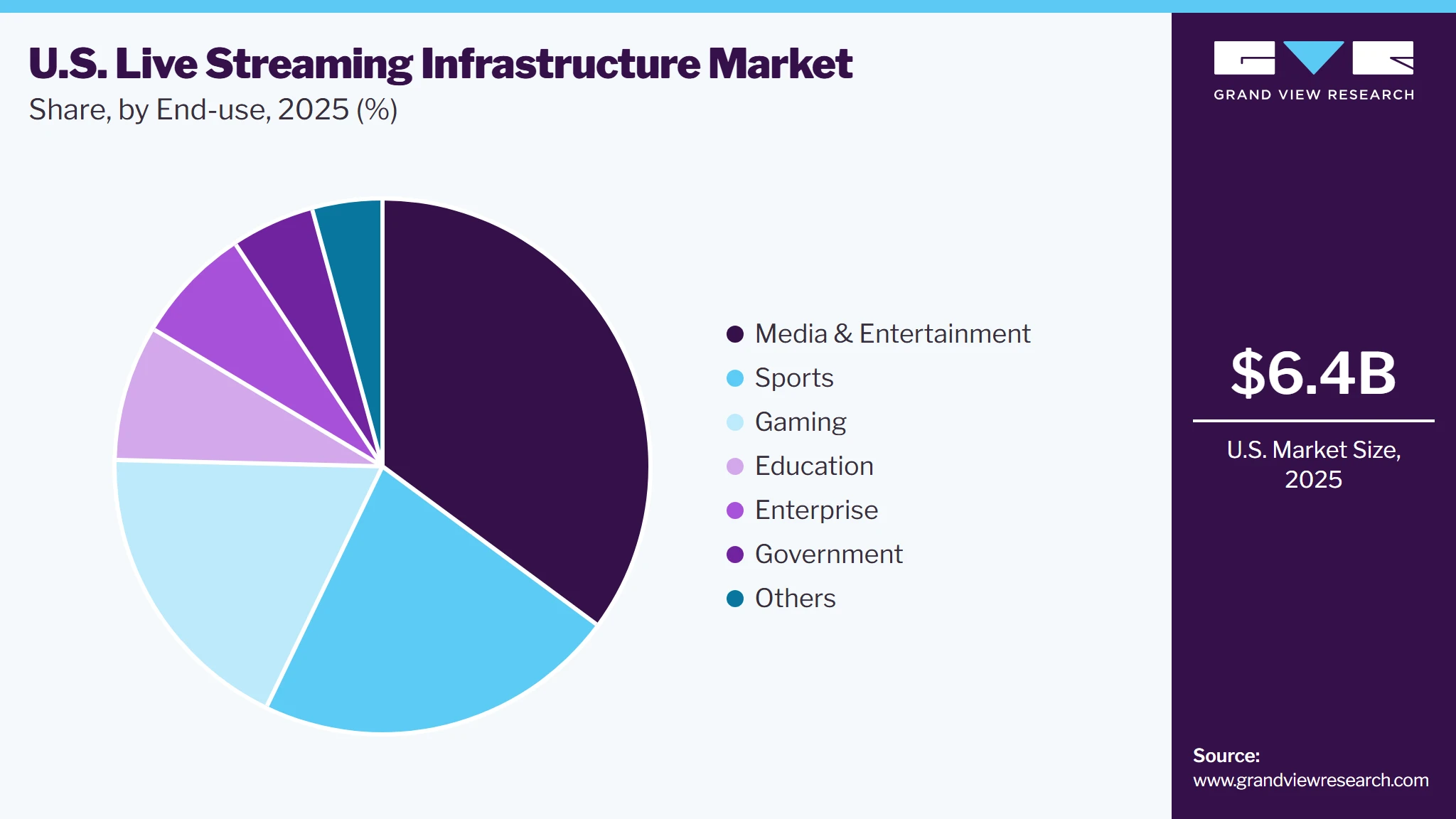
- By end use: Media & entertainment segment held the largest revenue share of 35.1% in 2025.
Market Size & Forecast
- Market Size in 2025: USD 6.4 Billion
- Estimated Market Size in 2026: USD 7.3 Billion
- Projected Market Size by 2033: USD 19.1 Billion
- CAGR (2026–2033): 14.7%
Three ways to get this report
Buy it, customize it, or ask a question.Ask an Analyst
Analyst response in 1 business day
- AccessReport author, directly
- Reply timeWithin 1 working day
- No sales callDirect answer only
- FormatEmail reply
- CostFree, no cost
Get the Full Report
What the study covers
- FormatsPDF · Excel · Dashboard
- Timeline2026–2033 annual, 2025 base
- Coverage20+ countries, 5 regions
- Companies10+ key players profiled
Customize the Report
20% free customization
- IncludeCountries, segments, points
- TailorTo your product definition
- ExtendDeeper competitor detail
- OrA fully bespoke study
- Turnaround5–10 working days
The U.S. live streaming infrastructure industry is increasingly adopting AI-powered video intelligence to analyze live streams in real time. This enables automated event detection, content monitoring, alerts, and actionable insights from live video. AI is also helping transform streaming infrastructure from a content-delivery system into an intelligent, data-driven platform. The integration of vision-language models and AI-based video analysis is further enabling streaming systems to understand complex scenes and respond to specific events based on contextual information. This is expanding applications across security, sports, transportation, industrial operations, and live events, where rapid detection and automated responses are increasingly important. In July 2026, Wowza Media Systems, LLC, a video streaming technology company, launched its Video Intelligence Framework (VIF), integrating real-time AI analysis directly into live-streaming workflows. The framework can detect objects and scenes, generate video insights, and trigger automated workflows based on events detected in live streams.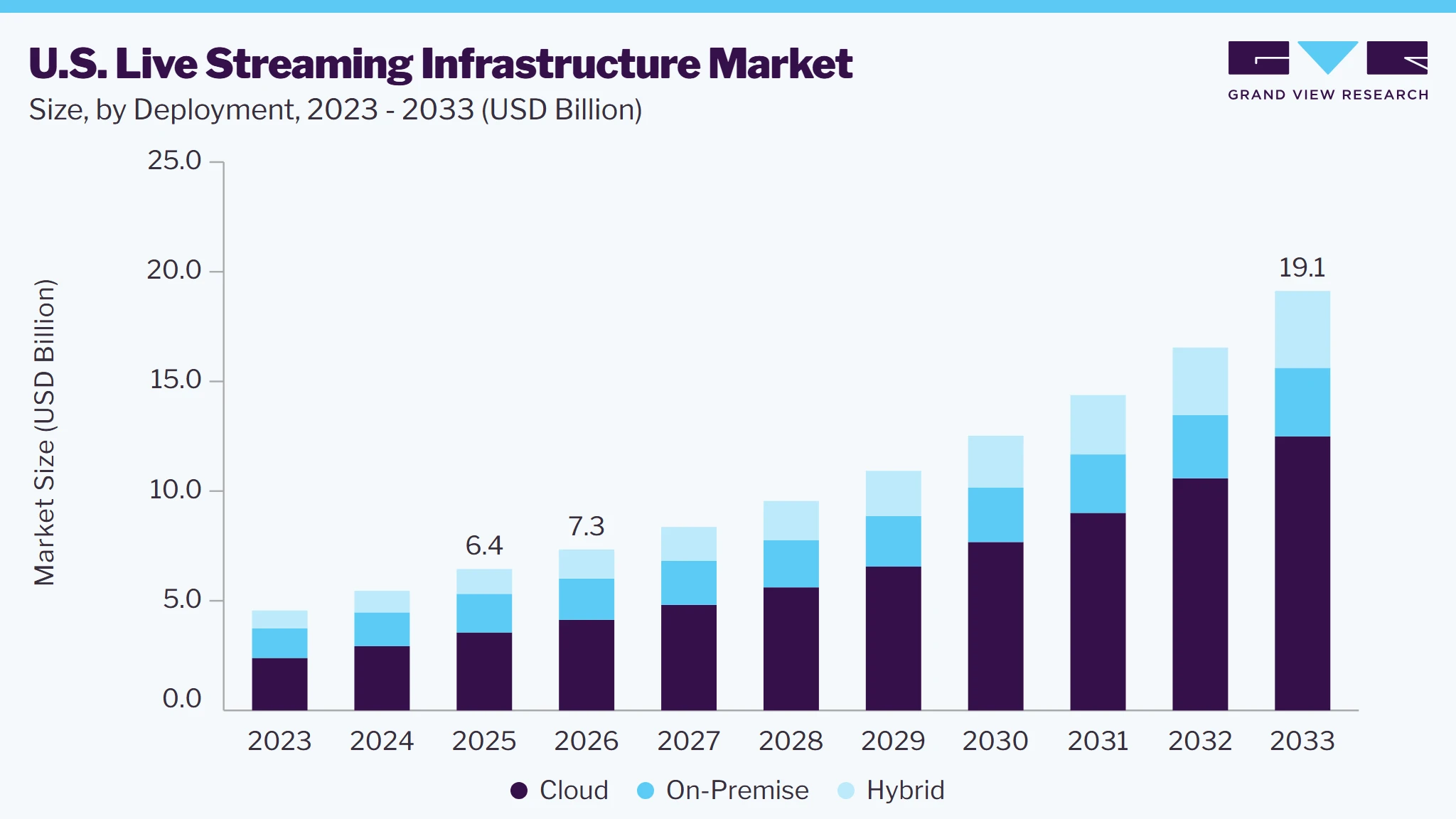 Source: Grand View Research, IR Documents, Primary Interviews, Paid DatabasesTo learn more about this report,
 Download Free Sample Report
 The U.S. live streaming infrastructure market is witnessing growing adoption of flexible and integrated OTT solutions that combine streaming delivery, app development, audience engagement, and monetization within a unified platform. Such solutions enable providers to launch OTT services faster, customize experiences across mobile, web, and connected-TV platforms, and scale services as audience demand grows. The integration of no-code development, partner ecosystems, and flexible monetization models is further enabling providers to reduce development complexity and adapt services without major changes to their underlying infrastructure. For instance, in February 2025, Brightcove Inc., a video streaming technology company, launched an enhanced Brightcove OTT solution in collaboration with Applicaster, introducing upgraded app experiences, improved streaming quality, and flexible monetization capabilities. The solution is designed to help media companies, sports organizations, and streaming providers reduce operational costs, accelerate OTT service deployment, and scale their streaming businesses efficiently.
The U.S. live streaming infrastructure industry is witnessing growing demand for ultra-low-latency streaming to support real-time applications. This trend is driven by the increasing popularity of live sports, gaming, and interactive streaming experiences. Streaming providers are adopting advanced content delivery technologies to minimize delays and improve viewer engagement. Edge computing is gaining importance as it enables content to be processed closer to users, reducing latency and improving streaming performance. The growing use of real-time video for live commerce and virtual events is further supporting demand for low-latency infrastructure. Providers are also focusing on improving network reliability to deliver uninterrupted streams during high-traffic events. The adoption of 5G networks and advanced video compression technologies is further improving real-time streaming capabilities and enabling higher-quality content delivery. These developments are encouraging investments in advanced streaming infrastructure across the U.S. market.
Market Dynamics
The U.S. live streaming infrastructure market is evolving with increasing emphasis on scalability, reliability, flexibility, and streaming performance. Growing digital content consumption is encouraging investments in infrastructure to support increasing live video traffic. Market participants are enhancing their solutions to improve service quality and manage changing workloads. The growing demand for seamless streaming experiences is encouraging continuous innovation across infrastructure and delivery solutions. These developments are expected to support the sustained market growth.
Growing digital content consumption is increasing demand for reliable live streaming infrastructure across various applications. The growing use of online video platforms is increasing the volume of live content delivered to audiences. According to the U.S. Census Bureau, 91.0% of U.S. households had a broadband Internet subscription, providing a broad connectivity base for the consumption of online and live video content. Consumers are also engaging with digital video content across multiple devices and platforms. This is encouraging providers to strengthen their streaming infrastructure to support higher traffic volumes. The need for consistent video quality is further increasing investments in scalable and reliable infrastructure.
The growing availability of live content is further expanding the need for efficient content delivery capabilities. Businesses are increasingly using live video to engage audiences and deliver real-time digital experiences. Higher streaming volumes require infrastructure capable of supporting large numbers of concurrent viewers. Providers are therefore enhancing their platforms to ensure reliable performance during periods of peak demand. This trend is increasing the importance of scalable and flexible streaming infrastructure solutions. As digital content consumption continues to rise, demand for supporting infrastructure is expected to grow steadily.
High infrastructure and operational costs can limit the adoption of live streaming infrastructure, particularly among smaller streaming providers. Building and maintaining streaming platforms requires substantial investment in servers, storage, bandwidth, computing capacity, and technical resources. These costs can increase as providers scale their platforms to support larger audiences, higher traffic volumes, and more live content. Smaller providers may therefore face difficulties allocating sufficient resources for advanced streaming infrastructure.
In addition, streaming platforms require continuous upgrades, maintenance, and technical support to ensure reliable performance and minimize service disruptions. Providers may need to expand network capacity, computing resources, and storage infrastructure as streaming demand increases. Such ongoing requirements can raise operating expenses and place pressure on the budgets of smaller providers. Consequently, high infrastructure and operational costs may restrain the adoption of advanced live streaming infrastructure solutions.
The growing adoption of live digital content in the U.S. is increasing demand for immersive and interactive streaming experiences, particularly across live sports, gaming, virtual events, live commerce, and creator-led content. U.S. streaming platforms are investing in low-latency delivery, real-time audience engagement, personalized content, and multi-platform distribution, thereby increasing demand for scalable, high-performance streaming infrastructure. The growing use of these applications is also encouraging providers to upgrade their infrastructure to deliver seamless experiences for large, geographically dispersed audiences.
The growing use of live streaming by enterprises, media companies, sports organizations, and digital platforms is further creating opportunities for advanced infrastructure solutions. Providers are investing in cloud-based infrastructure, content delivery networks, edge computing, and high-bandwidth connectivity to improve streaming quality and reduce latency. The rollout of 5G and the expansion of high-speed broadband networks are also supporting more reliable delivery of high-resolution and interactive live content. These developments are enabling streaming providers to support larger audiences and more complex content formats. Consequently, the increasing demand for immersive and interactive streaming experiences is expected to create significant growth opportunities in the market.
Market Concentration & Characteristics
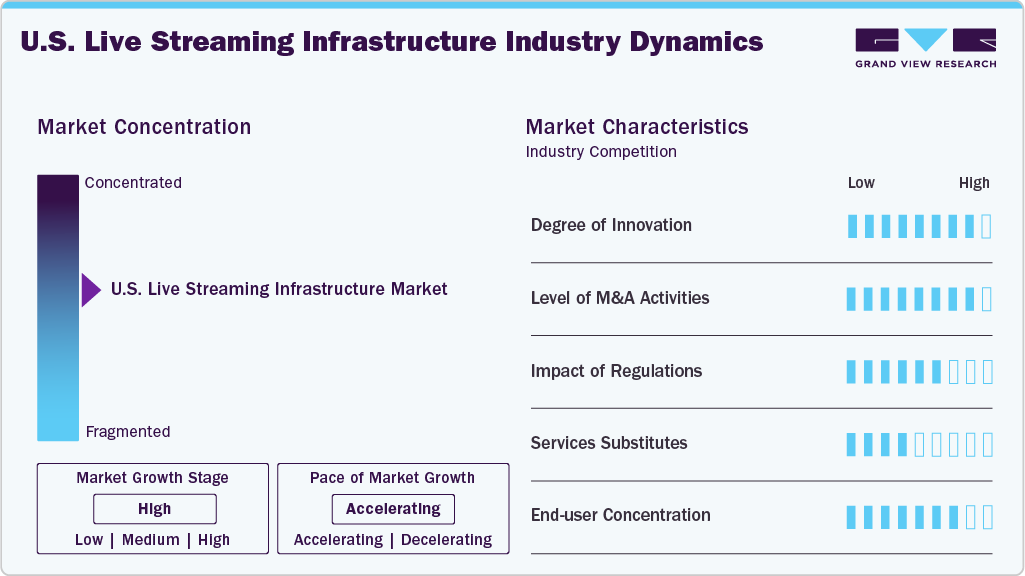
The U.S. live streaming infrastructure market is moderately concentrated, with several established companies holding significant market positions. Major providers include cloud platforms, content delivery networks, and streaming technology companies. These companies offer solutions across video processing, encoding, transcoding, storage, and content delivery. Their established infrastructure and customer bases strengthen their competitive positions. However, specialized and emerging providers also contribute to market competition.
 To learn more about this report, Download Free Sample Report
 Competition is based on scalability, reliability, streaming quality, technology capabilities, and pricing. Established companies are expanding their offerings through product development, partnerships, and infrastructure investments. Cloud-based solutions are further intensifying competition by providing flexible, scalable streaming capabilities. Specialized providers are focusing on areas such as live sports, gaming, and enterprise streaming. This mix of established and specialized providers supports the market's moderately concentrated structure.
Analyst Perspective
The U.S. live streaming infrastructure market is expected to maintain steady growth as demand for real-time digital content continues to increase. Advances in cloud-based streaming, AI-powered media processing, low-latency delivery, and content delivery networks are improving streaming performance. Media and entertainment, sports, gaming, enterprise communications, and live commerce are expected to remain key application areas. Providers are increasingly focusing on scalable infrastructure, reliable content delivery, and improved viewer experience. The market is expected to gradually shift toward cloud-native, AI-enabled, and low-latency streaming infrastructure.
Infrastructure Component Insights
The Content Delivery Network (CDN) segment led the U.S. live streaming infrastructure industry, accounting for the largest revenue share of 30.1% in 2025. The segment benefits from the growing need for efficient and reliable delivery of live video content to large audiences. Increasing demand for high-quality, low-latency streaming is supporting the adoption of CDN solutions. CDNs help streaming providers reduce latency and improve content delivery performance across geographically distributed audiences. The segment is expected to maintain its leading position as live streaming consumption continues to expand in the U.S.
The cloud-based solutions segment is expected to register significant growth over the forecast period. The growing need for scalable and flexible streaming infrastructure is encouraging providers to adopt cloud-based solutions. Cloud platforms enable streaming providers to scale computing, storage, and bandwidth resources based on demand. They also support faster deployment and integration with advanced streaming technologies. Increasing adoption of cloud infrastructure across media, sports, gaming, and enterprise applications is expected to support segment growth.
Deployment Insights
The cloud-based infrastructure segment dominated the U.S. live streaming infrastructure market in 2025. Its scalability and flexibility enable the delivery of live content to large, diverse audiences. Streaming providers can adjust computing, storage, and bandwidth resources based on changing demand. Cloud infrastructure also supports faster deployment, easier resource management, and integration with advanced streaming technologies. Growing adoption across media and entertainment, sports, gaming, and enterprise applications is expected to strengthen demand for cloud-based streaming infrastructure.
The hybrid deployment segment is expected to register strong growth over the forecast period. It enables providers to combine the scalability of cloud infrastructure with greater control over on-premise resources. This approach can support organizations with specific performance, security, data management, or infrastructure requirements. Hybrid models also provide flexibility in distributing streaming workloads between cloud and on-premise environments. Increasing demand for flexible, scalable, and customized streaming infrastructure is expected to support segment growth.
End-use Insights
The media & entertainment segment dominated the U.S. live streaming infrastructure industry in 2025, due to the widespread adoption of streaming platforms, OTT services, and digital content. The segment generates significant demand for reliable infrastructure to support movies, live shows, music events, and other entertainment content. The continued shift from traditional broadcasting toward digital streaming is increasing demand for advanced infrastructure solutions. Content providers are investing in scalable streaming technologies to deliver high-quality content to large audiences. Media & Entertainment is expected to remain a leading application segment in the market.
 To learn more about this report, Download Free Sample Report
 The gaming segment is growing, driven by the rising popularity of game streaming and esports. The increasing number of gamers and viewers is supporting demand for live gaming content. Streaming platforms are investing in infrastructure to deliver high-quality and low-latency gaming experiences. Interactive features and real-time engagement are further increasing infrastructure requirements. The growing use of gaming platforms and esports events is creating additional demand for streaming solutions. This trend is expected to support the continued growth of the gaming segment in the U.S. market.
Key U.S. Live Streaming Infrastructure Company Insights
Some key companies in the U.S. live streaming infrastructure industry are Amazon Web Services, Inc.; Microsoft; and Google LLC
-
Amazon Web Services, Inc., a cloud computing provider, is strengthening its live streaming infrastructure capabilities through AI-powered video processing, encoding, content delivery, and cloud-based media workflows. AWS supports broadcasters and streaming providers with scalable infrastructure for live video processing and delivery, and integrates AI into media workflows to enable automated content generation, real-time video optimization, and distribution across multiple platforms.
-
Microsoft, a technology and cloud services provider, is strengthening its live streaming capabilities through Azure cloud infrastructure, video processing, content delivery, and AI technologies. Its cloud and media solutions support scalable live video workflows, while integration with enterprise collaboration and communication platforms enables organizations to deliver live events, webinars, and other real-time video content.
Key U.S. Live Streaming Infrastructure Companies
-
Akamai Technologies, Inc.
-
Amazon Web Services, Inc.
-
Brightcove Inc.
-
Cloudflare, Inc.
-
Fastly
-
Google LLC
-
Harmonic Inc.
-
Kaltura
-
Microsoft
-
Mux, Inc.
-
Wowza Media Systems, LLC.
Competitive Benchmarking
Operating Strategies
Competitive Edge
Weaknesses
Mature Players: Amazon Web Services, Inc.; Microsoft; Google LLC; Cloudflare, Inc.; Akamai Technologies, Inc.
- Focus on expanding cloud, CDN, and edge infrastructure, integrating AI and video processing capabilities, strengthening partnerships, and enhancing live streaming platforms.
- Strong infrastructure capabilities, established customer relationships, broad technology portfolios, extensive network coverage, and the ability to support large-scale live streaming workloads.
- High infrastructure and operational costs, complex technology portfolios, intense competition, and challenges in meeting specialized requirements of smaller streaming providers.
Emerging Players: Harmonic Inc.; Kaltura; Mux, Inc.; Wowza Media Systems, LLC.
- Focus on developing specialized video streaming solutions, enhancing cloud-based platforms, integrating AI capabilities, improving low-latency delivery, and expanding partnerships.
- Specialized video expertise, flexible streaming solutions, faster product innovation, developer-focused platforms, and the ability to address specific requirements across media, sports, gaming, and enterprise applications.
- Smaller customer bases, comparatively limited infrastructure scale, lower financial resources than major cloud providers, and greater reliance on partnerships and third-party infrastructure.
Recent Developments
-
In May 2026, Cloudflare, Inc., a connectivity cloud and video streaming provider, introduced Stream Bindings for Workers, enabling developers to interact with their Stream video libraries directly through Workers. The capability supports video uploads, content management, signed playback URLs, and programmatic video pipelines, including integration with generative AI and inference workloads.
-
In February 2026, Amazon Web Services, Inc., a cloud computing provider, launched AWS Elemental Inference, an AI service that automatically generates vertical content and highlights clips from live and on-demand video. The service enables broadcasters and streamers to create mobile-optimized content in real time for platforms such as TikTok, Instagram Reels, and YouTube Shorts.
-
In September 2025, Akamai Technologies partnered with Harmonic, a video delivery solutions provider, to introduce Akamai Media Services Live 5 (MSL5) in September 2025. MSL5 supports low-latency streaming, expanded DVR capabilities, faster stream provisioning, and advanced event management for broadcasters and streaming providers.
U.S. Live Streaming Infrastructure Market Report Scope
Report Attribute
Details
Market size in 2025
USD 6.4 billion
Estimated market size in 2026
USD 7.3 billion
Projected market size by 2033
USD 19.1 billion
Growth rate
CAGR of 14.7% from 2026 to 2033
Base year for estimation
2025
Actual data
2021 – 2024
Forecast period
2026 – 2033
Quantitative units
Revenue in USD million/billion, and CAGR from 2026 to 2033
Report coverage
Revenue forecast, company ranking, competitive landscape, growth factors, and trends
Segments covered
Infrastructure component, deployment, end-use
Key companies profiled
Akamai Technologies, Inc.; Amazon Web Services, Inc.; Brightcove Inc.; Cloudflare, Inc.; Fastly; Google LLC; Harmonic Inc.; Kaltura; Microsoft; Mux, Inc.; Wowza Media Systems, LLC
Customization scope
Free report customization (equivalent up to 8 analysts working days) with purchase. Addition or alteration to country, regional & segment scope.
Pricing and purchase options
Avail customized purchase options to meet your exact research needs. Explore purchase options
U.S. Live Streaming Infrastructure Market Report Segmentation
This report forecasts revenue growth at the country level and provides an analysis of the latest industry trends in each of the sub-segments from 2021 to 2033. For this study, Grand View Research has segmented the U.S. live streaming infrastructure market report based on infrastructure component, deployment, and end-use:
-
Infrastructure Component Outlook (Revenue, USD Million/Billion, 2021 - 2033)
-
Encoding & Transcoding
-
Player & Analytics
-
Cloud-Based Solutions
-
Content Delivery Network (CDN)
-
Digital Rights Management (DRM) / Security
-
-
Deployment Outlook (Revenue, USD Million/Billion, 2021 - 2033)
-
Cloud
-
On-Premise
-
Hybrid
-
-
End-use Outlook (Revenue, USD Million/Billion, 2021 - 2033)
-
Media & Entertainment
-
Sports
-
Gaming
-
Education
-
Enterprise
-
Government
-
Others
-
Research Methodology
The U.S. live streaming infrastructure market figures in this report are based on a proven research process that combines executive interviews with secondary research from proprietary databases, company filings, and recognized regulatory and institutional sources. Market size is built through value-chain sizing—reconciling supply-side and demand-side estimates—and triangulated with bottom-up and top-down approaches. Every estimate passes multiple levels of expert validation before publication, with each U.S. live streaming infrastructure segment quantified using the revenue-capture definitions in the table below.
Segment Definition
Segment – Infrastructure Component
Revenue Capture Definition
Encoding & Transcoding
Revenue generated from live streaming encoding and transcoding solutions that convert, compress, optimize, and adapt audio/video content into multiple formats and bitrates for delivery across devices, platforms, and networks.
Player & Analytics
Revenue generated from video player technologies and analytics solutions that enable content playback, audience engagement tracking, performance monitoring, audience insights, monetization analytics, and streaming optimization.
Cloud-Based Solutions
Revenue generated from cloud-based live streaming infrastructure solutions, including cloud video platforms, media processing, storage, streaming workflows, scalability solutions, and managed streaming services.
Content Delivery Network (CDN)
Revenue generated from CDN solutions that distribute live video content through geographically distributed servers, enabling faster content delivery, reduced latency, improved streaming quality, and scalable audience reach.
Digital Rights Management (DRM) / Security
Revenue generated from content protection and security solutions, including DRM, encryption, authentication, access control, watermarking, and cybersecurity technologies used to secure live streaming content and prevent unauthorized access.
Segment – Deployment
Revenue Capture Definition
Cloud
Revenue generated from live streaming infrastructure deployed through public, private, or multi-cloud environments, including cloud streaming platforms, media processing, storage, CDN integration, and managed streaming services.
On-Premise
Revenue generated from live streaming infrastructure installed and operated within an organization's own data centers, including dedicated servers, encoding systems, storage, security solutions, and video processing equipment.
Hybrid
Revenue generated from live streaming infrastructure combining cloud and on-premise environments to provide flexible scalability, workload optimization, security, and operational control.
Segment – End Use
Revenue Capture Definition
Media & Entertainment
Revenue generated from live streaming infrastructure adopted by broadcasters, OTT platforms, production studios, and media companies for live content delivery, entertainment streaming, news broadcasting, and digital media distribution.
Sports
Revenue generated from live streaming infrastructure used by sports leagues, broadcasters, teams, and event organizers for real-time sports broadcasting, multi-camera streaming, audience engagement, and premium content delivery.
Gaming
Revenue generated from live streaming infrastructure deployed by gaming platforms, esports organizations, and content creators for game streaming, esports broadcasts, interactive experiences, and real-time viewer engagement.
Education
Revenue generated from live streaming infrastructure used by educational institutions, online learning platforms, and training providers for virtual classrooms, webinars, lectures, and digital learning content delivery.
Enterprise
Revenue generated from live streaming infrastructure adopted by businesses for internal communications, virtual events, employee training, corporate broadcasts, webinars, and customer engagement activities.
Government
Revenue generated from live streaming infrastructure used by government agencies and public organizations for public announcements, digital services, emergency communication, and official broadcasts.
Others
Revenue generated from live streaming infrastructure deployed across sectors such as healthcare, financial services, retail, telecommunications, and religious organizations for real-time communication, events, customer engagement, and digital content delivery.
Estimation Model
Layer No.
Layer Name
Key Question
Description
01
End-user Industry Layer
Who creates demand for U.S. live streaming infrastructure?
Identifies the base of organizations generating demand for live streaming infrastructure across industries such as media & entertainment, sports, gaming, enterprise, education, government, healthcare, telecommunications, and other sectors requiring real-time video streaming and content delivery.
02
Adoption / Usage Layer
Who actively adopts U.S. live streaming infrastructure?
Filters the addressable market based on live content consumption, OTT platform expansion, enterprise digital transformation, live event streaming, cloud adoption, remote collaboration, audience engagement, and investments in video streaming technologies.
03
Technology & Infrastructure Layer
Which infrastructure components are deployed?
Estimates adoption across encoding & transcoding, player & analytics, cloud-based solutions, content delivery networks (CDNs), digital rights management (DRM), and security, along with cloud, on-premise, and hybrid deployment models.
04
Revenue Capture Layer
How is revenue generated in the U.S. live streaming infrastructure ecosystem?
Calculates revenue generated from streaming platforms, cloud-based streaming services, video processing, encoding & transcoding, CDN services, storage, video players, analytics, DRM and security, infrastructure management, and related implementation, integration, and managed streaming services.
Delivered Customizations
This report has been delivered with the following In-depth customizations
Client Objective
Custom Research Modules Delivered
Strategic Value / Business Impact
Technology & Infrastructure Assessment
- Emerging live streaming technology trend analysis
- Streaming infrastructure innovation assessment
- Cloud, edge, AI, and low-latency streaming adoption analysis
- Ecosystem and technology partner mapping
- Identified emerging technology opportunities
- Supported infrastructure investment planning
- Evaluated technology adoption readiness
- Supported technology partnership decisions
Platform Positioning & Competitive Intelligence
- Streaming platform and infrastructure benchmarking
- Feature and capability comparison
- Pricing and service offering analysis
- Competitive strategy evaluation
- Improved platform differentiation strategy
- Supported pricing and service optimization
- Identified customer requirements and capability gaps
- Strengthened competitive positioning
Market Entry & Growth Assessment
- U.S. market sizing and forecasting
- End-user segmentation and adoption analysis
- Competitive landscape benchmarking
- Application and deployment analysis
- Identified high-growth market opportunities
- Supported go-to-market strategy development
- Highlighted investment priorities and market risks
- Enabled data-driven growth planning
Frequently Asked Questions About This Report
The U.S. live streaming infrastructure market size was valued at USD 6.4 billion in 2025 and is estimated at USD 7.3 billion in 2026.
The U.S. live streaming infrastructure market is expected to grow at a compound annual growth rate of 14.7% from 2026 to 2033 to reach USD 19.1 billion by 2033.
The cloud segment led with a 55.1% revenue share in 2025 and is also the fastest-growing area.
The media & entertainment segment led with a 35.1% revenue share in 2025, while gaming is the fastest-growing segment.
Key factors driving market growth include the increasing adoption of live sports and entertainment streaming, rising demand for low-latency video delivery, growing cloud-based streaming infrastructure, and the expansion of OTT platforms and digital live events.
Some key players operating in the U.S. live streaming infrastructure market include Akamai Technologies, Inc., Amazon Web Services, Inc., Brightcove Inc., Cloudflare, Inc., Fastly, Google LLC, Harmonic Inc., Kaltura, Microsoft, Mux, Inc., Wowza Media Systems, LLC.
The Content Delivery Network (CDN) segment led the market with a 30.1% revenue share in 2025, while cloud-based solutions are also the fastest-growing segment.
Major players are focusing on product innovation, cloud infrastructure expansion, strategic partnerships, low-latency streaming, and advanced video delivery technologies to strengthen their market position.
About the Author(s)
Digital Media Research Team
Technology · Digital MediaThis report was authored by the digital media research team at Grand View Research - comprising two research analysts, one senior research analyst, and one industry expert - with specialized expertise in the digital media segment of the technology industry. All findings are based on proprietary technology databases, executive interviews, and regulatory analysis, subject to internal peer review prior to publication.
Last Updated:
Speak to Analyst

Customize this report to your needs - add regions, segments, or data points, with 20% free customization.
Or view our licence options:


ISO 9001:2015 & 27001:2022 Certified
We are GDPR and CCPA compliant! Your transaction & personal information is safe and secure. For more details, please read our privacy policy.


