
- Home
- »
- Alcohol & Tobacco
- »
-
U.S. Luxury Wines And Spirits Market Size Report 2026-2033GVR Report cover

U.S. Luxury Wines And Spirits Market (2026 - 2033)
Size, Share & Trends Analysis Report By Product (Wine, Spirits), By Price Tier (Super-premium, Ultra-premium), By Distribution Channel (On-trade, Off-trade), And Segment Forecasts
Market Size, 2025
$54.4BMarket Estimate, 2026
$56.5BMarket Forecast, 2033
$82.4BCAGR, 2026–2033
5.5%U.S. Luxury Wines and Spirits Market Summary
The U.S. luxury wines and spirits market size was valued at USD 54.4 billion in 2025 and is projected to grow from USD 56.5 billion in 2026 to USD 82.4 billion by 2033, at a CAGR of 5.5% from 2026 to 2033. The market is primarily driven by premiumization and increasing consumer demand for high-quality, exclusive, and prestigious products. Growing interest in fine wines and craft spirits, along with the influence of luxury brands, is supporting market growth.
Key Market Trends & Insights
- By product: Spirits segment held the largest market share of 57.9% in 2025.
- By price tier: Super-premium segment held the largest market share of 50.5% in 2025.
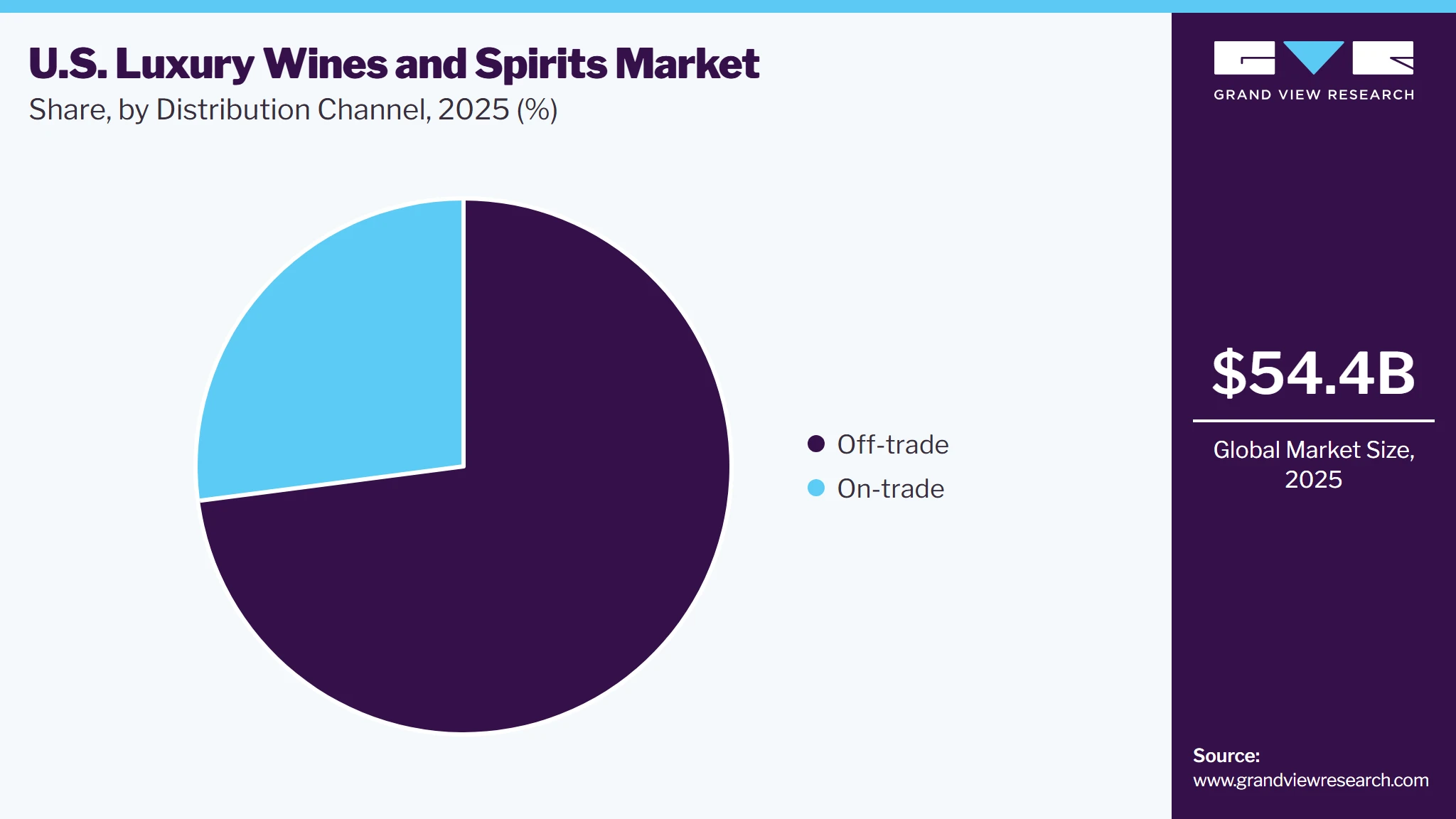
- By distribution channel: Off-trade segment held the largest market share of 76.0% in 2025.
Market Size & Forecast
- Market size in 2025: USD 54.4 Billion
- Estimated market size in 2026: USD 56.5 Billion
- Projected market size by 2033: USD 82.4 Billion
- CAGR (2026-2033): 5.5%
Three ways to get this report
Buy it, customize it, or ask a question.Ask an Analyst
Analyst response in 1 business day
- AccessReport author, directly
- Reply timeWithin 1 working day
- No sales callDirect answer only
- FormatEmail reply
- CostFree, no cost
Get the Full Report
What the study covers
- FormatsPDF · Excel · Dashboard
- Timeline2026–2033 annual, 2025 base
- Coverage20+ countries, 5 regions
- Companies10+ key players profiled
Customize the Report
20% free customization
- IncludeCountries, segments, points
- TailorTo your product definition
- ExtendDeeper competitor detail
- OrA fully bespoke study
- Turnaround5–10 working days
The market is also benefiting from the growing popularity of limited-edition releases, rare collections, and products with distinctive heritage and provenance. Consumers are increasingly seeking unique tasting experiences, personalized offerings, and innovative flavor profiles. Strong distribution networks, upscale hospitality venues, and the growing presence of luxury products in specialized retail channels are also supporting market expansion. In April 2025, The Macallan unveiled its limited-edition Distil Your World Hong Kong single malt in the U.S., with fewer than 500 bottles available for pre-sale to private clients. The release was inspired by Hong Kong’s culture, cuisine, markets, and architecture, with national U.S. distribution through premium retailers planned for September 2025.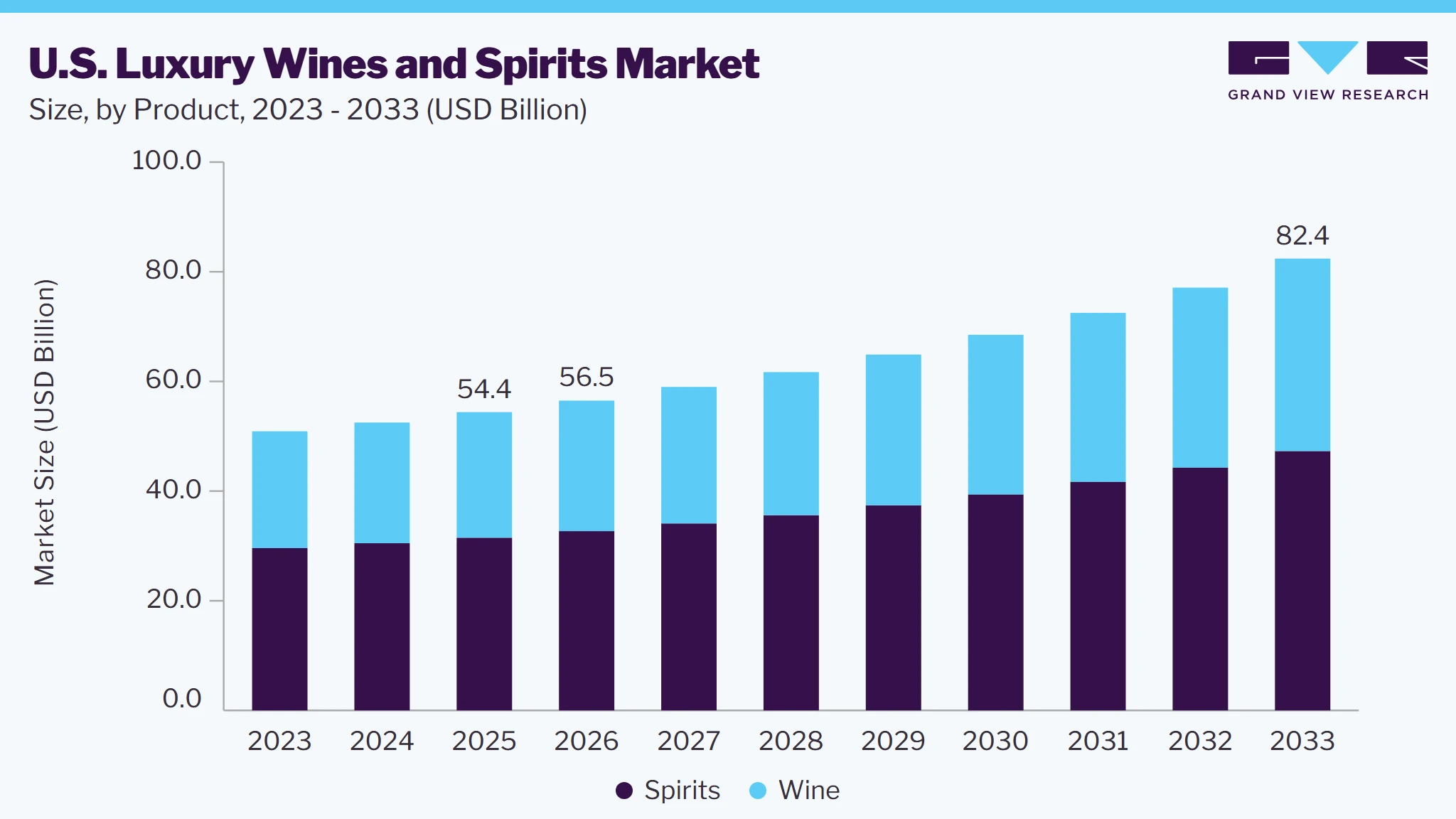 Source: Grand View Research, IR Documents, Primary Interviews, Paid DatabasesTo learn more about this report,
 Download Free Sample Report
Furthermore, the market is supported by increasing consumer interest in sustainability, organic production, and ethically sourced ingredients. Luxury producers are adopting eco-friendly packaging, responsible production practices, and transparent sourcing to appeal to environmentally conscious buyers. According to data published in February 2025, spirits producers are increasingly adopting sustainable packaging solutions, including lightweight recycled paperboard, aluminum, and recycled glass, to reduce waste and environmental impact.
Additionally, social media, influencer marketing, and digital storytelling are also helping brands strengthen visibility and connect with younger luxury consumers. For instance, super-premium whiskey brand Rabbit Hole Spirits used an integrated strategy combining social media, influencer content, and earned media to build awareness and drive product consideration among diverse consumers. From January to August 2024, its influencer program generated 1.2M+ audience reach and 573K+ impressions, demonstrating how creator-led digital storytelling can strengthen visibility and consumer engagement.
Market Dynamics
Growing preference for rare and limited-edition wines and spirits is strengthening demand in the U.S. luxury wine and spirits market. Consumers are increasingly attracted to exclusive products that offer distinct character, heritage, and scarcity. Limited availability can enhance the perceived prestige and collectability of premium labels. This trend encourages producers to introduce special releases and curated collections. In September 2026, Four Roses announced its Limited-Edition Small Batch Bourbon, a rare annual release featuring a carefully selected blend of aged bourbons. With limited availability and a distinctive aging profile, the release highlights how scarcity, craftsmanship, and heritage can enhance the appeal and collectability of premium spirits.
Stringent alcohol regulations and taxation can constrain the growth of the U.S. luxury wines and spirits market. Differences in state-level regulations can create complexity for producers, distributors, and retailers. Higher taxes and compliance requirements can increase the final cost of premium products. In March 2025, Trump proposed imposing a 200% tariff on European wine, Champagne, and spirits in retaliation for the EU’s proposed 50% tariff on American whiskey. These conditions may also make market expansion more challenging for smaller luxury producers. Additionally, in February 2025, Alexandre Arnault took a key role in restructuring LVMH’s wine and spirits division amid declining sales and profits, while growing tariff threats added further uncertainty to the business. Consequently, regulatory complexity can limit distribution efficiency and market accessibility.
Growing demand for organic and sustainably produced beverages presents an opportunity for luxury brands to differentiate their offerings. Consumers are becoming more attentive to production methods, sourcing practices, and environmental impact. In September 2026, Napa winemaker Julien Fayard launched USD 250 Cabernet Sauvignons made without added sulfites, highlighting a shift in luxury wine toward natural and mindful production practices. Producers can strengthen their market positioning through sustainable ingredients, eco-conscious packaging, and responsible production. Such initiatives can add value beyond taste and brand recognition. This creates opportunities for premium brands to attract environmentally conscious consumers.
Analyst Perspective
The U.S. luxury wines and spirits market is expected to maintain a positive outlook, supported by continued demand for premium-quality beverages and distinctive consumption occasions. The market is likely to benefit from consumers placing greater emphasis on authenticity, craftsmanship, provenance, and product quality. Competitive activity is expected to intensify as leading companies strengthen premium portfolios while smaller producers differentiate through specialized offerings. At-home consumption and premium retail are likely to remain important revenue contributors, alongside continued opportunities in upscale hospitality.
Consumer Insights for the U.S. Luxury Wine & Spirits
 To learn more about this report, Download Free Sample Report
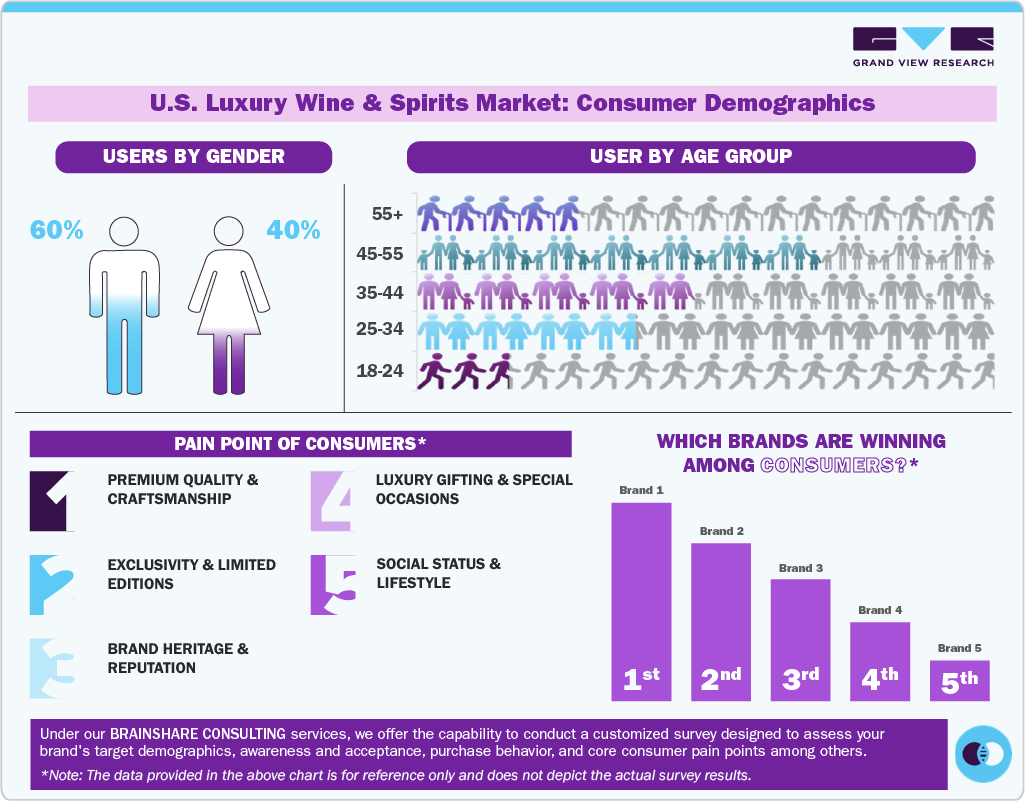
U.S. consumers in the luxury wine and spirits market increasingly prioritize premium quality, authenticity, and brand heritage when making purchasing decisions. There is growing demand for craft, limited-edition, and high-end products, particularly among affluent and younger consumers. Consumers are also placing greater emphasis on sustainability, responsible sourcing, and transparency in production. Digital channels, social media, influencer recommendations, and experiential marketing are becoming important drivers of brand discovery and engagement. Overall, the U.S. luxury wine and spirits market is evolving toward personalization, exclusivity, and distinctive brand experiences that combine premium products with strong storytelling.
Product Insights
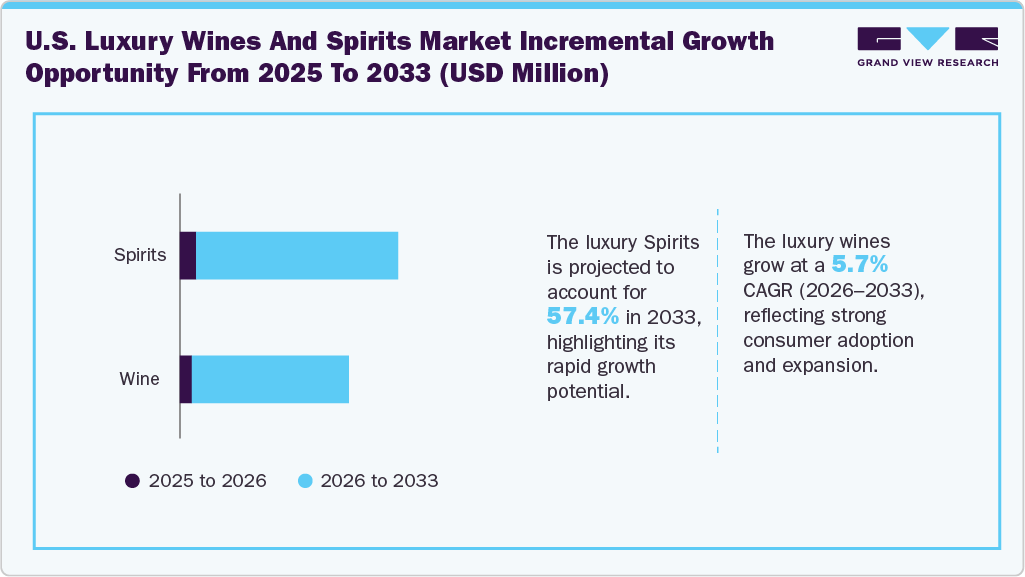
The spirits segment accounted for the largest share, accounting for around 57.9% of the U.S. luxury wines and spirits market revenue in 2025. The luxury spirits segment is driven by growing interest in aged, small-batch, and expertly crafted products with distinctive production characteristics. Consumers increasingly value unique maturation techniques, specialized ingredients, and established brand heritage when selecting premium spirits. Premium spirits also benefit from their role in celebratory occasions, hospitality, and upscale gifting. In September 2026, Louis XIII launched its ultra-luxury Black Pearl Cognac at USD 28,000 per decanter, limited to 398 sets worldwide, with availability by the pour at select high-end bars in New York, highlighting the growing appeal of rare aged spirits, distinctive production techniques, and established brand heritage.
 To learn more about this report, Download Free Sample Report
The wine segment is projected to grow at the fastest CAGR of 5.7% from 2026 to 2033. The luxury wine segment in the U.S. is driven by increasing consumer interest in premium vintages with distinctive taste, origin, and aging characteristics. Strong appreciation for established wine regions and renowned producers supports demand for high-end labels. Wine collecting and cellar-building also contribute to purchases of premium bottles with perceived long-term value. Fine-dining culture and wine-pairing experiences further encourage consumers to explore higher-quality selections. Additionally, curated tastings and specialist wine retailers help consumers discover and engage with luxury wine offerings.
Price Tier Insights
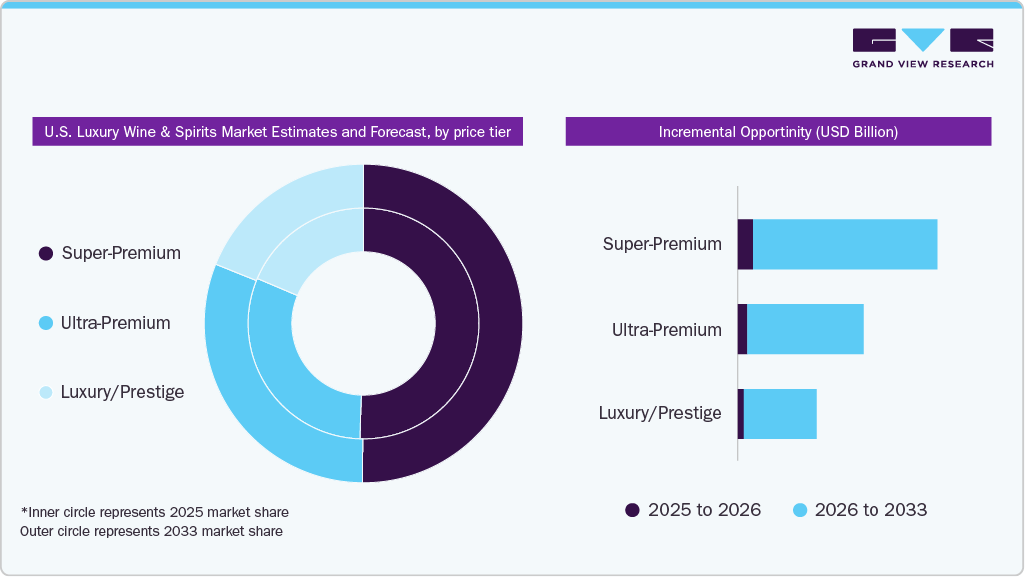
The super-premium price tiered wines and spirits market accounted for the largest share of 50.5% of the revenue in 2025. The super-premium segment is driven by consumers seeking elevated quality and distinctive characteristics without entering the highest luxury price bracket. Strong interest in aged expressions, superior craftsmanship, and recognizable brand credentials supports demand in this tier. Consumers are also attracted to products that provide a more sophisticated drinking experience for social occasions and personal consumption. Premium bars, restaurants, and specialty retailers help increase exposure to these offerings.
 To learn more about this report, Download Free Sample Report
The luxury/prestige price tiered wines and spirits market is projected to grow at the fastest CAGR of 5.8% from 2026 to 2033. The luxury/prestige segment is driven by the appeal of exclusivity, heritage, and strong brand reputation among high-end consumers. Products in this tier often carry distinctive provenance, exceptional craftsmanship, and presentation that reinforce their prestigious positioning. Collectability and association with status can encourage purchases beyond immediate consumption needs. High-end hospitality, private events, and luxury gifting further strengthen the visibility of prestige products.
Distribution Channel Insights
The sale of U.S. luxury wines and spirits through the off-trade channel accounted for the largest share of 76.0% of the revenue in 2025. The off-trade segment is driven by the expanding availability of luxury wines and spirits through specialty liquor stores, premium retailers, and online platforms. Consumers value the convenience of purchasing high-end beverages for home consumption, celebrations, and private gatherings. Specialist retailers can strengthen demand through expert recommendations, curated selections, and access to hard-to-find products. Online channels also provide broader product visibility and enable consumers to compare brands and product characteristics.
 To learn more about this report, Download Free Sample Report
The sale of U.S. luxury wines and spirits through the on-trade channel is projected to grow at the fastest CAGR of 6.4% from 2026 to 2033. The on-trade segment is driven by the growing presence of luxury wines and spirits in upscale restaurants, hotels, lounges, and premium bars. Consumers are increasingly seeking sophisticated drinking experiences where premium beverages complement fine dining and social occasions. Skilled bartenders, sommeliers, and curated beverage menus also encourage customers to explore higher-value products. Exclusive tastings, cocktail programs, and food-pairing experiences further enhance the appeal of luxury offerings.
Key Companies Insights & Market Share Insights
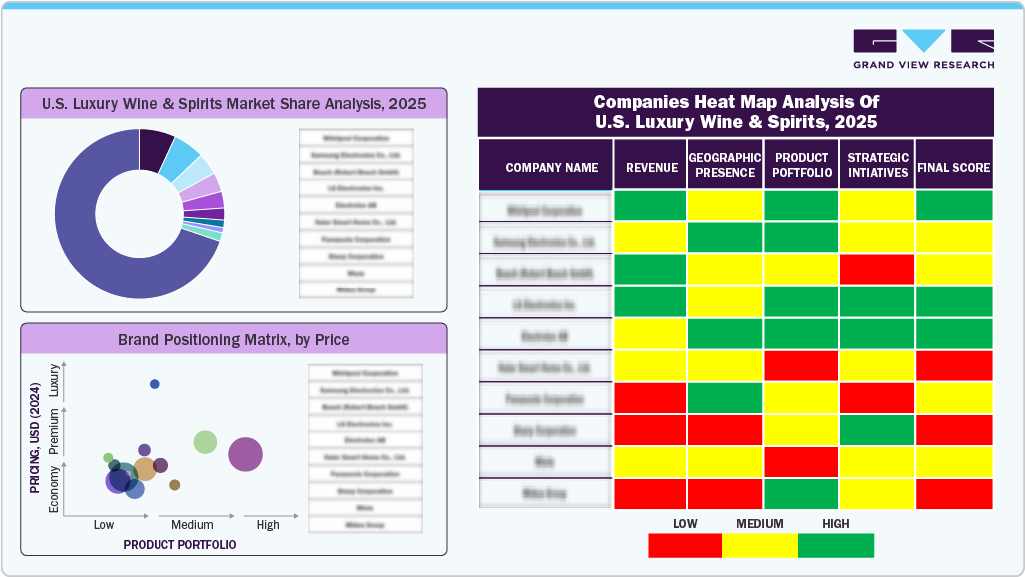
The U.S. luxury wines and spirits industry is characterized by strong competition among established global companies and specialized premium producers, with brand heritage, exclusivity, and distribution reach influencing competitive positioning. Key companies include LVMH, Pernod Ricard, Diageo, Rémy Cointreau, Brown-Forman, Campari Group, Suntory, Edrington Group, Treasury Wine Estates, and Constellation Brands. Market share remains relatively concentrated among major suppliers, although premium-focused brands and specialized producers continue to strengthen their presence. In wine, E. & J. Gallo Winery remains a leading U.S. supplier, while major spirits players include Diageo, Sazerac, Suntory Global Spirits, and Pernod Ricard USA.
Companies are increasingly focusing on premium portfolios, selective distribution, product innovation, and luxury positioning to strengthen their market share and competitive advantage.
 To learn more about this report, Download Free Sample Report
Key U.S. Luxury Wines And Spirits Companies
-
LVMH (Moët Hennessy Louis Vuitton)
-
Pernod Ricard
-
Diageo.
-
Rémy Cointreau
-
Brown-Forman Corporation.
-
Campari Group Ingredients
-
SUNTORY HOLDINGS LIMITED
-
Edrington Group
-
Laurent-Perrier Group
-
Constellation Brands
Competitive Benchmarking
Category
Operating Strategies
Competitive Edge
Weakness
Established Players (LVMH, Pernod Ricard)
- Premiumize portfolios, expand luxury labels, and strengthen upscale on-premise and retail channels.
- Brand equity, scale, broad distribution, and strong trade relationships.
- High cost structures, portfolio complexity, and slower adaptation to niche trends.
Emerging Players (Edrington Group)
- Focus on differentiated offerings, affluent niches, DTC engagement, and digital-led discovery.
- Faster innovation, distinctive positioning, and closer consumer engagement.
- Smaller scale, limited distribution, and lower awareness versus global brands.
Recent Developments
-
In September 2026, Louis XIII launched its ultra-luxury Black Pearl Cognac at USD 28,000 per decanter, limited to 398 sets worldwide, with availability by the pour at select high-end bars in New York, highlighting the growing appeal of rare aged spirits, distinctive production techniques, and established brand heritage.
-
In September 2026, Napa winemaker Julien Fayard launched USD 250 Cabernet Sauvignons made without added sulfites, highlighting a shift in luxury wine toward natural and mindful production practices.
-
In September 2026, Four Roses announced its Limited-Edition Small Batch Bourbon, a rare annual release featuring a carefully selected blend of aged bourbons. With limited availability and a distinctive aging profile, the release highlights how scarcity, craftsmanship, and heritage can enhance the appeal and collectability of premium spirits
U.S. Luxury Wines and Spirits Market Report Scope
Report Attribute
Details
Market size in 2025
USD 54.4 billion
Estimated market size in 2026
USD 56.5 billion
Projected market size by 2033
USD 82.4 billion
Growth Rate (Revenue)
CAGR of 5.5% from 2026 to 2033
Actuals
2021 - 2025
Forecast period
2026 - 2033
Quantitative (Revenue) units
Revenue in USD Million, and CAGR from 2026 to 2033
Report coverage
Revenue forecast, company ranking, competitive landscape, growth factors, and trends
Segments covered
Product, Price Tier & Distribution Channel
Country scope
U.S.
Key companies profiled
LVMH (Moët Hennessy Louis Vuitton), Pernod Ricard, Diageo, Rémy Cointreau, Brown-Forman Corporation, Campari Group, SUNTORY HOLDINGS LIMITED, Edrington Group, Laurent-Perrier Group, Constellation Brands
Customization scope
Free report customization (equivalent up to 8 analysts’ working days) with purchase. Addition or alteration to country, regional & segment scope.
Pricing and purchase options
Avail customized purchase options to meet your exact research needs. Explore purchase options
U.S. Luxury Wines And Spirits Market Report Segmentation
This report forecasts revenue growth at the regional and country levels and provides an analysis of the latest industry trends and opportunities in each of the sub-segments from 2021 to 2033. For the purpose of this study, Grand View Research has segmented the U.S. luxury wines and spirits market report on the basis of product, price tier & distribution channel.
-
Product Outlook (Revenue, USD Million; 2021 - 2033)
-
Wine
-
Spirits
-
Whiskey
-
Cognac
-
Brandy
-
Others
-
-
-
Price tier Outlook (Revenue, USD Million; 2021 - 2033)
-
Super-premium
-
Ultra-premium
-
Luxury/Prestige
-
-
Distribution Channel Outlook (Revenue, USD Million; 2021 - 2033)
-
On-trade
-
Off-trade
-
Research Methodology
The U.S. luxury wines and spirits Market figures in this report are based on a proven research process that combines executive interviews with secondary research from proprietary databases, company filings, and recognized regulatory and institutional sources. Market size is built through value-chain sizing-reconciling supply-side and demand-side estimates-and triangulated with bottom-up and top-down approaches. Every estimate passes multiple levels of expert validation before publication, with each U.S. luxury wines and spirits segment quantified using the revenue-capture definitions in the table below.
Segment Definition
Product
Revenue capture definition
Wine
The wine segment generates revenue through the sale of premium and luxury wines, including fine vintages, collectible bottles, aged wines, and limited-production labels. Revenue is captured through bottle sales across different price points, with higher-value purchases often associated with provenance, vintage, appellation, and aging characteristics. Additional revenue comes from wine clubs, curated collections, auctions, and direct purchases from wineries. Luxury wine brands can also capture greater value through exclusive releases and highly sought-after vintages.
Spirits
The spirits segment generates revenue through the sale of premium and luxury spirits such as aged whiskies, cognac, tequila, rum, vodka, and other high-end expressions. Revenue is captured through purchases of individual bottles, special editions, aged expressions, and collectible releases. Higher prices are supported by factors such as maturation period, production techniques, brand heritage, and product rarity. Limited releases, premium packaging, and exclusive bottle editions provide additional avenues for capturing value within the luxury spirits segment.
Estimation Model
Layer Name
Key Question
Description
Consumption Universe Layer
Who consumes luxury wine & spirits?
Adults who consume premium-priced wine and spirits, including affluent and experience-led consumers.
Access & Availability Layer
Who can access luxury wine & spirits?
Consumers with access through fine-wine retailers, luxury hospitality, specialty stores, clubs, and digital channels.
Purchase & Usage Layer
Who actively purchases luxury wine & spirits?
Consumers purchasing luxury bottles for personal enjoyment, gifting, entertaining, collecting, and special occasions.
Revenue Conversion Layer
How does consumption translate into revenue?
Revenue generated through bottle sales, premium experiences, memberships, private allocations, tastings, and luxury hospitality.
Delivered Customizations
This report has been delivered with the following In-depth customizations
Client Request
Customization Delivered
Value Adds
U.S. Luxury Wine & Spirit Market Structure & Growth Assessment
Mapped the US luxury landscape across premium price bands, key wine and spirit categories, regional markets, route-to-market structures, and on-/off-premise dynamics, with emphasis on where value is shifting within the category.
Identifies the most attractive growth pools, highlights areas of structural pressure, and helps prioritize category and channel investments.
U.S. Affluent Consumer & Occasion Deep Dive
Assessed high-income U.S. consumers across discovery behaviors, brand loyalty, trading-up thresholds, home entertaining, fine dining, gifting, collecting, and celebratory consumption, including differences across key demographic cohorts.
Pinpoints the occasions and consumer profiles most conducive to luxury conversion, enabling sharper segmentation, messaging, and activation strategies.
U.S. Luxury Wine & Spirit Brand, Channel & Experience Benchmarking
Evaluated relevant luxury players across brand equity, distribution footprint, hospitality partnerships, tasting-room and experiential platforms, limited releases, collaborations, digital engagement, and portfolio architecture.
Reveals whitespace for differentiation, strengthens route-to-market and experiential strategies, and identifies scalable models for building luxury brand desirability.
About the Author(s)
Alcohol & Tobacco Research Team
Consumer Goods · Alcohol & TobaccoThis report was authored by the alcohol & tobacco research team at Grand View Research - comprising two research analysts, one senior research analyst, and one industry expert - with specialized expertise in the alcohol & tobacco segment of the consumer goods industry. All findings are based on proprietary consumer goods databases, executive interviews, and regulatory analysis, subject to internal peer review prior to publication.
Last Updated:
Speak to Analyst

Customize this report to your needs - add regions, segments, or data points, with 20% free customization.
Or view our licence options:


ISO 9001:2015 & 27001:2022 Certified
We are GDPR and CCPA compliant! Your transaction & personal information is safe and secure. For more details, please read our privacy policy.


