
- Home
- »
- Medical Devices
- »
-
U.S. Oxygen Concentrator Market, Industry Report, 2033GVR Report cover
![U.S. Oxygen Concentrator Market Size, Share & Trends Report]()
U.S. Oxygen Concentrator Market (2025 - 2033) Size, Share & Trends Analysis Report By Product (Portable, Fixed), By Application (Home Care, Non-homecare), By Technology (Continuous Flow, Pulse Flow), And Segment Forecasts
U.S. Oxygen Concentrator Market Summary
The U.S. oxygen concentrator market size was estimated at USD 1.55 billion in 2024 and is projected to reach USD 3.09 billion by 2033, growing at a CAGR of 7.6% from 2025 to 2033. The increase in the prevalence of respiratory conditions such as COPD, asthma, and sleep apnea, rising healthcare spending, significant investment in R&D, advanced healthcare infrastructure, access to the newest technology, and new product launches.
Key Market Trends & Insights
- By product, the fixed concentrators segment led the market with a share of over 46.8% in 2024.
- By technology, the continuous flow segment accounted for the largest market share of 56.03% in 2024.
- By application, the home care segment accounted for the largest market share in 2024.
Market Size & Forecast
- 2024 Market Size: USD 1.55 Billion
- 2033 Projected Market Size: USD 3.09 Billion
- CAGR (2025-2033): 7.6%
According to the analyzed Medicare claims data, the Medicare penetration rate for portable oxygen concentrators (POCs) in the U.S. has steadily risen. For instance, in 2021, the POC penetration was 22.0%, while that of stationary was 17%. This is a developing trend favoring portable oxygen concentrators (POCs) over fixed oxygen concentrators and fueling the expansion of the U.S. oxygen concentrator industry.
Government support, such as the Federal Aviation Administration's (FAA) approval of portable concentrators during plane travel, further drives the region's growth. Furthermore, favorable reimbursement policies have enhanced the attractiveness of the U.S. oxygen concentrators market. For instance, in March 2024, a U.S. Congressman introduced the Supplemental Oxygen Access Reform (SOAR) Act to reform and improve access to supplementary oxygen for Medicare beneficiaries. These policies have increased the adoption of oxygen concentrators in the U.S. In addition, rising healthcare spending in the U.S. is driving the demand for effective diagnosis and treatment of respiratory diseases, thereby boosting the market for oxygen concentrators.
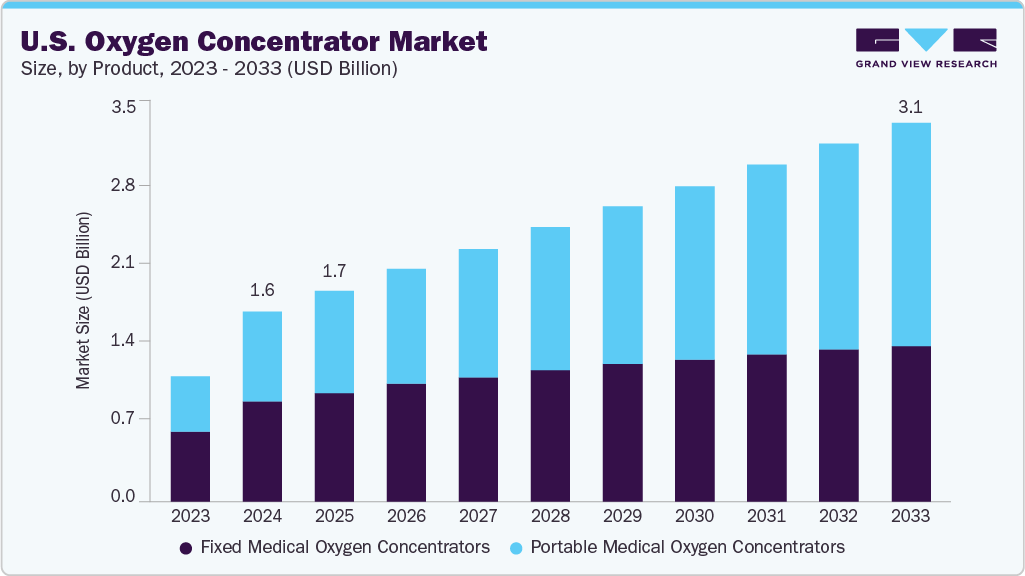
The rising prevalence of chronic respiratory diseases, particularly chronic obstructive pulmonary disease (COPD), is a key driver of the U.S. oxygen concentrator market. With COPD affecting over 5% of U.S. adults and contributing to nearly USD 50 billion in annual economic costs, the demand for effective oxygen therapy solutions continues to grow. Long-term oxygen therapy has been clinically proven to improve outcomes in hypoxemic patients, making oxygen concentrators an essential part of disease management.
Moreover, limitations of traditional oxygen delivery methods, such as stationary systems and oxygen cylinders that restrict mobility and require frequent refills, accelerate the shift toward portable oxygen concentrators. These devices provide patients with greater independence and flexibility while addressing the increasing burden of COPD, cystic fibrosis, and heart failure-related hypoxemia, thereby fueling adoption across the U.S. market.
Market Concentration & Characteristics
The chart below illustrates the relationship between market concentration, industry characteristics, and industry participants. The x-axis represents the level of industry concentration, ranging from low to high. The y-axis represents various industry characteristics, including industry competition, impact of regulations, level of partnerships & collaborations activities, degree of innovation, and regional expansion. For instance, the U.S. oxygen concentrator market is slightly fragmented, with many product & service providers entering the market. The degree of innovation, the level of partnerships & collaboration activities, and the impact of regulations on the industry is high.
The degree of innovation in the industry is high. The market is experiencing significant innovation as companies like Inogen are introducing cutting-edge products. For instance, in December 2022, Inogen U.S.-based company, received 510(k) premarket clearance from the U.S. Food and Drug Administration (FDA) for its new portable oxygen concentrator, Rove 4. This product is expected to enhance Inogen's leadership in portable oxygen concentrators. Such regulatory milestones strengthen manufacturers' portfolios, as seen with Inogen's Rove series.
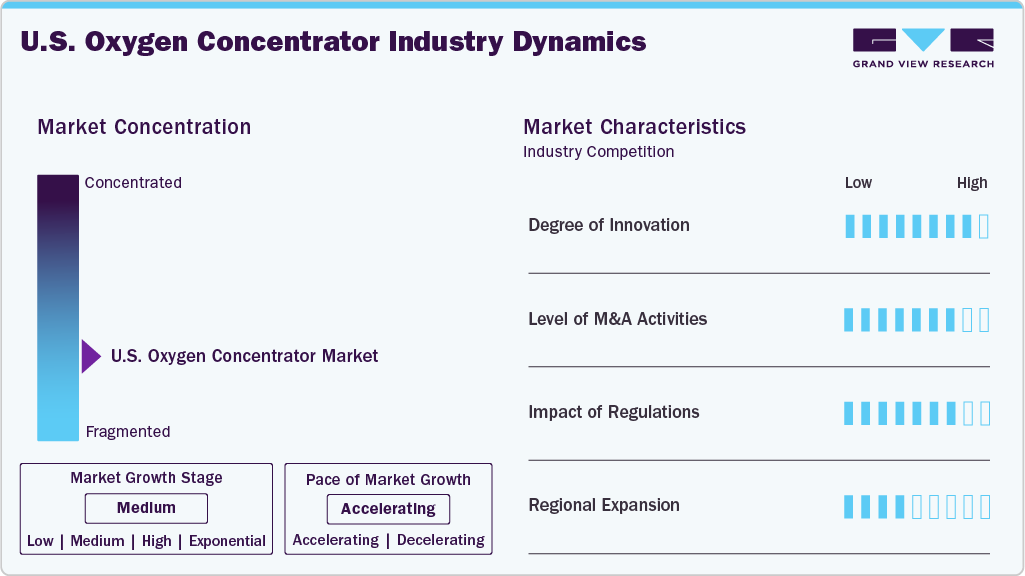
M&A activities like mergers, acquisitions, and partnerships facilitate geographic expansion and market entry for companies. For example, React Health, a player in medical device development, manufacturing, and distribution, acquired Invacare's Respiratory line in February 2023. This strategic move bolsters React Health's market standing, broadens its product offerings, and enhances its ability to serve a wider customer base.
“The addition of the Invacare product line to React Health’s Respiratory offering further strengthens our commitment to providing a full complement of products and services to treat chronic disease states in the home setting. We look forward to welcoming Invacare’s customers and patients to the React Health family.”
-Clint Geffert, President of Commercial Operations at React Health
The impact of regulations on the U.S. oxygen concentrator market is high. The market is significantly influenced by various regulations, which play a critical role in shaping the growth, innovation, and operational processes of oxygen concentrators. The regulatory framework for oxygen concentrators represents a significant barrier, particularly in terms of regulatory stringency. Companies such as Invacare Corporation and Philips have encountered prolonged consent decrees from the U.S. FDA, illustrating the stringent regulatory environment in the U.S. market.
The level of regional expansion in the U.S. oxygen concentrator industry is moderate. Increasing demand for oxygen concentrators in the U.S., owing to fostering collaboration, access to diverse datasets, and talent pools across regions. It enables companies to tap into new markets, leverage local expertise, comply with region-specific regulations, and gain insights from different healthcare systems, ultimately driving innovation and accelerating the adoption of oxygen concentrators.
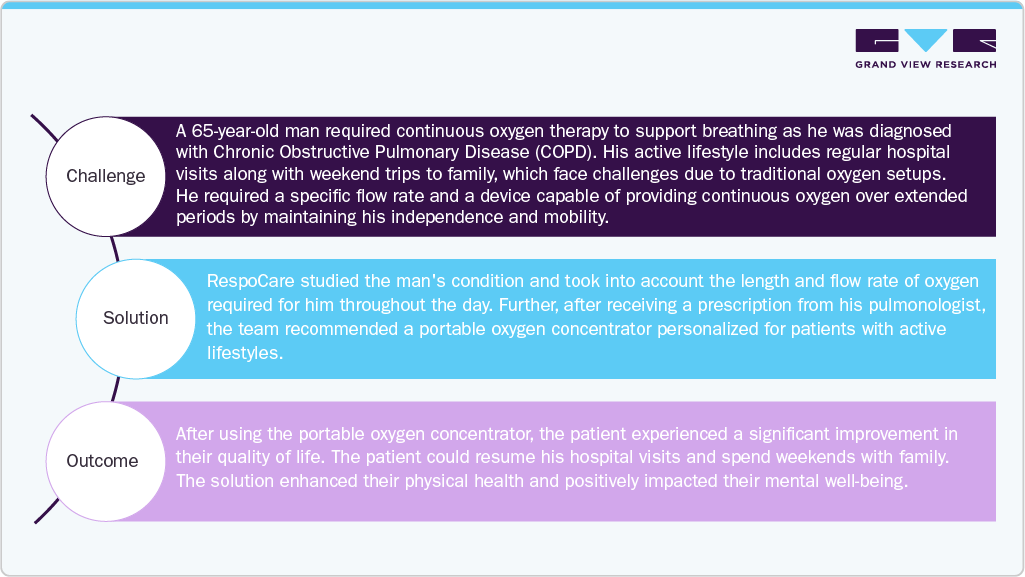
Case Study:
In October 2024, RespoCare published a case study titled “Freedom with Portable Oxygen”.
Product Insights
The fixed concentrators segment led the U.S. oxygen concentrator market with the largest revenue market share of 46.8% in 2024. Factors such as a higher oxygen output capacity, cost-effectiveness, and widespread adoption in home healthcare settings. Their ability to deliver continuous oxygen flow for patients with chronic respiratory conditions makes them the preferred choice, especially for long-term therapy, contributing to their dominant market share.
The portable oxygen concentrators (POCs) segment is anticipated to witness the fastest CAGR over the forecast period owing to the increasing need for portable medical oxygen concentrators, especially among mobile patients seeking out-of-home solutions. Companies are actively pursuing opportunities to expand in this market segment. For instance, in June 2022, Carire launched a new portable oxygen concentrator, LifeStyle, in the U.S. market. This product has substantially improved the quality of life for oxygen users worldwide by providing a more convenient and reliable oxygen source.
Application Insights
The home care segment led the U.S. oxygen concentrator industry with the largest revenue share in 2024. The home care segment is projected to experience the fastest CAGR during the forecast period. The growth can be attributed to the rising adoption of Long-Term Oxygen Therapy (LTOT) devices in home settings, the availability of a wide range of home oxygen therapy devices (including Liquid Oxygen systems and portable concentrators), and the shifting preferences of patients towards receiving treatment at home.
The non-homecare segment is expected to exhibit a moderate CAGR over the forecast period. The growth of the segment is driven by the increased adoption of oxygen therapy in hospitals and clinics. Moreover, an increasing number of hospital admissions due to respiratory diseases contributes to the segment’s growth.
Technology Insights
The continuous flow segment led the U.S. oxygen concentrator market with the largest revenue share of 56.03% in 2024. This segment's dominance can be attributed to the increasing prevalence of long-term respiratory disorders, including asthma, COPD, bronchiectasis, and chronic sinusitis. Continuous flow technology is also widely used in residential and military applications, providing a safer alternative to storing oxygen under pressure.
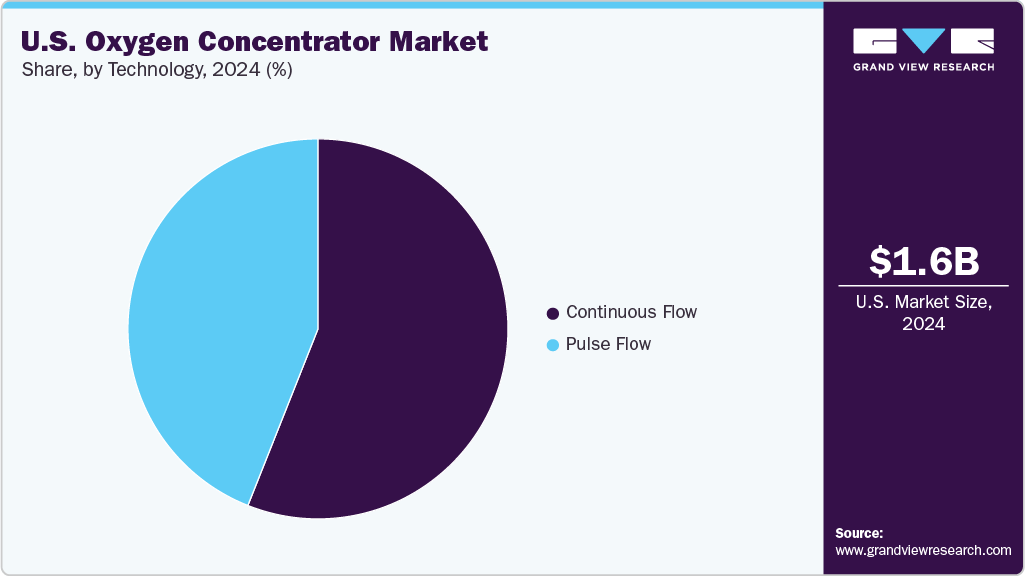
The pulse flow technology segment is expected to experience the fastest CAGR during the forecast period. The growth is driven by the advantages offered by pulse flow technology, including high mobility, lightweight design, and suitability for patients with active lifestyles. Pulse flow technology is particularly beneficial for treating respiratory conditions that require a lower oxygen delivery rate per minute. It is extensively used in portable oxygen concentrators (POCs).
Key U.S. Oxygen Concentrator Company Insights
The U.S. oxygen concentrators industry is highly competitive, with Inogen as a notable player in the portable oxygen category, holding a dominant position. It competes with both portable oxygen concentrator manufacturers and long-term oxygen therapy providers, such as Respironics (a subsidiary of Koninklijke Philips N.V.), React Health (Respiratory Product Line from Invacare Corporation), Caire Medical (a subsidiary of NGK Spark Plug), and DeVilbiss Healthcare (a subsidiary of Drive Medical).
Comparison Matrix: U.S. Oxygen Concentrator Market: Company-wise Market Share, Value & Unit Volume Trends (2021 - 2024)
Years
2021
2022
2023
2024
U.S. Oxygen Concentrator Market
Value
(USD Million)
2,399.2
(Note: Similar Analysis Will be provided in the final deliverable at Portable Medical Oxygen Concentrators and Fixed Medical Oxygen Concentrators levels for the below market players)
Volume (Units'000)
1,446,674
Key U.S. Oxygen Concentrator Companies:
- Respironics (a subsidiary of Koninklijke Philips N.V.) {Effective from January 25, 2024, Philips Respironics halted the sale of their POCs, with end of service scheduled for January 25, 2029.}
- Direct Supply
- GF Health Products, Inc.
- MedaCure Inc.
- Nidek Medical Products, Inc.
- O2 Concepts
- React Health
- CAIRE Inc. (Acquired by Niterra Co., Ltd., formerly known as NGK SPARK PLUG CO., LTD.)
- DeVilbiss Healthcare (a subsidiary of Drive Medical)
- GCE Group
- Compass Health Brands
Exit Strategies of Existing Market Players And Their Impact On Market Competitors
Invacare's exit strategy aims to realign the company with its mission and vision.
-
Invacare Corporation has announced its decision to discontinue its respiratory products line, including HomeFill and stationary & portable oxygen concentrators.
-
This strategic move, disclosed alongside the company's third-quarter financial results of 2022, highlights Invacare's commitment to taking decisive action to enhance shareholder value and accelerate the execution of its strategic plan.
-
Following an extensive review process lasting almost a year, the decision demonstrates the company's acknowledgment of unfavorable market conditions.
Entry Of React Health Following Invacare's Exit And Its Anticipated Impact
- The acquisition of Invacare's respiratory assets by React Health is likely to have significant implications for the oxygen concentrator market, including changes in competition, product availability, market dynamics, customer support, etc.
Recent Developments
-
In January 2025, Caire launched IntenOxy 5, a stationary oxygen concentrator in the U.S. and Puerto Rico. This delivers around 95.5% oxygen concentration and operates efficiently with low power consumption.
“The IntenOxy 5 Stationary Oxygen Concentrator has been an excellent addition to our oxygen therapy portfolio. The unit is a key component to how our DME and HME customers serve their respiratory patients, providing them with an at-home device that delivers the oxygen they need as they navigate activities of daily living,”
-Ken Hosako, president and CEO of Caire.
- In July 2023, VARON launched a new portable oxygen concentrator, VP-2, to the VP series of the company. This concentrator aims to provide efficient and reliable oxygen therapy regardless of their location.
Our goal is to make oxygen therapy more accessible by providing reliable, efficient, and affordable solutions for anyone in need. With VP-2 coming out, we believe we are much closer to the goal."
- Darren Wang, CEO of VARON
-
In July 2023, Canta Medical introduced an entire oxygen product range to the FIME 2023 United States. FIME 2023 is one of the largest international medical exhibitions for the U.S. healthcare market. It attracts over 10,000 healthcare participants and hosts over 500 medical device manufacturers and distributors
-
In April 2022, CAIRE launched LifeStyle, a portable oxygen concentrator for improving the quality of life for oxygen concentrator uses.
“Pioneering the first portable oxygen concentrator has long been both a point of pride, and an ongoing incentive to continue to innovate and develop those technologies that will ensure clinically efficacious oxygen delivery and an improved quality of life for all of our users around the world,”
-said Earl Lawson, CEO of CAIRE Inc.
U.S. Oxygen Concentrator Market Report Scope
Report Attribute
Details
Market size value in 2025
USD 1.72 billion
Revenue forecast in 2033
USD 3.09 billion
Growth rate
CAGR of 7.6% from 2025 to 2033
Actual data
2021 - 2024
Forecast period
2025 - 2033
Quantitative units
Revenue in USD million/billion, volume in units, and CAGR from 2025 to 2033
Report coverage
Revenue forecast, volume forecast, company ranking, competitive landscape, growth factors, and trends
Segments covered
Product, application, technology
Key companies profiled
Respironics (a subsidiary of Koninklijke Philips N.V.) {Effective from January 25, 2024, Philips Respironics halted the sale of their POCs, with end of service scheduled for January 25, 2029.}; Direct Supply; GF Health Products, Inc.; MedaCure Inc.; Nidek Medical Products, Inc.; O2 Concepts; React Health; CAIRE Inc. (Acquired by Niterra Co., Ltd., formerly known as NGK SPARK PLUG CO., LTD.); DeVilbiss Healthcare (a subsidiary of Drive Medical); GCE Group; Compass Health Brands
Customization scope
Free report customization (equivalent up to 8 analysts working days) with purchase. Addition or alteration to country, regional & segment scope.
Pricing and purchase options
Avail customized purchase options to meet your exact research needs. Explore purchase options
U.S. Oxygen Concentrator Market Report Segmentation
This report forecasts volume & revenue growth at country levels and provides an analysis of the latest industry trends in each of the sub-segments from 2021 to 2033. For this study, Grand View Research has segmented the U.S. oxygen concentrator market report based on product, application, and technology:
-
Product Outlook (Volume, Unit; Revenue, USD Million, 2021 - 2033)
-
Portable Medical Oxygen Concentrators
-
Fixed Medical Oxygen Concentrators
-
-
Application Outlook (Volume, Unit; Revenue, USD Million, 2021 - 2033)
-
Home Care
-
Non-Home Care
-
-
Technology Outlook (Volume, Unit; Revenue, USD Million, 2021 - 2033)
-
Continuous Flow
-
Pulse Flow
-
Frequently Asked Questions About This Report
The U.S. oxygen concentrator market size was estimated at USD 1.55 billion in 2024 and is expected to reach USD 1.72 billion in 2025.
The U.S. oxygen concentrator market is expected to grow at a compound annual growth rate of 7.6% from 2025 to 2033 to reach USD 3.09 billion by 2033.
The fixed concentrators segment led the market with the largest revenue market share of 46.8% in 2024. This growth is attributed to the higher oxygen output capacity, cost-effectiveness, and widespread adoption in home healthcare settings.
Some of the key players in U.S. oxygen concentrator market include Respironics (a subsidiary of Koninklijke Philips N.V.) {Effective from January 25, 2024, Philips Respironics halted the sale of their POCs, with end of service scheduled for January 25, 2029.}; Direct Supply; GF Health Products, Inc.; MedaCure Inc.; Nidek Medical Products, Inc ; O2 Concepts; React Health; CAIRE Inc. (Acquired by Niterra Co., Ltd. formerly known as NGK SPARK PLUG CO., LTD.); DeVilbiss Healthcare (a subsidiary of Drive Medical); GCE Group; Compass Health Brands
Key factors that are driving the market growth include the increase in the prevalence of respiratory conditions such as COPD, asthma, and sleep apnea, rising healthcare spending, significant investment in R&D, advanced healthcare infrastructure, access to the newest technology, and new product launches.
About the Author(s)
Medical Devices Research Team
Healthcare · Medical DevicesThis report was authored by the medical devices research team at Grand View Research - comprising two research analysts, one senior research analyst, and one industry expert - with specialized expertise in the medical devices segment of the healthcare industry. All findings are based on proprietary healthcare databases, executive interviews, and regulatory analysis, subject to internal peer review prior to publication.
Last Updated:
Speak to Analyst


Customize this report to your needs — add regions, segments, or data points, with 20% free customization.
Or view our licence options:


ISO 9001:2015 & 27001:2022 Certified
We are GDPR and CCPA compliant! Your transaction & personal information is safe and secure. For more details, please read our privacy policy.


