
- Home
- »
- Advanced Interior Materials
- »
-
U.S. Property Management Services Market Report, 2033GVR Report cover

U.S. Property Management Services Market (2026 - 2033) Size, Share & Trends Analysis Report By Service Type (Rent Collection, Mortgage & Utility Payment), By Property Type (Residential, Commercial, Industrial), By End Use (Institutional Investors), And Segment Forecasts
U.S. Property Management Services Market Summary
The U.S. property management services market size was estimated at USD 122.02 billion in 2025 and is projected to reach USD 184.25 billion by 2033, growing at a CAGR of 5.4% from 2026 to 2033. The sustained expansion of the construction industry remains a fundamental driver of growth for the U.S. property management services industry.
Key Market Trends & Insights
- By service type, the repair & maintenance segment is expected to grow at the fastest CAGR of 6.0% from 2026 to 2033.
- By property type, the commercial segment is expected to grow at the fastest CAGR of 6.0% from 2026 to 2033.
- By end use, the individual investors segment is expected to grow at the fastest CAGR of 5.9% from 2026 to 2033.
Market Size & Forecast
- 2025 Market Size: USD 122.02 Billion
- 2033 Projected Market Size: USD 184.25 Billion
- CAGR (2026-2033): 5.4%
Three ways to get this report
Buy it, customize it, or ask a question.Ask an Analyst
Analyst response in 1 business day
- AccessReport author, directly
- Reply timeWithin 1 working day
- No sales callDirect answer only
- FormatEmail reply
- CostFree, no cost
Get the Full Report
What the study covers
- FormatsPDF · Excel · Dashboard
- Timeline2026–2033 annual, 2025 base
- Coverage20+ countries, 5 regions
- Companies10+ key players profiled
Customize the Report
20% free customization
- IncludeCountries, segments, points
- TailorTo your product definition
- ExtendDeeper competitor detail
- OrA fully bespoke study
- Turnaround5–10 working days
Growing construction spending in the country, as indicated in the chart below, continues to reflect strong development activity across residential, multifamily, and mixed-use property segments. Ongoing investments in new housing projects are steadily increasing the national property inventory, particularly in high-growth urban and suburban markets. As new developments are completed and enter operational phases, they require structured leasing processes, tenant onboarding systems, maintenance oversight, and regulatory compliance management, services that are increasingly outsourced to professional property management firms.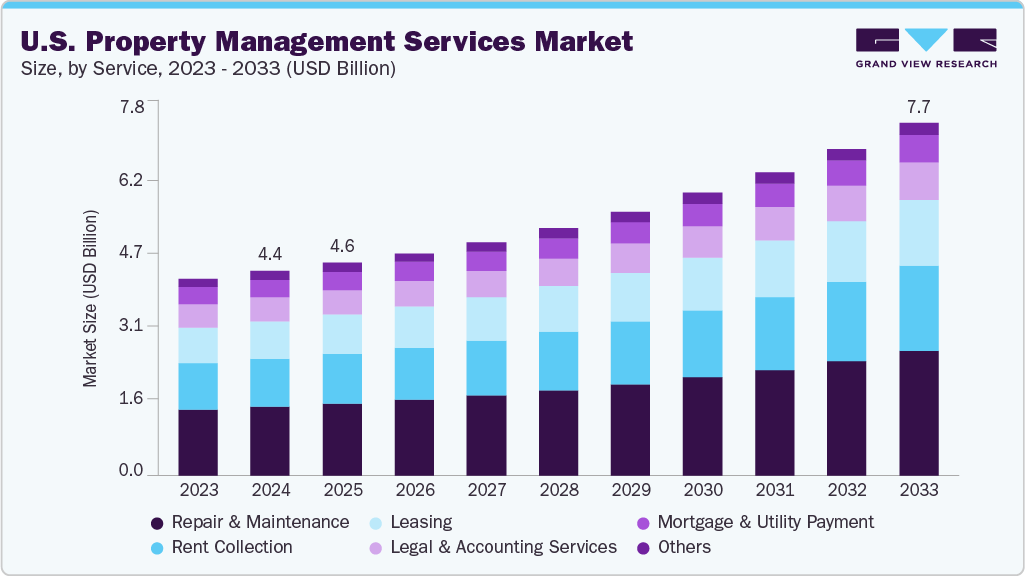 Source: Grand View Research, IR Documents, Primary Interviews, Paid DatabasesTo learn more about this report,
 Download Free Sample Report
 U.S. continues to attract global capital due to its transparent legal framework, relatively stable economic environment, and deep, liquid property markets. Foreign investors, including institutional funds, sovereign wealth funds, private equity firms, and high-net-worth individuals, allocate capital to U.S. residential, multifamily, and commercial assets as part of long-term portfolio diversification strategies. As cross-border investment activity increases, so does the number of professionally owned real estate assets requiring structured operational oversight.
Market Concentration & Characteristics
The U.S. property management services industry is highly fragmented, characterized by the presence of a large number of local property management firms, independent operators, and specialized service providers serving diverse property types and regional markets. Small- and medium-sized companies account for a significant share of managed properties, particularly in residential segments. Low entry barriers and localized service requirements encourage new participants, resulting in intense competition and limited market concentration despite the presence of several national property management companies.
The U.S. property management services industry demonstrates strong innovation driven by the adoption of AI-based platforms, cloud-based property management software, and automation tools. Companies are integrating digital rent payments, predictive maintenance systems, smart building technologies, and data analytics to enhance operational efficiency. Technology-enabled tenant communication, virtual leasing, and remote property monitoring solutions are transforming traditional management practices and improving decision-making across residential and commercial properties.
 To learn more about this report, Download Free Sample Report
 Merger and acquisition activity is increasing as property management firms expand their geographic presence and strengthen their technology capabilities. Companies are acquiring regional service providers and PropTech firms to broaden service portfolios and manage larger property portfolios efficiently. These strategic consolidations help firms achieve operational scale, improve digital infrastructure, and enhance client offerings, particularly to institutional investors and large real estate owners across the United States.
Regulations significantly influence the U.S. property management services industry through evolving housing laws, tenant protection policies, and compliance requirements. Property managers must adhere to fair housing regulations, rent control policies, safety standards, and financial reporting rules. Increasing regulatory oversight encourages the adoption of digital compliance tools, automated documentation, and transparent reporting systems, thereby driving demand for professional property management services that ensure legal compliance and mitigate risk.
Drivers, Opportunities & Restraints
Growth in multifamily housing and build-to-rent communities is especially significant for the market. Institutional investors, real estate investment trusts (REITs), and large portfolio owners are actively participating in new residential developments, and these stakeholders typically favor third-party management to ensure operational efficiency and performance optimization. Professional property managers are engaged early in the lifecycle of newly constructed assets to support occupancy stabilization, rent administration, preventive maintenance planning, and financial reporting.
The adoption of artificial intelligence (AI) and automation technologies presents a significant opportunity in the U.S. property management services industry, by enhancing operational efficiency and reducing cost pressures. Property management firms are increasingly leveraging AI-driven tools to automate routine tasks such as tenant inquiries, rent reminders, lease processing, and maintenance scheduling. Automated workflows reduce manual administrative workloads, minimize human error, and enable property managers to manage larger portfolios without proportionate increases in staffing. This scalability is particularly valuable in an environment characterized by rising labor costs and increasing service expectations.
Rental application fraud has emerged as a growing challenge in the U.S. property management services industry, undermining the reliability of tenant screening processes and increasing operational risk for property managers and owners. The rise of digital leasing platforms and remote application systems has streamlined tenant acquisition, but it has also made it easier for applicants to submit falsified income documents, manipulate credit information, or misrepresent identity details. Fraudulent applications undermine the effectiveness of traditional screening methods, increasing the risk of rent delinquency, lease defaults, and eviction proceedings.
Service Type Insights
The rent collection segment is expected to grow at a significant CAGR of 5.8% from 2026 to 2033. The repair & maintenance segment led the market with the largest revenue share of 33.7% in 2025 and is expected to grow at the fastest CAGR during the forecast period, driven by the expanding rental housing stock and the increasing focus on property upkeep and tenant satisfaction. Property owners and real estate investors are increasingly outsourcing maintenance activities to professional property management companies to ensure timely repairs, preventive maintenance, and efficient facility operations. Regular maintenance helps preserve property value, reduce long-term repair costs, and improve tenant retention, driving demand for specialized service providers.
The rent collection segment is projected to expand at a significant CAGR during the forecast period, as property owners and real estate investors increasingly outsource rent collection to professional management service providers to ensure timely payments, reduce administrative burden, and improve cash flow management. The shift toward online and automated payment systems, including mobile applications, tenant portals, and recurring payment options, is simplifying rent transactions while minimizing payment delays and errors. For instance, in September 2025, RentGuardus launched a new PropTech and InsurTech platform in the U.S. backed by USD 100 billion, offering guaranteed rent payments, legal protection, and risk management solutions for landlords and tenants.
Property Type Insights
The residential segment led the market with the largest revenue share of 63.9% in 2025, due to the increasing demand for rental housing and the expanding number of professionally managed residential properties. Rising home prices, changing lifestyle preferences, and growing urban mobility are encouraging more individuals and families to opt for rental accommodations, thereby increasing reliance on property management services. Property owners, including individual landlords and institutional investors, are increasingly outsourcing management functions to improve operational efficiency and tenant satisfaction.
The commercial property type segment is expected to grow at the fastest CAGR during the forecast period, due to increasing demand for professional management of office buildings, retail spaces, industrial facilities, and mixed-use developments. As commercial real estate operations become more complex, property owners and investors are increasingly outsourcing management functions to improve operational efficiency, cost control, and tenant retention.
End Use Insights
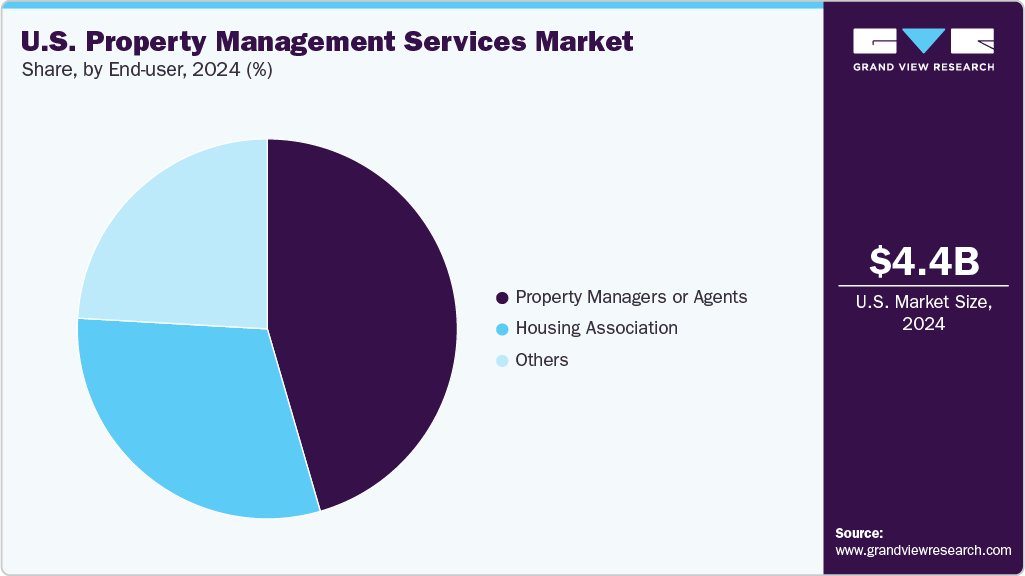
The individual property owners segment is expected to grow at a significant CAGR of 5.2% from 2026 to 2033. The institutional investors segment led the market with the largest revenue share of 41.2% in 2025 and is expected to grow at the fastest CAGR during the forecast period, as large investment entities such as pension funds, real estate investment trusts (REITs), insurance companies, and private equity firms continue expanding their real estate portfolios. These investors increasingly allocate capital toward diversified property assets, including residential communities, commercial complexes, logistics facilities, and mixed-use developments, creating strong demand for professional property management services to ensure efficient asset performance and long-term value creation.
 To learn more about this report, Download Free Sample Report
 The individual property owner segment is expected to grow at a significant CAGR during the forecast period, due to the rising number of small-scale real estate investors and landlords owning single-family homes, apartments, and rental units. Increasing property investments for passive income generation are encouraging individual owners to seek professional management services to efficiently handle operational responsibilities. Many property owners prefer outsourcing daily tasks such as tenant communication, rent collection, leasing, maintenance coordination, and legal compliance to reduce time commitment and operational complexity.
Key U.S. Property Management Services Company Insights
Some of the key players operating in the market include Greystar Worldwide, LLC, Lincoln Property Company, FirstService Residential, and Evernest, among others.
-
Greystar Worldwide, LLC operates through a vertically integrated real estate platform focused primarily on rental housing, offering services across property management, investment management, development, and construction. The company’s core market offerings include end-to-end property management for multifamily residential, mixed-use, and student housing assets; institutional investment management involving acquisition, asset management, and capital deployment strategies; and development and construction services covering multifamily communities, student accommodation, active adult living, and specialized real estate such as life science spaces.
-
Lincoln Property Company was founded in Dallas in 1965 as a developer of luxury multifamily housing and soon expanded into commercial real estate, adding office, industrial, and retail assets to its work. Over the decades, it broadened its services internationally, growing its leasing and property management business across the U.S. and into Europe, and today operates with a strategic focus on long-term client partnerships and growth plans backed by institutional investment. The company offers development and redevelopment services, acquisitions and investment support, leasing and corporate advisory, and property and asset management across office, industrial, retail, life science, data center, production studio, healthcare, government, university, mixed-use, and other commercial property types.
Key U.S. Property Management Services Companies:
- Greystar Worldwide, LLC
- Lincoln Property Company
- Asset Living
- FPI Management
- Alliance Residential Company
- FirstService Residential
- Evernest
- Darwin Homes, Inc
- HomeRiver Group
- Northpoint Asset Management
Recent Developments
-
In January 2026, Greystar and PGIM announced a collaboration to develop the Marlowe Natomas multifamily community in Sacramento, aiming to expand high-quality rental housing in a growing residential market. The partnership combines Greystar’s development and operational capabilities with PGIM’s investment expertise to deliver a modern residential project. The development is designed to address increasing housing demand through thoughtfully planned units and community-focused amenities.
-
In December 2025, Greystar and Pinnacle Bank formed a strategic partnership to expand a bridge lending program through structured capital support. Greystar will act as a junior capital partner, combining investment expertise with Pinnacle’s lending capabilities. The collaboration aims to strengthen real estate financing solutions and support market growth.
U.S. Property Management Services Market Report Scope
Report Attribute
Details
Market size value in 2026
USD 127.21 billion
Revenue forecast in 2033
USD 184.25 billion
Growth rate
CAGR of 5.4% from 2026 to 2033
Base year for estimation
2025
Historical data
2021 - 2024
Forecast period
2026 - 2033
Quantitative units
Revenue in USD million/billion, and CAGR from 2026 to 2033
Report coverage
Revenue forecast, company market position analysis, competitive landscape, growth factors, and trends
Segments covered
Service type, property type, end use, region
Country scope
U.S.
Key companies profiled
Greystar Worldwide, LLC; Schneider Electric Liquid; Asset Living, FPI Management; Alliance Residential Company; Mitsubishi Heavy Industries Ltd.; Evernest; Alfa Laval; HomeRiver Group; Northpoint Asset Management
Customization scope
Free report customization (equivalent up to 8 analysts working days) with purchase. Addition or alteration to country, regional & segment scope.
Pricing and purchase options
Avail customized purchase options to meet your exact research needs. Explore purchase options
U.S. Property Management Services Market Report Segmentation
This report forecasts revenue growth at global, regional & country levels and provides an analysis of the industry trends in each of the sub-segments from 2021 to 2033. For this study, Grand View Research has segmented the U.S. property management services market report based on the service type, property type, end use:
-
Service Type Outlook (Revenue, USD Billion, 2021 - 2033)
-
Rent Collection
-
Mortgage & Utility Payment
-
Leasing
-
Legal & Accounting Services
-
Repair & Maintenance
-
Other
-
-
Property Type Outlook (Revenue, USD Billion, 2021 - 2033)
-
Residential
-
Commercial
-
Industrial
-
Other
-
-
End Use Outlook (Revenue, USD Billion, 2021 - 2033)
-
Institutional Investors
-
Individual Property Owners
-
Housing Associations
-
Others
-
Frequently Asked Questions About This Report
The repair and maintenance services segment led the market and accounted for 33.7% of the global market revenue share in 2025 due to the expanding rental housing stock and increasing focus on property upkeep and tenant satisfaction. Property owners and real estate investors are increasingly outsourcing maintenance activities to professional property management companies to ensure timely repairs, preventive maintenance, and efficient facility operations. Regular maintenance helps preserve property value, reduce long-term repair costs, and improve tenant retention, driving demand for specialized service providers
Some of the key players operating in the U.S. property management services market include Greystar, Lincoln Property, Asset Living, FPI Management, Alliance Residential, FirstService Residential, Evernest, Darwin Homes, HomeRiver Group, Northpoint.
The U.S. property management services market is driven by rising rental demand, rapid urbanization, and increasing real estate investments. The growing need for professional management to handle complex operations, compliance with evolving regulations, and enhanced tenant expectations also fuel growth.
The U.S. property management services market size was estimated at USD 122.02 billion in 2025 and is expected to reach USD 127.21 billion in 2026.
The U.S. property management services market, in terms of revenue, is expected to grow at a compound annual growth rate of 5.4% from 2026 to 2033 to reach USD 184.25 billion by 2033.
About the Author(s)
Advanced Interior Materials Research Team
Advanced Materials · Advanced Interior MaterialsThis report was authored by the advanced interior materials research team at Grand View Research - comprising two research analysts, one senior research analyst, and one industry expert - with specialized expertise in the advanced interior materials segment of the advanced materials industry. All findings are based on proprietary advanced materials databases, executive interviews, and regulatory analysis, subject to internal peer review prior to publication.
Last Updated:
Speak to Analyst

Customize this report to your needs - add regions, segments, or data points, with 20% free customization.
Or view our licence options:


ISO 9001:2015 & 27001:2022 Certified
We are GDPR and CCPA compliant! Your transaction & personal information is safe and secure. For more details, please read our privacy policy.


