
- Home
- »
- Medical Devices
- »
-
U.S. Psychiatry Clinic Market Size, Industry Report, 2033GVR Report cover
![U.S. Psychiatry Clinic Market Size, Share & Trends Report]()
U.S. Psychiatry Clinic Market (2026 - 2033) Size, Share & Trends Analysis Report By Service (Evaluation & Diagnosis, Medication Management, Therapy, Telepsychiatry, Ancillary Services) By Age Group (Adult, Pediatric, Geriatric), By Region, And Segment Forecasts
- Report ID: GVR-4-68039-723-5
- Number of Report Pages: 100
- Format: PDF
- Historical Range: 2021 - 2025
- Forecast Period: 2026 - 2033
- Industry: Healthcare
- Report Summary
- Table of Contents
- Segmentation
- Methodology
- Download FREE Sample
-
 Download Sample Report
U.S. Psychiatry Clinic Market Summary
The U.S. psychiatry clinic market size was estimated at USD 10.96 billion in 2025 and is projected to reach USD 21.60 billion by 2033, growing at a CAGR of 7.79% from 2026 to 2033. This growth is primarily driven by the rising prevalence of mental health disorders such as anxiety, depression, bipolar disorder, and stress-related illnesses, fueled by lifestyle pressures, socio-economic stress, and increasing awareness of mental well-being.
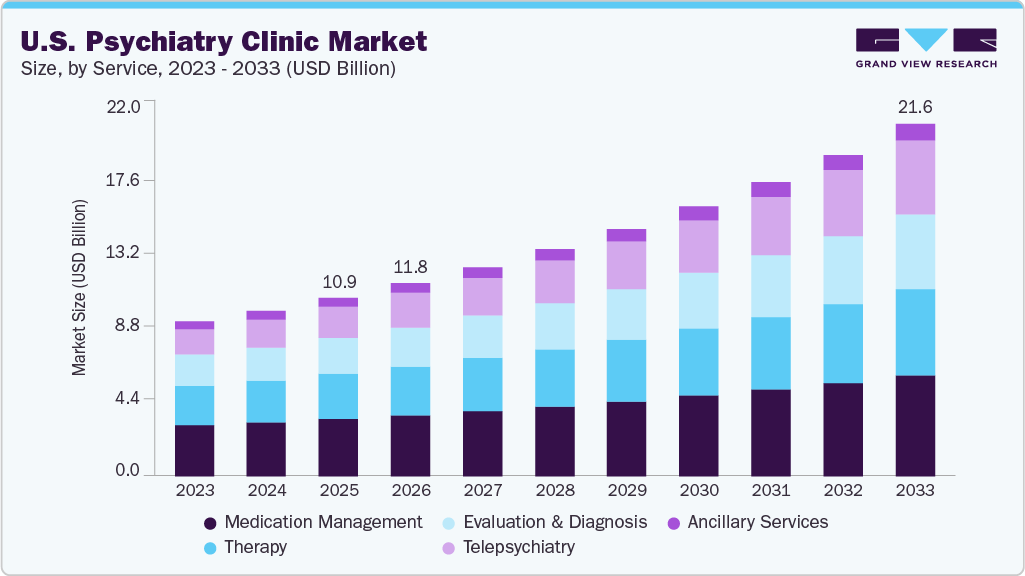
Growing recognition of mental health as an essential component of overall health, along with expanding de-stigmatization, has encouraged more individuals to seek psychiatric care. In addition, advancements in telepsychiatry, digital mental health platforms, and AI-enabled diagnostic support have expanded access to services, particularly in underserved and rural areas. Supportive government initiatives, increasing insurance coverage for behavioral health services, and employer-driven mental health programs further strengthen demand.
Rising Prevalence of Mental Health Disorders
The rising prevalence of mental health disorders such as depression, anxiety, bipolar disorder, PTSD, and substance use disorders is a primary driver of the market. As per WHO data published in September 2025, over 1 billion people worldwide are living with mental health disorders, which underscores the scale and urgency of the global mental health crisis. Conditions such as depression and anxiety cause significant emotional suffering and lead to productivity loss, reduced quality of life, and substantial economic burden on families, healthcare systems, and national economies.
Increasing numbers of individuals across all age groups are experiencing psychological stress due to factors such as lifestyle pressures, socioeconomic challenges, chronic disease burden, and post-pandemic mental health impacts. As more people seek diagnosis, counseling, and long-term psychiatric management, demand for specialized clinical services, medication management, and therapy continues to expand. This growing patient pool directly fuels the need for more psychiatrists, outpatient clinics, telepsychiatry platforms, and integrated behavioral health services, ultimately contributing to market growth and higher utilization of psychiatric care across the U.S.
As per the Institute for Health Metrics and Evaluation, in 2023, around 15% of the world’s population experienced some form of mental disorder, highlighting the widespread nature of the issue. Importantly, research suggests that up to 71% of the burden associated with anxiety disorders could be avoided if everyone had access to timely, effective, and optimal treatment. Mental disorders also contribute significantly to disability, accounting for about 17% of the total years lived with disability globally.
Prevalence of mental disorders worldwide, 2023
Country
Prevalence
Australia
21,915.46
UK
21,826.98
Brazil
20,145.53
Spain
18,558.72
France
18,523.82
Switzerland
18,282.96
Argentina
18,148.54
U.S.
17,333.87
Sweden
17,139.91
Norway
16,608.07
Canada
16,557.98
Denmark
16,530.26
Saudi Arabia
16,499.89
Guinea
16,423.09
Italy
15,966.92
Germany
14,983.57
Mexico
14,820.87
South Africa
14,486.29
India
14,292.18
Kuwait
14,215.97
Japan
13,084.15
UAE
13,054.11
China
12,705.55
Thailand
9,436.60
Source: Institute for Health Metrics and Evaluation
Greater Awareness and Reduced Stigma
Public health campaigns, social media advocacy, celebrity disclosures, and broader media coverage have normalized conversations about depression, anxiety, bipolar disorder, and other psychiatric conditions, encouraging people to seek professional help rather than suppress symptoms. Employers, schools, and healthcare providers are increasingly recognizing mental health as integral to overall well-being, leading to expanded screening, referrals, and insurance coverage for psychiatric services. This shift has resulted in higher patient volumes, greater acceptance of psychiatric treatment, and rising demand for outpatient psychiatry clinics, telepsychiatry services, and specialized treatment programs across the U.S.
The APA Foundation’s first major mental health public awareness initiative refers to the launch of its Mental Health Care Works campaign in August 2023, a nationwide effort designed to shift how Americans think about and act on mental health. Recognizing that millions of people struggle with symptoms yet do not seek treatment, the campaign emphasizes that mental health care is effective and encourages individuals to take the first step toward support. It raises awareness of mental health signs and symptoms, highlights the success of treatment, and seeks to reduce stigma and discrimination that often prevent people from asking for help.
Rawle Andrews, Jr., Esq., Executive Director of APAF, said:
“Our team at APAF and the APA member community understand that mental health is a fundamental aspect of overall well-being, but few treat it as such. Through this campaign, we hope to raise awareness, combat discrimination, and encourage action for struggling individuals.”
Technological Advancements & Telepsychiatry
Technological advancements and the rapid adoption of telepsychiatry are major growth drivers for the U.S. psychiatry clinic market, as they significantly enhance accessibility, efficiency, and quality of mental health care. Telepsychiatry platforms enable remote consultations, expanding reach to underserved and rural populations while reducing waiting times and improving continuity of care. Advanced digital tools such as AI-based diagnostic support, electronic health records, virtual therapy platforms, and remote patient monitoring enhance patient engagement, clinical decision-making, and treatment personalization. Moreover, increasing acceptance of virtual mental health services among patients and clinicians, supportive regulatory changes, and insurance reimbursement parity for telehealth have further strengthened utilization.
The American Telemedicine Association’s launch of the Center of Digital Excellence (CODE) in December 2024 marked a significant step toward strengthening digital integration in U.S. healthcare delivery. This initiative brings together leading health systems and digital health experts to establish best practices for incorporating telemedicine and digital care pathways across the care continuum. CODE aims to promote patient-centered and equitable access to virtual care, ensuring that technology enhances both clinical outcomes and operational efficiency. By creating a collaborative platform focused on innovation, standardization, and quality improvement, the initiative is expected to accelerate widespread adoption of digital health solutions, supporting more consistent, accessible, and effective care delivery nationwide.
Integration With Broader Healthcare
Integration with broader healthcare systems is a significant driver for the market as it enhances coordinated care, improves accessibility, and strengthens clinical outcomes. As mental health is increasingly recognized as integral to overall health, psychiatry services are being embedded into primary care, specialty care, hospitals, and value-based care models. This integration enables earlier diagnosis, seamless referrals, and continuous patient management through shared electronic health records and collaborative care frameworks. It also supports reimbursement expansion through integrated delivery networks and payer partnerships, while reducing stigma by normalizing mental health treatment within routine healthcare.
The identification of 60 hospitals and health systems with strong psychiatry and behavioral health programs highlights the growing emphasis U.S. healthcare providers are placing on comprehensive mental health services as a core part of clinical care. These leading organizations typically invest in multidisciplinary psychiatric teams, advanced treatment models, and integrated behavioral health services that span inpatient, outpatient, emergency, and community-based care. Their programs often incorporate evidence-based therapies, telepsychiatry, addiction medicine, child and adolescent services, and crisis stabilization units, reflecting broader national priorities to address rising mental health disorders, substance use conditions, and post-pandemic behavioral health needs.
Market Concentration & Characteristics
The market is fragmented, with many small players entering the market and launching new innovative products. The degree of innovation is moderate, and the level of merger & acquisition activities is medium. The impact of regulations on the market is high, and service expansion is medium.
The degree of innovation in the industry is moderate. In December 2025, the University of Oregon startup and its affiliated psychology clinic are innovating to improve community care by combining technology, clinical training, and accessible services to better meet local mental health needs. Through a partnership with Ksana Health, the UO Psychology Clinic uses Vira, a digital health app that helps clinicians track symptoms, gather self-reported patient data, and send personalized reminders between sessions, which makes therapy more continuous and effective while saving clinicians time on administrative work.
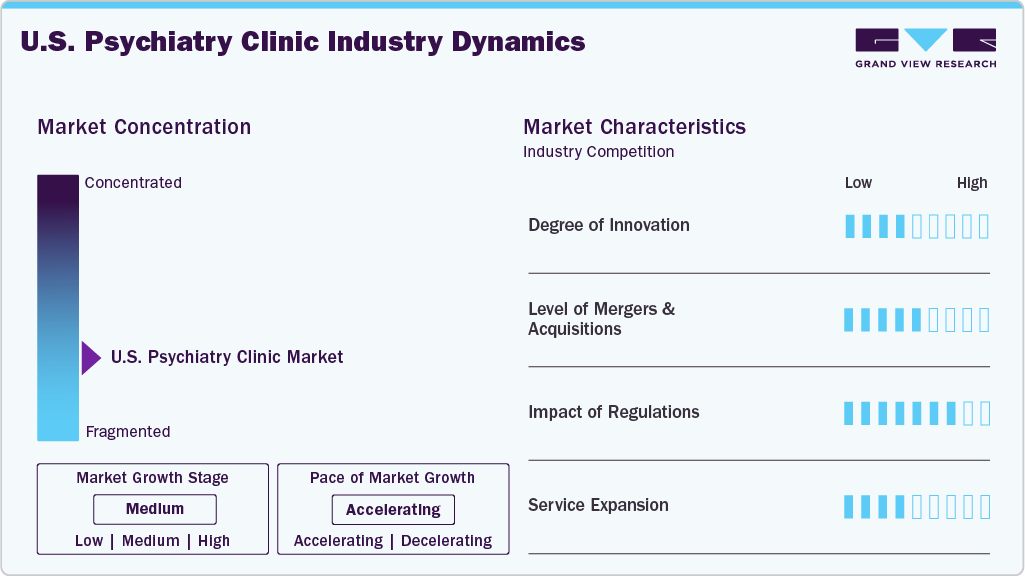
The market players are leveraging strategies such as collaborations, partnerships, and acquisitions, to promote the reach of their offerings and increase their service capabilities. In November 2025, Centerstone and Brightli completed their merger to create the largest nonprofit behavioral health provider in the U.S., marking a significant consolidation in the sector. The newly unified organization, operating under the Centerstone name, brings together more than 10,000 employees across approximately 360 outpatient, inpatient, and residential locations in nine states. It will serve approximately 250,000 people annually with mental health and substance use disorder care.
Regulations play a crucial role in the market, dictating operational standards and care delivery. Psychiatrists and clinical staff must hold state-issued medical licenses and, where applicable, DEA registration for prescribing controlled substances, while strict adherence to HIPAA and 42 CFR Part 2 governs patient confidentiality and behavioral health records. Clinics must comply with state mental health practice acts, mandatory reporting laws, informed consent standards, and quality-of-care requirements, and many seek accreditation from bodies such as The Joint Commission to demonstrate compliance with clinical and safety standards.
Market players utilize a strategy of service expansion to increase their service capabilities and promote the reach of their service offerings. For instance, in April 2025, Two Chairs announced the launch of integrated psychiatry services to complement its existing therapy offerings, aiming to address the fragmented nature of mental health treatment in the U.S. by combining therapy and psychiatric medication management within a single coordinated care team. This expansion is designed to reduce barriers that patients often face when navigating separate providers for therapy and medication, improving access and engagement, and leading to better clinical outcomes.
“People often have to piece together their mental health care journey on their own, seeing separate providers for therapy and medication with little coordination between them,” said Alex Katz, Founder and CEO of Two Chairs. “By adding psychiatry to our services, we’re removing those barriers and offering a coordinated care experience that helps patients get the right care faster and see better outcomes.”
Service Insights
The medication management segment dominated the market with the largest revenue share of 32.25% in 2025. This can be attributed to the rising prevalence and recognition of mental health disorders, which has expanded demand for consistent pharmacological care alongside therapy and other services. Moreover, broader adoption of telepsychiatry and digital health technologies has made psychiatric medication management services more accessible and scalable, enabling clinics to serve more patients remotely, integrate electronic health records for better tracking, and support adherence monitoring. Workforce shortages among psychiatrists have also encouraged team‑based care models in which nurse practitioners and physician assistants play a larger role in medication follow‑ups, further embedding medication management as a core service within clinics.
The telepsychiatry segment is expected to grow at the fastest CAGR during the forecast period. Telepsychiatry helps meet this demand by expanding access to psychiatric services, especially in rural and underserved areas where there are shortages of mental health professionals, long wait times, or no local specialists at all. Moreover, advances in digital technology, such as widespread high-speed internet, smartphones, secure video conferencing, and integration with electronic health records, have enhanced the quality and convenience of remote consultations, making both providers and patients more comfortable with virtual care.
Age Group Insights
The adult segment dominated the market with the largest revenue share of 65.54% in 2025. This can be attributed to the growing disease prevalence among adults in the U.S. One in every four adults in the U.S. has mental health problems, according to mental health statistics by Johns Hopkins Medicine. Moreover, adult psychiatric services are available in most psychiatry clinics. Langley Porter Psychiatric Hospital, Mayo Clinic, Bellevue Hospital & Manhattan Psychiatric Center are some of the top psychiatry clinics known for adult services.
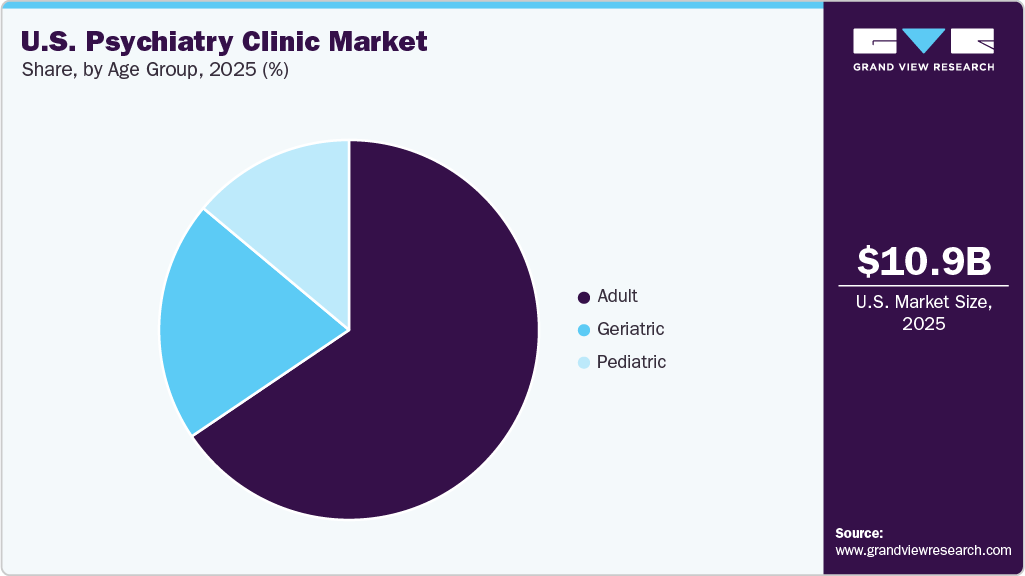
The pediatric segment is expected to grow at the fastest CAGR during the forecast period. This is driven by the rising mental health problems and substance abuse among teenagers. Every one in six adolescents has mental health issues, as per the National Council of Mental Wellbeing. Moreover, improving accessibility to better pediatric facilities and increasing awareness programs for child mental health are boosting the growth of the segment.
Region Insights
The Southeast psychiatry clinicmarket growth in the U.S. is attributed to the rising prevalence of mental health conditions such as anxiety, depression, and other behavioral disorders has generated sustained patient demand, reflecting broader national trends of increasing recognition and treatment of mental illness. This is matched by greater public awareness and reduced stigma around seeking psychiatric care, which encourages more individuals across demographic groups to pursue help, thereby expanding the addressable patient base.
The U.S. Northeast psychiatry clinic market is expected to grow at a significant CAGR during the forecast period. The Northeast has a high concentration of urban populations and well-developed healthcare infrastructure, which increases both access to and utilization of psychiatric services. Major metropolitan centers, such as New York, Boston, and Philadelphia, have extensive networks of clinics and specialized medical facilities that attract both patients and healthcare providers.
Key U.S. Psychiatry Clinic Company Insights
Key companies in the market, including Universal Health Services, Acadia Healthcare, UCSF Health, Mayo Clinic, Bellevue Hospital, and Menninger Clinic, play a crucial role in delivering specialized mental healthcare. They provide inpatient and outpatient services, crisis stabilization, and evidence-based treatments, while advancing integrated care models, telepsychiatry, and workforce development. Together, these organizations improve access, clinical outcomes, and the overall efficiency of psychiatric care across the U.S.
Key U.S. Psychiatry Clinic Companies:
- Universal Health Services
- Langley Porter Psychiatric Hospital (LPPH)
- Bellevue Hospital
- Manhattan Psychiatric Center
- Menninger Clinic
- Tucker Psychiatric Clinic
- Acadia Healthcare
- UCSF Health
- Peninsula Behavioral Health
- Mayo Clinic
Recent Developments
-
In June 2025, atai Life Sciences and Beckley Psytech announced a strategic all-share combination to form a new company called AtaiBeckley, aiming to become a global leader in psychedelic-based mental health therapies.
Cosmo Feilding Mellen, Chief Executive Officer and Co-Founder of Beckley added, “This combination brings together two highly complementary pipelines to create a market leader at the forefront of psychiatric care. Clinical data has shown the rapid and durable effects of our compounds, as well as their potential to fit within the existing treatment paradigm established by SPRAVATO®. We believe that the unified business will be even better positioned to accelerate development, drive long-term value for shareholders, and - most importantly - deliver meaningful innovation for patients.”
-
In October 2024, the Los Angeles County Department of Mental Health (LACDMH) announced expansion of its care and services across the county by hosting a series of groundbreaking and grand opening events aimed at improving mental health support and housing for vulnerable populations.
-
In August 2024, AbbVie announced that it had completed its acquisition of Cerevel Therapeutics, a clinical-stage biopharmaceutical company focused on developing treatments for neurological and psychiatric disorders, for USD 45.00 per share in cash, representing a total equity value of approximately USD 8.7 billion.
"AbbVie's acquisition of Cerevel strengthens our foundation in neuroscience and positions us to deliver sustainable long-term performance into the next decade and beyond," said Robert A. Michael, chief executive officer, AbbVie. "Our new Cerevel colleagues share our commitment to deliver meaningful change for patients living with neurological and psychiatric conditions. We are excited to welcome the talented Cerevel team to AbbVie."
U.S. Psychiatry Clinic Market Report Scope
Report Attribute
Details
The market size value in 2026
USD 11.85 billion
Revenue forecast in 2033
USD 21.60 billion
Growth Rate
CAGR of 7.79% from 2026 to 2033
Actual data
2021 - 2025
Forecast data
2026 - 2033
Quantitative units
Revenue in USD million/billion and CAGR from 2026 to 2033
Report coverage
Revenue forecast, company ranking, competitive landscape, growth factors, and trends
Segments covered
Service, age group, region
Country scope
U.S.
Key companies profiled
Universal Health Services; Langley Porter Psychiatric Hospital (LPPH); Bellevue Hospital; Manhattan Psychiatric Center; Menninger Clinic, Tucker Psychiatric Clinic; Acadia Healthcare; UCSF Health; Peninsula Behavioral Health; Mayo Clinic.
Customization scope
Free report customization (equivalent up to 8 analysts working days) with purchase. Addition or alteration to country, regional & segment scope.
Pricing and purchase options
Avail customized purchase options to meet your exact research needs. Explore purchase options
U.S. Psychiatry Clinic Market Report Segmentation
This report forecasts revenue growth, country level and provides an analysis of the latest industry trends in each of the sub-segments from 2021 to 2033. For this study, Grand View Research has segmented the U.S. psychiatry clinic market report based on service, age group, and region:
-
Service Outlook (Revenue, USD Billion, 2021 - 2033)
-
Evaluation & Diagnosis
-
Therapy
-
Medication Management
-
Telepsychiatry
-
Ancillary Services
-
-
Age Group Outlook (Revenue, USD Billion, 2021 - 2033)
-
Adult
-
Geriatric
-
Pediatric
-
-
Region Outlook (Revenue, USD Billion, 2021 - 2033)
-
Southeast
-
Midwest
-
West
-
Northeast
-
Southwest
-
Frequently Asked Questions About This Report
b. The U.S. psychiatry clinic market size was valued at USD 10.96 billion in 2025 and is expected to reach USD 11.85 billion in 2026.
b. The U.S. psychiatry clinic market is expected to grow at a compound annual growth rate of 7.79% from 2026 to 2033 to reach an estimated value of USD 21.60 billion by 2033
b. The medication management segment dominated the market with highest revenue share of 32.25% in 2025. This can be attributed to the rising prevalence and recognition of mental health disorders, which has expanded demand for consistent pharmacological care alongside therapy and other services.
b. Some key players operating in the U.S. psychiatry clinic market include Universal Health Services; Langley Porter Psychiatric Hospital (LPPH); Bellevue Hospital; Manhattan Psychiatric Center; Menninger Clinic, Tucker Psychiatric Clinic; Acadia Healthcare; UCSF Health; Peninsula Behavioural Health; Mayo Clinic.
b. Key factors that are driving the U.S. psychiatry clinic market growth include the rising prevalence of mental health disorders such as anxiety, depression, bipolar disorder, and stress-related illnesses, fueled by lifestyle pressures, socio-economic stress, and increasing awareness of mental well-being.


Share this report with your colleague or friend.
Need a Tailored Report?
Customize this report to your needs — add regions, segments, or data points, with 20% free customization.


ISO 9001:2015 & 27001:2022 Certified
We are GDPR and CCPA compliant! Your transaction & personal information is safe and secure. For more details, please read our privacy policy.
Trusted market insights - try a free sample
See how our reports are structured and why industry leaders rely on Grand View Research. Get a free sample or ask us to tailor this report to your needs.













