
- Home
- »
- Advanced Materials
- »
-
U.S. Refractory Market Size And Share Report, 2026-2033GVR Report cover
![U.S. Refractory Market (2026 - 2033)Report]()
U.S. Refractory Market (2026 - 2033)
Size, Share & Trends Analysis Report By End Use (Steel, Cement, Glass, Non-Ferrous Metals), Consumer Behavior, Key Companies, Competitive Analysis, And Segment Forecasts
Market Size, 2025
$2.6BMarket Estimate, 2026
$2.9BMarket Forecast, 2033
$4.5BCAGR, 2026–2033
6.6%U.S. Refractory Market Summary
The U.S. refractory market size was valued at USD 2.6 billion in 2025 and is projected to grow from USD 2.9 billion in 2026 to USD 4.5 billion by 2033, at a CAGR of 6.6% from 2026 to 2033. The growth is driven by increasing demand from key end-use industries, particularly iron & steel, non-ferrous metals, cement, glass, and power generation, along with rising investments in industrial capacity expansion and infrastructure development. The growing focus on energy-efficient high-temperature processes and the need for refractory materials with improved thermal resistance, durability, and operational performance are further supporting market growth.
Key Market Trends & Insights
- By end use: Steel segment accounted for the largest revenue share of 65.1% in 2025.
Market Size & Forecast
- Market Size in 2025: USD 2.6 Billion
- Estimated Market Size in 2026: USD 2.9 Billion
- Projected Market Size in 2033: USD 4.5 Billion
- CAGR (2026-2033): 6.6%
The increasing focus on sustainability and energy efficiency is driving demand for solutions that reduce energy consumption, minimize heat loss, and improve resource efficiency across buildings and industrial operations. Growing emphasis on low-carbon development, energy conservation, and environmentally sustainable construction is encouraging the adoption of materials and technologies that support improved thermal performance and reduced operational energy requirements.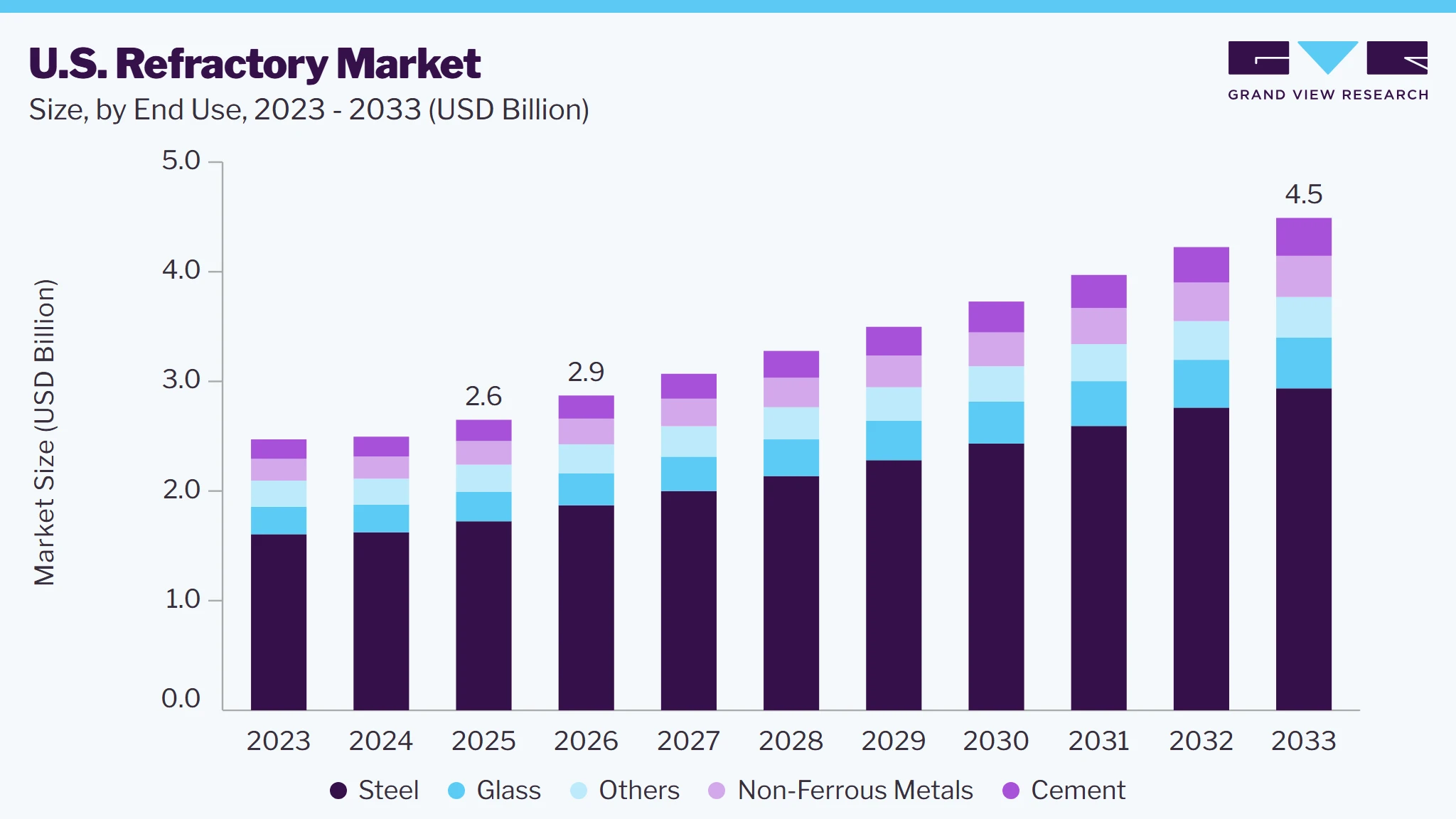
Market Dynamics
Governments, building owners, developers, and industries are increasingly prioritizing sustainable infrastructure and energy-efficient systems to meet environmental regulations and reduce carbon emissions. The growing adoption of green building standards, energy-performance requirements, and sustainable construction practices is further supporting investments in high-performance materials and technologies that enhance energy efficiency and long-term operational sustainability.
The expansion of smart buildings and automated building-management systems is creating favorable conditions for advanced building technologies designed to improve energy efficiency and operational performance. Building owners and developers are increasingly integrating sensors, automated controls, energy-management platforms, and intelligent façade systems to optimize indoor environmental conditions and reduce operating costs.
The growing construction of commercial offices, corporate facilities, airports, hotels, hospitals, educational institutions, and other high-performance buildings is supporting the adoption of energy-efficient building solutions. The increasing implementation of green-building standards and energy-performance requirements is further encouraging investment in advanced materials and technologies that contribute to improved building efficiency and sustainability.
High upfront costs remain a major constraint on the adoption of advanced energy-efficient building technologies. Specialized materials, components, control systems, and integration requirements can increase initial project costs compared with conventional building solutions.
Adoption can also be influenced by project-specific factors, including building design, climate conditions, energy prices, and expected energy savings. Installation and integration may be more complex in retrofit projects, while maintenance requirements, technical compatibility, and limited availability of specialized expertise can further restrict adoption, particularly in cost-sensitive applications.
The increasing development of high-performance commercial and institutional buildings presents significant growth opportunities for advanced building materials and energy-efficient technologies. Office buildings, airports, hotels, hospitals, educational facilities, and premium residential developments are increasingly incorporating solutions that improve energy performance, occupant comfort, and operational efficiency.
The expansion of low-carbon and energy-efficient building initiatives is expected to create additional opportunities as developers increasingly evaluate technologies based on long-term operational performance and lifecycle benefits rather than upfront construction costs alone. Continued advancements in material performance, durability, manufacturing efficiency, and system integration are expected to further support adoption across new construction and renovation projects.
Analyst Perspective
The industry is primarily driven by production and maintenance requirements across high-temperature industries, particularly iron & steel, cement, non-ferrous metals, glass, coal-based thermal power, and ammonia production. Refractories are closely linked to industrial output, operating capacity, and refractory replacement cycles. Ongoing plant maintenance, relining and replacement activity, capacity expansions, and modernization of high-temperature processing equipment are expected to sustain refractory consumption, while demand for longer service life, improved thermal performance, reduced downtime, and greater process efficiency is supporting the adoption of higher-performance refractory products.
End Use Insights
The steel segment held the highest revenue share of 65.1% in 2025, driven by the extensive use of refractories across steelmaking operations, including blast furnaces, basic oxygen furnaces, electric arc furnaces, ladles, tundishes, and reheating furnaces. Refractory demand is supported by the high-temperature and chemically demanding conditions associated with steel production, as well as ongoing requirements for furnace relining, maintenance, and replacement.
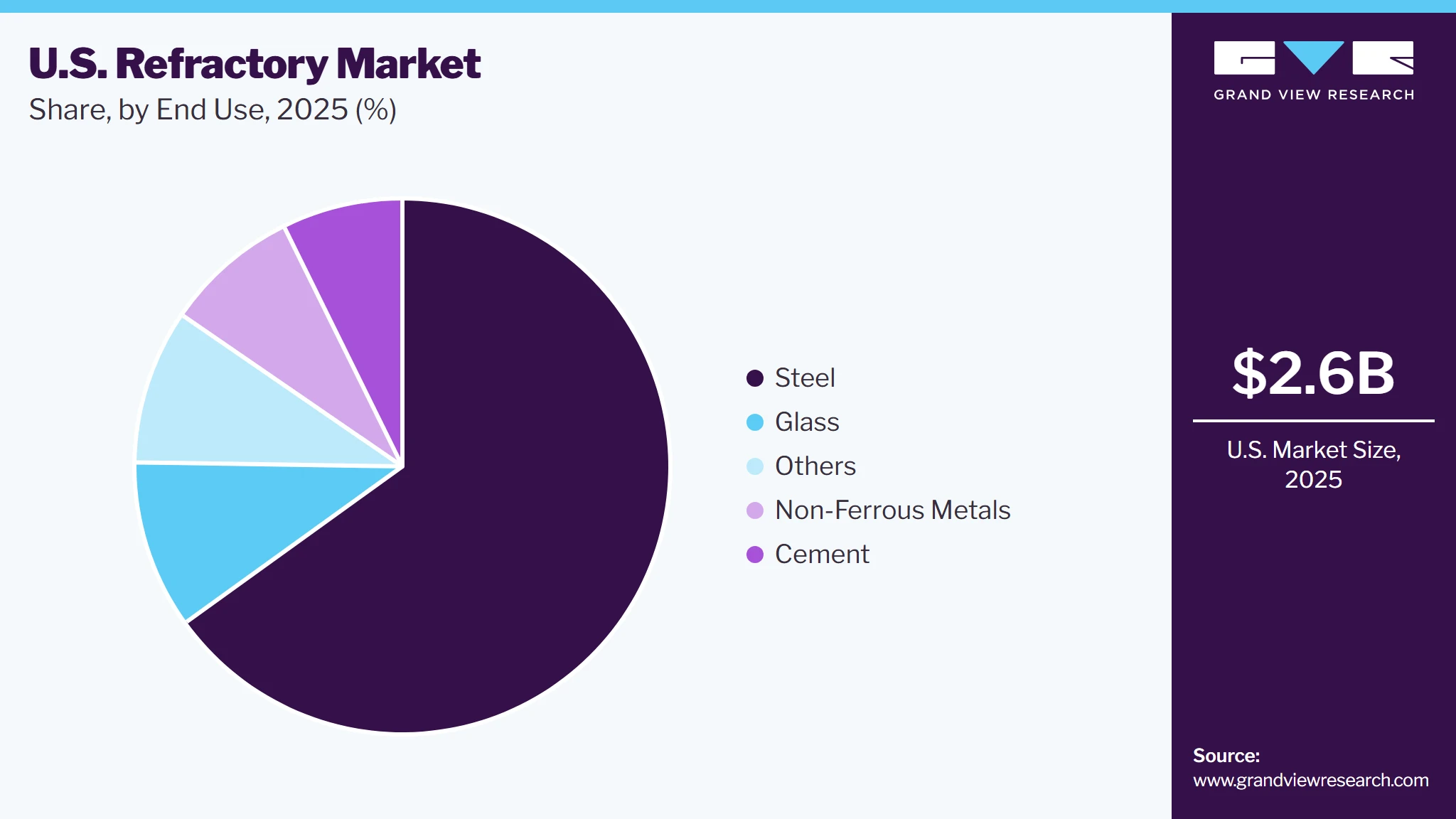
The cement segment is projected to register the highest CAGR of 7.3% during the forecast period, supported by increasing cement production, capacity expansion, and investments in construction and infrastructure activities. Refractories are used extensively in rotary kilns, preheaters, calciners, and clinker coolers, with demand influenced by plant modernization and the need for materials that can improve thermal efficiency, operational reliability, and equipment service life.
Key U.S. Refractory Companies Insights
Some of the key players operating in the U.S. refractory market include HarbisonWalker International, RHI Magnesita, Vesuvius, and others.
-
HarbisonWalker International (HWI), founded in 1865 and headquartered in Moon Township, Pennsylvania, is a manufacturer and supplier of refractory products and services for high-temperature industrial applications. The company offers shaped and unshaped refractory materials used across iron and steel, cement, aluminum, glass, petrochemical, and other industrial sectors. Its operations include manufacturing, technical services, and application support, with products designed for furnaces, kilns, ladles, tundishes, boilers, and other high-temperature processing equipment. The company became part of Calderys following the merger of Calderys and HWI.
-
RHI Magnesita, established in its current form in 2017 and with operations in North America, is a supplier of refractory materials, systems, and services for high-temperature industrial applications. The company provides basic and non-basic refractory products for iron and steel, cement, non-ferrous metals, glass, energy, and other industrial sectors. Its portfolio includes shaped and unshaped refractories, supported by engineering, installation, technical services, and refractory lifecycle management. RHI Magnesita’s North American operations serve industrial customers across the region.
-
Vesuvius, established in 1704 through its historical business origins and headquartered in London, United Kingdom, is a supplier of molten metal flow engineering and refractory products for the steel and foundry industries. The company provides products and systems used in steelmaking, continuous casting, and other high-temperature metal-processing applications, including flow-control systems, slide gates, tundish refractories, and related refractory products. Its operations include manufacturing, research and development, technical support, and customer service capabilities serving industrial customers in the United States and other markets.
Key U.S. Refractory Companies
-
Allied Mineral Products
-
Alsey Refractories Co.
-
HarbisonWalker International (Calderys)
-
Magneco/Metrel, Inc.
-
Minerals Technologies Inc.
-
Morgan Advanced Materials and its affiliates
-
Plibrico Company, LLC
-
RHI Magnesita North America
-
Shinagawa Advanced Materials Americas Inc.
-
Vesuvius
Competitive Benchmarking
Category
Operating Strategies
Competitive Edge
Weakness
Established Players (HarbisonWalker International (Calderys), RHI Magnesita North America, Morgan Advanced Materials and its affiliates, Shinagawa Advanced Materials Americas Inc., Vesuvius)
- Expand product portfolios across basic and non-basic, shaped and unshaped refractories to serve multiple high-temperature industries.
- Combine refractory products with technical services, installation, engineering, maintenance, and application support.
- Focus on long-term supply relationships with major steel, cement, non-ferrous metal, glass, and other industrial customers.
- Broad product portfolios enable participation across multiple end-use industries and refractory applications.
- Manufacturing networks, technical resources, and application expertise support large industrial customers and complex projects.
- Research and development capabilities support the development of products designed for longer service life and specific operating conditions.
- Large operating structures can result in higher fixed costs and slower response to smaller or highly specialized customer requirements.
- Exposure to cyclical industries, particularly steel and other metals, can affect refractory demand and capacity utilization.
- Higher-performance and technically specialized products may face pricing pressure in cost-sensitive applications.
Emerging & Regional Players (Allied Mineral Products, Alsey Refractories Co., Magneco/Metrel, Inc., Minerals Technologies Inc., Plibrico Company, LLC)
- Focus on specialized refractory formulations and application-specific solutions for selected high-temperature processes.
- Compete through customer proximity, technical support, customized products, and responsive supply capabilities.
- Concentrate on selected industries and applications where specialized refractory performance and service are important.
- Specialized product expertise can support customized solutions for specific furnaces, kiln, boiler, and process requirements.
- Regional manufacturing and distribution capabilities can provide shorter supply chains and closer customer support.
- More focused operations can enable flexibility in product development and response to changing customer requirements.
- Smaller geographic and manufacturing footprints can limit access to large multinational customers and projects.
- Narrower product portfolios may reduce participation across certain refractory categories and end-use industries.
- Greater dependence on selected industries or customers can increase exposure to fluctuations in industrial production.
Recent Developments
-
In March 2026, HWI, a member of Calderys, officially opened a new lightweight monolithics production facility in Fulton, Missouri. The facility was developed at HWI’s existing Rotary Kiln complex and includes a dedicated furnace system for GREENLITE aggregate production, robotic packaging and material-handling capabilities, and access to local clay reserves. The investment expands HWI’s production capacity for lightweight monolithic refractories and supports its supply capabilities across the Americas.
-
In February 2026, Calderys introduced CALDE MAG GUN VELOCITY, a hot-gunning refractory solution designed for repair applications in basic oxygen furnaces and electric arc furnaces. The technology is intended to increase repair efficiency and reduce the frequency of maintenance interventions, supporting improved furnace availability and refractory maintenance practices in steelmaking operations.
-
In March 2026, RHI Magnesita and Morgan Advanced Materials announced a regional commercial collaboration focused on improving thermal performance in steel treatment ladle applications. The collaboration involves the development of an Advanced Insulation System combining the companies’ respective capabilities in refractory and thermal-insulation technologies to support improved insulation performance in steelmaking operations.
U.S. Refractory Market Report Scope
Report Attribute
Details
Market Definition
The market size represents the annual consumption of refractories across various end-use industries in the U.S. for each specific year.
Market size in 2025
USD 2.6 billion
Estimated market size in 2026
USD 2.9 billion
Projected market size by 2033
USD 4.5 billion
Growth rate
CAGR of 6.6% from 2026 to 2033
Base year for estimation
2025
Historical data
2021 - 2024
Forecast period
2026 - 2033
Quantitative units
Volume in kilotons; revenue in USD billion, and CAGR from 2026 to 2033
Report coverage
Volume & revenue forecast, volume forecast, competitive landscape, growth factors, and trends
Segments covered
End use
Country scope
U.S.
Key companies profiled
Allied Mineral Products; Alsey Refractories Co.; HarbisonWalker International (Calderys); Magneco/Metrel, Inc.; Minerals Technologies Inc.; Morgan Advanced Materials and its affiliates; Plibrico Company, LLC; RHI Magnesita North America; Shinagawa Advanced Materials Americas Inc.; Vesuvius
Customization scope
Free report customization (equivalent up to 8 analysts working days) with purchase. Addition or alteration to country, regional & segment scope.
Pricing and purchase options
Avail customized purchase options to meet your exact research needs. Explore purchase options
U.S. Refractory Market Report Segmentation
This report forecasts revenue and volume growth at the country level and provides an analysis of the latest industry trends in each of the sub-segments from 2021 to 2033. For this study, Grand View Research has segmented the U.S. refractory market report on the basis of end use.
-
End Use Outlook (Volume, Kilotons; Revenue, USD Billion, 2021 - 2033)
-
Steel
-
Cement
-
Glass
-
Non-Ferrous Metals
-
Others
-
Research Methodology
The U.S. refractory market figures in this report are based on a proven research process that combines executive interviews with secondary research from proprietary databases, company filings, and recognized regulatory and institutional sources. Market size is built through value-chain sizing-reconciling supply-side and demand-side estimates-and triangulated with bottom-up and top-down approaches. Every estimate passes multiple levels of expert validation before publication, with each U.S. refractory segment quantified using the revenue-capture definitions in the table below.
Segment Definition
End Use
Revenue Capture Definition
Steel
Revenue is captured from the consumption of refractories in crude steel production, including high-temperature applications in blast furnaces, basic oxygen furnaces, electric arc furnaces, ladles, tundishes, reheating furnaces, and other steelmaking and processing operations.
Cement
Revenue is derived from refractory consumption in cement clinker production, particularly in rotary kilns, preheaters, calciners, coolers, and other high-temperature processing equipment.
Glass
Revenue is captured from refractory materials used in glass manufacturing, including glass melting furnaces, regenerators, forehearths, channels, and other high-temperature equipment involved in glass production and processing.
Non-Ferrous Metals
Revenue is generated from refractory consumption in primary and secondary aluminum production and copper production, including applications in smelters, furnaces, ladles, holding equipment, and other high-temperature metal processing operations.
Others
Includes revenue associated with refractory consumption in coal-based thermal power generation and ammonia production, including applications in boilers, furnaces, gasifiers, reformers, and other high-temperature industrial processing equipment.
Estimation Model
Layer No.
Layer Name
Key Question
Description
01
Addressable Industrial Production Base Layer
What is the potential demand base for refractories?
Quantify the production base across key refractory-consuming industries, including crude steel, cement clinker, copper, primary and secondary aluminum, glass, coal-based thermal power, and ammonia production. Evaluate production volumes, installed industrial capacity, capacity utilization, operating conditions, and expansion activity to establish the addressable demand base.
02
Refractory Consumption Intensity Layer
How much refractory is consumed per unit of industrial output?
Determine refractory consumption intensity across each end-use industry based on kilograms or tons of refractory consumed per ton of output, or equivalent production-based consumption factors. Assess variations by production technology, furnace type, process conditions, operating temperature, refractory lining requirements, and maintenance cycles.
03
Refractory Demand Layer
What quantity of refractories is required?
Derive annual refractory demand by applying industry-specific refractory consumption factors to the corresponding production volumes. Incorporate refractory requirements associated with new installations, relining, maintenance, repair, replacement, and routine consumption across high-temperature processing equipment. The resulting demand is measured in tons of refractories consumed annually.
04
Pricing & Revenue Layer
What is the monetary value of the installed glass demand?
Estimate market revenue by multiplying calculated refractory demand volumes by the applicable average selling prices. Pricing is assessed based on refractory type, product form, material composition, performance characteristics, application, and end-use industry. Where relevant, pricing differences between shaped and unshaped refractories and between basic and non-basic products are incorporated to maintain consistency with the defined market scope.
Delivered Customizations
This report has been delivered with the following In-depth customizations
Client Request
Customization Delivered
Value Adds
Refractory Type Segmentation & Demand Analysis
Detailed assessment of the U.S. refractory market across Basic Shaped, Basic Unshaped, Non-Basic Shaped, and Non-Basic Unshaped refractories, including product characteristics, applications, demand volumes, revenue contribution, and consumption by end-use industry.
Identifies high-growth product categories, shifts in product mix, and demand opportunities across major refractory-consuming industries.
Refractory Trade Outlook
Assessment of U.S. refractory imports and exports, including trade volumes, trade value, major trading partners, import/export trends, average unit values, and product-level trade patterns across relevant HS codes.
Evaluates U.S. import dependency, export competitiveness, sourcing patterns, and potential changes in international supply flows.
Refractory Pricing & Cost Analysis
Analysis of average selling prices by basic/non-basic and shaped/unshaped categories, supported by raw-material costs, manufacturing costs, energy costs, transportation, and import pricing.
Identifies key pricing drivers, product-level price differentials, and potential margin opportunities across refractory categories.
Frequently Asked Questions About This Report
The U.S. refractory market size was estimated at USD 2.6 billion in 2025 and is expected to reach USD 2.9 billion in 2026.
The U.S. refractory market is expected to grow at a compound annual growth rate of 6.6% from 2026 to 2033 to reach USD 4.5 billion by 2033.
By end use, steel accounted for the largest market revenue share of 65.1% in 2025.
The non-ferrous metals segment accounted for the least market revenue share in 2025.
The key factor driving the growth of the U.S. refractory market is the increasing demand from high-temperature industrial applications, particularly in the iron & steel, cement, non-ferrous metals, and glass industries.
Some of the key players of the U.S. refractory market are Allied Mineral Products, Alsey Refractories Co., HarbisonWalker International (Calderys), Magneco/Metrel, Inc., Minerals Technologies Inc., Morgan Advanced Materials and its affiliates, Plibrico Company, LLC, RHI Magnesita North America, Shinagawa Advanced Materials Americas Inc., and Vesuvius, and others.
By end use, the non-ferrous metals segment is anticipated to register the second fastest CAGR from 2026 to 2033.
The glass accounted for the second-largest market revenue share of 10.2% in 2025.
By end use, the cement segment is anticipated to register the fastest CAGR of 7.3% from 2026 to 2033.
About the Author(s)
Advanced Materials Research Team
Research · Advanced MaterialsThis report was authored by the advanced materials research team at Grand View Research - comprising two research analysts, one senior research analyst, and one industry expert - with specialized expertise in the advanced materials segment of the research industry. All findings are based on proprietary research databases, executive interviews, and regulatory analysis, subject to internal peer review prior to publication.
Last Updated:
Speak to Analyst


Customize this report to your needs — add regions, segments, or data points, with 20% free customization.
Or view our licence options:


ISO 9001:2015 & 27001:2022 Certified
We are GDPR and CCPA compliant! Your transaction & personal information is safe and secure. For more details, please read our privacy policy.


