U.S. Residential Electronic Home Locks Market Summary
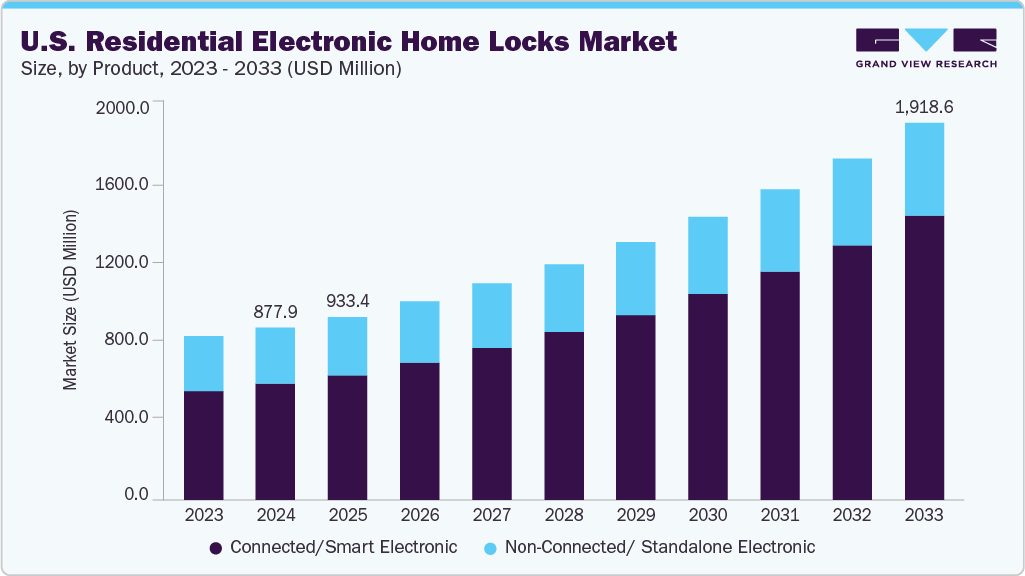
The U.S. residential electronic home locks market size was estimated at USD 877.9 million in 2024 and is projected to reach USD 1,918.6 million by 2033, growing at a CAGR of 9.4% from 2025 to 2033. The U.S. residential electronic door lock industry is witnessing significant expansion, with growing consumer awareness of the benefits of advanced home security and automation systems.
Key Market Trends & Insights
- By product, the connected/smart electronic door locks segment led the market with the largest revenue share of 67.53% in 2024.
- By application, the multi-family apartments segment is anticipated to grow at the fastest CAGR of 11.4% during the forecast period.
- By installation type, the do-it-yourself (DIY) segment led the market with the largest revenue share of 65.29% in 2024.
- By distribution channel, the online channel segment is anticipated to grow at the fastest CAGR of 12.0% during the forecast period.
Key Market Trends & Insights
- 2024 Market Size: USD 877.9 Million
- 2033 Projected Market Size: USD 1,918.6 Million
- CAGR (2025-2033): 9.4%
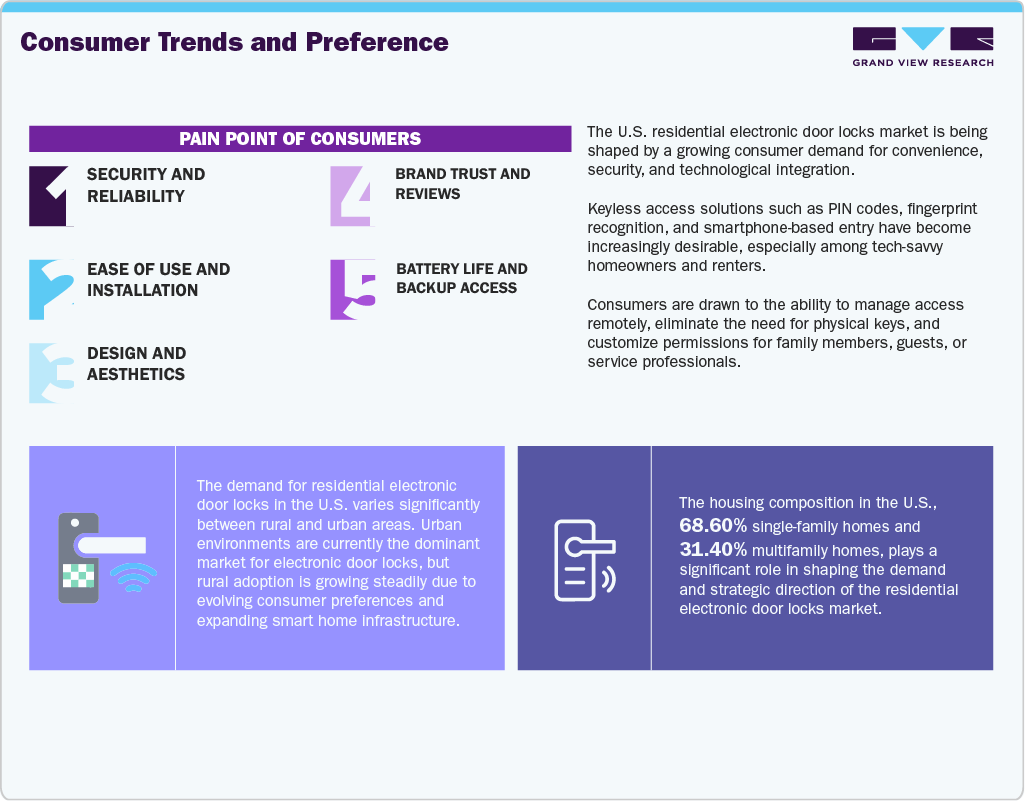
As the U.S. is a global leader in smart home technology adoption, electronic door locks are becoming a key feature of modern homes. The increasing preference for convenience, such as keyless entry and remote monitoring, is accelerating the shift from traditional locks to electronic alternatives. Homeowners are especially attracted to locks that offer features like automatic locking, remote access, and integration with other home security systems, such as surveillance cameras and alarms. Security concerns play a significant role in the growth of the electronic door lock market in the U.S. With rising burglary rates and a heightened awareness of home security, consumers are turning to electronic locks as a more reliable and secure alternative to traditional mechanical locks. The rise in home automation and connected devices in the U.S. residential electronic home locks industry is making electronic door locks more desirable for those seeking to modernize their homes and improve security.
Innovation is also a driving factor in the U.S. residential electronic home locks industry, as manufacturers continue to develop more affordable and feature-rich electronic locks. New technologies such as biometric fingerprint scanning, Bluetooth connectivity, and integration with voice-controlled devices are gaining traction. The ongoing trend toward smart homes, combined with the falling prices of electronic locks, is expected to drive even more widespread adoption.
As the U.S. residential electronic home locks industry continues to embrace smart home technologies, the demand for residential electronic door locks will remain strong, with future innovations expected to further enhance their security, convenience, and integration with other devices. For instance, in October 2024, Aqara launched the Smart Lock U300, a versatile keyless entry solution compatible with various smart home ecosystems including Apple HomeKit, Google Home, and Alexa.
Consumer Insights for U.S. Residential Electronic Door Locks:
Product Insights
The connected/smart electronic door locks segment led the market with the largest revenue share of 67.53% in 2024. The U.S. market is experiencing significant growth due to rising security concerns, the growing adoption of smart home technology, and changing consumer behavior. Homeowners are increasingly prioritizing enhanced security features in response to a perceived rise in burglary and package theft, especially in suburban and urban areas.
The non-connected/standalone electronic door locks segment is projected to grow at the fastest CAGR of 6.1% from 2025 to 2033. The U.S. market for residential non-connected (standalone) electronic door locks is experiencing steady growth due to rising demand for affordable, secure, and user-friendly home access solutions without the complexities of internet connectivity. Many homeowners, particularly in suburban and rural areas, are opting for standalone electronic locks as a practical upgrade from traditional mechanical locks.
Application Insights
The single-family homes segment led the market with the largest revenue share of 73.17% in 2024. The U.S. residential electronic home locks industry is increasing among single-family homes due to rising security concerns, a growing preference for smart home integration, and changing lifestyle patterns that prioritize convenience, connectivity, and remote control. Homeowners in single-family residences often have more autonomy and budget to invest in modern home upgrades compared to renters or multi-unit dwellers, making them a key driver of demand for these electronic locking systems.
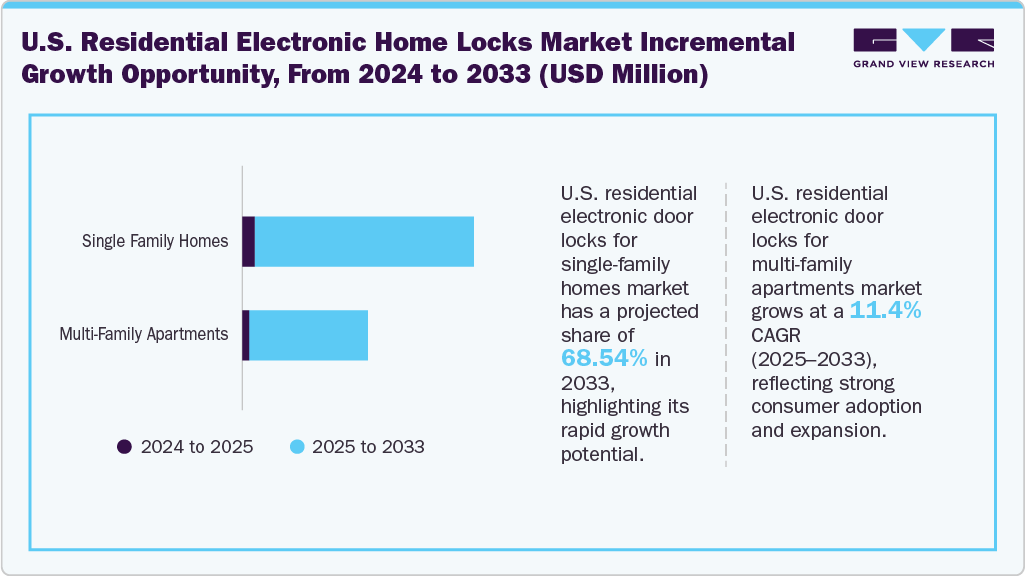
The multi-family apartments segment is projected to grow at the fastest CAGR of 11.4% from 2025 to 2033. The U.S. residential electronic home locks industry is increasing significantly among multi-family apartments due to a growing focus on security, convenience, and property management efficiency. With rising urban population density and the expansion of apartment living in cities and suburbs, building owners and developers are increasingly turning to smart access solutions to meet modern residents’ expectations and streamline building operations.
Installation Type Insights
The do-it-yourself (DIY) installation type segment led the market with the largest revenue share of 65.29% in 2024. The U.S. has seen a steady increase in home improvement activities, especially since the pandemic when more people began investing in their living spaces. DIY electronic locks are an easy and impactful way to enhance both the functionality and aesthetics of a home. Their modern designs and smart capabilities make them attractive upgrades during renovation projects.
The professional installation segment is projected to grow at the fastest CAGR of 8.0% from 2025 to 2033. The rise in new residential construction, particularly of smart and luxury homes, has also contributed to demand. Builders and homeowners alike are choosing high-end electronic locks not just for security but for convenience and modern aesthetics. These sophisticated systems, when professionally installed, become part of the home’s broader connected infrastructure, increasing their appeal and functionality.
Distribution Channel Insights
The offline segment led the market with the largest revenue share of 66.23% in 2024. Sales of residential electronic door locks in the U.S. through offline channels are increasing due to the strong consumer preference for hands-on experience and expert guidance when purchasing home security products. Many buyers want to physically inspect, test, and compare electronic locks in person before making a decision, especially since these products are critical to home safety. Retail stores provide an environment where consumers can explore various lock models, assess their quality, and gain a clearer understanding of how the technology works.
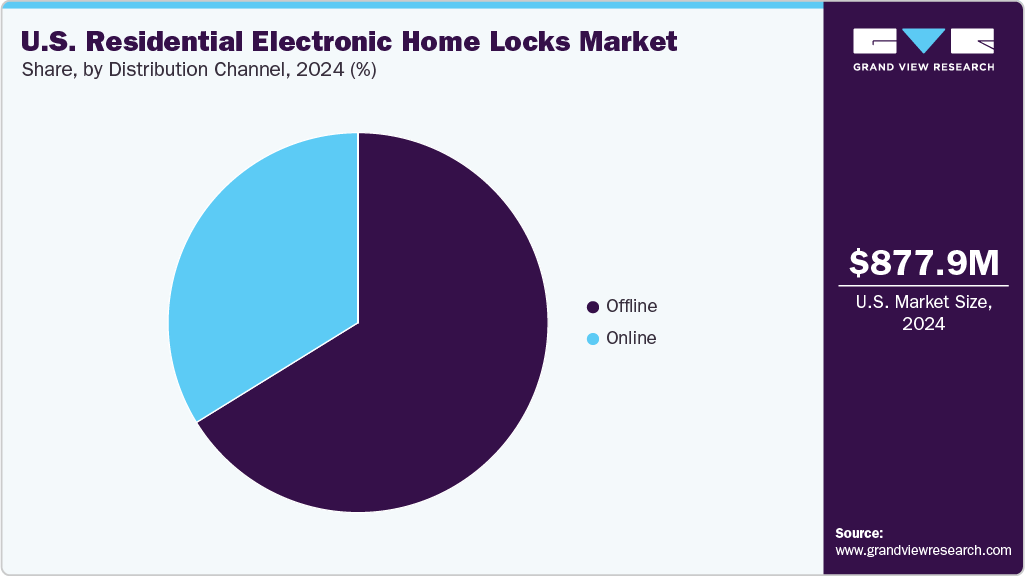
The online channel segment is projected to grow at the fastest CAGR of 12.0% from 2025 to 2033. The market for residential electronic door locks in the U.S. is increasingly shifting towards online sales due to several compelling reasons. One of the primary factors is the convenience and accessibility that online shopping provides. Consumers can browse a wide range of electronic door locks from the comfort of their homes, making it easier to compare different products, prices, and features without the need to visit multiple physical stores.
Key U.S. Residential Electronic Home Locks Company Insight
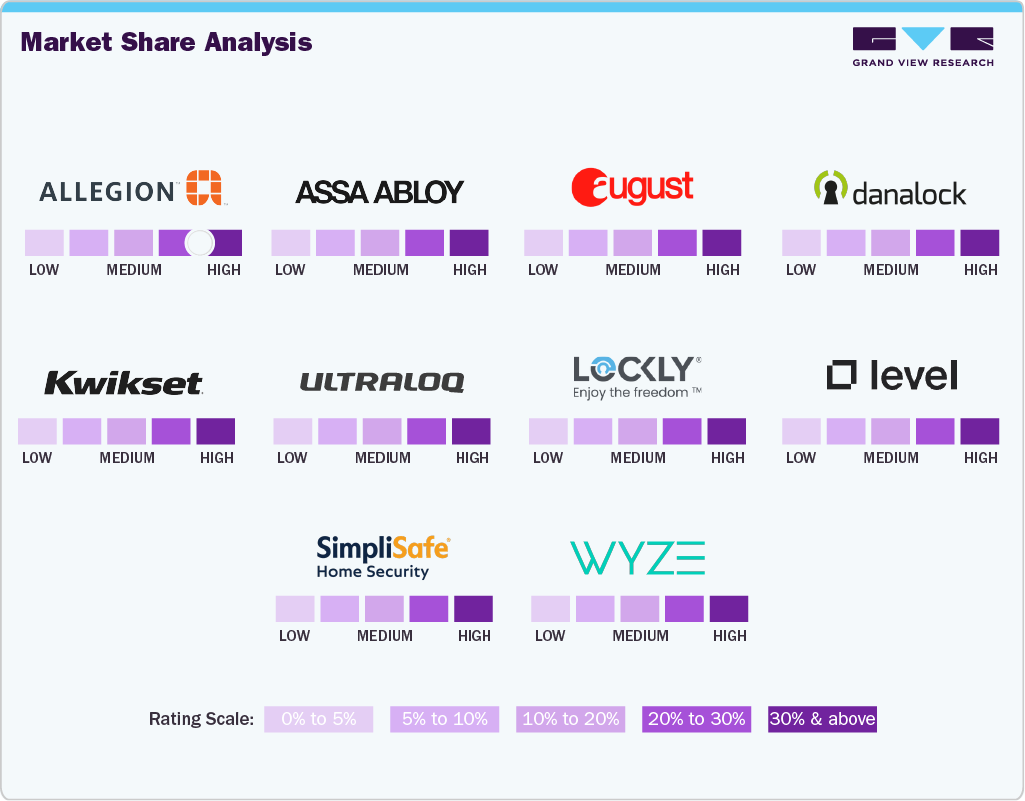
The U.S. residential electronic home locks industry is characterized by an oligopolistic structure in which a small group of incumbent manufacturers and smart-home entrants is exerting dominant influence while newer disruptors pursue niche differentiation through connectivity, design, and price. Competitive dynamics are being driven by three commercial vectors: product portfolio expansion toward app-native, deadbolt, and retrofit smart-lock variants to address DIY channel demand, M&A and strategic acquisitions to internalize technology (digital keys, BLE/NFC, cloud-services) and distribution, and aggressive pricing from direct-to-consumer entrants and IoT value players such as August, SimpliSafe, and Wyze that are commoditizing basic smart-lock functionality.
Key U.S. Residential Electronic Home Locks Companies:
- Allegion (Schlage)
- Assa Abloy (Yale, August)
- Kwikset
- August Home
- Danalock
- Ultraloq
- Lockly
- Level Locks
- SimpliSafe
- Wyze Labs
Recent Developments
-
In March 2025, Yale launched a new Yale Smart Lock designed for Google Home integration, allowing remote control via voice commands or the Google Home app. The lock’s standout feature is its long battery life, lasting up to a year on a single set of batteries.
-
In October 2024, Aqara launched the Smart Lock U300, a versatile keyless entry solution compatible with various smart home ecosystems including Apple HomeKit, Google Home, and Alexa. This lock supports multiple unlocking methods such as fingerprint recognition, custom PIN codes (including one-time codes), the Aqara mobile app, voice assistants, NFC cards, and traditional keys for emergencies.
-
In February 2023, Yale Home partnered with Pantone to launch a Limited Edition Assure Lock 2 in the bold 2023 Color of the Year, PANTONE 18-1750 Viva Magenta. Designed for style-conscious homeowners, Assure Lock 2 combines standout aesthetics with the convenience and security of a smart lock.
U.S. Residential Electronic Home Locks Market Report Scope
|
Report Attribute
|
Details
|
|
Market value size in 2025
|
USD 933.4 million
|
|
Revenue Forecast in 2033
|
USD 1,918.6 million
|
|
Growth rate
|
CAGR of 9.4% from 2025 to 2033
|
|
Base year for estimation
|
2024
|
|
Historical data
|
2021 - 2023
|
|
Forecast period
|
2025 - 2033
|
|
Quantitative (Revenue) units
|
Revenue in USD million/billion, and CAGR from 2025 to 2033
|
|
Report coverage
|
Revenue forecast, company ranking, competitive landscape, growth factors, and trends
|
|
Segments covered
|
Product, application, installation type, distribution channel
|
|
Country scope
|
U.S.
|
|
Key companies profiled
|
Allegion (Schlage); Assa Abloy (Yale, August); Kwikset; August Home; Danalock; Ultraloq; Lockly; Level Locks; SimpliSafe; Wyze Labs
|
|
Customization scope
|
Free report customization (equivalent up to 8 analysts’ working days) with purchase. Addition or alteration to country, regional & segment scope.
|
|
Pricing and purchase options
|
Avail customized purchase options to meet your exact research needs. Explore purchase options
|
U.S. Residential Electronic Home Locks Market Report Segmentation
This report forecasts revenue growth at the country, and provides an analysis of the latest industry trends and opportunities in each of the sub-segments from 2021 to 2033. For this study, Grand View Research has segmented the U.S. residential electronic home locks market report based on the product, application, installation type, distribution channel:
-
Product Outlook (Revenue, USD Million, 2021 - 2033)
-
Application Outlook (Revenue, USD Million, 2021 - 2033)
-
Single-Family Homes
-
New Construction
-
Remodeling
-
Multi-Family Apartments
-
New Construction
-
Remodeling
-
Installation Type Outlook (Revenue, USD Million, 2021 - 2033)
-
Distribution Channel Outlook (Revenue, USD Million, 2021 - 2033)
-
Online
-
E-Commerce
-
Company Owned Websites
-
Offline
Frequently Asked Questions About This Report
b. The U.S. residential electronic home locks market was valued at USD 877.9 million in 2024
b. The U.S. residential electronic home locks market is expected to grow at a compound annual growth rate (CAGR) of 9.4% from 2025 to 2033
b. Connected/smart electronic door locks held the largest market share in U.S. residential electronic home locks market, accounting for the market share of 67.53% in 2024.
b. Allegion (Schlage), Assa Abloy (Yale, August), Kwikset, August Home, Danalock, Ultraloq, Lockly, Level Locks, SimpliSafe, Wyze Labs
b. The U.S. residential electronic door lock market is witnessing significant expansion, with growing consumer awareness of the benefits of advanced home security and automation systems. As the U.S. is a global leader in smart home technology adoption, electronic door locks are becoming a key feature of modern homes.

 Download Sample Report
















