
- Home
- »
- Nutraceuticals & Functional Foods
- »
-
U.S. Sports Supplements Market Size, Industry Report, 2033GVR Report cover
![U.S. Sports Supplements Market Size, Share & Trends Report]()
U.S. Sports Supplements Market (2025 - 2033) Size, Share & Trends Analysis Report By Product (Capsules/Tablets, Powder, Liquid, Bars), By Source (Animal-based, Plant-based), By Distribution Channel, And Segment Forecasts
- Report ID: GVR-4-68040-802-7
- Number of Report Pages: 110
- Format: PDF
- Historical Range: 2021 - 2024
- Forecast Period: 2025 - 2033
- Industry: Consumer Goods
- Report Summary
- Table of Contents
- Segmentation
- Methodology
- Download FREE Sample
-
 Download Sample Report
U.S. Sports Supplements Market Summary
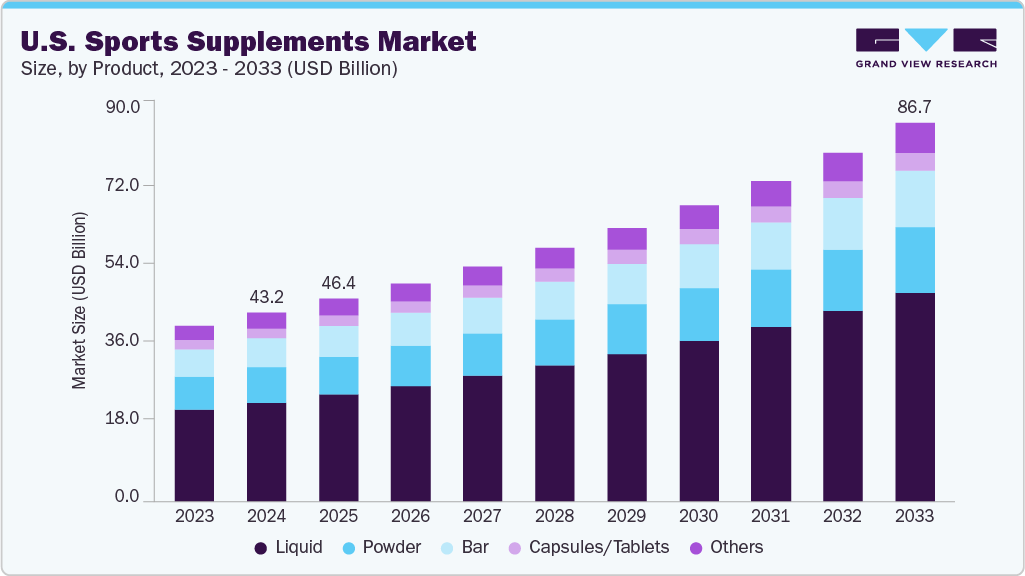
The U.S. sports supplements market size was estimated at USD 43.16 billion in 2024 and is projected to reach USD 86.74 billion by 2033, growing at a CAGR of 8.1% from 2025 to 2033. Many consumers aim to build strength, improve endurance, or manage weight, and supplements like protein powders, BCAAs, and pre-workout formulas provide targeted support for these goals. These products help enhance muscle growth, speed up post-workout recovery, and improve overall athletic performance, making them an essential part of the fitness routines for athletes, gym-goers, and active individuals. A 2024 study published in the Journal of the International Society of Sports Nutrition found that 68.3% of participants used supplements primarily to enhance sports performance, while 34.1% consumed them for general health reasons. Similarly, a 2021 National Institutes of Health survey of U.S. college athletes reported that 41.7% used protein products, 28.6% consumed energy drinks or shots, and 14% took creatine, highlighting the role of supplements in supporting muscle growth, recovery, and overall athletic performance.
Sports supplement consumption in the U.S. is increasingly tied to lifestyle fitness rather than professional athletics alone. The expansion of CrossFit, endurance running groups, and hybrid competition formats has widened supplement use among recreational athletes seeking structured recovery and performance support. Public data reinforces this shift. The National Institutes of Health (NIH), in a March 2024 athlete-focused survey, reported that 41.7% of U.S. college athletes used protein products, 28.6% consumed energy drinks or shots, and 14.0% reported creatine use, signalling widespread reliance on sports nutrition as part of everyday training. This aligns with broader increases in household spending on personal fitness services reported by the U.S. Census Bureau, which has indirectly strengthened the pull-through demand for performance nutrition products sold via gyms and specialty channels.
Consumers are gravitating towards short ingredient lists, natural sweeteners, and transparent sourcing, especially for protein powders, BCAAs, and pre-workouts. Regulatory oversight is also contributing to this trend; the U.S. Food and Drug Administration continues to review health claims and label accuracy under DSHEA standards, pushing brands toward evidence-backed formulations. Certifications such as NSF Certified for Sport and Informed Choice have become particularly important for collegiate and semi-professional users who require doping-safe assurance. This emphasis on transparency mirrors feedback gathered in academic nutrition commentary published throughout 2023-2024, which notes a growing consumer expectation for cleaner performance products positioned between athletic training and general wellness.
E-commerce and creator-led content have emerged as core demand accelerators. Short-format training content on TikTok, YouTube coaching channels, and athlete-endorsed supplement stacks have significantly improved discoverability among first-time users. This trend has also supported international brand entry, for instance, Fixx Nutrition finalised a U.S. e-commerce partnership in July 2025 with The Feed, a specialist marketplace for endurance athletes, highlighting how U.S. digital demand is attracting overseas brands targeting recovery gels, carb mixes, and hydration formats. Direct-to-consumer subscription models are further increasing customer retention by pairing supplements with digital coaching, training trackers, and habit-based loyalty programs.
Consumer Insights
In the U.S., income is a significant determinant of dietary and sports supplement usage. Data from the CDC’s National Health and Nutrition Examination Survey (NHANES) shows that 44.9% of individuals with household income below 130% of the Federal Poverty Level (FPL) reported using supplements. This figure rises to 56.2% among those between 130% and 349% of the FPL and peaks at 65.7% for households with income at or above 350% of the FPL. The findings clearly establish a correlation between higher income and higher supplement consumption, reflecting greater affordability and access among wealthier groups.
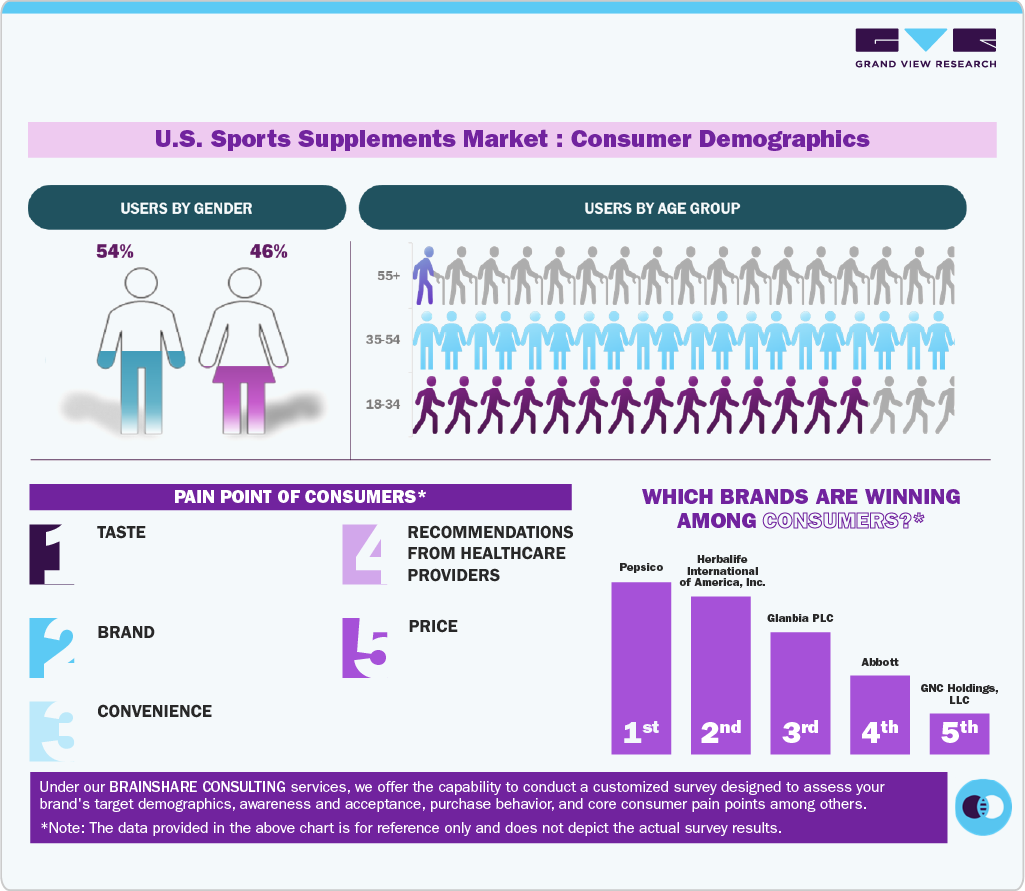
Another U.S. dataset underscores this trend by examining supplement use through the lens of household income brackets. 68% of adults earning less than USD 50,000 annually reported using dietary supplements. The adoption rate was higher in middle-income households (USD 50,000-100,000) and peaked in high-income households earning above USD 100,000, where supplement use was most widespread. This highlights that disposable income strongly influences the ability to purchase premium formulations or multiple types of supplements.
Product Insights
Liquid sports supplements accounted for a revenue share of 52.63% in the year 2024 in the U.S. sports supplements industry, reflecting the strong pull of ready-to-drink (RTD) options among gym-goers, recreational athletes, and time-pressed professionals. The growing appeal of this segment is closely linked to changing lifestyle patterns, particularly early-morning and post-work training routines, where convenience and portability outweigh the ritual of mixing powders. RTD offerings such as Muscle Milk’s shelf-stable protein beverages illustrate this consumer shift, providing immediate access to recovery nutrition without measuring, blending, or carrying accessories.
Sports supplement bars are projected to grow at a CAGR of 7.8% over the forecast period of 2025-2033. Brands are reformulating with superfoods, micronutrient fortification, higher fiber content, and reduced sugar to meet the expectations of health-focused buyers who use bars not only around workouts but also as mid-day functional snacks. In the U.S., this demand is coming from active lifestyle consumers as much as from gym users, with many shoppers treating premium protein bars as a “cleaner” replacement for traditional confectionery.
Source Insights
Animal-based sports supplements accounted for a revenue share of 76.05% in the year 2024 in the U.S. sports supplements industry. The country’s training culture is heavily centered around resistance exercise, collegiate athletics, and physique-driven performance goals. It continues to favor fast-absorbing formats such as whey, casein, and egg protein. These products remain the default choice for athletes and regular gym users who want visible muscle development and quicker recovery windows, especially immediately after training when nutrient timing is most critical. Egg-based and dairy-based proteins, in particular, are perceived as “high-impact” options in the U.S. market.
Plant-based sports supplements are projected to grow at a CAGR of 9.5% over the forecast period of 2025-2033. They are widely chosen by U.S. buyers with lactose intolerance or sensitivity to dairy-based proteins, as pea, rice, and hemp blends are typically gentler on the stomach and easier to process during post-workout recovery. Even though plant proteins can have lower levels of certain essential amino acids compared with whey or egg-derived sources, U.S. brands have increasingly addressed this by combining complementary plant ingredients to deliver a more complete amino acid profile. Pea protein, for example, is now one of the fastest-growing bases for vegan performance blends in the U.S. because it provides strong overall amino acid coverage with fewer digestive side effects.
Distribution Channel Insights
Hypermarkets & supermarkets sales accounted for a revenue share of 35.44% in the year 2024 in the U.S. sports supplements industry, driven by the growing integration of performance nutrition into mainstream household shopping. Large-format retailers such as Walmart, Costco, Target, and Kroger have expanded their shelf space for protein powders, RTD shakes, hydration mixes, and recovery products, making them widely accessible to everyday consumers who may not shop at specialty nutrition chains. This retail shift reflects U.S. purchasing behavior, where shoppers increasingly prefer to pick up supplements during their regular grocery runs rather than making separate visits to fitness stores. The one-stop convenience model has also boosted trial and impulse buying, as consumers are exposed to both national brands and emerging functional products in a familiar retail setting.
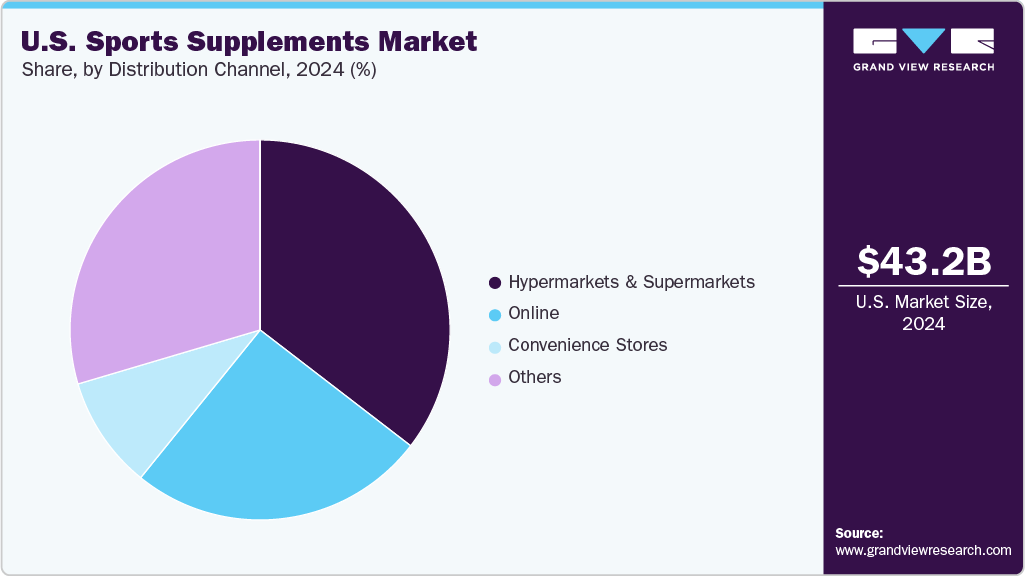
Online sales of sports supplements are projected to grow at a CAGR of 9.6% over the forecast period of 2025-2033. Digital platforms such as Amazon, Walmart.com, and brand-owned DTC sites provide U.S. shoppers with far more variety than local retail shelves, including emerging performance brands, vegan and functional formulations, and limited-edition product lines that rarely appear in supermarkets. The ability to compare ingredients, read verified reviews, and explore dosage breakdowns before purchase is a major driver of trust, particularly among younger U.S. consumers who research supplements the same way they evaluate fitness gear or wearable tech. For many U.S. buyers, online shopping is not just a matter of convenience; it is now the preferred way to evaluate, personalize, and consistently source performance nutrition.
Key U.S. Sports Supplements Company Insights
The U.S. sports supplements industry is defined by a blend of long-established nutrition brands and fast-growing challengers that compete on formulation efficacy, ingredient transparency, and performance credibility. Major players continue to prioritise clean-label positioning, third-party testing, and athlete-safe formulations to meet the expectations of both competitive users and mainstream fitness consumers. Distribution is highly diversified in the U.S., with brands scaling through specialty nutrition retailers such as GNC and Vitamin Shoppe. Bulk-value channels such as Costco, gym partnerships, and digitally native D2C storefronts cater to repeat buyers. Sponsorships with college athletics, CrossFit communities, combat sports, and influencer-led fitness ecosystems play a key role in brand recall, allowing companies to build trust faster through performance association rather than traditional advertising. The market is also heavily segmented by use case, from whey-based strength and muscle products to vegan recovery blends, electrolyte hydration sticks, and RTD performance beverages, enabling U.S. manufacturers to tailor offerings to highly specific training styles and lifestyle routines within the broader active population.
-
Universal Nutrition is a long-standing brand in the sports supplement market, recognized for its specialized products targeting athletes, bodybuilders, and fitness enthusiasts. Its flagship Animal line includes a diverse range of supplements such as Animal Pak for comprehensive performance nutrition, Animal Cuts for fat metabolism, Animal Pump for pre-workout energy and focus, and Animal Whey for muscle recovery and growth. The company focuses on delivering scientifically formulated blends of high-quality proteins, amino acids, creatine, and essential nutrients to meet the demands of intensive training. With over four decades of industry experience, Universal Nutrition has built strong credibility by aligning its products with the performance goals of serious athletes, positioning its offerings as essential tools for strength, endurance, and overall athletic development.
-
GNC Holdings, LLC is a global leader in health and wellness, offering a diverse range of sports supplements designed to enhance performance, endurance, strength, and recovery. Its product portfolio features well-known lines such as GNC AMP Wheybolic, Pro Performance Whey Protein, Beyond Raw LIT pre-workout, AMP Creatine HCl, and AMP BCAA Advanced, addressing the needs of both casual fitness enthusiasts and serious athletes. These formulations combine high-quality proteins, amino acids, creatine, and electrolytes to support energy, muscle development, and post-workout recovery. With a strong focus on scientific innovation and quality, GNC positions its sports nutrition products as essential tools for achieving fitness goals. It reinforces its reputation as a trusted provider of effective, result-driven solutions for active lifestyles.
Key U.S. Sports Supplements Companies:
- The Simply Good Foods Company
- Maxinutrition
- Universal Nutrition
- GNC Holdings, LLC
- Glanbia PLC
- NOW Foods
- SciTec, Inc
- THG PLC
- PepsiCo
- Abott
- Herbalife
Recent Developments:
-
In July 2025, Momentous entered into a multi-year partnership with USA Rugby, becoming the official supplement provider for both the men’s and women’s national teams. The partnership comes at a vital moment as USA Rugby builds on the women’s team’s success at the 2024 Olympics and prepares for major upcoming competitions, including the Rugby World Cup and Pacific Nations Cup. Momentous will supply its NSF Certified for Sport-certified vitamin, protein, and supplement products to support athlete performance, while both organisations will collaborate on educational content aimed at athletes and fans. The deal emphasizes shared values of transparency, integrity, and high-performance support as USA Rugby expands its profile and commercial reach.
-
In January 2024, Abbott announced the launch of its new PROTALITY brand, created specifically for adults pursuing weight loss who want to retain muscle while reducing calories. The first product in the line is a high-protein shake formulated with vitamins, minerals, and fiber to support muscle preservation during dieting, reflecting growing consumer interest in weight-management solutions that do not compromise strength. The company is positioning the brand alongside its broader adult-nutrition portfolio and is initially rolling it out through major U.S. e-commerce platforms before expanding to national retail chains. With this launch, Abbott is targeting the fast-growing segment of health-conscious consumers using structured diets or weight-loss therapies and seeking nutrition options that balance calorie control with muscle maintenance.
U.S. Sports Supplements Market Report Scope
Report Attribute
Details
Market size value in 2025
USD 46.38 billion
Revenue forecast in 2033
USD 86.74 billion
Growth rate
CAGR of 8.1% from 2025 to 2033
Actuals
2021 - 2024
Forecast period
2025 - 2033
Quantitative units
Revenue in USD million/billion and CAGR from 2025 to 2033
Report coverage
Revenue forecast, company ranking, competitive landscape, growth factors, and trends
Segments covered
Product, source, distribution channel
Country scope
U.S.
Key companies profiled
The Simply Good Foods Company; Maxinutrition; Universal Nutrition; GNC Holdings, LLC; Glanbia PLC; NOW Foods; SciTec, Inc.; THG PLC; PepsiCo; Abott; Herbalife
Customization scope
Free report customization (equivalent up to 8 analysts working days) with purchase. Addition or alteration to country, regional & segment scope.
Pricing and purchase options
Avail customized purchase options to meet your exact research needs. Explore purchase options
U.S. Sports Supplements Market Report Segmentation
This report forecasts revenue growth at regional & country levels and provides an analysis on the latest trends and opportunities in each of the sub-segments from 2021 to 2033. For this study, Grand View Research has segmented the U.S. sports supplements market on the basis of product, source, and distribution channel.
-
Product Outlook (Revenue, USD Million, 2021 - 2033)
-
Capsules/Tablets
-
Powder
-
Liquid
-
Bar
-
Others
-
-
Source Outlook (Revenue, USD Million, 2021 - 2033)
-
Animal-Based
-
Plant-Based
-
-
Distribution Channel Outlook (Revenue, USD Million, 2021 - 2033)
-
Hypermarkets & Supermarkets
-
Convenience Stores
-
Online
-
Others
-
Frequently Asked Questions About This Report
b. Liquid sports supplements accounted for a revenue share of 52.63% in the year 2024 in the U.S. sports supplements industry, due to their ease of consumption and rapid absorption benefits. Their popularity is further reinforced by growing consumer preference for ready-to-drink formats that support on-the-go fitness and recovery routines.
b. The U.S. sports supplements market was estimated at USD 43.16 billion in 2024 and is expected to reach USD 46.38 billion in 2025.
b. The U.S. sports supplements market is expected to grow at a compound annual growth rate of 8.1% from 2025 to 2033 to reach USD 86.74 billion by 2033.
b. Key players in the U.S. sports supplements market are The Simply Good Foods Company; Maxinutrition; Universal Nutrition; GNC Holdings, LLC; Glanbia PLC; NOW Foods; SciTec, Inc.; THG PLC; PepsiCo; Abott; Herbalife
b. The U.S. sports supplements market is being driven by a surge in health-conscious lifestyles, particularly among younger demographics prioritizing performance and physical fitness. Additionally, the expansion of e-commerce and personalized nutrition trends is boosting accessibility and encouraging regular consumption of tailored supplement solutions.


Share this report with your colleague or friend.
Need a Tailored Report?
Customize this report to your needs — add regions, segments, or data points, with 20% free customization.


ISO 9001:2015 & 27001:2022 Certified
We are GDPR and CCPA compliant! Your transaction & personal information is safe and secure. For more details, please read our privacy policy.
Trusted market insights - try a free sample
See how our reports are structured and why industry leaders rely on Grand View Research. Get a free sample or ask us to tailor this report to your needs.













