U.S. Ultrapure Water Treatment Systems Market Summary
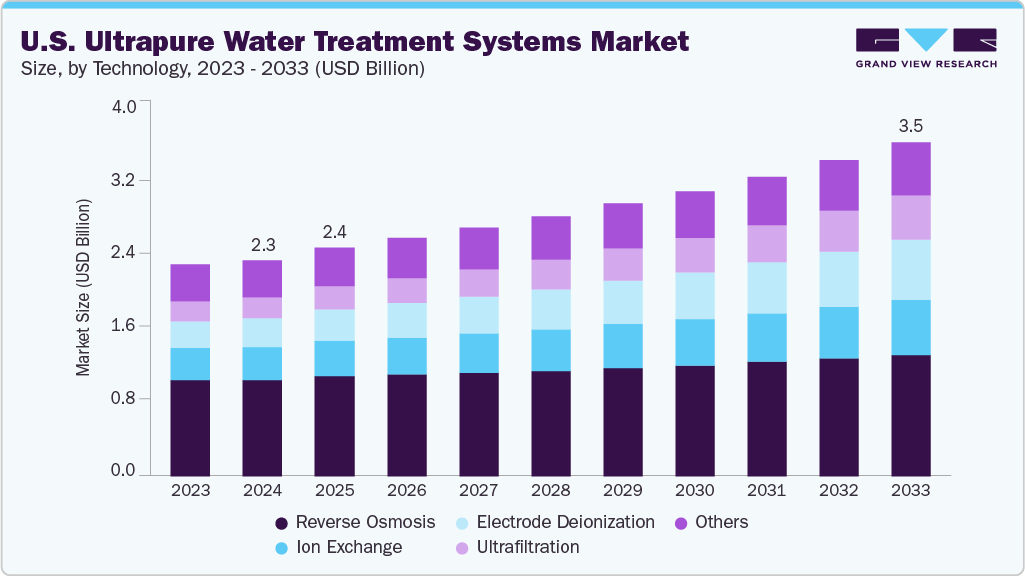
The U.S. ultrapure water treatment systems market size was estimated at USD 2,299.4 million in 2024 and is projected to reach USD 3,552.3 million by 2033, growing at a CAGR of 4.8% from 2025 to 2033. The industry is primarily driven by the growing demand for high-purity water in the semiconductor and electronics industries. As chip manufacturing becomes more advanced, the need for contamination-free water has intensified.
Key Market Trends & Insights
- The ultrapure water treatment systems market in the U.S. is expected to grow at a substantial CAGR of 4.8% from 2025 to 2033.
- By technology, the electrode deionization segment is expected to grow at a considerable CAGR of 8.6% from 2025 to 2033 in terms of revenue.
- By application, the ingredient segment is expected to grow at a considerable CAGR of 6.1% from 2025 to 2033 in terms of revenue.
- By end use, the semiconductor segment is expected to grow at a considerable CAGR of 5.5% from 2025 to 2033 in terms of revenue.
Market Size & Forecast
- 2024 Market Size: USD 2,299.4 Million
- 2033 Projected Market Size: USD 3,552.3 Million
- CAGR (2025-2033): 4.8%
Another key driver is the rapid growth of the pharmaceutical and biotechnology sectors, where ultrapure water is essential for drug formulation and laboratory processes. Increasing investments in healthcare infrastructure and R&D activities further boost demand. Moreover, the trend toward water reuse and recycling in industrial processes promotes the adoption of ultrapure systems. Rising concerns over waterborne contaminants and system reliability also play a crucial role.
Market Concentration & Characteristics
The market is moderately concentrated, with a few key players holding significant market share. Major companies dominate through advanced technologies, strong distribution networks, and long-term contracts with industrial clients. However, the presence of several regional and specialized firms adds a degree of fragmentation. This competitive mix fosters innovation while maintaining high entry barriers for new players.
The market demonstrates a high degree of innovation, driven by advancements in filtration, membrane, and monitoring technologies. Companies are investing in R&D to develop systems with improved efficiency, lower energy use, and enhanced reliability. Automation and digital integration are also gaining traction for real-time quality control. These innovations are critical to meet the stringent purity demands of advanced industries.
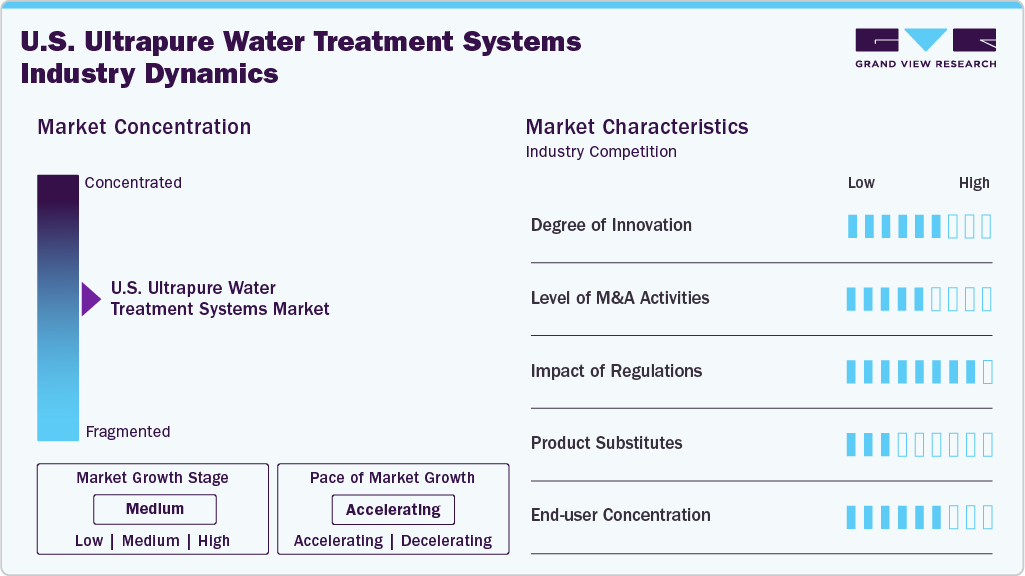
Mergers and acquisitions are a prominent strategy among major players in the U.S. market to expand product portfolios and gain access to niche technologies. Companies pursue acquisitions to strengthen their presence in high-growth sectors like semiconductors and life sciences. Strategic collaborations also help accelerate technological development and service capabilities. This consolidation trend contributes to increased competitiveness and broader market reach.
Regulations in the market, especially in sectors like pharmaceuticals, microelectronics, and power. Standards from bodies such as the EPA and FDA mandate strict water quality levels, prompting the need for advanced purification systems. Compliance requirements encourage continuous upgrades and adoption of certified technologies. Regulatory enforcement ensures sustained demand and consistent system performance.
Drivers, Opportunities & Restraints
The market is driven by rising demand from the semiconductor, pharmaceutical, and biotech sectors, where water purity is critical. Increasing technological complexity in manufacturing processes has amplified the need for high-performance treatment systems. Regulatory pressure to maintain strict water quality further fuels adoption. Additionally, the push for sustainable operations encourages industries to implement advanced purification and recycling solutions.
Significant growth opportunities lie in the adoption of ultrapure water systems for next-generation chip fabrication and precision medicine. Expansion of R&D facilities and cleanroom environments across industries opens new demand avenues. Integration of IoT and AI for smart monitoring presents a promising innovation frontier. Furthermore, federal investments in semiconductor and life sciences manufacturing bolster long-term growth prospects.
High capital investment and operational costs act as major restraints for smaller players and new entrants. The complexity of system design and maintenance can be a barrier for facilities with limited technical expertise. Additionally, the need for constant system upgrades to meet evolving purity standards may deter some users. Market growth is also challenged by economic uncertainty and fluctuations in industrial capital expenditure.
Technology Insights
The reverse osmosis (RO) segment led the market and accounted for a share of 44.4% in 2024, due to its proven ability to remove a wide range of contaminants. It is widely adopted across the semiconductor, pharmaceuticals, and power industries for its reliability and cost-effectiveness. RO systems are highly efficient in reducing dissolved solids, bacteria, and organic impurities. Their scalability and compatibility with other treatment technologies further enhance their market position.
Electrode deionization (EDI) is the fastest-growing technology in the U.S. market, driven by its chemical-free operation and continuous water purification capability. EDI is increasingly preferred for applications requiring high-purity water, especially in electronics and life sciences sectors. Its low maintenance needs and minimal environmental impact make it an attractive alternative to traditional ion exchange. The growing emphasis on sustainable and automated systems is accelerating EDI adoption.
Application Insights
The cleaning segment led the market and accounted for a share of 50.2% in 2024. The cleaning segment dominates the U.S. ultrapure water treatment systems market due to its critical role in semiconductor and pharmaceutical operations. Ultrapure water is essential for rinsing components and surfaces to eliminate microscopic contaminants. High-purity standards ensure product integrity and prevent equipment fouling or defects. As manufacturing precision increases, reliance on ultrapure water for cleaning applications continues to rise.
The ingredient segment is the fastest-growing application in the U.S. market, especially within pharmaceuticals, food processing, and biotechnology. Ultrapure water is increasingly used as a key ingredient in drug formulation, injectable solutions, and other sensitive products. Stringent FDA and USP regulations demand high water quality to avoid contamination and ensure safety. Growing emphasis on product purity and compliance is accelerating adoption in this segment.
End Use Insights
The semiconductor segment led the market and accounted for a share of 42.8% in 2024, owing to its stringent purity standards. Water used in chip fabrication must be free of even trace contaminants to prevent defects and ensure product quality. As semiconductor manufacturing advances, the volume and quality requirements for ultrapure water are rising. Continued investments in domestic chip production are further driving segment dominance.
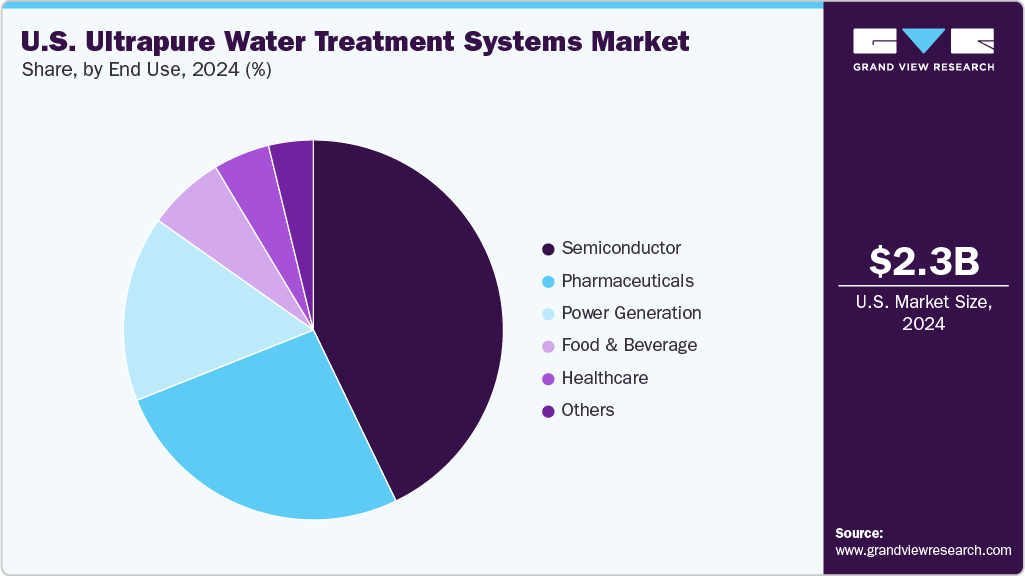
The pharmaceutical sector is witnessing significant growth in demand for ultrapure water systems, driven by regulatory requirements and the expansion of drug manufacturing facilities. Water purity is critical for formulation, cleaning, and laboratory operations to ensure compliance and patient safety. The rise of biologics and personalized medicine also increases the need for ultrapure processing environments. Federal support for healthcare infrastructure boosts market growth in this segment.
Key U.S. Ultrapure Water Treatment Systems Company Insights
Key players operating in the U.S. ultrapure water system market are undertaking various initiatives to strengthen their presence and increase the reach of their products and services. Strategies such as expansion activities and partnerships are key in propelling the market growth.
Key U.S. Ultrapure Water Treatment Systems Companies:
- TORAY INDUSTRIES, INC.
- Danaher Corporation
- Merck KGaA
- Pentair.
- Asahi Kasei Corporation
- OVIVO Inc.
- Applied Membranes Inc.
- Dupont
- Veolia
- Suez
Recent Developments
-
In June 2025, Aquatech acquired Century Water, a Singapore-based company focused on ultrapure water and wastewater recycling for high-tech industries. This acquisition enhances Aquatech’s presence in Southeast Asia and strengthens its expertise in advanced water treatment solutions. It also supports the company’s growth in the semiconductor and pharmaceutical markets through localized operations.
-
In February 2025, Toray Industries introduced a high-efficiency ultrafiltration membrane designed to reduce CO₂ emissions by minimizing the need for frequent cleaning in RO systems. The membrane offers strong water permeability while cutting down on biopolymer buildup, easing operational strain. Pilot tests showed improved performance and longer membrane life, with mass production set to begin in mid-2025.
U.S. Ultrapure Water Treatment Systems Market Report Scope
|
Report Attribute
|
Details
|
|
Market size value in 2025
|
USD 2,435.8 million
|
|
Revenue forecast in 2033
|
USD 3,552.3 million
|
|
Growth rate
|
CAGR of 4.8% from 2025 to 2033
|
|
Historical data
|
2021 - 2024
|
|
Forecast period
|
2025 - 2033
|
|
Quantitative units
|
Revenue in USD million/billion and CAGR from 2025 to 2033
|
|
Report coverage
|
Revenue forecast, company ranking, competitive landscape, growth factors, and trends
|
|
Segments covered
|
Technology, application, end use
|
|
Country scope
|
U.S.
|
|
Key companies profiled
|
TORAY INDUSTRIES, INC.; Danaher Corporation; Merck KGaA; Pentair.; Asahi Kasei Corporation; OVIVO Inc.; Applied Membranes Inc.; Dupont; Veolia; Suez;
|
|
Customization scope
|
Free report customization (equivalent up to 8 analysts working days) with purchase. Addition or alteration to country, regional & segment scope.
|
|
Pricing and purchase options
|
Avail customized purchase options to meet your exact research needs. Explore purchase options
|
U.S. Ultrapure Water Treatment Systems Market Report Segmentation
This report forecasts revenue growth at the country level and provides an analysis of the latest industry trends in each of the sub-segments from 2021 to 2033. For this study, Grand View Research has segmented the U.S. ultrapure water treatment systems market report based on technology,application, and end use:
-
Technology Outlook (Revenue, USD Million, 2021 - 2033)
-
Reverse Osmosis
-
Ion Exchange
-
Ultrafiltration
-
Electrode Deionization
-
Others
-
Application Outlook (Revenue, USD Million, 2021 - 2033)
-
Cleaning
-
Etching
-
Ingredient
-
Others
-
End Use Outlook (Revenue, USD Million, 2021 - 2033)
-
Semiconductor
-
Pharmaceuticals
-
Power Generation
-
Food & Beverage
-
Healthcare
-
Others
Frequently Asked Questions About This Report
b. The U.S. ultrapure water treatment systems market size was estimated at USD 2,299.4 million in 2024 and is expected to be USD 2,435.8 million in 2025.
b. The U.S. ultrapure water treatment systems market, in terms of revenue, is expected to grow at a compound annual growth rate of 4.8% from 2025 to 2033 to reach USD 3,552.3 million by 2033.
b. Cleaning segment accounted for a share of 50.2% in 2024. The cleaning segment dominates the U.S. ultrapure water treatment systems market due to its critical role in semiconductor and pharmaceutical operations. Ultrapure water is essential for rinsing components and surfaces to eliminate microscopic contaminants.
b. Some of the key players operating in the U.S. ultrapure water treatment systems market include TORAY INDUSTRIES, INC.; Danaher Corporation; Merck KGaA; Pentair.; Asahi Kasei Corporation; OVIVO Inc.; Applied Membranes Inc.; Dupont; Veolia; Suez.
b. The U.S. ultrapure water treatment systems market is driven by increasing demand from the semiconductor, pharmaceutical, and power industries requiring stringent water purity. Technological advancements and rising regulatory standards for water quality further accelerate market growth.

 Download Sample Report
















