
- Home
- »
- Next Generation Technologies
- »
-
Utility Management System Market Size Report, 2026-2033GVR Report cover

Utility Management System Market (2026 - 2033)
Size, Share & Trends Analysis Report By System (Industrial Utility Management Systems, Building Utility Management Systems), By Deployment (Cloud, On-Premises), By Component, By End Use, By Region, And Segment Forecasts
Market Size, 2025
$13.0BMarket Estimate, 2026
$14.3BMarket Forecast, 2033
$28.8BCAGR, 2026–2033
10.5%Utility Management System Market Summary
The global utility management system market size was valued at USD 13.0 billion in 2025 and is projected to grow from USD 14.3 billion in 2026 to USD 28.8 billion by 2033, at a CAGR of 10.5% from 2026 to 2033. The North America held the largest share of 33.6% of the global market in 2025. The market is driven by the growing focus on data-driven decision-making, and enterprises are increasingly relying on advanced analytics to identify inefficiencies and improve resource utilization.
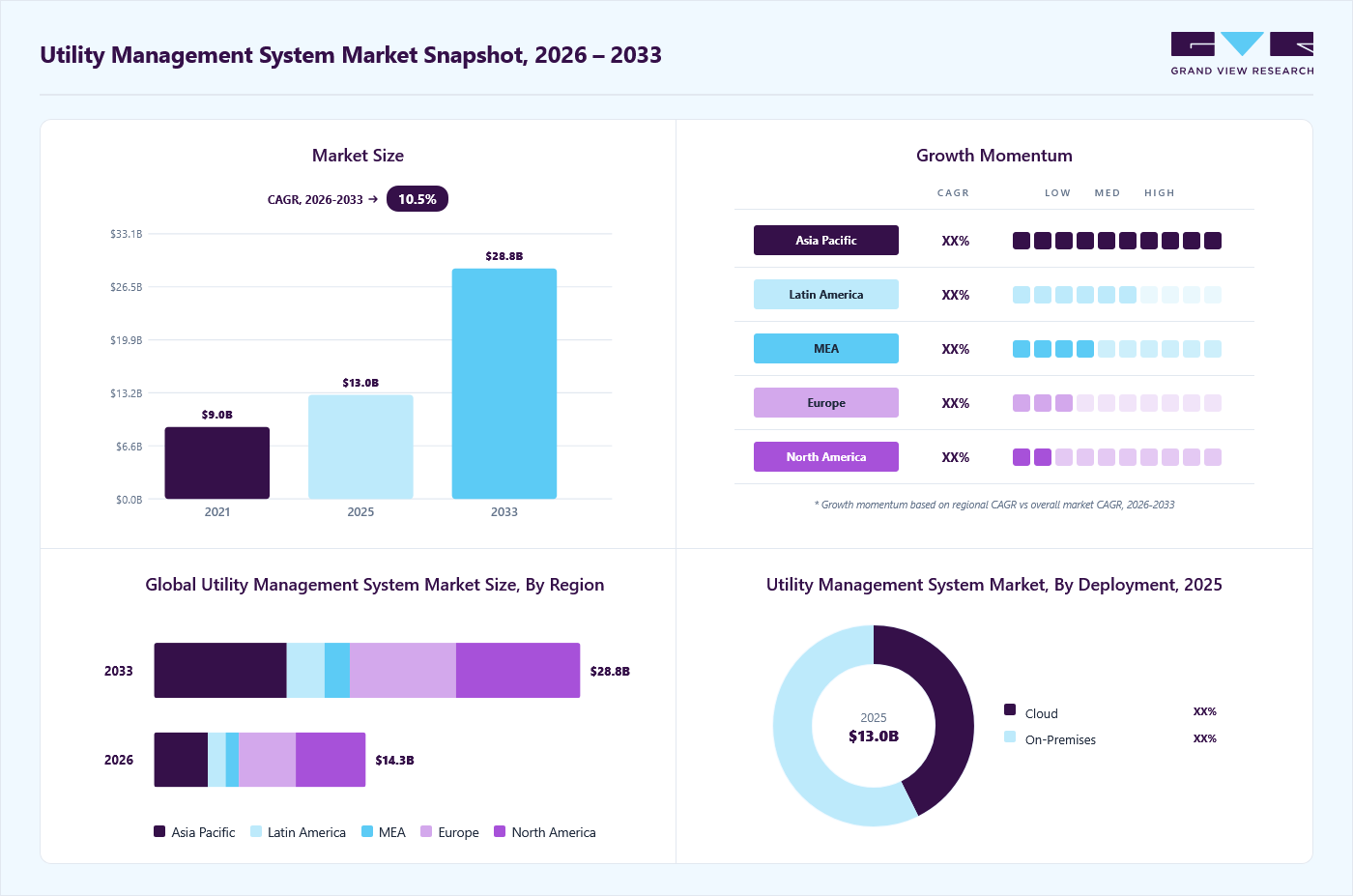 Source: Grand View Research, IR Documents, Primary Interviews, Paid DatabasesTo learn more about this report,
 Download Free Sample Report
 Key Market Trends & Insights
- By system: Industrial utility management systems segment held the largest market share of 62.7% in 2025.
- By deployment: On-premises segment held the largest market share in 2025.
- By component: Software segment held the largest market share in 2025.
- By end use: Manufacturing & industrial segment held the largest market share in 2025.
Regional Highlights
- Largest regional market: North America (33.6% revenue share, 2025)
- By country: The U.S. held the largest share in 2025
Market Size & Forecast
- Market size in 2025: USD 13.0 Billion
- Estimated market size in 2026: USD 14.3 Billion
- Projected market size by 2033: USD 28.8 Billion
- CAGR (2026-2033): 10.5%
Three ways to get this report
Buy it, customize it, or ask a question.Ask an Analyst
Analyst response in 1 business day
- AccessReport author, directly
- Reply timeWithin 1 working day
- No sales callDirect answer only
- FormatEmail reply
- CostFree, no cost
Get the Full Report
What the study covers
- FormatsPDF · Excel · Dashboard
- Timeline2026–2033 annual, 2025 base
- Coverage20+ countries, 5 regions
- Companies10+ key players profiled
Customize the Report
20% free customization
- IncludeCountries, segments, points
- TailorTo your product definition
- ExtendDeeper competitor detail
- OrA fully bespoke study
- Turnaround5–10 working days
The utility management system market is driven by the rising need for efficient monitoring and control of multiple utilities across industrial and commercial environments. Increasing energy costs and resource constraints have encouraged organizations to adopt integrated platforms that provide real-time visibility into electricity, water, and gas consumption. Regulatory frameworks focused on energy efficiency and emissions reduction have further strengthened the adoption of such systems. Governments and institutions are promoting digital infrastructure to improve transparency and operational efficiency in utility usage. The integration of IoT sensors and smart meters has enabled accurate data collection and centralized management. Organizations are focusing on reducing operational losses through leak detection and consumption optimization.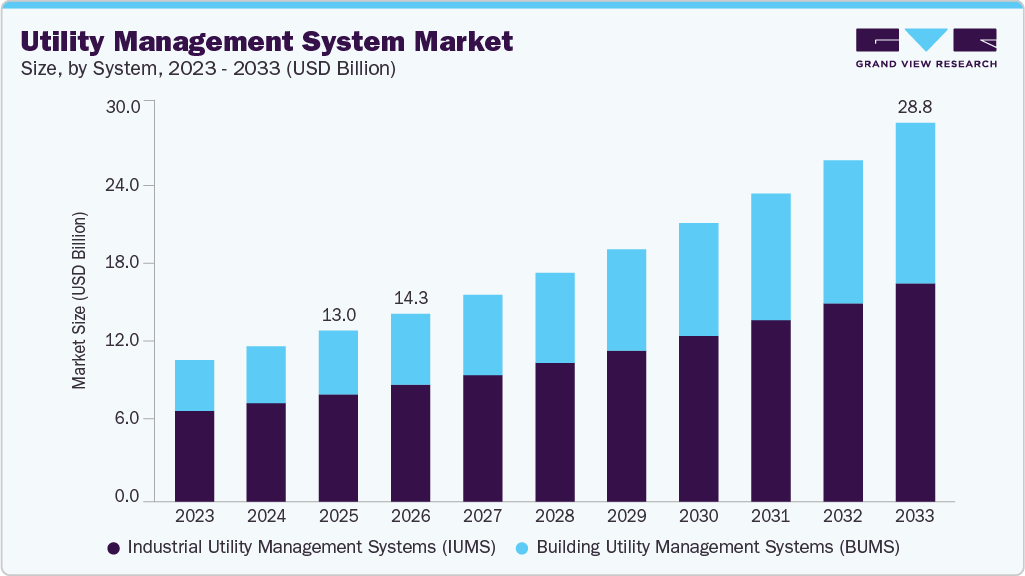 To learn more about this report, Download Free Sample Report
 The expansion of smart cities and urban infrastructure projects is another key factor influencing market growth. Urban developments require centralized systems to manage utilities across residential complexes, commercial buildings, and public infrastructure. The adoption of building automation systems has increased the need for integrated utility monitoring platforms. Rising awareness of sustainability goals has encouraged organizations to track and manage resource consumption more effectively. UMS supports compliance with environmental standards by providing detailed analytics and reporting capabilities, and the growing deployment of cloud-based platforms has enhanced the scalability and accessibility of these systems. Continuous advancements in analytics and automation technologies are further strengthening their adoption across sectors.
In addition, the increasing complexity of industrial operations has created demand for comprehensive utility optimization solutions. Manufacturing facilities require precise monitoring of multiple utilities to ensure uninterrupted operations and cost efficiency. The shift toward digital transformation across industries has accelerated the integration of utility management with enterprise systems. Organizations are prioritizing predictive maintenance and performance optimization to reduce downtime and improve productivity. The demand for customized solutions and system integration services has also increased, supporting market expansion. Additionally, the focus on sustainable resource management has encouraged long-term investments in such systems.
System Insights
The industrial utility management systems (IUMS) segment led the market and accounted for 62.7% of the global revenue in 2025. IUMS are driven by the need to optimize high-volume consumption of electricity, water, gas, and steam across manufacturing facilities. Increasing pressure to reduce operational costs and improve process efficiency has encouraged the adoption of real-time monitoring and control solutions. Regulatory requirements related to energy efficiency and emissions have further supported implementation across industrial sectors, and integration with industrial automation and control systems enables better visibility and performance tracking. Additionally, the focus on minimizing downtime and resource wastage has strengthened demand for advanced utility management platforms in industrial environments.
The building utility management systems (BUMS) segment is expected to grow significantly over the forecast period, driven by the growing adoption of smart buildings and integrated facility management solutions. Commercial and residential complexes require centralized platforms to monitor and manage multiple utilities efficiently, which has increased the focus on sustainability and energy conservation, and has increased the use of analytics-driven utility tracking systems. The deployment of smart meters and IoT-enabled devices has improved data accuracy and operational control. Furthermore, urbanization and infrastructure development have supported the expansion of utility management solutions across modern building environments.
Deployment Insights
The on-premises segment accounted for the largest market revenue share in 2025, due to data security and control requirements. Industries with critical infrastructure prefer localized systems to ensure compliance with regulatory and operational standards, as these deployments offer greater customization to align with specific operational needs and legacy systems. Organizations with established infrastructure rely on on-premises solutions for reliability and minimal dependency on external networks. The presence of existing hardware and long-term investment cycles further sustains demand for on-premises deployment.
The cloud segment is expected to grow significantly over the forecast period. Cloud-based UMSs are gaining traction due to their scalability and centralized access to multi-site operations. Organizations benefit from real-time monitoring and analytics without the need for extensive on-site infrastructure. The ability to integrate with IoT devices and smart meters enhances data accuracy and operational visibility. Subscription-based pricing models reduce upfront investment and support cost efficiency. Besides, remote accessibility and automated updates improve system performance and ease of management across distributed assets.
Component Insights
The software segment held the largest market share of the global revenue in 2025, due to the organizations adopting centralized platforms to gain actionable insights into consumption patterns and operational performance. Integration with IoT devices and smart meters enhances data accuracy and enables efficient decision-making. For instance, in January 2026, Hubbell launched Aclara360, a modular, scalable software solution from its Aclara brand that integrates with existing utility systems such as SCADA, DMS, and AMI. The platform delivers grid analytics, remote diagnostics, fault localization, and operational efficiency to manage distribution networks and optimize assets.
The services segment is expected to witness significant growth in the forecast period, driven by the growing need for system integration, customization, and ongoing support across complex utility environments. The rising complexity of multi-utility systems continues to drive demand for professional and support services across industries. For instance, in April 2026, Santee Cooper chose Oracle Utilities Customer Cloud Service to update its customer management system, making operations more efficient, handling more customer interactions, and offering a more consistent experience across both digital and agent-assisted channels.
End Use Insights
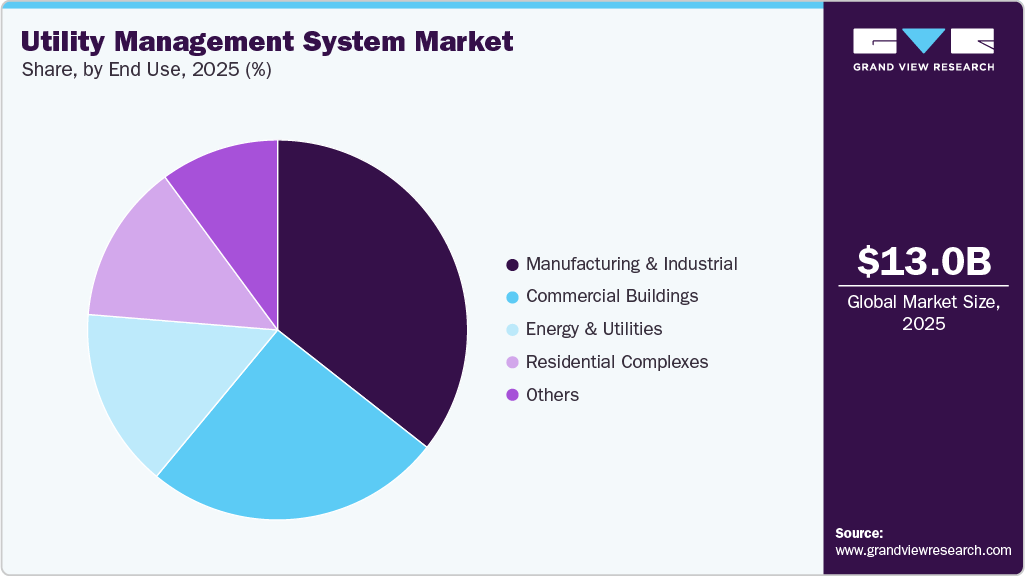
The manufacturing & industrial segment accounted for the largest market revenue share in 2025. Rising operational costs have increased the focus on real-time monitoring and control of utilities to improve efficiency. UMS supports process optimization by identifying energy losses and enabling predictive maintenance. For instance, in January 2026, MetTel launched its Utilities Expense Management (UEM) solution that aggregates billing for electricity, gas, water, telecom, and other utilities into a single command center for federal and commercial clients.
 To learn more about this report, Download Free Sample Report
 The residential complexes segment is projected to grow significantly over the forecast period, driven by increasing adoption of smart metering and centralized utility monitoring in urban housing developments. Growing awareness of energy and water conservation has encouraged residents and developers to implement efficient management systems. Utility management platforms enable accurate billing, consumption tracking, and resource allocation across multi-unit properties. The expansion of smart city initiatives and digital infrastructure has supported the integration of such systems into residential projects.
Regional Insights
The North America utility management system industry dominated the market, accounting for 33.6% of revenue share in 2025. The market is driven by the widespread deployment of advanced grid infrastructure and digital utility networks across commercial and industrial sectors. Strong regulatory focus on energy efficiency and emissions reporting has encouraged organizations to adopt integrated utility monitoring solutions. The presence of established technology providers supports continuous innovation in analytics and automation capabilities. High penetration of smart meters and connected devices enables accurate data collection and system integration.
 To learn more about this report, Download Free Sample Report
 U.S. Utility Management System Market Trends
The utility management system industry in the U.S. is supported by strong federal and state-level initiatives focused on grid modernization and infrastructure efficiency. High adoption of building automation systems has increased the need for integrated utility monitoring across commercial facilities. Organizations emphasize data-driven decision-making, encouraging the deployment of advanced analytics platforms for utility optimization, and significant investments in industrial digitization and energy management technologies have strengthened market penetration.
Europe Utility Management System Market Trends
The utility management system industry in Europe is influenced by stringent environmental regulations and energy efficiency directives that mandate monitoring and optimization of resource consumption. The region’s focus on sustainability and carbon reduction has increased the adoption of systems that provide detailed usage analytics and reporting. Retrofitting of aging infrastructure with digital solutions has created opportunities for advanced utility management platforms. Public and private investments in green buildings and energy-efficient facilities further support market expansion.
Asia Pacific Utility Management System Market Trends
The utility management system industry in the Asia Pacific is expected to experience the fastest CAGR over the forecasted period, due to rapid urbanization and the expansion of large-scale infrastructure projects requiring centralized utility control systems. Increasing industrialization across emerging economies has created demand for efficient management of energy and water resources. Government-led smart city programs have accelerated the deployment of digital utility platforms in urban environments, and rising population density has increased pressure on resource management, encouraging the adoption of monitoring and optimization solutions.
Key Utility Management System Company Insights
Some key companies in the utility management system industry are SAP SE, IBM Corporation, Oracle, and ABB Ltd, among others.
-
SAP provides enterprise software solutions that integrate core business functions, including finance, procurement, supply chain, human resources, and customer experience into a unified platform. The company focuses on enabling organizations to manage operations through data-driven processes and connected systems. Its portfolio includes enterprise resource planning applications, cloud platforms, and analytics tools that support real-time decision-making. SAP solutions are designed to connect people, processes, and data across organizations, improving operational visibility and coordination. SAP serves organizations across multiple sectors, supporting digital transformation through integrated enterprise technologies.
-
Oracle provides a broad range of enterprise technology solutions, including database systems, cloud infrastructure, and business applications. The company offers integrated platforms that support data management, enterprise resource planning, and application development across industries. Oracle systems manage critical business processes, combining hardware, software, and middleware within a unified environment. The company supports both on-premises and cloud-based deployments, enabling organizations to manage workloads across different environments. Its solutions are widely used for handling large-scale data processing and enterprise-level applications.
Key Utility Management System Companies:
The following key companies have been profiled for this study on the utility management system market.
- ABB Ltd
- AVEVA Solutions Limited
- GE Vernova
- IBM Corporation
- Microsoft Corporation
- Oracle
- Salesforce, Inc.
- SAP SE
- Schneider Electric SE
- Siemens AG
Recent Developments
-
In April 2026, Oracle announced enhancements to its Utilities Industry Suite at the Oracle Edge Customer Summit in Austin, Texas. The suite integrates customer, grid, and asset operations through AI features embedded across Oracle's IT stack, including database, cloud infrastructure, and applications. These capabilities enable utilities to break down data silos, streamline intelligent workflows, reduce operating costs, improve grid reliability, and enhance customer outcomes using governed enterprise data and pre-built machine learning insights.
-
In February 2026, GE Vernova launched GridOS for Distribution, a unified software solution that enables utilities to manage distribution grids as one intelligent system, addressing operational complexity from rising energy demand, disruptions, and distributed energy resources (DERs). The platform integrates real-time operations, DER management, network modeling, field execution, and visual intelligence on a secure, interoperable architecture built on advanced distribution management system (ADMS) technology.
-
In March 2025, Microsoft announced a collaboration with Itron to enhance utility operations by integrating generative AI and cloud capabilities into its Grid Edge Intelligence platform. It also supports natural-language queries through Microsoft Azure OpenAI Service and Copilot integration, while maintaining secure enterprise governance and access controls.
Utility Management System Market Report Scope
Report Attribute
Details
Market size in 2025
USD 13.0 billion
Estimated market size in 2026
USD 14.3 billion
Projected market size by 2033
USD 28.8 billion
Growth rate
CAGR of 10.5% from 2026 to 2033
Base year for estimation
2025
Actual data
2021 - 2024
Forecast period
2026 - 2033
Quantitative units
Revenue in USD million/billion and CAGR from 2026 to 2033
Report coverage
Revenue forecast, company ranking, competitive landscape, growth factors, and trends
Segments covered
System, deployment, end use, component, region
Regional scope
North America; Europe; Asia Pacific; Latin America; MEA
Country scope
U.S.; Canada; Mexico; UK; Germany; France; China; Japan; India; South Korea; Australia; Brazil; KSA; UAE; South Africa
Key companies profiled
ABB Ltd; AVEVA Solutions Limited; GE Vernova; IBM Corporation; Microsoft Corporation; Oracle; Salesforce, Inc.; SAP SE; Schneider Electric SE; Siemens AG
Customization scope
Free report customization (equivalent up to 8 analysts working days) with purchase. Addition or alteration to country, regional & segment scope.
Pricing and purchase options
Avail customized purchase options to meet your exact research needs. Explore purchase options
Global Utility Management System Market Report Segmentation
This report forecasts revenue growth at global, regional, and country levels and provides an analysis of the latest industry trends in each of the sub-segments from 2021 to 2033. For this study, Grand View Research has segmented the global utility management system market report based on system, deployment, end use, component, and region.
-
System Outlook (Revenue, USD Million, 2021 - 2033)
-
Industrial Utility Management Systems (IUMS)
-
Building Utility Management Systems (BUMS)
-
-
Deployment Outlook (Revenue, USD Million, 2021 - 2033)
-
Cloud
-
On-Premises
-
-
End Use Outlook (Revenue, USD Million, 2021 - 2033)
-
Manufacturing & Industrial
-
Commercial Buildings
-
Energy & Utilities
-
Residential Complexes
-
Others
-
-
Component Outlook (Revenue, USD Million, 2021 - 2033)
-
Hardware
-
Software
-
Services
-
-
Regional Outlook (Revenue, USD Million, 2021 - 2033)
-
North America
-
U.S.
-
Canada
-
Mexico
-
-
Europe
-
UK
-
Germany
-
France
-
-
Asia Pacific
-
China
-
Japan
-
India
-
South Korea
-
Australia
-
-
Latin America
-
Brazil
-
-
Middle East and Africa (MEA)
-
KSA
-
UAE
-
South Africa
-
-
Frequently Asked Questions About This Report
The industrial utility management systems (IUMS) segment led with a 62.7% revenue share in 2025, while the building utility management systems (BUMS) segment is expected to grow significantly.
The on-premises segment held the largest revenue share in 2025, while the cloud segment is is expected to grow significantly over the forecast period.
The software segment held the largest revenue share in 2025, while the services segment to witness significant growth.
Manufacturing & industrial segment held the largest share in 2025, while the residential complexes segment is projected to grow significantly over the forecast period.
The global uility management system market size was estimated at USD 13.0 billion in 2025 and is expected to reach USD 14.3 billion in 2026.
The global uility management system market is expected to grow at a compound annual growth rate of 10.5% from 2026 to 2033 to reach USD 28.8 billion by 2033.
North America dominated the uility management system market with a share of 33.6% in 2025. This is attributable to the widespread deployment of advanced grid infrastructure and digital utility networks across commercial and industrial sectors.
Some key players operating in the uility management system market include ABB Ltd; AVEVA Solutions Limited; GE Vernova; IBM Corporation; Microsoft Corporation; Oracle; Salesforce, Inc.; SAP SE; Schneider Electric SE; Siemens AG
Key factors that are driving the market growth include increasing focus on data-driven decision-making, and enterprises are increasingly relying on advanced analytics to identify inefficiencies and improve resource utilization.
About the Author(s)
Next Generation Technologies Research Team
Technology · Next Generation TechnologiesThis report was authored by the next generation technologies research team at Grand View Research - comprising two research analysts, one senior research analyst, and one industry expert - with specialized expertise in the next generation technologies segment of the technology industry. All findings are based on proprietary technology databases, executive interviews, and regulatory analysis, subject to internal peer review prior to publication.
Last Updated:
Speak to Analyst

Customize this report to your needs - add regions, segments, or data points, with 20% free customization.
Or view our licence options:


ISO 9001:2015 & 27001:2022 Certified
We are GDPR and CCPA compliant! Your transaction & personal information is safe and secure. For more details, please read our privacy policy.


