
- Home
- »
- Advanced Interior Materials
- »
-
Vanadium Market Size, Share & Trends Report, 2026-2033GVR Report cover

Vanadium Market (2026 - 2033)
Size, Share & Trends Analysis Report By Application (Steel, Non-ferrous Alloys, Chemicals, Energy Storage), By Region (North America, Europe, Asia Pacific, Latin America, MEA), And Segment Forecasts
Market Size, 2025
$2.8BMarket Estimate, 2026
$2.9BMarket Forecast, 2033
$3.7BCAGR, 2026–2033
3.6%Vanadium Market Summary
The global vanadium market size was valued at USD 2.8 billion in 2025 and is projected to grow from USD 2.9 billion in 2026 to USD 3.7 billion by 2033, at a CAGR of 3.6% from 2026 to 2033. Asia Pacific market dominated, with a revenue share of 69.6% in 2025. Rising crude steel production, driven by growing demand from the construction, automotive, machinery, and transportation sectors, is expected the boost vanadium demand in the coming years.
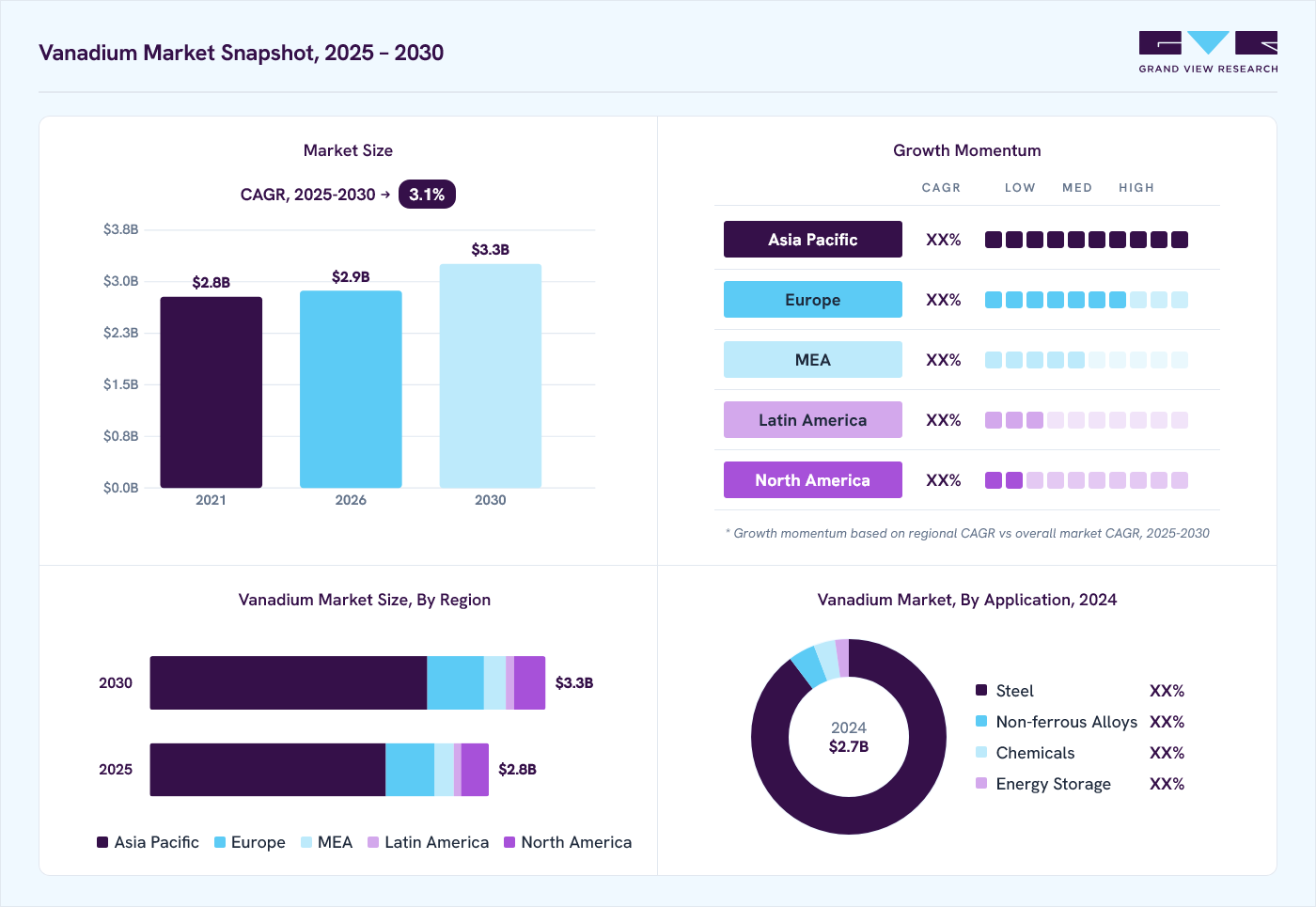 Source: Grand View Research, IR Documents, Primary Interviews, Paid DatabasesTo learn more about this report,
 Download Free Sample Report
 Key Market Trends & Insights
- By application: Steel segment led the market with the largest revenue share of 86.9% in 2025.
Regional Highlights
- Largest regional market: Asia Pacific (69.6% revenue share, 2025)
- By country: China held the largest market share in 2025.
Market Size & Forecast
- Market size in 2025: USD 2.8 Billion
- Estimated market size in 2026: USD 2.9 Billion
- Projected market size by 2033: USD 3.7 Billion
- CAGR (2026-2033): 3.6%
Three ways to get this report
Buy it, customize it, or ask a question.Ask an Analyst
Analyst response in 1 business day
- AccessReport author, directly
- Reply timeWithin 1 working day
- No sales callDirect answer only
- FormatEmail reply
- CostFree, no cost
Get the Full Report
What the study covers
- FormatsPDF · Excel · Dashboard
- Timeline2026–2033 annual, 2025 base
- Coverage20+ countries, 5 regions
- Companies10+ key players profiled
Customize the Report
20% free customization
- IncludeCountries, segments, points
- TailorTo your product definition
- ExtendDeeper competitor detail
- OrA fully bespoke study
- Turnaround5–10 working days
Rising crude steel production, driven by growing demand from the construction, automotive, machinery, and transportation sectors, is encouraging the demand for vanadium in the coming years. Vanadium is mainly utilized as an alloying element in steel manufacturing, as it enhances steel’s strength, durability, and resistance to wear. The increasing need for high-strength steel across construction, automotive, and aerospace industries continues to propel vanadium consumption. Besides rising global investments in infrastructure and industrial manufacturing is boosting the demand for vanadium . For instance, as reported by the International Energy Agency (IEA), global investment in infrastructure rose from USD 3.2 trillion in 2019 to USD 3.8 trillion in 2023, which in turn is expected to drive the demand for high-strength steel and subsequently propelling the vanadium industry.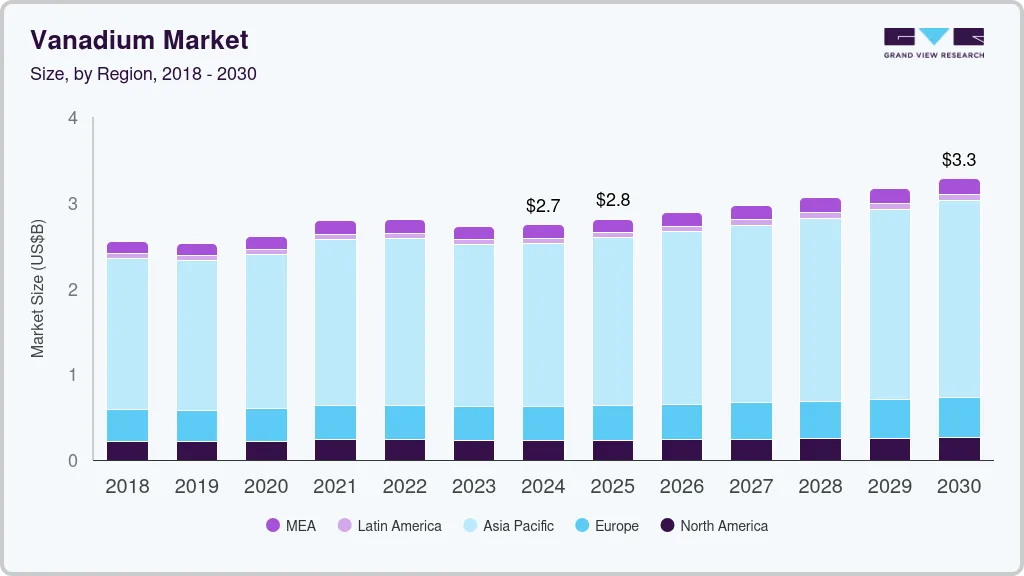 To learn more about this report, Download Free Sample Report
 The global vanadium market is experiencing steady growth, driven by its essential role in high-strength steel production, which accounts for approximately 90% of its consumption. Vanadium's ability to enhance the strength, durability, and corrosion resistance of steel makes it indispensable in key sectors such as construction, automotive, and heavy machinery. According to the World Steel Association, global crude steel output increased from 1,878.6 million tons in 2019 to 1,892.6 million tons in 2023, underscoring a stable demand trajectory from steel-intensive industries.
The market is also benefiting from the global shift toward renewable energy, with vanadium redox flow batteries (VRFBs) gaining prominence due to their long operational lifespan, scalability, and suitability for grid-scale energy storage. Projects such as China’s 100 MW/400 MWh Dalian VRFB installation highlight vanadium’s potential in stabilizing renewable energy supply. Additionally, the nuclear sector presents another avenue for demand, as vanadium-based alloys are increasingly used in advanced reactors due to their low neutron absorption and high resistance to extreme temperatures and corrosion.
Emerging markets are creating momentum, as urbanization and infrastructure development drive steel consumption. Efforts by countries including Australia and the U.S. to develop domestic vanadium sources also reflect growing geopolitical interest in securing critical mineral supply chains. As clean energy and carbon neutrality goals being prioritized, vanadium’s role in enabling both energy storage and clean power generation is making it a material of strategic importance.
Market Dynamics
The primary growth driver for the vanadium market is the expanding demand from the steel industry, which accounts for nearly 90% of global vanadium consumption. Vanadium is widely used as a microalloying element in high-strength, low-alloy (HSLA) steel, rebar, structural steel, tool steel, and pipeline steel because it significantly improves strength, toughness, wear resistance, and corrosion resistance while reducing the amount of steel required. Rapid urbanization, large-scale infrastructure development, and rising investments in transportation, construction, and industrial manufacturing, particularly across the Asia-Pacific region, are increasing demand for high-performance steel products. In addition, stricter building standards and the growing use of lightweight, high-strength steel in the automotive and aerospace sectors continue to support long-term demand for vanadium.
The increasing deployment of renewable energy sources such as solar and wind is driving the demand for vanadium redox flow batteries, which offer long duration energy storage, high safety, and extended cycle life. As countries invest in grid modernization and renewable energy integration, the need for reliable storage solutions is accelerating vanadium consumption.
In addition to energy storage, vanadium remains an essential alloying element in high strength low alloy steels used in construction, infrastructure, automotive, and industrial applications. Rising investments in urbanization and infrastructure development, particularly in emerging economies, continue to support steady demand for vanadium based steel products.
The vanadium market is affected by significant price fluctuations resulting from its dependence on steel production, limited primary mining operations, and concentrated supply in a few producing countries. Price volatility creates uncertainty for end users, while supply disruptions can impact procurement strategies and slow investment in vanadium intensive applications.
The rapid expansion of renewable energy capacity and the need for long duration energy storage present significant growth opportunities for vanadium. Governments and utilities are increasingly investing in vanadium redox flow battery projects to enhance grid reliability and energy security. Continued technological advancements and supportive energy policies are expected to strengthen vanadium demand over the coming years.
Market Concentration & Characteristics
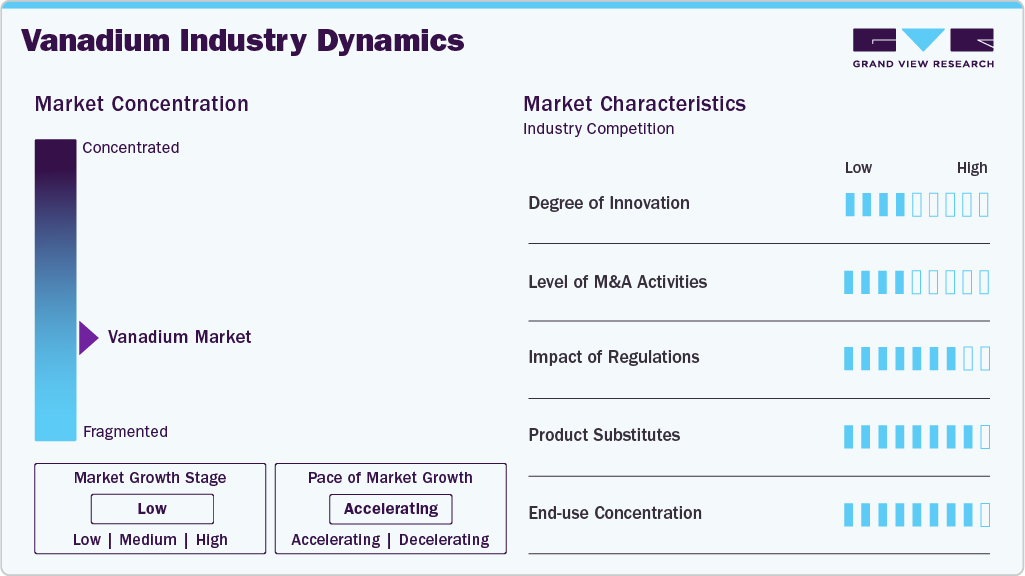
The market growth stage is low, and the pace of market growth is accelerating. The vanadium industry exhibits a moderate degree of innovation, largely driven by the growing development of vanadium redox flow batteries (VRFBs) for energy storage and ongoing research into high-performance alloys for use in advanced sectors such as aerospace and nuclear energy. Industry has witnessed a rise in R&D investments, particularly in regions prioritizing clean energy technologies. Despite this, reliance on conventional extraction and processing techniques continues to limit breakthrough advancements. Mergers and acquisitions remain relatively subdued, reflecting the concentrated nature of vanadium production, which China, Russia, and South Africa dominate. Additionally, strategic partnerships and vertical integration efforts are gaining traction, especially in Australia and North America, where there is a push to establish secure, domestic supply chains.
Regulatory frameworks significantly shape the vanadium market, with the mineral designated as critical in jurisdictions including the U.S., EU, and Australia. Environmental regulations around mining practices, waste disposal, and emissions are becoming more stringent, affecting project feasibility and operational costs. Simultaneously, government incentives promoting renewable infrastructure and strategic mineral reserves are supporting vanadium demand, especially for its applications in clean energy. Despite its advantages, vanadium faces moderate to high substitution risks. In steel production, niobium can partially replace vanadium, and in energy storage, lithium-ion batteries present stiff competition due to their lower costs and widespread use. However, vanadium remains difficult to replace in nuclear and aerospace uses, where its material properties are uniquely suited.
 To learn more about this report, Download Free Sample Report
 The market is also characterized by high end-user concentration, with over 90% of global vanadium supply consumed by the steel industry. This dependency exposes the market to volatility, particularly tied to fluctuations in steel output in major economies including China and India. Although new applications in renewable energy and nuclear power offer diversification, the market’s growth remains closely linked to industrial and infrastructure cycles that are influenced by broader economic and policy shifts.
Analyst Perspective
The vanadium market is expected to witness steady long-term growth, supported by its indispensable role in high-strength steel production and its expanding adoption in long-duration energy storage systems. While the steel industry will continue to account for the majority of vanadium consumption, growing investments in vanadium redox flow batteries are creating a new avenue for demand as countries strengthen grid infrastructure and integrate larger shares of renewable energy.
Application Insights
Based on application, steel segment led the market with the largest revenue share of 86.9% in 2025. The vanadium market is set to grow steadily, primarily driven by its critical role in steel manufacturing. As a key alloying element, vanadium enhances the strength, durability, and corrosion resistance of steel, making it vital for steel used in infrastructure, construction, automotive, and industrial machinery. With global urbanization, industrialization, and government investments in resilient infrastructure and transportation networks on the rise, demand for high-performance steel continues to climb. Additionally, the shift toward lightweight, fuel-efficient vehicles and sustainable construction practices further boosts the use of vanadium-enhanced steel. Growth in adjacent sectors such as renewable energy, where robust materials are needed for wind turbines and grid infrastructure, indirectly supports vanadium demand. The close link between steel usage and broad economic development ensures the expansion of vanadium industry.
The rapid growth of the energy storage sector, projected to expand at a CAGR of 5.2%, presents a significant opportunity for the vanadium market. This expansion is largely driven by the global transition toward renewable energy sources such as solar and wind, which require reliable, long-duration storage to balance intermittent supply. Vanadium redox flow batteries (VRFBs) have emerged as a preferred solution due to their long cycle life, deep discharge capabilities, and scalability for grid applications. As countries invest in decarbonizing their power systems and improving grid resilience, demand for VRFBs is expected to rise. Since vanadium is the core element in these batteries, their adoption directly translates into increased vanadium consumption. Furthermore, government support for energy storage technologies and clean energy goals globally will continue to accelerate this trend, reinforcing vanadium’s strategic role in the future energy economy.
Regional Insights
North America holds a notable position in the global vanadium market, driven primarily by demand from the U.S. The region’s focus on renewal of infrastructure, automotive advancements, and domestic production of critical minerals is shaping vanadium consumption patterns. Steel manufacturing remains the dominant application, however, there is a growing push toward energy storage technologies and high-performance alloys. Policies promoting clean energy and supply chain resilience are encouraging investment in domestic vanadium sources. As the region continues transitioning toward renewable energy and electrification, North America's vanadium demand is expected to strengthen steadily.
 To learn more about this report, Download Free Sample Report
 U.S. Vanadium Market Trends
In the U.S., the vanadium market is largely centered around the steel industry, which absorbs the majority of its consumption due to ongoing infrastructure projects and durable goods manufacturing. Other applications, such as chemical production, aerospace alloys, and energy storage account for a smaller share and are also gaining momentum. Government’s emphasis on clean energy solutions and grid modernization is fostering interest in advanced battery systems, including vanadium-based technologies. The U.S. is also investing in recycling and domestic recovery initiatives, positioning itself for long-term vanadium supply stability and end-use diversification.
Europe Vanadium Market Trends
The vanadium market in Europe is expanding steadily, driven by the region’s focus on sustainable industrial practices and the transition toward clean energy. European countries are increasingly adopting vanadium in applications such as catalytic converters, essential for reducing vehicle emissions, and in renewable energy storage systems to support grid reliability. The region is also active in researching and deploying vanadium redox flow batteries for long-duration energy storage, aligning with their climate goals. This steady growth is supported by regulatory frameworks, investment in green technologies, and a push toward circular economies across member states.
Asia Pacific Vanadium Market Trends
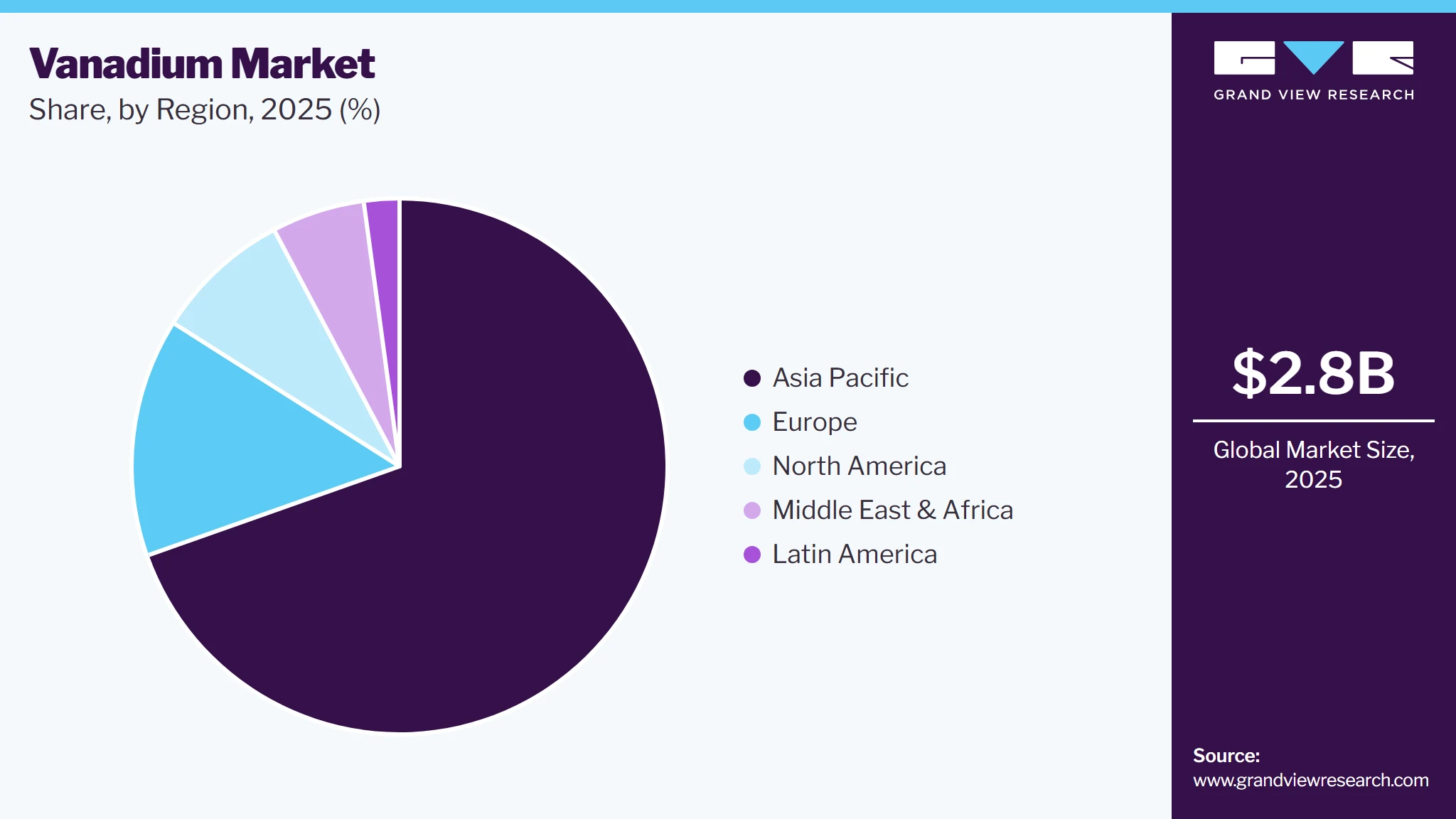
Asia Pacific dominated the vanadium market with the largest revenue share of 69.6% in 2025. This growth is attributed to significantly increasing investments in vanadium market across the region. China dominates the vanadium market in the Asia Pacific region due to its massive steel production capacity and vertically integrated supply chains. The country benefits from abundant vanadium-bearing resources and a well-established manufacturing ecosystem, allowing it to meet large-scale domestic demand across construction, automotive, and infrastructure sectors. Additionally, China has been proactive in developing vanadium redox flow battery projects to support its renewable energy goals, further cementing its role as a global vanadium hub. The combination of policy support, industrial scale, and technological integration underpins its leading position.
China Vanadium Market Trends
China held the largest market share in 2025. China is the world’s leading producer and consumer of vanadium, supported by its large steel manufacturing industry. The vanadium market is primarily driven by demand for high-strength low-alloy (HSLA) steel and rebar, where vanadium is used to improve strength, toughness, and durability. China’s vanadium supply is largely derived from vanadium-bearing titanomagnetite ores and steelmaking by-products. Growing interest in vanadium redox flow batteries (VRFBs) for long-duration energy storage is anticipated to create additional demand opportunities.
India Vanadium Market Trends
India, the fastest-growing vanadium market in the region, is expanding steadily, supported by rapid urbanization, infrastructure development, and increasing investment in construction and transportation. The government's focus on strengthening domestic manufacturing and expanding renewable energy capacity is also contributing to the rise in vanadium demand. While still emerging compared to regional leaders, India’s growth trajectory is supported by economic development and industrial expansion, indicating strong potential for vanadium consumption in the coming years.
Key Vanadium Company Insights
Some of the key companies in the vanadium market include HBIS Group Co., Ltd., Bushveld Minerals, Largo Inc., Australian Vanadium Limited, and others. These organizations are strategically focused on expanding their production capacity, securing long-term supply chains, and tapping into emerging applications such as energy storage. To gain a competitive edge, leading players are actively engaging in initiatives such as mergers and acquisitions, joint ventures, and partnerships-particularly in regions prioritizing renewable energy and critical minerals development. This collaborative approach is aimed at strengthening their market presence and responding to the rising global demand for vanadium across industrial and clean energy sectors.
-
HBIS Group Co., Ltd. is one of the world's largest steelmakers and a leading vanadium producer. HBIS operates captive vanadium resources and integrates vanadium extraction into its steel production chain. The company's scale and supply chain control make it a dominant player in the market.
-
Bushveld Minerals is a vertically integrated vanadium platform with ownership of primary vanadium assets, processing facilities, and downstream energy storage projects (including VRFBs).
Key Vanadium Companies:
The following are the leading companies in the vanadium market.
-
AMG
-
Aura Energy Ltd
-
Australian Vanadium Limited
-
Bushveld Minerals
-
EVRAZ plc
-
Glencore
-
HBIS Group
-
Largo, Inc.
-
Pangang Group Vanadium and Titanium Resources Co., Ltd.
-
Vanadium Resources Limited
Competitive Benchmarking
Category
Operating Strategies
Competitive Edge
Weakness
Established Players (e.g. AMG, Bushveld Minerals)
- Mature participants in the vanadium market primarily focus on vertically integrated operations that include vanadium ore mining, slag processing, roasting, refining, and downstream production of vanadium pentoxide, ferrovanadium, and vanadium chemicals.
- These companies emphasize securing long term raw material supplies through captive mining assets, steelmaking byproducts, and strategic procurement agreements to ensure production stability.
- Established players possess significant competitive advantages through their integrated mining and processing infrastructure, advanced metallurgical expertise, and secure access to vanadium bearing resources.
- Their ability to control the complete value chain from raw material extraction to refined vanadium products enables lower production costs, consistent product quality, and reliable supply for industrial customers.
- Despite their strong market positions, mature players face challenges related to fluctuations in steel production and vanadium prices, as a significant portion of global vanadium supply originates from steelmaking byproducts.
- Variations in steel output can directly influence vanadium availability and market stability.
Emerging & Regional Players (e.g., Aura Energy Ltd., Australian Vanadium Limited)
- Emerging participants in the vanadium market generally focus on developing new mining projects, expanding secondary vanadium recovery, and establishing alternative supply chains to support growing demand for critical minerals.
- Emerging companies benefit from operational flexibility and the ability to implement modern extraction, refining, and recycling technologies without extensive legacy infrastructure.
- Their operations often incorporate advanced automation, digital process monitoring, and energy efficient processing systems that improve recovery efficiency and reduce environmental impacts.
- Emerging participants face significant challenges related to limited production capacity, financing requirements, and lengthy project development timelines.
- Developing vanadium mining and processing operations requires substantial investment in exploration, extraction, refining infrastructure, and environmental compliance before commercial production can begin.
Recent Developments
-
In November 2024 VanadiumCorp Resource Inc. successfully passed the qualification process with CellCube for its Quebec-produced vanadium electrolyte. This development strengthens the North American vanadium redox flow battery (VRFB) supply chain and marks progress toward domestic energy storage solutions.
-
In October 2024 - Largo Inc. boosts vanadium production and secures a supply deal. Largo Inc. reported a 42% increase in vanadium pentoxide (V₂O₅) production in Q3 2024, totaling 3,072 tons. The company also finalized a binding agreement to supply 2,100 tonnes of V₂O₅ worth USD 23.5 million, showcasing strong operational momentum and rising demand.
-
In February 2024, AMG Vanadium acquired processing technologies and IP-related business from Transformation Technologies Inc. (TTI), which focuses on green energy and recyclable metals. With this acquisition, the company aims to improve its leadership position in recycling refinery waste. AMG Vanadium recycled vanadium from oil refining residues.
-
In February 2024, Australian Vanadium Limited (AVL) completed the merger with Technology Metals Australia. AVL acquired all the shares of Technology Metals Australia. With this strategic move, the company wants to broaden its footprint in primary vanadium production.
Vanadium Market Report Scope
Report Attribute
Details
Market definition
The market size represents the total revenue generated globally from the sale of vanadium within a specific year.
Market size in 2025
USD 2.8 billion
Estimated market size in 2026
USD 2.9 billion
Projected market size by 2033
USD 3.7 billion
Growth rate
CAGR of 3.6% from 2026 to 2033
Base year for estimation
2025
Historical data
2021 - 2024
Forecast period
2026 - 2033
Quantitative units
Revenue in USD million, volume in kilotons, and CAGR from 2026 to 2033
Report coverage
Revenue forecast, volume forecast, company ranking, competitive landscape, growth factors, and trends
Segments covered
Application, region.
Regional scope
North America; Europe; Asia Pacific; Latin America; Middle East & Africa
Country scope
U.S., Canada, Mexico, Germany, Italy, France, India, China, Japan, Brazil
Key companies profiled
AMG; Aura Energy Ltd.; Australian Vanadium Limited Bushveld Minerals; EVRAZ plc Glencore; HBIS Group; Largo, Inc.; Pangang Group Vanadium and Titanium Resources Co., Ltd.; and Vanadium Resources Limited
Customization scope
Free report customization (equivalent up to 8 analysts' working days) with purchase. Addition or alteration to country, regional & segment scope.
Pricing and purchase options
Avail customized purchase options to meet your exact research needs. Explore purchase options
Global Vanadium Market Report Segmentation
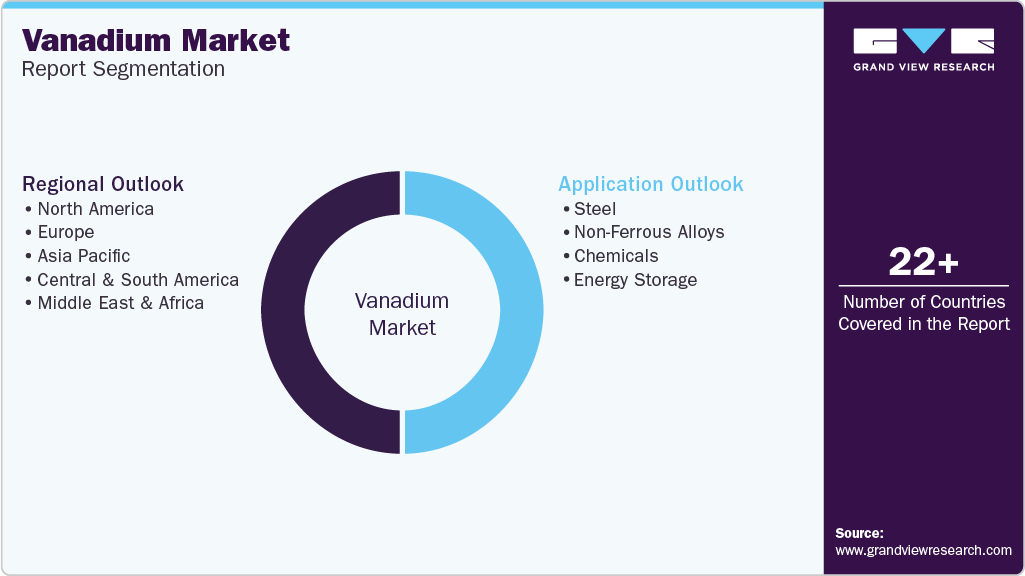
This report forecasts revenue growth at global, regional, and country levels and provides an analysis of the latest industry trends in each of the sub-segments from 2021 to 2033. For this study, Grand View Research has segmented the global vanadium market report based on application and region.
 To learn more about this report, Download Free Sample Report
 -
Application Outlook (Revenue, USD Million, 2021 - 2033)
-
Steel
-
Non-Ferrous Alloys
-
Chemicals
-
Energy Storage
-
-
Regional Outlook (Revenue, USD Million, 2021 - 2033)
-
North America
-
U.S.
-
Canada
-
Mexico
-
-
Europe
-
Germany
-
France
-
Italy
-
-
Asia Pacific
-
China
-
Japan
-
India
-
-
Latin America
-
Brazil
-
-
Middle East and Africa (MEA)
-
Research Methodology
The vanadium market figures in this report are based on a proven research process that combines executive interviews with secondary research from proprietary databases, company filings, and recognized regulatory and institutional sources. Market size is built through value-chain sizing-reconciling supply-side and demand-side estimates-and triangulated with bottom-up and top-down approaches. Every estimate passes multiple levels of expert validation before publication, with each vanadium segment quantified using the revenue-capture definitions in the table below.
Segment Definition
Application
Revenue Capture Definition
Steel
The steel segment captures revenue generated from vanadium used as an alloying element in carbon, high strength low alloy, tool, and specialty steels. Vanadium enhances tensile strength, toughness, wear resistance, and fatigue performance while enabling the production of lighter and more durable steel products.
Non-ferrous Alloys
The non ferrous alloys segment represents revenue generated from vanadium used in titanium, nickel, and other advanced alloy systems for aerospace, defense, marine, and chemical processing applications.
Chemicals
The chemicals segment includes revenue generated from vanadium compounds used as catalysts, pigments, ceramics, glass additives, and chemical intermediates. Vanadium based chemicals play an essential role in sulfuric acid production, oxidation reactions, and specialty industrial formulations.
Energy Storage
The energy storage segment captures revenue generated from vanadium used in vanadium redox flow batteries and other emerging energy storage technologies.
Estimation Model
Layer Name
Key Question
Description
Steel & Energy Storage Demand Base Layer
What forms the demand base?
Identify global demand from major vanadium consuming industries including steel production, energy storage, aerospace, chemicals, and titanium alloy manufacturing. Assess crude steel production, high strength steel consumption, vanadium redox flow battery (VRFB) deployments, and industrial manufacturing activity to establish the total addressable demand for vanadium.
Vanadium Application Penetration Layer
Where is vanadium utilized?
Estimate the penetration of vanadium across key applications including high strength low alloy (HSLA) steel, tool steel, aerospace titanium alloys, vanadium redox flow batteries, catalysts, and specialty chemicals. Analyze the adoption of ferrovanadium, vanadium pentoxide, vanadium electrolyte, and other vanadium products across end use industries and regions.
Vanadium Consumption Intensity Layer
How much vanadium is consumed?
Analyze vanadium consumption intensity based on steel production volumes, alloy composition requirements, battery energy storage capacity, and catalyst demand. Evaluate vanadium usage per ton of steel, per megawatt hour of VRFB capacity, and across other industrial applications. Consumption intensity varies according to steel grades, battery technology adoption, performance requirements, and regional manufacturing trends.
Revenue Layer
How is market revenue generated?
Market revenue is quantified through the sale of vanadium. Revenue generation is driven by demand from steel manufacturing, energy storage systems, aerospace, chemicals, and industrial applications. Market value is influenced by vanadium prices, ore grades, production volumes, battery deployment, steel production, and regional supply demand dynamics.
Delivered Customizations
This report has been delivered with the following In-depth customizations
CLIENT REQUEST
CUSTOMIZATION DELIVERED
VALUE ADDS
Regional Segmentation
Detailed regional analysis of the vanadium market across North America, Europe, Asia Pacific, Latin America, and Middle East & Africa. Included evaluation of vanadium mining and processing capacities, steel production, vanadium bearing resources, battery manufacturing investments, energy storage projects, infrastructure development, and government initiatives supporting critical minerals and decarbonization.
Identified key production hubs, high growth consumption markets, and emerging investment regions. Enabled strategic expansion planning based on steel production, renewable energy deployment, and critical mineral demand. Supported regional demand forecasting and supply chain optimization.
Trade Assessment
Evaluation of global vanadium trade flows, export import trends, country level trade balances, international sourcing patterns, logistics routes, tariff impacts, and regional manufacturing competitiveness. Included assessment of vanadium ore, vanadium pentoxide, ferrovanadium, recycled vanadium materials, and downstream products supplied to steel, aerospace, chemical, and battery industries, along with evolving trade regulations affecting critical minerals.
Highlighted export opportunities, sourcing risks, and supply diversification options. Supported strategic procurement decisions, supply chain resilience planning, compliance assessment, and international market expansion initiatives.
Opportunity Assessment
Identification of high growth opportunities across high strength low alloy steel production, vanadium redox flow batteries, renewable energy storage, aerospace alloys, industrial catalysts, recycling of vanadium bearing materials, and low carbon steel manufacturing.
Enabled prioritization of high return growth segments and emerging regional opportunities. Supported long term investment planning, mining and processing capacity expansion, product innovation, and strategic business development initiatives aligned with global energy transition and advanced materials demand.
Frequently Asked Questions About This Report
Asia Pacific market dominated, with a revenue share of 69.6% in 2025.
The key factor driving the growth of the global vanadium market is the rising crude steel production and growing demand for ferrovanadium.
Asia Pacific is anticipated to register the fastest CAGR over the forecast period.
Steel segment led the market with the largest revenue share of 86.9% in 2025.
The vanadium market size was valued at USD 2.8 billion in 2025 and is estimated at USD 2.9 billion in 2026.
The vanadium market is expected to grow at a CAGR of 3.6% from 2026 to 2033, reaching USD 3.7 billion by 2033.
About the Author(s)
Advanced Interior Materials Research Team
Advanced Materials · Advanced Interior MaterialsThis report was authored by the advanced interior materials research team at Grand View Research - comprising two research analysts, one senior research analyst, and one industry expert - with specialized expertise in the advanced interior materials segment of the advanced materials industry. All findings are based on proprietary advanced materials databases, executive interviews, and regulatory analysis, subject to internal peer review prior to publication.
Last Updated:
Speak to Analyst

Customize this report to your needs - add regions, segments, or data points, with 20% free customization.
Or view our licence options:


ISO 9001:2015 & 27001:2022 Certified
We are GDPR and CCPA compliant! Your transaction & personal information is safe and secure. For more details, please read our privacy policy.


