
- Home
- »
- Nutraceuticals & Functional Foods
- »
-
Vanillin Market Size, Share & Trends Report, 2026-2033GVR Report cover

Vanillin Market (2026 - 2033)
Size, Share & Trends Analysis Report By Product (Synthetic, Bio-based), By Application (Food & Beverage, Fragrance, Pharmaceutical), By Region (North America, Europe, Asia Pacific, Latin America, MEA), And Segment Forecasts
Market Size, 2025
$900.0MMarket Estimate, 2026
$1,000.0MMarket Forecast, 2033
$1,500.0MCAGR, 2026–2033
6.4%Vanillin Market Summary
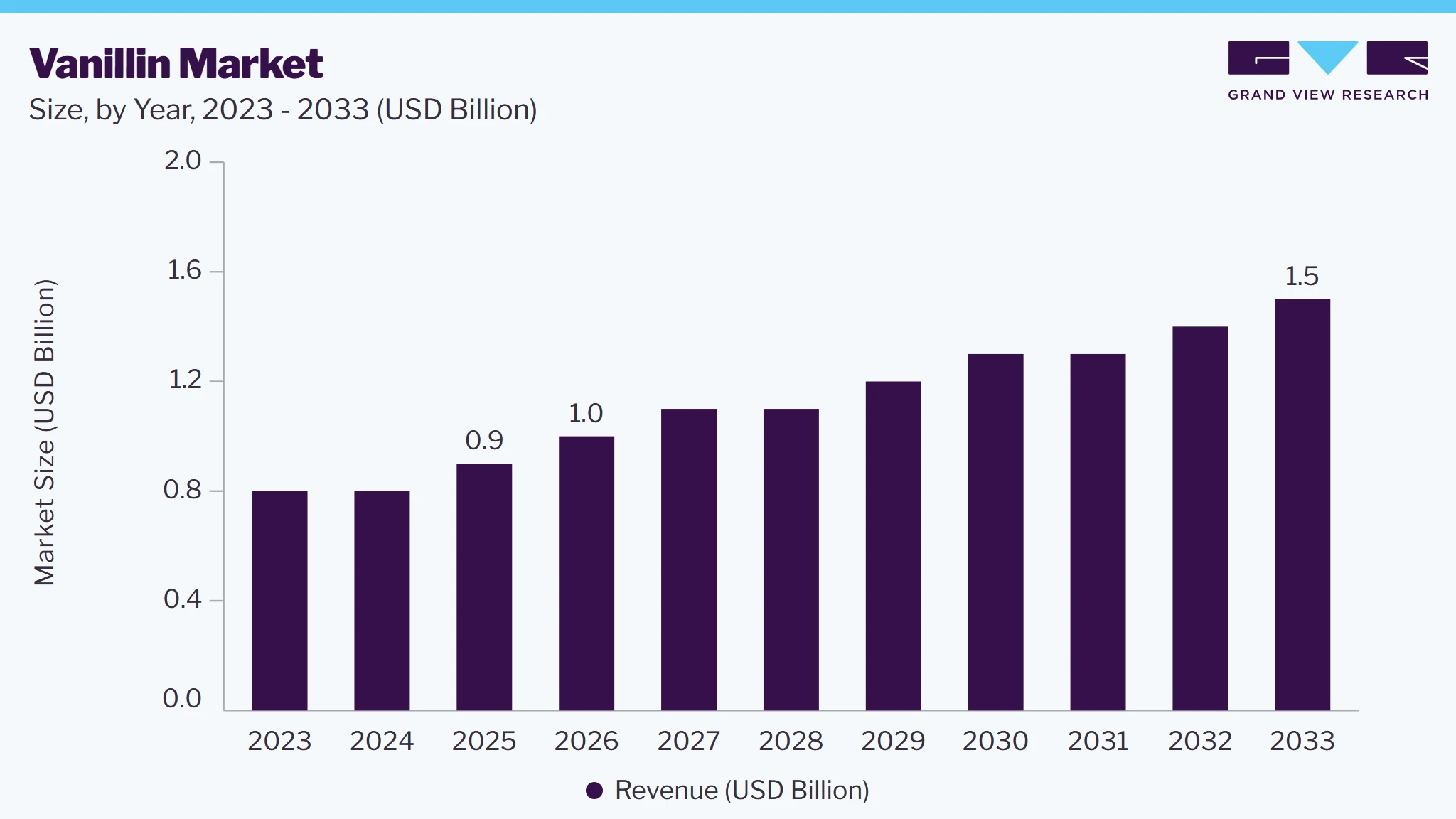
The global vanillin market size was valued at USD 900.0 million in 2025 and is projected to grow from USD 1000.0 million in 2026 to USD 1500.0 billion in 2033, at a CAGR of 6.4% from 2026 to 2033. Asia Pacific dominated the market, accounting for a revenue share of 40.0% in 2025. Globally, rising demand from various end use industries to enhance product flavor and aroma is expected to be a key growth driver.
Key Market Trends & Insights
- By application: Pharmaceutical segment accounted for the largest revenue share of around 50.0% in 2025.
- By product: Bio-based segment accounted for the largest revenue share of over 60.0% in 2025.
Regional Highlights
- Largest regional market: Asia Pacific (40.0% revenue share, 2025)
Market Size & Forecast
- Market size in 2025: USD 900.0 million
- Estimated market size in 2026: USD 1000.0 million
- Projected market size by 2033: USD 1500.0 million
- CAGR (2026-2033): 6.4%
Three ways to get this report
Buy it, customize it, or ask a question.Ask an Analyst
Analyst response in 1 business day
- AccessReport author, directly
- Reply timeWithin 1 working day
- No sales callDirect answer only
- FormatEmail reply
- CostFree, no cost
Get the Full Report
What the study covers
- FormatsPDF · Excel · Dashboard
- Timeline2026–2033 annual, 2025 base
- Coverage20+ countries, 5 regions
- Companies10+ key players profiled
Customize the Report
20% free customization
- IncludeCountries, segments, points
- TailorTo your product definition
- ExtendDeeper competitor detail
- OrA fully bespoke study
- Turnaround5–10 working days
It is one of the key ingredients used extensively in the food & beverage industry and is widely used as a flavoring agent in products such as bakery and confectionery items, ice cream, chocolates, and alcoholic beverages.The robust growth across various end-use industries, such as food & beverage, fragrance, cosmetics, and pharmaceuticals, in different geographies is one of the key factors driving this market. The rising food & beverage industry will remain a key element due to its ability to enhance the flavor and taste of various food products. Moreover, it contains low-calorie content and numerous antioxidants. The global population is shifting its consumption patterns towards wholesome ingredients, driven by rising awareness of organic food and a healthy lifestyle.
 Source: Grand View Research, IR Documents, Primary Interviews, Paid DatabasesTo learn more about this report,
 Download Free Sample Report
The workers operating in the vicinity of the production process may have health concerns. Primarily due to these concerns, various regulatory bodies, such as REACH, the Code of Federal Regulations, and NIOSH, have imposed regulations to prevent worker health issues and limit the use of synthetic products above certain levels. REACH has established regulations on the classification, labeling, and packaging of these products according to hazard classes, such as eye irritation, skin sensitivity, acute toxicity, aquatic chronic toxicity, and acute aquatic toxicity.
Vanillin is widely consumed in the Asia Pacific and Europe, with major food & beverage consumer countries such as China, India, and Germany. The increasing population, coupled with rising income levels, is expected to drive market growth over the forecast period. The global population is shifting toward wholesome ingredients, driven by rising awareness of the benefits of organic food and healthy lifestyles. It has become increasingly challenging for food product companies to meet these needs, with key manufacturers focusing on balancing flavor and health. Achieving this criterion is quite challenging due to the presence of various regulatory standards.
Vanillin is also witnessing growing demand in the pharmaceutical industry. It is widely used as an aromatic masking agent and flavoring in toothpaste, cleaning products, medicines, and livestock fodder. Vanillin acts as a chemical intermediate in the production of fine chemicals and pharmaceuticals. The pharmaceuticals segment is anticipated to offer lucrative market opportunities, driven by the growing demand for bio-based process intermediates for drug manufacturing. Vanillin is utilized as an inactive excipient or as an intermediate in the production of medicines and drugs. Furthermore, it is used to remove the bitter taste in medicines and to mask or cover tablet surfaces. Rising awareness of environmentally friendly, natural perfumes, skin-friendly deodorants, and other aromatic products is another factor likely to improve the dynamics of the bio vanillin market over the next few years.
The food & beverage industry is experiencing a shift in consumption patterns driven by rising disposable incomes and a hectic lifestyle, leading to changes in food choices. Superior economic growth, coupled with rising demand for ready-to-eat and processed foods, is driving the use of vanillin in this industry. Moreover, the surging demand for room and car fresheners, along with the growing popularity of aromatherapy, is projected to drive vanillin demand in the cosmetics and toiletries segment. Increasing demand across growing application segments, including incense sticks, candles, and pesticides, is expected to further fuel market growth over the forecast period.
Market Dynamics
The vanillin market is shaped by evolving consumer preferences, regulatory developments, and technological advancements across the global flavor and fragrance industry. Growing demand for cost-effective flavoring ingredients in food and beverage applications continues to support market expansion, while increasingly stringent food safety regulations and compliance requirements present challenges for manufacturers. Together, these factors are expected to influence the competitive landscape and growth of the vanillin market during the forecast period.
Rising consumption of processed and convenience foods is a key factor driving the vanillin market. An increase in the urban population, changing dietary trends, and the growing use of ready-to-eat products have positively impacted demand for flavoring compounds such as vanillin. Vanillin is widely used in the bakery, confectionery, dairy, and beverage sectors to achieve a consistent, reliable vanilla flavor in end-use products. In addition, expansion of the global bakery and confectionery industry, along with increasing innovation in flavored dairy and dessert products, is further supporting market growth. The preference for vanillin among food processors is attributed to its cost-effectiveness, high stability at high temperatures, and consistent vanilla flavor, compared to natural vanilla extract, which is subject to supply and price fluctuations. Furthermore, growing food consumption in emerging markets, such as the Asia Pacific, is encouraging ingredient suppliers to expand their distribution and production capabilities. For instance, in March 2025, Brenntag Specialties and Syensqo expanded their distribution partnership to strengthen the supply of aroma ingredients, including vanillin, across the Asia Pacific food and nutrition markets. Such developments reflect the increasing integration of vanillin within the global food supply chain, thereby supporting sustained market growth.
Food safety regulations and new standards for food additives are among the principal barriers to vanillin’s market. Food authorities in leading markets such as Asia Pacific, Europe, and North America have been continually amending food safety standards regarding vanillin purity, testing, and the allowable use. For instance, in August 2025, the National Health Commission of the People's Republic of China (NHC) notified the World Trade Organization (WTO) of a revised national food safety standard for vanillin, introducing stricter quality specifications and standardized testing protocols for compliance. These regulatory reforms tend to increase the need for certification, testing, and documentation, thereby increasing production costs and the time spent on product approvals. Variations in regulations across regions also increase the complexity of international business practices. All these issues increase the burden on manufacturers and restrain the growth of the vanillin market.
Advancements in bio-based and fermentation-derived vanillin technologies present a significant growth opportunity for the vanillin market. Advances in biotechnology and precise fermentation have paved the way for the creation of vanillin through bio-based ingredients such as sugar or plant-based components. These developments have created opportunities to produce sustainable, commercially viable alternatives to petrochemically synthesized vanillin and traditional vanilla extracts, which face limitations due to their agricultural origins. In addition, the increasing consumer preference for sustainable, naturally derived, and clean-label products is driving market growth, as food and beverage companies are turning to innovative bio vanillin solutions for their bakery, confectionery, dairy, and even fragrance products. For instance, in March 2026, Lallemand Inc. launched Hevani, an ingredient based on fermentation-derived vanillin, which responds to growing interest in natural flavors in global food applications. Such innovations transition toward greener production methods and are expected to create new revenue streams for manufacturers while strengthening long term market expansion.
Analyst Perspective
The global vanillin market is experiencing robust expansion, driven by widespread applications across the food, cosmetic, and pharmaceutical industries. Concurrently, global consumption volumes are expected to exceed 59,000 to 60,000 tonnes. While traditional, crop-based natural vanilla extract remains a luxury commodity primarily sourced from Madagascar, which accounts for less than 1% of the total global supply. Consequently, the market relies heavily on chemical synthesis, alongside a rapidly emerging bio-vanillin sector. This bio-based segment, which leverages microbial biotransformation and the oxidative depolymerization of renewable biomass such as lignin, is gaining significant traction to meet stricter global regulations and shifting consumer preferences for sustainable, nature-identical ingredients.
Application Insights
The pharmaceutical segment accounted for the largest revenue share of around 50.0% in 2025. The segment is expected to grow at the fastest CAGR of about 8.0% over the forecast period. There are numerous applications of vanillin as an intermediate chemical as well as an additive in the pharmaceutical sector. It is used for tablet masking, minimizing the bitter taste of medicines, oral medication processing, topical medicated lotions, and other pharmaceutical products.
The fragrance industry is another significant application segment in the global market. It is used as a key aroma ingredient in the production of various fragrance products and perfumes, including aromatic candles, essential oils, sweet-flavored perfumes, organic perfumes, and deodorants. In addition, increasing consumer demand for aromatherapy products, toiletries, and car fresheners is expected to drive future demand.
Product Insights
The bio-based segment accounted for the largest revenue share of around 60.0% in 2025. Rising awareness of healthy, natural ingredient functional foods without synthetic preservatives or artificial additives is a key factor driving the demand for bio-based products. Moreover, key players are increasing R&D spending on a new process to manufacture low-cost bio-vanillin products. For instance, major players are manufacturing bio-based vanillin products by fermenting ferulic acid and eugenol.
The synthetic segment is expected to grow at the fastest CAGR of more than 7.0% during the forecast period. Synthetic vanillin can be produced from petrochemicals, unlike real vanilla extract. The high prices of bio-based products are fueling demand for synthetic products over the forecast period. However, growing health concerns are expected to hinder the demand for synthetic vanillin over the forecast period.
Regional Insights
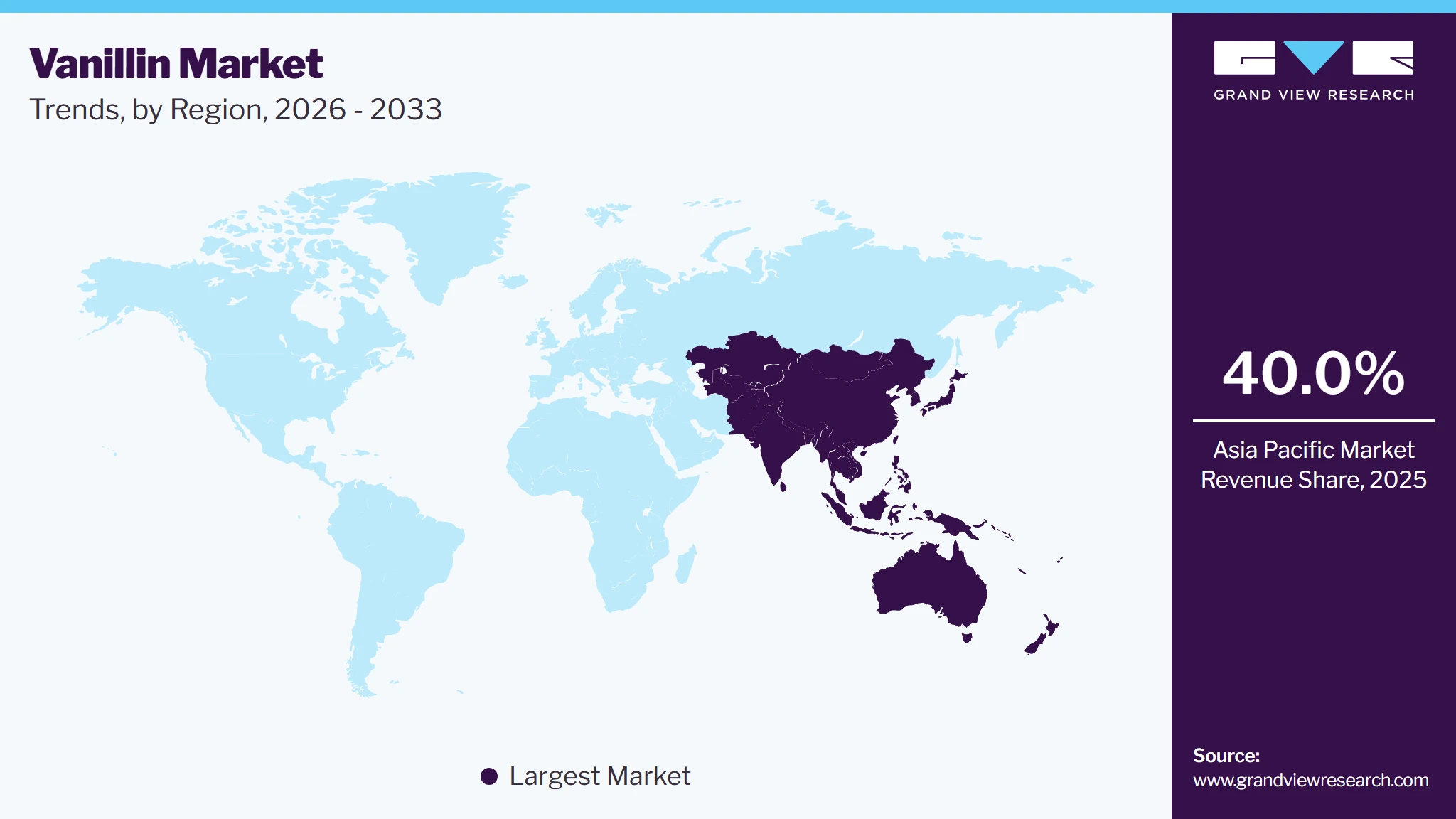
Asia Pacific dominated the market and accounted for the largest revenue share of over 40.0% in 2025. The region is expected to grow at the fastest CAGR of about 8.0% during the forecast period, driven by rising demand across various end-use industries. The presence of emerging economies such as India, China, and Japan is projected to drive the food industry, which in turn will propel the vanillin market. Food & beverage manufacturers typically operate at high volume and low profit margins. Increasing population, rising income levels, and expanding food application scope are projected to propel market growth over the forecast period. Furthermore, diverse consumer tastes, population growth, and extensive foreign investment are among the socioeconomic factors supporting market growth.
 To learn more about this report, Download Free Sample Report
The food & beverage segment in the Asia Pacific held a significant share which is mainly driven by consumption patterns, dietary preferences, diversity regarding demographics, and increasing income levels.
The steady growth of the pharmaceutical industry in the European region is expected to boost the demand for vanillin over the forecast period. A more collaborative environment between the European regulatory bodies and pharma manufacturers is expected to enable the launch of several initiatives in the region.
Key Vanillin Company Insights
The market is competitive, with a large number of manufacturers accounting for a majority of the market share. Product launches, strategic acquisitions, and innovative applications are among the key business strategies market participants are undertaking to maintain and expand their global reach.
Key Vanillin Companies:
The following key companies have been profiled for this study on the vanillin market.
-
Apple Flavor & Fragrance Group Co Ltd.
-
Camlin Fine Sciences Ltd.
-
De Monchy Aromatics
-
International Flavors & Fragrances Inc.
-
Ennolys
-
Advanced Biotech
-
Omega Ingredients Ltd.
-
Comax Flavors
Recent Developments
-
In March 2025, Brenntag Specialties and Syensqo renewed and expanded their distribution partnership for aroma products, including Rhovanil Vanillin and Rhodiarome Ethylvanillin, across Southeast Asia, Australia, New Zealand, and Taiwan. The agreement strengthened regional distribution capabilities and ensured continued access to premium aroma ingredients for food, beverage, and fragrance manufacturers.
-
In December 2024, Indesso soft-launched its second vanillin production facility in Ungaran, Central Java, supported by an investment of over USD 20 million. The new facility is expected to double the company’s existing vanillin production capacity while improving production efficiency and sustainability.
Vanillin Market Report Scope
Report Attribute
Details
Market size in 2025
USD 900.0 million
Estimated market size in 2026
USD 1000.0 million
Projected market size by 2033
USD 1500.0 million
Growth rate
CAGR of 6.4% from 2026 to 2033
Base year for estimation
2025
Historical data
2021 - 2024
Forecast period
2026 - 2033
Quantitative units
Revenue in USD billion, volume in tons, and CAGR from 2026 to 2033
Report coverage
Revenue forecast, company ranking, competitive landscape, growth factors, and trends
Segments covered
Product, application, region
Regional scope
North America, Europe, Asia Pacific, Latin America, Middle East & Africa
Country scope
U.S.; Canada; Mexico; Germany; UK; France; Italy; Spain; China; India; Japan; South Korea; Brazil; Argentina; Saudi Arabia; South Africa
Key companies profiled
Apple Flavor & Fragrance Group Co Ltd.; Camlin Fine Sciences Ltd.; De Monchy Aromatics; International Flavors & Fragrances; Ennolys; Advanced Biotech; Omega Ingredients Ltd.;Comax Flavors
Customization scope
Free report customization (equivalent up to 8 analysts working days) with purchase. Addition or alteration to country, regional & segment scope.
Pricing and purchase options
Avail of customized purchase options to meet your exact research needs. Explore purchase options
Global Vanillin Market Report Segmentation
This report forecasts revenue growth at the global, regional, and country levels and provides an analysis on the latest industry trends and opportunities in each of the sub-segments from 2021 to 2033. For this study, Grand View Research has segmented the global vanillin market report on the basis of product, application, and region:
 To learn more about this report, Download Free Sample Report
-
Product Outlook (Volume, Tons; Revenue, USD Billion, 2021 - 2033)
-
Synthetic
-
Bio-based
-
-
Application Outlook (Volume, Tons; Revenue, USD Billion, 2021 - 2033)
-
Food & Beverage
-
Fragrances
-
Pharmaceuticals
-
-
Regional Outlook (Volume, Tons; Revenue, USD Billion, 2021 - 2033)
-
North America
-
U.S.
-
Canada
-
Mexico
-
-
Europe
-
Germany
-
UK
-
France
-
Italy
-
Spain
-
-
Asia Pacific
-
China
-
India
-
Japan
-
South Korea
-
-
Latin America
-
Brazil
-
Argentina
-
-
Middle East & Africa
-
Saudi Arabia
-
South Africa
-
-
Frequently Asked Questions About This Report
The global vanillin market size was valued at USD 900.0 million in 2025 and is estimated at USD 1,000.0 million for 2026.
The global vanillin market is expected to grow at a CAGR of 6.4% from 2026 to 2033, reaching USD 1,500.0 million.
Key players include Apple Flavor & Fragrance Group Co Ltd.; Camlin Fine Sciences Ltd.; De Monchy Aromatics; International Flavors & Fragrances; Ennolys; Advanced Biotech; Omega Ingredients Ltd.;Comax Flavors
Asia Pacific dominated with a 40.0% revenue share in 2025.
Bio-based dominated the vanillin market with a share of 60.0% in 2025.
About the Author(s)
Nutraceuticals & Functional Foods Research Team
Consumer Goods · Nutraceuticals & Functional FoodsThis report was authored by the nutraceuticals & functional foods research team at Grand View Research - comprising two research analysts, one senior research analyst, and one industry expert - with specialized expertise in the nutraceuticals & functional foods segment of the consumer goods industry. All findings are based on proprietary consumer goods databases, executive interviews, and regulatory analysis, subject to internal peer review prior to publication.
Last Updated:
Speak to Analyst

Customize this report to your needs - add regions, segments, or data points, with 20% free customization.
Or view our licence options:


ISO 9001:2015 & 27001:2022 Certified
We are GDPR and CCPA compliant! Your transaction & personal information is safe and secure. For more details, please read our privacy policy.


