
- Home
- »
- Animal Health
- »
-
Veterinary Rehabilitation Market Size, Industry Report, 2033GVR Report cover
![Veterinary Rehabilitation Market Size, Share & Trends Report]()
Veterinary Rehabilitation Market (2026 - 2033) Size, Share & Trends Analysis Report By Product, By Animal (Companion Animals, Production Animals), By Indication (Post-Surgery, Traumatic Injuries), By End Use, By Region, And Segment Forecasts
- Report ID: GVR-4-68040-899-5
- Number of Report Pages: 150
- Format: PDF
- Historical Range: 2021 - 2024
- Forecast Period: 2026 - 2033
- Industry: Healthcare
- Report Summary
- Table of Contents
- Segmentation
- Methodology
- Download FREE Sample
-
 Download Sample Report
Veterinary Rehabilitation Market Summary
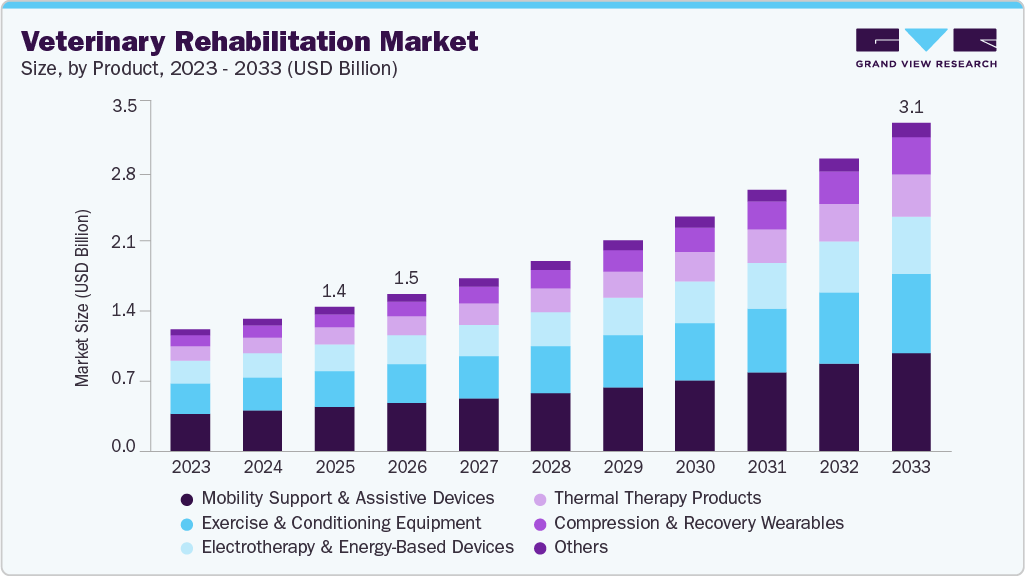
The global veterinary rehabilitation market size was estimated at USD 1.4 billion in 2025 and is projected to reach USD 3.1 billion by 2033, growing at a CAGR of 11.1% from 2026 to 2033. The market is growing due to the rising incidence of mobility issues, injuries, and chronic conditions such as osteoarthritis in companion and production animals.
Key Market Trends & Insights
- North America dominated the global veterinary rehabilitation market with the largest revenue share of 35.9% in 2025.
- The veterinary rehabilitation industry in the U.S. accounted for the largest market revenue share in North America in 2025.
- By product, the mobility support & assistive devices segment led the market with the largest revenue share of 30.8% in 2025.
- By animal, the companion segment accounted for the largest market revenue share in 2025.
- By indication, the post-surgery segment accounted for the largest market revenue share in 2025.
Market Size & Forecast
- 2025 Market Size: USD 1.4 Billion
- 2033 Projected Market Size: USD 3.1 Billion
- CAGR (2026-2033): 11.1%
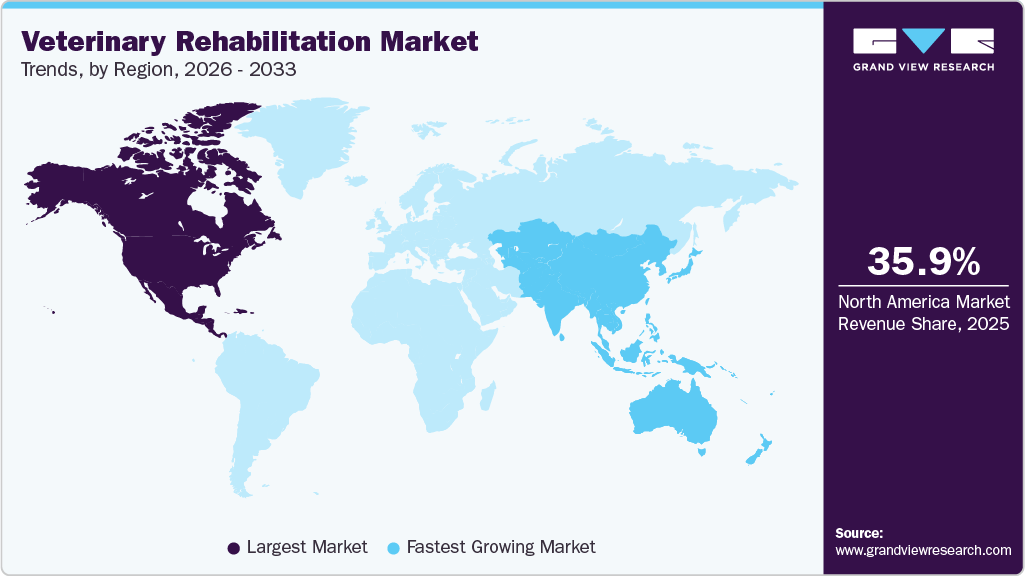
- North America: Largest market in 2025
- Asia Pacific: Fastest growing market
Increasing pet humanization is encouraging owners to spend more on advanced recovery therapies, such as physiotherapy and hydrotherapy. In addition, a higher number of surgical procedures in animals is driving demand for post-operative rehabilitation products and services.Technological advancements and increasing adoption of advanced, non-invasive treatment solutions are crucial factors driving the global market. As pet owners and veterinarians increasingly prefer therapies that offer faster recovery, reduced pain, and minimal side effects, the demand for innovative rehabilitation devices continues to rise. In addition, the growing focus on improving clinical outcomes and expanding treatment capabilities within a single platform is further accelerating market expansion.
For instance, in February 2025, Fotonmedix’s Vetmedix high-power veterinary laser received certification from the U.S. Food and Drug Administration, which highlights a significant technological milestone. The device’s ability to combine laser surgery and rehabilitation therapy, along with features such as deeper tissue penetration and multi-condition treatment, enhances its clinical utility and adoption across veterinary practices. Such innovations improve treatment efficiency and strengthen global market penetration, thereby contributing to the overall market growth.
Moreover, rising innovation in veterinary orthopedic procedures and the growing demand for more precise, effective surgical outcomes further contribute to the market growth. As veterinarians increasingly seek advanced tools that improve surgical accuracy, reduce complications, and enhance post-operative recovery, the adoption of specialized implants and instruments continues to grow, ultimately supporting better rehabilitation outcomes and faster animal recovery.
For instance, according to an article published by AO Foundation, in March 2024, innovations by AO VET include advanced solutions such as anatomically contoured osteotomy plates, locking implant systems for small animals, and precision-guided surgical tools like screw targeting clamps. These technologies improve fracture management, enable treatment of complex orthopedic conditions, and enhance surgical efficiency. Such advancements increase the success rate of orthopedic procedures and drive the need for post-surgical rehabilitation services, thereby significantly contributing to the market growth.
In addition, the rising incidence of limb loss, injuries, and mobility impairments in dogs, along with increasing pet humanization and willingness to spend on advanced care, further supports the market growth. For instance, according to an article published by The Roch Society, in July 2025, innovations in canine prosthetics like OrthoPets and Bionic Pets are enabling customized solutions such as 3D-printed limbs and mobility aids that restore movement and improve quality of life. These advanced devices require proper fitting, follow-up care, and structured rehabilitation therapies, thereby increasing demand for veterinary rehab devices.
Market Concentration & Characteristics
The veterinary rehabilitation industry is characterized as highly fragmented,driven by the presence of numerous small-scale, regional, and local players that collectively contribute a significant share of product offerings. These participants often operate within limited geographic boundaries, catering to niche customer needs with specialized or cost-effective solutions. The absence of strong consolidation results in intense competition, varied pricing strategies, and inconsistent product standardization across regions.
The veterinary rehabilitation industry demonstrates a moderate to high degree of innovation, driven by continuous advancements in technologies such as laser therapy devices, mobility aids, and prosthetics. Companies are increasingly focusing on developing customized, non-invasive, and more effective rehabilitation solutions to improve treatment outcomes and recovery time, though innovation is often uneven due to the presence of many small players with limited R&D capabilities.
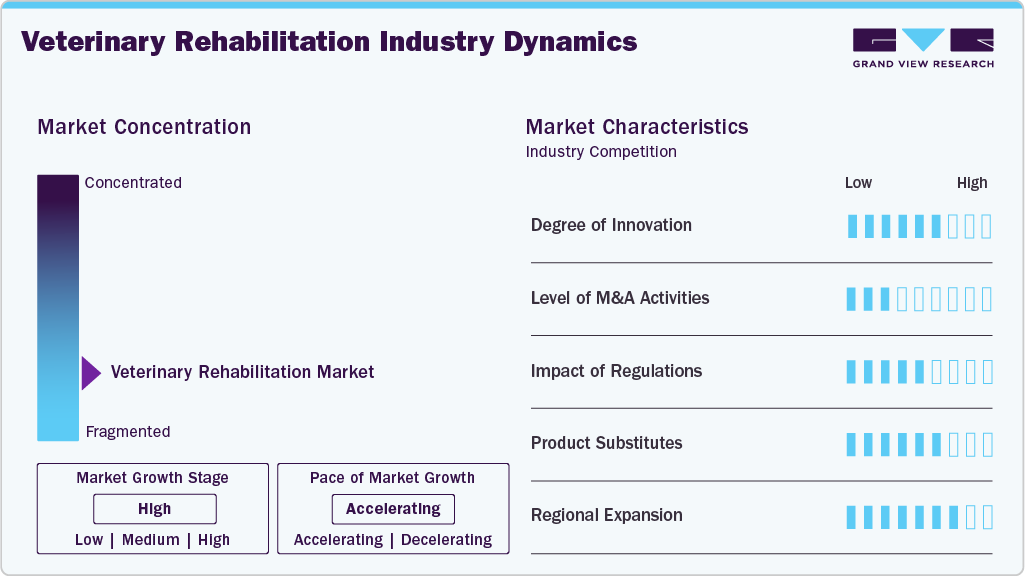
The level of mergers and acquisitions in the veterinary rehabilitation industry is relatively low to moderate, as the sector remains fragmented with a large number of regional and local participants. While some larger companies pursue strategic acquisitions to expand their product portfolios and geographic presence, overall consolidation is still in the early stages.
Regulatory impact on the veterinary rehabilitation industry is moderate, with standards and approvals required for medical devices and treatment procedures to ensure safety and efficacy. Compliance with regulations, especially in developed regions, can influence product development timelines and market entry, but it also enhances credibility and adoption of advanced rehabilitation solutions.
The threat of product substitutes in the veterinary rehabilitation industry is moderate, as alternatives such as pain medications, traditional surgery without rehabilitation, or basic mobility aids can be used instead of advanced rehabilitation therapies. However, increasing awareness about long-term recovery benefits is gradually reducing reliance on these substitutes.
Regional expansion in the veterinary rehabilitation industry is steadily increasing, with companies focusing on entering emerging markets due to rising pet ownership and improving veterinary infrastructure. At the same time, developed regions continue to drive adoption through higher spending capacity and greater awareness, encouraging players to expand their global footprint.
Product Insights
The mobility support & assistive devices segment led the market with the largest revenue share of 30.8% in 2025. The growing demand for non-invasive, cost-effective treatment options for orthopedic conditions in pets is significantly driving the mobility support & assistive devices segment within the veterinary rehabilitation industry. For instance, the launch of custom dog knee braces by TailwindPets in June 2025 highlights how advanced orthotic solutions are enabling effective management of conditions such as ACL injuries, patellar luxation, and arthritis without the need for surgery. These customized braces improve mobility and reduce pain, support faster recovery, and prevent further injury, increasing their adoption among pet owners and veterinarians. As such, innovative, vet-recommended mobility aids gain traction, they are boosting the demand for assistive devices and contributing to the overall growth of this segment in the veterinary rehabilitation industry.
The compression & recovery wearables segment is anticipated to grow at the fastest CAGR over the forecast period. The increasing demand for cost-effective, easy-to-use wound care and support solutions in animal healthcare is driving the segment within the veterinary rehabilitation industry. For instance, products such as self-adhesive veterinary bandages offered by L WELL MEDTECH SOLUTIONS SDN. BHD. provide flexible support, compression, and protection for injuries, post-surgical recovery, and rehabilitation needs. Their features, such as elasticity, self-adhesion, and ease of application, make them highly suitable for both clinical and at-home care settings. As such, versatile and affordable assistive products gain wider adoption across veterinary clinics, equine care, and pet owners, they significantly contribute to the segment growth in the industry.
Animal Insights
The companion animals segment accounted for the largest market revenue share in 2025. The rising prevalence of chronic musculoskeletal conditions in companion animals is a major factor driving the segment growth. Osteoarthritis alone affects nearly 20-25% of the overall dog population, with prevalence rising to up to 80% in dogs over 8 years of age, indicating a significant burden among aging pets. In addition, joint disorders impact a large proportion of animals, with certain joints showing prevalence rates exceeding 50% in older dogs. Such widespread incidence of mobility-related conditions requires long-term management through physiotherapy, assistive devices, and rehabilitation programs rather than one-time treatments. As a result, the growing number of affected companion animals is significantly increasing demand for veterinary rehabilitation services, thereby driving segment growth.
The other animals segment is anticipated to grow at the fastest CAGR during the forecast period. Growing wildlife rescue efforts and increasing intervention in treating injured wild animals are driving the other animals segment in the veterinary rehabilitation industry. A significant number of wildlife species are affected by injuries caused by habitat destruction, vehicle collisions, and human-wildlife conflicts, leading to fractures, limb loss, and mobility impairments. These conditions require specialized rehabilitation care, including physiotherapy, assistive devices, and long-term recovery programs to restore function or improve survivability. Furthermore, the expansion of wildlife sanctuaries, rescue centers, and conservation programs is enabling greater adoption of advanced rehabilitation solutions. This rising need for structured care for non-companion animals is driving the steady growth of this segment.
Indication Insight
The post-surgery segment accounted for the largest market revenue share in 2025. The growing preference for non-invasive and technology-driven recovery solutions is significantly enhancing post-surgical care in the veterinary rehabilitation industry. Technologies from INDIBA Group, such as radiofrequency therapy and K-Laser treatments, play a crucial role in improving healing outcomes by reducing inflammation, relieving pain, and accelerating tissue repair after surgical procedures. These solutions help restore mobility, minimize scar tissue formation, and shorten recovery periods, making them highly valuable in post-operative care protocols. As veterinary practices increasingly adopt advanced therapies, the reliance on structured rehabilitation following surgeries continues to grow, strengthening this segment.
The acute & chronic diseases segment is anticipated to grow at the fastest CAGR during the forecast period. The growing incidence of both injury-related conditions and long-term degenerative disorders in animals is driving the segment growth. Conditions such as fractures, ligament tears, and post-surgical trauma require short-term rehabilitation for pain relief and functional recovery, while chronic disorders like osteoarthritis, neurological issues, and joint degeneration require continuous therapy and mobility support. With increasing animal lifespan and improved diagnostics, more cases are being identified and managed for longer periods. This ongoing need for both immediate and sustained care is significantly increasing the adoption of rehabilitation services, thereby accelerating growth in this segment.
End Use Insights
The veterinary rehab centers & hospitals segment accounted for the largest market revenue share in 2025. The expanding network of specialized veterinary rehabilitation centers and hospitals is playing a crucial role in advancing the veterinary rehabilitation industry. These facilities offer dedicated infrastructure, skilled professionals, and access to advanced therapies, including physiotherapy, hydrotherapy, laser treatment, and post-surgical care, enabling comprehensive recovery programs for animals. Their ability to provide continuous monitoring, customized treatment plans, and multidisciplinary care improves clinical outcomes and builds trust among pet owners. In addition, the increasing number of such centers, along with rising referrals from general veterinary clinics, is enhancing accessibility to rehabilitation services, thereby strengthening overall industry growth.
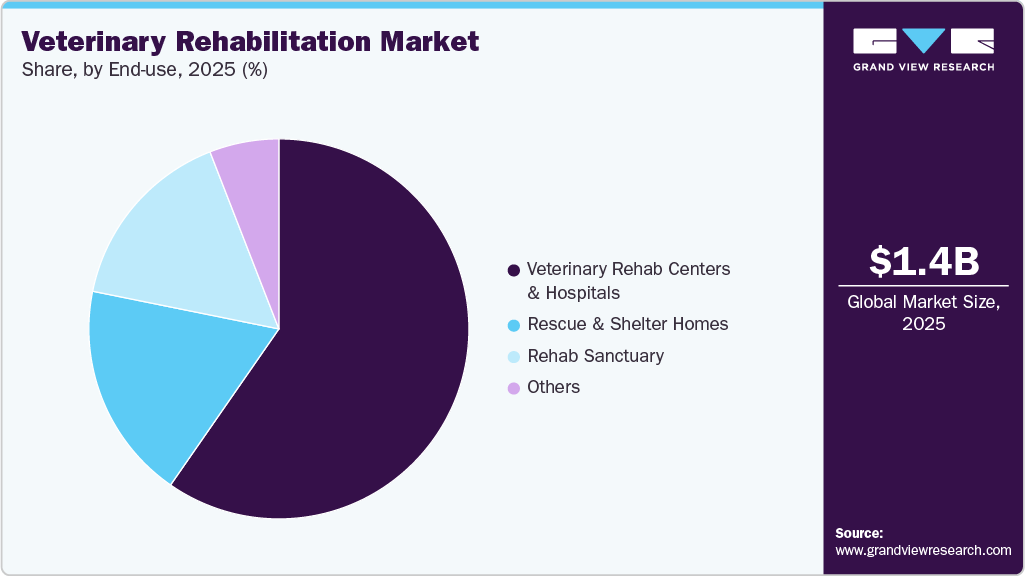
The rehab sanctuary segment is anticipated to grow at the fastest CAGR over the forecast period. Rehabilitation sanctuaries play a significant role in driving the global market by providing dedicated facilities for the long-term care and recovery of injured, disabled, or rescued animals. These sanctuaries often handle complex cases such as trauma, neurological disorders, and post-surgical recovery, creating consistent demand for advanced rehabilitation therapies, including physiotherapy, hydrotherapy, laser therapy, and mobility aids. Unlike standard veterinary clinics, rehab sanctuaries focus on continuous, specialized care, leading to greater use of rehabilitation equipment and skilled professionals.
Regional Insights
North America dominated the global veterinary rehabilitation market with the largest revenue share of 35.9% in 2025, due to its well-established veterinary infrastructure and high pet ownership rates. There is strong demand for advanced treatments such as hydrotherapy, laser therapy, and pain management. The increasing prevalence of chronic conditions like arthritis and obesity in pets is boosting rehabilitation needs. Pet owners are highly willing to spend on specialized and long-term care. In addition, continuous technological advancements are enhancing treatment effectiveness.
U.S. Veterinary Rehabilitation Market Trends
The veterinary rehabilitation market in the U.S. accounted for the largest market revenue share in North America in 2025, owing to the increasing awareness among pet owners in the United States regarding advanced mobility solutions for companion animals. For instance, according to an article published by Royal Canin SAS, in September 2025, the growing use of assistive devices such as braces, prosthetics, and wheelchairs enables effective management of orthopedic and neurological conditions, post-surgical recovery, and age-related mobility issues. In addition, the strong human-animal bond in the U.S. is encouraging higher spending on premium and specialized care, including customized rehabilitation programs and advanced diagnostics. With veterinarians actively recommending early mobility restoration and integrated rehabilitation approaches, the adoption of these solutions continues to rise, thereby supporting overall industry expansion in the region.
The Canada veterinary rehabilitation market is expected to grow at a significant CAGR during the forecast period. The rising number of injured and rescued wildlife cases is strengthening the demand for veterinary rehabilitation services across Canada. For instance, according to an article published by CTV News on February 02, 2026, a single wildlife rehabilitation facility recorded over 2,100 animal admissions in 2025, highlighting a significant increase in patient volume. Many of these animals require specialized, long-term care, including treatment for trauma, neurological issues, and recovery before release into the wild. This growing caseload, driven largely by human-wildlife interactions and increased awareness of rehabilitation facilities, is pushing the need for advanced rehabilitation therapies, infrastructure, and skilled professionals.
Europe Veterinary Rehabilitation Market Trends
The veterinary rehabilitation market in Europe is supported by strict animal welfare regulations and a strong culture of pet care. The increasing aging pet population is driving demand for rehabilitation and mobility-related treatments. Veterinary professionals are increasingly adopting advanced rehabilitation techniques. Public awareness about post-operative and chronic disease management is also rising. Moreover, the presence of established veterinary networks ensures wider accessibility to such services.
The UK veterinary rehabilitation market held a significant share in Europe in 2025. The improving emphasis on professional standards and qualified practitioners is supporting the growth of the industry in the country. For instance, according to an article published by National Association of Veterinary Physiotherapists in February 2026, the lack of formal regulation has led to the establishment of strict membership criteria, including advanced academic qualifications, continuous professional development, and adherence to ethical standards. This structured approach enhances trust among pet owners and veterinarians, encouraging greater adoption of veterinary physiotherapy for post-operative care, chronic condition management, and performance enhancement.
The veterinary rehabilitation market in Germany is growing significantly over the forecast period in Europe. The growing focus on specialized training and capacity-building in wildlife rehabilitation is driving the expansion of the veterinary rehabilitation industry in Germany. For instance, according to an article published by EUROWA on November 25, 2025, dedicated veterinarian specialist courses were conducted to train professionals in handling and rehabilitating oiled wildlife, covering critical areas such as clinical procedures, facility management, and emergency response. Such structured training programs enhance the skills and preparedness of veterinarians to manage complex wildlife cases, particularly during environmental emergencies.
Asia Pacific Veterinary Rehabilitation Market Trends
The veterinary rehabilitation market in the Asia Pacific is expected to grow at the fastest CAGR over the forecast period,due to rapid urbanization and rising disposable incomes. Increasing pet ownership and growing awareness of animal healthcare are key drivers. Veterinary infrastructure is expanding significantly in countries like China and India. There is also a shift toward preventive and rehabilitative care among pet owners. In addition, growing investments in veterinary services and training are accelerating market development.
The Australia veterinary rehabilitation market is expanding due to a rising number of wildlife injuries caused by bushfires, road accidents, and habitat destruction. There is an increasing focus by governments and institutions on strengthening wildlife care and rehabilitation infrastructure. Growing collaboration between veterinarians and rehabilitation centers is improving treatment outcomes. In addition, demand for specialized services such as physiotherapy and post-surgical recovery is increasing. This is further supported by rising awareness of animal welfare and conservation efforts.
The veterinary rehabilitation market in India is witnessing notable growth. The rising number of wildlife rescue and rehabilitation cases in India is significantly contributing to the growth of the veterinary rehabilitation industry, as highlighted in a Times of India article published on April 11, 2026. Increasing incidents such as road accidents, habitat encroachment, and human-animal conflicts are leading to a higher influx of injured animals requiring specialized care, including orthopedic treatment, wound management, and long-term rehabilitation. This growing caseload necessitates the expansion of dedicated wildlife rehab centers and drives the adoption of mobility aids, physiotherapy, and post-trauma care solutions, thereby strengthening the overall veterinary rehabilitation ecosystem in India.
Latin America Veterinary Rehabilitation Market Trends
The veterinary rehabilitation market in Latin America is growing steadily due to the rising adoption of companion animals and increasing awareness of advanced animal healthcare. Improving economic conditions in key countries are enabling higher spending on veterinary services, including post-injury and post-surgical rehabilitation. The expansion of veterinary clinics and specialty care centers is enhancing access to rehabilitation therapies. In addition, growing emphasis on livestock health and productivity is supporting the use of rehabilitation in farm animals. Increasing educational initiatives and professional training in veterinary care are further strengthening market growth across the region.
The Brazil veterinary rehabilitation market is gaining momentum, driven by the rapid increase in pet ownership and improving access to veterinary services. The rising middle-class population is contributing to higher spending on animal healthcare, including rehabilitation therapies. There is also growing awareness of preventive and post-injury care among pet owners. Expansion of veterinary clinics in urban areas is enabling better service availability. Furthermore, livestock rehabilitation is gaining attention in commercial farming to enhance productivity.
Middle East & Africa Veterinary Rehabilitation Market Trends
The veterinary rehabilitation market in the Middle East & Africa is witnessing gradual growth driven by improving awareness of animal health and welfare. Investments in veterinary infrastructure are increasing, particularly in urban centers. Governments and NGOs are promoting better animal care practices and supporting rehabilitation services. The rise in companion animal ownership is also contributing to demand. However, growth remains uneven due to limited access to advanced veterinary facilities in rural areas.
The South Africa veterinary rehabilitation market is gradually expanding due to increasing awareness of animal welfare and the growing importance of advanced veterinary care. Rising pet ownership, particularly in urban areas, is driving demand for specialized services such as physiotherapy and post-surgical rehabilitation. The presence of wildlife reserves and conservation programs is also contributing to the need for rehabilitation services for injured wild animals. In addition, improving veterinary infrastructure and training are supporting the adoption of modern treatment techniques. However, market growth is moderated by limited access to specialized services in rural regions.
The veterinary rehabilitation market in the UAE is growing due to high disposable incomes and increasing demand for premium pet care services. Pet humanization trends are encouraging owners to opt for advanced treatments, including rehabilitation therapies. The presence of modern veterinary facilities and specialty clinics supports market expansion. In addition, the rising adoption of exotic pets is creating demand for specialized rehabilitation services. Government initiatives promoting animal welfare are also contributing to growth.
Key Veterinary Rehabilitation Company Insights
The veterinary rehabilitation industry is highly fragmented, characterized by the presence of numerous small clinics, specialized rehabilitation centers, and large veterinary service providers. Key competitive factors include the growing adoption of advanced rehabilitation therapies and increasing demand for post-operative and chronic care services. In addition, to strengthen their market position and expand service offerings, major players are actively engaging in strategies such as partnerships, facility expansions, service innovation, and the introduction of advanced rehabilitation technologies.
Key Veterinary Rehabilitation Companies:
The following key companies have been profiled for this study on the veterinary rehabilitation market.
- H2O For Fitness
- Multi Radiance Medical
- Kalstein
- Wontech
- OrthoPets, LLC
- Dynasplint Systems
- Walkin' Pets
- Hydro Physio
- Doggon Wheels
- Bionic Pets
Recent Developments
-
In 2026, Fotonmedix Semiconductor Technology received FDA certification for its Vetmedix high-power veterinary laser device, enabling entry into the North American market and strengthening its global footprint. This initiative accelerates the adoption of advanced laser-based rehabilitation technologies, enhances treatment capabilities, and increases competition in the global veterinary rehabilitation industry.
-
In May 2024, WIMBA partnered with Intrauma S.p.A. to leverage HP 3D printing technology for developing custom veterinary orthotics and prosthetics, enhancing precision and treatment outcomes in animal care. This collaboration accelerates the adoption of advanced, patient-specific rehabilitation solutions, improves mobility outcomes, and strengthens innovation-driven competition in the global market.
-
In November 2024, Paw Prosper acquired K9 Mobility to strengthen its presence in Europe through a dedicated E-commerce platform. This acquisition will help consumers with easy access, leading to increased adoption of pet mobility aids.
Veterinary Rehabilitation Market Report Scope
Report Attribute
Details
Market size value in 2026
USD 1.5 billion
Revenue forecast in 2033
USD 3.1 billion
Growth rate
CAGR of 11.1% from 2026 to 2033
Base year for estimation
2025
Historical data
2021 - 2024
Forecast period
2026 - 2033
Quantitative units
Revenue in USD million/billion and CAGR from 2026 to 2033
Report coverage
Revenue forecast, company ranking, competitive landscape, growth factors, and trends
Segments covered
Product, animal, indication, end use, regional
Regional scope
North America; Europe; Asia Pacific; Latin America; MEA
Country scope
U.S.; Canada; Mexico; UK; Germany; France; Italy; Spain; Denmark; Sweden; Norway; Japan; China; India; Thailand; South Korea; Australia; Brazil; Argentina; South Africa; UAE; Saudi Arabia; Kuwait; Qatar; Oman
Key companies profiled
H2O For Fitness; Multi Radiance Medical; Kalstein; Wontech; OrthoPets, LLC; Dynasplint Systems; Walkin' Pets; Hydro Physio; Doggon Wheels; Bionic Pets
Customization scope
Free report customization (equivalent up to 8 analysts working days) with purchase. Addition or alteration to country, regional & segment scope.
Pricing and purchase options
Avail customized purchase options to meet your exact research needs. Explore purchase options
Global Veterinary Rehabilitation Market Report Segmentation
This report forecasts revenue growth at global, regional, and country levels and provides an analysis of the latest industry trends in each of the sub-segments from 2021 to 2033. For this study, Grand View Research has segmented the global veterinary rehabilitation market report based on product, animal, indication, end use, and region.
-
Product Outlook (Revenue, USD Million, 2021 - 2033)
-
Mobility Support & Assistive Devices
-
Orthopedic Braces
-
Prosthetic Limbs and Orthotic Supports
-
Mobility Carts/ Wheelchairs
-
Others
-
-
Exercise & Conditioning Equipment
-
Electrotherapy & Energy-Based Devices
-
Electrotherapy Devices
-
Laser Therapy Devices
-
Others
-
-
Thermal Therapy Products
-
Compression & Recovery Wearables
-
Compression Bandages And Wraps
-
Recovery Sleeves
-
Support Wraps
-
Post-Surgical Compression Garments
-
Others
-
-
Others
-
-
Animal Outlook (Revenue, USD Million, 2021 - 2033)
-
Production Animals
-
Companion Animals
-
Other Animals
-
-
Indication Outlook (Revenue, USD Million, 2021 - 2033)
-
Post-Surgery
-
Traumatic Injuries
-
Acute & Chronic Diseases
-
Developmental Abnormality
-
Other Indications
-
-
End Use Outlook (Revenue, USD Million, 2021 - 2033)
-
Veterinary Rehab Centers & Hospitals
-
Rescue & Shelter Homes
-
Rehab Sanctuary
-
Others
-
-
Region Outlook (Revenue, USD Million, 2021 - 2033)
-
North America
-
U.S.
-
Canada
-
Mexico
-
-
Europe
-
UK
-
Germany
-
France
-
Italy
-
Spain
-
Denmark
-
Sweden
-
Norway
-
-
Asia Pacific
-
Japan
-
China
-
India
-
Australia
-
Thailand
-
South Korea
-
-
Latin America
-
Brazil
-
Argentina
-
-
Middle East & Africa
-
South Africa
-
UAE
-
Saudi Arabia
-
Kuwait
-
Qatar
-
Oman
-
-
Frequently Asked Questions About This Report
b. The global veterinary rehabilitation market size was estimated at USD 1.4 billion in 2025 and is expected to reach USD 1.5 billion in 2026.
b. The global veterinary rehabilitation market is expected to grow at a compound annual growth rate of 11.1% from 2026 to 2033 to reach USD 3.1 billion by 2033.
b. North America dominated the veterinary rehabilitation market with a share of 35.9% in 2025. This is attributable to its well-established veterinary infrastructure and high pet ownership rates.
b. Some key players operating in the veterinary rehabilitation market include H2O For Fitness, Multi Radiance Medical, Kalstein, Wontech, OrthoPets, LLC, Dynasplint Systems, Walkin' Pets, Hydro Physio, Doggon Wheels, Bionic Pets
b. Key factors that are driving the market growth include growing pet humanization, increasing pet expenditure, rising incidence of mobility issues, injuries, and chronic conditions such as osteoarthritis in companion and production animals.


Share this report with your colleague or friend.
Need a Tailored Report?
Customize this report to your needs — add regions, segments, or data points, with 20% free customization.


ISO 9001:2015 & 27001:2022 Certified
We are GDPR and CCPA compliant! Your transaction & personal information is safe and secure. For more details, please read our privacy policy.
Trusted market insights - try a free sample
See how our reports are structured and why industry leaders rely on Grand View Research. Get a free sample or ask us to tailor this report to your needs.













