
- Home
- »
- Advanced Interior Materials
- »
-
Waste Management Equipment Market Size Report 2026-2033GVR Report cover

Waste Management Equipment Market (2026 - 2033) Size, Share & Trends Analysis Report By Equipment (Collection & Transportation Machinery, Sorting Equipment, Recycling Machinery), By Category (Hazardous, Non-Hazardous), By Waste, By Automation Level, By Region And Segment Forecasts
Market Size, 2025
$27.3BMarket Estimate, 2026
$28.9BMarket Forecast, 2033
$44.8BCAGR, 2026–2033
6.5%Waste Management Equipment Market Summary
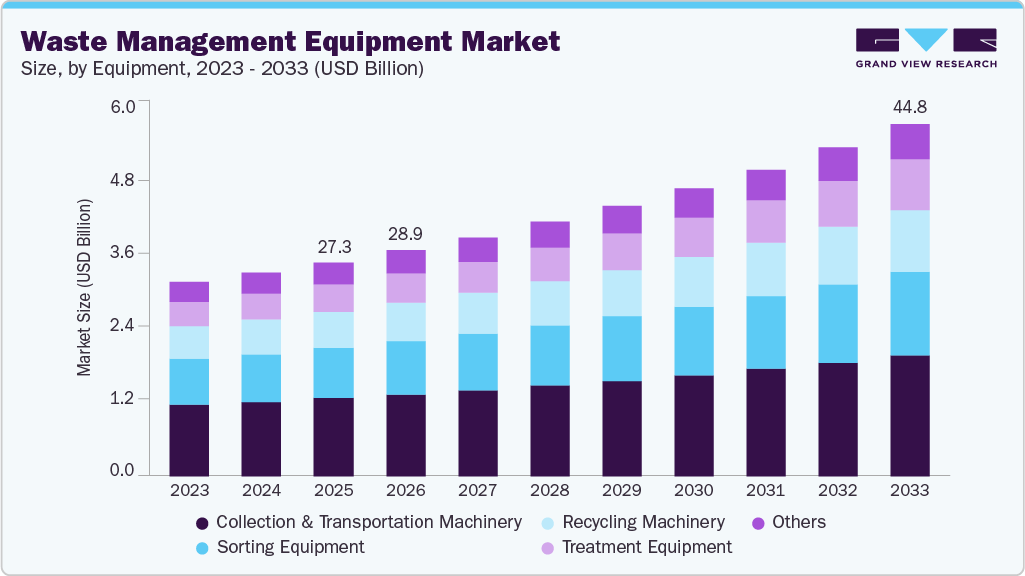
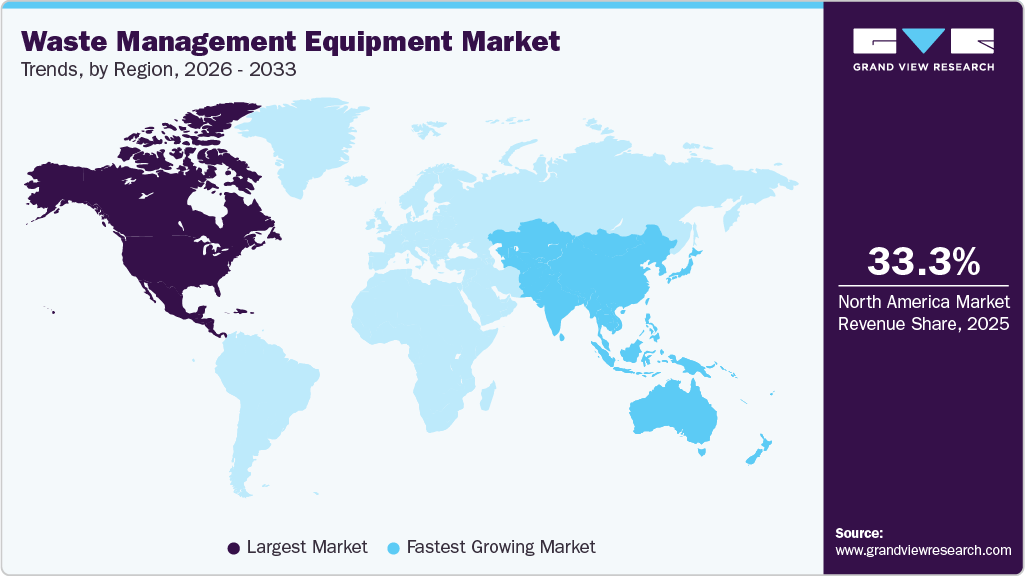
The global waste management equipment market size was valued at USD 27.3 billion in 2025 and is projected to grow from USD 28.9 billion in 2026 to USD 44.8 billion by 2033, at a CAGR of 6.5% from 2026 to 2033. North America held the dominating position in the global waste management equipment market with 33.3% share in 2025.
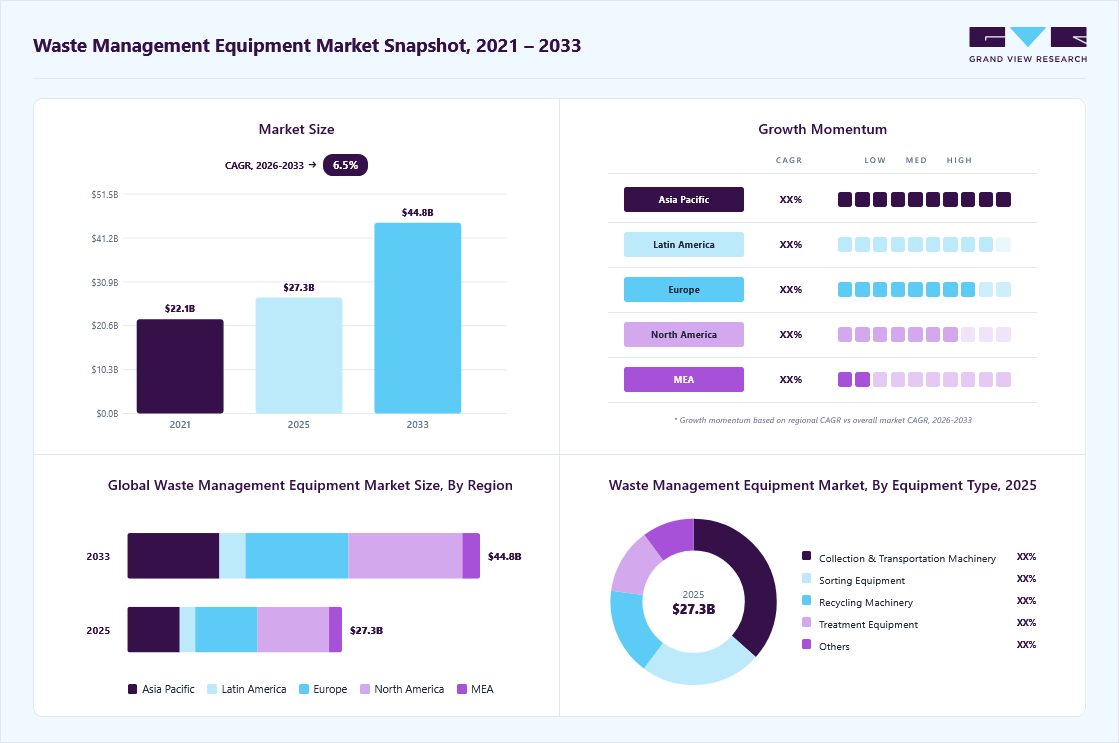 Source: Grand View Research, IR Documents, Primary Interviews, Paid DatabasesTo learn more about this report,
 Download Free Sample Report
Key Market Trends & Insights
- By equipment: collection and transportation machinery accounted for the largest share of 36.5% in the waste management equipment market in 2025.
- By category: the non-hazardous category accounted for the largest share of 84.6% in the waste management equipment industry in 2025.
- By waste: municipal solid waste accounted for the largest share of 52.3% in 2025.
- By automation level: semi-automatic systems accounted for the largest share of the global market.
Regional Highlights
- Largest regional market: North America (33.3% revenue share, 2025)
- Fastest-growing regional market: Asia Pacific (highest CAGR, 2026-2033)
- By country: The U.S. held the largest market share in 2025.
Market Size & Forecast
- Market size in 2025: USD 27.3 Billion
- Estimated market size in 2026: USD 28.9 Billion
- Projected market size by 2033: USD 44.8 Billion
- CAGR (2026-2033): 6.5%
Prism AI by Grand View Research Free to tryAsk a question about the waste management equipment marketTry asking✓Every figure cited from GVR research Prefer the report? Download free sample →Rising volumes of municipal solid waste, construction debris, and industrial by-products are putting pressure on governments and private players to adopt efficient waste handling and processing solutions. Another key driver is the growing adoption of automation and smart technologies in waste management operations. The shift toward fully automated, sensor-based systems is improving operational efficiency, reducing labor dependency, and increasing recycling rates. Innovations in AI-driven sorting, robotics, and digital monitoring systems are transforming traditional waste processing methods. Further, the waste management equipment market is driven by the rapid increase in global municipal solid waste generation. According to the United Nations Environment Programme, waste volumes are projected to rise from 2.1 billion tons in 2023 to 3.8 billion tons by 2050, creating significant demand for efficient collection, sorting, and treatment equipment.
 To learn more about this report, Download Free Sample Report
Market Dynamics
The waste management equipment market is driven by the ongoing increase in global waste generation, resulting from rapid urbanization, industrial expansion, and changing consumer lifestyles. Growing populations and rising consumption levels are creating significant pressure on municipalities and industries to handle larger waste volumes efficiently and sustainably. This is increasing demand for advanced waste management equipment such as compactors, shredders, automated sorting systems, recycling machinery, and waste treatment technologies.
Governments are also implementing stricter environmental regulations and sustainability targets to reduce landfill waste and improve recycling rates. These factors are encouraging investments in modern waste processing infrastructure, supporting strong demand for efficient and technologically advanced waste management equipment globally.
High capital investment and operational costs are major restraints in the waste management equipment market. Advanced waste processing systems such as automated sorting equipment, recycling machinery, waste-to-energy technologies, and treatment plants require substantial initial investment for installation and infrastructure development. In addition, ongoing maintenance, energy consumption, equipment upgrades, and skilled labor requirements increase operational expenses over time.
Small municipalities and waste management companies often face budget limitations that restrict adoption of advanced equipment. Fluctuating raw material and fuel costs can further impact profitability and operating efficiency. These financial challenges can slow modernization of waste management infrastructure, particularly in developing and cost-sensitive regional markets.
Market Concentration & Characteristics
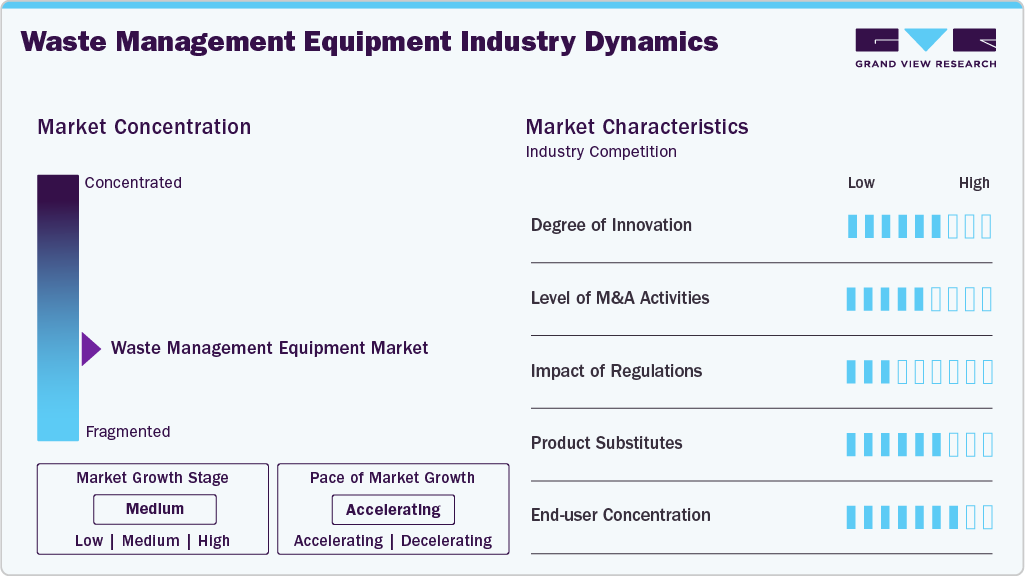
The waste management equipment market is fragmented, characterized by the presence of numerous global and regional players operating across different equipment categories. The market includes a mix of large manufacturers with broad product portfolios and smaller, specialized companies focused on specific solutions, such as sorting, recycling, or treatment equipment. Variations in wastes, regional regulations, and infrastructure development levels further contribute to the fragmented nature of the market by encouraging local participation.
The industry is experiencing a strong wave of innovation driven by the need for higher efficiency, automation, and sustainability. Advanced technologies such as AI-based sorting systems, robotics, IoT-enabled monitoring, and waste-to-energy solutions are transforming traditional waste handling processes. Manufacturers are increasingly focusing on developing high-performance, energy-efficient, and automated equipment to improve recovery rates and reduce operational costs.
 To learn more about this report, Download Free Sample Report
Regulatory frameworks play a critical role in shaping the market. Governments across regions are implementing stringent environmental laws, waste segregation mandates, and recycling targets to reduce landfill dependency and environmental impact. Policies promoting extended producer responsibility (EPR), emission control, and sustainable waste disposal are driving the adoption of advanced treatment and recycling equipment.
The market exhibits a diversified end-user base, with demand coming from municipalities, industrial sectors, healthcare facilities, and construction activities. Municipal bodies represent a major share due to the continuous generation of household waste and the need for organized waste collection and processing systems. At the same time, industries and commercial establishments are increasingly investing in dedicated waste management equipment to comply with environmental norms and improve operational efficiency.
Equipment Insights
Collection and transportation machinery accounted for the largest share of 36.5% in the waste management equipment market in 2025, driven by its essential role in the waste management value chain. Equipment such as garbage trucks, compactors, and loaders was widely adopted by municipalities and private operators to ensure efficient waste collection and logistics. The dominance of this segment was supported by the increasing volume of municipal solid waste and the need for reliable and scalable collection infrastructure across urban and semi-urban areas.
Treatment equipment is expected to witness the fastest growth due to the rising focus on sustainable waste processing and disposal. Technologies such as waste-to-energy systems, incinerators, anaerobic digesters, and advanced composting solutions are gaining traction as governments and industries aim to reduce reliance on landfills and their associated environmental impacts. Increasing regulatory pressure, along with growing adoption of circular economy practices, is driving demand for efficient treatment solutions.
Category Insights
The non-hazardous category accounted for the largest share of 84.6% in the waste management equipment industry in 2025, primarily due to the high volume of everyday waste generated from households, commercial establishments, and general industrial activities. Municipal solid waste formed a significant portion of this segment, driving consistent demand for collection, sorting, and recycling equipment. The widespread need for routine waste handling infrastructure across urban areas, along with ongoing municipal investments, supported the dominance of non-hazardous waste equipment.
The hazardous waste segment is expected to grow at the fastest rate of 7.8% over the forecast period, driven by increasing regulatory scrutiny and rising awareness of safe disposal of toxic and industrial waste. Industries such as chemicals, pharmaceuticals, and healthcare are generating higher volumes of hazardous waste, necessitating specialized treatment and handling equipment. Stringent environmental and safety regulations are pushing organizations to adopt advanced technologies for proper disposal and contamination control, thereby accelerating the growth of this segment.
Waste Insights
Municipal solid waste (MSW) accounted for the largest share of 52.3% in 2025, driven by the ongoing generation of household and commercial waste across urban and semi-urban areas. The increasing population, rapid urbanization, and changing consumption patterns significantly contributed to the rising volume of MSW, creating strong demand for collection, transportation, and sorting equipment. Municipal authorities remained the primary end users, investing in efficient waste handling infrastructure to manage daily waste streams, thereby supporting the segment’s dominance.
E-waste is expected to witness the fastest growth due to the rapid increase in the consumption and disposal of electronic devices such as smartphones, computers, and household appliances. The growing awareness of environmental hazards associated with improper e-waste disposal, along with stringent regulations promoting recycling and safe handling, is driving demand for specialized recycling and recovery equipment. Additionally, the rising focus on recovering valuable materials such as metals and components from electronic waste is further accelerating the growth of this segment.
Automation Level Insights
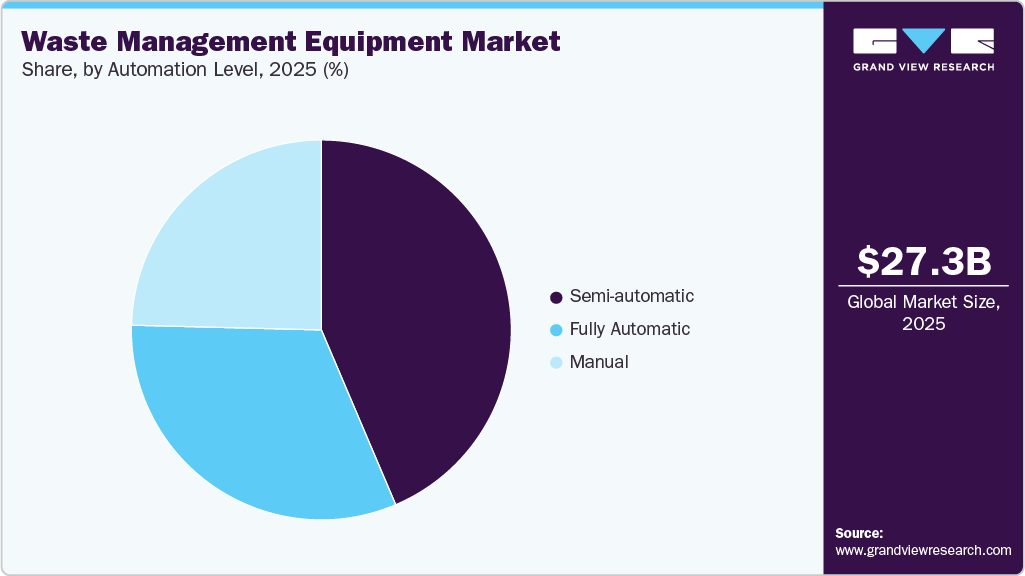
Semi-automatic systems accounted for the largest share of the global market, as they offer a balanced combination of cost efficiency and operational performance. These systems are widely adopted across municipalities and small to mid-scale facilities where full automation is not economically feasible. Semi-automatic equipment enables partial mechanization while still requiring manual intervention, making it suitable for regions with moderate budgets and labor availability. The equipment’s flexibility and lower initial investment helped the segment maintain its dominant position in 2025.
 To learn more about this report, Download Free Sample Report
Fully automatic systems are expected to witness the fastest growth at a CAGR of 7.1% due to increasing demand for higher efficiency, accuracy, and reduced human intervention. Advanced technologies such as AI-based sorting, robotics, and smart monitoring systems are driving the adoption of fully automated waste management solutions. These systems enhance processing speed, improve recycling rates, and reduce operational costs over time. Growing labor constraints, along with the need for scalable, sustainable waste-processing infrastructure, are further accelerating the shift toward fully automated equipment.
Regional Insights
The waste management equipment industry in North America held the largest share of the global market, supported by well-established waste management infrastructure and early adoption of advanced technologies. Strong regulatory enforcement, high awareness of recycling and sustainability, and significant investments in automated waste-processing systems have driven demand across the region. The presence of organized municipal systems and private sector participation has further strengthened the deployment of efficient collection, sorting, and treatment equipment.
 To learn more about this report, Download Free Sample Report
U.S. Waste Management Equipment Market Trends
The U.S. waste management equipment industry is supported by its advanced infrastructure and high waste generation levels. The country continues to invest in modern collection, recycling, and treatment systems to improve efficiency and sustainability. According to the United States Environmental Protection Agency, as of September 2025, there were 2,639 municipal solid waste (MSW) landfills across the country. The presence of such extensive waste management infrastructure highlights the strong demand for collection, sorting, and treatment equipment. Ongoing modernization efforts and increasing focus on recycling and automation are further supporting market growth.
The Canada waste management equipment industry is expected to witness steady growth during the forecast period, driven by increasing environmental awareness and government initiatives promoting sustainable waste practices. The country is focusing on increasing recycling rates, reducing reliance on landfills, and implementing extended producer responsibility programs. Investments in modern waste processing infrastructure and the adoption of advanced equipment for sorting and treatment are gradually increasing.
Europe Waste Management Equipment Market Trends
The waste management equipment industry in Europe is driven by its strong focus on sustainability, circular economy practices, and stringent environmental regulations. The region continues to emphasize recycling, waste reduction, and energy recovery, leading to consistent demand for advanced sorting and treatment equipment. Ongoing technological advancements and policy support for reducing landfill usage are further supporting market expansion.
The Germany waste management equipment industry led the European market due to its highly advanced recycling infrastructure and strong regulatory framework. According to the European Environment Agency, the country generated around 606 kg of municipal waste per capita in 2022, significantly above the EU average, highlighting the need for efficient waste management systems. At the same time, Germany achieved a recycling rate of about 69%, with landfill usage below 1%, indicating a strong shift toward recovery and treatment technologies. These factors continue to drive demand for advanced sorting, recycling, and treatment equipment across the country.
The waste management equipment industry in the UK is expected to witness steady growth in the market during the forecast period, driven by increasing regulatory focus on waste reduction and recycling targets. The country is actively transitioning toward a circular economy, with policies that encourage waste segregation, resource recovery, and reduced reliance on landfills. Rising investments in modern recycling facilities and waste treatment infrastructure are supporting the adoption of advanced equipment.
Asia Pacific Waste Management Equipment Market Trends
The waste management equipment industry in the Asia Pacific is expected to witness the fastest growth due to rapid urbanization, population expansion, and increasing industrial activities. Rising waste generation, coupled with improving regulatory frameworks and government initiatives to modernize waste management systems, is accelerating the adoption of advanced equipment. Emerging economies are investing heavily in infrastructure development and smart city projects, creating strong demand for efficient and scalable waste management solutions.
The China waste management equipment industry held the largest share in the Asia Pacific, driven by its massive urban population and high waste generation levels. The country has been actively strengthening its waste management infrastructure through large-scale investments in waste-to-energy plants, recycling facilities, and automated sorting systems. Government policies promoting waste segregation, circular economy practices, and the reduction of landfill usage have accelerated the adoption of advanced equipment.
The waste management equipment industry in India is expected to grow at the fastest pace during the forecast period, driven by rising waste generation and a stronger regulatory focus on waste management. According to a 2023 report by the Energy and Resources Institute, India generates over 62 million tonnes of waste annually. Out of this, only 43 million tonnes are collected, with around 12 million tonnes treated, while nearly 31 million tonnes are disposed of in landfills or open dump sites. This significant gap in collection and treatment infrastructure is driving strong demand for modern waste management equipment.
Middle East & Africa Waste Management Equipment Market Trends
The waste management equipment industry in the Middle East & Africa region is showing developing growth, driven by increasing infrastructure development and a growing focus on sustainable waste management practices. Rapid urban expansion and tourism-related waste generation in certain countries are driving demand for improved waste-handling systems. While the market is still in a relatively early stage, government initiatives and investments in modern waste treatment and recycling facilities are expected to support steady growth over the forecast period.
The Saudi Arabia waste management equipment industry led the market in the Middle East & Africa region, driven by rapid urbanization, population growth, and increasing waste generation. The country is actively investing in modern waste management infrastructure under national sustainability initiatives, with a strong focus on reducing landfill dependency and increasing recycling rates. Government programs aligned with Vision 2030 are promoting the development of advanced waste treatment facilities, waste-to-energy projects, and efficient collection systems.
Latin America Waste Management Equipment Market Trends
The waste management equipment industry in Latin America is witnessing gradual growth in the market, supported by increasing urbanization and rising awareness of environmental issues. Governments in the region are taking steps to improve waste collection and recycling infrastructure, although challenges related to funding and informal waste systems persist. Investments in modernization and public-private partnerships are expected to drive future demand for waste management equipment.
The Brazil waste management equipment industry accounted for the largest share of the market in Latin America, driven by rising urbanization and increasing municipal waste generation. The country has been gradually strengthening its waste management framework through national solid waste policies that emphasize proper disposal, recycling, and landfill reduction. Growing investments in waste collection systems, material recovery facilities, and treatment infrastructure are supporting the adoption of modern equipment.
Key Waste Management Equipment Company Insights
Some of the key players operating in the market include TOMRA Systems ASA, ANDRITZ AG, and Terex Corporation.
-
TOMRA Systems ASA is a Norway-based company that develops technology solutions for efficient waste collection and material sorting. Founded in 1972, it is well known for its reverse vending systems and sensor-based sorting equipment used in recycling operations. The company’s solutions help improve recovery rates, reduce waste, and support sustainable resource use across industries such as recycling, food processing, and mining. With operations across multiple countries, TOMRA plays an important role in advancing modern, technology-driven waste management practices.
-
ANDRITZ AG is an Austria-based international technology group that delivers industrial equipment and process solutions across sectors such as pulp and paper, metals, hydropower, and environmental systems. Established in 1852 and headquartered in Graz, the company also provides equipment for recycling and waste processing, including separation and resource recovery technologies. Its solutions are designed to improve operational efficiency and support sustainable practices. With a strong global presence and operations in numerous countries, ANDRITZ plays a key role in advancing environmentally focused industrial technologies.
Key Waste Management Equipment Companies:
The following key companies have been profiled for this study on the waste management equipment market.
- Wastequip LLC
- TOMRA Systems ASA
- CP Manufacturing Inc.
- Bollegraaf Recycling Solutions
- Recycling Equipment Manufacturing Inc. (REM)
- Sierra International Machinery, LLC
- Hitachi Zosen Corporation
- Morita Holdings Corporation
- Babcock & Wilcox Enterprises, Inc.
- ANDRITZ AG
- Terex Corporation
- EcoGreen Equipment
- TANA Oy
- Machinex Industries Inc.
- FORNNAX TECHNOLOGY PVT LTD
Competitive Benchmarking
Operating Strategies
Competitive Edge
Weaknesses
Mature Players: TOMRA Systems ASA; Hitachi Zosen Corporation; ANDRITZ AG; Terex Corporation; Babcock & Wilcox Enterprises, Inc.
- These companies focus on expanding advanced waste processing and recycling equipment portfolios while strengthening global distribution and service networks.
- They invest in automated sorting technologies, waste-to-energy systems, shredders, compactors, and recycling machinery to improve operational efficiency and waste recovery rates.
- These companies benefit from advanced waste processing technologies, strong engineering expertise, and broad equipment portfolios covering recycling, waste treatment, and material recovery applications.
- Their global manufacturing capabilities, established customer relationships, and extensive after-sales service networks strengthen market presence across municipal and industrial waste management sectors.
- These companies often face high manufacturing, installation, and operational costs associated with advanced waste management equipment and large-scale processing systems.
- Dependence on government infrastructure spending, municipal budgets, and industrial investment cycles can expose companies to fluctuations in project demand.
Emerging Players: EcoGreen Equipment; FORNNAX TECHNOLOGY PVT LTD; Machinex Industries Inc.; TANA Oy; CP Manufacturing Inc.
- These players focus on cost-effective waste processing equipment, regional market expansion, and customized recycling solutions for municipal and industrial customers.
- Many companies strengthen local distributor partnerships and target niche applications such as tire recycling, metal shredding, and compact waste treatment systems.
- These players benefit from lower manufacturing costs, flexible operations, and ability to provide customized waste management equipment for regional customer requirements.
- Competitive pricing strategies help them target small municipalities, recycling facilities, and industrial waste operators with limited budgets.
- These players often face limitations related to smaller manufacturing capacity, lower brand recognition, and limited access to advanced waste processing technologies.
- Restricted research and development resources can slow innovation and reduce competitiveness in automated and high-capacity waste management systems.
Recent Developments
-
In October 2025, Fornnax launched the R-Max3300 fine shredder, designed to efficiently process low-density waste streams such as municipal solid waste (MSW), commercial and industrial waste, and bulky materials. The equipment enhances material size reduction, improves downstream recycling efficiency, and supports advanced waste processing operations across recycling and resource recovery facilities.
-
In August 2025, Declaration Partners invested in CP Group to support its expansion in recycling and sorting technologies. The funding will be used to enhance engineering capabilities and drive innovation. It also aims to advance automation and AI-based sorting solutions. The move is expected to strengthen CP Group’s presence in waste processing equipment.
Waste Management Equipment Market Report Scope
Report Attribute
Details
Market size in 2025
USD 27.3 Billion
Estimated Market size in 2026
USD 28.9 billion
Projected Market size by 2033
USD 44.8 billion
Growth rate
CAGR of 6.5% from 2026 to 2033
Base year
2025
Historical data
2021 - 2024
Forecast period
2026 - 2033
Quantitative units
Revenue in USD million/billion and CAGR from 2026 to 2033
Report coverage
Revenue forecast, company ranking, competitive landscape, growth factors, and trends
Segments covered
Equipment, category, waste, automation level, region
Regional scope
North America; Europe; Asia Pacific; Latin America; Middle East & Africa
Country scope
U.S.; Canada; Mexico; UK; Germany; France; Spain; Italy; China; Japan; India; Australia; South Korea; Brazil; Argentina; Saudi Arabia; South Africa; UAE
Key companies profiled
Wastequip LLC; TOMRA Systems ASA; CP Manufacturing Inc.; Bollegraaf Recycling Solutions; Recycling Equipment Manufacturing Inc. (REM); Sierra International Machinery, LLC; Hitachi Zosen Corporation; Morita Holdings Corporation; Babcock & Wilcox Enterprises, Inc.; ANDRITZ AG; Terex Corporation; EcoGreen Equipment; TANA Oy; Machinex Industries Inc.; FORNNAX TECHNOLOGY PVT LTD
Customization scope
Free report customization (equivalent up to 8 analysts working days) with purchase. Addition or alteration to country, regional & segment scope.
Pricing and purchase options
Avail customized purchase options to meet your exact research needs. Explore purchase options
Global Waste Management Equipment Market Report Segmentation
This report forecasts revenue growth at global, regional, and country levels and provides an analysis of the latest industry trends in each of the sub-segments from 2021 to 2033. For this study, Grand View Research has segmented the global waste management equipment market report based on equipment, category, waste, automation level, and region.
-
Equipment Outlook (Revenue, USD Billion, 2021 - 2033)
-
Collection & Transportation Machinery
-
Waste Containers & Bins
-
Collection Vehicles
-
Compactors
-
Others
-
-
Sorting Equipment
-
Optical Sorters
-
Mechanical Separators
-
Magnetic Sorters
-
Others
-
-
Recycling Machinery
-
Crushers & Shredders
-
Granulators
-
Shears
-
Others
-
-
Treatment Equipment
-
Composting Equipment
-
Waste-to-Energy Equipment
-
Anaerobic Digesters
-
Others
-
-
Other
-
-
Category Outlook (Revenue, USD Billion, 2021 - 2033)
-
Hazardous
-
Non-Hazardous
-
-
Waste Outlook (Revenue, USD Billion, 2021 - 2033)
-
Municipal Solid Waste (MSW)
-
Industrial Waste
-
Medical & Biomedical Waste
-
Construction & Demolition Waste
-
E-waste
-
Others
-
-
Automation Level Outlook (Revenue, USD Billion, 2021 - 2033)
-
Fully Automatic
-
Semi-automatic
-
Manual
-
-
Regional Outlook (Revenue, USD Billion, 2021 - 2033)
-
North America
-
U.S.
-
Canada
-
Mexico
-
-
Europe
-
Germany
-
France
-
Italy
-
Spain
-
UK
-
-
Asia Pacific
-
China
-
India
-
Japan
-
South Korea
-
Australia
-
-
Latin America
-
Brazil
-
Argentina
-
-
Middle East and Africa
-
Saudi Arabia
-
South Africa
-
UAE
-
-
Delivered Customizations
This report has been delivered with the following In-depth customizations
Client Request
Customization Delivered
Value Adds
Regional Segmentation
Detailed analysis of the waste management equipment market across North America, Europe, Asia Pacific, Latin America, and Middle East & Africa, including country-level evaluation for the U.S., Germany, China, India, Brazil, and Saudi Arabia. The study assessed trends in waste generation, the development of recycling infrastructure, industrial waste management activities, and regulatory frameworks influencing equipment demand across regional markets.
Helps identify regions with stronger waste management investments, recycling initiatives, and infrastructure development activities. Supports regional expansion strategy and prioritization of high-growth waste management markets.
Opportunity Assessment
Identification of growth opportunities linked to rising municipal waste generation, recycling targets, waste-to-energy projects, industrial waste processing, smart waste management systems, and increasing adoption of automated sorting and recycling technologies. The study also evaluated opportunities in tire recycling, plastic waste processing, and sustainable waste treatment infrastructure development.
Helps companies align long-term growth strategies with environmental regulations, sustainability targets, and increased investments in recycling and waste-processing infrastructure. Supports investment planning and market expansion strategies.
Competitive Benchmarking
Detailed benchmarking of key waste management equipment manufacturers based on equipment portfolio, automation capabilities, manufacturing footprint, distribution network, after-sales service, and positioning across recycling, waste processing, and material recovery applications. The study also assessed innovation in automated sorting systems, waste-to-energy technologies, and environmentally sustainable processing solutions.
Provides a clearer understanding of technology leadership, product differentiation, and competitive positioning within the waste management equipment market. Helps identify partnership opportunities, expansion strategies, and product development gaps.
Frequently Asked Questions About This Report
Asia Pacific is the fastest-growing region over the forecast period.
The collection and transportation machinery led with a 36.5% revenue share in 2025, while treatment equipment is the fastest-growing.
North America dominated with a 33.3% revenue share in 2025.
Non-hazardous category held the largest share of 84.6% in 2025 , while hazardous waste is the fastest-growing category.
Municipal solid waste (MSW) held the largest share (over 52.0%) in 2025, while E-waste is the fastest-growing segment.
The semi-automatic systems segment dominated the market in 2025, while fully automatic systems is the fastest-growing level.
The global waste management equipment market size was valued at USD 27.3 billion in 2025 and is estimated at USD 28.9 billion for 2026.
The global waste management equipment market is expected to grow at a CAGR of 6.5% from 2026 to 2033, reaching USD 44.8 billion.
Key factors include increasing rising waste generation due to urbanization and industrial growth, along with increasing demand for efficient collection, recycling, and treatment solutions. Stringent environmental regulations and growing focus on sustainability and circular economy practices are further accelerating the adoption of advanced waste management equipment.
Key players include Wastequip LLC; TOMRA Systems ASA; CP Manufacturing Inc.; Bollegraaf Recycling Solutions; Recycling Equipment Manufacturing Inc. (REM); Sierra International Machinery, LLC; Hitachi Zosen Corporation; Morita Holdings Corporation; Babcock & Wilcox Enterprises, Inc.; ANDRITZ AG; Terex Corporation; EcoGreen Equipment; TANA Oy; Machinex Industries Inc.; FORNNAX TECHNOLOGY PVT LTD.
About the Author(s)
Advanced Interior Materials Research Team
Advanced Materials · Advanced Interior MaterialsThis report was authored by the advanced interior materials research team at Grand View Research - comprising two research analysts, one senior research analyst, and one industry expert - with specialized expertise in the advanced interior materials segment of the advanced materials industry. All findings are based on proprietary advanced materials databases, executive interviews, and regulatory analysis, subject to internal peer review prior to publication.
Last Updated:
Speak to Analyst

Customize this report to your needs - add regions, segments, or data points, with 20% free customization.
Or view our licence options:


ISO 9001:2015 & 27001:2022 Certified
We are GDPR and CCPA compliant! Your transaction & personal information is safe and secure. For more details, please read our privacy policy.


