
- Home
- »
- Plastics, Polymers & Resins
- »
-
Waterborne Silicone Market Size & Share Report, 2026-2033GVR Report cover

Waterborne Silicone Market (2026 - 2033)
Size, Share & Trends Analysis Report By Type (Emulsions, Dispersions, Gels), By Application (Paints & Coatings, Personal Care, Adhesives & Sealants), By End-use, By Region, And Segment Forecasts
Market Size, 2025
$1.7BMarket Estimate, 2026
$1.8BMarket Forecast, 2033
$3.2BCAGR, 2026–2033
8.7%Waterborne Silicone Market Summary
The global waterborne silicone market size was valued at USD 1.7 billion in 2025 and is projected to grow from USD 1.8 billion in 2026 to USD 3.2 billion by 2033, at a CAGR of 8.7% from 2026 to 2033. Asia Pacific dominated the waterborne silicone market with the largest revenue share of 40.5% in 2025. The rising focus on sustainable building practices is increasing the use of waterborne silicone in construction sealants and coatings, as they offer durability, weather resistance, and low environmental impact.
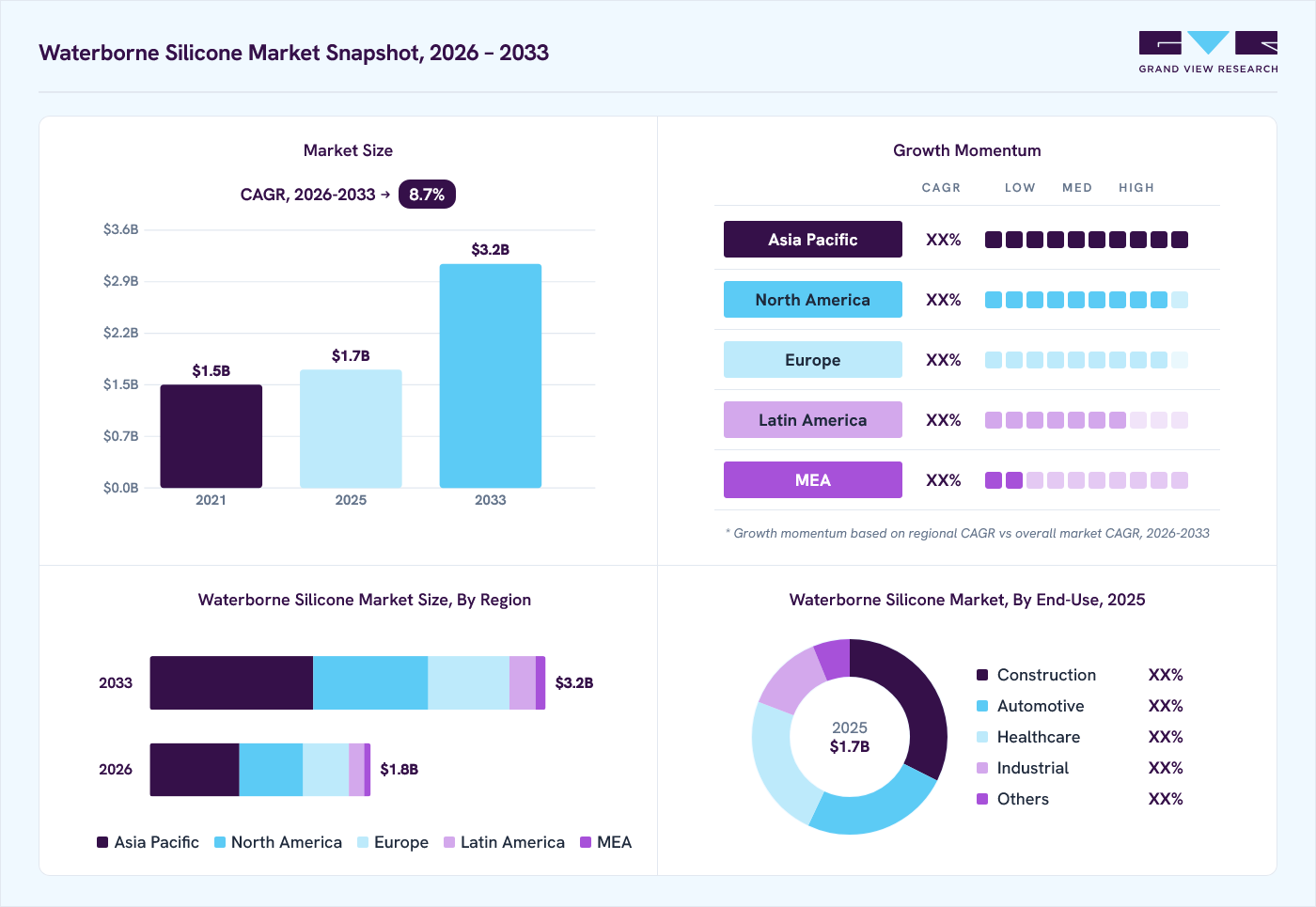 Source: Grand View Research, IR Documents, Primary Interviews, Paid DatabasesTo learn more about this report,
 Download Free Sample Report
Key Market Trends & Insights
- By type: Emulsions segment held the largest market share of 45.0% in 2025.
- By application: Paints & coatings segment held the largest market share of 36.7% in 2025.
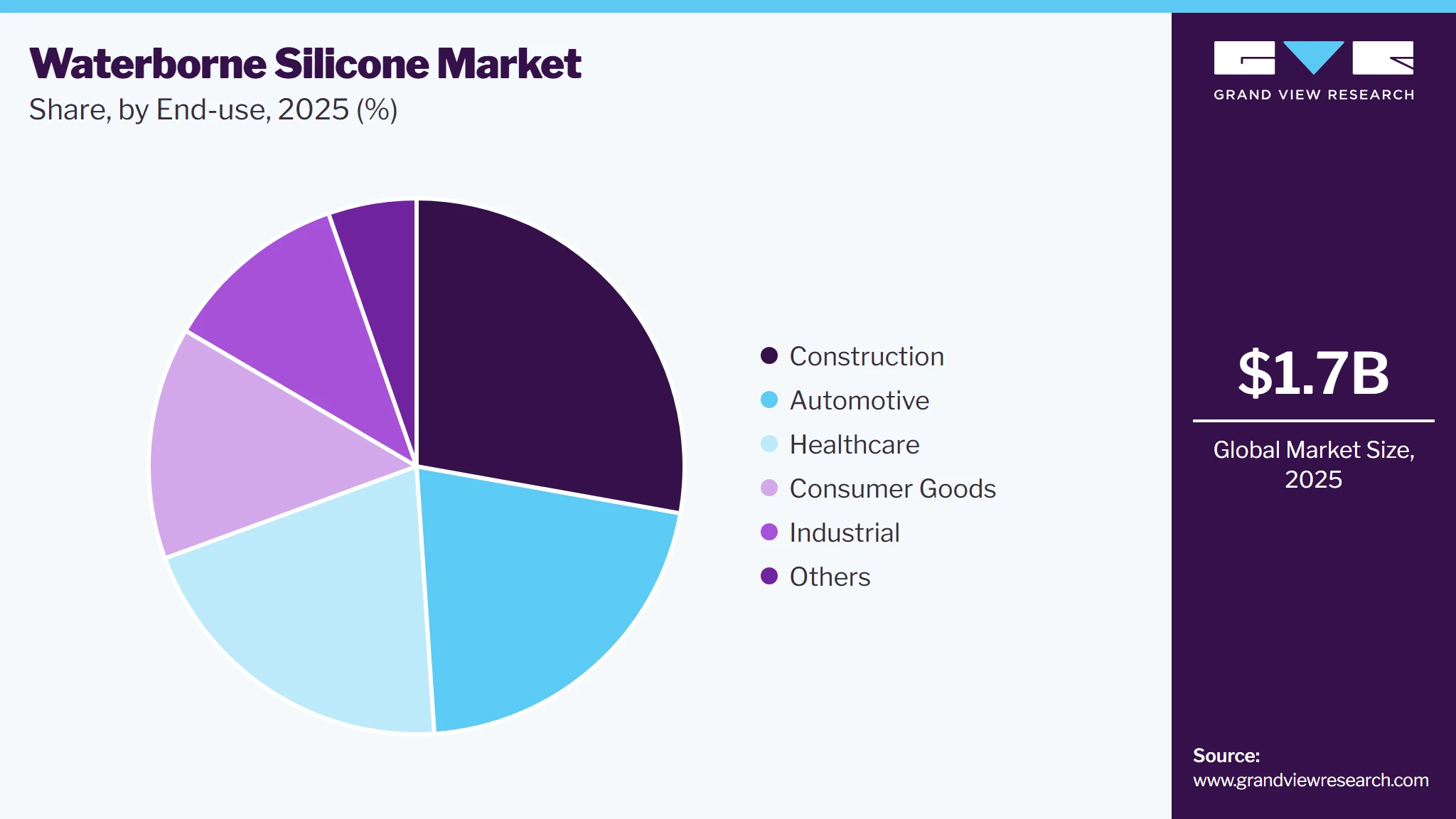
- By end use: Construction segment held the largest market share of 27.8% in 2025.
Regional Highlights
- Largest regional market: Asia Pacific (40.5% revenue share, 2025)
- By country: China held the largest market share in 2025
Market Size & Forecast
- Market size in 2025: USD 1.7 Billion
- Estimated market size in 2026: USD 1.8 Billion
- Projected market size by 2033: USD 3.2 Billion
- CAGR (2026-2033): 8.7%
Three ways to get this report
Buy it, customize it, or ask a question.Ask an Analyst
Analyst response in 1 business day
- AccessReport author, directly
- Reply timeWithin 1 working day
- No sales callDirect answer only
- FormatEmail reply
- CostFree, no cost
Get the Full Report
What the study covers
- FormatsPDF · Excel · Dashboard
- Timeline2026–2033 annual, 2025 base
- Coverage20+ countries, 5 regions
- Companies10+ key players profiled
Customize the Report
20% free customization
- IncludeCountries, segments, points
- TailorTo your product definition
- ExtendDeeper competitor detail
- OrA fully bespoke study
- Turnaround5–10 working days
Stricter green building regulations and certification programs further support market growth. The waterborne silicone industry is experiencing a strong shift toward sustainable and environmentally friendly solutions, particularly in the coatings and adhesives industries. As global regulations tighten on volatile organic compounds (VOCs), manufacturers are increasingly adopting waterborne silicones as a key alternative to solvent-based formulations. These materials provide excellent durability, weather resistance, and adhesion without emitting harmful fumes.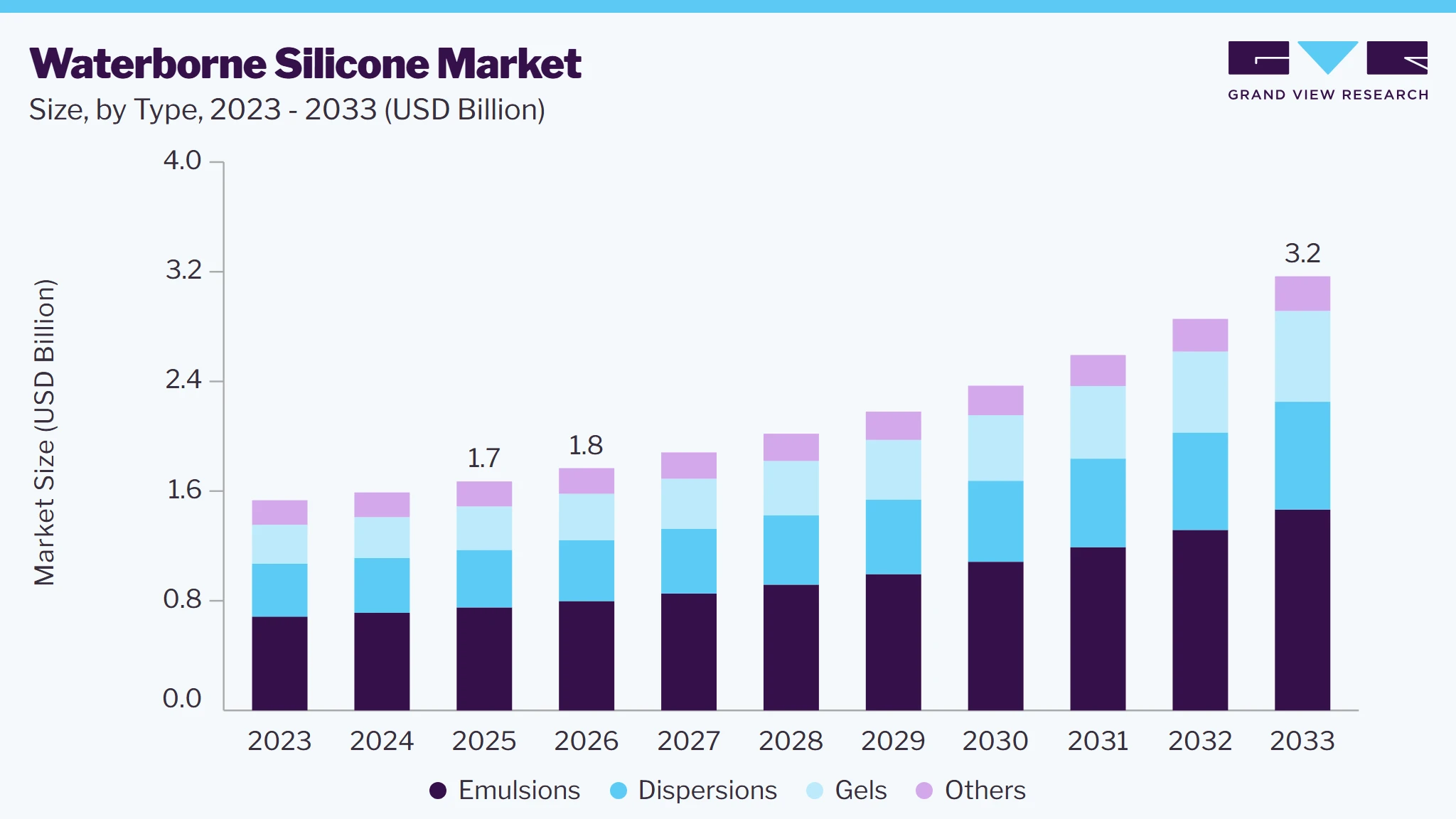 To learn more about this report, Download Free Sample Report
Industries such as automotive, construction, and electronics are integrating waterborne silicone technologies into their product lines to meet regulatory compliance while maintaining high performance. This trend aligns with broader ESG (Environmental, Social, and Governance) goals, reinforcing corporate commitments to sustainability and reducing carbon footprints in industrial applications.
Market Dynamics
The waterborne silicone market is shaped by sustained substitution toward low-VOC, water-based formulations across construction, coatings, and adhesives. Demand remains concentrated in Asia Pacific, while construction holds the largest end-use share and paints and coatings remain the leading application, making commercial pull highly dependent on building activity, infrastructure maintenance, and industrial coating cycles. The market also carries a specialty commercial structure, with value creation tied to formulation performance, regulatory compliance, and end-use specific integration rather than commodity volume alone. Waterborne silicones gain traction where durability, weather resistance, and clean-label positioning are required.
Stricter green building standards and VOC emission controls are accelerating adoption of waterborne silicone in construction sealants and coatings. These systems are increasingly selected as substitutes for solvent-based formulations because they deliver weather resistance, adhesion, and durability without the emission burden associated with conventional chemistries. The shift is particularly visible in end uses that require long service life and compliance with environmental rules. As a result, waterborne silicone is moving from a niche specialty input to a preferred formulation platform in regulated coating and sealant applications.
This regulatory pull is reinforced by broader industrial demand for protective coatings in construction, marine, automotive, and electronics applications. Manufacturers are using waterborne silicones to meet performance and compliance targets at the same time, especially in markets where sustainability certification and ESG commitments influence material selection. In healthcare, the same chemistry is gaining attention for medical adhesives, wound care, and other biocompatible uses, which adds a second demand layer beyond building materials. The driver is therefore not only environmental compliance, but also the need for high-performance, application-specific formulations.
The main restraint in the waterborne silicone market is the cost and technical burden of formulation development. Compared with conventional systems, waterborne silicone production requires specialized raw materials, tighter process control, and extensive R&D to balance adhesion, flexibility, durability, and substrate compatibility. These requirements raise entry barriers and limit the speed at which smaller suppliers can scale. Price-sensitive customers, particularly in developing markets, may also delay migration because the performance benefit does not always offset the higher formulation cost.
The strongest medium-term opportunity lies in biomedical and healthcare applications. Waterborne silicones are gaining relevance in medical adhesives, wound care products, drug delivery systems, and breathable protective films for wearable devices. Demand is rising for non-toxic, hypoallergenic, and moisture-resistant materials that can support sterilization and long-term skin contact. This opens a value-added channel where performance, safety, and regulatory acceptance matter more than price alone, creating room for premium formulations and specialized product development.
Analyst Perspective
The waterborne silicone market is moving from a compliance-led substitution phase toward a more value-led specialty formulation phase. Growth will continue to be supported by construction coatings and sealants, but the next layer of opportunity will come from healthcare, personal care, and other performance-critical applications that reward biocompatibility, durability, and low-VOC chemistry. Product leadership will depend less on basic availability and more on formulation expertise, application engineering, and the ability to serve regulated customers with consistent quality. Regional demand will remain concentrated in Asia Pacific, while North America and Europe will continue to shape specification standards through sustainability and emission rules. The most competitive suppliers will be those that combine technical depth, global supply reliability, and sustainability positioning. Margin pressure will persist from raw material volatility, complex processing requirements, and competition from established silicone producers, which will make scale and specialization equally important over the next cycle.
Type Insights
Based on the type, the emulsions segment led the market with the largest revenue share of 45.0% in 2025. Waterborne silicone emulsions are gaining significant traction in the textile industry due to their ability to enhance fabric softness, water repellency, and durability without compromising breathability. With increasing consumer demand for high-performance, eco-friendly textiles, manufacturers are incorporating silicone emulsions in functional clothing, upholstery, and industrial fabrics.
The waterborne silicone gel segment is witnessing rapid growth, particularly in the medical and skincare industries, where biocompatibility and flexibility are critical. These gels are widely used in advanced wound care, transdermal drug delivery patches, and scar treatment formulations due to their moisture retention and non-irritating properties. The rise in minimally invasive medical treatments and wearable health monitoring devices is further fueling demand for soft, breathable silicone gels that ensure patient comfort and prolonged adhesion. As the healthcare sector moves toward skin-friendly and hypoallergenic materials, waterborne silicone gels are becoming an essential component in next-generation medical and cosmetic applications.
Application Insights
Based on the application, the paints & coatings segment led the market with the largest revenue share of 36.7% in 2025. The demand for waterborne silicone in paints and coatings is accelerating due to the rising need for long-lasting protection in harsh environmental conditions. Industrial and automotive sectors are increasingly adopting these coatings to enhance resistance against extreme temperatures, corrosion, and chemical exposure. In addition, stringent environmental regulations limiting VOC emissions have led manufacturers to replace solvent-based coatings with waterborne silicone formulations. The growing focus on energy-efficient buildings and reflective roof coatings further strengthens market demand, as silicone-based coatings provide superior thermal management and weatherproofing benefits.
In the personal care industry, waterborne silicone is becoming a key ingredient in skincare, haircare, and cosmetic formulations due to its lightweight texture and breathable properties. Unlike traditional oil-based silicones, waterborne variants offer a non-greasy feel, making them highly desirable in high-end skincare products, sunscreens, and anti-aging creams. Consumers' increasing preference for clean-label and water-based beauty products is pushing manufacturers to innovate with silicone emulsions and gels that provide smooth application and long-lasting hydration.
End-use Insights
Based on the end use, the construction segment led the market with the largest revenue share of 27.8% in 2025. Waterborne silicone is playing an increasingly vital role in the construction industry, particularly in the production of high-performance sealants and waterproof coatings. As infrastructure projects expand globally, there is a rising need for durable, flexible, and low-maintenance building materials that can withstand extreme weather conditions. Waterborne silicone sealants provide superior adhesion to a variety of substrates, reducing the risk of cracks and leaks in buildings over time.
 To learn more about this report, Download Free Sample Report
The healthcare industry is increasingly adopting waterborne silicone for medical device coatings, pharmaceutical packaging, and bio-compatible applications. As patient safety and hygiene become top priorities, hospitals and manufacturers are favoring silicone-based coatings that offer antimicrobial resistance, ease of sterilization, and enhanced durability. Waterborne silicone formulations are also being explored for drug-eluting stents, catheter coatings, and surgical adhesives, where long-term biocompatibility is essential. With continuous advancements in medical technology and stricter regulatory oversight, the demand for safe, non-toxic, and high-performance silicone materials in healthcare applications is expected to grow substantially.
Regional Insights
North America waterborne silicone industry growth is driven by the strong push toward sustainable industrial coatings, driving the adoption of waterborne silicone in sectors such as aerospace, automotive, and energy. Stringent environmental regulations from agencies like the U.S. Environmental Protection Agency (EPA) and Canada’s environmental authorities are limiting VOC emissions, prompting manufacturers to transition from solvent-based to waterborne formulations.
U.S. Waterborne Silicone Market Trends
The waterborne silicone industry in the U.S. is driven by the increasing adoption of waterborne silicone in medical and healthcare applications. The country has a strong presence of medical device manufacturers and pharmaceutical companies that are actively integrating silicone-based coatings, adhesives, and hydrogels into wound care, drug delivery systems, and surgical instruments. With rising healthcare expenditures and a growing elderly population requiring advanced medical treatments, the demand for biocompatible and hypoallergenic materials is surging. Moreover, regulatory standards set by the U.S. Food and Drug Administration (FDA) are encouraging the use of safer, non-toxic materials in medical products, further driving innovation in waterborne silicone formulations for healthcare applications.
Asia Pacific Waterborne Silicone Market Trends
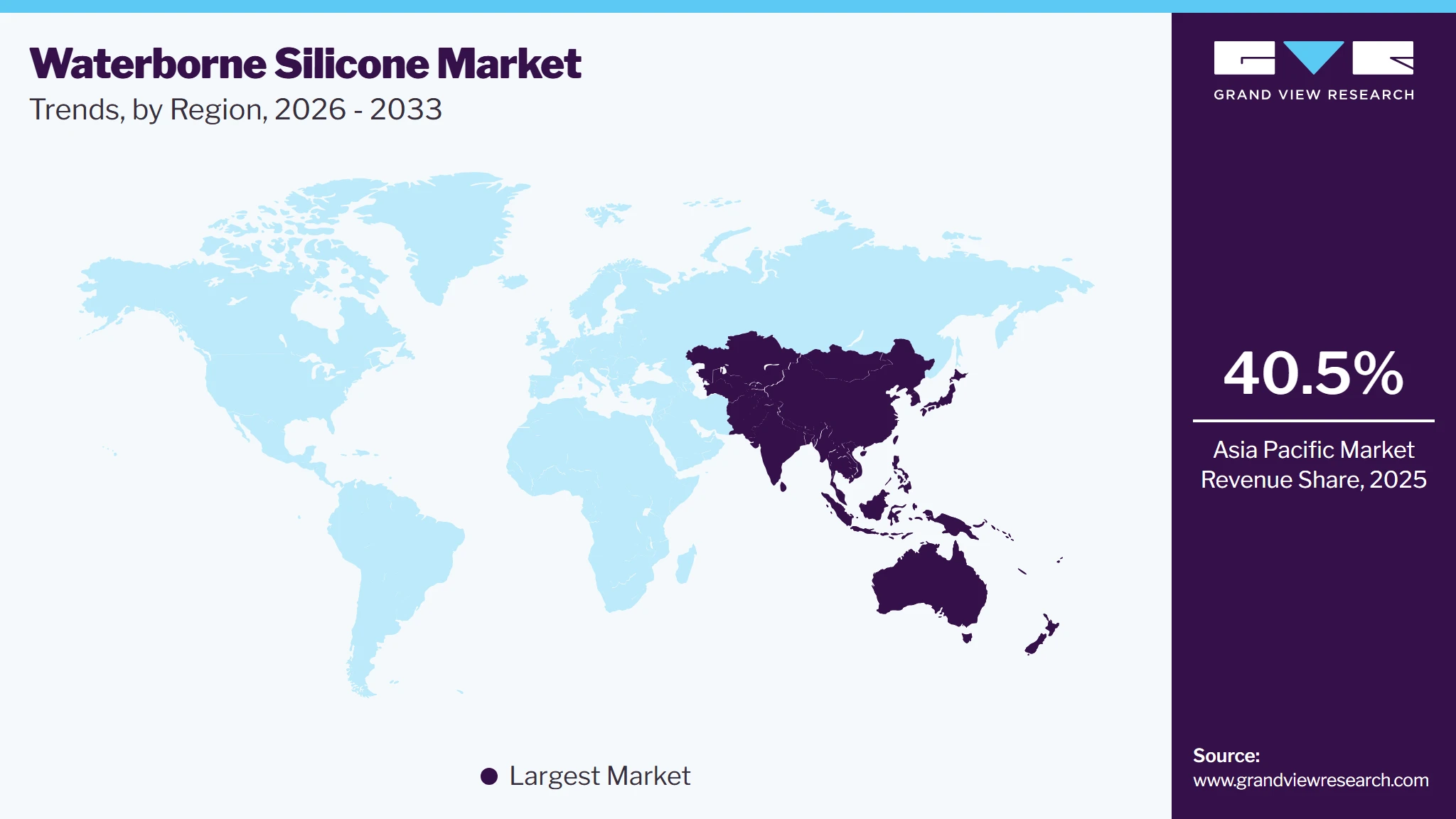
Asia Pacific dominated the waterborne silicone market with the largest revenue share of 40.5% in 2025. The Asia Pacific region is witnessing rapid urbanization and infrastructure expansion, driving the demand for waterborne silicone in construction applications. Countries such as India, Indonesia, and Vietnam are investing heavily in smart cities, residential projects, and industrial zones, requiring durable and energy-efficient building materials. Waterborne silicone is gaining traction in sealants, coatings, and waterproofing solutions due to its excellent adhesion, weather resistance, and environmental compliance.
 To learn more about this report, Download Free Sample Report
The waterborne silicone market in China held the largest share in the Asia Pacific region in 2025. With the country leading global production of consumer electronics, electric vehicles, and 5G infrastructure, the demand for high-performance, moisture-resistant coatings and adhesives has surged. Waterborne silicone is increasingly being used in circuit board protection, chip packaging, and thermal management applications due to its superior insulation and heat dissipation properties.
Europe Waterborne Silicone Market Trends
Europe waterborne silicone industry remains at the forefront of sustainable material adoption, with strict regulatory policies such as the European Green Deal and REACH (Registration, Evaluation, Authorisation and Restriction of Chemicals) framework driving demand for waterborne silicone. Industries across construction, automotive, and consumer goods are actively replacing traditional solvent-based silicones with waterborne alternatives to align with low-VOC requirements and carbon neutrality goals.
Key Waterborne Silicone Company Insights
The waterborne silicone industry is highly competitive, with several key players dominating the landscape. The waterborne silicone industry is characterized by a competitive landscape with several key players driving innovation and market growth. Major companies in this sector are investing heavily in research and development to enhance the performance, cost-effectiveness, and sustainability of their types.
Key Waterborne Silicone Companies:
The following key companies have been profiled for this study on the waterborne silicone market.
-
Momentive Performance Materials
-
Dow Chemical Company
-
Shin-Etsu Chemical Co., Ltd.
-
Wacker Chemie AG
-
Elkem Silicones
-
Evonik Industries AG
-
BRB International BV
-
Siltech Corporation
Competitive Benchmarking
Category
Operating Strategies
Competitive Edge
Weakness
Established Players (Momentive Performance Materials, Dow Chemical Company, Shin-Etsu Chemical Co., Ltd., Wacker Chemie AG, Elkem Silicones, Evonik Industries AG.)
- Use integrated silicone platforms to serve coatings, sealants, and personal care through broad formulation portfolios.
- Prioritize regulatory-compliant product development and long-term supply relationships with global industrial customers.
- Invest in technical service, application support, and specialty grade expansion.
- Strong global manufacturing reach and established customer trust.
- Better ability to absorb R&D cost and compliance burden.
- Wider integration across upstream and downstream silicone value chains.
- Slower response to small, fast-growing niche applications.
- Higher fixed-cost exposure in cyclical demand environments.
- Greater pressure from pricing competition in mature markets.
Emerging Players (BRB International BV, Siltech Corporation)
- Focus on specialty grades and selected high-value end-use niches.
- Compete through formulation flexibility and customer-specific technical support.
- Use targeted channel partnerships and selective market expansion.
- Faster product adaptation for niche applications.
- Higher commercial agility in specialty formulations.
- Stronger focus on differentiated, application-led value propositions.
- Lower scale compared with multinational peers.
- More limited geographic coverage and manufacturing depth.
- Greater vulnerability to raw material cost swings and customer concentration.
Recent Developments
-
In March 2024, Shin-Etsu Chemical Co., Ltd. developed the first emulsifier-free, water-based silicone resin, named the KRW-6000 Series. This resin boasts superior film properties, quick curing through heating, and excellent durability. Its water-solvent composition omits organic solvents, contributing to VOC-free products and reducing greenhouse gas emissions due to its fast-curing capabilities at low temperatures.
-
In June 2024, SioResin announced a new water-based, high-temperature graphene silicone resin coating using their SiO-715 silicone resin emulsion. This coating combines high-temperature resistance with water-based formulation and thermal conductivity, targeting applications in industrial pipelines, heating vessels, and domestic heating.
Waterborne Silicone Market Report Scope
Report Attribute
Details
Market size value in 2025
USD 1.7 billion
Market size value in 2026
USD 1.8 billion
Revenue forecast in 2033
USD 3.2 billion
Growth rate
CAGR of 8.7% from 2026 to 2033
Base year for estimation
2025
Historical data
2021 - 2024
Forecast period
2026 - 2033
Quantitative units
Revenue in USD million/billion, volume in kilotons, and CAGR from 2026 to 2033
Report coverage
Revenue forecast, company ranking, competitive landscape, growth factors, and trends
Segments covered
Type, application, end-use, region
Regional scope
North America; Europe; Asia Pacific; Central & South America; Middle East & Africa
Country scope
U.S., Canada; Mexico; Germany; UK; France; Italy; Spain, China; India; Japan; South Korea, Australia Brazil; Argentina, Saudi Arabia, UAE, South Africa
Key companies profiled
Momentive Performance Materials; Dow Chemical Company; Shin-Etsu Chemical Co.; Ltd.; Wacker Chemie AG; Elkem Silicones; Evonik Industries AG; BRB International BV; Siltech Corporation
Customization scope
Free report customization (equivalent up to 8 analysts' working days) with purchase. Addition or alteration to country, regional & segment scope.
Pricing and purchase options
Avail customized purchase options to meet your exact research needs. Explore purchase options
Global Waterborne Silicone Market Report Segmentation
This report forecasts revenue & volume growth at global, regional, and country levels and provides an analysis of the latest industry trends in each of the sub-segments from 2021 to 2033. For this study, Grand View Research has segmented the global waterborne silicone market report based on type, application, end-use, and region:
 To learn more about this report, Download Free Sample Report
-
Type Outlook (Volume, Kilotons; Revenue, USD Million, 2021 - 2033)
-
Emulsions
-
Dispersions
-
Gels
-
Others
-
-
Application Outlook (Volume, Kilotons; Revenue, USD Million, 2021 - 2033)
-
Paints & Coatings
-
Adhesives & Sealants
-
Personal Care
-
Others
-
-
End Use Outlook (Volume, Kilotons; Revenue, USD Million, 2021 - 2033)
-
Construction
-
Automotive
-
Healthcare
-
Consumer Goods
-
Industrial
-
Others
-
-
Regional Outlook (Volume, Kilotons; Revenue, USD Million, 2021 - 2033)
-
North America
-
U.S.
-
Canada
-
Mexico
-
-
Europe
-
Germany
-
UK
-
France
-
Italy
-
Spain
-
-
Asia Pacific
-
China
-
India
-
Japan
-
South Korea
-
Australia
-
-
Central & South America
-
Brazil
-
Argentina
-
-
Middle East & Africa
-
Saudi Arabia
-
UAE
-
South Africa
-
-
Research Methodology
The waterborne silicone market figures in this report are based on a proven research process that combines executive interviews with secondary research from proprietary databases, company filings, and recognized regulatory and institutional sources. Market size is built through value-chain sizing - reconciling supply-side and demand-side estimates - and triangulated with bottom-up and top-down approaches. Every estimate passes multiple levels of expert validation before publication, with each waterborne silicone segment quantified using the revenue-capture definitions in the table below.
Segment Definition
Segment - Type
Revenue capture definition
Emulsions
Revenue is captured through bulk sales of silicone emulsions used in coatings, textiles, sealants, and personal care formulations where water dispersion is the primary commercial route.
Dispersions
Revenue is generated from stable silicone dispersion systems sold into high-performance coatings, treatment chemistries, and specialty industrial formulations that require controlled particle distribution.
Gels
Revenue is earned from premium gel formulations used in medical, skincare, and protective applications where softness, flexibility, and skin compatibility drive specification.
Others
This captures residual revenue from niche waterborne silicone formats that do not fall under emulsions, dispersions, or gels, including hybrid specialty systems.
Segment - Application
Revenue capture definition
Paints & Coatings
Revenue is captured through silicone-based coating sales for architectural, industrial, and protective uses where weatherability, UV resistance, and low-VOC performance are commercial buying criteria.
Adhesives & Sealants
Revenue is generated from silicone systems used in sealing, bonding, and gap-filling applications where adhesion, elasticity, and weather resistance define value capture.
Personal Care
Revenue is earned through incorporation of waterborne silicone into skin care, hair care, and cosmetic formulations where sensory performance and clean-label positioning support premium pricing.
Others
This includes revenue from specialty uses outside the core application set, such as textiles, paper treatment, and selected niche industrial uses.
Segment - End Use
Revenue capture definition
Construction
Revenue is captured through waterborne silicone use in building sealants, waterproof coatings, façade protection, and maintenance materials specified for durability and compliance.
Automotive
Revenue is generated from coatings, sealants, and surface treatment applications used in vehicle assembly and component protection where performance and regulatory alignment matter.
Healthcare
Revenue is earned from medical coatings, adhesives, hydrogels, and device-contact materials where biocompatibility and sterilization tolerance are required.
Consumer Goods
This captures revenue from household, personal care, wearable, and general consumer applications that use silicone for comfort, protection, or functional performance.
Industrial
Revenue is generated from coatings, protection layers, and process-specific formulations used in manufacturing, electronics, marine, and other industrial environments.
Others
This row captures remaining revenue from end uses that do not fit the core commercial categories but still use waterborne silicone for performance or protection.
Construction
Revenue is captured through waterborne silicone use in building sealants, waterproof coatings, façade protection, and maintenance materials specified for durability and compliance.
Estimation Model
Layer Name
Key Question
Description
Base Demand Layer
Where is demand generated?
The model first anchors total revenue to reported market size and then maps demand into the report’s type, application, and end-use structure.
Formulation Split Layer
Why split by product?
Revenue is then allocated across emulsions, dispersions, gels, and others based on commercial prevalence, specification depth, and downstream usage intensity.
Use-Case Layer
Why weight by application?
Application revenue follows purchasing intensity in coatings, sealants, and personal care, where waterborne silicone is selected for performance and regulatory value.
Regional Layer
Why add geography?
Regional allocation reflects Asia Pacific concentration, North American regulatory pull, and specialty demand in Europe and other mature markets.
Delivered Customizations
This report has been delivered with the following In-depth customizations
CLIENT REQUEST
CUSTOMIZATION DELIVERED
VALUE ADDS
Add country-level segmentation
Provided an expanded country-level view across priority demand centers with supporting market logic for regional consumption, regulatory intensity, and application adoption patterns.
Improves investor and sales targeting by identifying the most commercially relevant country markets.
Expand end-use analysis
Added a deeper end-use split across construction, automotive, healthcare, consumer goods, industrial, and others with specific revenue capture logic.
Strengthens application mapping and supports more precise market sizing assumptions.
Include company benchmarking
Delivered a competitive benchmark of mature and emerging players with operating strategies, competitive edge, and weaknesses.
Helps position suppliers by scale, specialization, and commercial readiness.
Frequently Asked Questions About This Report
The global waterborne silicone market size was estimated at USD 1.7 billion in 2025 and is projected to grow from USD 1.8 billion in 2026
The global waterborne silicone market is expected to grow at a CAGR of 8.7% from 2026 to 2033, reaching USD 3.2 billion by 2033.
Based on the application, the paints & coatings segment led the market with the largest revenue share of 36.7% in 2025.
Based on the end use, the construction segment led the market with the largest revenue share of 27.8% in 2025.
The waterborne silicone market is shaped by sustained substitution toward low-VOC, water-based formulations across construction, coatings, and adhesives. Demand remains concentrated in Asia Pacific, while construction holds the largest end-use share and paints and coatings remain the leading application, making commercial pull highly dependent on building activity, infrastructure maintenance, and industrial coating cycles.
The strongest medium-term opportunity lies in biomedical and healthcare applications. Waterborne silicones are gaining relevance in medical adhesives, wound care products, drug delivery systems, and breathable protective films for wearable devices.
Based on the type, the emulsions segment led the market with the largest revenue share of 45.0% in 2025.
The key players in the waterborne silicone market include Momentive Performance Materials, Dow Chemical Company, Shin-Etsu Chemical Co., Ltd., Wacker Chemie AG, Elkem Silicones, and Evonik Industries AG, among others.
The rising focus on sustainable building practices is increasing the use of waterborne silicone in construction sealants and coatings, as they offer durability, weather resistance, and low environmental impact. Stricter green building regulations and certification programs further support market growth.
About the Author(s)
Plastics, Polymers & Resins Research Team
Bulk Chemicals · Plastics, Polymers & ResinsThis report was authored by the plastics, polymers & resins research team at Grand View Research - comprising two research analysts, one senior research analyst, and one industry expert - with specialized expertise in the plastics, polymers & resins segment of the bulk chemicals industry. All findings are based on proprietary bulk chemicals databases, executive interviews, and regulatory analysis, subject to internal peer review prior to publication.
Last Updated:
Speak to Analyst

Customize this report to your needs - add regions, segments, or data points, with 20% free customization.
Or view our licence options:


ISO 9001:2015 & 27001:2022 Certified
We are GDPR and CCPA compliant! Your transaction & personal information is safe and secure. For more details, please read our privacy policy.


