
- Home
- »
- Clothing, Footwear & Accessories
- »
-
Wind Instruments Market Size & Share Report, 2026-2033GVR Report cover
![Wind Instruments Market (2026 - 2033)Report]()
Wind Instruments Market (2026 - 2033)
Size, Share & Trends Analysis Report By Type (Saxophone, Flute, Harmonica), By Region (North America, Europe, Asia Pacific, Central & South America, Middle East & Africa), And Segment Forecasts
Market Size, 2025
$1.6BMarket Estimate, 2026
$1.7BMarket Forecast, 2033
$2.2BCAGR, 2026–2033
3.5%Wind Instruments Market Summary
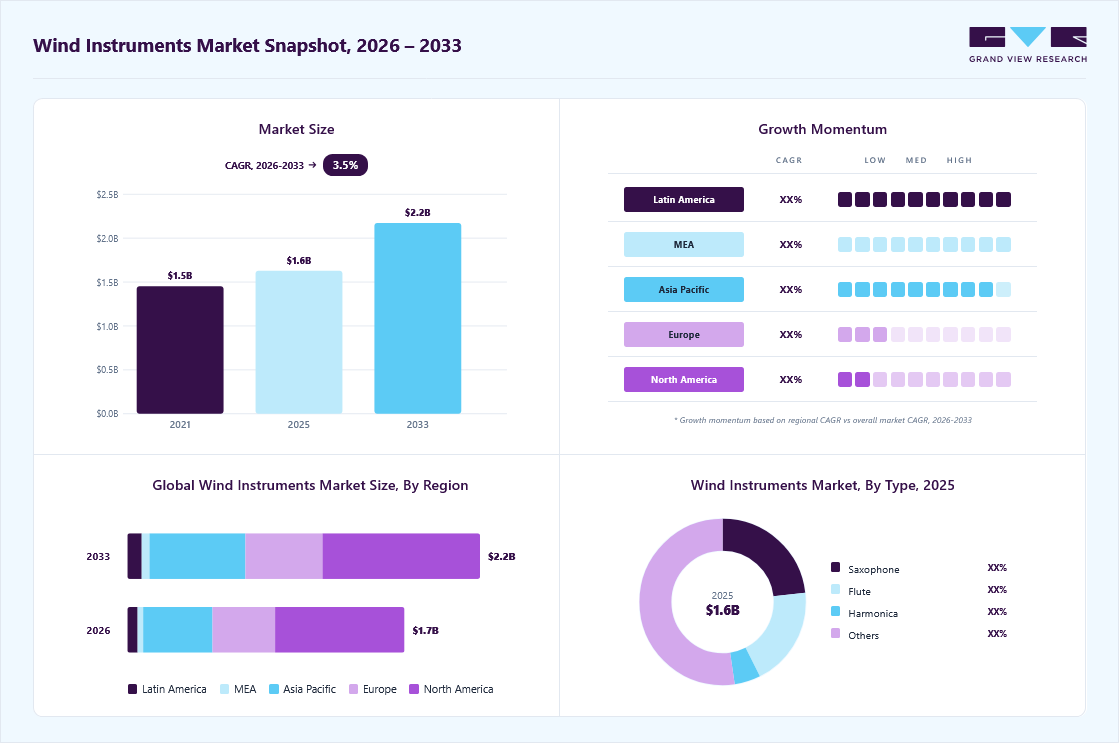
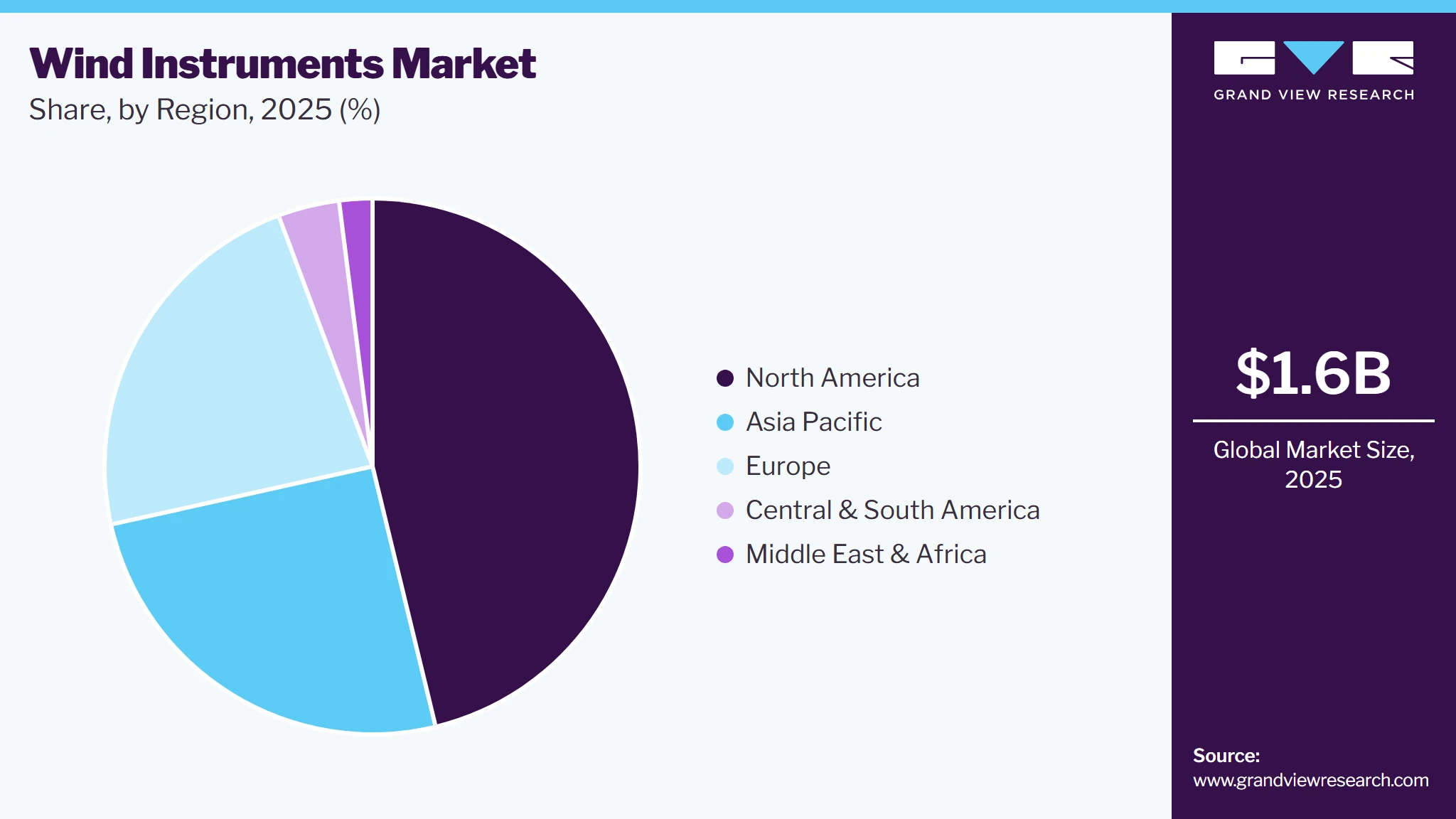
The global wind instruments market size was valued at USD 1.6 billion in 2025 and is projected to grow from USD 1.7 billion in 2026 to USD 2.2 billion by 2033, at a CAGR of 3.5% from 2026 to 2033. North America dominated the market, accounting for the largest revenue share of 46.2% in 2025. The market is experiencing steady growth, supported by increasing participation in music education, school band programs, orchestras, and recreational music activities.
Key Market Trends & Insights
- By type: Saxophone segment held the largest market share of 23.2% in 2025.
Regional Highlights
- Largest regional market: North America (46.2% revenue share, 2025)
- By country: The U.S. held the largest revenue share in 2025
Market Size & Forecast
- Market size in 2025: USD 1.6 Billion
- Estimated market size in 2026: USD 1.7 Billion
- Projected market size by 2033: USD 2.2 Billion
- CAGR (2026-2033): 3.5%
Rising consumer interest in learning musical instruments, coupled with expanding investments in performing arts and cultural education, is driving demand for flutes, clarinets, saxophones, trumpets, trombones, and other wind instruments.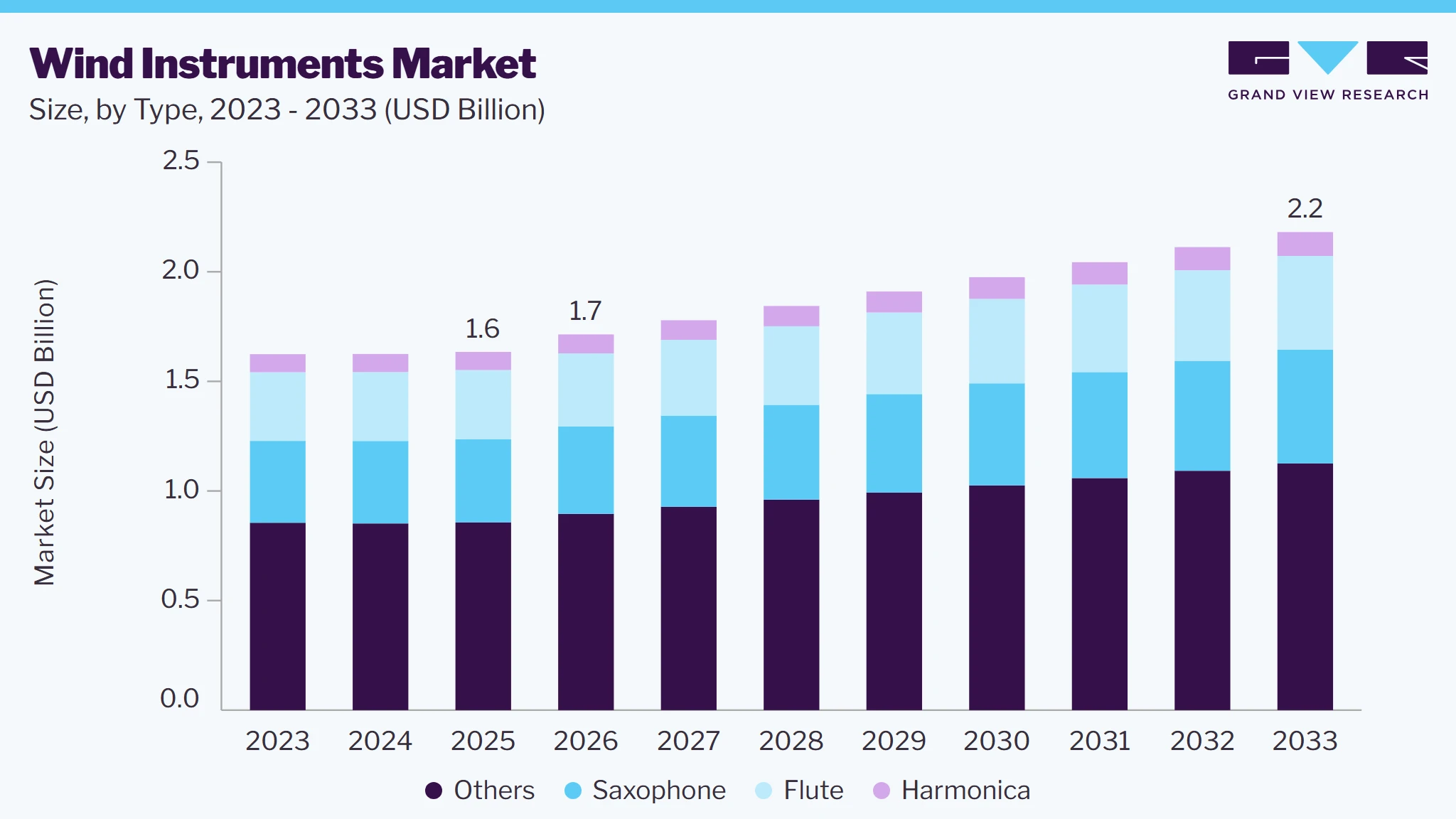
The growing popularity of live performances, community bands, and digital music learning platforms is further strengthening the wind-instrument industry, while advancements in musical-instrument manufacturing continue to enhance product quality, durability, and playability.
The market is also witnessing a notable shift toward technologically advanced and digitally enabled wind instruments that combine the authentic feel of traditional instruments with modern electronic features. Manufacturers are introducing products with digital sound engines, enhanced connectivity, and practice-friendly capabilities to cater to learners and professional musicians alike.
Growing global participation in music education, concert performances, marching bands, and cultural events is creating sustained demand in the wind instruments industry. Educational institutions, music academies, and performing arts organizations are expanding investments in wind instruments to support structured music training and ensemble performances.
At the same time, increasing consumer interest in learning musical instruments as a recreational activity is encouraging purchases across beginner, intermediate, and professional product categories. This growing participation is contributing to the expansion of the wind instruments industry, with demand spanning flutes, clarinets, saxophones, trumpets, trombones, French horns, tubas, and other wind instruments.
The market is also benefiting from continuous innovation in instrument design and production techniques. Manufacturers are adopting advanced alloys, precision machining, corrosion-resistant finishes, and ergonomic key mechanisms to improve sound quality, durability, and player comfort. Furthermore, advancements in musical instrument manufacturing are enabling the development of lightweight, high-performance instruments with improved acoustic consistency and lower maintenance requirements. These innovations are helping manufacturers address the evolving needs of students, educators, and professional musicians while enhancing overall product value.
In addition, the wind instruments equipment market is witnessing increasing demand for premium and customized instruments as musicians seek products tailored to their playing styles and performance requirements. Consumers are placing greater emphasis on tonal precision, craftsmanship, aesthetic finishes, and brand reputation when selecting instruments. This trend encourages manufacturers to expand their premium product portfolios, offer customization options, and introduce specialized models for orchestral musicians, solo performers, jazz artists, and marching bands.
Moreover, evolving retail strategies are improving product accessibility across global markets. Manufacturers and distributors are strengthening omnichannel sales networks by combining specialty music stores, authorized dealers, and digital commerce platforms to provide broader product availability, expert guidance, financing options, and after-sales services. The increasing availability of online demonstrations, virtual consultations, and educational content is also helping consumers make informed purchasing decisions, further supporting the long-term market growth.
Market Dynamics
The increasing participation in music education, school bands, orchestras, and live performance events is a key driver of the wind instruments market. Governments, educational institutions, and private music academies are expanding music programs to promote creative learning and cultural engagement, driving demand for flutes, clarinets, saxophones, trumpets, trombones, and other wind instruments. In addition, rising interest in recreational music learning among children and adults, supported by online tutorials and digital music education platforms, is encouraging first-time instrument purchases. The growing number of concerts, marching bands, orchestras, and community music groups is also contributing to replacement demand and premium instrument sales, supporting the long-term expansion of the wind instruments industry.
Furthermore, ongoing advancements in musical instrument manufacturing are enabling companies to introduce ergonomically designed, lightweight, and acoustically refined instruments that cater to musicians of all skill levels. Manufacturers are also expanding their product portfolios with beginner, intermediate, and professional models, improving accessibility while meeting the evolving performance expectations of consumers. These factors continue to strengthen market demand across educational, recreational, and professional applications.
The relatively high purchase and maintenance costs of professional wind instruments remain a significant restraint for the wind instrument equipment market. Premium instruments made from high-quality brass, silver, gold-plated brass, or handcrafted wood often require substantial upfront investment, making them less affordable for students, beginners, and price-sensitive consumers. In addition to the initial purchase cost, regular servicing, pad replacement, valve maintenance, cleaning, and repairs contribute to the overall cost of ownership, particularly for frequently used instruments.
These risks have become more prominent with the increasing use of connected cardiovascular monitoring technologies. For instance, in January 2025, the U.S. Food and Drug Administration (FDA) identified cybersecurity vulnerabilities in certain Contec and Epsimed patient monitors that could potentially allow unauthorized access to patient information and remote manipulation of device functions. Such incidents reinforce concerns regarding the security and reliability of connected medical devices and may delay their adoption across healthcare settings.
Moreover, many consumers face challenges in selecting instruments that match their skill level, musical preferences, and long-term learning goals, leading to delayed purchasing decisions. Budget constraints at schools, music academies, and community organizations can also limit large-scale procurement of high-quality instruments. These affordability constraints, combined with relatively long product replacement cycles, continue to limit broader adoption and present a key challenge to the sustained market growth.
The increasing use of wind instruments in school-based music education creates an opportunity for manufacturers to develop affordable, durable, student-oriented instruments and institutional packages. For instance, Yamaha’s Class Band program provides classroom-based instruction using flute, clarinet, saxophone, trumpet, trombone, and euphonium, while also offering teacher training and guidance. This demonstrates an opportunity for manufacturers to strengthen direct partnerships with schools through instrument packages, training, rentals, and educational support.
Analyst Perspective
The wind instruments market is evolving through a combination of technological innovation, expanding music education initiatives, and growing participation in recreational and professional music activities. Demand is increasingly shifting toward high-quality, ergonomically designed, and digitally integrated instruments that enhance playability, sound precision, and learning experiences. The wind instruments industry is also benefiting from rising investments by educational institutions, orchestras, and performing arts organizations, which continue to generate consistent demand for both student and professional-grade instruments. At the same time, advancements in musical instrument manufacturing, including precision engineering, sustainable materials, and enhanced production techniques, are enabling manufacturers to improve product quality while expanding premium product portfolios. Furthermore, the market is witnessing greater online penetration through direct-to-consumer channels, virtual product demonstrations, and digital music learning platforms, enabling manufacturers to reach a broader consumer base and drive long-term market growth.
Brand Market Share Insights
The wind instruments industry is highly competitive, with manufacturers focusing on product innovation, precision craftsmanship, and technological advancements to strengthen their market positions. Leading companies such as Yamaha Corporation, Yanagisawa Wind Instruments Co., Ltd., Eastman Music Company, Casio Computer Co., Ltd., Roland Corporation, Kawai Musical Instrument Mfg. Co., Ltd., Steinway & Sons, Fender Musical Instrument Corporation, C.F. Martin & Co., Inc., and D'Addario & Company, Inc. compete by expanding their product portfolios, enhancing acoustic performance, and improving manufacturing capabilities. The wind instruments industry is increasingly characterized by investments in lightweight materials, ergonomic designs, precision key mechanisms, and digital technologies that improve playability, sound quality, and overall user experience for students, educators, and professional musicians.

The market is also witnessing growing demand for premium instruments, digital music solutions, and high-quality accessories, encouraging manufacturers to diversify beyond traditional product offerings. Companies are strengthening their presence through direct-to-consumer platforms, artist collaborations, music education initiatives, and global dealer networks to improve brand visibility and customer engagement. Furthermore, continuous advancements in musical instrument manufacturing, including precision machining, sustainable production practices, and digital instrument technologies, are enabling companies to differentiate their offerings. As a result, the market is becoming increasingly innovation-driven, with competition centered on craftsmanship, product reliability, customization, and integrated digital features that cater to the evolving needs of modern musicians.
Consumer Insights
Consumer behavior in the wind instruments industry is increasingly driven by sound quality, instrument craftsmanship, and long-term performance, with buyers prioritizing products that offer superior tonal accuracy, comfortable ergonomics, and reliable durability over entry-level alternatives. Students, hobbyists, and professional musicians are placing greater emphasis on instruments that provide consistent intonation, responsive key mechanisms, and enhanced playability to support music education, rehearsals, and live performances. This trend is encouraging manufacturers in the wind instrument industry to focus on premium materials, precision engineering, and innovative product designs that improve both performance and the user experience.
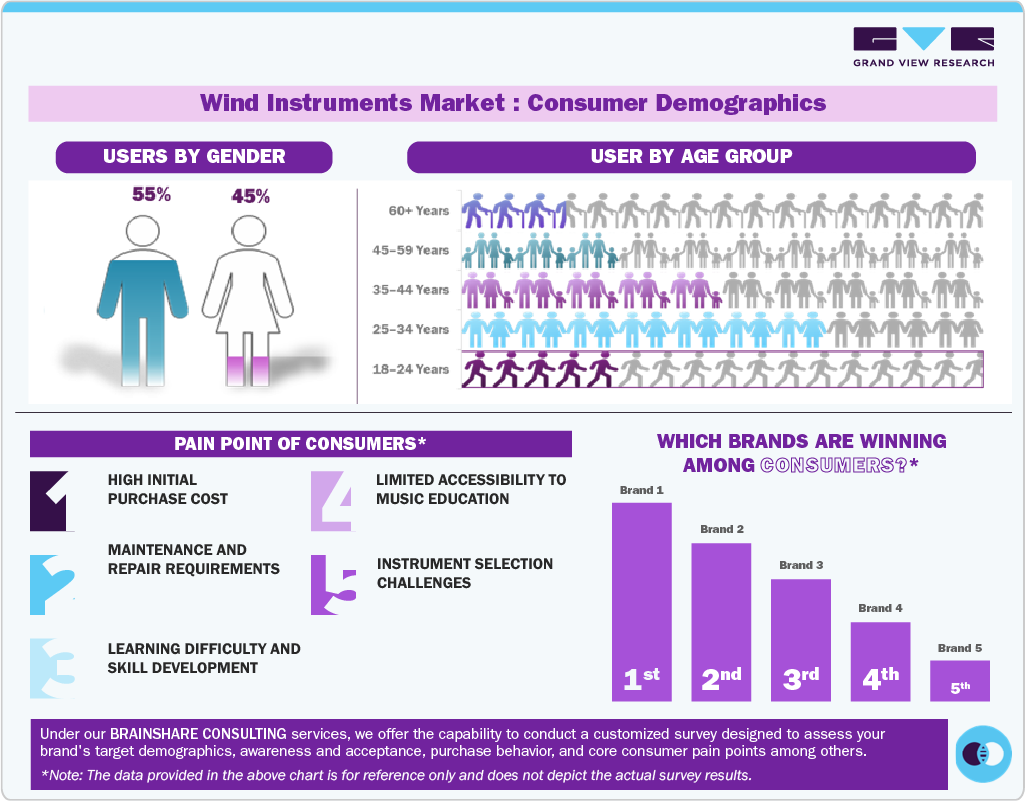
At the same time, purchasing behavior is becoming more comprehensive, as consumers increasingly invest in complementary products and accessories alongside their primary instruments. The expansion of online music education platforms, artist-led tutorials, and virtual performances is also influencing purchasing decisions, encouraging consumers to upgrade to intermediate and professional-grade instruments as their skills progress. As a result, companies engaged in musical instrument manufacturing are expanding their product ecosystems and after-sales services to strengthen customer loyalty. This evolving purchasing pattern is supporting sustained demand across the wind instrument equipment industry, with recurring accessory purchases and instrument upgrades contributing to long-term market growth.
Type Insights
The saxophone segment led the market with the largest revenue share of 23.2% in 2025, driven by its widespread adoption in jazz, concert, and marching bands, as well as orchestras and contemporary music performances. The instrument continues to witness strong demand from music schools, universities, and professional performers due to its versatility across multiple musical genres and skill levels. In addition, continuous advancements in musical instrument manufacturing, including improved key mechanisms, lightweight materials, enhanced intonation, and ergonomic designs, are strengthening the appeal of products. Growing participation in music education and live performances is further supporting replacement purchases and sustained demand, reinforcing the growth of the wind instruments industry.
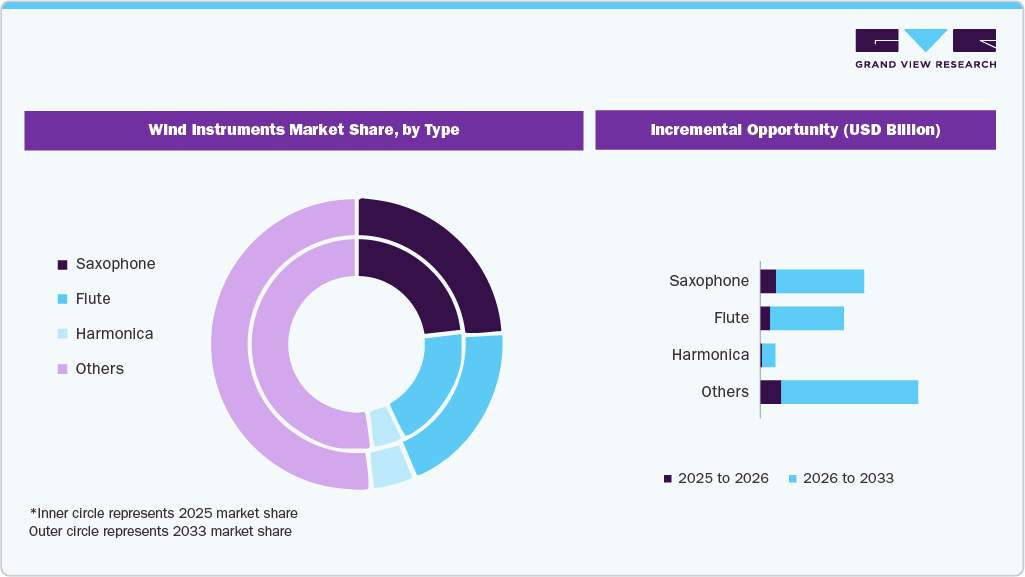
The flute segment is anticipated to grow at the fastest CAGR of 3.6% from 2026 to 2033, supported by increasing enrollment in music education programs and rising participation in orchestras, chamber ensembles, and solo performances. Consumers increasingly prefer flutes that offer improved tonal quality, durability, and ease of handling, prompting manufacturers to introduce instruments with precision-engineered key systems, corrosion-resistant materials, and enhanced acoustic performance. Furthermore, the expanding popularity of recreational music learning, online music instruction, and cultural performance is broadening the customer base for flute products. These factors continue to support product innovation and sustained demand across the wind instrument equipment market.
Regional Insights
North America dominated the global wind instruments market with the largest revenue share of 46.2% in 2025, supported by the region's well-established music education ecosystem, strong participation in school band and orchestral programs, and high consumer spending on premium musical instruments. The U.S. and Canada continue to witness sustained demand from educational institutions, professional musicians, community bands, and recreational learners, driving purchases across saxophones, flutes, clarinets, trumpets, and other wind instruments. Consumers increasingly prioritize instruments that offer superior acoustic performance, ergonomic designs, long-term durability, and precision craftsmanship, encouraging manufacturers to invest in advanced musical instrument manufacturing processes. The region also benefits from the presence of leading instrument manufacturers, extensive dealer networks, and a mature retail ecosystem, reinforcing the growth of the wind instruments industry.
U.S. Wind Instruments Market Trends
The wind instruments market in the U.S. accounted for the largest revenue share of 82.6% in North America in 2025, driven by the country's extensive network of school music programs, university marching bands, military bands, orchestras, and professional performance venues. Unlike many other regions, consumer demand in the U.S. is strongly influenced by institutional procurement, with schools and colleges regularly replacing and upgrading instruments to support music education curricula. In addition, a growing number of adult learners and hobby musicians are investing in intermediate and professional-grade wind instruments as participation in community bands and recreational ensembles continues to rise. Consumers increasingly value handcrafted instruments, premium finishes, responsive key mechanisms, and consistent tonal quality, prompting musical instrument manufacturers to introduce high-performance models tailored to different skill levels. These trends continue to strengthen the competitive landscape of the wind instruments industry.
The Canada wind instruments market is expected to grow at a significant CAGR of 1.3% from 2026 to 2033. The country's strong cultural emphasis on music, coupled with the presence of regional orchestras and youth ensembles, continues to generate consistent demand for wind instruments across beginner and intermediate segments. Canadian consumers are increasingly seeking instruments that combine tonal consistency, durability, and ease of maintenance, while educators and institutions prioritize reliable products that can withstand long-term classroom and ensemble use. These trends are encouraging companies engaged in musical instrument manufacturing to introduce high-quality instruments tailored to educational and performance applications, strengthening the wind instruments industry.
There is a growing demand for sustainable and durable wind instruments, driven by increasing preference for products manufactured using responsibly sourced materials and environmentally conscious production processes. At the same time, rental and trade-up programs offered by music retailers are improving affordability for first-time learners, lowering initial purchase costs while encouraging upgrades to premium instruments over time.
Europe Wind Instruments Market Trends
The wind instruments market in Europe accounted for a significant revenue share of 21.5% in 2025, driven by sustained demand from educational institutions, community music programs, and a vibrant live performance culture across the region. The market is benefiting from increasing interest in recreational music, encouraging manufacturers to introduce wind instruments with enhanced ergonomics, improved durability, and advanced acoustic performance. Growing adoption of digital retail channels is expanding product accessibility for both novice and professional musicians, while manufacturers are incorporating sustainable materials and modern production technologies to meet evolving consumer preferences.
The France wind instruments market is supported by the country's rich musical heritage, renowned conservatories, and strong participation in orchestral, military band, jazz, and chamber music performances. Consumer demand is increasingly centered on premium-quality wind instruments that deliver exceptional tonal precision, handcrafted craftsmanship, and long-term reliability. French musicians and music institutions place significant emphasis on heritage brands, precision engineering, and professional-grade instruments, creating sustained demand for clarinets, saxophones, flutes, oboes, and bassoons. This preference for high-end products continues to encourage innovation in musical instrument manufacturing.
The wind instrument market in the UK is expected to grow at a significant CAGR of 1.9% from 2026 to 2033. The country's strong network of conservatories, music examination boards, and performing arts organizations continues to generate consistent demand for woodwind and brass instruments among students, educators, and professional musicians. Consumers in the UK are increasingly seeking instruments that offer precision craftsmanship, reliable intonation, and long-term durability, while also valuing products that require minimal maintenance and provide consistent performance. This trend is encouraging manufacturers in the wind instrument industry to expand their premium and intermediate product portfolios while leveraging advances in musical instrument manufacturing to improve ergonomics, acoustic response, and precision.
Asia Pacific Wind Instruments Market Trends
The wind instrument industry is expected to grow at a significant CAGR of 5.2% from 2026 to 2033,driven by expanding music education programs, rising disposable incomes, and increasing participation in recreational and professional music activities across China, Japan, South Korea, India, Australia, and Southeast Asia. Consumers across the region are increasingly investing in wind instruments as music learning becomes more accessible through schools, private academies, and digital education platforms. Demand is particularly strong for beginner and intermediate instruments that offer affordability, durability, and ease of play, while professional musicians continue to seek premium instruments with superior tonal quality and precision engineering. The growing popularity of Western orchestral music, marching bands, jazz ensembles, and contemporary live performances is further strengthening the wind instruments industry, encouraging manufacturers to expand regional production and distribution capabilities through advancements in musical instrument manufacturing.
The China wind instruments market accounted for the revenue share of 22.4% in 2025, supported by the country's expanding music education ecosystem, rising household expenditure on extracurricular learning, and increasing participation in orchestral, band, and contemporary music programs. Government initiatives promoting arts education, coupled with the rapid growth of private music institutions, continue to strengthen demand for woodwind and brass instruments among students and young musicians. Chinese consumers increasingly prefer instruments that combine premium sound quality, durability, and affordability, while professional performers are showing greater interest in high-end imported and domestically manufactured models. The growing capabilities of domestic musical instrument manufacturing, supported by modern production technologies and skilled craftsmanship, are further enhancing the competitiveness of the wind instruments industry across both domestic and export markets.
The India wind instrument industry is expected to grow at the fastest CAGR of 8.5% from 2026 to 2033. Growing enrollment in private music academies, the popularity of contemporary and independent music, and the expansion of church and community music programs are creating sustained demand for flutes, saxophones, trumpets, clarinets, and other wind instruments. Consumers are increasingly seeking affordable, durable, and easy-to-maintain instruments that offer reliable sound quality for learning and performance. This trend is encouraging companies engaged in musical instrument manufacturing to strengthen their entry-level and intermediate product portfolios while expanding their retail presence across metropolitan and Tier II cities, supporting the long-term growth of the wind instruments industry.
Central & South America Wind Instruments Market Trends
The wind instruments market in Central & South America is expected to grow at a substantial CAGR of 4.6% from 2026 to 2033. Consumers in the region increasingly seek durable, easy-to-maintain instruments that offer reliable acoustic performance and value for money, while professional musicians continue to invest in premium models for orchestral, jazz, and live performance applications. These trends are strengthening the wind instruments industry and encouraging manufacturers to expand regional distribution networks through advancements in musical instrument manufacturing.
Middle East & Africa Wind Instruments Market Trends
The wind instruments market in the Middle East & Africa is expected to grow at a significant CAGR of 4.9% from 2026 to 2033. The market is witnessing gradual growth, supported by rising government investments in arts and cultural development and increasing participation in orchestras, military bands, and community music programs across countries such as the UAE, Saudi Arabia, South Africa, and Qatar. The growing establishment of international music schools, conservatories, and cultural festivals is creating sustained demand for woodwind and brass instruments. Consumers across the region are increasingly seeking premium instruments that offer durability, consistent acoustic performance, and high-quality craftsmanship, while educational institutions continue to invest in beginner and intermediate instruments to strengthen music learning. These trends are encouraging manufacturers to strengthen their regional presence through improved distribution networks and advancements in musical instrument manufacturing, supporting the long-term.
Key Wind Instrument Companies:
The following key companies have been profiled for this study on the global wind instruments market.
-
Casio Computer Co., Ltd.
-
C.F. Martin & Co., Inc.
-
D'addario & Company, Inc.
-
Eastman Music Company
-
Fender Musical Instrument Corporation
-
Kawai Musical Instrument Mfg. Co., Ltd.
-
Roland Corporation
-
Steinway & Sons
-
Yamaha Corporation
-
Yanagisawa Wind Instruments Co., Ltd.
Competitive Benchmarking
Category
Operating Strategies
Competitive Edge
Weakness
Mature Players: Yamaha Corporation; Yanagisawa Wind Instruments Co., Ltd.; Eastman Music Company; D'Addario & Company, Inc.
Expand premium wind instrument portfolios through continuous product innovation, strengthen global dealer and distributor networks, collaborate with music institutions and professional artists, and invest in advanced manufacturing and craftsmanship.
Strong global brand recognition, comprehensive product portfolios across woodwind and brass instruments, extensive distribution networks, superior manufacturing expertise, and strong relationships with educational institutions and professional musicians.
Premium pricing limits accessibility for budget-conscious buyers and is dependent on institutional demand, high manufacturing costs, and exposure to fluctuations in discretionary consumer spending.
Emerging Players: C.F. Martin & Co., Inc.; Roland Corporation; Casio Computer Co., Ltd.; Kawai Musical Instrument Mfg. Co., Ltd.; Fender Musical Instrument Corporation; Steinway & Sons
Expand presence in the wind instruments segment through product diversification, leverage established musical instrument distribution channels, strengthen digital sales platforms, and develop strategic collaborations with educational organizations and retailers.
Established reputation in the broader musical instruments industry, strong retail and online distribution, technological capabilities, loyal customer base, and opportunities to leverage existing manufacturing and brand equity for market expansion.
Comparatively limited specialization in wind instruments, lower brand recognition among dedicated wind instrument professionals, dependence on broader instrument portfolios, and strong competition from specialized wind instrument manufacturers.
Recent Developments:
-
In January 2026, Yamaha Corporation expanded its professional brass instrument portfolio with the launch of the YTR-8335IIRSKG NAMM26 Limited Edition Xeno Trumpet, designed for advanced performers and collectors. Limited to just 100 units worldwide, the trumpet features the exclusive "KANGAKKI" bell engraving, phosphor bronze bottom valve caps, black mother-of-pearl finger buttons, and premium performance enhancements that deliver improved tonal depth and refined playability. This launch reflects the growing emphasis on premium craftsmanship, limited-edition instruments, and high-performance product innovation within the Wind Instruments Industry.
-
In January 2026, Roland Corporation introduced the Aerophone Brisa Digital Wind Instrument at The NAMM Show 2026, expanding its portfolio of digital wind instruments for students and professional musicians. The instrument features a flute-style key layout, 100 onboard sounds, Roland's SuperNATURAL Winds sound engine, Bluetooth connectivity, MIDI functionality, and dual breath sensors, delivering a versatile and intuitive playing experience. This launch reflects the increasing integration of digital technologies, connectivity, and multifunctionality across the Wind Instruments Equipment Market, supporting modern music learning, performance, and content creation.
-
In February 2026, Yamaha Corporation introduced Flute Assist, an innovative learning accessory designed to help beginners produce sound more easily while developing proper flute-playing techniques. Recognized with the "Gotta Stock It" award at The NAMM Show 2026, the accessory supports music educators and students by improving confidence during the early stages of learning. The development highlights the growing focus on education-oriented innovation and accessible learning solutions in Musical Instrument Manufacturing, enabling manufacturers to expand participation in the Wind Instruments Market.
Wind Instruments Market Report Scope
Report Attribute
Details
Market size in 2025
USD 1.6 billion
Estimated market size in 2026
USD 1.7 billion
Projected market size by 2033
USD 2.2 billion
Growth rate
CAGR of 3.5% from 2026 to 2033
Base year for estimation
2025
Historical data
2021 - 2024
Forecast period
2026 - 2033
Quantitative units
Revenue in USD million/billion, and volume in thousand units CAGR from 2026 to 2033
Report coverage
Revenue forecast, company ranking, competitive landscape, growth factors, and trends
Segments covered
Type, region
Regional scope
North America; Europe; Asia Pacific; Central & South America; Middle East & Africa
Country scope
U.S.; Canada; Mexico; UK; Germany; France; Italy; Spain; China; India; Japan; South Korea; Australia & New Zealand; Malaysia; Indonesia; Vietnam;Philippines; Singapore; Thailand; Brazil; South Africa
Key companies profiled
Casio Computer Co., Ltd.; C.F. Martin & Co., Inc.; D'addario & Company, Inc.; Eastman Music Company; Fender Musical Instrument Corporation; Kawai Musical Instrument Mfg. Co., Ltd.; Roland Corporation; Steinway & Sons; Yamaha Corporation; Yanagisawa Wind Instruments Co., Ltd.
Customization scope
Free report customization (equivalent up to 8 analysts working days) with purchase. Addition or alteration to country, regional & segment scope.
Pricing and purchase options
Avail customized purchase options to meet your exact research needs. Explore purchase options
Global Wind Instruments Market Report Segmentation
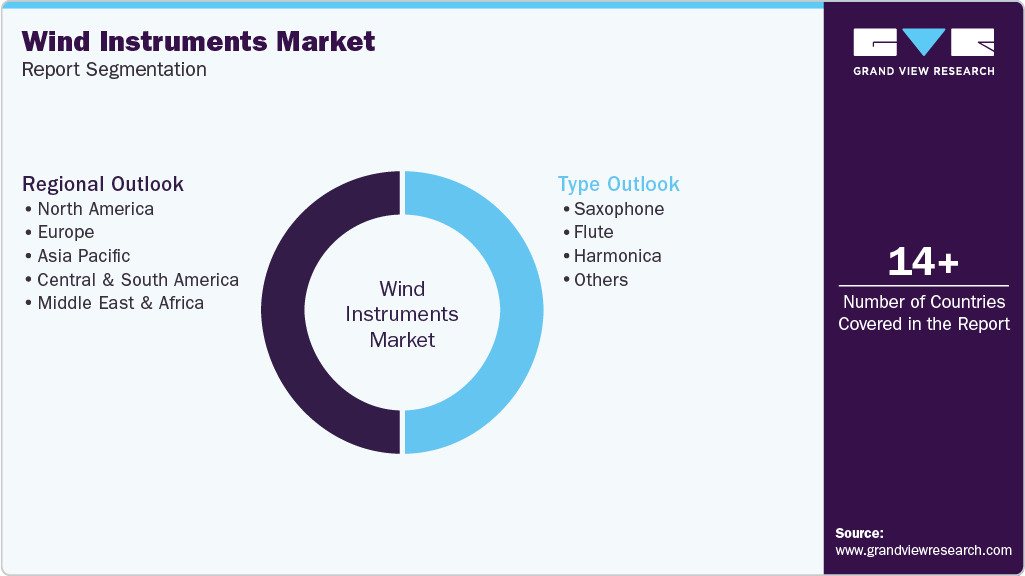
This report forecasts revenue growth at the global, regional & country levels and provides an analysis of the latest trends and opportunities in each sub-segment from 2021 to 2033. For this study, Grand View Research has segmented the global wind instruments market report based on type, and region.
-
Type Outlook (Volume, Thousand Units; Revenue, USD Billion, 2021 - 2033)
-
Saxophone
-
Flute
-
Harmonica
-
Others
-
-
Regional Outlook (Volume, Thousand Units; Revenue, USD Billion, 2021 - 2033)
-
North America
-
U.S.
-
Canada
-
Mexico
-
-
Europe
-
UK
-
Germany
-
France
-
Italy
-
Spain
-
-
Asia Pacific
-
China
-
India
-
Japan
-
South Korea
-
Australia & New Zealand
-
Malaysia
-
Singapore
-
Thailand
-
Vietnam
-
Indonesia
-
Philippines
-
-
Central & South America
-
Brazil
-
-
Middle East & Africa
-
South Africa
-
-
Research Methodology
The wind instruments marketfigures in this report are based on a proven research process that combines executive interviews with secondary research from proprietary databases, company filings, and recognized regulatory and institutional sources. Market size is built through value-chain sizing—reconciling supply-side and demand-side estimates—and triangulated with bottom-up and top-down approaches. Every estimate passes multiple levels of expert validation before publication, with each wind instruments segment quantified using the revenue-capture definitions in the table below.
Segment Definition
Segment - Type
Revenue capture definition
Saxophone
This segment covers the revenues generated through the sales of wind instruments market products, specifically saxophones designed for students, amateur musicians, professional performers, jazz bands, orchestras, and marching bands. The segment includes alto, tenor, soprano, and baritone saxophones manufactured using brass and advanced alloy materials. Real-life examples include the Yamaha YAS-280 Alto Saxophone, Selmer Paris Series III, Yanagisawa WO Series, and Jupiter JAS700.
Flute
This segment covers the revenues generated through the sales of the wind instruments market, specifically flutes used in orchestras, school bands, music academies, solo performances, and recreational learning. The segment includes concert flutes, piccolos, alto flutes, and bass flutes manufactured from silver, nickel silver, gold, and other premium materials. Real-life examples include the Yamaha YFL-222, Pearl Quantz Series, Gemeinhardt 2SP, and Trevor James Cantabile Flute.
Harmonica
This segment covers the revenues generated through the sales of the wind instruments industry, specifically harmonicas used for blues, folk, country, rock, and recreational music applications. The segment includes diatonic, chromatic, tremolo, and octave harmonicas designed for beginners and professional musicians. Real-life examples include the Hohner Marine Band 1896, Suzuki Manji, Lee Oskar Major Diatonic, and Seydel 1847 Classic.
Others
This segment covers the revenues generated through the sales of the wind instruments equipment market, including wind instruments other than saxophones, flutes, and harmonicas. It comprises products such as clarinets, oboes, bassoons, recorders, trumpets, trombones, French horns, tubas, cornets, euphoniums, bagpipes, and pan flutes used across music education, orchestras, marching bands, military bands, and professional performances. Real-life examples include the Buffet Crampon B12 Clarinet, Yamaha YTR-2330 Trumpet, Conn 88H Trombone, and Jupiter JTU1110 Tuba.
Estimation Model
Section
Key Question
Description
Music Participation Layer
Who uses wind instruments?
Estimate the population enrolled in school bands, orchestras, military bands, and music academies to define the addressable user base.
Accessibility Layer
Who has access to purchase?
Apply regional instrument availability, music education infrastructure, and retail penetration to identify consumers with access to wind instruments.
Demand Conversion Layer
Who purchases wind instruments?
Estimate buyers based on enrollment in music programs, replacement demand, professional musicians, and institutional procurement by schools and bands.
Revenue Layer
How much revenue is generated?
Calculate revenue by combining annual instrument sales with average selling prices, while considering brass and woodwind product mix, institutional contracts, and consumer purchases through offline and online channels.
Delivered Customization
This report has been delivered with the following In-depth customizations
Client Request
Customization Delivered
Value Adds
School Bands, Orchestras & Music Education Demand Analysis
Analyzed procurement trends for wind instruments across schools, universities, marching bands, orchestras, and music academies, covering budget allocations, instrument replacement cycles, and student participation in music education programs.
Helps stakeholders identify institutional demand, forecast procurement opportunities, and strengthen partnerships with educational organizations and performing arts institutions.
Professional Performance & Product Portfolio Assessment
Evaluated demand across orchestras, concert bands, jazz ensembles, military bands, and solo performers, including preferences for brass and woodwind instruments, handcrafted models, and premium product offerings.
Enables manufacturers to optimize product portfolios, target professional musicians, and expand presence in high-value performance segments.
Regional Manufacturing & Aftermarket Service Evaluation
Assessed regional manufacturing capabilities, repair and maintenance services, accessory demand, and distribution networks supporting the lifecycle of wind instruments across mature and emerging markets.
Provides strategic insights into aftermarket revenue opportunities, supply chain optimization, regional expansion, and long-term customer retention through value-added services.
Frequently Asked Questions About This Report
The global wind instruments market was valued at USD 1.6 billion in 2025 and is expected to reach USD 1.7 billion in 2026.
The wind instruments market volume was 4,451 thousand units in 2025.
The U.S. dominated the wind instruments market by country.
The flute segment is expected to register the fastest CAGR, at 3.6%.
By type, the saxophone segment accounted for the largest share of the wind instruments market, with a 23.2% market share in 2025.
North America dominated the wind instruments market, accounting for a 46.2% market share in 2025.
Key factors driving the wind instruments market include rising music education and participation, growing live performances and entertainment activities, increasing demand for professional and high-quality instruments, and technological innovations in instrument design.
The global wind instruments market is expected to grow at a compound annual growth rate of 3.5% from 2026 to 2033, reaching USD 2.2 billion by 2033.
Key players in the wind instruments market include Casio Computer Co., Ltd.; C.F. Martin & Co., Inc.; D'addario & Company, Inc.; Eastman Music Company; Fender Musical Instrument Corporation; Kawai Musical Instrument Mfg. Co., Ltd.; Roland Corporation; Steinway & Sons; Yamaha Corporation; Yanagisawa Wind Instruments Co., Ltd.
About the Author(s)
Clothing, Footwear & Accessories Research Team
Consumer Goods · Clothing, Footwear & AccessoriesThis report was authored by the clothing, footwear & accessories research team at Grand View Research - comprising two research analysts, one senior research analyst, and one industry expert - with specialized expertise in the clothing, footwear & accessories segment of the consumer goods industry. All findings are based on proprietary consumer goods databases, executive interviews, and regulatory analysis, subject to internal peer review prior to publication.
Last Updated:
Speak to Analyst


Customize this report to your needs — add regions, segments, or data points, with 20% free customization.
Or view our licence options:


ISO 9001:2015 & 27001:2022 Certified
We are GDPR and CCPA compliant! Your transaction & personal information is safe and secure. For more details, please read our privacy policy.


