
- Home
- »
- Advanced Interior Materials
- »
-
Wire Mesh Market Size, Share & Growth Report, 2026-2033GVR Report cover

Wire Mesh Market (2026 - 2033)
Size, Share & Trend Analysis Report, By End Use (Construction, Industrial, Agriculture, Mining), By Material (Steel, Stainless Steel, Aluminum) By Region (North America, Europe, Asia Pacific, Latin America, MEA), And Segment Forecasts
Market Size, 2025
$8.5BMarket Estimate, 2026
$8.8BMarket Forecast, 2033
$11.6BCAGR, 2026–2033
4.0%Wire Mesh Market Summary
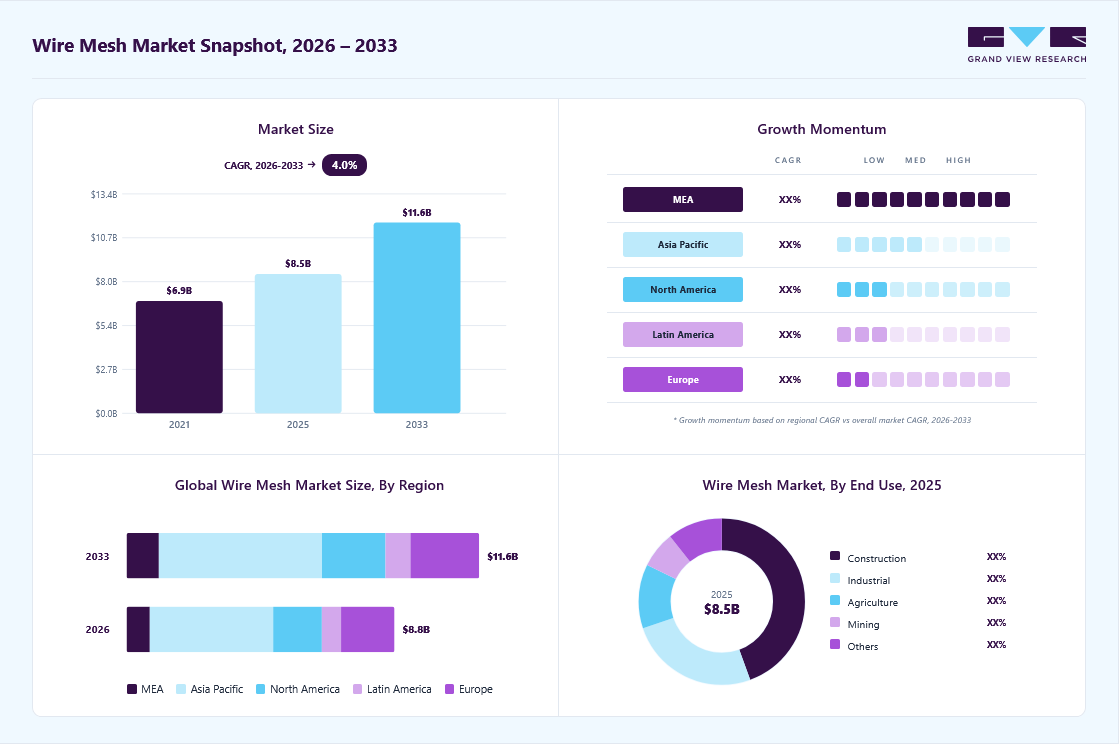
The global wire mesh market size was valued at USD 8.5 billion in 2025 and is projected to grow from USD 8.8 billion to USD 11.6 billion by 2033, at a CAGR of 4.0% from 2026 to 2033. Asia Pacific dominated the market, accounting for a revenue share of 46.0% in 2025. The expansion of construction and infrastructure development is a major growth driver for the market.
 Source: Grand View Research, IR Documents, Primary Interviews, Paid DatabasesTo learn more about this report,
 Download Free Sample Report
 Key Market Trends & Insights
- By end use: Construction accounted for the largest market revenue share of 44.4% in 2025.
- By material: Aluminum segment is anticipated to register the fastest CAGR of 4.4% from 2026 to 2033.
Regional Highlights
- Largest regional market: Asia Pacific (46.0% revenue share, 2025)
- Fastest-growing regional market: Middle East & Africa (highest CAGR, 2026 - 2033)
- By Country: China held the largest share in 2025.
Market Size & Forecast
- Market Size in 2025: USD 8.5 Billion
- Estimated Market Size in 2026: USD 8.8 Billion
- Projected Market Size by 2033: USD 11.6 Billion
- CAGR (2026-2033): 4.0%
Three ways to get this report
Buy it, customize it, or ask a question.Ask an Analyst
A direct answer, usually in 1 working day
- AccessReport author, directly
- Reply timeWithin 1 working day
- No sales callDirect answer only
- FormatEmail reply
- CostFree, no cost
Get the Full Report
What the study covers
- FormatsPDF · Excel · Dashboard
- Timeline2026–2033 annual, 2025 base
- Coverage20+ countries, 5 regions
- Companies10+ key players profiled
Customize the Report
20% free customization
- IncludeCountries, segments, points
- TailorTo your product definition
- ExtendDeeper competitor detail
- OrA fully bespoke study
- Turnaround5–10 working days
Wire mesh is widely used in concrete reinforcement, fencing, partitions, façade systems, safety barriers, and structural applications because of its strength, flexibility, and ease of installation. Growing investment in residential buildings, commercial facilities, industrial plants, transportation infrastructure, and utility projects is supporting demand for welded and woven mesh products.In March 2026, ABB Robotics reported that automotive manufacturers are accelerating investments in automation and robotics, with 31% of surveyed decision-makers identifying increased automation investment as a key response to rising costs and competitive pressures. The survey of 473 automotive industry decision-makers also highlighted labor shortages, wage pressures, and energy and material costs as major challenges, prompting manufacturers to improve production efficiency and workplace safety through automated systems.
 To learn more about this report, Download Free Sample Report
 This trend is expected to support demand for wire mesh in automotive manufacturing facilities, particularly for machine guarding, safety fencing, robotic cell enclosures, partitions, storage systems, and material handling areas. As automotive plants deploy more robots, cobots, AMRs, and automated production cells, the requirement for durable physical barriers and protective enclosures is likely to increase, creating an additional application avenue for wire mesh manufacturers.
Increasing demand for security, perimeter protection, and specialized architectural applications is further contributing to market growth. Industrial facilities, warehouses, logistics centers, airports, energy infrastructure, and critical facilities increasingly use wire mesh fencing, security panels, guards, and barriers to protect assets and control access.
Market Dynamics
The expansion of construction and infrastructure activities is driving demand for wire mesh across residential, commercial, and civil engineering projects. Wire mesh is widely used for concrete reinforcement, fencing, safety barriers, filtration, and structural applications due to its strength, flexibility, and ease of installation. Increasing construction of buildings, transportation infrastructure, and industrial facilities is supporting broader adoption.
Rising industrial manufacturing and material handling activities are further strengthening demand for the product. Industries such as mining, agriculture, automotive, food processing, and chemical processing use wire mesh for screening, separation, guarding, filtration, and conveying applications. Increasing automation and the need for durable, application-specific screening and filtration solutions are encouraging manufacturers to adopt specialized wire mesh products.
Fluctuations in steel and other raw material prices represent a key restraint for the global wire mesh market, as steel is the primary material used in a large share of wire mesh products. In September 2026, steel prices in China continued to move higher, with high-speed wire rod, rebar, and steel channels increasing by 1.0%, 0.9%, and 0.5%, respectively, from August 31 to September 6, while coking coal prices increased by 6.7%. Such fluctuations can increase production costs for wire mesh manufacturers and create pricing uncertainty, particularly for products made from carbon steel and galvanized steel.
Growing demand for corrosion-resistant, high-strength, and precision-engineered wire mesh is creating opportunities across mining, infrastructure, filtration, energy, and industrial processing applications. Manufacturers are developing stainless steel, galvanized, welded, woven, and coated wire mesh products tailored to specific operating conditions. Increasing demand for durable filtration and screening systems, combined with infrastructure modernization, is expected to expand opportunities for higher-value wire mesh products.
Analyst Perspective
The wire mesh market is positioned for steady growth, driven by expanding construction and infrastructure activities, rising industrial manufacturing, and increasing demand for fencing, reinforcement, screening, filtration, and material-handling solutions. Growing automation and continuous production systems are also encouraging the adoption of precision-manufactured mesh with controlled apertures, dimensional accuracy, and improved corrosion resistance.
End Use Insights
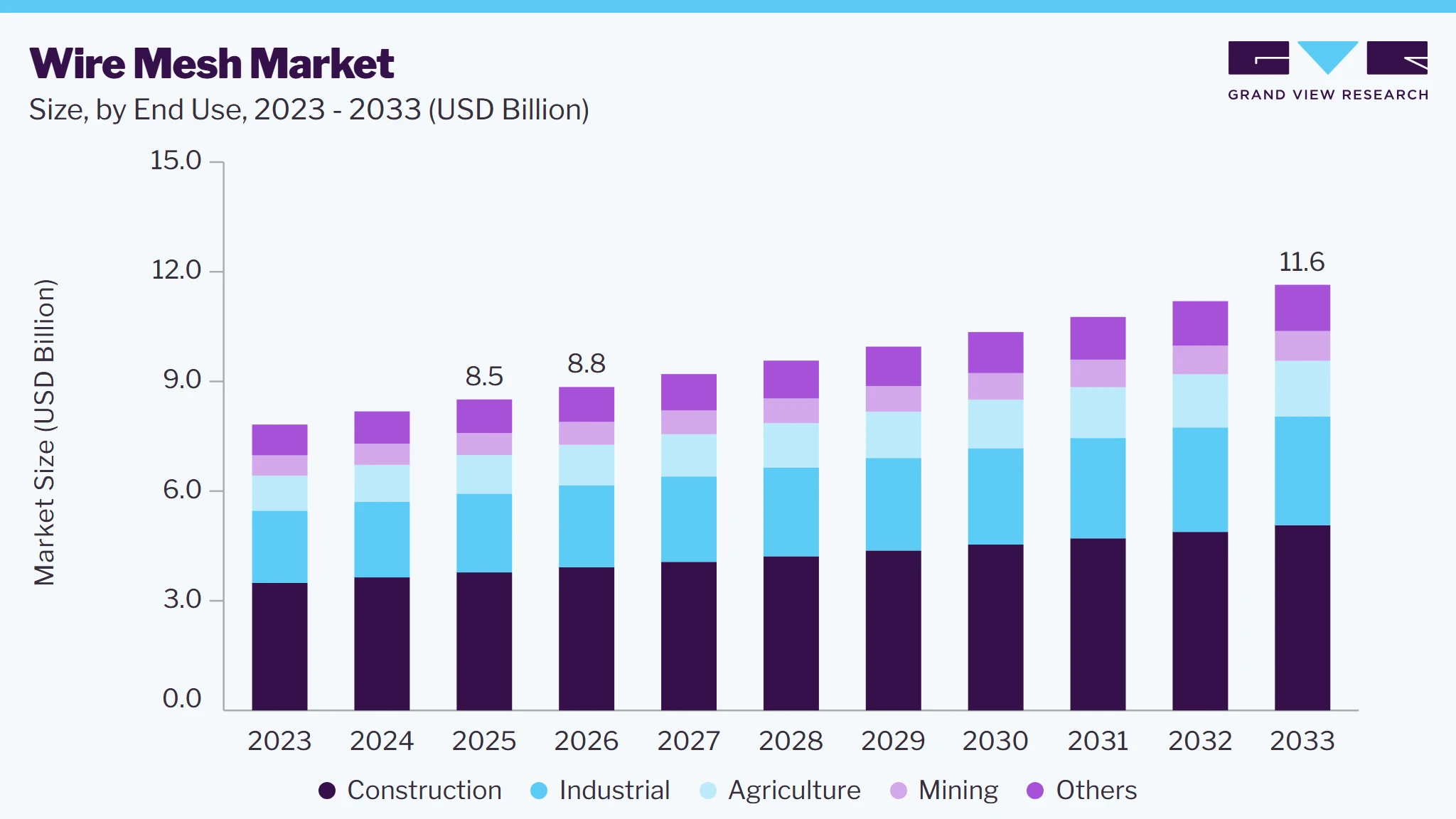
The construction segment held the revenue share of 44.4% in 2025 and is expected to witness strong growth in the market due to the increasing use of wire mesh in concrete reinforcement, fencing, façade systems, partitioning, plastering, and structural applications. Welded and woven wire mesh provides improved structural strength, crack control, dimensional stability, and ease of installation, making it suitable for residential, commercial, and infrastructure projects. Growing urbanization, infrastructure development, renovation activities, and construction of roads, bridges, industrial facilities, and buildings are increasing the demand for reinforcement and safety solutions.
The agriculture segment is expected to witness steady growth in the market. According to the ICAR Kharif Agro Advisories for Farmers 2025, recommended carnation cultivation practices include using mesh systems installed at different heights above the soil surface to support the plants, with two to three layers positioned around 15 cm above the soil and additional layers spaced 20 cm apart. Such agricultural practices demonstrate the use of wire mesh as an important support and crop management material in protected and intensive cultivation systems. The increasing adoption of structured crop support systems, particularly for high-value floriculture crops such as carnation, can therefore contribute to demand for wire mesh in the agriculture segment, where mesh is used for plant support, crop training, structural protection, and improved cultivation efficiency.
Material Insights
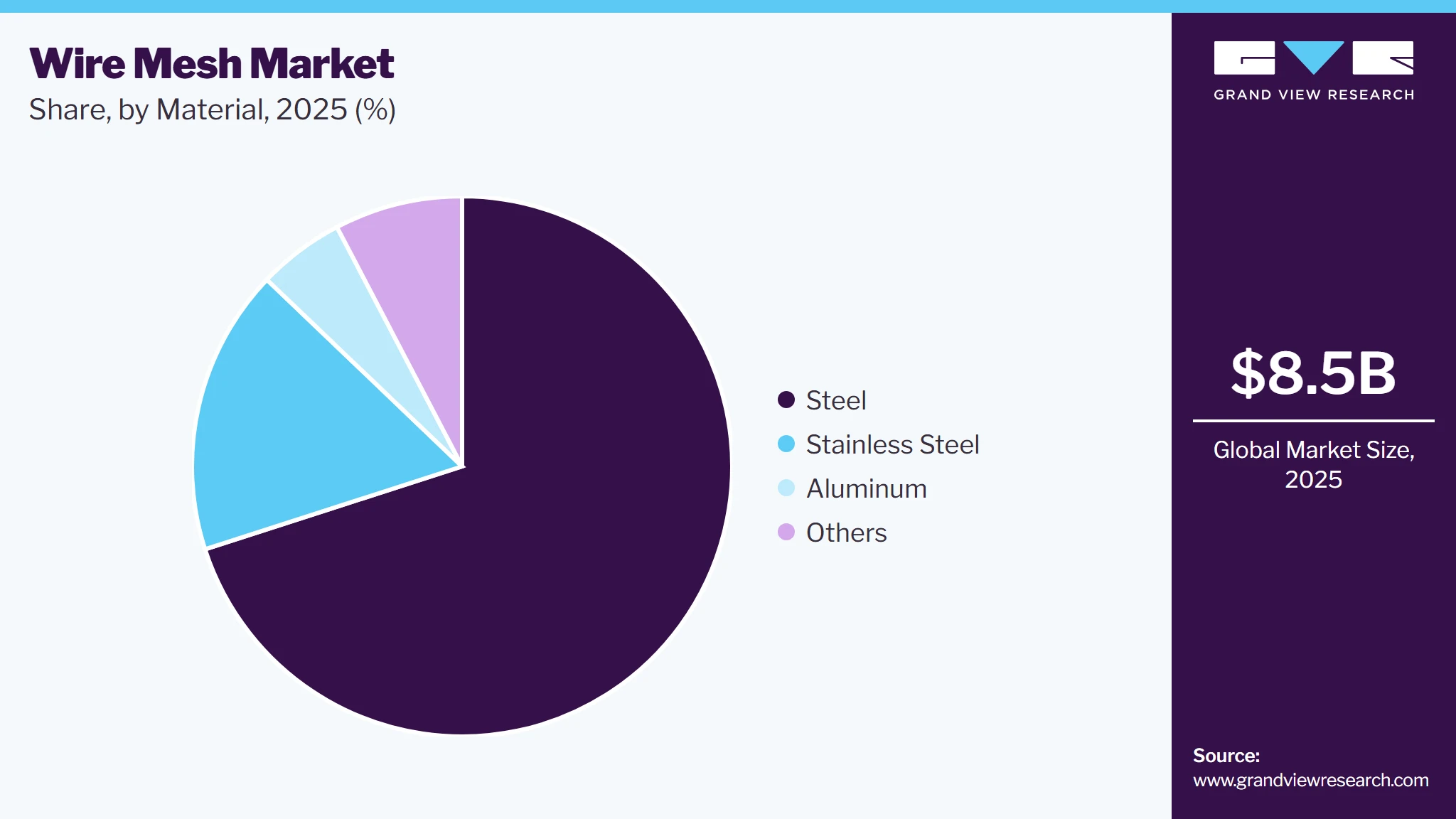
The steel segment held the revenue share of 70.0% in 2025 and is expected to maintain strong demand in the market due to the material's high strength, durability, flexibility, and suitability for diverse industrial and commercial applications. In January 2026, Anping Bingzhe Metal Products Co., Ltd. launched a red-spray-coated steel mesh, expanding its wire mesh offering with surface-treated products designed to provide enhanced protection and visual appeal. Steel wire mesh is extensively used in construction reinforcement, fencing, mining screens, industrial partitions, machinery guards, and agricultural enclosures, where resistance to mechanical stress is essential. Growing infrastructure development, construction activity, industrial expansion, and demand for durable security and reinforcement solutions are supporting consumption of steel wire mesh.
 To learn more about this report, Download Free Sample Report
 The aluminum segment is expected to see strong growth in the wire mesh market due to its lightweight nature, corrosion resistance, high strength-to-weight ratio, and ease of fabrication. Aluminum wire mesh is increasingly used in construction, architecture, filtration, ventilation, agriculture, and industrial applications where reduced weight and resistance to moisture and corrosion are important. Growing demand for lightweight building materials, architectural façades, screening systems, and ventilation components is supporting the adoption of aluminum mesh.
Regional Insights
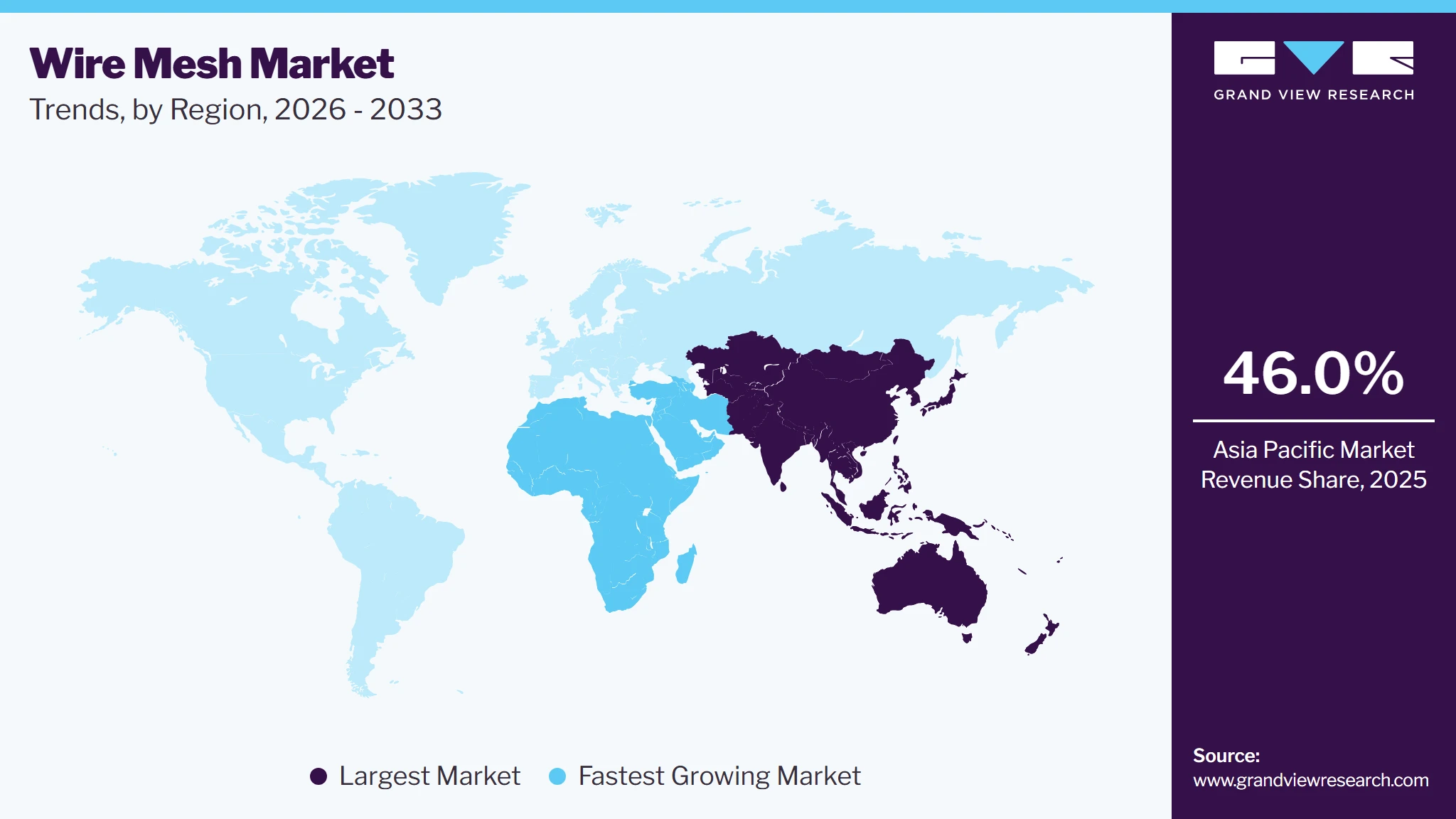
Asia Pacific accounted for the largest market revenue share of 46.0% in 2025. It is expected to remain a leading region in the market, supported by rapid construction activity, agricultural development, infrastructure investment, and expanding manufacturing industries. China, India, Japan, and South Korea are major markets, with wire mesh widely used for reinforcement, fencing, filtration, screening, animal enclosures, and industrial applications. China has a large manufacturing base for steel and aluminum wire mesh, while India is witnessing rising demand from residential and commercial construction, infrastructure projects, agriculture, and industrial fabrication. Increasing investments in transportation infrastructure, industrial facilities, and urban development across Southeast Asia are further supporting regional consumption.
 To learn more about this report, Download Free Sample Report
 China Wire Mesh Market Trends
China represents a major market for wire mesh due to its extensive construction, infrastructure, agriculture, mining, manufacturing, and industrial processing sectors. Large-scale urban development and infrastructure construction continue to generate demand for welded and woven mesh products. China's extensive steel production and wire manufacturing base also supports a large domestic supply chain, allowing manufacturers to serve construction, agricultural, industrial, and export markets.
Europe Wire Mesh Market Trends
Germany, Italy, France, and the UK are growing markets for wire mesh, used in reinforcement, fencing, industrial screening, filtration, safety systems, and architectural applications. Demand is increasingly shifting toward specialized and corrosion-resistant mesh products for infrastructure, industrial processing, and building applications. Renovation of aging infrastructure, energy projects, and investments in industrial facilities are creating additional opportunities for welded, woven, and expanded wire mesh products.
North America Wire Mesh Market Trends
North America is witnessing steady demand for wire mesh due to construction, infrastructure development, agriculture, mining, industrial manufacturing, and security applications. The U.S. accounts for a major share of regional consumption, with welded and woven mesh commonly used for concrete reinforcement, fencing, machine guarding, filtration, and material screening. Mexico is also contributing to regional demand through automotive manufacturing, construction, and industrial development. Increasing investments in transportation infrastructure, commercial facilities, warehouses, and manufacturing plants are supporting demand for durable steel wire mesh products.
The U.S. is the largest wire mesh market in North America, supported by extensive construction, infrastructure, agriculture, manufacturing, mining, and industrial processing activities. Commercial facilities, industrial sites, agricultural properties, and infrastructure projects also support demand for fencing and security mesh. In September 2026, U.S. housing construction data showed that total housing starts declined 2.6% in August to a seasonally adjusted annual rate of 1.275 million units, while single family housing starts increased 7.6% to 918,000 units, indicating continued activity in residential construction despite higher financing and material costs. Continued single family construction and the pipeline of permitted projects can therefore sustain demand for wire mesh products in the U.S. construction sector, although elevated material and financing costs could constrain the pace of future projects.
Middle East & Africa Wire Mesh Market Trends
The Middle East & Africa wire mesh market is developing steadily, supported by infrastructure construction, urban development, agriculture, mining, oil and gas facilities, and industrial expansion. Saudi Arabia and the UAE are important markets because large-scale construction and infrastructure projects require reinforcement mesh, fencing, safety barriers, and industrial screening products. South Africa has established demand from mining, construction, agriculture, and industrial processing applications. Increasing investment in industrial facilities, transportation networks, housing, and agricultural infrastructure across the region is expected to create additional opportunities for welded, woven, and specialized wire mesh products.
Key Wire Mesh Company Insights
Some of the key players operating in the market include Anping Wire Mesh Group, Badische Stahlwerke GmbH, and others
-
Anping Wire Mesh Group, represented by Anping ShuangMai Metal Products Co., Ltd., is a China-based manufacturer and supplier of wire and metal mesh products serving construction and related industrial applications. The company specializes in bar tie wire, rebar tie wire, binding wire, black annealed wire, metal lath, diamond mesh lath, self-furring diamond mesh lath, rib lath, and other construction-related mesh products. Its offerings are primarily used for concrete reinforcement, masonry, plastering, formwork, and construction fastening applications, with products supplied to customers in international markets.
-
Badische Stahlwerke GmbH, based in Kehl, Germany, is an electric steel producer supplying wire rod, reinforcing steel, billets, and reinforcement products to the European construction industry. In the wire mesh segment, the company produces wire rod that is processed within its group companies into welded reinforcing wire mesh, lattice girders, reinforcement wire, and spacers. Its product portfolio includes plain and ribbed wire rod, with wire rod serving as a key feedstock for welded reinforcement mesh used in reinforced concrete construction.
Key Wire Mesh Companies
The following key companies have been profiled for this study on the wire mesh market.
-
Anping Wire Mesh Group
-
Badische Stahlwerke
-
Banker Wire
-
Bekaert
-
Dorstener Drahtwerke
-
Gerard Daniel Worldwide
-
McNally Bharat Engineering Company
-
Riverdale Mills
-
TWP Inc.
-
Van Merksteijn International
Competitive Benchmarking
Category
Operating Strategies
Competitive Edge
Weakness
Established Players (e.g. Bekaert, Van Merksteijn International, Riverdale Mills)
- Mature players in the global wire mesh market generally operate through large-scale manufacturing networks covering welded wire mesh, woven wire mesh, expanded mesh, perforated mesh, and specialized mesh products. Their strategies emphasize consistent production quality, broad material offerings across steel, stainless steel, aluminum, and other alloys, and the ability to serve diverse end-use sectors such as construction, industrial processing, agriculture, mining, and infrastructure.
- The primary competitive advantage of mature players is their established manufacturing scale and extensive product portfolios. High production volumes allow them to achieve economies of scale in wire drawing, welding, weaving, coating, and finishing operations, while established procurement networks provide comparatively reliable access to steel and other raw materials.
- Mature players can face relatively high operating costs because of their large manufacturing footprints, extensive labor and distribution networks, and investments in sophisticated production equipment. Wire mesh manufacturing is also exposed to fluctuations in steel, stainless steel, aluminum, energy, and transportation costs, which can pressure margins, particularly in price-sensitive standard mesh categories.
Emerging & Regional Players (e.g., McNally Bharat Engineering Company, Anping Wire Mesh Group)
- Emerging players in the wire mesh market generally pursue focused strategies based on regional supply, customized products, and specialized applications. Rather than competing directly across the entire product spectrum, they often concentrate on specific mesh configurations, materials, coatings, or end-use industries such as construction reinforcement, fencing, agriculture, mining, and filtration.
- The competitive advantage of emerging players largely comes from operational flexibility and their ability to respond rapidly to localized demand. Smaller manufacturing structures can enable faster customization, shorter communication chains, and more flexible minimum order quantities than large-scale suppliers.
- Emerging players typically face limitations in production scale, purchasing power, distribution reach, and brand recognition. Smaller procurement volumes can make them more vulnerable to fluctuations in steel and other raw-material prices, while limited manufacturing capacity may restrict their ability to fulfill large infrastructure or industrial contracts.
Recent Development
-
In September 2026, Russian online marketplace Wildberries launched a tender to procure approximately 478,000 square meters of galvanized metal wire mesh for logistics centers across eight regions in Russia, with the material reportedly intended to protect against drone attacks following repeated strikes on its warehouse infrastructure.
-
In June 2026, IFA Steels announced an expansion of its welded wire mesh production capacity under its Weld King brand, strengthening its manufacturing capabilities to address growing demand for welded wire mesh across construction, infrastructure, agriculture, and industrial applications. The capacity expansion is expected to support higher production volumes and improve the company’s ability to serve customers with welded wire mesh products, reflecting the broader demand for durable steel mesh solutions in infrastructure and construction projects.
Wire Mesh Market Report Scope
Report Attribute
Details
Market Definition
Market size represents the sale of various wire mesh materials for different end uses in a specific year.
Market size in 2025
USD 8.5 billion
Estimated market size in 2026
USD 8.8 billion
Projected market size by 2033
USD 11.6 billion
Growth rate
CAGR of 4.0% from 2026 to 2033
Base year for estimation
2025
Historical data
2021 - 2024
Forecast period
2026 - 2033
Quantitative units
Revenue in USD million, volume in kilotons, and CAGR from 2026 to 2033
Report coverage
Revenue forecast, volume forecast, competitive landscape, growth factors, and trends
Segments covered
End use, material, and region
Regional scope
North America; Europe; Asia Pacific; Latin America; Middle East & Africa
Country scope
U.S.; Canada; Mexico; Germany; UK; France; Italy; China; India; Japan; South Korea; Brazil
Key companies profiled
Bekaert; Van Merksteijn International; Riverdale Mills; Dorstener Drahtwerke; Banker Wire; Badische Stahlwerke; Gerard Daniel Worldwide; TWP Inc.; McNally Bharat Engineering Company; Anping Wire Mesh Group
Customization scope
Free report customization (equivalent up to 8 analysts working days) with purchase. Addition or alteration to country, regional & segment scope.
Pricing and purchase options
Avail customized purchase options to meet your exact research needs. Explore purchase options
Global Wire Mesh Market Report Segmentation
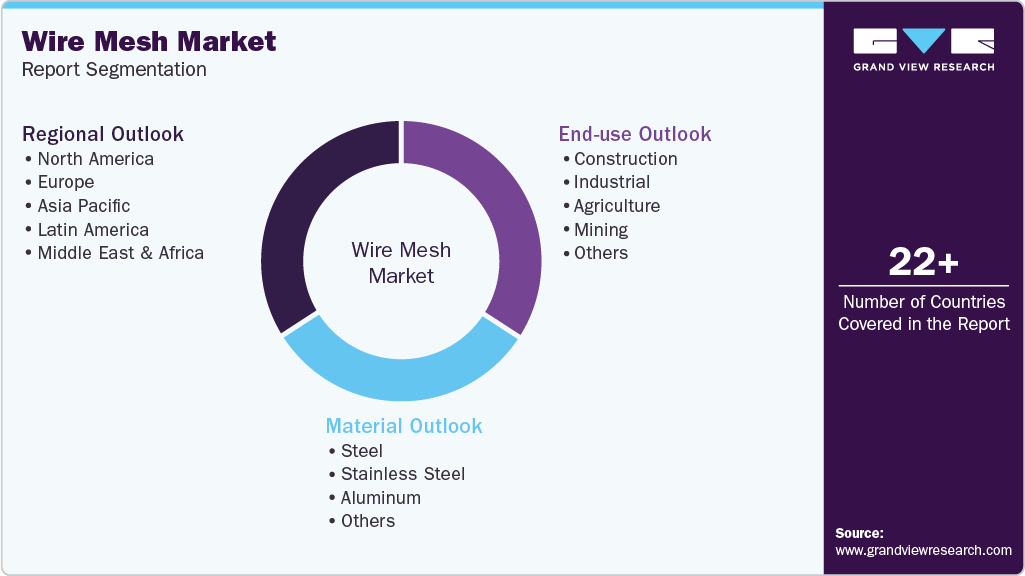
This report forecasts revenue and volume growth at global, regional, and country levels and provides an analysis of the latest industry trends in each of the sub-segments from 2021 to 2033. For this study, Grand View Research has segmented the global wire mesh market report on the basis of end use, material, and region.
 To learn more about this report, Download Free Sample Report
 -
End Use Outlook (Volume, Kilotons; Revenue, USD Million, 2021 - 2033)
-
Construction
-
Industrial
-
Agriculture
-
Mining
-
Others
-
-
Material Outlook (Volume, Kilotons; Revenue, USD Million, 2021 - 2033)
-
Steel
-
Stainless Steel
-
Aluminum
-
Others
-
-
Regional Outlook (Volume, Kilotons; Revenue, USD Million, 2021 - 2033)
-
North America
-
U.S.
-
Canada
-
Mexico
-
-
Europe
-
Germany
-
UK
-
France
-
Italy
-
-
Asia Pacific
-
China
-
India
-
Japan
-
South Korea
-
-
Latin America
-
Brazil
-
-
Middle East & Africa
-
Research Methodology
The wire mesh market figures in this report are based on a proven research process that combines executive interviews with secondary research from proprietary databases, company filings, and recognized regulatory and institutional sources. Market size is built through value-chain sizing - reconciling supply-side and demand-side estimates - and triangulated with bottom-up and top-down approaches. Every estimate passes multiple levels of expert validation before publication, with each wire mesh segment quantified using the revenue-capture definitions in the table below.
Segment Definition
End Use
Revenue Capture Definition
Construction
The construction segment captures revenue generated from wire mesh used in concrete reinforcement, fencing, partitions, safety barriers, scaffolding, plastering, and other structural and architectural applications.
Industrial
The industrial segment represents revenue generated from wire mesh used in machinery guards, filtration and screening systems, conveyor belts, partitions, storage systems, material handling equipment, and industrial enclosures.
Agriculture
The agriculture segment includes revenue generated from wire mesh used for animal enclosures, poultry cages, fencing, crop protection, storage areas, and agricultural screening applications.
Mining
The mining segment captures revenue generated from wire mesh used for screening and sizing, rockfall protection, mine ventilation, material handling, safety barriers, and ground support systems.
Others
The others segment represents revenue generated from wire mesh used in applications such as automotive, aerospace, food processing, residential, retail, landscaping, and security.
Material
Revenue Capture Definition
Steel
The steel segment captures revenue generated from the sale of wire mesh manufactured using carbon steel or other conventional steel grades.
Stainless Steel
The stainless steel segment represents revenue generated from wire mesh manufactured using stainless steel grades such as 304, 316, and other alloy variants.
Aluminum
The aluminum segment includes revenue generated from wire mesh manufactured using aluminum wire and aluminum alloys.
Others
The others segment captures revenue generated from wire mesh manufactured using materials other than steel, stainless steel, and aluminum, including copper, brass, bronze, nickel alloys, titanium, and other specialty materials.
Estimation Model
Layer Name
Key Question
Description
Construction & Industrial Demand Base Layer
What forms the demand base?
Identify global demand from major wire mesh consuming industries including construction, agriculture, mining, infrastructure, transportation, and industrial manufacturing. Assess construction activity, infrastructure investments, agricultural production, mining operations, and industrial output to establish the total addressable demand for wire mesh products.
Wire Mesh Application Penetration Layer
Where is wire mesh utilized?
Estimate the penetration of wire mesh across key applications including concrete reinforcement, fencing & security, animal enclosures, agricultural applications, filtration & screening, mining screens, gabions, partitions, and industrial equipment. Analyze the adoption of welded wire mesh, woven wire mesh, expanded mesh, and other mesh formats across end-use industries and regions.
Wire Mesh Consumption Intensity Layer
How much wire mesh is consumed?
Analyze wire mesh consumption intensity based on construction floor area, concrete reinforcement requirements, fencing length, agricultural land and livestock facilities, mining throughput, and industrial screening requirements. Evaluate mesh usage according to wire diameter, opening size, mesh configuration, material, coating, and application specifications. Consumption intensity varies according to project scale, structural requirements, operating conditions, corrosion resistance, and replacement cycles.
Revenue Layer
How is market revenue generated?
Market revenue is quantified through the sale of wire mesh products manufactured from steel, stainless steel, aluminum, and other materials, including welded, woven, expanded, and specialty mesh. Revenue generation is driven by construction, agriculture, mining, infrastructure, and industrial applications.
Delivered Customizations
We have successfully delivered the following deep-dive customizations
Client Request
Customization Delivered
Value Adds
Regional Segmentation
Detailed regional analysis of the wire mesh market across North America, Europe, Asia Pacific, Latin America, and Middle East & Africa. Included evaluation of construction activity, infrastructure development, agricultural production, mining operations, industrial manufacturing, fencing requirements, and investments in manufacturing capacity.
Identified major production hubs, high growth consumption markets, and emerging demand centers. Enabled strategic expansion planning based on construction, agriculture, mining, and industrial activity. Supported regional demand forecasting and supply chain optimization.
Opportunity Assessment
Identification of high growth opportunities across construction reinforcement, infrastructure projects, agricultural fencing, mining and quarrying, industrial filtration, security fencing, animal enclosures, transportation infrastructure, energy projects, and customized industrial mesh applications.
Enabled prioritization of high return growth segments and emerging regional opportunities. Supported long term manufacturing capacity expansion, product innovation, customization capabilities, strategic partnerships, and business development initiatives aligned with infrastructure, industrial, agricultural, and mining sector growth.
Cross Segmentation
Comprehensive cross segmentation analysis by material, product type, application, end use, and region, including steel, stainless steel, aluminum, and other materials across woven wire mesh, welded wire mesh, expanded metal mesh, and other products.
Enabled identification of the most attractive material, product, and application combinations. Supported product portfolio optimization, customer targeting, capacity planning, and investment prioritization strategies.
Frequently Asked Questions About This Report
The global wire mesh market size was estimated at USD 8.5 billion in 2025 and is expected to reach USD 8.8 billion in 2026.
The global wire mesh market is expected to grow at a compound annual growth rate of 4.0% from 2026 to 2033 to reach USD 11.6 billion by 2033.
Asia Pacific dominated the market with revenue share of 46.0% in 2025.
China dominated the Asia Pacific market with revenue share of 44.7% in 2025.
Based on end use, construction accounted for largest revenue share of 44.4% in 2025.
Steel accounted for largest revenue share of 70.0% in 2025.
Aluminum is anticipated to register the fastest CAGR over the forecast period.
The key driver of growth in the global wire mesh market is increasing demand for durable and versatile reinforcement, filtration, fencing, and construction applications across residential, commercial, and industrial sectors.
Some of the key players of the global wire mesh market are Bekaert, Van Merksteijn International, Riverdale Mills, Dorstener Drahtwerke, Banker Wire, Badische Stahlwerke, Gerard Daniel Worldwide, TWP Inc., McNally Bharat Engineering Company, Anping Wire Mesh Group, and others.
About the Author(s)
Advanced Interior Materials Research Team
Advanced Materials · Advanced Interior MaterialsThis report was authored by the advanced interior materials research team at Grand View Research - comprising two research analysts, one senior research analyst, and one industry expert - with specialized expertise in the advanced interior materials segment of the advanced materials industry. All findings are based on proprietary advanced materials databases, executive interviews, and regulatory analysis, subject to internal peer review prior to publication.
Last Updated:
Speak to Analyst

Customize this report to your needs - add regions, segments, or data points, with 20% free customization.
Or view our licence options:


ISO 9001:2015 & 27001:2022 Certified
We are GDPR and CCPA compliant! Your transaction & personal information is safe and secure. For more details, please read our privacy policy.


