
- Home
- »
- Medical Devices
- »
-
Wound Imaging Device Market Size, Share Report 2026-2033GVR Report cover

Wound Imaging Device Market (2026 - 2033)
Size, Share & Trends Analysis Report By Product Type (Dedicated Handheld & Portable Devices, Mobile App & Software Solutions), By Technology / Modality, By Wound Type, By End-use, By Region, And Segment Forecasts
Market Size, 2025
$288.2MMarket Estimate, 2026
$330.2MMarket Forecast, 2033
$953.7MCAGR, 2026–2033
16.4%Wound Imaging Device Market Summary
The global wound imaging device market size was valued at USD 288.2 million in 2025 and is projected to grow from USD 330.2 million in 2026 to USD 953.7 million by 2033, at a CAGR of 16.4% from 2026 to 2033. North America dominated the market, accounting for the largest revenue share of 47.1% in 2025. The growth of the wound imaging device industry is primarily driven by the rising prevalence of chronic wounds, including diabetic foot ulcers, pressure ulcers, and venous leg ulcers, along with the increasing global burden of diabetes and an aging population.
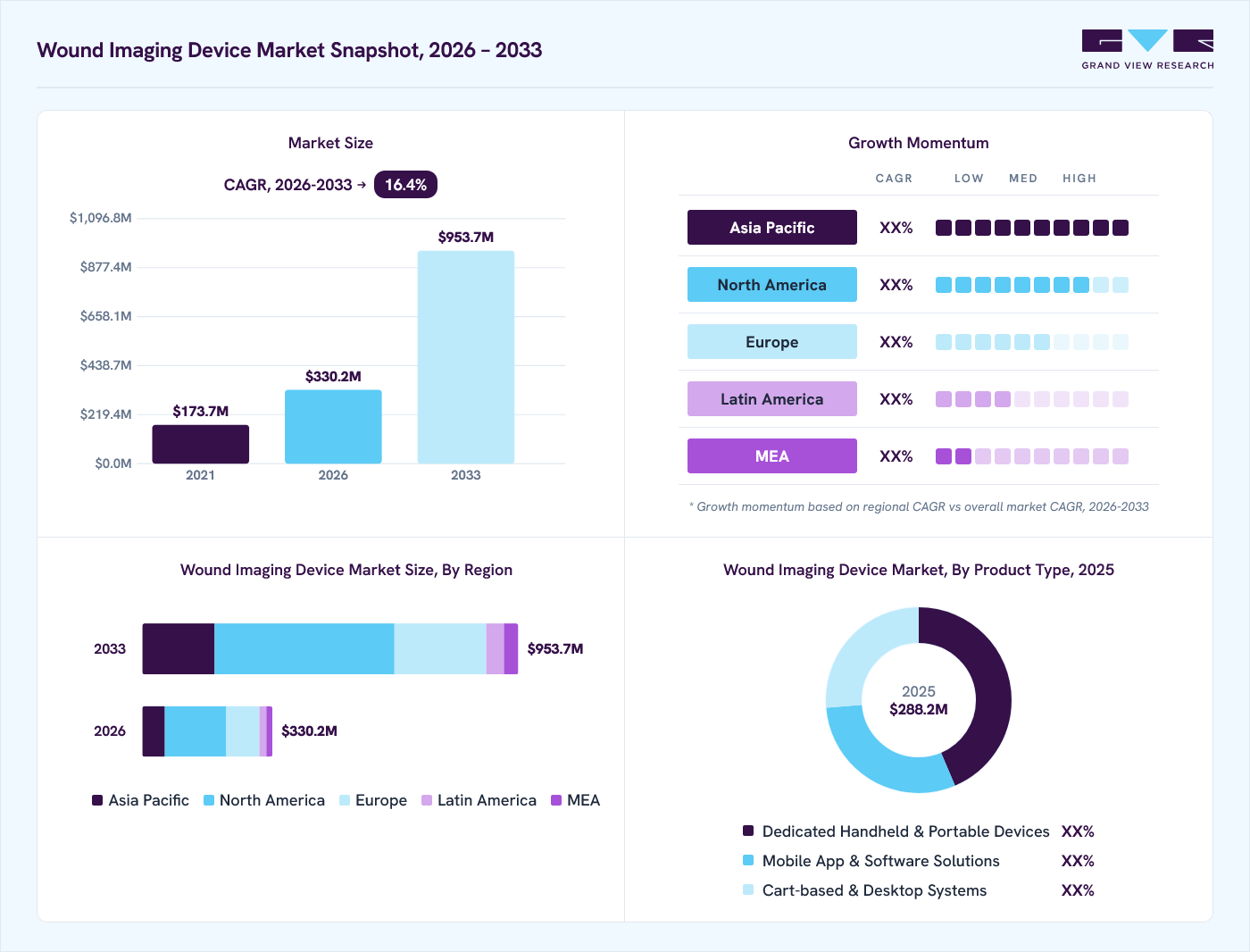 Source: Grand View Research, IR Documents, Primary Interviews, Paid DatabasesTo learn more about this report,
 Download Free Sample Report
 Key Market Trends & Insights
- By product type: Dedicated handheld & portable devices held the largest revenue share of 43.6% in 2025.
- By technology/modality: Visible light imaging (2D/color) held the largest revenue share of 51.0% in 2025.
- By wound type: Chronic wounds held the largest revenue share of 66.0% in 2025.
- By end use: Hospitals held the largest revenue share of 47.6% in 2025.
Regional Highlights
- Largest regional market: North America (47.1% revenue share, 2025)
- Fastest-growing regional market: Asia Pacific (highest CAGR, 2026-2033)
- By country: The U.S. held the largest revenue share of North America in 2025
Market Size & Forecast
- Market size in 2025: USD 288.2 Million
- Estimated market size in 2026: USD 330.2 Million
- Projected market size by 2033: USD 953.7 Million
- CAGR (2026-2033): 16.4%
Three ways to get this report
Buy it, customize it, or ask a question.Ask an Analyst
A direct answer, usually in 1 working day
- AccessReport author, directly
- Reply timeWithin 1 working day
- No sales callDirect answer only
- FormatEmail reply
- CostFree, no cost
Get the Full Report
What the study covers
- FormatsPDF · Excel · Dashboard
- Timeline2026–2033 annual, 2025 base
- Coverage20+ countries, 5 regions
- Companies10+ key players profiled
Customize the Report
20% free customization
- IncludeCountries, segments, points
- TailorTo your product definition
- ExtendDeeper competitor detail
- OrA fully bespoke study
- Turnaround5–10 working days
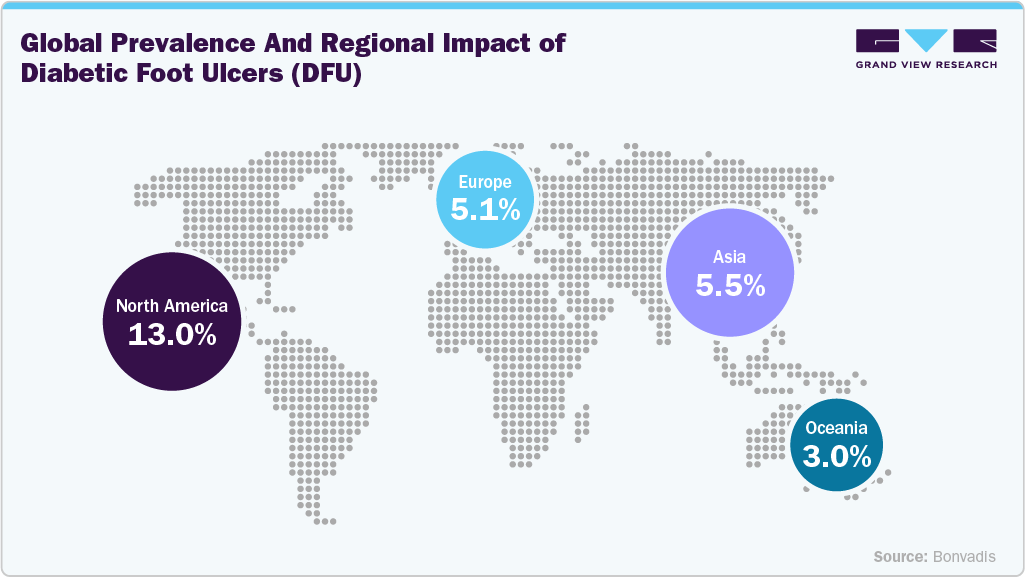
Growing adoption of AI-enabled wound assessment, digital wound documentation, and telemedicine solutions is further accelerating demand by enabling accurate wound measurement, early detection of complications, and improved clinical decision-making across healthcare settings. The increasing prevalence of chronic wounds, particularly diabetic foot ulcers (DFUs), pressure ulcers, and venous leg ulcers, is a major driver of the wound imaging device market.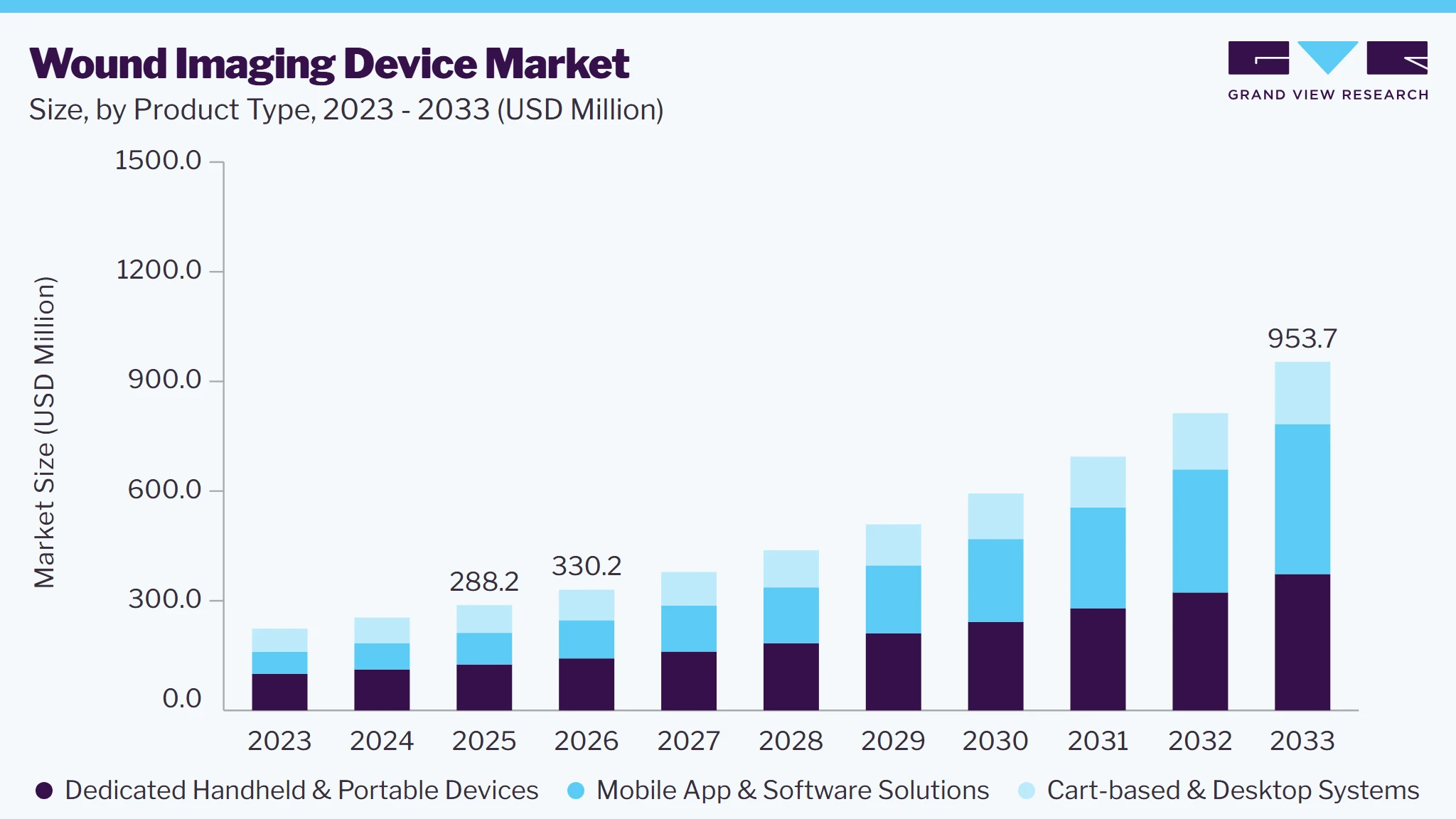 To learn more about this report, Download Free Sample Report
 As the global diabetic population continues to grow, healthcare providers are adopting wound imaging technologies to enable accurate wound measurement, monitor healing progression, and support early detection of complications. Studies indicate that people with diabetes have a 19-34% lifetime risk of developing a diabetic foot ulcer, highlighting the need for advanced wound assessment solutions.
 To learn more about this report, Download Free Sample Report
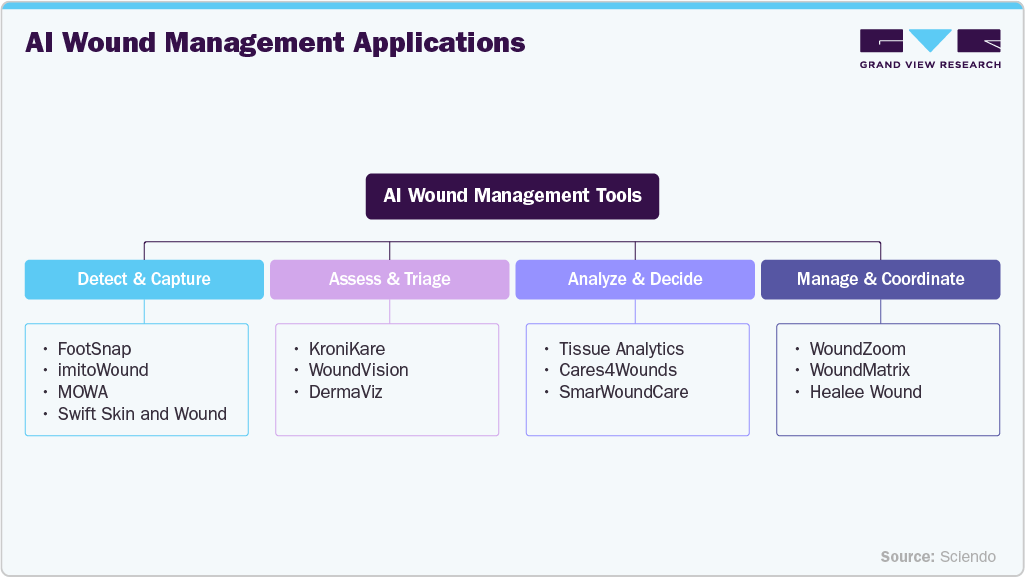
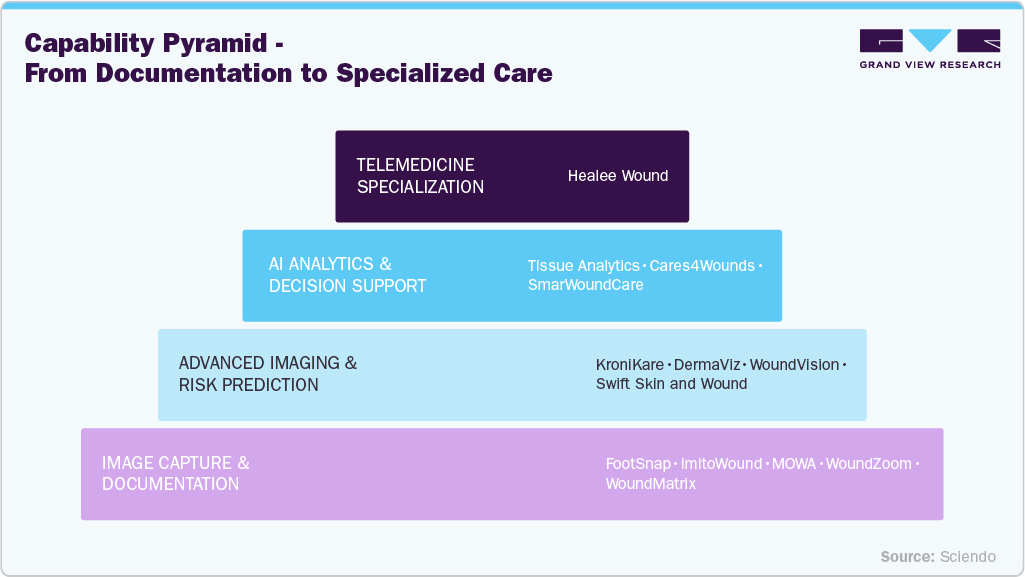
 The increasing adoption of AI-powered wound assessment technologies is a key driver of the wound imaging device market, enabling automated wound measurement, tissue classification, healing prediction, and early detection of complications with greater accuracy than conventional assessment methods. AI-based image analysis also standardizes wound documentation, reduces clinician variability, and supports remote monitoring through telemedicine, improving clinical outcomes and workflow efficiency. For instance, Swift Medical's Swift Skin & Wound platform leverages AI and a database of more than 32 million wound images to provide automated wound assessment, tissue analytics, and clinical decision support. The platform has demonstrated improved clinical efficiency, including 79% faster wound assessments and 15% fewer wound-related hospitalizations, highlighting the growing adoption of AI in wound care.
 To learn more about this report, Download Free Sample Report
  To learn more about this report, Download Free Sample Report
 The rising prevalence of diabetic foot ulcers (DFUs) is a major driver of the wound imaging device market, as these chronic wounds require regular assessment to monitor healing and detect complications early. Wound imaging devices enable accurate wound measurement, tissue analysis, and documentation, helping clinicians optimize treatment decisions, reduce the risk of infection and amputation, and improve patient outcomes.
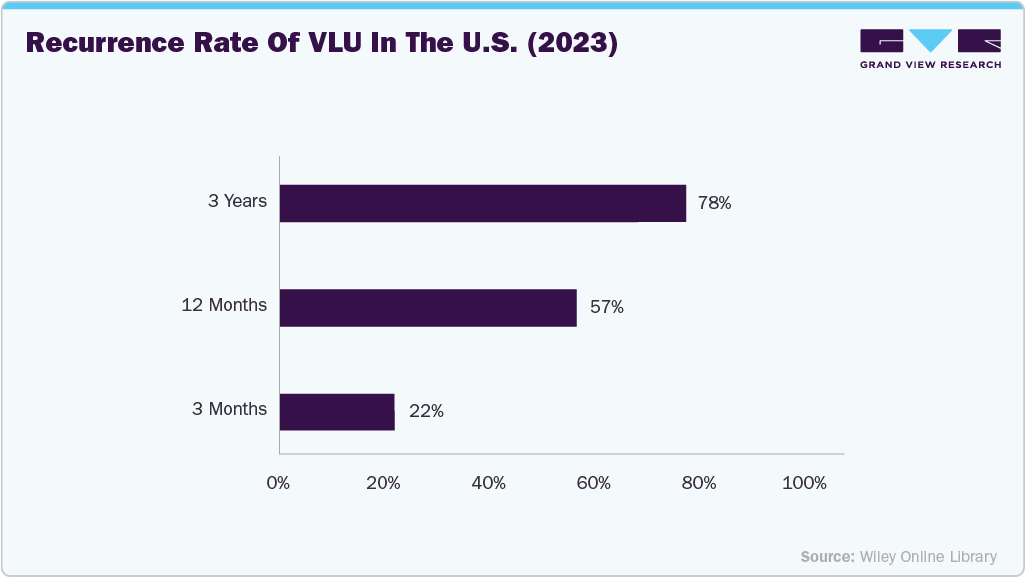
Similarly, the increasing prevalence of venous leg ulcers (VLUs) is driving the demand for wound imaging devices, as these chronic wounds require frequent monitoring to assess healing progression and guide treatment decisions. Advanced wound imaging technologies provide accurate wound measurement, tissue visualization, and digital documentation, enabling clinicians to optimize compression therapy, detect complications early, and improve overall patient outcomes.
Market Dynamics
The wound imaging device market is experiencing strong growth, driven by the rising prevalence of chronic wounds, increasing incidence of diabetes, and growing adoption of AI-powered digital wound assessment technologies. Advancements in 3D, fluorescence, and hyperspectral imaging, as well as cloud-based analytics, are improving diagnostic accuracy and treatment monitoring across healthcare settings. However, high device costs, reimbursement limitations, and regulatory compliance requirements may restrain market growth, while expanding telemedicine, home healthcare, and smartphone-based wound-imaging solutions offer significant growth opportunities.
The wound imaging device market is primarily driven by the increasing prevalence of chronic wounds, including diabetic foot ulcers, pressure ulcers, and venous leg ulcers, along with the rising global burden of diabetes and an aging population. Growing adoption of AI-powered wound assessment, digital wound documentation, and telemedicine is accelerating demand for accurate, real-time wound monitoring. In addition, advancements in portable imaging technologies and increasing focus on early diagnosis and personalized wound management are further supporting market growth.
The wound imaging device market is restrained by the high cost of advanced imaging systems, AI-enabled software, and ongoing maintenance, which can limit adoption among small hospitals, clinics, and other healthcare facilities with constrained budgets. In addition, limited reimbursement coverage for digital wound imaging in several countries reduces the financial incentive for healthcare providers to invest in these technologies. The need for clinician training and integration with existing hospital IT systems further adds to implementation costs and adoption challenges.
The wound imaging device market presents significant growth opportunities as the adoption of telemedicine, home healthcare, and AI-enabled remote wound monitoring solutions expands. The increasing demand for smartphone-based wound imaging applications and cloud-connected platforms enables clinicians to assess wounds remotely, improve care coordination, and reduce unnecessary hospital visits. In addition, integrating wound imaging devices with artificial intelligence and electronic health records (EHRs) is expected to enhance clinical decision-making and drive broader market adoption.
Furthermore, growing investments in digital health infrastructure, increasing healthcare expenditure, and supportive government initiatives promoting remote patient monitoring are creating favorable conditions for market expansion. The rising focus on value-based healthcare and personalized wound management is also encouraging healthcare providers to adopt advanced imaging technologies that improve treatment outcomes, optimize resource utilization, and reduce long-term healthcare costs.
Market Concentration & Characteristics
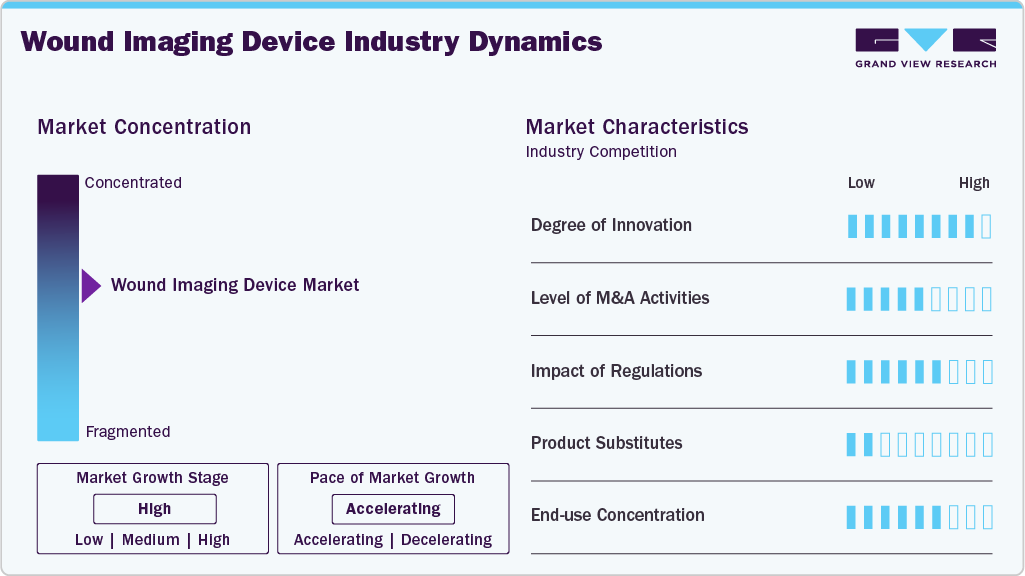
The wound imaging device market is characterized by high innovation, driven by advancements in AI-powered image analysis, multimodal imaging, smartphone-based wound assessment, and cloud-enabled clinical workflows. Manufacturers are continuously enhancing imaging accuracy, bacterial detection, thermal assessment, and remote monitoring capabilities to improve clinical decision-making. For instance, in April 2025, MolecuLight launched the Thermal Imaging Module for its MolecuLight DX platform, integrating thermal imaging with fluorescence imaging and digital wound measurement in a single handheld device to provide comprehensive point-of-care wound assessment.
“MolecuLight continues to push the boundaries of diagnostic imaging in wound care, and this launch represents a significant leap forward,” said Anil Amlani, CEO of MolecuLight. “For the first time, clinicians can access critical insights from three essential assessment modalities - precise digital wound measurement, our validated bacterial fluorescence imaging, and informative thermal imaging - all seamlessly integrated within a single, handheld device. This powerful, multimodal capability provides a truly comprehensive view of the wound environment right at the point-of-care, empowering clinicians with unparalleled insights for more effective, data-driven treatment decisions and enhanced monitoring of healing progress.”
 To learn more about this report, Download Free Sample Report
 The wound imaging device industry is witnessing a moderate level of mergers and acquisitions, with companies pursuing strategic acquisitions and partnerships to strengthen their digital health, AI, and wound care capabilities. M&A activity is primarily focused on expanding product portfolios, integrating advanced imaging technologies with software platforms, and enhancing geographic reach. These collaborations are accelerating innovation, improving end-to-end wound management solutions, and increasing market competitiveness.
Regulatory frameworks have a high impact on the market, as manufacturers must comply with stringent safety, performance, cybersecurity, and clinical validation requirements before commercialization. Regulatory approvals from agencies such as the U.S. FDA, European MDR, and other national authorities are driving the development of reliable, AI-enabled wound imaging systems while ensuring patient safety and data security. These regulations also encourage interoperability with electronic health records (EHRs) and support broader clinical adoption of digital wound assessment technologies. For instance, in January 2026, MolecuLight announced that its MolecuLightDX wound measurement technology was qualified by the U.S. FDA as a Medical Device Development Tool (MDDT). This qualification enables the device’s quantitative wound measurement function to generate FDA-accepted data for clinical investigations and supports its use as a validated tool in the evaluation and regulatory development of new wound care products, strengthening confidence in digital wound imaging technologies.
“The FDA’s qualification of MolecuLightDX as an MDDT reflects the strength of our clinical evidence and the agency’s confidence in the accuracy and reproducibility of our wound measurement technology,” said Anil Amlani, Chief Executive Officer of MolecuLight. “This designation enables researchers and sponsors to use MolecuLightDX as a standardized, trusted measurement tool in wound healing studies, accelerating innovation and improving patient outcomes.”
The wound imaging device market exhibits moderate to high end-use concentration, with hospitals and specialized wound care centers accounting for the largest share due to their high patient volumes and adoption of advanced wound assessment technologies. However, the increasing use of portable imaging devices, AI-powered software, and telemedicine platforms is expanding adoption across outpatient clinics, home healthcare, and long-term care facilities, gradually diversifying the end-user landscape.
Analyst Perspective
The wound imaging device market is expected to witness strong long-term growth, driven by the increasing prevalence of chronic wounds, rapid adoption of AI-powered wound assessment, and expanding use of digital health technologies. The transition from subjective visual wound evaluation to objective, image-based assessment is improving clinical accuracy, treatment planning, and patient outcomes across hospitals, wound care clinics, and home healthcare settings.
The integration of artificial intelligence, cloud connectivity, electronic health records (EHRs), and remote patient monitoring will be a key differentiator among market participants. Companies that focus on developing portable, cost-effective, and interoperable imaging solutions while expanding regulatory approvals and clinical evidence are expected to strengthen their competitive position and capture significant market share during the forecast period.
Product Type Insights
The dedicated handheld & portable devices segment dominated the wound imaging device market in 2025, owing to their portability, ease of use, and ability to provide rapid, point-of-care wound assessment across hospitals, outpatient clinics, and home healthcare settings. These devices offer accurate wound measurement, high-resolution imaging, and real-time documentation while improving clinical workflow and reducing assessment variability. Their increasing integration with AI-powered analytics and cloud-based platforms has further strengthened their adoption for chronic wound monitoring and treatment planning.
The mobile app & software solutions segment is expected to register the fastest growth during the forecast period, driven by the increasing adoption of smartphone-based wound assessment, telemedicine, and remote patient monitoring. AI-powered mobile applications enable real-time wound measurement, automated documentation, and cloud-based data sharing, improving clinical decision-making and care coordination. Their lower implementation cost, ease of deployment, and seamless integration with electronic health records (EHRs) are further accelerating adoption across hospitals, home healthcare, and outpatient settings.
Technology/Modality Insights
The visible light imaging (2D/color) segment dominated the wound imaging device industry in 2025, owing to its widespread adoption for routine wound documentation, accurate wound measurement, and cost-effective clinical assessment. The technology is easy to use, integrates seamlessly with smartphones and electronic health records (EHRs), and supports consistent monitoring of wound healing over time. Its broad availability across hospitals, wound care clinics, and home healthcare settings has further strengthened its leading market position.
The near-infrared (NIR) & hyperspectral imaging segment is expected to witness the fastest growth during the forecast period, driven by its ability to provide non-invasive assessment of tissue oxygenation, perfusion, and wound viability before visible clinical changes occur. These advanced imaging technologies enable early detection of infection and ischemia, supporting more precise treatment decisions and improved healing outcomes. Increasing integration with AI-based image analysis and growing adoption in chronic wound management and research are further accelerating segment growth.
Wound Type Insights
The chronic wounds segment dominated the wound imaging device market in 2025, driven by the rising prevalence of diabetic foot ulcers, pressure ulcers, and venous leg ulcers that require continuous monitoring and long-term management. Wound imaging devices enable accurate measurement, standardized documentation, and timely assessment of healing progression, improving clinical decision-making. The increasing burden of diabetes, an aging population, and growing adoption of digital wound care solutions further supported the segment’s market dominance.
The acute & other wounds segment is expected to register the fastest growth during the forecast period, driven by the increasing number of surgical procedures, traumatic injuries, burns, and emergency wound cases worldwide. Growing adoption of digital wound imaging for rapid assessment, infection monitoring, and treatment planning in emergency departments and surgical settings is accelerating demand. In addition, the expanding use of portable, AI-enabled wound imaging devices in hospitals and ambulatory care centers is expected to further support segment growth.
End Use Insights
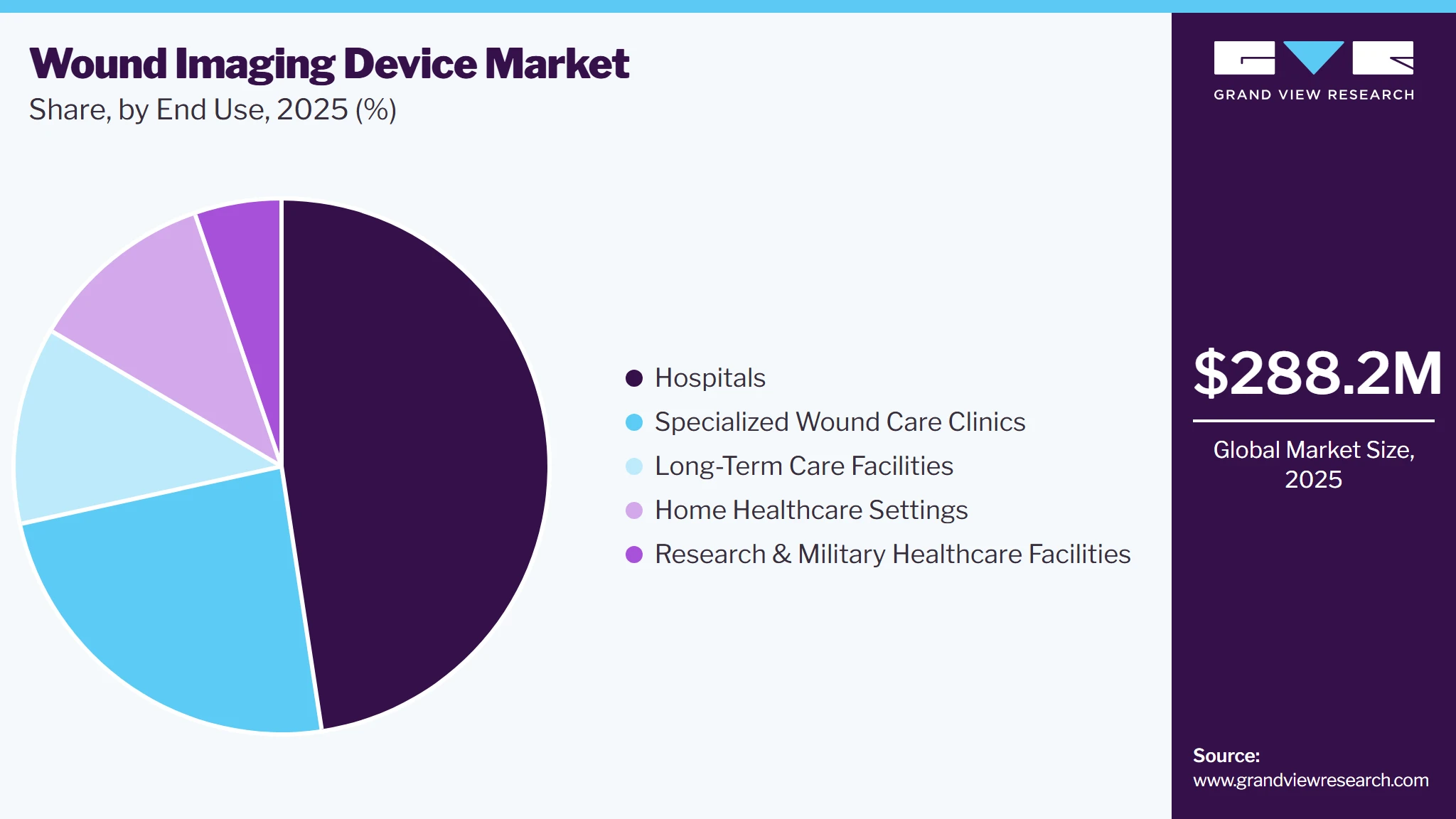
The hospitals segment dominated the wound imaging device industry in 2025, driven by the high volume of patients with chronic wounds, surgical wounds, burns, and traumatic injuries requiring advanced wound assessment. Hospitals have well-established infrastructure and greater access to digital imaging technologies, enabling accurate wound documentation, monitoring, and multidisciplinary care. The increasing adoption of AI-enabled wound imaging systems integrated with electronic health records (EHRs) further strengthened the segment’s market leadership.
 To learn more about this report, Download Free Sample Report
 The specialized wound care clinics segment is expected to register the fastest growth during the forecast period, driven by the increasing number of patients with chronic and complex wounds requiring dedicated multidisciplinary care. These clinics are rapidly adopting advanced wound imaging devices to improve diagnostic accuracy, monitor healing progression, and optimize treatment outcomes. Growing hospital referrals, rising demand for outpatient wound management, and greater integration of AI-enabled imaging technologies are further accelerating segment growth.
Regional Insights
The North America wound imaging device market accounted for a significant share of the global market, driven by the high prevalence of chronic wounds, diabetic foot ulcers, and pressure injuries, as well as the widespread adoption of advanced digital wound care technologies. The region also benefits from well-established healthcare infrastructure, favorable reimbursement for wound management services, increasing integration of AI-enabled imaging solutions, and the strong presence of leading medical device manufacturers, all of which support continued market growth.
 To learn more about this report, Download Free Sample Report
 U.S. Wound Imaging Device Market Trends
The U.S. wound imaging device industry accounts for the largest share of North America, driven by the high prevalence of chronic wounds, the increasing incidence of diabetes and obesity, and strong adoption of digital wound assessment technologies. The country's advanced healthcare infrastructure, favorable reimbursement landscape, widespread implementation of electronic health records (EHRs), and early adoption of AI-enabled wound imaging solutions continue to support market growth across hospitals, wound care centers, and home healthcare settings.
Europe Wound Imaging Device Market Trends
 To learn more about this report, Download Free Sample Report
 The Europe wound imaging device industry holds a substantial share of the global market, driven by the rising prevalence of chronic wounds, an aging population, and increasing adoption of advanced digital wound management solutions. Strong government support for digital healthcare, expanding telemedicine services, and the presence of well-established wound care centers and leading medical device manufacturers are further accelerating the adoption of AI-enabled wound imaging technologies across the region.
The U.K. wound imaging device market is experiencing steady growth, driven by the increasing burden of chronic wounds, an aging population, and the rising prevalence of diabetes. Growing adoption of digital wound assessment technologies across the National Health Service (NHS), along with increasing investment in AI-enabled wound management and community-based care, is supporting improved clinical outcomes and driving market expansion.
The wound imaging device market in France is witnessing significant growth, driven by the increasing prevalence of chronic wounds, a rapidly aging population, and the growing burden of diabetes. Rising investments in digital health, expanding adoption of AI-assisted wound assessment technologies, and strong government support for modernizing healthcare services are accelerating the use of wound imaging devices across hospitals and specialized wound care clinics.
Asia Pacific Wound Imaging Device Market Trends
The Asia Pacific wound imaging device industry is expected to grow at the fastest CAGR during the forecast period, driven by the rising prevalence of diabetes, the increasing incidence of chronic and traumatic wounds, and the expanding healthcare infrastructure across emerging economies. Growing investments in digital healthcare, increasing adoption of AI-enabled wound assessment technologies, and greater awareness of advanced wound management are further accelerating market growth throughout the region.
The Japan wound imaging device market is growing significantly, driven by the country's rapidly aging population, rising prevalence of diabetes and chronic wounds, and strong emphasis on early diagnosis and advanced wound management. Increasing adoption of AI-enabled medical imaging, supportive healthcare infrastructure, and ongoing investments in digital health technologies are further accelerating the use of wound imaging devices across hospitals and long-term care facilities.
Latin America Wound Imaging Device Market Trends
The Latin America wound imaging device industry is experiencing steady growth, driven by the rising prevalence of diabetes, chronic wounds, and traumatic injuries, as well as improved access to healthcare services. Rising investments in healthcare infrastructure, growing awareness of advanced wound management, and the gradual adoption of digital and AI-enabled wound assessment technologies are supporting market expansion across the region.
MEA Wound Imaging Device Market Trends
The MEA wound imaging device industry is witnessing gradual growth, driven by the rising prevalence of diabetes, chronic wounds, burns, and traumatic injuries across the region. Increasing investments in healthcare infrastructure, expanding adoption of digital health technologies, and growing government initiatives to modernize healthcare systems are supporting the uptake of advanced wound imaging devices, particularly in the Gulf countries.
Key Wound Imaging Device Company Insights
The wound imaging device market is moderately consolidated, with key players focusing on AI-powered wound assessment, cloud-based imaging platforms, and integration with electronic health records to strengthen their competitive position. Companies are expanding their market presence through product innovation, regulatory approvals, strategic partnerships, and geographic expansion, while increasing demand for digital wound management solutions intensifies competition and drives market share gains.
Key Wound Imaging Device Companies
The following key companies have been profiled for this study of the wound imaging device market.
-
MolecuLight
-
Spectral AI, Inc.
-
Swift Medical Inc.
-
eKare, Inc.
-
Net Health
-
Kent Imaging Inc
-
WoundVision
-
Adiuvo Diagnostics Private Limited
-
ARANZ Medical Limited
-
WoundZoom
-
Healthy.io Ltd
-
imito AG
Competitive Benchmarking
Operating Strategies
Competitive Edge
Weaknesses
Established Players (MolecuLight; Net Health; Swift Medical Inc.)
- Expand global distribution and commercial presence.
- Invest in AI-enabled wound imaging and digital health platforms.
- Strong brand recognition and customer loyalty.
- Broad product portfolio and global distribution network.
- Higher product pricing.
- Slower product innovation due to complex organizational structures.
Emerging Players (Kent Imaging Inc.; Spectral AI, Inc.; WoundVision)
- Develop AI-powered, smartphone-based wound-imaging solutions.
- Focus on cloud-based wound management platforms.
- Faster innovation and product development.
- Cost-effective and scalable digital solutions.
- Limited global market presence.
- Smaller sales and distribution networks.
Recent Developments
-
In January 2026, MolecuLight announced that the wound measurement functionality of its MolecuLightDX device had been qualified by the U.S. Food and Drug Administration as a Medical Device Development Tool (MDDT). This qualification enables technology to generate scientifically validated, FDA-accepted wound measurement data for use in medical device clinical investigations, supporting the development and evaluation of new wound care technologies.
-
In April 2025, MolecuLight launched a Thermal Imaging Module for its MolecuLightDX fluorescence imaging platform. The new clip-on module enables clinicians to capture thermal images alongside fluorescence images for bacterial detection and standard wound images for digital measurement, providing a comprehensive point-of-care wound assessment solution that enhances clinical decision-making and wound management.
Wound Imaging Device Market Report Scope
Report Attribute
Details
Market size in 2025
USD 288.2 million
Estimated market size in 2026
USD 330.2 million
Projected market size by 2033
USD 953.7 million
Growth rate
CAGR of 16.4% from 2026 to 2033
Historical data
2021 - 2024
Forecast period
2026 - 2033
Quantitative units
Revenue in USD million and CAGR from 2026 to 2033
Report coverage
Revenue forecast, company ranking, competitive landscape, growth factors, and trends
Segments covered
Product type, technology / modality, wound type, end use, region
Regional scope
North America; Europe; Asia Pacific; Latin America; MEA
Country scope
U.S.; Canada; Mexico; Germany; UK; France; Italy; Spain; Norway; Denmark; Sweden; Russia; Iceland; Finland; China; Japan; India; South Korea; Australia; Thailand; Singapore; Brazil; Argentina; Saudi Arabia; South Africa; UAE; Kuwait; Israel
Key companies profiled
MolecuLight; Spectral AI, Inc.; Swift Medical Inc.; eKare, Inc.; Net Health; Kent Imaging Inc.; WoundVision; Adiuvo Diagnostics Private Limited; ARANZ Medical Limited; WoundZoom; Healthy.io Ltd; imito AG
Customization scope
Free report customization (equivalent up to 8 analysts' working days) with purchase. Addition or alteration to country, regional & segment scope.
Pricing and purchase options
Avail customized purchase options to meet your exact research needs. Explore purchase options
Global Wound Imaging Device Market Report Segmentation
This report forecasts revenue growth at the global, regional, and country levels and provides an analysis of the latest industry trends in each of the sub-segments from 2021 to 2033. For this study, Grand View Research has segmented the global wound imaging device market report based on product type, technology / modality, wound type, end use, and region:
-
Product Type Outlook (Revenue, USD Million, 2021 - 2033)
-
Dedicated Handheld & Portable Devices
-
Mobile App & Software Solutions
-
Cart-based & Desktop Systems
-
-
Technology / Modality Outlook (Revenue, USD Million, 2021 - 2033)
-
Visible Light Imaging (2D/Color)
-
Structured Light / 3D Volumetric Imaging
-
Fluorescence Imaging
-
Near-Infrared (NIR) & Hyperspectral Imaging
-
Thermal Imaging
-
-
Wound Type Outlook (Revenue, USD Million, 2021 - 2033)
-
Chronic Wounds
-
Diabetic Foot Ulcers (DFUs)
-
Pressure Ulcers (PUs)
-
Venous Leg Ulcers (VLUs)
-
-
Acute & Other Wounds
-
Surgical Wounds
-
Clean & Clean-Contaminated Wounds (Class I/II)
-
Contaminated & Dirty Wounds (Class III/IV)
-
-
Traumatic Wounds
-
Burns
-
-
-
End Use Outlook (Revenue, USD Million; 2021 - 2033)
-
Hospitals
-
Specialized Wound Care Clinics
-
Long-Term Care Facilities (Nursing Homes/Skilled Nursing)
-
Home Healthcare Settings
-
Research & Military Healthcare Facilities
-
-
Regional Outlook (Revenue, USD Million, 2021 - 2033)
-
North America
-
U.S.
-
Canada
-
Mexico
-
-
Europe
-
Germany
-
UK
-
France
-
Italy
-
Spain
-
Sweden
-
Denmark
-
Norway
-
-
Asia Pacific
-
Japan
-
China
-
India
-
Australia
-
South Korea
-
Thailand
-
-
Latin America
-
Brazil
-
Argentina
-
-
Middle East & Africa
-
South Africa
-
Saudi Arabia
-
UAE
-
Kuwait
-
-
Research Methodology
The wound imaging device market figures in this report are based on a proven research process that combines executive interviews with secondary research from proprietary databases, company filings, and recognized regulatory and institutional sources. Market size is built through value-chain sizing-reconciling supply-side and demand-side estimates-and triangulated with bottom-up and top-down approaches. Every estimate passes multiple levels of expert validation before publication, with each wound imaging device segment quantified using the revenue-capture definitions in the table below.
Segment Definition
Segment - Product Type
Revenue capture definition
Dedicated Handheld & Portable Devices
Revenue is generated from the sale of standalone handheld and portable wound imaging devices used for wound assessment, measurement, and documentation. It includes hardware equipped with technologies such as 2D/3D imaging, fluorescence, thermal, NIR, and hyperspectral imaging, along with bundled device accessories, but excludes software subscriptions, cloud services, and maintenance contracts.
Mobile App & Software Solutions
Revenue is generated from mobile wound imaging applications, AI-powered wound assessment software, cloud-based analytics platforms, and software licensing or subscription fees used for wound measurement, documentation, monitoring, and clinical decision support. It includes SaaS subscriptions and software upgrades but excludes standalone imaging hardware sales.
Cart-based & Desktop Systems
Revenue is generated from the sale of cart-based and desktop wound imaging systems used in hospitals and specialized wound care clinics for comprehensive wound assessment and documentation. It includes integrated imaging hardware, workstation software, and bundled accessories but excludes recurring software subscriptions, cloud services, and maintenance contracts.
Estimation Model
Layer Name
Description
Bottom-Up Epidemiological Modeling
Estimated the market by analyzing the prevalence and incidence of chronic and acute wound (diabetic foot ulcers, pressure ulcers, venous leg ulcers, surgical and traumatic wounds), combined with wound imaging device adoption rates across hospitals, wound care clinics, and home healthcare. Device utilization per patient and average selling prices (ASPs) were incorporated across key global regions.
Top-Down Revenue Triangulation
Estimated the market by evaluating the wound imaging segment within the broader advanced wound care and digital health markets, using revenue data from leading manufacturers such as MolecuLight, Swift Medical, eKare, Spectral AI, WoundVision, and Healthy.io. Public financial disclosures, product portfolio analysis, regulatory approvals, distribution networks, and industry databases were triangulated to validate market estimates.
Demand-Side Care-Setting Modeling
Estimated demand by assessing wound imaging device adoption across hospitals, specialized wound care clinics, outpatient centers, and home healthcare settings. Analysis incorporated procedure volumes, chronic wound patient populations, imaging frequency, reimbursement policies, healthcare infrastructure, and penetration of AI-enabled digital wound assessment technologies across major geographic markets.
Delivered Customizations
This report has been delivered with the following In-depth customizations
Client Request
Customization Delivered
Value Adds
Country-level market assessment and competitive benchmarking
Country-wise market sizing, regulatory landscape, reimbursement analysis, and competitive intelligence for key regions.
Enables informed regional expansion strategies and investment decisions.
Product portfolio and technology benchmarking
Product mapping, technology comparison (2D, 3D, fluorescence, NIR, hyperspectral), pricing analysis, and feature benchmarking.
Supports product positioning, competitive differentiation, and portfolio optimization.
Strategic company profiling and pipeline analysis
Detailed company profiles, pipeline products, recent product launches, partnerships, mergers & acquisitions, and innovation benchmarking.
Provides actionable competitive intelligence and identifies future growth opportunities and strategic positioning.
Frequently Asked Questions About This Report
The global wound imaging device market size was estimated at USD 288.2 million in 2025 and is expected to reach USD 330.2 million in 2026.
The global wound imaging device is expected to grow at a compound annual growth rate of 16.4% from 2026 to 2033 to reach USD 953.7 million by 2033.
The dedicated handheld & portable devices segment led the market with the largest revenue share of 43.6% in 2025.
Asia Pacific is the fastest-growing region over the forecast period.
The dedicated handheld & portable devices segment led the market with the largest revenue share of 43.6% in 2025.
The visible light imaging (2D/color) segment led the market with the largest revenue share of 51.0% in 2025.
The hospitals segment led the market with the largest revenue share of 47.6% in 2025.
North America dominated the wound imaging device market with the largest revenue share of 47.1% in 2025.
Key factors that are driving the wound imaging device market growth include the rising prevalence of chronic wounds, increasing incidence of diabetes, and growing adoption of AI-powered digital wound assessment technologies.
Some key players operating in the wound imaging device include MolecuLight, Spectral AI, Inc., Swift Medical Inc., eKare, Inc., Net Health, Kent Imaging Inc, WoundVision, Adiuvo Diagnostics Private Limited, ARANZ Medical Limited, WoundZoom, Healthy.io Ltd and imito AG.
About the Author(s)
Medical Devices Research Team
Healthcare · Medical DevicesThis report was authored by the medical devices research team at Grand View Research - comprising two research analysts, one senior research analyst, and one industry expert - with specialized expertise in the medical devices segment of the healthcare industry. All findings are based on proprietary healthcare databases, executive interviews, and regulatory analysis, subject to internal peer review prior to publication.
Last Updated:
Speak to Analyst

Customize this report to your needs - add regions, segments, or data points, with 20% free customization.
Or view our licence options:


ISO 9001:2015 & 27001:2022 Certified
We are GDPR and CCPA compliant! Your transaction & personal information is safe and secure. For more details, please read our privacy policy.


