
- Home
- »
- Advanced Interior Materials
- »
-
Zero Waste Mining Market Size And Share Report, 2033GVR Report cover

Zero Waste Mining Market (2026 - 2033)
Size, Share & Trends Analysis Report By Technology (Tailings Management Technologies, Ore Sorting & Pre-Concentration), By Mine (Metal Mining, Coal Mining, Industrial Minerals), By Region, And Segment Forecasts
Market Size, 2025
$8.6BMarket Estimate, 2026
$9.4BMarket Forecast, 2033
$18.4BCAGR, 2026–2033
10.1%Zero Waste Mining Market Summary
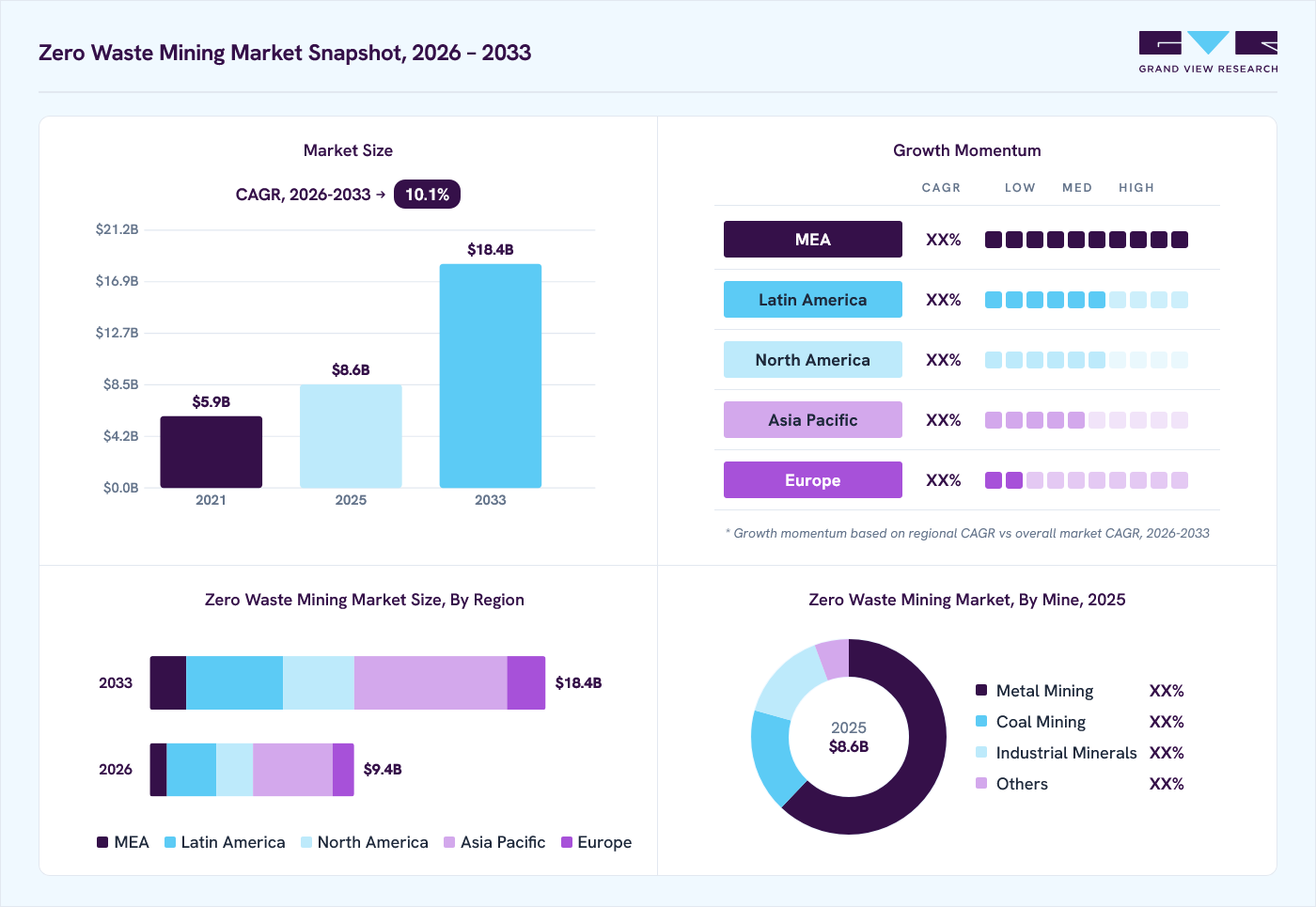
The global zero waste mining market size was valued at USD 8.6 billion in 2025 and is projected to grow from USD 9.4 billion to USD 18.4 billion by 2033, at a CAGR of 10.1% from 2026 to 2033. Asia Pacific dominated the market, accounting for the largest revenue share of 38.9% in 2025. Zero waste mining is a sustainable mining approach that aims to maximize the recovery and utilization of all extracted materials while minimizing or eliminating waste generation throughout the mining lifecycle.
 Source: Grand View Research, IR Documents, Primary Interviews, Paid DatabasesTo learn more about this report,
 Download Free Sample Report
 Key Market Trends & Insights
- Largest regional market: Asia Pacific (38.9% revenue share, 2025)
- Fastest-growing regional market: Middle East & Africa (highest CAGR, 2026-2033)
- By country: China held the largest market share in 2025.
Regional Highlights
- Largest regional market: Asia Pacific (38.9% revenue share, 2025)
- Fastest-growing regional market: Middle East & Africa (highest CAGR, 2026-2033)
- By country: China held the largest market share in 2025.
Market Size & Forecast
- 2025 Market Size: USD 8.6 Billion
- Estimated Market Size in 2026: USD 9.4 Billion
- Projected Market Size by 2033: USD 18.4 Billion
- CAGR (2026-2033): 10.1%
Three ways to get this report
Buy it, customize it, or ask a question.Ask an Analyst
Analyst response in 1 business day
- AccessReport author, directly
- Reply timeWithin 1 working day
- No sales callDirect answer only
- FormatEmail reply
- CostFree, no cost
Get the Full Report
What the study covers
- FormatsPDF · Excel · Dashboard
- Timeline2026–2033 annual, 2025 base
- Coverage20+ countries, 5 regions
- Companies10+ key players profiled
Customize the Report
20% free customization
- IncludeCountries, segments, points
- TailorTo your product definition
- ExtendDeeper competitor detail
- OrA fully bespoke study
- Turnaround5–10 working days
The zero waste mining industry is experiencing strong growth as mining companies face increasing pressure to maximize resource utilization while minimizing environmental impacts. Declining ore grades, rising extraction costs, and the growing demand for critical minerals have made it economically attractive to recover additional value from waste streams such as tailings, waste rock, slag, and process residues.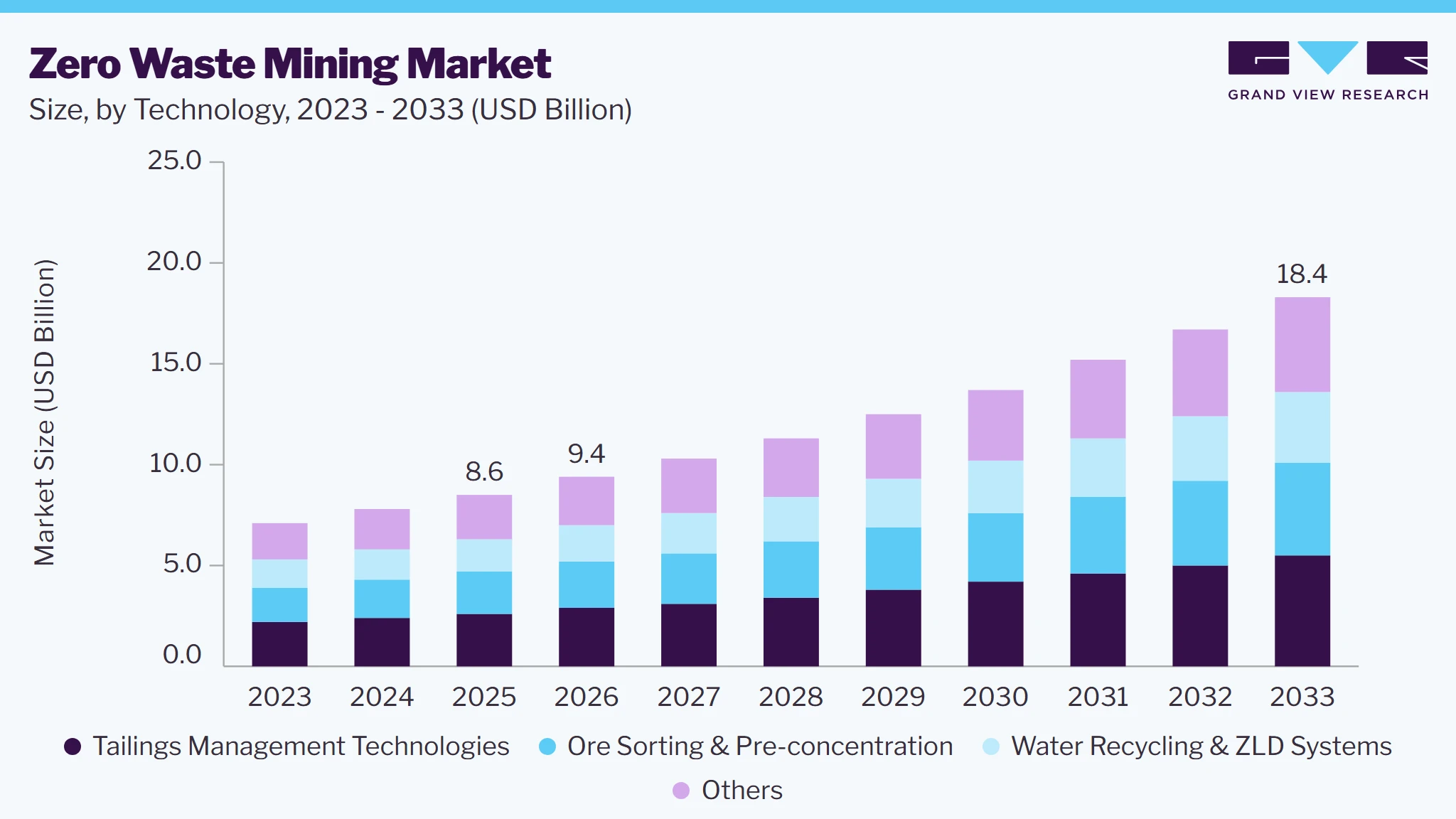 To learn more about this report, Download Free Sample Report
 Advanced mineral processing technologies, ore sorting systems, and metal recovery solutions enable operators to extract previously unrecoverable minerals, improving overall resource efficiency and extending the life of existing mining assets. This combination of economic and operational benefits is encouraging mining companies to adopt zero waste mining strategies across both new and existing operations.
Market Dynamics
Mining companies are adopting technologies that maximize resource recovery, minimize tailings generation, and reduce waste disposal to comply with stringent environmental regulations and achieve sustainability goals. These initiatives help reduce environmental liabilities while improving operational efficiency and long-term profitability.
Advancements in ore sorting, tailings reprocessing, water recycling, and waste valorization technologies are further accelerating the transition toward zero-waste mining. By recovering valuable minerals from waste streams and reusing process water and by-products, mining operators can reduce raw material losses, lower operating costs, and improve the overall utilization of mined resources, thereby supporting the broader adoption of zero-waste mining practices.
The adoption of zero waste mining solutions requires substantial investments in advanced processing technologies, digital monitoring systems, and waste management infrastructure. Integrating these solutions into existing mining operations can be technically complex and capital intensive, particularly for older mines, limiting adoption among small and medium sized mining companies.
The increasing global focus on circular economy principles and the recovery of valuable minerals from tailings and mining waste is creating significant opportunities for the zero waste mining industry. Governments and mining companies are investing in innovative recycling, secondary resource extraction, and waste reuse technologies to improve resource security, reduce environmental impacts, and support the growing demand for critical minerals used in clean energy and advanced manufacturing industries.
Analyst Perspective
The market for zero waste mining is entering a phase of accelerated growth as mining companies increasingly recognize that waste streams can become valuable sources of additional revenue rather than environmental liabilities. Declining ore grades, rising demand for critical minerals, and stricter environmental regulations are driving investments in advanced technologies such as ore sorting, tailings reprocessing, water recycling, and waste valorization to maximize resource recovery while reducing environmental impact.
Technology Insights
Tailings management technologies held the revenue share of 30.7% in 2025. Advances in filtration systems, thickened and paste tailings technologies, dry-stack tailings, sensor-based monitoring, and tailings reprocessing solutions are enabling operators to reduce waste volumes, improve water recovery, and extract residual metals that were previously considered uneconomical. Rising concerns over tailings dam failures and stricter environmental regulations are further accelerating investments in modern tailings management systems that enhance operational safety and support sustainable mining practices.
Ore sorting & pre-concentration is anticipated to register the fastest CAGR over the forecast period as mining companies increasingly seek to maximize resource efficiency while reducing waste generation at the earliest stages of mineral processing. Advanced sensor-based ore-sorting technologies, including X-ray transmission, X-ray fluorescence, laser-induced fluorescence, near-infrared, and hyperspectral imaging, enable the separation of valuable ore from waste rock before grinding and beneficiation. This reduces the volume of material processed, lowers energy and water consumption, minimizes tailings generation, and decreases processing costs.
Mine Insights
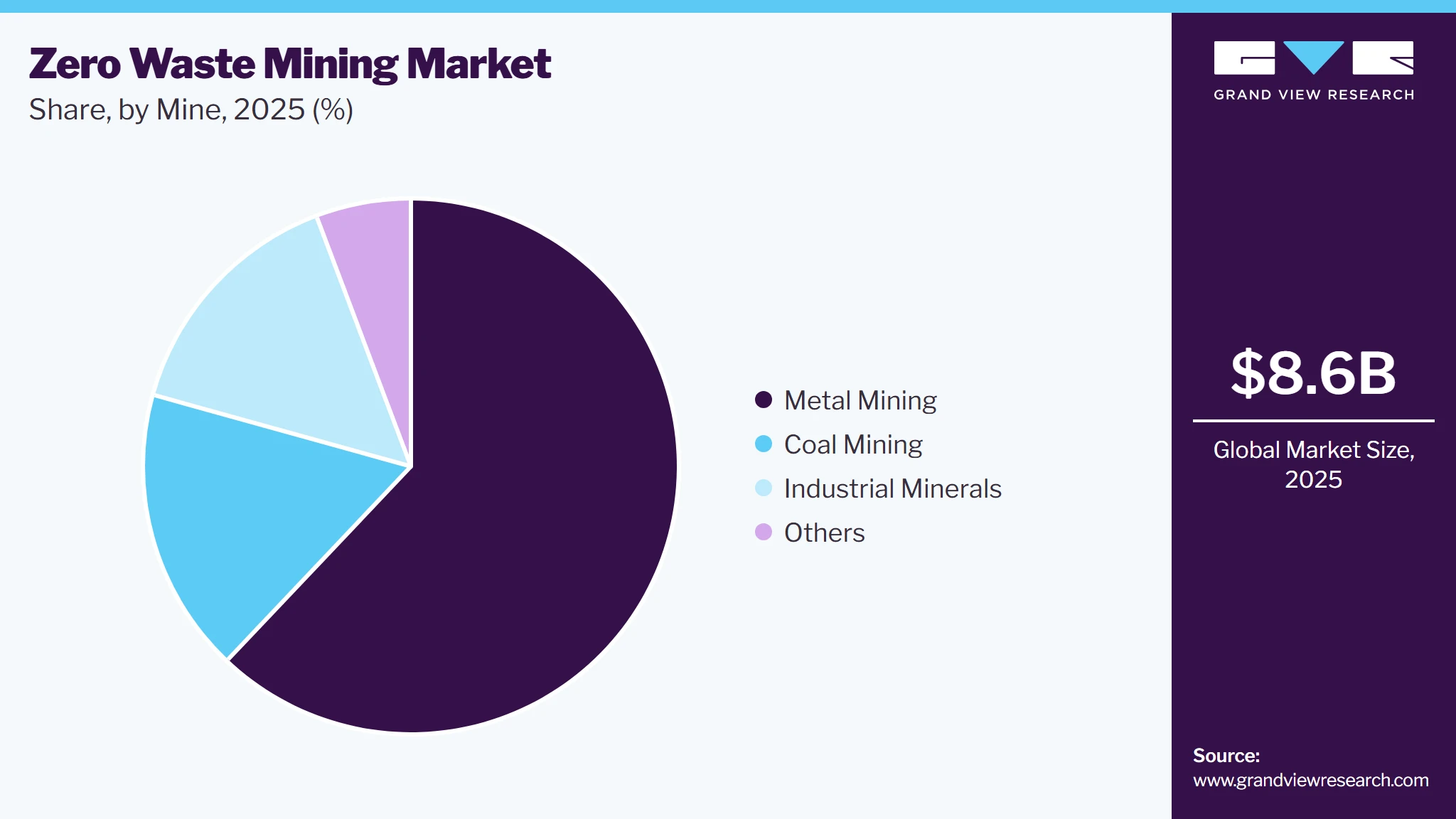
The metal mining segment dominates the market with the revenue share of 62.3% in 2025 due to the large volumes of waste rock and tailings generated during the extraction of metals such as copper, iron ore, gold, nickel, lithium, and zinc. Declining ore grades and increasing demand for critical minerals are driving mining companies to adopt zero-waste practices that improve resource recovery, reduce tailings disposal, and enhance water and energy efficiency.
 To learn more about this report, Download Free Sample Report
 The industrial minerals segment is witnessing substantial growth in the market as producers increasingly adopt sustainable mining practices to improve resource utilization and reduce waste generation. Mining operations for minerals such as limestone, gypsum, silica, feldspar, kaolin, talc, and phosphate are integrating technologies including selective mining, ore sorting, tailings reuse, and water recycling to maximize mineral recovery and minimize disposal volumes. Rising demand from construction, ceramics, glass, agriculture, and chemical industries is encouraging operators to optimize extraction efficiency while complying with stricter environmental regulations and sustainability targets.
Regional Insights
Asia Pacific zero waste mining market held the largest global revenue share of 38.9% in 2025. Countries such as China, Australia, and India are accelerating the adoption of ore sorting, dry processing, tailings reprocessing, and water recycling systems to maximize mineral recovery while reducing waste generation. Australia has emerged as a leader in implementing advanced sensor-based ore sorting and dry beneficiation technologies across gold and iron ore mines, while China continues to promote comprehensive utilization of mine tailings under its circular economy initiatives.
 To learn more about this report, Download Free Sample Report
 China Zero Waste Mining Market Trends
China’s zero-waste mining market is being driven by increasingly stringent environmental regulations, resource conservation priorities, and the government’s push toward green and circular mining practices. China’s recent solid waste management action plan emphasizes source reduction, comprehensive utilization of tailings and associated minerals, underground backfilling, and greater utilization of bulk industrial solid waste, creating strong demand for technologies that minimize mining waste generation and recover value from tailings and waste rock. In addition, China’s long-standing circular economy framework requires mining companies to improve mineral recovery, water recycling, land reclamation, and the comprehensive utilization of associated minerals and tailings.
Europe Zero Waste Mining Market Trends
Europe zero waste mining market is witnessing steady growth in the market, supported by stringent environmental legislation, circular economy policies, and the increasing focus on securing domestic supplies of critical raw materials. Mining companies are investing in technologies that improve resource efficiency while minimizing their environmental footprints through tailings valorization, waste rock utilization, and closed-loop water management. Countries including Sweden, Finland, and Norway are actively developing sustainable mining projects that prioritize waste reduction throughout the mine lifecycle.
North America Zero Waste Mining Market Trends
North America zero waste mining market is experiencing strong adoption of zero waste mining technologies as mining companies seek to improve operational efficiency, meet ESG commitments, and comply with stricter environmental regulations. The region has witnessed increasing investments in intelligent ore sorting, mine water recycling, and tailings reprocessing technologies that enhance metal recovery while lowering waste disposal costs. Canada remains a key contributor through sustainable mining initiatives supported by the Towards Sustainable Mining framework, while several mining operators are evaluating historical tailings as secondary sources of copper, gold, and critical minerals.
The U.S. zero waste mining market represents a significant market for zero waste mining technologies owing to increasing demand for domestically sourced critical minerals, rising emphasis on responsible mining, and ongoing modernization of mining operations. Federal initiatives supporting secure supply chains for lithium, rare earth elements, copper, and other strategic minerals are encouraging mining companies to maximize resource recovery while reducing waste generation.
Middle East & Africa Zero Waste Mining Market Trends
The zero waste mining market in the Middle East & Africa is gradually adopting zero waste mining practices as governments and mining companies seek to improve resource efficiency, conserve water, and increase the economic value of mining operations. Water scarcity across the Middle East is driving investments in dry processing technologies and advanced mine water recycling systems, while African countries are increasingly focusing on recovering valuable minerals from historical tailings and waste rock. South Africa has become a notable market for tailings retreatment, particularly in gold mining, where companies are recovering residual gold from decades old tailings facilities using advanced processing technologies.
Key Zero Waste Mining Company Insights
Some of the key players operating in the market include CDE Group, Eriez, and others
-
CDE Group is a global provider of wet processing solutions for the mining, quarrying, and recycling industries, with operations spanning Europe, North America, Asia Pacific, the Middle East, and Africa. The company specializes in designing and manufacturing integrated systems that maximize resource recovery while minimizing waste generation, water consumption, and environmental impact. CDE Group offers advanced wet processing technologies, including ore washing, classification, fines recovery, thickening, slurry management, and tailings dewatering systems.
-
Eriez is a leading manufacturer of separation, material handling, and inspection technologies serving the mining, recycling, food processing, and industrial sectors worldwide. The company has established a strong presence in mineral processing through its portfolio of magnetic separation, flotation, screening, and metal detection solutions that improve ore recovery and operational efficiency. Eriez provides high-intensity magnetic separators, flotation systems, hydrofloat coarse particle flotation technology, metal recovery equipment, and advanced process optimization solutions.
Zero Waste Mining Companies:
The following key companies have been profiled for this study on the zero waste mining market
-
CDE Group
-
Eriez
-
FLSmidth
-
Metso
-
MineSense Technologies
-
NextOre
-
STEINERT GmbH
-
TAKRAF Group
-
TOMRA Mining
-
Weir Minerals
Competitive Benchmarking
Category
Operating Strategies
Competitive Edge
Weakness
Established Players (e.g. CDE Group, Eriez)
- Mature participants in the zero waste mining market primarily focus on delivering integrated mine waste management solutions that combine ore sorting, tailings reprocessing, water recycling, dry stack tailings, waste valorization, and resource recovery technologies.
- Their strategies emphasize maximizing mineral recovery while minimizing waste generation throughout the mining lifecycle.
- Established players possess significant competitive advantages through comprehensive technology portfolios, extensive engineering expertise, and proven experience across large-scale mining operations worldwide.
- Their ability to provide integrated solutions covering mineral processing, water management, waste recovery, and environmental remediation enables customers to implement complete zero waste mining strategies through a single technology partner.
Despite their strong market positions, mature players face challenges related to high research and development costs, lengthy project implementation periods, and substantial capital requirements for technology deployment. Emerging & Regional Players (e.g., MineSense Technologies, NextOre)
- Emerging participants in the zero waste mining market generally focus on specialized technologies such as ore sorting, tailings reprocessing, critical mineral recovery, water recycling, waste valorization, and low-impact mineral processing.
- Rather than competing directly with established providers across the entire mining value chain, these companies emphasize innovative technology development, modular processing systems, and flexible deployment models.
- Emerging companies benefit from operational flexibility and the ability to rapidly develop innovative technologies without the limitations of legacy product platforms.
- Their solutions often incorporate advanced automation, cloud-based analytics, real-time process optimization, and modular equipment designs that enable faster deployment and easier integration into existing mining operations.
- Emerging participants face significant challenges related to limited commercial deployment, restricted financial resources, and technology validation requirements.
- Scaling innovative zero waste mining technologies from pilot projects to commercial mining operations requires substantial capital investment, extensive field testing, and long qualification periods.
Recent Development
-
In July 2026, India accelerated its efforts to recover critical minerals from mine waste, tailings, overburden, fly ash, and other industrial waste streams under the National Critical Mineral Mission to reduce dependence on mineral imports essential to electric vehicles, renewable energy, electronics, and defense.
-
In June 2025, Business Finland continued to accept applications for its Zero Waste Mining and Critical Minerals Campaign 2025, a USD 12.5 million funding initiative aimed at accelerating sustainable innovation across the mining and minerals value chain.
Zero Waste Mining Report Scope
Report Attribute
Details
Market Definition
The market size represents the annual revenue generated by manufacturers, technology providers, engineering firms, and service providers offering solutions that reduce or eliminate waste generation during mining operations.
Market size value in 2025
USD 8.6 billion
Market size value in 2026
USD 9.4 billion
Revenue forecast in 2033
USD 18.4 billion
Growth rate
CAGR of 10.1% from 2026 to 2033
Base year for estimation
2025
Historical data
2021 - 2024
Forecast period
2026 - 2033
Quantitative Units
Revenue in USD million/billion and CAGR from 2026 to 2033
Report coverage
Revenue forecast, competitive landscape, growth factors, and trends
Segments covered
Technology, mine, region
Regional scope
North America; Europe; Asia Pacific; Latin America; Middle East & Africa
Country scope
U.S.; Canada; Mexico; Finland; Sweden; Poland; Russia; China; India; Indonesia; Australia; Brazil; Chile; Peru; Saudi Arabia, South Africa; Ghana; Zambia
Key companies profiled
CDE Group; Eriez; FLSmidth; Metso; MineSense Technologies; NextOre; STEINERT GmbH; TAKRAF Group; TOMRA Mining; Weir Minerals; and others
Customization scope
Free report customization (equivalent up to 8 analysts working days) with purchase. Addition or alteration to country, regional & segment scope.
Pricing and purchase options
Avail customized purchase options to meet your exact research needs. Explore purchase options
Global Zero Waste Mining Market Report Segmentation
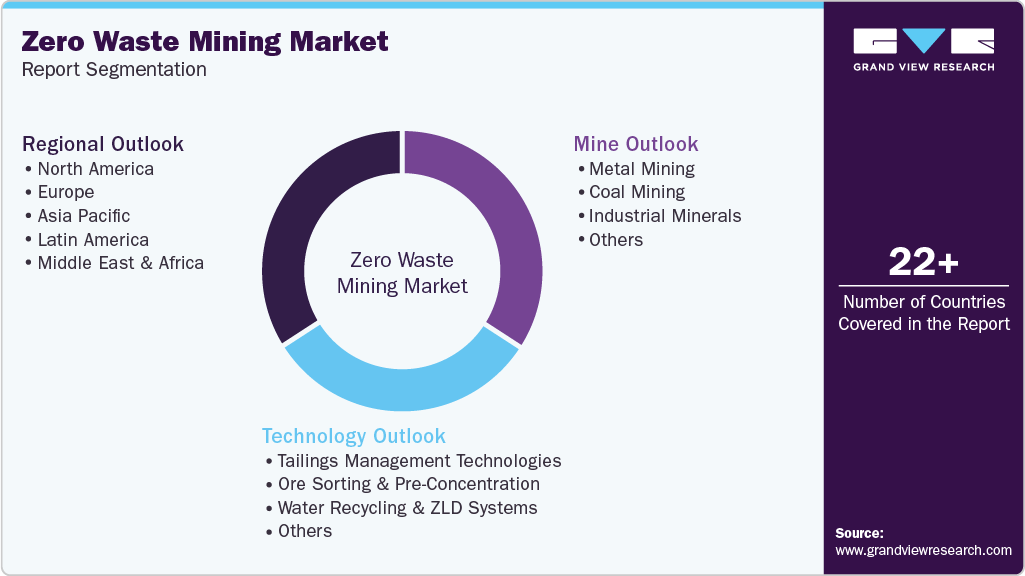
This report forecasts revenue growth at global, regional, and country levels and provides an analysis of the latest industry trends in each of the sub-segments from 2021 to 2033. For this study, Grand View Research has segmented the global zero waste mining market report based on technology, mine, and region:
 To learn more about this report, Download Free Sample Report
 -
Technology Outlook (Revenue, USD Billion, 2021 - 2033)
-
Tailings Management Technologies
-
Ore Sorting & Pre-Concentration
-
Water Recycling & ZLD Systems
-
Others
-
-
Mine Outlook (Revenue, USD Billion, 2021 - 2033)
-
Metal Mining
-
Coal Mining
-
Industrial Minerals
-
Others
-
-
Regional Outlook (Revenue, USD Billion, 2021 - 2033)
-
North America
-
U.S.
-
Canada
-
Mexico
-
-
Europe
-
Finland
-
Sweden
-
Poland
-
Russia
-
-
Asia Pacific
-
China
-
India
-
Indonesia
-
Australia
-
-
Latin America
-
Brazil
-
Chile
-
Peru
-
-
Middle East & Africa
-
Saudi Arabia
-
South Africa
-
Zambia
-
Ghana
-
-
Research Methodology
The zero waste mining market figures in this report are based on a proven research process that combines executive interviews with secondary research from proprietary databases, company filings, and recognized regulatory and institutional sources. Market size is built through value-chain sizing-reconciling supply-side and demand-side estimates-and triangulated with bottom-up and top-down approaches. Every estimate passes multiple levels of expert validation before publication, with each zero waste mining segment quantified using the revenue-capture definitions in the table below.
Segment Definition
Technology
Revenue Capture Definition
Tailings Management Technologies
The tailings management technologies segment captures revenue generated from solutions designed to minimize, treat, and repurpose mine tailings while reducing environmental impact.
Ore Sorting & Pre-concentration
The ore sorting and pre-concentration segment represents revenue generated from advanced sensor-based sorting, X-ray transmission, laser, optical, and AI-enabled technologies that separate valuable ore from waste rock before downstream processing.
Water Recycling & ZLD Systems
The water recycling and zero liquid discharge (ZLD) systems segment includes revenue generated from technologies that recover, recycle, and reuse process water while eliminating liquid waste discharge from mining operations.
Others
The others segment captures revenue generated from technologies supporting zero waste mining, including waste rock valorization, mine waste recycling, metal recovery from secondary resources, bioleaching, carbon mineralization, renewable energy integration, and digital mine optimization solutions.
Mine
Revenue Capture Definition
Metal Mining
The metal mining segment captures revenue generated from zero waste mining technologies deployed in the extraction and processing of metals such as iron ore, copper, gold, nickel, lithium, zinc, and other base and precious metals
Coal Mining
The coal mining segment represents revenue generated from zero waste mining solutions implemented across surface and underground coal mining operations.
Industrial Minerals
The industrial minerals segment includes revenue generated from zero waste mining technologies used in the extraction and processing of minerals such as limestone, silica, phosphate, potash, kaolin, talc, and feldspar.
Others
The others segment captures revenue generated from zero waste mining technologies applied to rare earth elements, gemstones, mineral sands, aggregates, and other specialty mining operations.
Estimation Model
Layer Name
Key Question
Description
Mining Waste Generation Demand Base Layer
What forms the demand base?
Identify global mining activities across metal mining, coal mining, and industrial minerals. Assess the generation of tailings, waste rock, mine water, and processing residues, along with regulatory requirements and sustainability commitments driving waste reduction. This layer establishes the total addressable demand for zero waste mining technologies and solutions.
Zero Waste Technology Penetration Layer
Where are zero waste mining solutions utilized?
Estimate the penetration of zero waste mining technologies across key applications including tailings management, ore sorting & pre concentration, water recycling & zero liquid discharge (ZLD) systems, resource recovery, and mine waste valorization. Analyze adoption across open pit and underground mining operations in different regions based on environmental regulations, resource efficiency goals, and critical mineral demand.
Resource Recovery & Waste Utilization Intensity Layer
How much waste is recovered and reused?
Analyze resource recovery intensity based on ore throughput, tailings generation, water reuse rates, waste rock utilization, and recovery of valuable minerals from mining residues. Evaluate the effectiveness of ore sorting, tailings reprocessing, and closed loop water management systems. Recovery intensity varies according to ore grade, mining method, processing technology, and environmental compliance requirements.
Revenue Layer
How is market revenue generated?
Market revenue is quantified through the supply of zero waste mining technologies, engineering services, tailings management systems, ore sorting solutions, water recycling systems, and resource recovery services. Revenue generation is driven by mining companies investing in operational efficiency, waste minimization, environmental compliance, and sustainable mineral extraction. Market value is influenced by mining investments, technology adoption, commodity prices, regulatory mandates, and demand for critical minerals.
Delivered Customizations
We have successfully delivered the following deep-dive customizations:
Client Request
Customization Delivered
Value Adds
Regional Segmentation
Detailed regional analysis of the zero waste mining market across North America, Europe, Asia Pacific, Latin America, and Middle East & Africa. Included evaluation of mine waste generation, tailings management practices, critical mineral recovery initiatives, water recycling infrastructure, government sustainability policies, circular economy adoption, and investments in advanced resource recovery technologies.
Identified leading regions adopting zero waste mining practices and emerging investment hotspots. Enabled strategic expansion planning based on environmental regulations, mining activities, and sustainability initiatives. Supported regional demand forecasting and technology adoption analysis.
Opportunity Assessment
Identification of high growth opportunities across critical mineral recovery from tailings, dry ore beneficiation, mine water reuse, zero liquid discharge systems, AI enabled ore sorting, mine waste valorization, carbon neutral mining operations, renewable energy integration, and circular economy initiatives.
Enabled prioritization of high return investment opportunities and emerging regional markets. Supported long term technology investments, capacity expansion, business diversification, and strategic growth aligned with sustainable mining and circular economy objectives.
Cross Segmentation
Comprehensive cross segmentation analysis by technology, mine, and region, including tailings management technologies, ore sorting and pre concentration, water recycling and zero liquid discharge systems, and other zero waste mining technologies across metal mining, coal mining, industrial minerals, and other mines.
Enabled identification of the most attractive technology and mine combinations along with high growth opportunities. Supported technology selection, investment prioritization, operational optimization, and strategic planning.
Frequently Asked Questions About This Report
The global zero waste mining market size was valued at USD 8.6 billion in 2025 and is estimated at USD 9.4 billion in 2026.
Asia Pacific dominated the market with revenue share of 38.9% in 2025.
The global zero waste mining market is expected to grow at a CAGR of 10.1% from 2026 to 2033 to reach USD 18.4 billion by 2033.
The key factor driving the growth of the global zero waste mining market is the increasing emphasis on sustainable mining practices and the recovery of valuable minerals from mine waste, supported by stringent environmental regulations and the growing demand for critical minerals.
The tailings management technologies accounted for largest revenue share of 30.7% in 2025, while the ore sorting & pre-concentration is fastest-growing segment.
Metal mining accounted for largest revenue share of 62.3% in 2025, while the industrial minerals is fastest-growing segment.
Some of the key players of the global zero waste mining market are OCDE Group, Eriez, FLSmidth, Metso, MineSense Technologies, NextOre, STEINERT GmbH, TAKRAF Group, TOMRA Mining, Weir Minerals, and others.
About the Author(s)
Advanced Interior Materials Research Team
Advanced Materials · Advanced Interior MaterialsThis report was authored by the advanced interior materials research team at Grand View Research - comprising two research analysts, one senior research analyst, and one industry expert - with specialized expertise in the advanced interior materials segment of the advanced materials industry. All findings are based on proprietary advanced materials databases, executive interviews, and regulatory analysis, subject to internal peer review prior to publication.
Last Updated:
Speak to Analyst

Customize this report to your needs - add regions, segments, or data points, with 20% free customization.
Or view our licence options:


ISO 9001:2015 & 27001:2022 Certified
We are GDPR and CCPA compliant! Your transaction & personal information is safe and secure. For more details, please read our privacy policy.


