
- Home
- »
- Advanced Interior Materials
- »
-
3D Woven Composites Market Size, Share Report 2026-2033GVR Report cover

3D Woven Composites Market (2026 - 2033)
Size, Share & Trends Analysis Report By Fiber Type (Carbon Fiber, Glass Fiber, Aramid Fiber, Hybrid Fibers), By Resin Type, By Manufacturing Process, By End-use, By Region, And Segment Forecasts
Market Size, 2025
$170.0MMarket Estimate, 2026
$190.6MMarket Forecast, 2033
$442.3MCAGR, 2026–2033
12.8%3D Woven Composites Market Summary
The global 3D woven composites market size was valued at USD 170.0 million in 2025 and is projected to grow from USD 190.6 million in 2026 to USD 442.3 million by 2033, at a CAGR of 12.8% from 2026 to 2033. Asia Pacific dominated the market, accounting for the largest revenue share of 34.0% in 2025. The market is experiencing growing demand as industries seek lightweight materials with high strength, stiffness, impact resistance, and enhanced structural integrity.
 Source: Grand View Research, IR Documents, Primary Interviews, Paid DatabasesTo learn more about this report,
 Download Free Sample Report
 Key Market Trends & Insights
- By fiber type: Carbon fiber segment held the largest market share of 58.2% in 2025.
- By resin type: Epoxy segment held the largest market share of 60.6% in 2025.
- By manufacturing process: Resin transfer molding segment held the largest market share of 35.5% in 2025.
- By end use: Aerospace & defense segment held the largest market share of 43.2% in 2025.
Regional Highlights
- Largest regional market: Asia Pacific (34.0% revenue share, 2025)
- By country: China dominated the Asia Pacific with the largest revenue share in 2025
Market Size & Forecast
- Market size in 2025: USD 170.0 Million
- Estimated market size in 2026: USD 190.6 Million
- Projected market size by 2033: USD 442.3 Million
- CAGR (2026-2033): 12.8%
Three ways to get this report
Buy it, customize it, or ask a question.Ask an Analyst
A direct answer, usually in 1 working day
- AccessReport author, directly
- Reply timeWithin 1 working day
- No sales callDirect answer only
- FormatEmail reply
- CostFree, no cost
Get the Full Report
What the study covers
- FormatsPDF · Excel · Dashboard
- Timeline2026–2033 annual, 2025 base
- Coverage20+ countries, 5 regions
- Companies10+ key players profiled
Customize the Report
20% free customization
- IncludeCountries, segments, points
- TailorTo your product definition
- ExtendDeeper competitor detail
- OrA fully bespoke study
- Turnaround5–10 working days
Unlike conventional 2D laminated composites, 3D woven structures incorporate reinforcement in multiple directions, providing enhanced through-thickness properties and reducing susceptibility to delamination. These characteristics make the technology particularly suitable for highly loaded structural components. To learn more about this report, Download Free Sample Report
 The aerospace and defense sectors are major contributors to market development, as manufacturers require lightweight structural materials that withstand high mechanical loads, impacts, fatigue, and demanding operating conditions. 3D woven composites can be incorporated into structural components, engine-related applications, aircraft interiors, protective structures, and other high-performance components. Automotive manufacturers are also evaluating these materials for lightweight structural applications, particularly in performance-oriented and electric vehicles. Wind energy manufacturers are exploring advanced reinforcement architectures to improve the durability and structural efficiency of large components.
Technological development is focused on improving weaving precision, production speed, fiber architecture, resin compatibility, and overall manufacturing efficiency. Advanced 3D weaving machines can create complex textile preforms with controlled fiber orientation and improved structural performance. Automated performing and resin-transfer processes are helping reduce manual intervention and improve production consistency. Hybridization of carbon, glass, aramid, and other high-performance fibers is enabling manufacturers to develop application-specific reinforcement systems.
Market Dynamics
The 3D woven composites industry is driven by the increasing demand for lightweight, structurally efficient materials across aerospace, defense, automotive, wind energy, and industrial applications. The technology provides enhanced through-thickness reinforcement and damage tolerance compared with conventional laminated composite structures. However, high manufacturing complexity, specialized equipment requirements, expensive high-performance fibers, and limited production expertise can restrict adoption, particularly in cost-sensitive applications. The market is therefore influenced by the balance between superior performance and manufacturing economics.
The increasing demand for lightweight structural materials is a major driver for 3D woven composites. Aerospace and defense manufacturers are under continuous pressure to reduce structural weight while maintaining strength, stiffness, fatigue resistance, and damage tolerance. 3D woven architectures can provide reinforcement in multiple directions and improve resistance to delamination, making them attractive for highly loaded structural components.
The growing use of advanced composites in next-generation aircraft, spacecraft, defense platforms, and high-performance vehicles is expanding demand for advanced textile-based reinforcement technologies. Weight reduction also supports improved fuel efficiency and operational performance, strengthening the economic value proposition of these materials.
High manufacturing complexity and production costs remain significant restraints for the 3D woven composites industry. Manufacturing these structures requires specialized weaving equipment, precise control of fiber architecture, advanced preforming processes, and compatible resin-infusion or molding technologies. High-performance reinforcement fibers, such as carbon fiber, can further increase material costs. In addition, manufacturers require specialized technical expertise to consistently design and produce complex three-dimensional textile architectures.
The development of automated and sustainable manufacturing technologies presents a significant opportunity for the market. Automated 3D weaving, robotic preforming, digital process control, and advanced resin-infusion technologies can improve production consistency while reducing labor requirements and material waste. The development of thermoplastic matrices and recyclable composite systems can further improve the sustainability profile of 3D woven composites. Manufacturers are also exploring hybrid fiber systems and bio-based materials to reduce environmental impact while maintaining structural performance.
Market Concentration & Characteristics
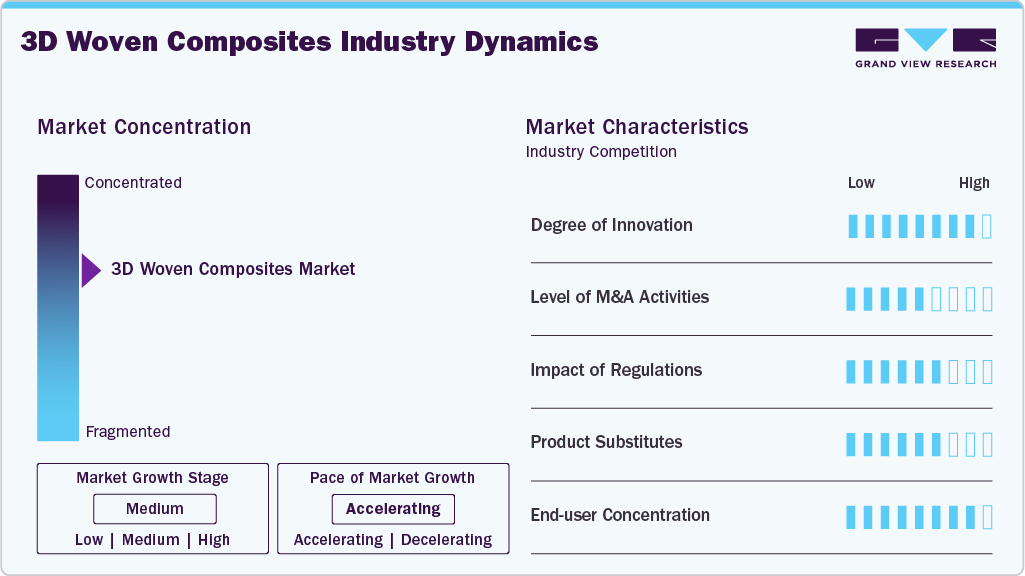
The 3D woven composites industry is moderately consolidated, with competition concentrated among specialized advanced textile manufacturers, composite material suppliers, aerospace-focused manufacturers, and companies with proprietary weaving and preforming technologies. Competitive differentiation is based on fiber architecture, mechanical performance, manufacturing capabilities, product customization, quality consistency, and application-specific engineering expertise. Aerospace and defense qualifications create significant barriers for new entrants, particularly because customers require extensive testing and validation before adopting new composite technologies.
 To learn more about this report, Download Free Sample Report
 The threat of substitutes is moderate because 3D woven composites compete with conventional 2D laminated composites, 3D braided composites, stitched composites, pultruded composites, and lightweight metals such as aluminum and titanium. Conventional laminated composites remain widely established because of their mature manufacturing processes, extensive design databases, and relatively familiar processing methods. Metals also continue to be preferred where conductivity, temperature resistance, established repair infrastructure, or lower initial manufacturing complexity is important. However, 3D woven composites offer advantages in through-thickness strength, impact resistance, damage tolerance, and delamination resistance.
Analyst Perspective
The 3D woven composites market is positioned for steady growth as demand for lightweight, high-strength, and damage-tolerant materials increases across aerospace & defense, automotive, wind energy, and industrial applications. Advancements in automated 3D weaving, hybrid fibers, thermoplastic resins, and advanced molding technologies are improving performance and manufacturing efficiency. While high production costs and specialized processing requirements remain challenges, growing commercialization and technological development are expected to expand adoption in high-value structural applications.
Fiber Type Insights
The carbon fiber segment led the market with the largest revenue share of 58.2% in 2025 and is projected to grow at the fastest CAGR during the forecast period, primarily due to its superior strength-to-weight ratio, high stiffness, fatigue resistance, and lightweight characteristics. Carbon fiber is extensively utilized in aerospace and defense applications where weight reduction and structural performance are critical. Its compatibility with advanced 3D weaving and high-performance resin systems further supports adoption in complex structural components. The increasing use of carbon fiber composites in aircraft structures, defense platforms, high-performance vehicles, and other demanding applications is expected to sustain their leading position.
The hybrid fibers segment is expected to grow at a significant CAGR of 12.9% over the forecast period, as manufacturers increasingly combine different reinforcement fibers to balance mechanical performance, weight, durability, and cost. Hybrid 3D woven structures can integrate carbon, glass, aramid, and other fibers within a single architecture to provide application-specific properties. This approach enables manufacturers to optimize strength, stiffness, impact resistance, and material costs depending on end-use requirements.
Resin Type Insights
The epoxy segment led the market with the largest revenue share of 60.6% in 2025, due to the widespread use of epoxy resin systems in high-performance 3D woven composite applications. Epoxy provides strong fiber adhesion, high mechanical strength, stiffness, dimensional stability, and resistance to environmental and chemical stresses. These properties make epoxy particularly suitable for aerospace and defense structures, where consistent structural performance and durability are essential.
The thermoplastic resins segment is expected to grow at the fastest CAGR of 13.3% over the forecast period, as manufacturers increasingly seek faster processing, improved toughness, recyclability, and opportunities for automated high-volume composite manufacturing. Thermoplastic matrices can support shorter processing cycles and enable joining technologies such as welding, making them attractive for automotive and transportation applications. Their potential for recycling and reprocessing also aligns with increasing sustainability requirements across composite manufacturing.
Manufacturing Process Insights
The resin transfer molding (RTM) segment led the market with the largest revenue share of 35.5% in 2025, because the technology provides controlled resin distribution, consistent component quality, and the ability to manufacture complex composite structures with good dimensional accuracy. RTM is particularly suitable for 3D woven preforms because resin can be introduced into a closed mold containing the reinforcement architecture. Its ability to produce repeatable structural components makes it attractive for aerospace, automotive, defense, and industrial applications.
The 3D weaving segment is expected to grow at the fastest CAGR of 13.0% over the forecast period, as manufacturers increasingly adopt advanced textile architectures that improve through-thickness strength, impact resistance, and delamination resistance. 3D weaving enables fibers to be integrated across multiple directions, allowing manufacturers to develop complex preforms tailored to specific structural requirements. Advancements in automated weaving equipment, digital textile design, and process control are improving manufacturing precision and scalability.
End Use Insights
The aerospace & defense segment led the market with the largest revenue share of 43.2% in 2025, driven by the industry's strong demand for lightweight, high-strength, impact-resistant, and damage-tolerant materials. 3D woven composites provide multidirectional reinforcement and enhanced resistance to delamination, making them suitable for demanding structural applications. Their ability to reduce component weight while maintaining structural integrity supports aircraft efficiency and performance.
 To learn more about this report, Download Free Sample Report
 The automotive & transportation segment is expected to grow at the fastest CAGR of 13.5% over the forecast period, as manufacturers increasingly focus on lightweighting, energy efficiency, vehicle performance, and structural optimization. The development of electric vehicles is strengthening this trend, as reducing vehicle weight can improve energy efficiency and driving range. 3D woven composites can provide high structural strength and impact resistance while reducing weight compared with conventional materials in selected applications.
Regional Insights
The 3D woven composites market in North America held a significant share in 2025, supported by strong demand from the aerospace, defense, automotive, space, wind energy, and advanced manufacturing industries. The region has a mature ecosystem of composite manufacturers, fiber suppliers, research institutions, and aerospace original equipment manufacturers. Demand is particularly supported by the development of lightweight aircraft and defense structures requiring high damage tolerance and structural performance. Manufacturers are increasingly investing in automated composite manufacturing to improve production efficiency and consistency.
U.S. 3D Woven Composites Market Trends
The 3D woven composites market in the U.S. is anticipated to grow at a significant CAGR during the forecast period, driven by the extensive presence of the aerospace, defense, space, automotive, and advanced manufacturing industries. The aerospace and defense sectors are particularly important due to the need for lightweight, high-strength, impact-resistant, and damage-tolerant structures. U.S. companies and research organizations are developing advanced technologies for 3D weaving, composite forming, and automated manufacturing. Defense modernization and space exploration activities are creating additional applications for high-performance composite structures.
Asia Pacific 3D Woven Composites Market Trends
Asia Pacific dominated the global 3D woven composites market with the largest revenue share of 34.0% in 2025 and is projected to grow at the fastest CAGR during the forecast period, driven by expansion in the aerospace, defense, automotive, wind energy, marine, and advanced manufacturing industries. Countries across the region are strengthening domestic capabilities in advanced materials and composite manufacturing. Increasing investments in aircraft production and defense systems are creating demand for lightweight, high-performance structural materials. The region's expanding renewable energy industry is also supporting opportunities for advanced composite technologies. China, Japan, South Korea, and India are developing capabilities in advanced textile manufacturing and composite processing.
 To learn more about this report, Download Free Sample Report
 The 3D woven composites market in China accounted for the largest market revenue share in the Asia Pacific in 2025, due to its large aerospace, defense, automotive, wind energy, and industrial manufacturing base. The development of domestic aircraft and defense platforms is increasing the demand for advanced lightweight structural materials. Chinese manufacturers are investing in advanced fiber, textile, and composite-processing capabilities to reduce dependence on external technologies. The country's large wind energy industry is creating additional demand for high-performance composite reinforcement materials.
Europe 3D Woven Composites Market Trends
The 3D woven composites market in Europe is prominent, supported by the aerospace, automotive, wind energy, marine, and industrial manufacturing industries. The region's focus on reducing transportation emissions is increasing demand for lightweight structural materials. European aerospace manufacturers are investing in advanced composite technologies to improve aircraft efficiency and structural performance. The region's large wind energy industry provides additional applications for advanced composite reinforcement.
The Germany 3D woven composites market is growing due to its strong automotive, aerospace, machinery, technical textile, and industrial manufacturing sectors. German companies possess significant expertise in advanced textile architectures, automated manufacturing, and composite processing. The automotive industry's focus on lightweight electric vehicles is creating opportunities for advanced composite structures. Aerospace and defense applications are also supporting demand for high-performance woven reinforcements.
Central & South America 3D Woven Composites Market Trends
The 3D woven composites market in Central and South America is emerging, supported by aerospace, automotive, wind energy, marine, and industrial applications. Brazil is particularly important because of its aerospace manufacturing capabilities and expanding renewable energy sector. Increasing wind energy development is driving demand for lightweight, durable composite materials. Aerospace and defense activities provide opportunities for specialized high-performance composite applications.
Middle East & Africa 3D Woven Composites Market Trends
The 3D woven composites market in the Middle East & Africa is developing through investments in aerospace, defense, renewable energy, transportation, and advanced manufacturing. Industrial diversification programs in several Middle Eastern economies are encouraging the development of domestic high-value manufacturing capabilities. Growing renewable energy projects are creating opportunities for advanced composite materials in energy infrastructure. Aerospace and defense investments are also increasing the demand for lightweight, high-performance structural materials.
Key 3D Woven Composites Company Insights
Some of the key players operating in the market include Bally Ribbon Mills and Safran
-
Bally Ribbon Mills is a U.S.-based manufacturer specializing in engineered woven fabrics and advanced textile structures, including 3D woven and multilayer fabrics. The company serves demanding applications across aerospace, defense, automotive, and industrial markets, with capabilities spanning high-performance fibers and customized textile architectures.
-
Safran is a France-based aerospace and defense group with extensive capabilities in aircraft systems, propulsion, equipment, and advanced materials. The company has developed expertise in composite technologies and lightweight structural solutions for aerospace applications, supporting the integration of advanced composite materials into aircraft and engine-related systems.
3D Weaving NV and 3Dwovens Composites are some of the emerging market participants in the 3D woven composites industry.
-
3D Weaving NV is a Belgium-based company focused on the development and production of three-dimensional woven structures and advanced textile preforms. The company specializes in complex 3D textile architectures designed to enhance structural performance and reinforcement in composite applications.
-
3Dwovens Composites focuses on 3D woven composite technologies and engineered textile reinforcement solutions for advanced structural applications. The company develops three-dimensional woven architectures designed to improve mechanical performance, lightweighting, and delamination resistance compared with conventional laminated structures.
Key 3D Woven Composites Companies
The following key companies have been profiled for this study on the global 3D woven composites market:
-
Bally Ribbon Mills
-
Safran
-
Albany International Corp
-
Optima 3D Ltd
-
Tantra Composite Technologies Pvt. Ltd.
-
Tex Tech Industries
-
3Dwovens Composites
-
3D Weaving NV
-
Lindauer DORNIER GmbH
-
Kale Texnique
Competitive Benchmarking
Category
Operating Strategies
Competitive Edge
Weakness
Established Players (Bally Ribbon Mills, Safran, Albany International Corp., Optima 3D Ltd., Tantra Composite Technologies Pvt. Ltd., Tex Tech Industries)
Invest in advanced 3D weaving, multilayer textile architectures, preform manufacturing, and high-performance fiber-reinforced composite technologies to improve structural strength, weight reduction, damage tolerance, and manufacturing efficiency.
Expand production capabilities and commercial reach through strategic partnerships with aerospace OEMs, defense contractors, automotive manufacturers, composite processors, and research institutions.
Strengthen application-specific solutions by developing customized 3D woven preforms and composite structures using carbon, glass, aramid, and hybrid fibers for aerospace, defense, automotive, industrial, and other demanding applications.
Strong technical expertise and established capabilities in advanced textile architectures, 3D weaving, and engineered composite reinforcement solutions.
Long-standing relationships with aerospace, defense, automotive, and industrial customers are supported by established manufacturing and commercialization networks.
Significant R&D capabilities and application engineering expertise enable the development of customized 3D woven structures for complex and high-performance applications.
High capital requirements for advanced weaving equipment, composite processing infrastructure, testing, and qualification of new products.
Long qualification and commercialization cycles, particularly for aerospace and defense applications, can delay revenue realization from new technologies.
Dependence on high-performance fibers and specialized raw materials can expose manufacturers to fluctuations in material costs and supply-chain constraints.
Emerging / Specialized Players (3Dwovens Composites, 3D Weaving NV, Lindauer DORNIER GmbH, Kale Texnique)
Focus on specialized 3D weaving technologies, complex textile architectures, automated weaving systems, and application-specific composite preforms to meet emerging requirements for lightweight, high-performance structures.
Expand market presence through collaborations with composite manufacturers, aerospace and defense companies, research institutes, universities, and technology partners to accelerate development and commercialization.
Develop customized weaving solutions and advanced machinery capable of producing complex three-dimensional preforms with controlled fiber orientation, improved structural performance, and greater manufacturing flexibility.
Strong specialization in advanced 3D weaving, technical textiles, textile machinery, and engineered preform technologies enables these companies to target specialized applications.
Greater operational flexibility can support faster development of customized textile architectures and quicker response to customer-specific requirements.
Well-positioned to benefit from increasing demand for lightweight structures, automated composite manufacturing, hybrid fiber architectures, and advanced reinforcement technologies.
Relatively smaller production and commercialization networks compared with large established aerospace and composite-material suppliers.
Limited penetration in high-volume applications can limit economies of scale and increase the cost of advanced 3D-woven composite solutions.
Dependence on partnerships with fiber suppliers, composite processors, OEMs, and end users can increase commercialization risks and lengthen adoption timelines.
Recent Developments
- In July 2026, Albany Engineered Composites and A&P Technology announced a strategic collaboration to develop and industrialize advanced braided composite manufacturing solutions using A&P's braiding technologies and Albany's advanced RTM expertise.
3D Woven Composites Market Report Scope
Report Attribute
Details
Market size in 2025
USD 170.0 million
Estimated market size in 2026
USD 190.6 million
Projected market size by 2033
USD 442.3 million
Growth rate
CAGR of 12.8% from 2026 to 2033
Base year for estimation
2025
Historical data
2021 - 2024
Forecast period
2026 - 2033
Quantitative units
Revenue in USD million/billion, and CAGR from 2026 to 2033
Report coverage
Revenue forecast, company ranking, competitive landscape, growth factors, and trends
Segments covered
Fiber type, resin type, manufacturing process, end use, region
Regional scope
North America; Europe; Asia Pacific; Central & South America: Middle East & Africa
Country scope
U.S.; Canada; Mexico; Germany; UK; France; Italy; Spain; China; Japan; India; South Korea; Brazil; Saudi Arabia
Key companies profiled
Bally Ribbon Mills; Safran; Albany International Corp; Optima 3D Ltd; Tantra Composite Technologies Pvt. Ltd.; Tex Tech Industries; 3Dwovens Composites; 3D Weaving NV; Lindauer DORNIER GmbH; Kale Texnique
Customization scope
Free report customization (equivalent up to 8 analysts working days) with purchase. Addition or alteration to country, regional & segment scope.
Pricing and purchase options
Avail customized purchase options to meet your exact research needs. Explore purchase options
Global 3D Woven Composites Market Report Segmentation
This report forecasts revenue growth at the regional & country levels and provides an analysis of the industry trends in each of the sub-segments from 2021 to 2033. For this study, Grand View Research has segmented the global 3D woven composites market report based on the fiber type, resin type, manufacturing process, end use, and region:
-
Fiber Type Outlook (Revenue, USD Million, 2021 - 2033)
-
Carbon Fiber
-
Glass Fiber
-
Aramid Fiber
-
Hybrid Fibers
-
Other Fibers
-
-
Resin Type Outlook (Revenue, USD Million, 2021 - 2033)
-
Epoxy
-
Polyester & Vinyl Ester
-
Thermoplastics
-
Phenolic
-
Others
-
-
Manufacturing Process Outlook (Revenue, USD Million, 2021 - 2033)
-
3D Weaving
-
Resin Transfer Molding (RTM)
-
Vacuum Infusion
-
Others
-
-
End Use Outlook (Revenue, USD Million, 2021 - 2033)
-
Aerospace & Defense
-
Automotive & Transportation
-
Wind Energy
-
Industrial
-
Construction & Infrastructure
-
Other End-use Industries
-
-
Regional Outlook (Revenue, USD Million, 2021 - 2033)
-
North America
-
U.S.
-
Canada
-
Mexico
-
-
Europe
-
UK
-
Germany
-
France
-
Italy
-
Spain
-
-
Asia Pacific
-
China
-
Japan
-
India
-
South Korea
-
-
Central and South America
-
Brazil
-
-
Middle East and Africa
-
Saudi Arabia
-
-
Research Methodology
The 3D woven composites marketfigures in this report are based on a proven research process that combines executive interviews with secondary research from proprietary databases, company filings, and recognized regulatory and institutional sources. Market size is built through value-chain sizing-reconciling supply-side and demand-side estimates-and triangulated with bottom-up and top-down approaches. Every estimate passes multiple levels of expert validation before publication, with each3D woven composites segment quantified using the revenue-capture definitions in the table below.
Segment Definition
Segment - Fiber Type
Revenue Capture Definition
Carbon Fiber
Revenue generated from the sale of 3D woven composites utilizing carbon fibers as the primary reinforcement material. This includes revenues from carbon fiber-based woven composite structures, preforms, and finished composite components designed to provide high strength-to-weight ratios, stiffness, fatigue resistance, and lightweight performance across aerospace, automotive, defense, and industrial applications.
Glass Fiber
Revenue generated from the sale of 3D woven composites utilizing glass fibers as the primary reinforcement material. This includes revenues from glass fiber-based woven composite structures, preforms, and finished components designed to provide mechanical strength, corrosion resistance, durability, and cost-effective performance across industrial, automotive, marine, wind energy, and infrastructure applications.
Aramid Fiber
Revenue generated from the sale of 3D woven composites utilizing aramid fibers as the primary reinforcement material. This includes revenues from aramid-based woven composite structures, preforms, and finished components designed to provide high impact resistance, toughness, lightweight performance, and ballistic or protective properties for aerospace, defense, transportation, and specialized industrial applications.
Hybrid Fibers
Revenue generated from the sale of 3D woven composites incorporating two or more fiber types, such as carbon fiber, glass fiber, and aramid fiber, within the same reinforcement architecture. This includes revenues from hybrid woven preforms and finished composite structures designed to combine properties such as strength, stiffness, impact resistance, weight reduction, and cost efficiency for application-specific requirements.
Other Fibers
Revenue generated from the sale of 3D woven composites utilizing reinforcement fibers other than carbon, glass, aramid, or their primary hybrid combinations. This includes composites incorporating fibers such as natural fibers, basalt fibers, and other specialty reinforcement fibers for applications requiring specific mechanical, environmental, weight, or sustainability characteristics.
Segment - Resin Type
Revenue Capture Definition
Epoxy
Revenue generated from the sale of 3D woven composites utilizing epoxy resins as the matrix material. This includes revenues from epoxy-based composite preforms and finished components offering high mechanical strength, stiffness, dimensional stability, chemical resistance, and strong fiber adhesion for aerospace, defense, automotive, wind energy, and industrial applications.
Polyester & Vinyl Ester
Revenue generated from the sale of 3D woven composites utilizing polyester or vinyl ester resin systems as the matrix material. This includes revenues from composite preforms and finished structures designed to provide corrosion resistance, durability, and cost-effective mechanical performance, particularly in wind energy, marine, automotive, construction, and industrial applications.
Thermoplastics
Revenue generated from the sale of 3D woven composites utilizing thermoplastic resin systems as the matrix material. This includes revenues from thermoplastic composite preforms and finished components designed to provide rapid processing, toughness, weldability, recyclability potential, and high-volume manufacturing capabilities for automotive, aerospace, transportation, and industrial applications.
Phenolic
Revenue generated from the sale of 3D woven composites utilizing phenolic resins as the matrix material. This includes revenues from phenolic-based woven composite structures and finished components designed to provide fire resistance, low smoke generation, thermal stability, and structural performance for aerospace, transportation, defense, and other applications requiring enhanced fire safety.
Others
Revenue generated from the sale of 3D woven composites utilizing resin systems other than epoxy, polyester, vinyl ester, thermoplastic, and phenolic resins. This includes specialized resin systems developed to provide specific thermal, mechanical, chemical, processing, or environmental properties for niche and high-performance applications.
Segment - Manufacturing Process
Revenue Capture Definition
3D Weaving
Revenue generated from the sale of 3D woven composite preforms and structures manufactured using 3D weaving technology. This includes revenues from three-dimensional woven fabrics, near-net-shape preforms, and woven reinforcement structures designed to provide multidirectional strength, improved through-thickness performance, impact resistance, and reduced delamination for aerospace, defense, automotive, wind energy, and industrial applications.
Resin Transfer Molding (RTM)
Revenue generated from the sale of 3D woven composite components manufactured using resin transfer molding technology. This includes revenues from composite preforms and finished structural components produced by injecting resin into a closed mold containing 3D woven reinforcement, providing controlled resin distribution, dimensional accuracy, repeatable production, and high structural performance for aerospace, automotive, defense, industrial, and other applications.
Vacuum Infusion
Revenue generated from the sale of 3D woven composite components manufactured using vacuum infusion technology. This includes revenues from 3D woven preforms and finished composite structures produced by drawing resin through the reinforcement under vacuum pressure, supporting the production of lightweight, large, and complex components for wind energy, marine, automotive, construction, industrial, and other applications.
Others
Revenue generated from the sale of 3D woven composite components manufactured using technologies other than RTM, VARTM, and resin infusion. This includes processes such as compression molding, autoclave processing, pultrusion-related processes, automated composite manufacturing, and other specialized techniques used to manufacture 3D woven composite structures.
Segment - End Use
Revenue Capture Definition
Aerospace & Defense
Revenue generated from the sale of 3D woven composites for aerospace and defense applications. This includes revenues from composite structures and components used in aircraft, spacecraft, missiles, military platforms, protective systems, and other applications requiring lightweight construction, high strength, impact resistance, fatigue performance, and damage tolerance.
Automotive & Transportation
Revenue generated from the sale of 3D woven composites for automotive and transportation applications. This includes revenues from composite components used in passenger vehicles, electric vehicles, commercial vehicles, rail systems, and other transportation platforms to reduce weight, improve structural performance, increase energy efficiency, and enhance durability.
Wind Energy
Revenue generated from the sale of 3D woven composites for wind energy applications. This includes revenues from composite reinforcement materials, structural components, and finished structures used in wind turbine blades and related systems to provide lightweight construction, high fatigue resistance, structural strength, and durability under repeated loading conditions.
Industrial
Revenue generated from the sale of 3D woven composites for industrial applications. This includes revenues from composite components used in machinery, equipment, pressure systems, robotics, energy equipment, industrial structures, and other applications requiring lightweight, durable, and high-performance structural materials.
Construction & Infrastructure
Revenue generated from the sale of 3D woven composites for construction and infrastructure applications. This includes revenues from composite structural components, reinforcement systems, panels, bridge components, strengthening systems, and other infrastructure products designed to provide high strength, corrosion resistance, durability, and reduced structural weight.
Other End-use Industries
Revenue generated from the sale of 3D woven composites for end-use industries other than aerospace and defense, automotive and transportation, wind energy, industrial, and construction and infrastructure. This includes applications in marine, sports and recreation, consumer products, medical equipment, and other specialized sectors requiring advanced lightweight composite structures.
Estimation Model
Layer Name
Key Question
Description
Parent Market Analysis
What is the overall size and growth outlook of the global advanced composites, technical textiles, and fiber-reinforced composites market?
The estimation begins by evaluating the broader advanced composites, technical textiles, and fiber-reinforced composites market. Aerospace and defense production, automotive manufacturing, wind energy installations, industrial composite applications, infrastructure development, investments in lightweight materials, and advancements in composite manufacturing technologies are analyzed to establish the total addressable market for 3D woven composites.
Fiber Type & Resin Penetration Analysis
What proportion of the advanced composites market is represented by 3D woven composites across different fiber and resin systems?
This layer estimates the penetration of 3D woven composite structures across carbon fiber, glass fiber, aramid fiber, hybrid fibers, and other reinforcement materials, while assessing their utilization with epoxy, polyester and vinyl ester, thermoplastic, phenolic, and other resin systems. Adoption trends across high-performance structural applications, lightweight components, impact-resistant structures, and specialized composite applications are analyzed to determine the penetration of 3D woven composites within the broader composites market.
Regional & End Use Demand Assessment
Which regions and end-use industries contribute the highest demand for 3D woven composites?
Market demand is evaluated across major regions based on aerospace and defense manufacturing, automotive and transportation production, wind energy development, industrial manufacturing, construction and infrastructure investments, and advanced composite manufacturing capabilities. Demand is further segmented across aerospace & defense, automotive & transportation, wind energy, industrial, construction & infrastructure, and other end-use industries to determine regional and industry-level revenue contribution.
Company Revenue Validation & Market Forecasting
How is the final market size validated and forecast?
The final market estimates are validated using company revenues, 3D weaving and composite manufacturing capacities, production facilities, product portfolios, technology launches, customer contracts, strategic partnerships, investments, and secondary research. Bottom-up and top-down approaches are triangulated using fiber consumption, composite production volumes, average selling prices, application-level demand, and regional adoption trends to generate reliable market size estimates and long-term forecasts for the 3D woven composites market.
Delivered Customizations
We have successfully delivered the following deep-dive customizations:
Client Request
Customization Delivered
Value Adds
Technology and Innovation Assessment
Comprehensive assessment of technological developments across automated 3D weaving, advanced textile architectures, hybrid fiber reinforcement, thermoplastic composite systems, automated preforming, resin transfer and infusion technologies, digital manufacturing, simulation, process monitoring, and advanced curing technologies. The analysis evaluates how manufacturers are improving weaving precision, fiber placement, production speed, structural performance, material utilization, and manufacturing consistency.
Provides visibility into the technologies shaping the next generation of 3D woven composites and identifies innovations capable of reducing manufacturing complexity and production costs.
Competitive Landscape Assessment
Detailed benchmarking of key 3D woven composite manufacturers and technology providers based on product portfolios, fiber and resin capabilities, 3D weaving technologies, manufacturing capacity, production facilities, application focus, geographic presence, customer industries, strategic partnerships, collaborations, technology investments, and recent product or process developments.
Provides a clear understanding of competitive positioning and market concentration while identifying companies with differentiated technologies and specialized capabilities.
Sustainability Assessment
Evaluation of sustainability initiatives across the 3D woven composites value chain, including material efficiency, lightweighting, waste reduction during weaving and composite processing, recyclable thermoplastic matrices, hybrid and alternative fibers, low-energy manufacturing, reuse and recycling of composite structures, and lifecycle considerations.
Identifies opportunities to improve the environmental profile of 3D woven composites while maintaining performance and cost competitiveness.
Frequently Asked Questions About This Report
The 3D woven composites market size was estimated at USD 170.0 million in 2025 and is expected to reach USD 190.6 million in 2026.
The 3D woven composites market is expected to grow at a compound annual growth rate of 12.8% from 2026 to 2033 to reach USD 442.3 million by 2033.
The epoxy segment accounted for the highest revenue share of 60.6% in 2025, driven by its superior mechanical strength, strong fiber adhesion, dimensional stability, and extensive use in high-performance 3D woven composite applications.
Key factors driving the 3D woven composites market include growing demand for lightweight, high-strength materials, increasing adoption in aerospace and defense, and advancements in 3D weaving and composite manufacturing technologies.
The resin transfer molding (RTM) segment is the fastest-growing manufacturing process in the 3D woven composites market.
The automotive & transportation segment is the fastest growing end use industry in the 3D woven composites market.
The aerospace & defense segment accounted for the largest revenue share of 43.2% in 2025, driven by strong demand for lightweight, high-strength, and damage-tolerant composite structures in aircraft, spacecraft, and defense applications.
Asia Pacific held the highest revenue market share of 34.0% in 2025, driven by expanding aerospace and defense manufacturing, automotive production, wind energy installations, and growing investments in advanced composite manufacturing capabilities.
Some key players in the 3D woven composites market include Bally Ribbon Mills, Safran, Albany International Corp, Optima 3D Ltd, Tantra Composite Technologies Pvt. Ltd., Tex Tech Industries, 3Dwovens Composites, 3D Weaving NV, Kale Texnique, and Lindauer DORNIER GmbH.
About the Author(s)
Advanced Interior Materials Research Team
Advanced Materials · Advanced Interior MaterialsThis report was authored by the advanced interior materials research team at Grand View Research - comprising two research analysts, one senior research analyst, and one industry expert - with specialized expertise in the advanced interior materials segment of the advanced materials industry. All findings are based on proprietary advanced materials databases, executive interviews, and regulatory analysis, subject to internal peer review prior to publication.
Last Updated:
Speak to Analyst

Customize this report to your needs - add regions, segments, or data points, with 20% free customization.
Or view our licence options:


ISO 9001:2015 & 27001:2022 Certified
We are GDPR and CCPA compliant! Your transaction & personal information is safe and secure. For more details, please read our privacy policy.


