
- Home
- »
- Next Generation Technologies
- »
-
Smart Home Market Size, Share & Growth Report 2026-2033GVR Report cover
![Smart Home Market (2026 - 2033)Report]()
Smart Home Market (2026 - 2033)
Size, Share & Trends Analysis Report By Product (Security & Access Controls, Lighting Control), By Protocols (Wired Protocols, Hybrid), By Application (New Construction, Retrofit), By Region, And Segment Forecasts
Market Size, 2025
$162.8BMarket Estimate, 2026
$207.0BMarket Forecast, 2033
$887.4BCAGR, 2026–2033
23.1%Smart Home Market Summary
The global smart home market size was valued at USD 162.8 billion in 2025 and is projected to grow from USD 207.0 billion in 2026 to USD 887.4 billion by 2033, growing at a CAGR of 23.1% from 2026 to 2033. Asia Pacific dominated the global market, accounting for the largest revenue share of 38.2% in 2025. The market is witnessing a surge in AI-powered devices, enhancing automation and user experience across products like cameras, smart lighting, streaming devices, and appliances.

Key Market Trends & Insights
- By product: Security & access control segment held the largest share of over 31.0% in 2025.
- By protocol: Hybrid protocols segment accounted for the largest market share of 41.1% in 2025.
- By application: Retrofit segment accounted for the largest market share of 60.8%in 2025.
Regional Highlights
- Largest regional market: Asia Pacific (38.2% revenue share, 2025)
- By country: The U.S. held the largest market share in 2025.
Market Size & Forecast
- Market size in 2025: USD 162.8 Billion
- Estimated market size in 2026: USD 207.0 Billion
- Projected market size by 2033: USD 887.4 Billion
- CAGR (2026-2033): 23.1%
The increasing adoption of AI-driven digital assistants is making smart home technology more intuitive and hands-free, influencing consumer preferences. Additionally, the widespread availability of smartphones and high-speed internet is accelerating the demand for connected smart home solutions, enabling seamless control and integration.The rapid advancement of Internet of Things (IoT) technology has significantly contributed to smart home industry expansion. IoT enables devices to communicate with each other, creating a seamless and integrated home environment. This connectivity allows for improved device performance, increased energy efficiency, and greater user control. As more devices become IoT-enabled, the potential for creating fully connected, intelligent homes is growing significantly and making it easier for consumers to manage various aspects of their homes from anywhere in the world. With better integration, these devices are becoming increasingly appealing to a broader audience thereby fueling smart home industry growth.

Additionally, the increasing consumer focus on energy efficiency and sustainability is a key trend in the smart home industry. As environmental concerns rise globally, more homeowners are looking for ways to reduce their energy consumption and minimize their carbon footprint. Smart home solutions, like smart thermostats, lighting systems, and energy-efficient appliances, allow consumers to better monitor and optimize their energy usage. This not only results in lower utility bills but also aligns with a growing desire for eco-friendly living, encouraging widespread adoption of energy-efficient smart home products.
Furthermore, the integration of voice assistants and artificial intelligence (AI) into smart home ecosystems is revolutionizing the market. Devices such as Amazon Alexa, Google Assistant, and Apple Siri allow users to interact with their smart home systems through voice commands, enhancing the ease of use and accessibility of these technologies. AI-powered devices learn from user preferences and optimize home environments automatically, improving convenience and energy management. This trend is fostering an even more intuitive user experience, where the home adapts to its occupants' needs and preferences, driving further smart home industry expansion.
Moreover, the increasing demand for home security and safety solutions is driving the smart home industry growth. With growing concerns about burglary, property damage, and personal safety, consumers are turning to smart security devices such as smart cameras, doorbell cameras, motion sensors, and smart locks. These devices provide homeowners with real-time alerts and remote monitoring capabilities, enhancing security. This growing demand for smart security solutions is expected to contribute significantly in the coming years.
Market Dynamics
The smart home market is expanding rapidly, driven by increasing internet connectivity, the growing adoption of IoT-enabled devices, rising consumer demand for convenience and energy efficiency, and advancements in artificial intelligence and home automation technologies. These factors are making smart home solutions more accessible, affordable, and attractive to households worldwide.
The growing adoption of IoT (Internet of Things) and connected devices is a major driver of smart home and automation markets. The increasing connectivity of household appliances, security systems, lighting, and climate-control devices enables consumers to monitor and control their homes remotely via smartphones and voice assistants. This convenience, combined with improved interoperability between devices, is encouraging widespread adoption across both developed and emerging markets.
In addition, advancements in wireless connectivity, such as Wi-Fi 6, 5G, and Bluetooth Low Energy, are making IoT devices faster, more reliable, and more energy-efficient. This has lowered barriers for manufacturers and improved user experience, further accelerating demand. Businesses are also integrating IoT into home ecosystems to offer personalized automation, predictive maintenance, and enhanced security features, making connected living more attractive and accessible to a broader consumer base.
The high cost of deploying smart city infrastructure remains a major restraint on market growth. Establishing connected systems involving sensors, communication networks, data platforms, and control centers requires substantial capital investment, which can be challenging for developing and budget-constrained regions. In addition to cost, the integration of multiple technologies across existing urban infrastructure presents significant complexity. Coordinating among various stakeholders, ensuring interoperability with legacy systems, and managing large-scale deployments often lead to delays and implementation challenges, slowing adoption in many cities.
The growing emphasis on energy conservation and sustainability presents a major opportunity for the smart home market. Consumers and governments alike are increasingly focused on reducing energy consumption and lowering carbon emissions. Smart thermostats, intelligent lighting systems, energy monitoring devices, and automated home management solutions help optimize energy use and reduce utility costs.
Moreover, favorable government initiatives promoting energy-efficient buildings and smart infrastructure are creating new growth avenues for market participants. The integration of renewable energy systems, smart grids, and home energy management platforms is expected to expand the adoption of smart home technologies. With growing environmental awareness, energy-efficient smart home solutions are expected to emerge as a major growth segment in the market.
Market Concentration & Characteristics
The smart home market is moderately fragmented, with the presence of several global technology leaders and numerous regional and niche solution providers competing across diverse product categories, including smart security, lighting, appliances, and home automation systems. The market is characterized by a high degree of innovation, supported by rapid advancements in artificial intelligence (AI), Internet of Things (IoT), cloud computing, voice assistants, and home automation technologies. Additionally, the level of M&A activities is high, as technology companies and smart device manufacturers actively pursue acquisitions and strategic partnerships to strengthen technological capabilities, expand product portfolios, and gain access to new markets and customer segments.
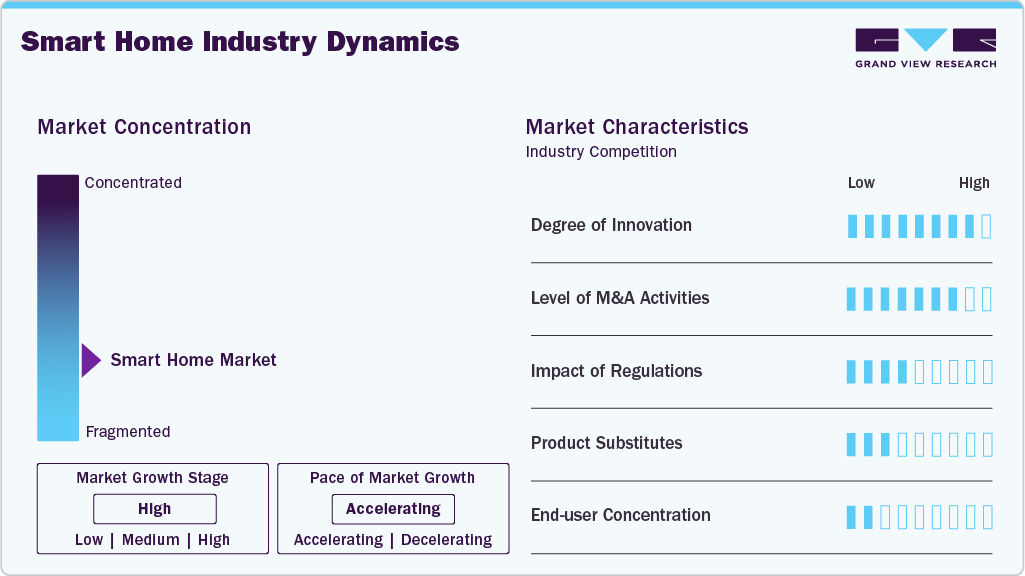
Furthermore, the impact of regulations is medium, as compliance with data privacy, cybersecurity, wireless communication, and consumer protection standards influences product development and deployment. The threat of product substitutes is medium, as traditional home appliances and conventional security systems remain viable alternatives; however, smart home solutions offer superior automation and connectivity. End-user concentration is low, owing to the highly fragmented customer base consisting of millions of residential consumers globally, reducing dependence on any specific customer group and providing a broad demand foundation for market growth.
Analyst Perspective
The smart home market is being driven by the growing demand for connected living ecosystems that enhance convenience, security, and energy efficiency through integrated IoT devices and AI-enabled automation. It is further supported by increasing consumer adoption of smart appliances, rising penetration of high-speed internet and wireless connectivity, and the shift toward subscription-based and cloud-driven service models across residential environments.
Product Insights
Based on product, the security & access control segment accounted for the largest revenue share in 2025 and is expected to grow at a significant CAGR over the forecast period, owing to rising concerns over safety, theft, and break-ins, prompting consumers to adopt smart home security systems. These solutions include smart cameras, doorbell cameras, motion sensors, smart locks, and alarm systems, offering enhanced monitoring, control, and peace of mind. With the growing adoption of connected devices, the trend toward remote security monitoring and automation continues to rise. Additionally, advancements in facial recognition, AI-driven surveillance, and integration with home automation systems are enhancing the effectiveness of smart security solutions.
The home healthcare segment is expected to witness the highest CAGR of over 32% from 2025 to 2033, which is driven by the aging population and increasing health awareness. As people prefer to age in place, there is a growing demand for smart home technologies that can assist with health monitoring, emergency alerts, and daily care tasks. Devices such as fall detection sensors, remote health monitoring, and smart medication reminders are gaining popularity. Additionally, the growing advancements in telemedicine, wearables, and AI-driven health monitoring tools are making healthcare more accessible and convenient in the home environment.
Protocols Insights
Based on protocols, the hybrid protocols segment led the market, accounting for the largest revenue share of 41.1% in 2025, driven by its ability to combine the strengths of both wired and wireless technologies. This approach allows for enhanced connectivity and flexibility, as hybrid protocols can operate without interfering with existing Wi-Fi networks and can utilize power lines for communication, eliminating the need for additional routers. As a result, hybrid systems are gaining popularity among consumers who seek reliable and efficient smart home solutions.
The wireless protocols segment is expected to witness the highest CAGR from 2025 to 2033, driven by the increasing integration of Internet of Things (IoT) devices with advanced technologies like artificial intelligence (AI) and machine learning, enabling seamless connectivity and automation. This segment benefits from rising consumer demand for energy-efficient solutions, enhanced security systems, and personalized home automation experiences. The affordability of smart devices and advancements like voice-controlled virtual assistants further boost adoption. Additionally, the proliferation of Wi-Fi 6 technology ensures reliable connectivity for multiple devices, while growing awareness of sustainability and convenience continues to propel the hybrid segment's growth.
Application Insights
Based on application, the retrofit segment led the market, accounting for the largest revenue share of 60.8% in 2025, driven by the growing demand for upgrading existing homes with smart technologies. Many homeowners are opting to retrofit their homes with smart thermostats, lighting, security systems, and home automation devices without undergoing significant renovations. This segment benefits from lower installation costs and easy integration with existing infrastructure. The trend of affordability and increased availability of retrofit products makes it appealing to a wide range of consumers who wish to modernize their homes without starting from scratch.

The new construction segment is expected to witness the highest CAGR from 2025 to 2033, driven by the increasing incorporation of smart technologies in newly built homes. As the demand for smart homes rises, developers and builders are integrating advanced home automation, energy-efficient systems, and connected devices directly into the construction process. The growing trend of “smart homes from the ground up” is spurred by the increasing awareness of energy efficiency, security, and convenience among homebuyers. Additionally, building codes and standards are evolving to incorporate smart technologies, making it more feasible for builders to include these systems in new constructions.
Regional Insights
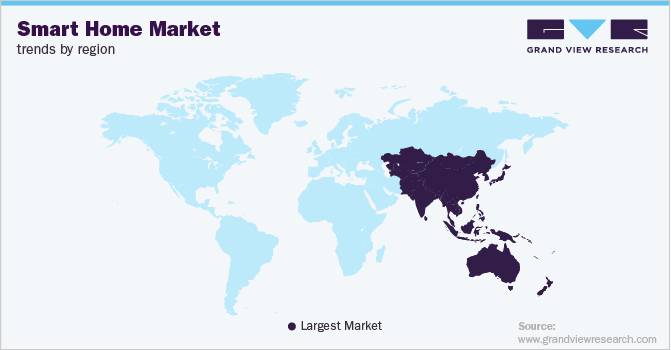
Asia Pacific dominated the smart home market, accounting for the largest revenue share of 38.2% in 2025, driven by increasing consumer demand for convenience, energy efficiency, and security. As the adoption of Internet of Things (IoT) devices grows, consumers are seeking integrated smart home systems that offer seamless control over lighting, heating, cooling, security, and entertainment. The region’s high disposable income, along with widespread internet penetration, also contributes to the rapid expansion of smart homes, particularly in urban areas. Moreover, government incentives and initiatives promoting energy efficiency and sustainability are further fueling market growth.
U.S. Smart Home Market Trends
The smart home market in the U.S. held the largest share in the North America region in 2025. Consumers are increasingly adopting smart devices such as thermostats, cameras, and smart speakers for better home management and convenience. Additionally, growing concerns around home security and energy conservation are pushing the adoption of interconnected smart home devices. The rise of home automation systems that allow remote control via smartphones and integration with AI technologies is further driving demand.
Europe Smart Home Market Trends
The smart home market in Europe is expected to grow at a CAGR of over 26% from 2025 to 2033, as consumers increasingly demand convenience, security, and energy efficiency. There is a noticeable trend toward integrating multiple smart devices into comprehensive ecosystems, allowing for seamless automation of lighting, heating, security, and entertainment systems. As in other regions, sustainability and energy savings are top priorities, with consumers seeking smart thermostats, energy management tools, and eco-friendly appliances.
The UK smart home market is expected to grow at a significant rate in the coming years, propelled by a growing focus on energy efficiency, sustainability, and home security. The UK’s commitment to reducing carbon emissions is further accelerating the demand for smart home products with energy-saving capabilities.
The smart home market in Germany is driven by a strong emphasis on automation and energy efficiency. German consumers are particularly drawn to products that provide both convenience and environmental benefits, such as smart lighting, heating systems, and solar-powered devices. The market is also influenced by the country’s commitment to sustainability and its focus on reducing carbon emissions, with government incentives encouraging the adoption of energy-efficient technologies.
Asia Pacific Smart Home Market Trends
The smart home market in Asia Pacific is expected to grow at the highest CAGR of over 28% from 2025 to 2033, driven by the increasing adoption of connected devices, improved internet infrastructure, and the rising demand for convenience, security, and energy efficiency. Consumers in APAC are increasingly seeking integrated smart home ecosystems that offer automation across lighting, HVAC, security systems, and appliances. The market is also influenced by the growing interest in smart homes as part of the broader trend of digitalization and urbanization, with both affluent urban populations and emerging middle-class consumers embracing connected living.
Japan smart home market is gaining traction, driven by a strong demand for advanced technology and innovation, with a particular focus on home security and energy efficiency. The market is also seeing a rise in demand for elderly care solutions, as Japan has one of the world's fastest-aging populations. Smart home systems that support health monitoring, fall detection, and remote caregiving are becoming increasingly popular. Additionally, the government’s push for energy-efficient technologies is driving the adoption of smart appliances and devices, such as smart thermostats and energy management systems, as part of efforts to reduce carbon emissions.
The smart home market in China is rapidly expanding and is propelled by the country’s technological advancements, a growing middle class, and government initiatives supporting smart cities. The adoption of AI-powered devices, voice assistants, and IoT-enabled products is gaining momentum as consumers seek greater convenience and efficiency. Chinese tech giants such as Alibaba and Tencent are heavily investing in smart home ecosystems, and the integration of 5G technology is expected to further accelerate the market’s growth by enabling faster, more reliable connections. The trend of smart home integration is also being driven by urbanization and the increasing interest in home automation for security, energy savings, and enhanced user experiences.
Key Smart Home Company Insights
Some of the key players operating in the market include Siemens AG and Schneider Electric SE, among others
-
Siemens AG is known for its technological leadership in automation, electrification, and digitalization. The company offers a broad portfolio of smart home and building automation products, focusing on energy management, smart grids, and IoT-integrated solutions. Siemens provides cutting-edge solutions for smart homes, including home automation systems, smart thermostats, lighting control, and security features. Their technologies aim to improve energy efficiency, security, and convenience for both residential and commercial spaces.
-
Schneider Electric SE is a global player in energy management and automation. The company offers a wide range of products and services aimed at enhancing energy efficiency, sustainability, and smart home experience. Schneider Electric’s smart home solutions include connected devices for lighting, heating, security, and energy monitoring, all designed to integrate seamlessly with home automation systems. By leveraging IoT technologies and data-driven insights, Schneider Electric helps consumers optimize energy usage, reduce costs, and enhance comfort, positioning itself as a prominent player in the smart home market.
Assa Abloy AB and Philips Lighting B.V. are some of the emerging market participants in the Smart Home market.
-
Assa Abloy AB is a global player in access solutions, specializing in products and services related to locks, doors, and entrance automation. The company offers a wide range of smart home solutions, including electronic locks, keyless entry systems, and smart security products. With operations in over 70 countries, Assa Abloy focuses on providing innovative and secure solutions for residential, commercial, and institutional sectors. The company’s smart home technologies enhance home security, offering convenience, control, and automation through advanced digital locking systems and connected devices.
-
Philips Lighting B.V., now known as Signify, is a global provider of lighting solutions, with a strong focus on smart lighting products for residential, commercial, and industrial applications. The company is at the forefront of the smart home lighting market, offering a wide range of connected, energy-efficient lighting products. The company's innovative solutions include smart bulbs, light control systems, and IoT-enabled lighting that can be controlled via smartphones or voice assistants.
Key Smart Home Companies:
The following key companies have been profiled for this study on the smart home market.
-
LG Electronics, Inc.
-
Siemens AG
-
Amazon.com, Inc.
-
Google Nest (Google LLC)
-
Samsung Electronics Co., Ltd.
-
Schneider Electric SE
-
Legrand S.A.
-
Robert Bosch GmbH
-
Assa Abloy AB
-
Sony Group Corp.
-
ABB, Ltd.
-
Philips Lighting B.V.
-
Honeywell International, Inc.
Competitive Benchmarking
Operating Strategies
Competitive Edge
Weaknesses
Established Players (Siemens AG, Google Nest, and Schneider Electric SE)
- Mature players leverage broad integrated ecosystems across smart home categories to drive retention and cross-selling.
- They focus on recurring revenues via subscriptions, cloud services, predictive maintenance, and automation platforms.
- Strong brand presence and wide distribution networks enable large-scale market reach.
- High R&D spending and economies of scale support innovation and cost efficiency.
- Slower innovation due to legacy systems and complex organizational structures.
- Less flexibility in addressing niche or fast-changing consumer needs.
Emerging Players (Assa Abloy AB and Philips Lighting B.V.)
- Emerging players focus on niche areas like AI automation, energy management, and smart wellness solutions.
- They use digital-first channels, partnerships, and agile development to enable rapid market entry.
- Faster innovation and strong adaptability to new technologies.
- Ability to deliver highly customized, user-focused solutions.
- Limited capital and a smaller distribution reach restrict scaling.
- Lower brand trust and reliance on external ecosystems impact growth stability.
Recent Developments
-
In February 2025, Amazon.com, Inc. unveiled Alexa+, its upgraded AI-powered virtual assistant. Alexa+ integrates generative AI capabilities, powered by Amazon Bedrock models like Nova and Anthropic’s Claude AI, enabling more natural conversations, improved contextual understanding, and multi-command handling. It offers personalized experiences by remembering user preferences and acting as an autonomous "agent" for tasks like reservations and repairs.
-
In September 2024, Schneider Electric SE launched an AI-powered energy management feature on its Wiser Home app, designed to optimize energy consumption for water heaters and EV chargers. This feature, developed in-house, uses AI to learn from user habits, weather forecasts, and tariff data to manage energy loads and reduce bills automatically.
-
In August 2024, LG Electronics unveiled a new chapter in connected home living at IFA 2024 with the ThinQ AI Home Hub. This hub acts as a central control point for managing and monitoring all compatible smart appliances within the home, enhancing convenience and connectivity. Featuring advanced AI capabilities, the ThinQ AI Home Hub learns user preferences to provide personalized services and streamline daily routines, marking a significant step in LG's vision for intelligent and integrated home environments.
Smart Home Market Report Scope
Report Attribute
Details
Market size in 2025
USD 162.8 billion
Estimated market size in 2026
USD 207.0 billion
Projected market size by 2033
USD 887.4 billion
Growth rate
CAGR of 23.1% from 2026 to 2033
Base year for estimation
2025
Historical data
2021 - 2024
Forecast period
2026 - 2033
Quantitative units
Revenue in USD million/billion and CAGR from 2026 to 2033
Report coverage
Revenue forecast, company ranking, competitive landscape, growth factors, and trends
Segments covered
Product, protocols, application, region
Regional scope
North America; Europe; Asia Pacific; Latin America; MEA
Country scope
U.S.; Canada; Germany; UK; Germany, France; Italy; Spain; Russia; Nordic Region; China; Japan; India; Australia; ASEAN, Brazil; Saudi Arabia; South Africa; UAE
Key companies profiled
LG Electronics, Inc.; Siemens AG; Amazon.com, Inc.; Google Nest (Google LLC); Samsung Electronics Co., Ltd.; Schneider Electric SE; Legrand S.A.; Robert Bosch GmbH; Assa Abloy AB; Sony Group Corp.; ABB Ltd.; Philips Lighting B.V.; and Honeywell International, Inc.
Customization scope
Free report customization (equivalent up to 8 analysts' working days) with purchase. Addition or alteration to country, regional & segment scope.
Pricing and purchase options
Avail customized purchase options to meet your exact research needs. Explore purchase options
Global Smart Home Market Report Segmentation
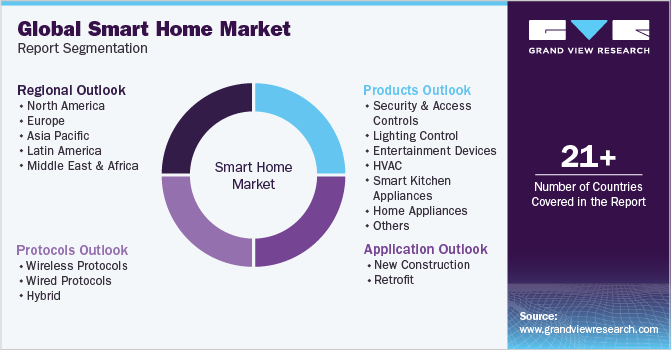
This report forecasts revenue growth at global, regional, and country levels and provides an analysis of the latest technological trends in each of the sub-segments from 2021 to 2033. For this study, Grand View Research has segmented the global smart home market report based on product, protocols, application, and region:
-
Product Outlook (Revenue, USD Million, 2021 - 2033)
-
Security & Access Controls
-
Security Cameras
-
Video Door Phones
-
Smart Locks
-
Remote Monitoring Software & Services
-
Others
-
-
Lighting Control
-
Smart Lights
-
Relays & Switches
-
Occupancy Sensors
-
Dimmers
-
Other Products
-
-
Entertainment Devices
-
Smart Displays/TV
-
Streaming Devices
-
Sound bars and Speakers
-
-
HVAC
-
Smart Thermostats
-
Sensors
-
Smart Vents
-
Others
-
-
Smart Kitchen Appliances
-
Refrigerators
-
Dish Washers
-
Cooktops
-
Microwave/Ovens
-
-
Home Appliances
-
Smart Washing Machines
-
Smart Water Heaters
-
Smart Vacuum Cleaners
-
-
Smart Furniture
-
Home Healthcare
-
Other Devices
-
-
Protocols Outlook (Revenue, USD Million, 2021 - 2033)
-
Wireless Protocols
-
ZigBee
-
Wi-Fi
-
Bluetooth
-
Z Wave
-
Others
-
-
Wired Protocols
-
Hybrid
-
-
Application Outlook (Revenue, USD Million, 2021 - 2033)
-
New Construction
-
Retrofit
-
-
Regional Outlook (Revenue, USD Million, 2021 - 2033)
-
North America
-
U.S.
-
Canada
-
-
Europe
-
UK
-
Germany
-
France
-
Italy
-
Spain
-
Benelux
-
Nordic Countries
-
Russia
-
-
Asia Pacific
-
China
-
Japan
-
India
-
South Korea
-
Australia
-
Indonesia
-
Thailand
-
-
Latin America
-
Brazil
-
Mexico
-
Argentina
-
-
Middle East & Africa
-
Saudi Arabia
-
South Africa
-
UAE
-
Egypt
-
Nigeria
-
-
Research Methodology
(a) Segment Definition
Segment - Type
Revenue capture definition
Security & Access Controls
Revenue is generated from the sale and deployment of smart security systems, including connected cameras, video doorbells, smart locks, intrusion detection sensors, biometric access systems, and related monitoring services. Monetization comes from device sales, installation fees, cloud video storage subscriptions, and recurring security monitoring contracts.
Lighting Control
Revenue is captured from smart lighting solutions, including connected bulbs, switches, dimmers, occupancy sensors, and centralized lighting management platforms. Providers earn through hardware sales, software integration services, and subscription-based automation and energy management features for residential properties.
Entertainment Devices
Revenue is derived from smart entertainment products such as smart TVs, streaming devices, smart speakers, home audio systems, and connected media hubs. Monetization comes from device sales, premium content services, software upgrades, and ecosystem-based subscriptions.
HVAC
Revenue is generated through smart heating, ventilation, and air conditioning solutions, including connected thermostats, HVAC controllers, air quality monitors, and energy optimization systems. Providers earn through equipment sales, installation services, maintenance contracts, and subscription-based energy management platforms.
Smart Kitchen Appliances
Revenue is captured from connected kitchen devices such as smart refrigerators, ovens, microwaves, coffee makers, dishwashers, and cooking assistants. Monetization comes from appliance sales, software-enabled features, remote monitoring services, and connected ecosystem integrations.
Home Appliances
Revenue is generated through smart household appliances including washing machines, dryers, vacuum cleaners, water heaters, air purifiers, and other connected domestic equipment. Providers earn from product sales, maintenance services, and premium digital functionalities enabled through mobile applications and cloud connectivity.
Smart Furniture
Revenue is derived from intelligent furniture products such as adjustable smart beds, connected desks, automated recliners, and furniture embedded with sensors or IoT capabilities. Monetization comes from product sales, premium customization features, and integrated wellness or automation services.
Home Healthcare
Revenue is generated from connected health and wellness devices used in residential settings, including remote patient monitoring systems, smart medical alert devices, health sensors, and wellness-tracking equipment. Providers earn through hardware sales, telehealth integrations, data monitoring subscriptions, and healthcare service partnerships.
Other Devices
Revenue is captured from a broad range of connected home products not classified elsewhere, including smart blinds, smart irrigation systems, connected pet care devices, environmental sensors, and home automation accessories. Monetization comes from equipment sales, installation services, and software-enabled subscriptions.
Segment - Protocols
Revenue capture definition
Wireless Protocols
Revenue is generated from smart home devices and platforms that communicate through wireless standards such as Wi-Fi, Bluetooth, Zigbee, Z-Wave, Thread, and cellular connectivity. Monetization comes from hardware sales, connectivity modules, licensing fees, and ecosystem integration services that enable seamless device communication.
Wired Protocols
Revenue is captured from smart home solutions utilizing physical communication infrastructure such as Ethernet, KNX, Modbus, power-line communication, or other wired networking technologies. Providers earn through equipment sales, installation projects, network infrastructure deployment, and maintenance services.
Hybrid
Revenue is generated from smart home systems that combine both wired and wireless communication technologies to improve reliability, scalability, and interoperability. Monetization comes from integrated hardware solutions, system design services, software platforms, and long-term support contracts.
Segment - Application
Revenue capture definition
New Construction
Revenue is generated through the integration of smart home technologies during the design and construction phase of residential buildings. Providers earn from large-scale contracts with builders, developers, and construction firms the install connected devices, automation systems, and centralized control platforms.
Retrofit
Revenue is captured from upgrading existing residential properties with smart home technologies. Monetization comes from device sales, installation services, system integration, and replacement of conventional equipment with connected alternatives, driven by homeowners seeking enhanced convenience, security, and energy efficiency.
(b) Estimation Model
Layer No.
Layer Name
Key Question
Description
Outcome Callout
01
Housing & Infrastructure
Which households are relevant for smart home deployments?
Identify residential units and housing stocks (single-family homes, multi-family apartments, luxury villas) investing in or possessing basic modern residential infrastructure to define the Total Addressable Market (TAM).
Defines the TAM (Total Addressable Market).
02
Digital Connectivity Layer
Which households can realistically deploy smart home solutions?
Filter addressable housing base across regions using digital readiness and local network factors to define the reachable, technically capable Serviceable Available Market (SAM).
Defines the SAM (Serviceable Available Market).
03
Solution Adoption Layer
Which households adopt smart home solutions?
Apply consumer adoption rates, behavioral intentions, and tech-readiness profiles across various property types to identify active, automated households.
Identifies active smart households.
04
Monetisation Layer
How much revenue is generated?
Estimate annual per-household spending across hardware, software platforms, data privacy subscriptions, and expert setup to multiply by active household deployments and derive Total Market Revenue.
Derives Total Market Revenue.
Delivered CustomizationsThis report has been delivered with the following In-depth customizations
Client Request
Customization Delivered
Value Adds
Smart Home Devices, Automation & Connected Living Trends
Conducted a focused analysis of smart home devices, home automation platforms, voice assistants, connected appliances, smart lighting, smart security systems, and energy management solutions, covering adoption trends, ecosystem integration, interoperability, and digital transformation across residential environments.
Helps stakeholders identify high-growth smart home segments, evaluate consumer adoption and ecosystem convergence, and assess monetization opportunities in connected living and subscription-based service models.
Smart Home Security, Surveillance & Access Control Adoption Trends
Evaluated smart locks, video doorbells, connected cameras, alarm systems, remote monitoring platforms, and AI-enabled home security solutions, along with adoption maturity across geographies, consumer segments, and price tiers.
Provides insights into home security digitization priorities, consumer trust drivers, and scalable platform opportunities for improving safety, convenience, and recurring revenue generation.
Smart Home Infrastructure & Integrated Living Intelligence Assessment
Assessed demand for integrated smart home ecosystems combining IoT devices, cloud-based control platforms, AI-driven automation, energy optimization systems, and cross-device interoperability, along with cybersecurity, data privacy, and standards challenges.
Supports investment and expansion strategies by identifying high-readiness markets, evaluating ecosystem maturity, and highlighting opportunities for unified home intelligence platforms enabling long-term scalable growth.
Frequently Asked Questions About This Report
The security & access control segment led the market with 31.0% revenue share in 2025, while the home healthcare segment is the fastest-growing model.
The hybrid protocols segment accounted for the largest revenue share of 41.1% in 2025, while the wireless protocols segment is the fastest-growing area.
The retrofit segment led the market, accounting for the largest revenue share of 60.8% in 2025, while new construction is the fastest-growing segment.
The global smart home market is expected to grow at a compound annual growth rate of 23.1% from 2026 to 2033, and is expected to reach USD 887.4 billion by 2033.
The global smart home market size was estimated at USD 162.8 billion in 2025 and is expected to reach USD 207.0 billion in 2026.
Key players include LG Electronics, Inc.; Siemens AG; Amazon.com, Inc.; Google Nest (Google LLC); Samsung Electronics Co., Ltd.; Schneider Electric SE; Legrand S.A.; Robert Bosch GmbH; Assa Abloy AB; Sony Group Corp.; ABB Ltd.; Philips Lighting B.V.; and Honeywell International, Inc.
Key factors that are driving the market growth include the growing need for smart security & surveillance systems, and increasing demand for low-carbon emission-oriented and energy-saving solutions.
Asia Pacific dominated the smart home market with a share of 38.2% in 2025. This is attributable to the increasing adoption of smart devices in the residential vertical to improve the standard of living.
About the Author(s)
Next Generation Technologies Research Team
Technology · Next Generation TechnologiesThis report was authored by the next generation technologies research team at Grand View Research - comprising two research analysts, one senior research analyst, and one industry expert - with specialized expertise in the next generation technologies segment of the technology industry. All findings are based on proprietary technology databases, executive interviews, and regulatory analysis, subject to internal peer review prior to publication.
Last Updated:
Speak to Analyst

Customize this report to your needs — add regions, segments, or data points, with 20% free customization.
Or view our licence options:


ISO 9001:2015 & 27001:2022 Certified
We are GDPR and CCPA compliant! Your transaction & personal information is safe and secure. For more details, please read our privacy policy.












