
- Home
- »
- Consumer F&B
- »
-
A2 Milk Market Size, Share And Trends Report, 2026-2033GVR Report cover
![A2 Milk Market (2026 - 2033)Report]()
A2 Milk Market (2026 - 2033)
Size, Share & Trends Analysis Report By Product (Powder, Liquid), By Packaging (Cartons, Bottles), By Distribution Channel (Hypermarkets & Supermarkets, Convenience Stores, Online), By Region (North America), And Segment Forecasts
Market Size, 2025
$4.8BMarket Estimate, 2026
$5.6BMarket Forecast, 2033
$18.6BCAGR, 2026–2033
18.6%A2 Milk Market Summary
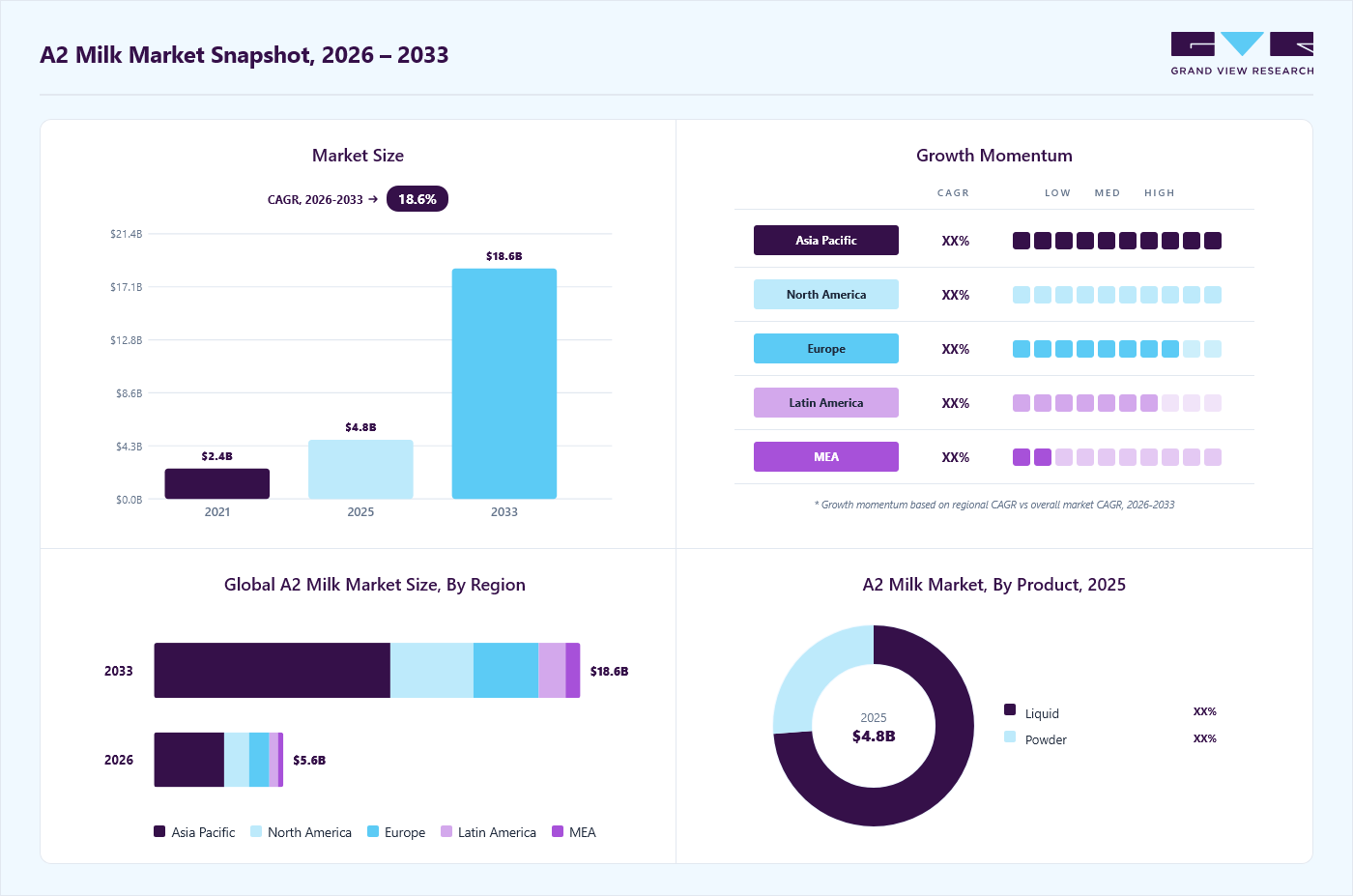
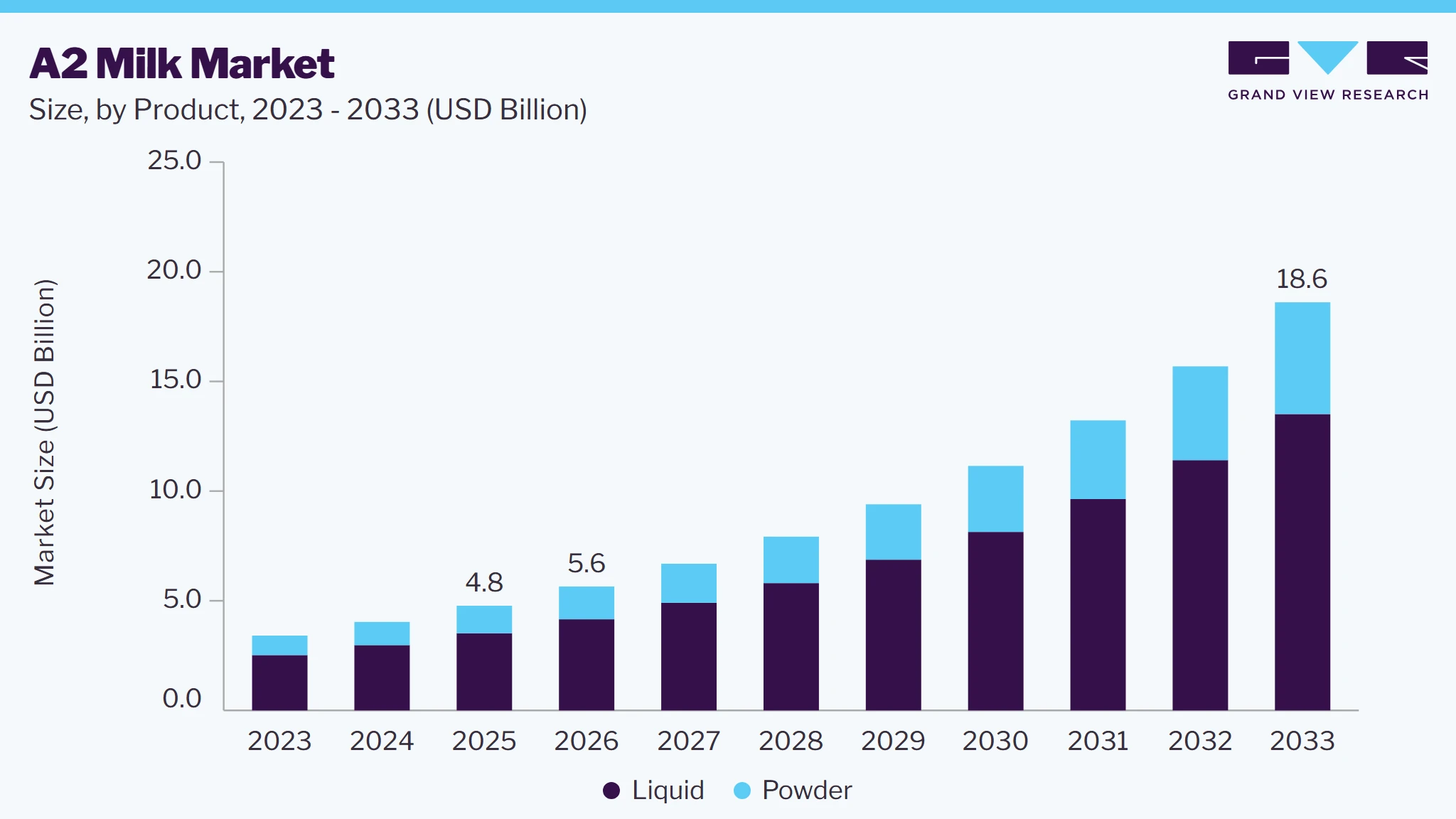
The global A2 milk market size was valued at USD 4.8 billion in 2025 and is projected to grow from USD 5.6 billion in 2026 to USD 18.6 billion by 2033, at a CAGR of 18.6% from 2026 to 2033. Asia Pacific dominated the A2 milk market with the largest revenue share of 54.1% in 2025. A key driver of this growth is the increasing preference for nutritious food worldwide.
Key Market Trends & Insights
- By product: Liquid A2 milk segment held the largest market share of 73.7% in 2025.
- By distribution channel: Hypermarket & supermarket segment held the largest market share of 51.5% in 2025.
- By packaging: Carton packaging segment held the largest market share of 63.1% in 2025.
Regional Highlights
- Largest regional market: Asia Pacific (54.1% revenue share, 2025)
Market Size & Forecast
- Market size in 2025: USD 4.8 Billion
- Estimated market size in 2026: USD 5.6 Billion
- Projected market size by 2033: USD 18.6 Billion
- CAGR (2026-2033): 18.6%
Additionally, rising health awareness is expected to boost A2 milk consumption, further contributing to market expansion in the coming years. Unlike traditional milk, A2 milk powder is easier for the human body to digest, enhancing its appeal. As a result, consumers have increased their spending on healthy and nutritious foods, with a strong focus on maintaining physical fitness, which has significantly driven market growth during the COVID-19 era. Consequently, market revenue is expected to see a positive growth trajectory throughout the pandemic.A2 milk is offered by various producers in both liquid and powder packaging, and it comes in different packaging options, such as cartons and bottles. Producers are also leveraging diverse distribution channels, including supermarkets, hypermarkets, convenience stores, and online platforms, to boost sales. The introduction of flavored options is anticipated to further increase product adoption. However, in countries such as the U.S., Germany, the UK, and Australia, governments have implemented regulations governing the production and distribution of milk and dairy products. For instance, the U.S. Food & Drug Administration (FDA) has established guidelines for milk production and its derivatives.
Additionally, dairy industry players are increasingly sourcing fat-free and healthy milk products to attract a broader customer base, which is expected to contribute to market growth during the assessment period. Emerging economies such as China and India, where the food and beverage industry are experiencing rapid expansion, are also projected to offer significant growth opportunities.
The rising trend of health consciousness, coupled with increasing demand for high-nutrition beverages among youth and millennials, is fueling global demand for A2 milk. As consumers grow more concerned about their health due to the rise in chronic conditions such as high blood pressure and heart disease, the market is set to benefit from new opportunities. Growing investments by key market players, particularly in organic A2 milk, which is popular in fitness centers for weight management, are also expected to drive the market. The increasing demand for healthy, energy-boosting beverages in North America is further contributing to the industry's growth.
Market Dynamics
The A2 milk market is being driven by increasing consumer awareness of digestive health and the perceived benefits of A2 protein compared to conventional milk. Rising demand for premium dairy products, growing health-conscious populations, and a shift toward natural and minimally processed food options are supporting market expansion. Manufacturers are investing in product diversification, including A2 milk-based yogurt, infant formula, cheese, and other dairy products, to attract a broader consumer base. Additionally, expanding distribution networks through supermarkets, specialty stores, and e-commerce platforms is improving product accessibility. Favorable marketing initiatives, increasing disposable incomes, and growing interest in functional nutrition are expected to further accelerate growth in the A2 milk market.
The higher digestibility of A2 milk is a key factor driving its adoption among health-conscious consumers. Many individuals perceive A2 milk as gentler on the digestive system compared to conventional milk, making it an attractive option for daily consumption. According to the ScienceDirect data published in September 2025, A2 milk is easily more digestible than conventional A1 milk because it does not release beta-casomorphin-7 (BCM-7) during digestion, a compound associated with digestive discomfort. This perceived digestive comfort has encouraged consumers to switch to A2 milk as part of their wellness-focused lifestyles. As awareness of digestive health continues to grow, demand for easily digestible dairy products is expected to increase.
The higher price of A2 milk compared to conventional milk products acts as a significant restraint on market growth. Premium pricing is often associated with specialized breeding, segregation, and certification processes required for A2 milk production. According to the data published in January 2026, A2 milk requires specialized cattle selection, dedicated production processes, and separate supply chain management compared to regular milk. These additional requirements increase production costs and ultimately raise retail prices. As a result, price-sensitive consumers may continue to prefer conventional milk, particularly in developing regions. This cost barrier can limit widespread adoption and reduce market penetration among mass-market consumers.
The growing expansion of e-commerce and direct-to-consumer dairy platforms presents a significant opportunity for the A2 milk market. Digital channels enable manufacturers to reach a wider customer base, including consumers in regions where specialty dairy products have limited retail availability. Product innovation, such as fortified and functional A2 milk offerings, is also creating new avenues for market penetration. Furthermore, increasing consumer interest in premium and specialty food products is encouraging brands to diversify their A2 milk portfolios and enter untapped markets.
Analyst Perspective
The A2 milk market is positioned within a broader structural shift toward health-led premiumization in global dairy consumption, where digestive wellness, clean-label preferences, and functional nutrition are becoming key decision drivers for consumers. Unlike traditional dairy categories, its growth is strongly influenced by perception-led value creation, where consumers associate A2 protein with improved digestive comfort and overall well-being. At the same time, the category is evolving through multi-channel expansion, as organized retail, online grocery platforms, and direct dairy delivery models improve accessibility beyond niche health-conscious segments. This combination of health-driven demand and expanding distribution ecosystems is gradually transforming A2 milk from a specialty product into a mainstream premium dairy alternative.
Product Insights
Based on product, the liquid A2 milk segment led the market with the largest revenue share of 73.7% in 2025. In 2024, the liquid segment led the market, accounting for a revenue share of 73.8%. Consumers tend to prefer fresh milk because it is rich in essential nutrients such as calcium, vitamins, and proteins. As a result, liquid A2 milk contributed more significantly to market revenue due to its convenience and widespread consumption.
The powder segment is anticipated to grow at the highest CAGR of 19.4% from 2025 to 2030. This growth is driven by the increasing use of A2 milk powder in online, which is expected to significantly boost the segment's market share. The rising demand for A2 milk powder in various distribution channels, such as confectionery, baked desserts, and savory products, is also contributing to its expansion. Additionally, the powder packaging's low moisture content enhances its durability, allowing it to be stored for extended periods, further supporting its market growth.
Packaging Insights
Based on packaging, the carton packaging segment led the market with the largest revenue share of 63.1% in 2025. Carton packaging is considered safer and more convenient for food storage, as it protects the product and provides longer durability. Additionally, cartons are lightweight, which reduces transportation costs. The carton segment has been the primary contributor to global market revenue due to the strong demand for rigid packaging in the dairy products sector worldwide.
Furthermore, the bottles segment is expected to grow at the second-highest CAGR of 18.1% from 2025 to 2030. Milk bottles can be made from plastic or glass and are often used by milkmen for delivering fresh milk. They are also reusable through refilling. The increasing demand for convenient packaging solutions in the dairy beverages industry is anticipated to further enhance the segment's share during the forecast period.
Distribution Channels Insights
Based on distribution channel, supermarket & hypermarket channels led the market, accounting for the largest revenue share of 51.5% in 2025. These organized retail channels focus on providing customer-oriented services by offering a wide range of fast-moving consumer goods (FMCG) directly to consumers. These stores allow customers to physically verify products before purchasing, significantly contributing to market revenue.
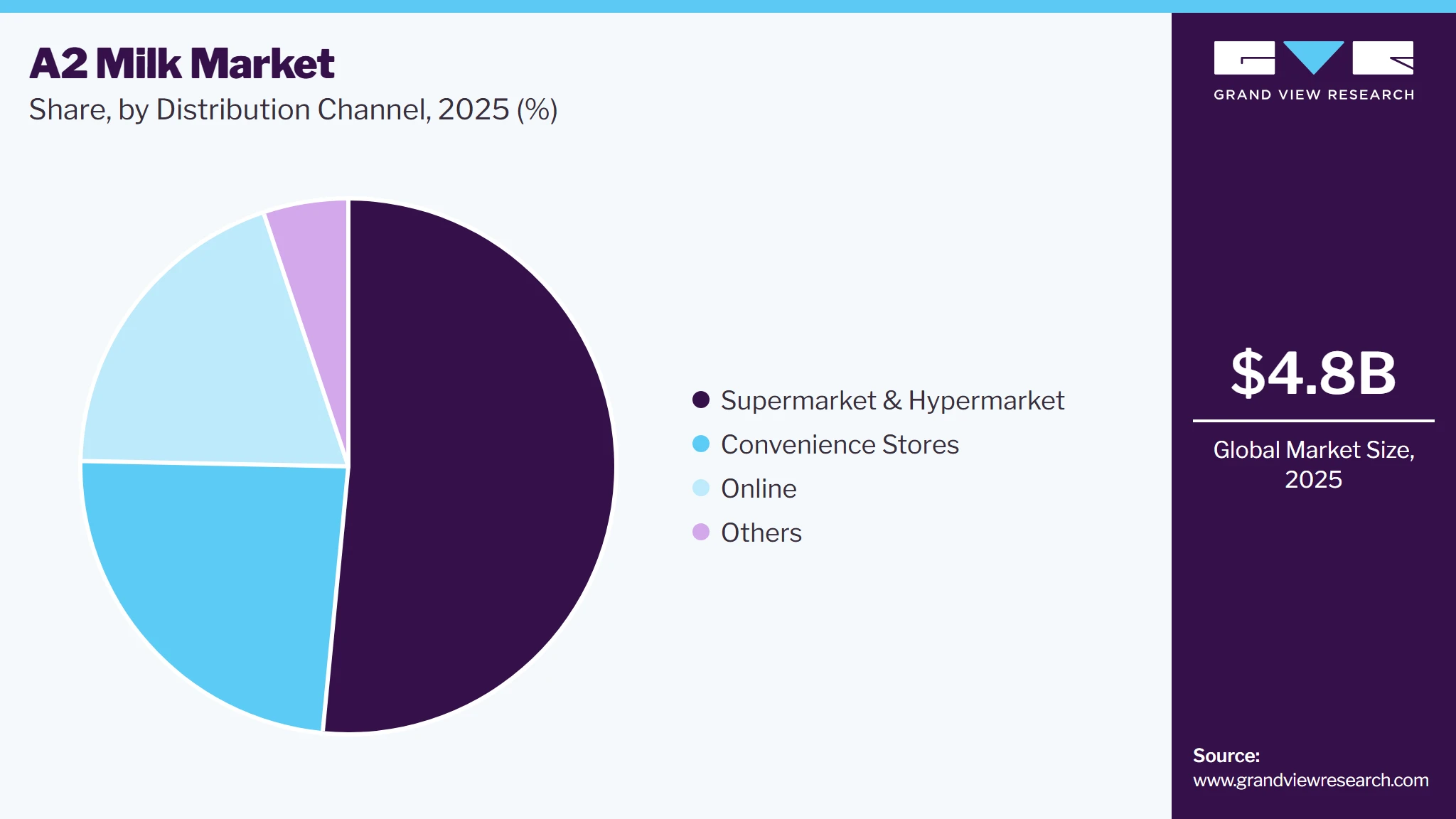
Moreover, the online segment is expected to register the fastest growth during the forecast years, with a CAGR of 19.4% from 2025 to 2030. The use of online shopping portals and mobile apps is getting popular due to its simplicity and convenience. Products are available for economic rates on online channels compared to offline. Moreover, the rising smartphone users and internet penetration across the globe further boosted the online distribution channel segment during the forecast period.
Regional Insights
North America A2 milk market is expected to grow with a CAGR of 18.7% from 2025 to 2030. Countries such as the U.S. and Canada are positively contributing to the growth of the market owing to the significant demand for healthy milk across the countries. This rapid growth is expected due to the increased demand with acceptance of A2 milk as beverages and increased spending from consumers.
U.S. A2 Milk Market Trends
The A2 milk market in the U.S. held the largest share in the North America region in 2025. The U.S. A2 Milk market has been experiencing significant growth in recent years, driven by increasing consumer awareness of potential digestive benefits and a growing interest in premium dairy products. A2 Milk Company, the pioneer in this segment, has established a strong presence, but competition is intensifying as more domestic dairy producers enter the market.
Europe A2 Milk Market Trends
Europe A2 milk market is expected to grow with a CAGR of 18.1% from 2025 to 2030. The European A2 Milk market has been experiencing steady growth, driven by increasing consumer awareness of its potential health benefits. This growth is expected to continue, with consumers showing a willingness to pay premium prices for A2 milk products. The market is seeing diversification beyond liquid milk into A2 yogurts and cheeses. There's also a notable trend towards organic and grass-fed A2 milk, aligning with broader preferences for natural and sustainably produced dairy.
Asia Pacific A2 Milk Market Trends
Asia Pacific dominated the A2 milk market with the largest revenue share of 54.1% in 2025. Consumer awareness of A2 milk's potential digestive benefits is rapidly increasing, particularly among urban, health-conscious consumers and parents of young children. The market is seeing significant product diversification, with A2 milk being incorporated into onlines, flavored milk drinks, and other dairy products. In countries such as India, where lactose intolerance is prevalent, A2 milk is gaining traction as a more digestible alternative to conventional milk.

Japan A2 milk market is expected to grow with a CAGR of 18.1% from 2025 to 2030. Japanese consumers, known for their high health consciousness and willingness to try functional foods, are gradually becoming aware of A2 milk and its potential benefits. The aging population in Japan is a significant driver, as older consumers are often more concerned about digestive health. A2 milk is being marketed as a premium product, aligning well with Japan's preference for high-quality, value-added dairy products.
Key A2 Milk Company Insights
The market is characterized by the presence of various well-established players and several small and medium players. In July 2023, A Greener World (AGW) announced that the a2 Milk Company’s Grassfed a2 Whole Milk and Grassfed a2 2% Reduced Fat Milk have earned the Certified Regenerative label from AGW. This certification ensures the entire farm's commitment to regeneration and sustainability. It evaluates positive impacts on soil health, water quality, air, biodiversity, infrastructure, animal welfare, and social responsibility. The A2 milk manufacturers are aggressively following organic as well as inorganic strategies to expand their footprints across the geography.
Key A2 Milk Companies
The following key companies have been profiled for this study on the a2 milk market.
-
Vinamilk
-
Freedom Foods Group Limited
-
Erden Creamery Private Limited
-
Lion Dairy & Drinks
-
Vrindavan Dairy Farm
-
KESARIYA FARM PRIVATE LIMITED
-
SIDS FARM PRIVATE LIMITED
-
Happy Milk
-
GCMMF
-
The a2 Milk Company Limited
Competitive Benchmarking
Category
Operating Strategies
Competitive Edge
Weakness
Established Players (Vinamilk; Freedom Foods Group Limited; The a2 Milk Company Limited; GCMMF)
- Strong focus on large-scale dairy sourcing, branded A2 milk product lines, multi-channel distribution (modern retail, online grocery, dairy cooperatives, and HoReCa), and investment in premium positioning and product certification.
- Strong brand trust, established dairy supply chains, wide geographic presence, and ability to scale premium dairy production efficiently.
- High pricing compared to conventional milk, dependence on certified A2 cattle supply, and relatively slower penetration in price-sensitive emerging markets.
Emerging Players (Snowville Creamery; Vrindavan Dairy Farm; KESARIYA FARM PRIVATE LIMITED; SIDS FARM PRIVATE LIMITED; Happy Milk)
- Emphasis on direct-to-consumer delivery, subscription-based dairy supply, organic and clean-label positioning, and niche targeting of health-conscious and lactose-sensitive consumers.
- Strong focus on innovation, high agility, and personalization, and faster adoption of digital sales channels and wellness-driven branding.
- Limited production scale, weaker brand recognition, fragmented supply chains, and challenges in maintaining consistent A2 certification and quality standards.
Recent Developments
-
In April 2024, The a2 Milk Company launched a fresh brand platform, marking its first collaboration with creative agency BMF. The new campaign, titled "Tough Tummies," revolves around the platform "Only a2 Will Do," emphasizing the unique absence of the A1 protein in a2 Milk, which is present in most regular milk. This campaign aims to highlight the benefits of a2 Milk for individuals with sensitive stomachs, promoting its natural composition as a healthier choice for easier digestion.
A2 Milk Market Report Scope
Report Attribute
Details
Market size in 2025
USD 4.8 billion
Estimated market size in 2026
USD 5.6 billion
Projected market size by 2033
USD 18.6 billion
Growth rate
CAGR of 18.6% from 2026 to 2033
Base year for estimation
2025
Historical data
2021 - 2024
Forecast period
2026 - 2033
Quantitative units
Revenue in USD million/billion and CAGR from 2026 to 2033
Report coverage
Revenue forecast, company ranking, competitive landscape, growth factors, and trends
Segments covered
Product, packaging, distribution channel, region
Regional scope
North America; Europe; Asia Pacific; Central & South America; MEA
Country scope
U.S.; Canada; Mexico; Germany; UK; France; Italy; Spain; China; Australia & New Zealand; India; Japan; Brazil; South Africa
Key companies profiled
Vinamilk; Freedom Foods Group Limited; Erden Creamery Private Limited; Snowville Creamery; Vrindavan Dairy Farm; KESARIYA FARM PRIVATE LIMITED; SIDS FARM PRIVATE LIMITED; Happy Milk; GCMMF; The a2 Milk Company Limited
Customization scope
Free report customization (equivalent up to 8 analysts' working days) with purchase. Addition or alteration to country, regional & segment scope.
Pricing and purchase options
Avail customized purchase options to meet your exact research needs. Explore purchase options
Global A2 Milk Market Report Segmentation
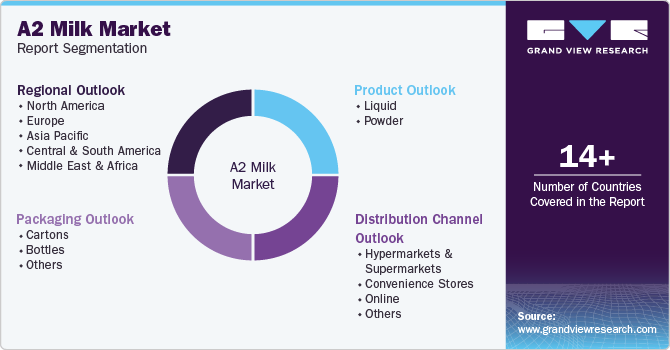
This report forecasts revenue growth at the global, regional, and country levels and provides an analysis of the latest industry trends and opportunities in each of the sub-segments from 2021 to 2033. For the purpose of this study, Grand View Research has segmented the global a2 milk market report on the basis of product, packaging, distribution channel, and region:
-
Product Outlook (Revenue, USD Million, 2021 - 2033)
-
Liquid
-
Powder
-
-
Packaging Outlook (Revenue, USD Million, 2021 - 2033)
-
Cartons
-
Bottles
-
Others
-
-
Distribution Channel Outlook (Revenue, USD Million, 2021 - 2033)
-
Hypermarkets & Supermarkets
-
Convenience Stores
-
Online
-
Others
-
-
Regional Outlook (Revenue, USD Million, 2021 - 2033)
-
North America
-
U.S.
-
Canada
-
Mexico
-
-
Europe
-
UK
-
Germany
-
France
-
Italy
-
Spain
-
-
Asia Pacific
-
China
-
Japan
-
India
-
Australia & New Zealand
-
-
Central & South America
-
Brazil
-
-
Middle East & Africa
-
South Africa
-
-
Research Methodology
The A2 milk market figures in this report are based on a proven research process that combines executive interviews with secondary research from proprietary databases, company filings, and recognized regulatory and institutional sources. Market size is built through value-chain sizing - reconciling supply-side and demand-side estimates - and triangulated with bottom-up and top-down approaches. Every estimate passes multiple levels of expert validation before publication, with each A2 milk segment quantified using the revenue-capture definitions in the table below.
Segment Definition
Segment - Product
Revenue capture definition
Liquid
Revenue is generated through the sale of ready-to-consume A2 milk in liquid form, which is typically packaged in bottles or cartons. It is directly consumed by households and is preferred for its convenience, freshness, and quick usage in daily diets.
Powder
Revenue is generated through A2 milk powder, which is processed and dehydrated for longer shelf life and easy storage. It is widely used for travel, infant nutrition, and regions with limited cold storage facilities, offering convenience and extended usability.
Estimation Model
Consumption Universe Layer
Access & Availability Layer
Purchase & Usage Layer
Revenue Conversion Layer
Who consumes A2 milk globally?
Who can access A2 milk via retail & delivery?
Who are active A2 milk users?
How much revenue is generated?
Total population consuming milk and dairy products, driven by rising health consciousness, digestive wellness concerns, and preference for premium nutritional beverages across global households.
Portion of consumers who can access A2 milk through organized retail, dairy cooperatives, specialty health stores, and expanding e-commerce and direct-to-home dairy delivery networks.
Share of accessible consumers actively purchasing A2 milk, influenced by awareness of digestive benefits, trust in branded dairy products, product affordability, and substitution from regular milk.
Final revenue generated through per-capita spending on A2 milk products, purchase frequency, premium pricing structure, and increasing adoption of value-added variants such as flavored and fortified A2 milk.
Delivered Customizations
This report has been delivered with the following In-depth customizations
Client Request
Customization Delivered
Value Adds
A2 Milk Product Innovation & Premiumization Trends
Assessed evolving product trends such as flavored A2 milk variants, fortified and functional dairy products, organic A2 milk offerings, lactose-sensitive positioning, and clean-label nutrition-focused innovations targeting health-conscious consumers.
Supports brands in identifying differentiation opportunities, strengthening premium positioning, and aligning product development with shifting health, wellness, and digestive comfort preferences.
A2 Milk Distribution Channel Dynamics
Evaluated distribution performance across modern retail, dairy cooperatives, specialty stores, HoReCa, and online grocery/quick-commerce platforms, including direct-to-home dairy services and subscription-based delivery models shaping consumer access to A2 milk.
Provides insights into channel-wise growth potential, consumer accessibility patterns, and evolving purchasing behavior to optimize distribution strategy and maximize market penetration.
A2 Milk Consumer Behavior & Demand Shifts
Analyzed changing consumer preferences driven by digestive health concerns, rising intolerance awareness, shift toward premium dairy alternatives, and increasing willingness to pay for perceived health benefits of A2 milk among urban and younger populations.
Enables stakeholders to understand evolving consumption patterns, tailor marketing strategies, and improve targeting of health-conscious and premium dairy consumers across key regions.
Frequently Asked Questions About This Report
Asia Pacific dominated with a 54.1% revenue share in 2025.
The liquid A2 milk segment led with a 73.7% revenue share in 2025.
The cartons segment is the fastest-growing product segment.
The supermarket & hypermarket channel held the largest share (over 51.5%) in 2025, and the online distribution channel is the fastest-growing.
Key players include Vinamilk, Freedom Foods Group Limited, Erden Creamery Private Limited, Snowville Creamery, Vrindavan Dairy Farm, Kesariya Farm Private Limited, Sids Farm Private Limited, Happy Milk, GCMMF, and The A2 Milk Company Limited.
The global A2 milk market size was valued at USD 4.0 billion in 2024 and is estimated at USD 5.6 billion for 2026.
The global A2 milk market is expected to grow at a CAGR of 18.6% from 2026 to 2033, reaching USD 18.6 billion by 2033.
Key factors include rising consumer awareness of digestive health, growing demand for perceived natural and premium dairy products, and increasing concerns about lactose intolerance and milk sensitivity.
North America is the fastest-growing region over the forecast period.
About the Author(s)
Consumer F&B Research Team
Consumer Goods · Consumer F&BThis report was authored by the consumer f&b research team at Grand View Research - comprising two research analysts, one senior research analyst, and one industry expert - with specialized expertise in the consumer f&b segment of the consumer goods industry. All findings are based on proprietary consumer goods databases, executive interviews, and regulatory analysis, subject to internal peer review prior to publication.
Last Updated:
Speak to Analyst


Customize this report to your needs — add regions, segments, or data points, with 20% free customization.
Or view our licence options:


ISO 9001:2015 & 27001:2022 Certified
We are GDPR and CCPA compliant! Your transaction & personal information is safe and secure. For more details, please read our privacy policy.


