
- Home
- »
- Next Generation Technologies
- »
-
Acoustic Camera Market Size And Share Report, 2026-2033GVR Report cover
![Acoustic Camera Market (2026 - 2033)Report]()
Acoustic Camera Market (2026 - 2033)
Size, Share & Trends Analysis Report By Product Type, By Array Type (2D, 3D), By Measurement Type (Near-Field, Far-Field), By Application, By End Use Industry, By Region, And Segment Forecasts
Market Size, 2025
$162.7MMarket Estimate, 2026
$175.5MMarket Forecast, 2033
$305.5MCAGR, 2026–2033
8.2%Acoustic Camera Market Summary
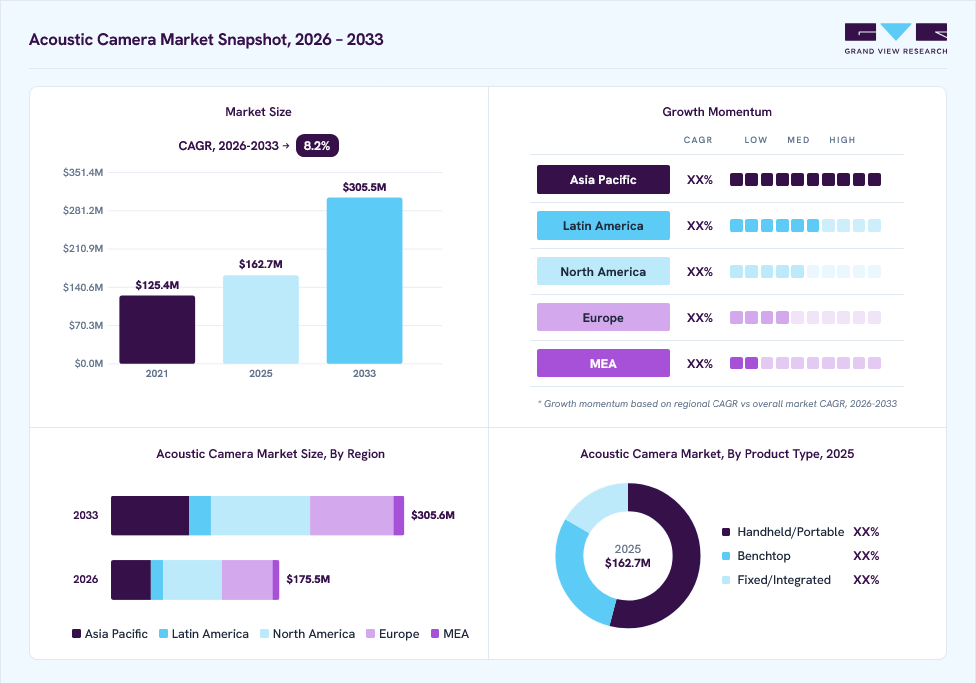
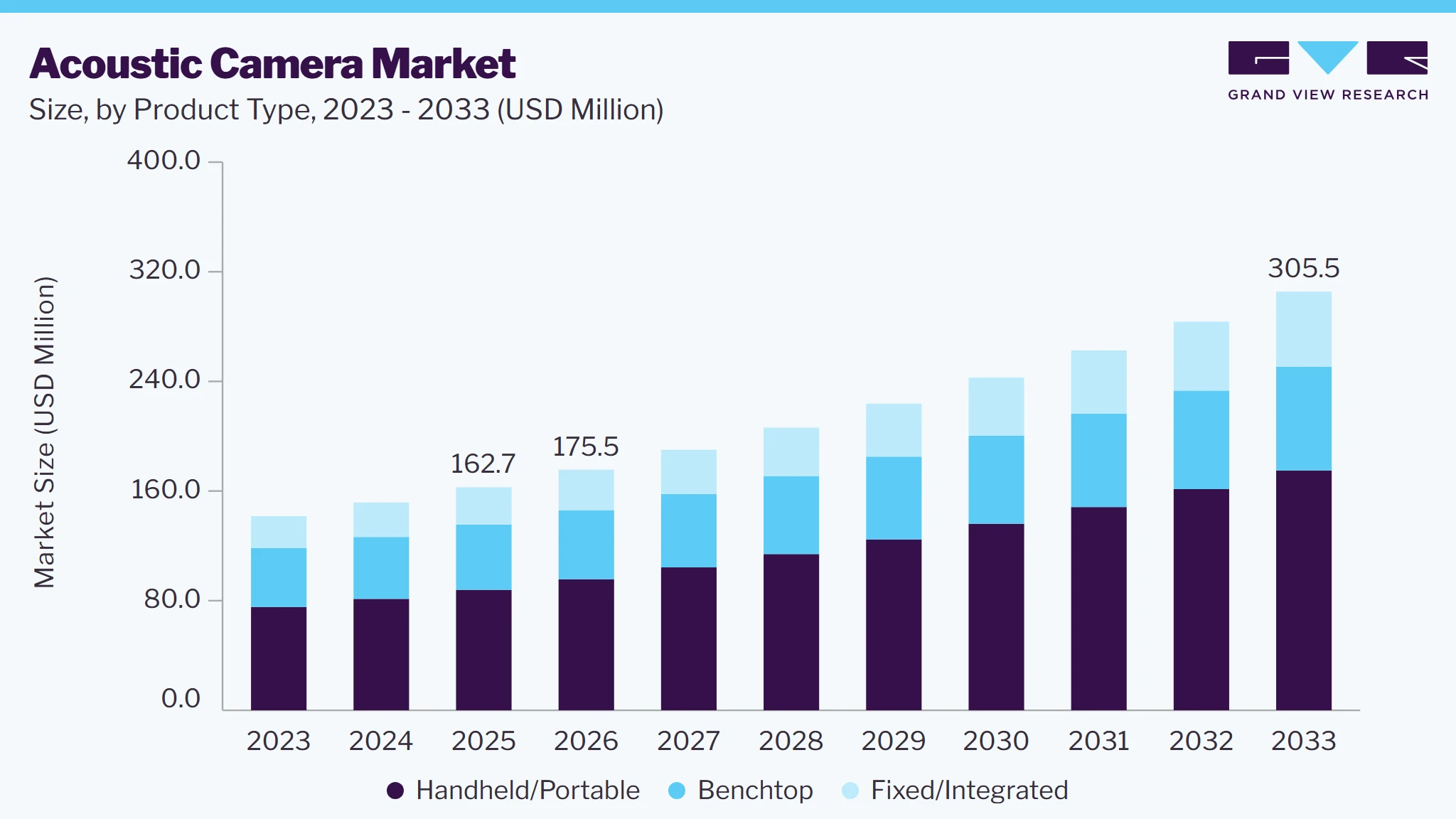
The global acoustic camera market size was valued at USD 162.7 million in 2025 and is projected to grow from USD 175.5 million in 2026 to USD 305.5 million by 2033, at a CAGR of 8.2% from 2026 to 2033. North America dominated the market, accounting for the largest revenue share of 35.1% in 2025. The market growth is primarily driven by the increasing adoption of predictive maintenance and condition monitoring technologies, rising demand for noise source localization and quality control, growing investments in industrial automation and smart manufacturing, and increasing regulatory emphasis on workplace and environmental noise management.
Key Market Trends & Insights
- By product type: Handheld/portable segment held the largest revenue share of 54.0% in 2025
- By array type: 2D segment held the largest revenue share of 65.7% in 2025
- By measurement type: Far-field segment held the largest revenue share of 60.2% in 2025
- By application: Noise source identification segment held the largest revenue share of 31.0% in 2025
Regional Highlights
- Largest regional market: North America (35.1% revenue share, 2025)
- Fastest growing regional market: Asia Pacific (fastest CAGR, 2026-2033)
- By Country: The U.S. held the largest market share in 2025
Market Size & Forecast
- Market size in 2025: USD 162.7 Million
- Estimated market size in 2026: USD 175.5 Million
- Projected market size by 2033: USD 305.5 Million
- CAGR (2026-2033): 8.2%
The acoustic camera industry’s growth is driven by the increasing participation in fitness and recreational activities, the rising consumer spending on sports apparel and equipment, and the growing popularity of outdoor adventure sports across all age groups. The adoption of smart sports equipment, connected fitness devices, and performance-enhancing technologies is accelerating as consumers, sports clubs, educational institutions, and fitness centers seek durable, innovative, and personalized solutions to improve athletic performance, support active lifestyles, enhance training efficiency, and elevate overall recreational experiences.The increasing focus on industrial automation, equipment reliability, and product quality is accelerating demand for acoustic cameras across manufacturing and engineering environments. Companies are increasingly deploying acoustic imaging systems to identify air and gas leaks, bearing and gearbox faults, mechanical abnormalities, electrical discharges, and other sources of unwanted noise without requiring extensive equipment disassembly or production downtime. The growing adoption of condition monitoring and predictive maintenance programs is further supporting the expansion of the acoustic camera industry, as acoustic cameras provide visual and quantitative insights that complement conventional vibration, thermal, and ultrasonic inspection techniques.
Additionally, rapid advancements in microphone array technology, digital signal processing, beamforming, artificial intelligence, and imaging software are driving innovation across the acoustic camera industry. Manufacturers are integrating high-density microphone arrays, advanced beamforming algorithms, real-time acoustic maps, automated sound classification, and intelligent analytics to improve source localization accuracy and measurement efficiency.
Furthermore, growing enhancements in sensor sensitivity, spatial resolution, processing capabilities, and compact hardware designs are enabling acoustic cameras to be deployed across laboratories, production floors, outdoor environments, and field inspection applications. Integration with measurement software, digital twins, industrial IoT platforms, and other diagnostic systems is further enhancing the value of acoustic imaging technologies, thereby driving the market growth.
Moreover, the increasing adoption of electric vehicles, advanced vehicle components, and lightweight automotive designs is creating significant demand for acoustic cameras in noise, vibration, and harshness (NVH) testing. Similar demand is emerging in aerospace, rail transportation, consumer electronics, HVAC systems, and industrial machinery, where manufacturers are focusing on reducing unwanted noise and improving acoustic performance. These factors are expected to further drive the acoustic camera industry growth in the coming years.
Market Dynamics
The acoustic camera market is experiencing significant growth, driven by increasing demand for real-time sound visualization, expanding adoption of predictive maintenance technologies, rising investments in industrial automation, and growing regulatory requirements related to noise and workplace safety. The increasing use of acoustic imaging in automotive NVH testing, industrial equipment inspection, aerospace engineering, energy infrastructure, and manufacturing quality control is creating strong demand for advanced acoustic measurement solutions. Integration of microphone arrays, AI-powered sound classification, advanced beamforming, wireless connectivity, and cloud-based analytics is improving measurement accuracy, operational efficiency, and ease of use, creating substantial long-term growth opportunities for the global market.
The growing emphasis on predictive maintenance, equipment reliability, and reducing unplanned downtime is driving the adoption of acoustic cameras across manufacturing, energy, automotive, aerospace, and industrial facilities. Acoustic cameras allow maintenance teams and engineers to rapidly identify abnormal sound sources associated with machinery faults, compressed-air leaks, electrical discharges, bearing failures, gear defects, and other equipment abnormalities. Unlike conventional inspection methods that may require extensive testing or equipment shutdown, acoustic imaging can provide rapid visual localization of potential problems during operating conditions.
The expansion of smart manufacturing and Industry 4.0 initiatives is further strengthening demand for acoustic monitoring technologies. Manufacturers are increasingly integrating acoustic cameras with condition-monitoring systems, industrial IoT platforms, automated inspection processes, and maintenance software to improve asset visibility and reduce operational losses. The ability to visualize sound sources and generate detailed acoustic maps enables engineers to identify problems more efficiently and prioritize maintenance activities. As industrial operators increasingly focus on asset utilization, energy efficiency, workplace safety, and production continuity, demand for advanced acoustic inspection technologies is expected to rise in both developed and emerging markets.
Acoustic cameras typically incorporate multiple precision microphones, specialized data acquisition hardware, high-performance signal processing capabilities, and advanced visualization software, resulting in relatively high acquisition costs compared with conventional sound measurement instruments. These costs can limit adoption among small and medium-sized enterprises, research organizations with constrained budgets, and industrial users with limited inspection requirements. Additional expenses associated with software licenses, calibration, maintenance, training, and system upgrades can further increase the total cost of ownership.
The effective use of acoustic cameras also requires technical expertise in acoustics, signal processing, measurement techniques, and interpretation of acoustic imaging results. In complex industrial environments, background noise, reflections, reverberation, and multiple simultaneous sound sources can affect measurement accuracy and complicate analysis. Competition from alternative technologies such as traditional microphones, sound level meters, vibration sensors, thermal imaging, and ultrasonic inspection systems can further limit adoption where lower-cost diagnostic solutions are considered sufficient. These factors may constrain market penetration, particularly in price-sensitive and less technologically mature regions.
The increasing integration of artificial intelligence, machine learning, edge computing, and industrial IoT technologies is creating new opportunities for acoustic camera manufacturers to develop intelligent and automated inspection solutions. AI-powered systems can assist users in identifying abnormal sound patterns, classifying noise sources, detecting equipment anomalies, and prioritizing maintenance requirements. Automated analysis can reduce dependence on highly specialized acoustic expertise while improving inspection speed and consistency, making acoustic imaging more accessible to maintenance personnel and field technicians.
The development of compact, portable, wireless, and battery-operated acoustic cameras is further expanding the addressable market. Manufacturers are increasingly developing systems that can be deployed for routine factory inspections, compressed-air leak detection, building diagnostics, electrical fault detection, vehicle testing, and field maintenance. Integration with cloud platforms, digital twins, remote monitoring systems, and automated reporting can enable organizations to store, compare, and analyze acoustic data across multiple assets and locations. These developments are creating opportunities for recurring software revenues, analytics services, remote diagnostics, and integrated condition-monitoring solutions while supporting broader adoption of acoustic imaging technology.
Market Concentration & Characteristics
The acoustic camera market is characterized by the presence of specialized acoustic measurement companies, industrial inspection technology providers, sensor and microphone manufacturers, automotive testing solution providers, and engineering technology companies competing across industrial, automotive, aerospace, energy, research, and commercial applications. The market is characterized by a high degree of technological innovation, supported by continuous advancements in microphone array density, digital signal processing, acoustic beamforming, artificial intelligence, imaging resolution, and wireless connectivity.
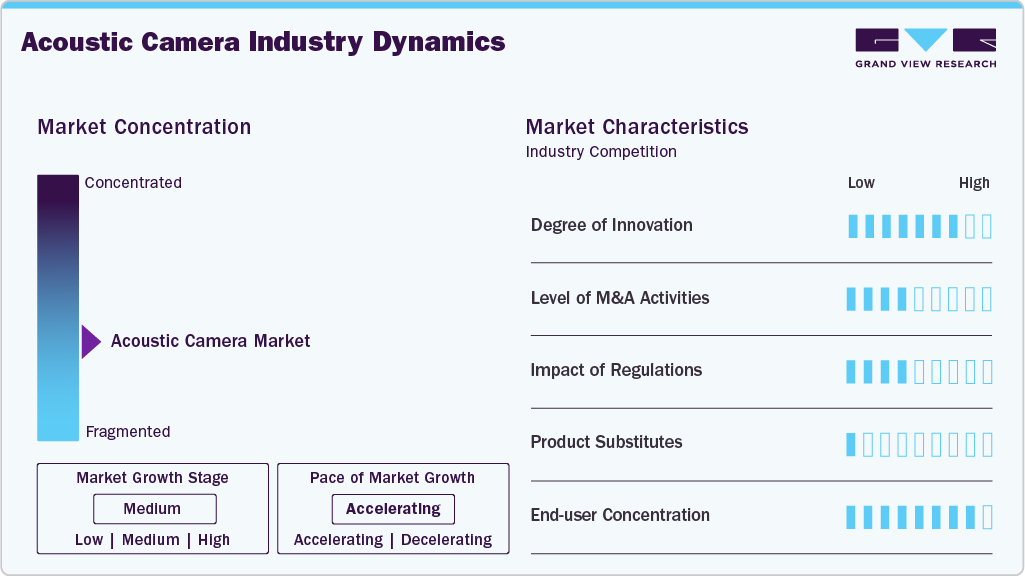
Strategic partnerships with automotive manufacturers, industrial equipment companies, research institutions, and engineering service providers are enabling companies to expand application capabilities and geographic reach. The market is expected to witness increasing adoption of portable and automated acoustic imaging systems, while competition from conventional acoustic measurement equipment, vibration analysis, thermal inspection, and ultrasonic technologies remains a moderate constraint. The growing demand for real-time diagnostics, predictive maintenance, energy-efficiency monitoring, and automated quality inspection is expected to continue to strengthen product differentiation and competitive positioning across the global market.
Analyst Perspective
The acoustic camera market is shaped by advancements in acoustic imaging and beamforming technologies, growing demand for real-time noise source identification and leakage detection, increasing adoption of predictive maintenance and condition-monitoring solutions, stricter workplace and environmental noise regulations, and expansion of Industry 4.0 and smart manufacturing.
Product Type Insights
The handheld/portable segment dominated the acoustic camera industry, accounting for the largest revenue share of 54.0% in 2025, propelled by growing demand for lightweight, flexible, and easy-to-deploy acoustic inspection systems across automotive, industrial, and maintenance applications. These devices enable technicians to conduct measurements at different locations without extensive setup, supporting their adoption for field diagnostics, predictive maintenance, and noise source identification.
The fixed/integrated segment is expected to grow at the fastest CAGR of over 7% from 2026 to 2033, supported by the rising integration of acoustic monitoring into automated production lines, test chambers, and continuous condition-monitoring systems. These systems enable consistent, repeatable measurements and real-time detection of abnormal acoustic patterns. Increasing industrial automation, predictive maintenance practices, and demand for continuous quality control are expected to further drive the adoption of fixed acoustic cameras.
Array Type Insights
The 2D segment dominated the acoustic camera industry, accounting for the largest revenue share of 65.7% in 2025, supported by its cost-effectiveness, simpler configuration, and broad adoption for conventional sound-source localization and noise analysis applications. 2D acoustic cameras provide reliable visualization while requiring relatively lower computational and hardware requirements, making them suitable for automotive testing, machinery inspection, and general industrial applications.
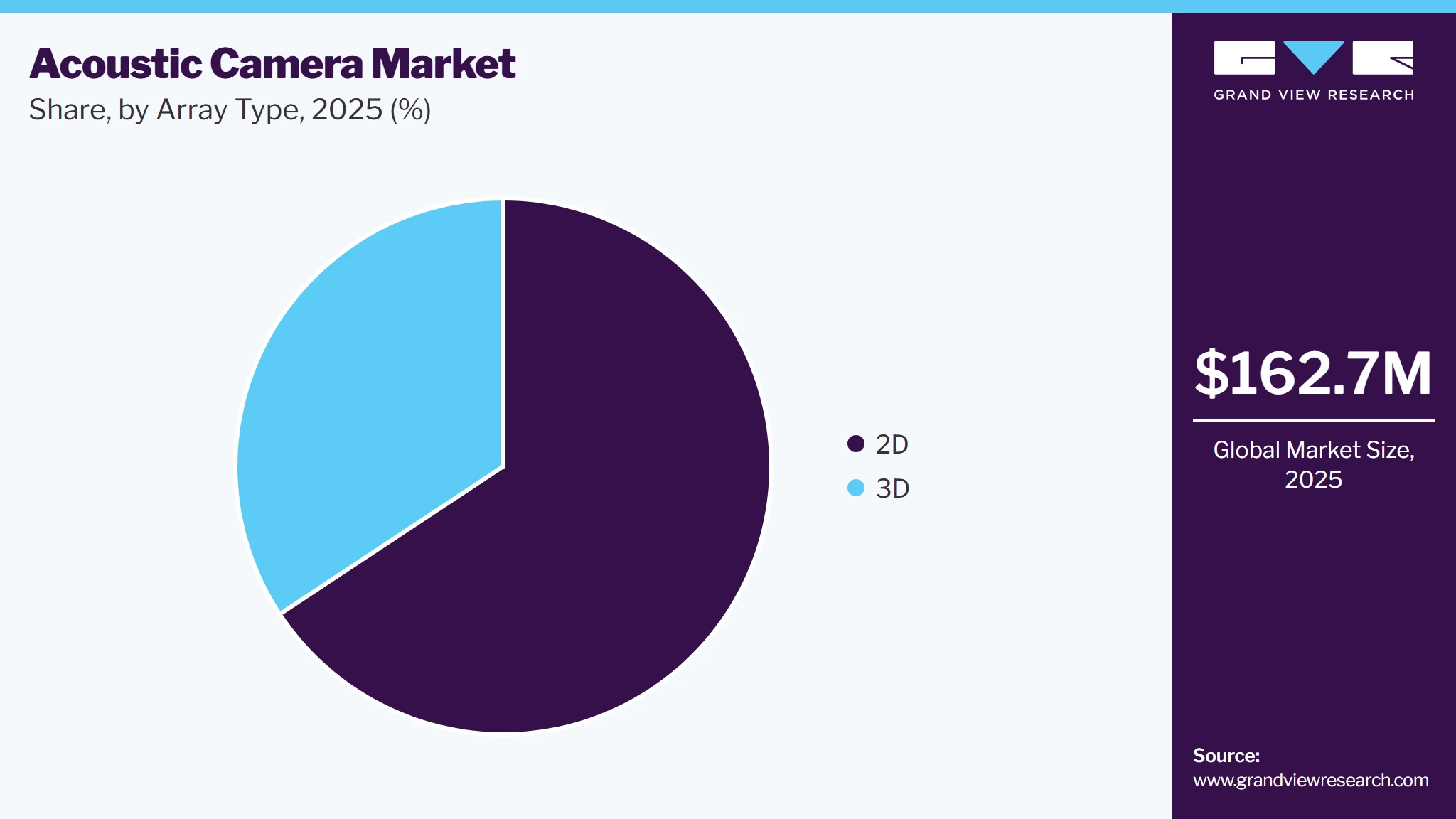
The 3D segment is expected to grow at a significant CAGR from 2026 to 2033, fueled by increasing demand for highly accurate spatial visualization and advanced acoustic analysis. Three-dimensional imaging enables users to determine the location and distribution of sound sources more precisely, particularly in complex equipment and large testing environments. Advancements in sensor-array technology, imaging software, and real-time 3D visualization are further expanding their use in automotive engineering, aerospace, research, and industrial testing.
Measurement Type Insights
The far-field segment dominated the acoustic camera industry, accounting for the largest revenue share of 60.2% in 2025, driven by rising demand for non-contact acoustic measurements across automotive testing, industrial machinery inspection, building diagnostics, and infrastructure monitoring. Far-field acoustic cameras allow users to identify sound sources from a distance, reducing the need to access or physically interact with operating equipment. This capability is particularly valuable when equipment is large, moving, hot, or located in potentially hazardous environments.
The near-field segment is expected to grow significantly from 2026 to 2033, driven by increasing demand for detailed acoustic characterization of compact components and localized noise sources. Near-field measurements provide high-resolution information close to the sound-emitting surface, making them useful for product development, component testing, electronics, and machinery diagnostics. The growing emphasis on precision engineering and early-stage noise optimization is expected to drive demand for near-field acoustic imaging.
Application Insights
The noise source identification segment accounted for the largest market share in 2025, fueled by increasing requirements to quickly locate and analyze unwanted noise across vehicles, machinery, electronic equipment, and industrial systems. Acoustic cameras provide visual representations of sound sources, allowing engineers to identify problematic components without extensive manual testing. Rising focus on noise reduction, product quality, workplace comfort, and regulatory compliance is further supporting adoption across multiple industries.
The leak detection segment is expected to grow at the fastest CAGR from 2026 to 2033, driven by the increasing adoption of acoustic imaging to identify compressed-air, gas, and vacuum leaks in industrial facilities. Acoustic cameras can detect high-frequency sounds generated by leaks and help operators locate them rapidly, even in noisy production environments. Increasing energy-efficiency initiatives, pressure to reduce operational costs, and the growing adoption of predictive maintenance are expected to accelerate the use of acoustic cameras for leak detection.
End Use Insights
The automotive segment accounted for the largest share of the acoustic camera industry in 2025, propelled by increasing vehicle development activities focused on noise, vibration, and harshness (NVH) reduction and improved passenger comfort. Acoustic cameras are increasingly used to identify noise generated by engines, electric motors, tires, HVAC systems, doors, and other vehicle components. The rapid development of electric vehicles is further increasing demand, as reduced powertrain noise makes previously less noticeable sources of vehicle noise more prominent.
The industrial & manufacturing segment is expected to grow at the fastest CAGR from 2026 to 2033. This growth is driven by expanding adoption of predictive maintenance, automated inspection, equipment monitoring, and compressed-air leak detection. Manufacturers are increasingly deploying acoustic imaging to identify abnormal machine sounds, detect leaks, and prevent unexpected equipment failures. Growing industrial automation, Industry 4.0 initiatives, and the need to reduce downtime and improve energy efficiency are expected to strengthen demand for acoustic cameras across manufacturing facilities.
Regional Insights
The North America acoustic camera market held the largest global revenue share of 35.1% in 2025, supported by strong adoption across automotive, aerospace & defense, manufacturing, energy, and industrial maintenance applications. Demand is being driven by increasing use of acoustic imaging for noise-source localization, predictive maintenance, compressed-air leak detection, electrical discharge detection, and NVH testing. The region benefits from advanced automotive and aerospace testing infrastructure, high adoption of industrial inspection technologies, and growing emphasis on operational efficiency and equipment reliability.

U.S. Acoustic Camera Market Trends
The U.S. acoustic camera industry dominated, with the largest revenue share of 80.6% in 2025, driven by strong demand from aerospace & defense, automotive, industrial manufacturing, energy & utilities, and building applications. The country's established industrial base, advanced R&D infrastructure, and growing adoption of predictive maintenance are supporting market expansion. The availability of portable acoustic imaging systems with automated analytics and cloud-based reporting is also increasing adoption among field-service and maintenance teams.
Europe Acoustic Camera Market Trends
The Europe acoustic camera industry is expected to grow at a CAGR of 7.4% from 2026 to 2033. The market growth is supported by stringent environmental and workplace noise regulations, strong automotive manufacturing capabilities, and increasing adoption of advanced acoustic testing technologies. The region has substantial demand for acoustic cameras across automotive NVH, aerospace testing, industrial equipment diagnostics, building acoustics, and environmental noise monitoring.
The UK acoustic camera market is expected to grow significantly in the coming years, supported by demand from aerospace, automotive, manufacturing, construction, and environmental monitoring applications. Increasing attention to occupational and environmental noise, combined with investments in advanced testing and condition-monitoring technologies, is encouraging adoption. Acoustic cameras are being increasingly used for noise-source identification, building acoustics, machinery diagnostics, and R&D applications.
The acoustic camera market in Germany is driven by the country's strong automotive and industrial manufacturing base, with acoustic cameras widely relevant to NVH testing, Product Type development, production quality control, and machinery diagnostics. Increasing EV production is creating new requirements for acoustic characterization of electric motors, power electronics, and vehicle components. Germany's emphasis on precision engineering, industrial automation, and predictive maintenance is expected to further support market growth.
Asia Pacific Acoustic Camera Market Trends
The Asia Pacific acoustic camera industry is expected to grow at the highest CAGR of 10.1% from 2026 to 2033, driven by rapid industrialization, expanding automotive production, increasing electronics manufacturing, and investments in industrial automation. Growing manufacturing capacity, increasing noise-control requirements, and rising adoption of advanced quality-inspection technologies are supporting demand across China, Japan, South Korea, and India.
The Japan acoustic camera market is gaining traction, supported by its advanced automotive, electronics, robotics, and precision-manufacturing industries. Acoustic cameras are increasingly relevant for NVH testing, product development, equipment diagnostics, and manufacturing quality control. Growing demand for compact, technologically advanced inspection systems, together with continued investment in automation and R&D, is driving market growth.
The acoustic camera market in China is expanding rapidly, with the country's large automotive, electronics, machinery, and manufacturing sectors. Increasing industrial automation, EV production, manufacturing quality requirements, and investment in predictive maintenance are creating opportunities for acoustic imaging technologies. The growing need to identify machinery faults, compressed-air leaks, production defects, and noise sources is expected to support adoption across industrial facilities.
Key Acoustic Camera Company Insights
Some of the key players operating in the market are Brüel & Kjær (HBK) and Siemens Digital.
-
Brüel & Kjær (HBK) provides advanced acoustic measurement and sound-source localization solutions for automotive, aerospace, industrial, and research applications. The company focuses on high-performance microphone arrays, beamforming, acoustic imaging, and noise-vibration-harshness testing. Its established expertise in sound and vibration measurement, extensive engineering capabilities, and strong relationships with industrial customers support its competitive position in the global acoustic camera industry.
-
Siemens AG offers acoustic analysis and engineering solutions that integrate acoustic measurement with simulation, digital engineering, and industrial software capabilities. The company is strengthening its position through AI-enabled analysis, digital twin technologies, and the integration of acoustic insights into product development and predictive maintenance workflows. Its broad industrial customer base and engineering software ecosystem provide a significant competitive advantage.
Norsonic AS and GFAI Tech GmbH are some of the emerging participants in the acoustic camera market.
-
Norsonic AS is a specialized acoustic measurement company providing acoustic cameras and sound-intensity measurement solutions for noise-source localization, environmental noise assessment, building acoustics, and industrial applications. The company focuses on high-resolution acoustic imaging, portable measurement solutions, and advanced sound-analysis capabilities. Its expertise in acoustic measurement and established presence in professional noise-testing applications support its position in the global market.
-
GFAI tech GmbH is a specialized player in acoustic imaging technologies, offering modular acoustic camera systems and real-time sound visualization solutions for research, engineering, automotive, industrial, and field applications. The company emphasizes microphone-array technology, beamforming, sound-source localization, and software-based acoustic analysis. Its flexible product configurations and focus on high-resolution acoustic visualization strengthen its position across specialized industrial and R&D applications.
Key Acoustic Camera Companies
The following key companies have been profiled for this study of the acoustic camera market.
-
Brüel & Kjær Sound & Vibration Measurement A/S (HBK)
-
Siemens AG
-
Fluke Corporation
-
Norsonic AS
-
GFAI Tech
-
Sorama B.V.
-
Microflown Technologies B.V.
-
Distran AG
-
SM Instruments Inc.
-
CAE Software & Systems GmbH
Competitive Benchmarking
Category
Operating Strategies
Competitive Edge
Weakness
Established Players (NIKE, Inc.; Adidas AG; PUMA SE)
- Focus on advanced acoustic cameras, microphone arrays, beamforming, software, and integrated noise-testing solutions. Invest in AI, real-time imaging, and advanced signal processing.
- Focus on advanced acoustic cameras, microphone arrays, beamforming, software, and integrated noise-testing solutions. Invest in AI, real-time imaging, and advanced signal processing.
- Focus on advanced acoustic cameras, microphone arrays, beamforming, software, and integrated noise-testing solutions. Invest in AI, real-time imaging, and advanced signal processing.
Emerging Players (Decathlon; Under Armour, Inc.; New Balance)
- Focus on portable acoustic cameras, sound-source localization, leak detection, machinery diagnostics, and application-specific solutions.
- Focus on portable acoustic cameras, sound-source localization, leak detection, machinery diagnostics, and application-specific solutions.
- Focus on portable acoustic cameras, sound-source localization, leak detection, machinery diagnostics, and application-specific solutions.
Recent Developments
-
In May 2026, Norsonic released Acoustic Camera software version 6.0.653 for its Nor848 acoustic-camera platform. The update supports the company's modular Hextile and Multitile acoustic-camera systems and demonstrates continued investment in software capabilities for high-resolution sound-source localization and acoustic diagnostics.
-
In April 2026, Microflown Technologies released Voyager 2.10 firmware, adding Direction of Arrival (DOA) plotting, expanded sound-quality data export, and improved file-management capabilities. The update strengthens the company's acoustic measurement and sound-localization capabilities for engineering and testing applications.
-
In March 2026, gfai tech GmbH announced its HydroVision SeaStar24 webinar, focused on passive acoustic imaging for observing underwater scenes in 2D and 3D. The development expands the company's acoustic-imaging capabilities into underwater applications and demonstrates its continued focus on advanced sound and vibration measurement technologies.
Acoustic Camera Market Report Scope
Report Attribute
Details
Market size in 2025
USD 162.7 million
Estimated market size in 2026
USD 175.5 million
Projected market size by 2033
USD 305.5 million
Growth rate
CAGR of 8.2% from 2026 to 2033
Base year for estimation
2025
Historical data
2021 - 2024
Forecast period
2026 - 2033
Quantitative units
Revenue in USD million and CAGR from 2026 to 2033
Report product
Revenue forecast, company ranking, competitive landscape, growth factors, and trends
Segments covered
Product type, array type, measurement type, application, end use, and region
Region scope
North America; Europe; Asia Pacific; Latin America; Middle East & Africa
Country scope
U.S.; Canada; Mexico; UK; Germany; France; China; Japan; India; South Korea; Australia; Brazil; Saudi Arabia; UAE; South Africa
Key companies profiled
Brüel & Kjær Sound & Vibration Measurement A/S (HBK); Siemens AG, Fluke Corporation; Norsonic AS; GFAI Tech; Sorama B.V.; Microflown Technologies B.V.; Distran AG; SM Instruments Inc.; CAE Software & Systems GmbH
Customization scope
Free report customization (equivalent to up to 8 analyst’s working days) with purchase. Addition or alteration to country, regional & segment scope.
Pricing and purchase options
Avail customized purchase options to meet you exact research needs. Explore purchase options
Global Acoustic Camera Market Report Segmentation
This report forecasts revenue growth at the global, regional, and country levels and provides an analysis of the latest technological trends in each of the sub-segments from 2021 to 2033. For this study, Grand View Research has segmented the global acoustic camera market report based on product type, array type, measurement type, application, end use industry, and region:
-
Product Type Outlook (Revenue, USD Million, 2021 - 2033)
-
Handheld/Portable
-
Benchtop
-
Fixed/Integrated
-
-
Array Type Outlook (Revenue, USD Million, 2021 - 2033)
-
2D Acoustic Camera
-
3D Acoustic Camera
-
-
Measurement Type Outlook (Revenue, USD Million, 2021 - 2033)
-
Near-Field
-
Far-Field
-
-
Application Outlook (Revenue, USD Million, 2021 - 2033)
-
Noise Source Identification
-
Leak Detection
-
Predictive Maintenance & Condition Monitoring
-
Noise Mapping & Compliance Monitoring
-
Quality Control & Inspection
-
Others
-
-
End Use Industry Outlook (Revenue, USD Million, 2021 - 2033)
-
Automotive
-
Industrial & Manufacturing
-
Aerospace & Defense
-
Energy & Utilities
-
Construction & Infrastructure
-
Electronics
-
Others
-
-
Regional Outlook (Revenue, USD Million, 2021 - 2033)
-
North America
-
U.S.
-
Canada
-
Mexico
-
- Europe
-
UK
-
Germany
-
France
-
-
Asia Pacific
-
China
-
Japan
-
India
-
South Korea
-
Australia
-
-
Latin America
-
Brazil
-
-
Middle East and Africa (MEA)
-
Saudi Arabia
-
UAE
-
South Africa
-
-
Research Methodology
The acoustic camera market figures in this report are based on a proven research process that combines executive interviews with secondary research from proprietary databases, company filings, and recognized regulatory and institutional sources. Market size is built through value-chain sizing-reconciling supply-side and demand-side estimates-and triangulated with bottom-up and top-down approaches. Every estimate passes multiple levels of expert validation before publication, with each acoustic camera segment quantified using the revenue-capture definitions in the table below.
Segment Definition
Segment - Product Type
Revenue capture definition
Fitness Equipment
Revenue is generated through the sale of handheld and portable acoustic cameras designed for mobile sound-source localization, leak detection, equipment diagnostics, field inspection, and on-site noise analysis.
Ball & Team Sports Equipment
Revenue is generated from equipment used in Revenue is generated through the sale of benchtop acoustic camera systems used in laboratories, engineering facilities, R&D centers, and controlled testing environments for detailed acoustic measurement and analysis.
Outdoor & Adventure Equipment
Revenue is generated through the sale and integration of fixed or permanently installed acoustic camera systems for continuous monitoring, automated inspection, production-line quality control, and industrial condition monitoring.
Segment - Array Type
Revenue capture definition
2D Acoustic Camera
Revenue is generated through the sale of 2D acoustic camera systems that use planar microphone arrays to visualize and localize sound sources across two-dimensional fields for noise diagnostics and industrial testing.
3D Acoustic Camera
Revenue is generated through the sale of 3D acoustic camera systems capable of spatial sound-source localization and three-dimensional acoustic mapping for advanced engineering, inspection, and diagnostic applications.
Segment - Measurement Type
Revenue capture definition
Near-Field
Revenue is generated through the sale of acoustic camera systems designed for near-field measurements, enabling detailed localization and characterization of sound sources in proximity to machinery, components, and products.
Far-Field
Revenue is generated through the sale of acoustic camera systems designed for far-field measurements, enabling sound-source localization and noise mapping over larger distances and broader environments.
Segment - Application
Revenue capture definition
Noise Source Identification
Revenue is generated through the sale of acoustic cameras and associated software used to locate, visualize, and analyze noise sources in machinery, vehicles, equipment, buildings, and industrial environments.
Leak Detection
Revenue is generated through the sale of acoustic imaging systems used to detect and locate compressed-air, gas, vacuum, and other fluid leaks in industrial equipment and infrastructure.
Predictive Maintenance & Condition Monitoring
Revenue is generated through the sale of acoustic camera solutions used to identify abnormal sounds, equipment faults, mechanical wear, and developing failures as part of predictive maintenance and condition-monitoring programs.
Noise Mapping & Compliance Monitoring
Revenue is generated through the sale of acoustic imaging and mapping systems used for environmental noise assessment, workplace noise monitoring, regulatory compliance, and sound-level mapping.
Quality Control & Inspection
Revenue is generated through the sale of acoustic camera systems used for non-contact quality inspection, defect detection, product testing, and manufacturing-line acoustic diagnostics.
Others
Revenue is generated through acoustic camera applications in research, building acoustics, consumer electronics testing, transportation, security, education, and specialized acoustic investigations.
Segment - End Use Industry
Revenue capture definition
Automotive
Revenue is generated through the sale of acoustic camera systems for vehicle NVH testing, engine and powertrain diagnostics, component testing, wind-noise analysis, and vehicle quality control.
Industrial & Manufacturing
Revenue is generated through the sale of acoustic cameras for machinery diagnostics, production-line inspection, leak detection, predictive maintenance, and industrial noise-source identification.
Aerospace & Defense
Revenue is generated through the sale of acoustic imaging systems for aircraft and component testing, propulsion-system diagnostics, structural analysis, noise characterization, and specialized defense testing.
Energy & Utilities
Revenue is generated through the sale of acoustic camera solutions for compressed-air and gas leak detection, electrical fault identification, equipment monitoring, turbine inspection, and power-generation maintenance.
Construction & Infrastructure
Revenue is generated through the sale of acoustic cameras for building acoustics, HVAC inspection, structural diagnostics, noise mapping, construction quality assessment, and infrastructure monitoring.
Electronics
Revenue is generated through the sale of acoustic camera systems for electronic-device testing, component diagnostics, cooling-system analysis, product noise evaluation, and quality inspection.
Others
Revenue is generated through acoustic camera applications across research institutions, healthcare, transportation, marine, telecommunications, education, and other specialized industries requiring acoustic measurement and sound-source localization.
Estimation Model
Layer Name
Key Question
Description
End-User Adoption Layer
Who are the potential adopters?
Identifies automotive manufacturers, industrial companies, aerospace and defense organizations, energy and utility providers, construction companies, electronics manufacturers, research institutions, and maintenance teams seeking acoustic imaging, noise detection, and equipment diagnostics.
Product Enablement Layer
Who can provide acoustic cameras?
Deployment depends on acoustic camera manufacturers, acoustic measurement technology providers, microphone-array developers, test-and-measurement companies, acoustic software providers, system integrators, distributors, and specialized engineering solution providers.
Application Deployment Layer
Where are acoustic cameras currently being used?
Acoustic cameras are used across noise-source identification, leak detection, predictive maintenance, condition monitoring, noise mapping, regulatory compliance, quality control, product testing, building inspection, and industrial diagnostics.
Revenue Generation Layer
How is revenue generated?
Revenue is generated through acoustic camera hardware sales, software licenses, system integration, acoustic measurement services, maintenance and support contracts, upgrades, accessories, calibration services, and customized acoustic testing solutions.
Delivered Customizations
This report has been delivered with the following In-depth customizations
Client Request
Customization Delivered
Value Adds
Acoustic Camera Product Portfolio Optimization & Application Demand Assessment
Conducted detailed evaluation of acoustic camera products across handheld, portable, benchtop, and fixed acoustic imaging systems, assessing microphone-array configurations, frequency ranges, detection capabilities, software functionality, pricing strategies, and application demand across industrial, automotive, aerospace & defense, electronics, energy, and building inspection applications to identify high-value product opportunities.
Improves product portfolio positioning, supports product development and planning, enhances application-specific targeting, and strengthens competitive differentiation.
Acoustic Imaging Technology Integration & Innovation Strategy
Assessed the integration of microphone arrays, beamforming, acoustic source localization, AI-enabled sound analysis, real-time visualization, noise-source detection, 2D/3D acoustic imaging, thermal-acoustic analysis, and advanced signal-processing technologies to evaluate technology adoption, product functionality, measurement accuracy, and opportunities for next-generation acoustic camera development.
Enhances detection accuracy, improves measurement and visualization capabilities, supports automated fault identification, enables faster diagnostics, and strengthens technology-driven differentiation.
Industrial Application & End-Use Opportunity Assessment
Evaluated acoustic camera adoption across manufacturing, automotive, aerospace, electronics, energy & power, building inspection, and research applications, analyzing requirements for leak detection, machinery fault diagnosis, quality inspection, noise testing, predictive maintenance, and environmental noise monitoring to identify high-growth application areas.
Enables manufacturers to prioritize high-potential end-use industries, develop application-specific solutions, optimize sales strategies, and capture emerging demand for non-contact acoustic inspection and predictive maintenance.
Frequently Asked Questions About This Report
The global acoustic camera market size was valued at USD 162.7 million in 2025 and is estimated at USD 175.5 million in 2026.
The global acoustic camera market is expected to reach USD 305.5 million by 2033, at a compound annual growth rate (CAGR) of 8.2% from 2026 to 2033.
By product type, the handheld/portable segment held the dominant position and accounted for the highest revenue share of 54.0% in 2025.
North America dominated the market with a 35.1% revenue share in 2025.
The increasing adoption of predictive maintenance and condition monitoring technologies, rising demand for noise source localization and quality control, growing investments in industrial automation and smart manufacturing, and increasing regulatory emphasis on workplace and environmental noise management are the key factors driving the market growth.
Brüel & Kjær Sound & Vibration Measurement A/S (HBK), Siemens AG, Fluke Corporation, Norsonic AS, GFAI Tech), Sorama B.V., Microflown Technologies B.V., Distran AG, SM Instruments Inc., and CAE Software & Systems GmbH are the key players in the market
2D segment held the largest revenue share of 65.7% in 2025
By measurement type, the far-field segment dominated the market in 2025.
By application, the noise source identification segment held the largest market share in 2025.
About the Author(s)
Next Generation Technologies Research Team
Technology · Next Generation TechnologiesThis report was authored by the next generation technologies research team at Grand View Research - comprising two research analysts, one senior research analyst, and one industry expert - with specialized expertise in the next generation technologies segment of the technology industry. All findings are based on proprietary technology databases, executive interviews, and regulatory analysis, subject to internal peer review prior to publication.
Last Updated:
Speak to Analyst


Customize this report to your needs — add regions, segments, or data points, with 20% free customization.
Or view our licence options:


ISO 9001:2015 & 27001:2022 Certified
We are GDPR and CCPA compliant! Your transaction & personal information is safe and secure. For more details, please read our privacy policy.


