
- Home
- »
- Next Generation Technologies
- »
-
Agricultural Irrigation Machinery Market Size Report, 2033GVR Report cover
![Agricultural Irrigation Machinery Market Size, Share & Trends Report]()
Agricultural Irrigation Machinery Market (2026 - 2033) Size, Share & Trends Analysis Report By Irrigation System (Sprinkler, Drip, Center Pivot), By Component (Pumps & Motors, Pipes & Tubes), By Automation Level, By Application, By Region, And Segment Forecasts
- Report ID: GVR-4-68040-867-6
- Number of Report Pages: 120
- Format: PDF
- Historical Range: 2021 - 2025
- Forecast Period: 2026 - 2033
- Industry: Technology
- Report Summary
- Table of Contents
- Segmentation
- Methodology
- Download FREE Sample
-
 Download Sample Report
Agricultural Irrigation Machinery Market Summary
The global agricultural irrigation machinery market size was estimated at USD 8.71 billion in 2025 and is projected to reach USD 15.37 billion by 2033, growing at a CAGR of 7.4% from 2026 to 2033. The market is expanding steadily as agriculture worldwide shifts toward efficient water management and higher farm productivity.
Key Market Trends & Insights
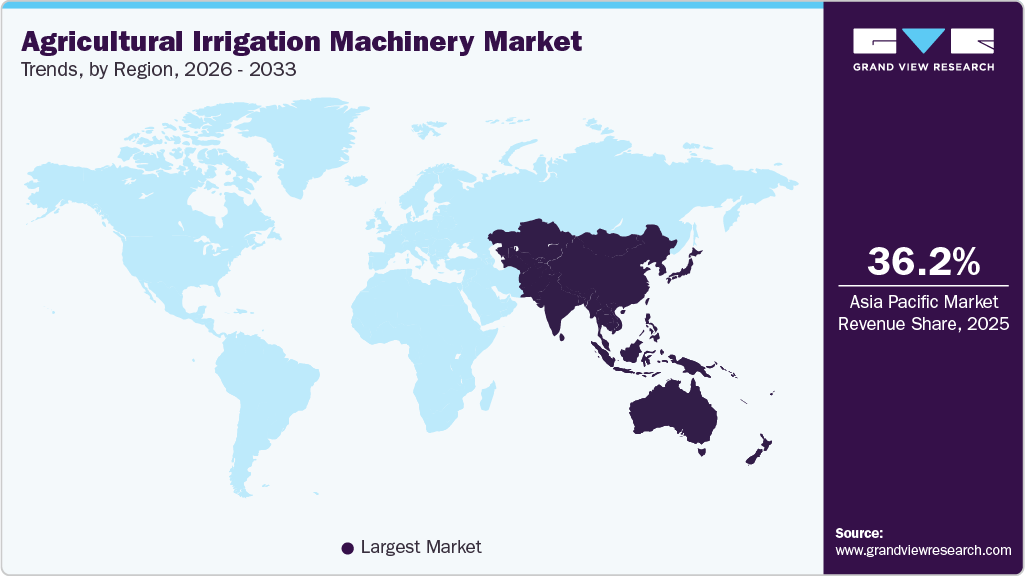
- Asia Pacific held 36.2% revenue share of the agricultural irrigation machinery market.
- China dominated the agricultural irrigation machinery market in 2025.
- By irrigation system, sprinkler irrigation systems held the largest revenue share of 34.8% in 2025.
- By component, pumps & motors held the largest revenue share in 2025.
- By automation level, the fully automated/smart irrigation systems segment is expected to grow at the fastest CAGR during the forecast period.
Market Size & Forecast
- 2025 Market Size: USD 8.71 Billion
- 2033 Projected Market Size: USD 15.37 Billion
- CAGR (2026-2033): 7.4%
- Asia Pacific: Largest market in 2025
Increasing pressure on freshwater resources and the need to improve crop yields are encouraging farmers to adopt modern irrigation machinery instead of traditional irrigation methods. Governments and agricultural agencies are also promoting mechanized irrigation through subsidy programs and water-saving initiatives, supporting consistent market growth across both developed and emerging economies. One of the major market drivers is the rising concern over water scarcity and climate variability. Irregular rainfall patterns and prolonged drought conditions in several agricultural regions are forcing farmers to rely on controlled irrigation systems such as sprinkler and drip irrigation. These systems help deliver water directly to crops, reducing wastage while improving yield quality. In 2025 and moving into 2026, farmers are increasingly investing in irrigation infrastructure as a long-term solution to stabilize agricultural output despite changing weather conditions.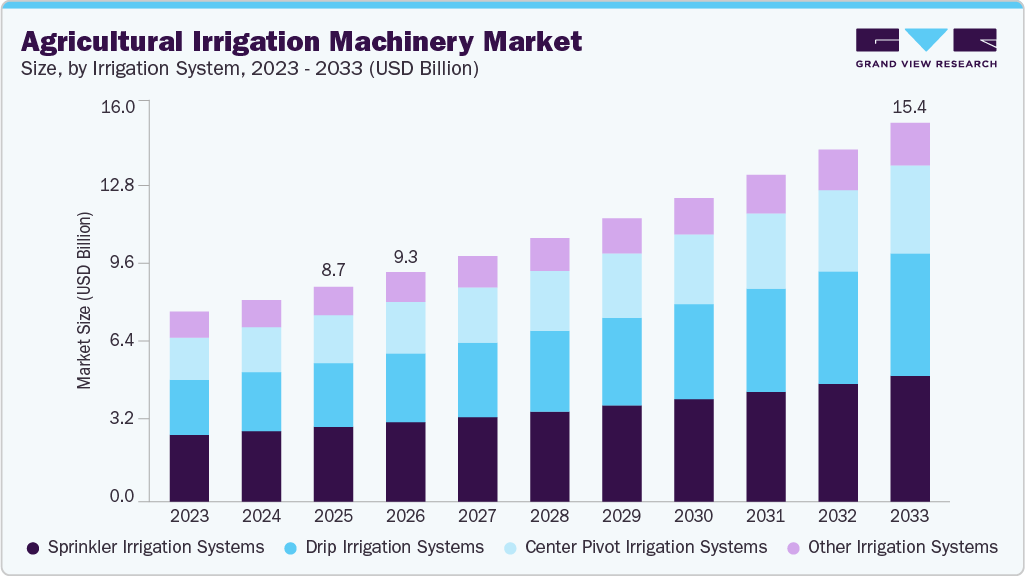
Technological advancement is another key factor driving market growth. Automation features such as smart controllers, moisture sensors, and automated valves are becoming more common in irrigation machinery. Farmers are gradually transitioning from manual and semi-automated systems toward fully automated irrigation solutions that optimize water usage and reduce labor dependency. This trend is particularly visible in large farms and commercial agriculture, where efficiency and cost savings are critical operational priorities.
Changing crop patterns and the growth of high-value agriculture are also contributing to demand. Cultivation of fruits, vegetables, plantation crops, and greenhouse farming is increasing globally, and these crops require precise and frequent irrigation. As a result, drip irrigation systems and controlled watering technologies are gaining strong adoption. The expansion of protected cultivation and precision farming practices is further strengthening demand for advanced irrigation machinery.
In addition, increasing agricultural mechanization in developing regions is supporting long-term market expansion. Countries in the Asia Pacific, Latin America, and parts of Africa are investing in modern farming equipment to improve food security and farm efficiency. Rising awareness among farmers about water conservation, combined with digital agriculture trends and supportive government policies, is expected to sustain steady adoption of irrigation machinery through 2033. Overall, the market is moving toward smarter, automated, and resource-efficient irrigation solutions that align with sustainable agriculture goals.
Irrigation System Insights
The sprinkler irrigation systems segment accounted for the largest market share of 34.8% in 2025. The dominance of this segment is mainly driven by its wide applicability across different crop types, farm sizes, and soil conditions, making it a practical solution for farmers globally. Sprinkler systems are easier to install compared to advanced irrigation setups and provide uniform water distribution, which helps improve crop productivity while reducing water wastage. Increasing adoption of mechanized farming practices and growing awareness about efficient water use encouraged farmers to shift from traditional flood irrigation toward sprinkler-based systems. In addition, government support programs promoting water-efficient irrigation and the rising need to manage unpredictable rainfall patterns further supported strong demand for sprinkler irrigation systems during the year.
The drip irrigation systems segment is anticipated to grow at the fastest CAGR during the forecast period, driven by the increasing need for precise water management and higher crop productivity. Drip irrigation delivers water directly to plant roots, significantly reducing water loss and improving fertilizer efficiency, which makes it highly suitable for fruits, vegetables, and plantation crops. Rising water scarcity concerns and growing awareness among farmers about water-saving technologies accelerated the adoption of drip systems across both developed and emerging agricultural markets. Government subsidy programs supporting micro-irrigation, along with the expansion of high-value crop cultivation and greenhouse farming, further contributed to the strong growth of drip irrigation systems.
Component Insights
The pumps & motors segment dominated the market in 2025. This dominance is mainly due to their essential role in operating irrigation systems, as pumps and motors are required to move water from sources such as wells, rivers, and reservoirs to agricultural fields. Increasing adoption of mechanized irrigation systems and expansion of irrigated farmland significantly increased demand for efficient pumping solutions. Farmers increasingly invested in electric and solar-powered pumps to ensure a reliable water supply while reducing operating costs and energy consumption. In addition, government initiatives promoting irrigation infrastructure development and the growing need to manage water resources efficiently further supported strong demand for pumps and motors across agricultural regions.
The sensors segment is expected to register the highest CAGR from 2026 to 2033, driven by the growing adoption of smart and precision irrigation practices in modern agriculture. Sensors such as soil moisture, weather, and flow sensors help farmers monitor field conditions in real time and apply water only when needed, improving water efficiency and crop yield. Increasing awareness about resource optimization and rising labor costs encouraged farmers to adopt data-based irrigation solutions. The expansion of automated irrigation systems and integration of digital farming technologies further accelerated demand for sensors, as they play a key role in enabling intelligent irrigation management and reducing water wastage.
Automation Level Insights
The manual irrigation systems segment dominated the market in 2025. This dominance was mainly due to the widespread presence of small and medium-sized farms, particularly in developing agricultural economies, where farmers continue to rely on cost-effective and simple irrigation solutions. Manual systems require lower initial investment and minimal technical knowledge, making them more accessible for farmers with limited financial resources. Traditional farming practices, limited access to automation infrastructure, and affordability concerns supported the continued use of manual irrigation methods. In addition, many rural regions still faced constraints related to electricity availability and digital connectivity, which further sustained demand for manual irrigation systems despite the gradual shift toward automated technologies.
The fully automated/smart irrigation systems segment is expected to register the fastest CAGR from 2026 to 2033. Smart irrigation systems use controllers, sensors, and automated scheduling to deliver the right amount of water at the right time, reducing labor effort and minimizing water wastage. Rising labor costs, growing awareness about resource optimization, and the expansion of digital farming technologies encouraged farmers and commercial agricultural operators to invest in automated solutions. In addition, government support for smart farming practices and the increasing availability of connected irrigation technologies are further accelerating the adoption of fully automated irrigation systems during the forecast period.
Application Insights
The field crops segment accounted for the largest market share in 2025. This dominance is mainly attributed to the large cultivation area dedicated to staple crops such as cereals, grains, and oilseeds, which require a consistent and reliable water supply to maintain stable yields. Increasing global food demand and the need to improve agricultural productivity encouraged farmers to adopt irrigation machinery across large-scale farming operations. In addition, government initiatives supporting irrigation infrastructure development and the expansion of commercial farming practices further strengthened the adoption of irrigation machinery in field crop cultivation.
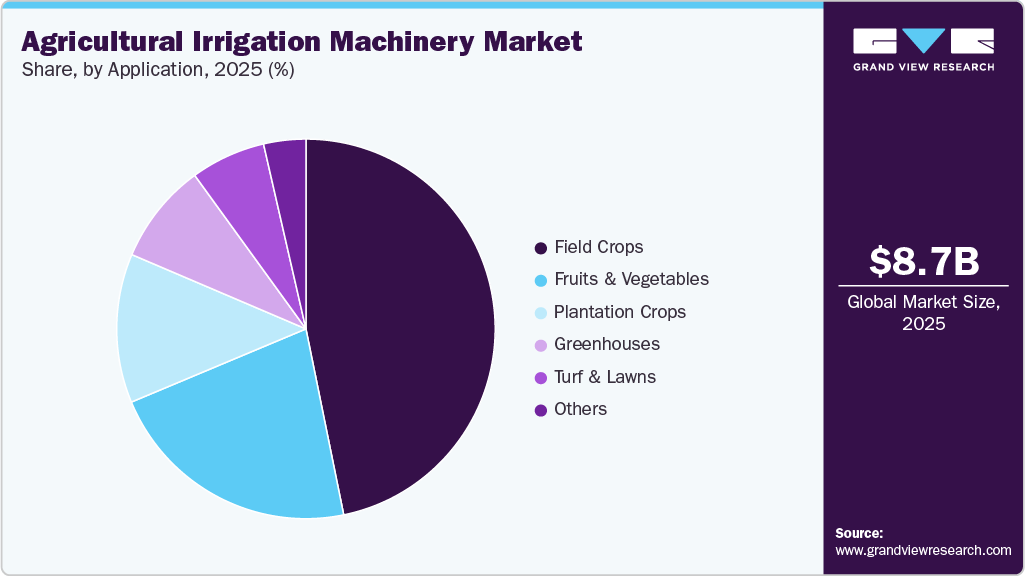
The greenhouses segment is anticipated to register the fastest CAGR during the forecast period. This growth is driven by the increasing adoption of controlled environment agriculture, where precise irrigation is essential to maintain optimal crop conditions. Greenhouse farming requires accurate water delivery and moisture control, which encourages the use of advanced irrigation machinery such as drip and automated systems. The rising demand for high-quality vegetables, fruits, and specialty crops supported the expansion of greenhouse cultivation, particularly near urban consumption centers. Limited arable land availability and the need for year-round production also pushed growers to invest in efficient irrigation technologies specifically designed for greenhouse environments.
Regional Insights
The agricultural irrigation machinery market in North America is expected to grow at a significant CAGR from 2026 to 2033. The market growth is mainly driven by increasing water scarcity, rising adoption of precision agriculture, and strong government support for efficient irrigation practices across the U.S. and Canada. Farmers in the region are increasingly shifting from traditional flood irrigation toward sprinkler and drip irrigation systems to improve water efficiency and crop productivity. Government initiatives are playing an important role in market expansion. For example, in 2025, the U.S. Department of Agriculture (USDA) supported irrigation efficiency improvements through conservation funding programs, including a USD 11.16 million irrigation conservation project in Minnesota under the Regional Conservation Partnership Program, aimed at improving irrigation efficiency and groundwater protection across 25 counties. These programs encourage farmers to adopt modern irrigation equipment and precision water-management systems, directly supporting machinery demand in the region.
U.S. Agricultural Irrigation Machinery Market Trends
The agricultural irrigation machinery market in the U.S. is projected to grow significantly during the forecast period. Growth is primarily supported by rising investments in water-saving technologies, modernization of irrigation infrastructure, and strong policy support for drought resilience. Farmers are increasingly adopting automated irrigation systems integrated with sensors, data analytics, and precision control to reduce water usage while maintaining crop yields. The shift toward sustainable farming and resource optimization is further accelerating demand for advanced irrigation machinery across major agricultural states. For instance, USDA water-conservation initiatives such as the Water-Saving Commodities Program, which provides grants to irrigation districts and producers to deploy water-efficient irrigation practices and technologies across drought-affected regions. The program aims to conserve up to 50,000 acre-feet of water across 250,000 acres of irrigated land, encouraging adoption of modern irrigation systems and equipment nationwide.
Asia Pacific Agricultural Irrigation Machinery Market Trends
The agricultural irrigation machinery market in the Asia Pacific is expected to grow at the fastest CAGR from 2026 to 2033. The market growth is primarily driven by rising food production requirements, increasing water scarcity, and rapid modernization of agricultural practices across countries such as China, India, Australia, and Southeast Asian nations. Farmers are increasingly adopting sprinkler and drip irrigation systems to improve water-use efficiency and enhance crop productivity. The growing adoption of precision agriculture technologies and the expansion of commercial farming activities are further supporting demand for advanced irrigation machinery across the region. For instance, in 2025, China continued to invest in high-standard farmland development programs, which promote water-saving irrigation infrastructure and smart agricultural equipment deployment to improve agricultural productivity and resource efficiency.
India agricultural irrigation machinery market is projected to grow significantly during the forecast period. Farmers are increasingly deploying automated irrigation solutions integrated with sensors and fertigation systems to improve productivity while reducing water consumption and labor requirements. In 2025, the Government of India continued expanding irrigation efficiency under the Pradhan Mantri Krishi Sinchayee Yojana (PMKSY), providing subsidies for drip and sprinkler irrigation systems under the “Per Drop More Crop” initiative to improve water-use efficiency and agricultural output across multiple states.
Europe Agricultural Irrigation Machinery Market Trends
The agricultural irrigation machinery market in Europe is anticipated to grow steadily from 2026 to 2033, mainly due to strict water-management regulations, increasing climate variability, and strong adoption of precision farming technologies. Farmers across Southern and Western Europe are increasingly investing in drip and sprinkler irrigation systems to improve water efficiency and reduce operational costs. The shift toward sustainable agriculture under regional environmental policies is also encouraging the modernization of irrigation infrastructure. For instance, continued funding under the EU Common Agricultural Policy (CAP) 2023-2027 which supports the adoption of water-efficient irrigation equipment and climate-resilient agricultural technologies across member states.
The UK agricultural irrigation machinery market is expected to grow during the forecast period. Farmers are increasingly investing in efficient irrigation machinery to maintain crop productivity amid unpredictable rainfall patterns and tightening water-use regulations. In 2025, the UK government continued support through the Environmental Land Management (ELM) schemes, encouraging sustainable water management and efficient irrigation practices to improve long-term agricultural productivity and environmental sustainability.
Key Agricultural Irrigation Machinery Company Insights
Some prominent players in the market include Jain Irrigation Systems Ltd., Komet Austria GmbH - Komet Irrigation Corp., Lindsay Corporation, Mahindra EPC Irrigation Limited, and Metzer Group, among others.
-
Jain Irrigation Systems Limited is a diversified hi-tech agricultural company providing micro-irrigation and integrated farming solutions. Its offerings include drip and sprinkler irrigation systems, pipes, fittings, and precision irrigation products, along with agronomic and project services. The company serves farmers globally through manufacturing facilities across multiple continents and supports agricultural irrigation machinery adoption through water-efficient irrigation technologies.
-
Komet Irrigation is a family-owned irrigation technology company specializing in high-efficiency sprinkler irrigation solutions for agriculture and related applications. The company offers pivot sprinklers, big volume irrigation guns, and precision sprinkler components designed for uniform water distribution and low-pressure operation. Its products are used in agricultural irrigation systems worldwide, with global presence across regions including the U.S., Brazil, Europe, and other international farming markets.
Key Agricultural Irrigation Machinery Companies:
The following key companies have been profiled for this study on the agricultural irrigation machinery market
- Finolex Plasson
- Jain Irrigation Systems Ltd.
- Komet Austria GmbH - Komet Irrigation Corp.
- Lindsay Corporation
- Mahindra EPC Irrigation Limited
- Metzer Group
- Nelson Irrigation
- NETAFIM
- Rain Bird Corporation
- REINKE MANUFACTURING CO., INC.
- Rivulis
- Röhren- und Pumpenwerk BAUER GmbH
- SENNINGER
- The Toro Company
- Valmont Industries, Inc.
Recent Developments
- In January 2025, Valley Irrigation announced the strategic consolidation of its irrigation technology platforms into the AgSense 365 app, combining AgSense, Valley 365, PrecisionKing, and PivoTrac into a single unified irrigation management platform. The new solution is designed to simplify irrigation operations, improve efficiency, enable remote monitoring and control, and accelerate the adoption of data-driven precision irrigation technologies for growers globally.
Agricultural Irrigation Machinery Market Report Scope
Report Attribute
Details
Market size value in 2026
USD 9.31 billion
Revenue forecast in 2033
USD 15.37 billion
Growth rate
CAGR of 7.4% from 2026 to 2033
Actual data
2021 - 2025
Forecast period
2026 - 2033
Quantitative units
Revenue in USD million/billion and CAGR from 2026 to 2033
Report coverage
Revenue forecast, company share, competitive landscape, growth factors, and trends
Segments covered
Irrigation system, component, automation level, application, region
Regional scope
North America; Europe; Asia Pacific; Latin America; MEA
Country scope
U.S.; Canada; Mexico; UK; Germany; France; China; India; Japan; Australia; South Korea; Brazil; UAE; Saudi Arabia; South Africa
Key companies profiled
Finolex Plasson; Jain Irrigation Systems Ltd.; Komet Austria GmbH - Komet Irrigation Corp.; Lindsay Corporation; Mahindra EPC Irrigation Limited; Metzer Group; Nelson Irrigation; NETAFIM; Rain Bird Corporation; REINKE MANUFACTURING CO., INC.; Rivulis; Röhren- und Pumpenwerk BAUER GmbH; SENNINGER; The Toro Company; Valmont Industries, Inc.
Customization scope
Free report customization (equivalent to 8 analysts working days) with purchase. Addition or alteration to country, regional & segment scope.
Pricing and purchase options
Avail customized purchase options to meet your exact research needs. Explore purchase options
Global Agricultural Irrigation Machinery Market Report Segmentation
This report forecasts revenue growth at global, regional, and country levels and provides an analysis of the latest industry trends in each of the sub-segments from 2021 to 2033. For this study, Grand View Research has segmented the global agricultural irrigation machinery market report based on irrigation system, component, automation level, application, and region:
-
Irrigation System Outlook (Revenue, USD Million, 2021 - 2033)
-
Sprinkler Irrigation Systems
-
Drip Irrigation Systems
-
Center Pivot Irrigation Systems
-
Other Irrigation Systems
-
-
Component Outlook (Revenue, USD Million, 2021 - 2033)
-
Pumps & Motors
-
Pipes & Tubes
-
Valves
-
Filters
-
Sprayers & Emitters
-
Controllers & Automation Devices
-
Sensors
-
Others
-
-
Automation Level Outlook (Revenue, USD Million, 2021 - 2033)
-
Manual Irrigation Systems
-
Semi-Automated Systems
-
Fully Automated / Smart Irrigation Systems
-
-
Application Outlook (Revenue, USD Million, 2021 - 2033)
-
Field Crops
-
Fruits & Vegetables
-
Plantation Crops
-
Turf & Lawns
-
Greenhouses
-
Others
-
-
Regional Outlook (Revenue, USD Million, 2021 - 2033)
-
North America
-
U.S.
-
Canada
-
Mexico
-
-
Europe
-
Germany
-
UK
-
France
-
-
Asia Pacific
-
China
-
India
-
Japan
-
South Korea
-
Australia
-
-
Latin America
-
Brazil
-
-
Middle East & Africa
-
UAE
-
Saudi Arabia
-
South Africa
-
-
Frequently Asked Questions About This Report
b. The global agricultural irrigation machinery market size was estimated at USD 8.71 billion in 2025 and is expected to reach USD 9.31 billion in 2026.
b. The global agricultural irrigation machinery market is expected to grow at a compound annual growth rate of 7.4% from 2026 to 2033 to reach USD 15.37 billion by 2033.
b. The sprinkler irrigation systems segment dominated the agricultural irrigation machinery market with market share of 34.8% in 2025. This dominance is driven by its wide applicability across different crop types, farm sizes, and soil conditions, making it a practical solution for farmers globally.
b. Some key players operating in the market include Finolex Plasson, Jain Irrigation Systems Ltd.; Komet Austria GmbH - Komet Irrigation Corp.; Lindsay Corporation; Mahindra EPC Irrigation Limited; Metzer Group; Nelson Irrigation; NETAFIM; Rain Bird Corporation; REINKE MANUFACTURING CO., INC.; Rivulis; Röhren- und Pumpenwerk BAUER GmbH; SENNINGER; The Toro Company; Valmont Industries, Inc
b. Factors such as increasing water scarcity, rising adoption of precision farming technologies, growing demand for higher agricultural productivity, and government initiatives supporting efficient irrigation systems are driving the market growth.


Share this report with your colleague or friend.
Need a Tailored Report?
Customize this report to your needs — add regions, segments, or data points, with 20% free customization.


ISO 9001:2015 & 27001:2022 Certified
We are GDPR and CCPA compliant! Your transaction & personal information is safe and secure. For more details, please read our privacy policy.
Trusted market insights - try a free sample
See how our reports are structured and why industry leaders rely on Grand View Research. Get a free sample or ask us to tailor this report to your needs.













