
- Home
- »
- Agrochemicals & Fertilizers
- »
-
Agricultural Pheromones Market Size & Share Report, 2033GVR Report cover

Agricultural Pheromones Market (2026 - 2033)
Size, Share & Trends Analysis Report By Product (Sex Pheromones, Aggregation Pheromones), By Delivery Method (Pheromone Dispensers, Traps, Sprayable Pheromones), By Crop Type, By Farming System, By Region, And Segment Forecasts
Market Size, 2025
$3.1BMarket Estimate, 2026
$3.5BMarket Forecast, 2033
$8.9BCAGR, 2026–2033
14.2%Agricultural Pheromones Market Summary
The global agricultural pheromones market size was valued at USD 3.1 billion in 2025 and is projected to grow from USD 3.5 billion in 2026 to USD 8.9 billion by 2033, at a CAGR of 14.2% from 2026 to 2033. The market in North America dominated with a revenue share of 31.4% in 2025. The market growth is supported by the increasing adoption of agricultural pheromones in sustainable crop protection, particularly for pest monitoring, mating disruption, and mass trapping across fruits, vegetables, nuts, cereals, and other high-value crops.
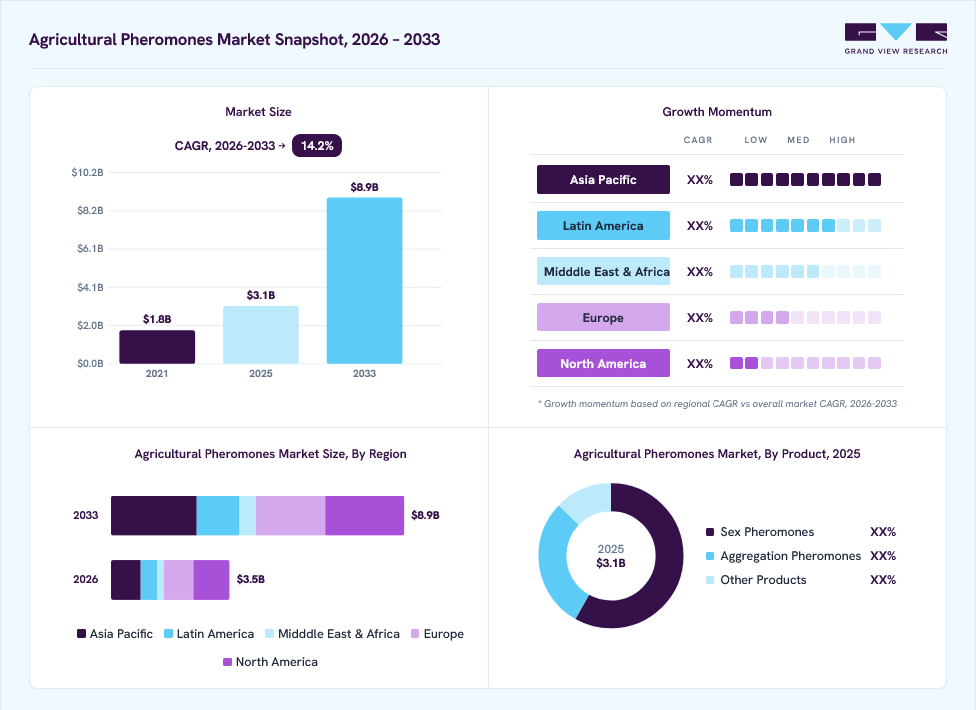 Source: Grand View Research, IR Documents, Primary Interviews, Paid DatabasesTo learn more about this report,
 Download Free Sample Report
Key Market Trends & Insights
- By product: Sex pheromones segment held the largest market share of 58.4% in 2025.
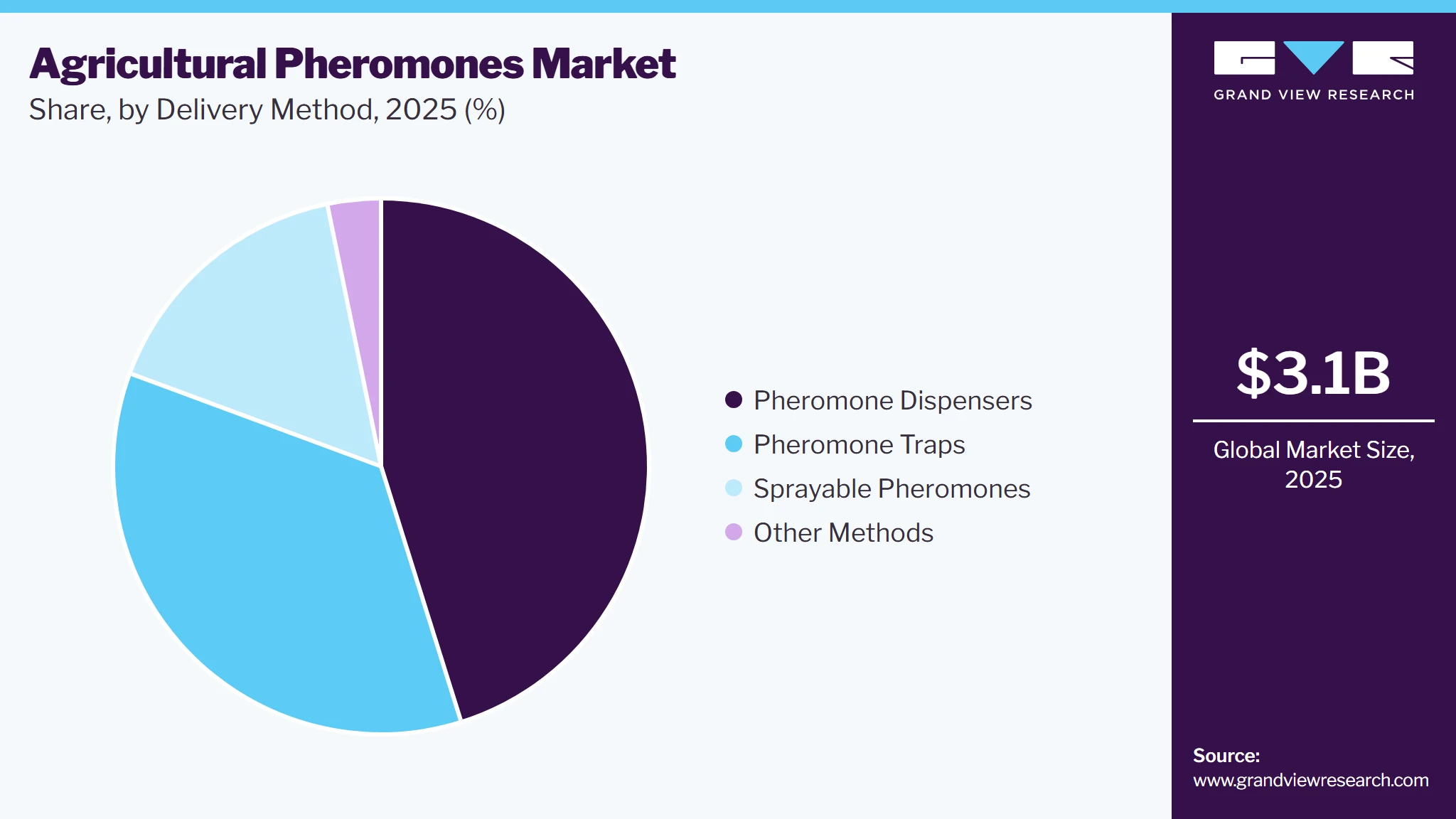
- By delivery method: Pheromone dispensers segment held the largest market share of 45.0% in 2025.
- By crop type: Fruits & vegetables segment held the largest market share of 44.1% in 2025.
- By farming system: Conventional farming segment held the largest market share of 87.4% in 2025.
Regional Highlights
- Largest regional market: North America (31.4% revenue share, 2025)
- Fastest-growing regional market: Asia Pacific (highest CAGR, 2026-2033)
- By country: The U.S. held the largest market share in 2025
Market Size & Forecast
- Market size in 2025: USD 3.1 Billion
- Estimated market size in 2026: USD 3.5 Billion
- Projected market size by 2033: USD 8.9 Billion
- CAGR (2026-2033): 14.2%
Prism AI by Grand View Research Free to tryAsk a question about the agricultural pheromones market✓Every figure cited from GVR research Prefer the report? Download free sample →
The agricultural pheromones industry is gaining momentum as farmers and crop producers seek more targeted and efficient approaches to insect population management. Pheromone-based products provide species-specific solutions that can support early pest detection, improve the timing of control measures, and minimize unnecessary crop treatments. Their application across fruits, vegetables, nuts, and other specialty crops is expanding as producers increasingly prioritize crop quality and productivity. The growing commercialization of pheromone-based products, broader availability of ready-to-use dispensers, and development of application methods suited to large-scale farming are also contributing to market expansion. In addition, increasing awareness among growers about precision-based pest management is creating new opportunities for pheromone technologies across both conventional and specialty agriculture.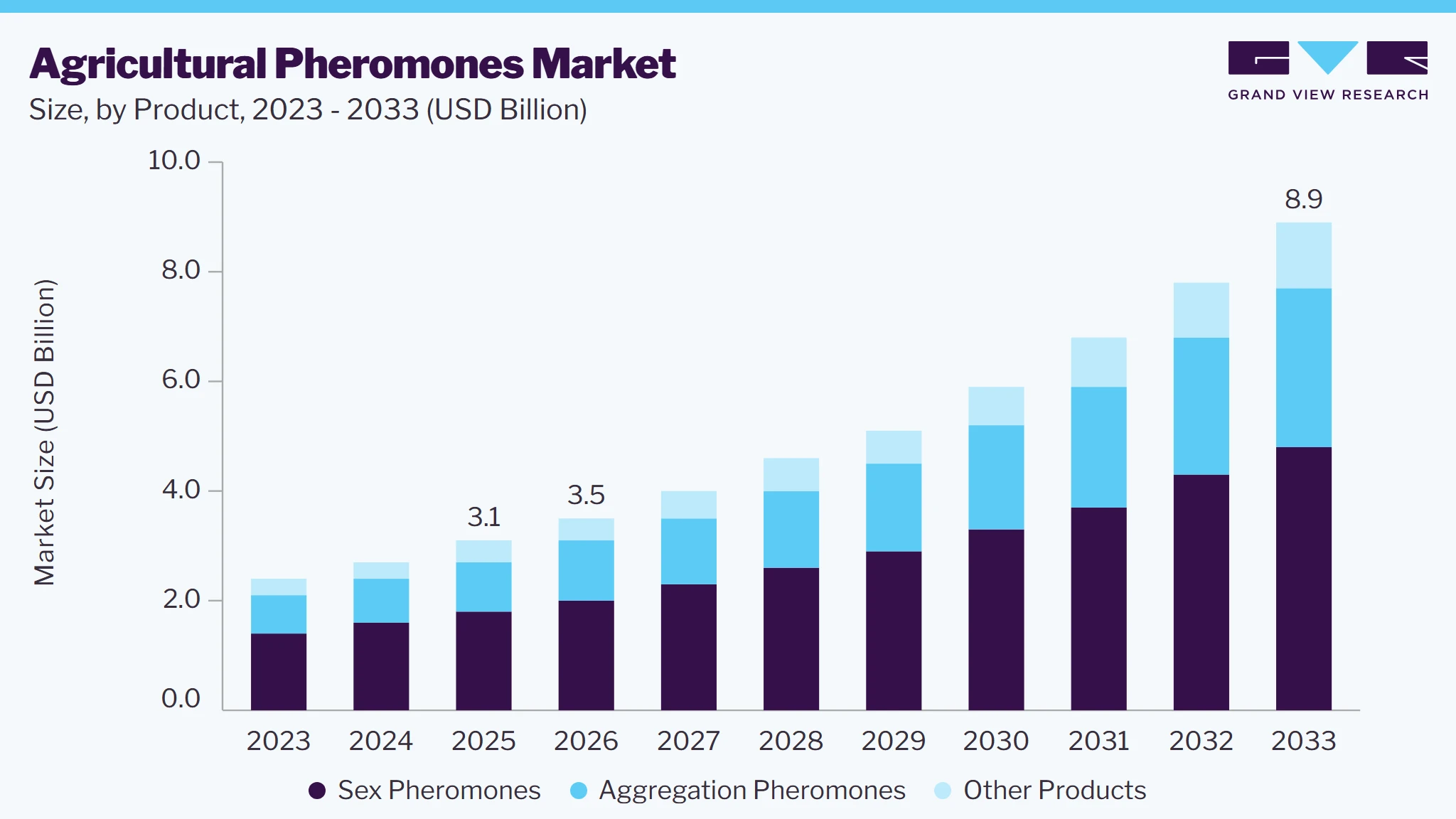 To learn more about this report, Download Free Sample Report
Market Dynamics
Market development is being influenced by improvements in product commercialization, distribution networks, and the scalability of pheromone-based pest control programs. The increasing availability of crop-specific formulations and easy-to-deploy dispenser systems is helping growers integrate pheromone solutions into routine farm management. Demand is also supported by the expansion of horticulture, vineyards, orchards, and other high-value agricultural segments, where crop quality and pest-related losses can significantly impact profitability. Furthermore, digital agriculture and precision farming technologies are creating opportunities to combine pheromone monitoring with sensors, automated traps, remote surveillance, and data-driven pest forecasting. However, relatively high product costs, the need for specialized application knowledge, and variations in pheromone performance under different climatic conditions may limit adoption in some developing agricultural markets.
The increasing shift toward sustainable crop protection is a major driver of the agricultural pheromones market. Farmers are increasingly adopting pheromone-based solutions for pest monitoring, mating disruption, and mass trapping to control targeted insect populations while minimizing the environmental and health concerns associated with broad-spectrum chemical pesticides. Growing consumer demand for residue-free and organically produced food, increasing regulatory pressure to reduce pesticide use, and rising concerns regarding insecticide resistance are encouraging the adoption of pheromone-based pest management across fruits, vegetables, cereals, nuts, and other high-value crops.
The expansion of integrated pest management programs is further increasing demand for species-specific pheromone products that enable early pest detection and targeted intervention. Continuous advancements in pheromone chemistry, dispenser design, controlled-release technologies, and digital pest monitoring systems are expected to improve product efficacy and support market growth throughout the forecast period.
The relatively high cost of pheromone-based pest management products compared with conventional chemical pesticides can limit adoption, particularly among small-scale farmers in price-sensitive agricultural markets. Pheromone products are often species-specific and may require specialized dispensers, traps, or repeated field deployment, increasing application and management costs. Their effectiveness can also vary depending on pest density, crop conditions, climatic factors, and the proper placement and timing of dispensers.
Limited awareness regarding pheromone-based pest management, inadequate technical knowledge, and insufficient access to agronomic support in developing agricultural markets further restrict adoption. In addition, the need for regular monitoring and integration with other pest-control measures can increase the complexity of implementation, creating challenges for widespread commercialization.
The growing expansion of organic farming and sustainable agriculture presents significant opportunities for agricultural pheromone manufacturers. Increasing restrictions on the use of certain chemical pesticides, rising consumer demand for pesticide-residue-free food, and greater adoption of integrated pest management are creating favorable conditions for pheromone-based crop protection solutions. The increasing cultivation of high-value fruits, vegetables, nuts, and specialty crops is particularly supporting demand for targeted pest management technologies.
Technological advancements in controlled-release systems, long-lasting pheromone dispensers, automated traps, and digital pest monitoring are improving the efficiency and scalability of pheromone-based pest management. Integration of pheromone traps with sensors, remote monitoring, and precision agriculture platforms can enable real-time pest detection and more targeted interventions. In addition, expanding agricultural production and investments in sustainable crop protection across Asia-Pacific, Latin America, and Africa provide attractive opportunities for manufacturers to develop region-specific pheromone products and strengthen distribution networks.
Market Concentration & Characteristics
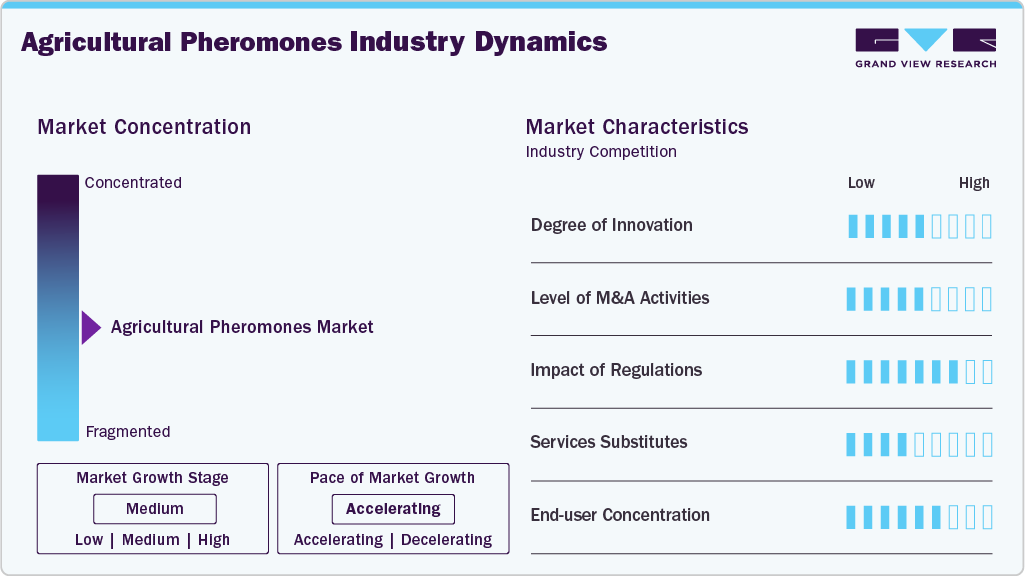
The agricultural pheromones market is moderately fragmented, with the presence of multinational crop protection companies, specialized pheromone manufacturers, biological pest management companies, and regional suppliers. Competition is primarily driven by pheromone efficacy, target-pest coverage, formulation stability, dispenser technology, product longevity, regulatory compliance, and distribution capabilities. Leading companies are expanding their pheromone-based product portfolios through research and development, strategic partnerships, acquisitions, and collaborations with growers, agricultural distributors, and integrated pest management providers. Increasing investment in advanced pheromone formulations, automated monitoring systems, digital agricultural technologies, and species-specific pest management solutions is expected to intensify competition over the forecast period.
 To learn more about this report, Download Free Sample Report
Participants are strengthening their market position through strategic investments in research and development, pheromone product innovation, and expansion of pest management portfolios. Companies are collaborating with agricultural distributors, research institutions, growers, and integrated pest management organizations to improve pheromone efficacy and accelerate market adoption. Investments in advanced pheromone synthesis, controlled-release formulations, long-lasting dispensers, automated trapping systems, and regional distribution networks are helping manufacturers improve product availability, expand geographic reach, and meet the growing demand for sustainable and targeted pest management solutions.
Analyst Perspective
The agricultural pheromones market is driven by the increasing adoption of sustainable crop protection practices and the growing demand for targeted pest management solutions. Rising concerns over pesticide residues, environmental contamination, and insecticide resistance, along with the expansion of organic farming, are accelerating the adoption of pheromone-based monitoring, mating disruption, and mass-trapping solutions across diverse crop types. Advancements in pheromone synthesis, controlled-release formulations, dispenser technologies, and digital pest monitoring systems are improving product efficacy, longevity, and application efficiency while supporting integrated pest management and reducing reliance on conventional chemical pesticides.
Product Insights
The sex pheromones segment dominated the agricultural pheromones market, accounting for 58.4% of total revenue in 2025. These pheromones are widely used for pest monitoring and mating disruption by influencing the reproductive behavior of targeted insect species. Their species-specific action enables farmers to manage pest populations while reducing dependence on broad-spectrum chemical pesticides. Growing adoption of integrated pest management (IPM) and increasing concerns over pesticide residues are supporting demand for sex pheromone products. Strong utilization across fruits, vegetables, nuts, and other high-value crops is expected to maintain the segment's leading position.
The aggregation pheromones segment is expected to register the fastest growth, expanding at a CAGR of 15.5% during the forecast period. These pheromones attract groups of insects toward a specific location and are increasingly used in pest monitoring and mass-trapping applications. Their ability to target pest populations with high precision is encouraging adoption as farmers seek alternatives to conventional insecticides. Rising insecticide resistance and growing emphasis on sustainable crop protection are creating favorable conditions for aggregation of pheromone technologies. Expanding use in commercial agriculture and high-value crops is expected to accelerate segment growth.
Delivery Method Insights
The pheromone dispensers segment dominated the agricultural pheromones industry, accounting for 45.0% of total revenue in 2025. Dispensers provide controlled and sustained release of pheromone compounds, making them particularly suitable for mating disruption and long-duration pest management programs. Their ability to maintain consistent pheromone concentrations across crop fields supports effective suppression of targeted pest populations. Increasing adoption of IPM and demand for solutions that reduce chemical pesticide applications are driving the use of pheromone dispensers. Improvements in dispenser design, release duration, and field performance are expected to reinforce the segment's market position.
 To learn more about this report, Download Free Sample Report
The sprayable pheromones segment is expected to grow at the fastest CAGR of 17.5% during the forecast period. Sprayable formulations offer greater flexibility in applying pheromone compounds across agricultural fields and can be integrated into existing crop protection practices. Growing interest in convenient and targeted pest management solutions is encouraging farmers to consider spray-based pheromone technologies. Advances in formulation stability and controlled release mechanisms are improving the persistence and effectiveness of these products. Rising adoption of precision agriculture and sustainable pest control practices is expected to create strong growth opportunities for the segment.
Crop Type Insights
The fruits & vegetables segment dominated the agricultural pheromones market, accounting for 44.1% of total revenue in 2025. Pheromone-based pest management is widely used in these crops because insect infestations can significantly affect crop quality, appearance, and market value. Increasing consumer preference for residue-free produce is encouraging growers to adopt targeted alternatives to conventional pesticide applications. The expansion of organic and integrated pest management practices is supporting the use of pheromone traps and mating disruption technologies in horticultural production. Growing cultivation of high-value fruits and vegetables is expected to sustain strong demand for agricultural pheromones.
The oilseeds & pulses segment is expected to register the fastest growth, expanding at a CAGR of 16.1% during the forecast period. The increasing cultivation of soybeans, pulses, and other oilseed crops is driving greater demand for effective pest monitoring and control solutions. Pheromone technologies enable growers to detect pest populations at an early stage and implement targeted interventions before significant crop damage occurs. Rising concerns regarding insecticide resistance and the environmental impact of intensive chemical pesticide use are encouraging the adoption of pheromone-based approaches. Growing emphasis on sustainable production and improved crop protection is expected to support rapid segment expansion.
Farming System Insights
The conventional farming segment dominated the agricultural pheromones industry, accounting for the largest revenue share of 87.4% in 2025. Large-scale conventional farms are increasingly integrating pheromone-based solutions into established pest management programs to improve pest monitoring and reduce unnecessary pesticide applications. The widespread availability of pheromone traps, dispensers, and other commercial pest management technologies supports adoption across conventional agricultural systems. Growing regulatory pressure to manage pesticide residues and rising insecticide resistance are encouraging conventional growers to diversify their crop protection practices. Continued integration of pheromones into IPM programs is expected to preserve the segment's leading market position.
The organic farming segment is expected to grow at the fastest CAGR of 19.7% during the forecast period.Organic growers have a strong demand for pheromone-based pest management due to restrictions on many conventional synthetic pesticides. Pheromone traps and mating disruption technologies provide targeted approaches for controlling insect pests while aligning sustainable and residue-conscious production practices. Rising consumer demand for organic food and expansion of certified organic cultivation are creating a favorable environment for pheromone adoption. Increasing awareness of non-chemical pest management and the expansion of high-value organic crops are expected to drive rapid growth in the segment.
Regional Insights
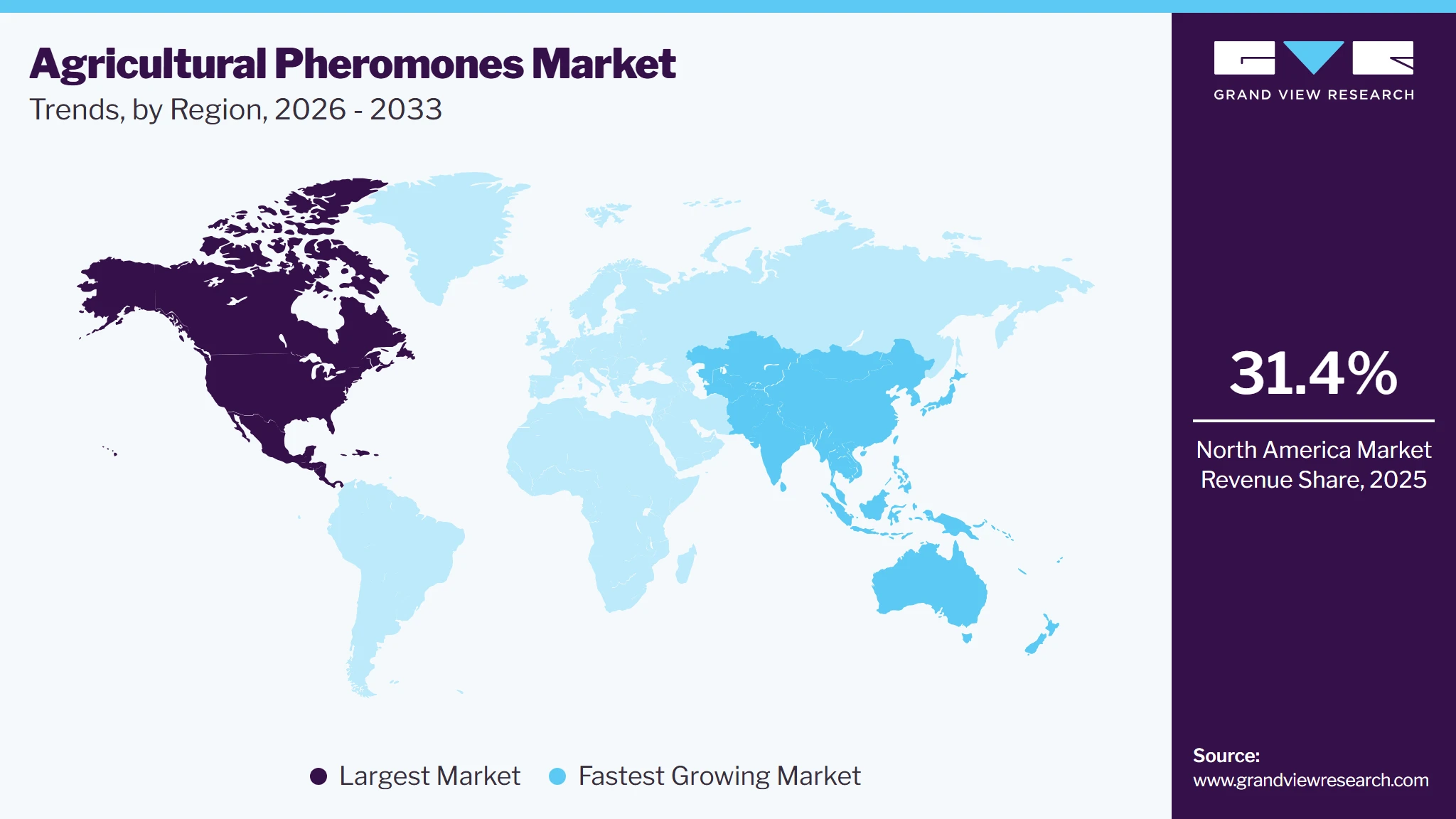
The North America agricultural pheromones market dominated with the largest global revenue share of 31.4% in 2025. Strong adoption of integrated pest management (IPM) practices is driving the use of pheromone-based monitoring, mating disruption, and mass-trapping solutions. The region benefits from advanced agricultural infrastructure, high awareness of sustainable crop protection, and established distribution networks. Regulatory efforts to reduce pesticide residues and manage insecticide resistance are encouraging growers to adopt targeted pest management technologies. Strong cultivation of high-value fruits, vegetables, nuts, and specialty crops is expected to sustain regional demand.
 To learn more about this report, Download Free Sample Report
U.S. Agricultural Pheromones Market Trends
The U.S. represents a major market for agricultural pheromones, supported by the widespread adoption of precision agriculture and integrated pest management practices. Growers are increasingly using pheromone traps and mating disruption technologies to improve pest monitoring and reduce unnecessary pesticide applications. Demand is particularly strong across fruits, vegetables, nuts, and other high-value crops where pest control directly affects crop quality and economic returns. Growing regulatory attention to pesticide use and increasing concerns about insecticide resistance are driving the shift toward pheromone-based solutions. Continued investments in sustainable agriculture and advanced pest monitoring technologies are expected to strengthen market development.
Asia Pacific Agricultural Pheromones Market Trends
The Asia Pacific agricultural pheromones industry is expected to grow at the fastest CAGR of 16.9% during the forecast period. Expanding agricultural production, rising crop losses from insect pests, and growing awareness of sustainable pest management are driving regional adoption. Governments and agricultural organizations are promoting integrated pest management and reduced dependence on conventional chemical pesticides. Growing cultivation of fruits, vegetables, rice, oilseeds, and other high-value crops is creating significant opportunities for pheromone-based pest control. Improvements in agricultural infrastructure, distribution networks, and farmer awareness are expected to accelerate regional market growth.
The China agricultural pheromones market represents a significant growth opportunity due to its large agricultural base and increasing focus on sustainable crop protection. Growing concerns regarding pesticide residues, soil and environmental impacts, and insecticide resistance are encouraging the adoption of targeted pest management technologies. Pheromone traps and mating disruption solutions are gaining attention across horticulture, fruit cultivation, and other commercial crop applications. Government initiatives supporting reduced pesticide use and integrated pest management are creating favorable conditions for market expansion. Increasing investment in modern agricultural technologies and precision pest monitoring is expected to support long-term demand.
Europe Agricultural Pheromones Market Trends
Europe is experiencing growing demand for agricultural pheromones as growers adopt environmentally responsible, residue-conscious crop protection practices. Strict regulations governing pesticide use are encouraging the integration of pheromone-based monitoring, mating disruption, and trapping technologies into IPM programs. The region's well-established organic farming sector is creating further opportunities for non-chemical pest management solutions. Strong production of fruits, vegetables, grapes, nuts, and specialty crops supports the use of species-specific pheromone technologies. Continued emphasis on sustainable agriculture and reduced chemical inputs is expected to strengthen regional market growth.
Latin America Agricultural Pheromones Market Trends
Latin America is emerging as an attractive market for agricultural pheromones, supported by the expansion of commercial agriculture and increasing cultivation of export-oriented crops. Growing production of fruits, vegetables, coffee, sugarcane, soybeans, and other high-value crops is increasing the need for effective pest monitoring and targeted control. Rising concerns about pesticide residues are encouraging producers to adopt sustainable pest management solutions to ensure compliance with international market requirements. Expansion of integrated pest management practices and growing awareness among commercial growers are supporting pheromone adoption. Investments in modern agricultural technologies and crop protection infrastructure are expected to create further opportunities across the region.
Middle East Agricultural Pheromones Market Trends
The Middle East agricultural pheromones industry is developing as growers seek efficient and environmentally responsible approaches to pest management under challenging agricultural conditions. Limited arable land, water constraints, and the expansion of protected cultivation are increasing the importance of precise crop protection technologies. Pheromone traps and monitoring systems are gaining relevance in greenhouse horticulture, as well as in fruits, vegetables, and other high-value crops. Growing investments in modern farming systems and controlled-environment agriculture are creating opportunities for advanced pest monitoring solutions. Increasing awareness of sustainable agriculture and efforts to reduce excessive pesticide use are expected to support gradual market expansion.
Key Agricultural Pheromones Company Insights
Companies operating in the agricultural pheromones market are adopting strategies centered on product innovation, pheromone formulation development, strategic partnerships, and expansion of pest management solutions to strengthen their competitive position. Leading manufacturers are investing in advanced pheromone synthesis, controlled-release technologies, dispenser systems, and integrated pest monitoring solutions to improve product efficacy and provide reliable pest control across diverse crops. They are also collaborating with growers, agricultural distributors, research institutions, and integrated pest management providers to expand market reach and support the adoption of sustainable crop protection practices.
-
Russell IPM is a leading manufacturer of agricultural pheromones, offering a broad portfolio of pheromone-based pest monitoring, trapping, and mating disruption solutions for crop protection. The company leverages expertise in pheromone chemistry, insect behavior, trapping technologies, and integrated pest management to develop targeted solutions for a wide range of agricultural pests. Russell IPM continues to strengthen its market position through product innovation, research and development, and expansion of sustainable pest management technologies that help reduce reliance on conventional chemical pesticides.
-
Suterra is a leading manufacturer of agricultural pheromones, providing pheromone-based mating disruption, monitoring, and pest management solutions for agricultural and horticultural applications. The company combines expertise in pheromone technology, controlled-release delivery systems, and integrated pest management to develop solutions that effectively disrupt pest reproduction and support sustainable crop protection. Suterra continues to strengthen its competitive position through investments in pheromone innovation, advanced dispenser technologies, strategic collaborations, and expansion of its global pest management solutions to address the growing demand for environmentally responsible crop protection.
Key Agricultural Pheromones Companies
The following key companies have been profiled for this study of the agricultural pheromones market.
-
Russell IPM
-
Suterra
-
Provivi
-
Trécé Inc.
-
Ashland
-
Ecophero
-
Harmony Ecotech Pvt. Ltd
-
Pherobio Technology Co., Ltd
-
Pherobank
-
BedoukianBio
Competitive Benchmarking
Operating Strategies
Competitive Edge
Weaknesses
Mature Players: Russell IPM; Suterra; Trécé Inc.; BedoukianBio; Pherobank
- Invest heavily in R&D for advanced pheromone formulations, controlled-release technologies, dispensers, traps, and mating disruption solutions.
- Expand product portfolios through new product development, strategic partnerships, and collaborations with distributors and IPM providers.
- Develop species-specific solutions for monitoring, mass trapping, attract-and-kill, and mating disruption across high-value crops.
- Strengthening manufacturing and global distribution networks.
- Invest in digital pest monitoring, automated trapping, and precision agriculture technologies.
- Strong industry reputation and established relationships with growers, distributors, and IPM providers.
- Strong expertise in pheromone chemistry, insect behavior, formulation, and controlled-release technologies.
- Broad product portfolios covering multiple pest species, crops, and applications.
- Established distribution and regulatory capabilities support global commercialization.
- High R&D, product development, and regulatory compliance costs.
- Pheromone efficacy can vary with pest density, climate, crop conditions, and application practices.
- Specialized pheromone products and dispensers can be more expensive than conventional pesticides.
- Large established players may be slower to respond to highly localized pest-management requirements.
Emerging Players: Provivi; Ecophero; Harmony Ecotech Pvt. Ltd.; Pherobio Technology Co., Ltd.; Ashland
- Focus on innovative pheromone and semiochemical solutions for specific pest species and high-value crops.
- Expand partnerships with regional distributors, growers, research institutions, and crop protection companies.
- Introduce next-generation mating disruption, monitoring, and pheromone delivery technologies.
- Invest in production scale-up, product registration, and farmer education programs.
- Flexible product development enables faster response to emerging pest-management requirements.
- Ability to develop specialized solutions for specific pest species, crops, and regions.
- Strong focus on innovative pheromone chemistry and advanced delivery technologies.
- Agile business models support faster commercialization and adaptation.
- Limited global manufacturing and distribution capabilities compared with established manufacturers.
- Lower R&D and regulatory resources may slow product development and geographic expansion.
- Greater dependence on regional distributors and strategic partners.
- Lower international brand recognition may constrain market penetration.
Recent Developments
-
In September 2024, Syngenta Biologicals and Provivi partnered to develop and commercialize pheromone-based pest management solutions targeting Yellow Stem Borer and Fall Armyworm, strengthening the adoption of sustainable and targeted crop protection technologies in key Asian agricultural markets.
-
In April 2025, FMC Corporation received its first product registration in Brazil for Sofero Fall, a sprayable pheromone solution targeting fall armyworm. The product uses mating disruption and microencapsulation technology to provide longer-lasting pest control, strengthening FMC’s presence in sustainable and pheromone-based crop protection.
Agricultural Pheromones Market Report Scope
Report Attribute
Details
Market size in 2025
USD 3.1 billion
Estimated market size in 2026
USD 3.5 billion
Projected market size by 2033
USD 8.9 billion
Growth rate
CAGR of 14.2% from 2026 to 2033
Base year for estimation
2025
Historical data
2021 - 2024
Forecast period
2026 - 2033
Quantitative units
Revenue in USD billion and CAGR from 2026 to 2033
Report coverage
Revenue forecast, company ranking, competitive landscape, growth factors, and trends
Segments covered
Product, delivery method, crop type, farming system, and region
Regional scope
North America; Europe; Asia Pacific; Latin America; Middle East & Africa
Country scope
U.S.; Canada; Mexico; Germany; UK; France; Italy; Spain; China; India; Japan; South Korea; Brazil; Argentina; Saudi Arabia; South Africa
Key companies profiled
Russell IPM; Suterra; Provivi; Trécé Inc.; Ashland; Ecophero; Harmony Ecotech Pvt. Ltd; Pherobio Technology Co., Ltd; Pherobank; BedoukianBio
Customization scope
Free report customization (equivalent up to 8 analysts’ working days) with purchase. Addition or alteration to country, regional & segment scope.
Pricing and purchase options
Avail customized purchase options to meet your exact research needs. Explore purchase options
Global Agricultural Pheromones Market Report Segmentation
This report forecasts revenue growth at the global, regional & country levels and provides an analysis of the latest industry trends in each of the sub-segments from 2021 to 2033. For this study, Grand View Research has segmented the agricultural pheromones Market report based on product, delivery method, crop type, farming system, and region:
-
Product Outlook (Revenue, USD Billion, 2021 - 2033)
-
Sex Pheromones
-
Aggregation Pheromones
-
Other Products
-
-
Delivery Method Outlook (Revenue, USD Billion, 2021 - 2033)
-
Pheromone Dispensers
-
Pheromone Traps
-
Sprayable Pheromones
-
Other Methods
-
-
Crop Type Outlook (Revenue, USD Billion, 2021 - 2033)
-
Cereal & Grains
-
Oilseeds & Pulses
-
Fruits & Vegetables
-
Other Crop Types
-
-
Farming System Outlook (Revenue, USD Billion, 2021 - 2033)
-
Conventional Farming
-
Organic Farming
-
-
Regional Outlook (Revenue, USD Billion, 2021 - 2033)
-
North America
-
U.S.
-
Canada
-
Mexico
-
-
Europe
-
Germany
-
UK
-
France
-
Italy
-
Spain
-
-
Asia Pacific
-
China
-
India
-
Japan
-
South Korea
-
-
Latin America
-
Brazil
-
Argentina
-
-
Middle East & Africa
-
Saudi Arabia
-
South Africa
-
-
Research Methodology
The agricultural pheromones market figures in this report are based on a proven research process that combines executive interviews with secondary research from proprietary databases, company filings, and recognized regulatory and institutional sources. Market size is built through value-chain sizing-reconciling supply-side and demand-side estimates-and triangulated with bottom-up and top-down approaches. Every estimate passes multiple levels of expert validation before publication, with each agricultural pheromones segment quantified using the revenue-capture definitions in the table below.
Segment Definition
Product
Revenue capture definition
Sex Pheromones
Market revenue is generated through the sale of sex pheromones, which mimic insect sex signals to attract males or disrupt mating behavior. These pheromones are widely used for pest monitoring, mass trapping, and mating disruption across fruits, vegetables, nuts, and other high-value crops.
Aggregation Pheromones
Revenue is generated through aggregation pheromones that attract both male and female insects toward a common location, supporting mass trapping and pest monitoring applications. The increasing adoption of targeted and integrated pest management practices is supporting demand for these products.
Other Products
Revenue is generated from other pheromone and semiochemical products, including alarm, trail, and host-marking pheromones used in specialized pest monitoring and control applications. Their adoption remains concentrated in specific pest species and agricultural applications.
Delivery Method
Revenue capture definition
Pheromone Dispensers
Sales are generated through pheromone dispensers that provide controlled and sustained release of active pheromone compounds in crop fields. These systems are widely used for mating disruption and long-duration pest management, with demand supported by the increasing adoption of sustainable crop protection practices.
Pheromone Traps
Market revenue is derived from pheromone-based traps used to attract, capture, and monitor targeted insect pests. Increasing demand for early pest detection, population monitoring, mass trapping, and reduced pesticide use is supporting the adoption of pheromone traps across commercial agriculture.
Sprayable Pheromones
Revenue is generated through sprayable pheromone formulations applied directly to crops to provide targeted pest management or mating disruption. Advances in formulation and controlled-release technologies are improving application efficiency and expanding the use of sprayable pheromone solutions.
Other Methods
Revenue is generated through other pheromone delivery systems and application technologies, including attract-and-kill systems and specialized release mechanisms designed for specific pest management requirements.
Crop Type
Revenue capture definition
Cereal & Grains
Revenue is generated from the application of agricultural pheromones in crops such as corn, wheat, rice, and barley for monitoring and controlling targeted insect pests. Growing emphasis on integrated pest management and minimizing chemical pesticide use supports adoption in large-scale cereal production.
Oilseeds & Pulses
Market revenue comes from pheromone-based pest monitoring, trapping, and mating disruption in crops such as soybean, canola, peas, and other pulses. Increasing focus on sustainable pest management and protection of crop yields is supporting demand for pheromone solutions in this segment.
Fruits & Vegetables
Revenue is generated through pheromone applications in fruits and vegetables, including apples, citrus, grapes, tomatoes, peppers, and other high-value crops, to monitor and control economically important insect pests. High sensitivity to pesticide residues and strong adoption of IPM practices make this an important application segment.
Other Crop Types
Demand is supported by the use of pheromone-based pest management in crops such as cotton, sugarcane, tobacco, nuts, and specialty crops. Increasing cultivation of high-value crops and demand for residue-free agricultural products are supporting adoption across these applications.
Farming System
Revenue capture definition
Conventional Farming
Revenue is generated through the adoption of pheromone-based monitoring, trapping, and mating disruption solutions within conventional farming systems. Increasing insecticide resistance, regulatory pressure, and the need to optimize chemical pesticide use are encouraging conventional growers to integrate pheromones into IPM programs.
Organic Farming
Revenue is generated through pheromone-based pest management solutions used in certified and organic farming systems, where restrictions on synthetic chemical pesticides increase the importance of biological and non-chemical control methods. Rising demand for organic and residue-free produce is supporting adoption of pheromone traps and mating disruption technologies.
Estimation Model
Layer No.
Layer Name
Key Question
Description
01
Raw Material & Production Layer
What forms the supply base?
Identify the sourcing and production of agricultural pheromones using pheromone-active compounds, chemical synthesis intermediates, solvents, carriers, polymers, and formulation ingredients. Assess pheromone synthesis technologies, formulation and encapsulation processes, controlled-release systems, production capacities, quality control standards, and supply chain dynamics supporting commercial availability. Evaluate advancements in pheromone chemistry, stabilization techniques, dispenser technologies, and manufacturing infrastructure that influence product efficacy, release duration, scalability, and shelf life.
02
Delivery Method Adoption Layer
Where is agricultural pheromones utilized?
Assess the adoption of agricultural pheromones across key delivery methods, including pheromone dispensers, pheromone traps, sprayable pheromones, and other specialized delivery systems. Demand is primarily driven by the need for targeted pest monitoring, mating disruption, mass trapping, and reduced reliance on conventional chemical pesticides. Increasing adoption of integrated pest management, organic farming, residue-free crop production, and sustainable crop protection practices supports market expansion.
03
Consumption Intensity Layer
How much agricultural pheromones is consumed?
Analyze consumption by evaluating pheromone usage across major crop categories, including cereals and grains, oilseeds and pulses, fruits and vegetables, and other commercial and specialty crops. The assessment considers cultivated area, target pest prevalence, crop-specific pheromone requirements, application frequency, farming practices, adoption rates, and the increasing use of pheromone-based pest management to estimate annual demand.
04
Revenue Layer
How is market revenue generated?
Market revenue is generated through the production and commercial sale of agricultural pheromone products, including sex pheromones, aggregation pheromones, and other semiochemical solutions used for pest monitoring, mating disruption, mass trapping, and targeted pest control. Revenue growth is supported by increasing demand for sustainable crop protection, expansion of organic farming, rising insecticide resistance, advancements in pheromone synthesis and controlled-release technologies, strategic partnerships with agricultural distributors and IPM providers, and growing investments in precision pest management solutions.
Delivered Customizations
This report has been delivered with the following In-depth customizations
Client Request
Customization Delivered
Value Adds
Cross-segmentation
The assessment provides detailed cross-segmentation of the agricultural pheromones market across product, delivery method, crop type, and farming system. The analysis evaluates demand for sex pheromones and aggregation pheromones across pheromone dispensers, pheromone traps, sprayable pheromones, and other delivery methods, with crop-level assessment covering cereals and grains, oilseeds and pulses, fruits and vegetables, and other commercial crops. The study also assesses adoption across conventional and organic farming systems, as well as consumption patterns, pest prevalence, application intensity, regulatory developments, distribution networks, and technological advancements in pheromone-based pest management.
Enables identification of high-growth opportunities across specific product-delivery method-crop-farming system combinations. Supports targeted product development, formulation, and dispenser innovation, manufacturing expansion, distribution planning, and market entry strategies by highlighting high-potential crop applications, pest management requirements, sustainable farming trends, and variations in adoption across agricultural systems.
Opportunity Assessment
Detailed evaluation of growth opportunities across sustainable crop protection, integrated pest management, organic agriculture, residue-free farming, and precision pest management practices. The assessment covers increasing adoption of pheromone-based monitoring and mating disruption, advancements in pheromone chemistry and controlled-release formulations, development of long-lasting dispensers and automated traps, expansion of IPM programs, digital pest monitoring, and regulatory initiatives supporting reduced reliance on conventional chemical pesticides.
Enables identification of high-growth investment opportunities across the agricultural pheromones value chain. Supports strategic product development, capacity expansion, technology investments, customer acquisition, and market entry decisions through insights into emerging pest management technologies, crop-specific opportunities, sustainability initiatives, and long-term demand drivers.
Competitive Benchmarking
Comparative assessment of leading agricultural pheromone manufacturers based on pheromone technology capabilities, product portfolios, formulation and dispenser innovation, manufacturing capacity, geographic presence, R&D investments, regulatory approvals, distribution networks, strategic partnerships, and sustainable pest management initiatives. The benchmarking evaluates target-pest coverage, product efficacy, crop applications, release duration, customer relationships, commercialization strategies, and the ability to scale pheromone-based solutions across global agricultural markets.
Supports benchmarking against key competitors while identifying opportunities to enhance pheromone product innovation, improve formulation and delivery performance, expand distribution reach, strengthen grower engagement, and develop strategic collaborations. Enables informed decisions regarding R&D investments, portfolio expansion, technology partnerships, acquisitions, and long-term competitive positioning in the agricultural pheromones market.
Frequently Asked Questions About This Report
Asia Pacific is the fastest-growing region over the forecast period.
By farming system, conventional farming dominated the agricultural pheromones market, accounting for 87.4% of revenue in 2025, supported by the increasing integration of pheromone-based solutions into conventional pest management programs.
The global agricultural pheromones market size was valued at USD 3.1 billion in 2025 and is estimated at USD 3.5 billion for 2026.
The global agricultural pheromones market is expected to grow at a CAGR of 14.2% from 2026 to 2033, reaching USD 8.9 billion by 2033.
Key players include Russell IPM, Suterra, Provivi, Trécé Inc., Ashland, Ecophero, Harmony Ecotech Pvt. Ltd., Pherobio Technology Co., Ltd., Pherobank, and BedoukianBio. These companies focus on pheromone innovation, advanced delivery technologies, product development, strategic partnerships, and sustainable pest management solutions.
The market is primarily driven by the increasing adoption of integrated pest management, rising concerns over pesticide residues and insecticide resistance, expansion of organic farming, and growing demand for sustainable crop protection solutions. Advancements in pheromone formulations, controlled-release technologies, and precision pest monitoring are also supporting market growth.
The aggregation pheromones segment is expected to register the fastest growth, expanding at a CAGR of 15.5% during the forecast period, driven by increasing use in pest monitoring and mass-trapping applications.
The pheromone dispensers segment dominated the market, accounting for 45.0% of revenue in 2025, supported by their widespread use in controlled release and mating disruption applications.
The fruits & vegetables segment dominated the agricultural pheromones market, capturing 44.1% of revenue in 2025, driven by the high value of horticultural crops and increasing adoption of targeted pest management solutions.
North America dominated the global agricultural pheromones market, accounting for 31.4% of revenue in 2025, supported by strong adoption of integrated pest management, advanced agricultural technologies, and sustainable crop protection practices.
About the Author(s)
Agrochemicals & Fertilizers Research Team
Bulk Chemicals · Agrochemicals & FertilizersThis report was authored by the agrochemicals & fertilizers research team at Grand View Research - comprising two research analysts, one senior research analyst, and one industry expert - with specialized expertise in the agrochemicals & fertilizers segment of the bulk chemicals industry. All findings are based on proprietary bulk chemicals databases, executive interviews, and regulatory analysis, subject to internal peer review prior to publication.
Last Updated:
Speak to Analyst

Customize this report to your needs - add regions, segments, or data points, with 20% free customization.
Or view our licence options:


ISO 9001:2015 & 27001:2022 Certified
We are GDPR and CCPA compliant! Your transaction & personal information is safe and secure. For more details, please read our privacy policy.


