
- Home
- »
- Next Generation Technologies
- »
-
AI API Market Size, Share And Trends Report, 2026-2033GVR Report cover

AI API Market (2026 - 2033)
Size, Share & Trends Analysis Report By Functionality (Generative AI APIs, Computer Vision APIs, Recommendation APIs), By Deployment (Cloud Based APIs, Edge APIs), By End-use, By Region, And Segment Forecasts
Market Size, 2025
$63.2BMarket Estimate, 2026
$82.6BMarket Forecast, 2033
$575.7BCAGR, 2026–2033
32.0%AI API Market Summary
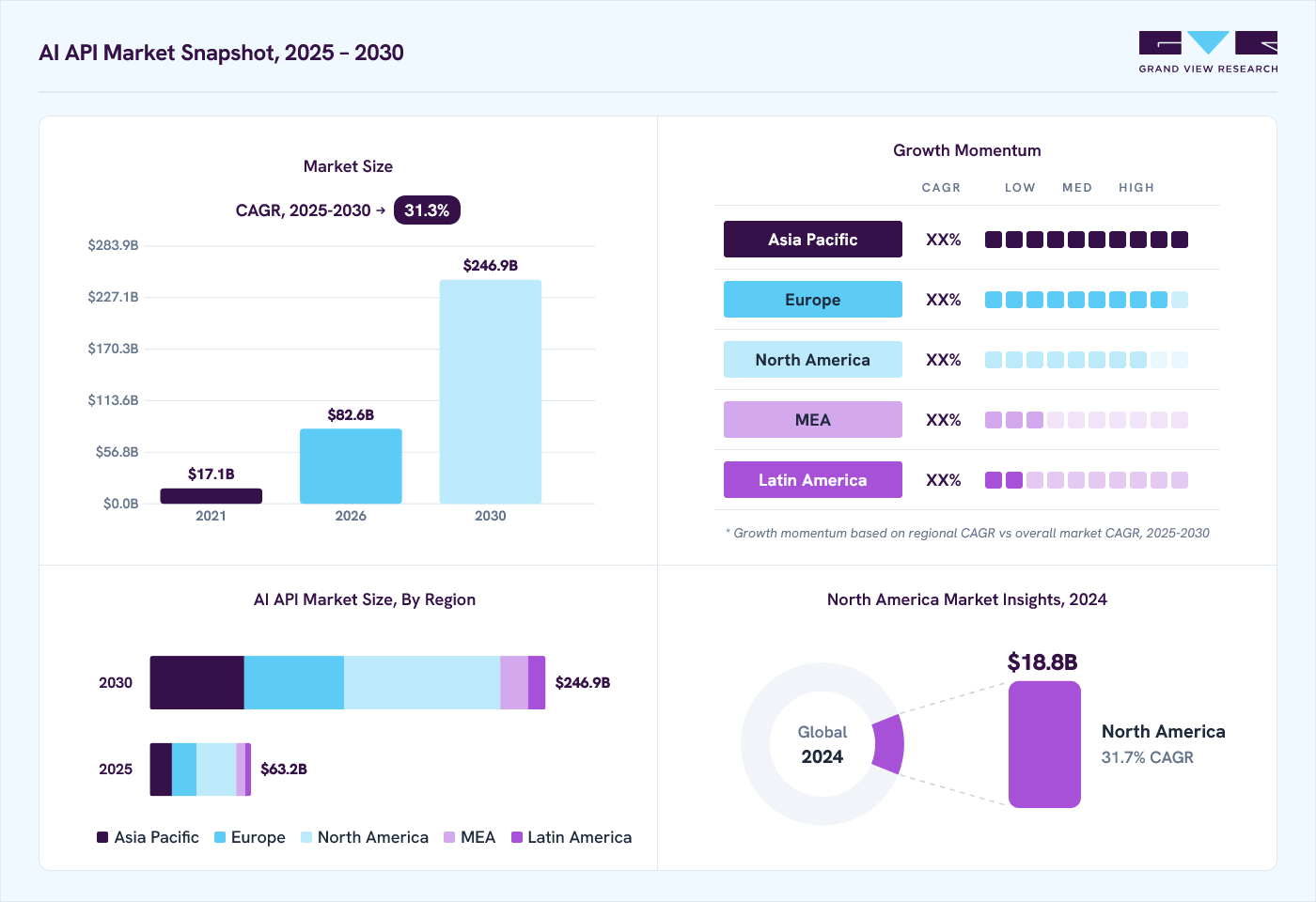
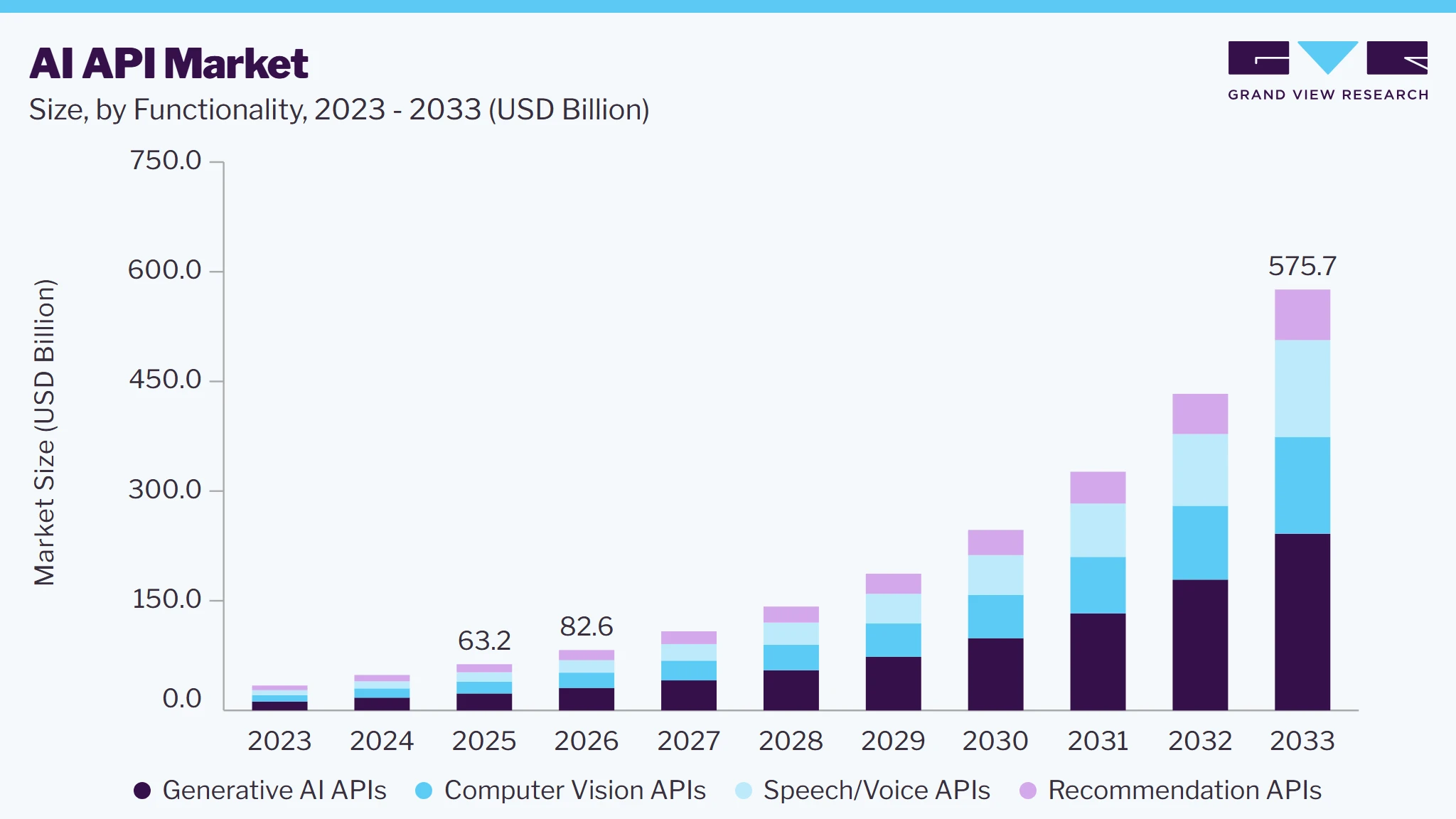
The global AI API Market size was valued at USD 63.2 billion in 2025 and is projected to grow from USD 82.6 billion in 2026 to USD 575.7 billion by 2033, at a CAGR of 32.0% from 2026 to 2033. North America dominated the market, accounting for a revenue share of 38.9% in 2025. The AI API market is growing due to the increasing adoption of AI-powered solutions across the travel industry.
 Source: Grand View Research, IR Documents, Primary Interviews, Paid DatabasesTo learn more about this report,
 Download Free Sample Report
 Key Market Trends & Insights
- By functionality: Generative AI APIs segment held a significant 36.6% revenue share in 2025.
- By deployment: Cloud-Based APIs segment held the largest revenue share of 63.1% in 2025.
- By end use: IT & Telecommunications segment held a significant 28.4% revenue share in 2025.
Regional Highlights
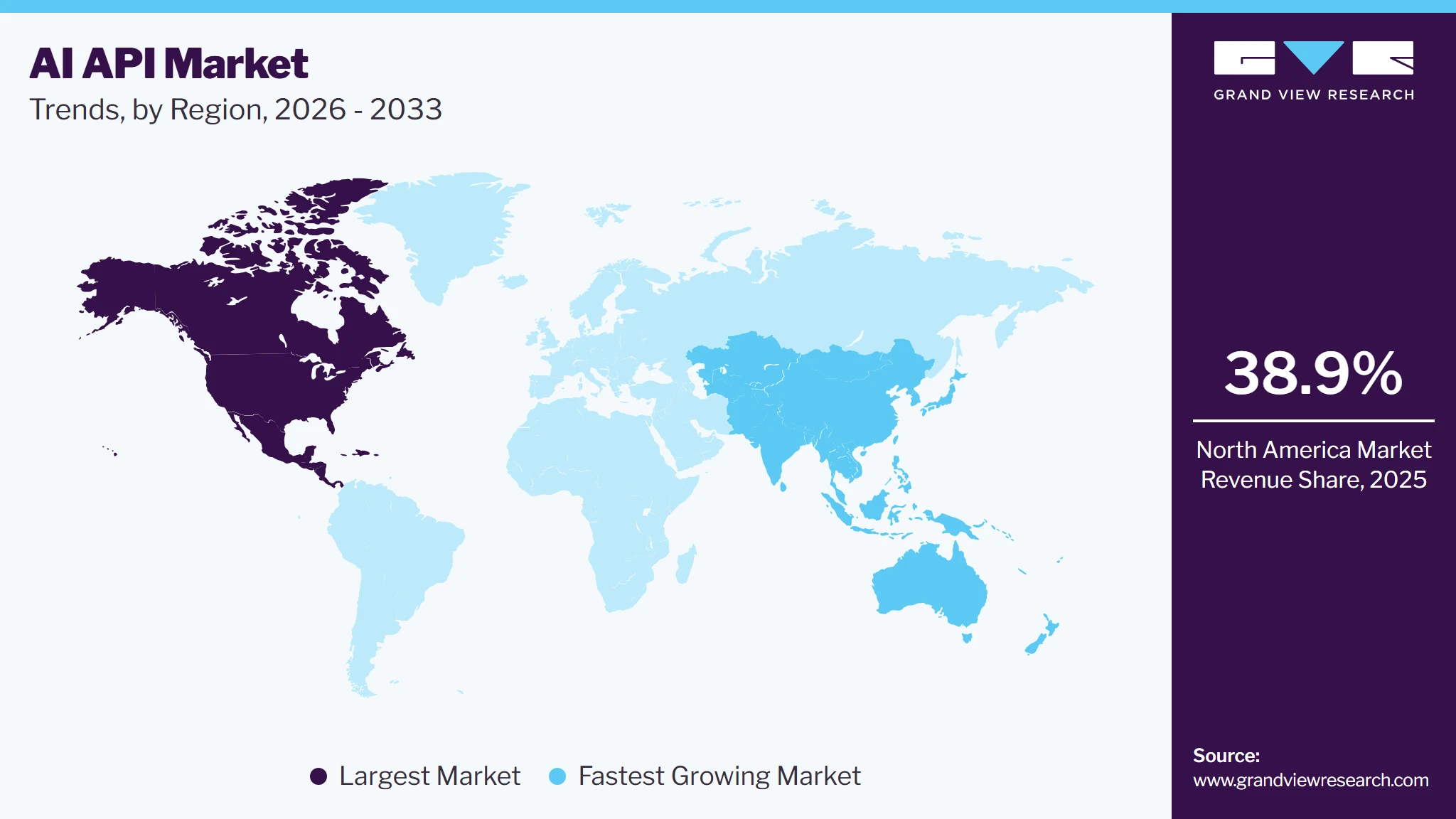
- Largest regional market: North America (38.9% revenue share, 2025)
- Fastest growing regional market: Asia Pacific (highest CAGR, 2026-2033)
- By country: The U.S. held the largest market share in 2025.
Market Size & Forecast
- Market size in 2025: USD 63.2 Billion
- Estimated market size in 2026: USD 82.6 Billion
- Projected market size by 2033: USD 575.7 Billion
- CAGR (2026-2033): 32.0%
Three ways to get this report
Buy it, customize it, or ask a question.Ask an Analyst
Analyst response in 1 business day
- AccessReport author, directly
- Reply timeWithin 1 working day
- No sales callDirect answer only
- FormatEmail reply
- CostFree, no cost
Get the Full Report
What the study covers
- FormatsPDF · Excel · Dashboard
- Timeline2026–2033 annual, 2025 base
- Coverage20+ countries, 5 regions
- Companies10+ key players profiled
Customize the Report
20% free customization
- IncludeCountries, segments, points
- TailorTo your product definition
- ExtendDeeper competitor detail
- OrA fully bespoke study
- Turnaround5–10 working days
These solutions improve personalized travel experiences and customer service. They also enhance operational automation and support greater efficiency across tourism businesses. Features such as pattern recognition and trend analysis enable companies to gain deeper insights into customer behavior, market trends, and operational inefficiencies, leading to more strategic decision-making. By leveraging AI APIs, businesses are rapidly refining and improving their products without the need for intricate on-site AI development. Moreover, AI APIs enhance scalability by automating extensive processes and delivering intelligent solutions that drive business growth and innovation.
Fueled by the rise of automation, widespread artificial intelligence (AI) adoption, and the growing demand for real-time decision-making, AI APIs help in digital transformation by seamlessly integrating intelligent solutions. AI APIs are reshaping business transformation by facilitating the smooth incorporation of intelligent technologies across various industries. Moreover, in the BFSI sector, AI APIs enhance fraud detection by analyzing transaction patterns in real time, streamlining customer interactions through intelligent chatbots, and strengthening risk assessment with predictive analytics.
 To learn more about this report, Download Free Sample Report
 Within retail and e-commerce, AI APIs drive personalized shopping experiences by evaluating customer behavior and optimizing dynamic pricing strategies. By enabling hyper-automation and real-time data processing, AI APIs empower businesses to innovate swiftly, enhance operational efficiency, and maintain a competitive edge in an increasingly technology-driven landscape.
Businesses are integrating AI APIs to enhance efficiency, improve customer experiences, and enable data-driven decision-making. The global AI API market is expected to grow at a double-digit CAGR, fueled by advancements in cloud computing, edge AI, and large language models. Key sectors driving adoption include finance, healthcare, retail, and cybersecurity. However, challenges such as data privacy concerns, regulatory constraints, and high implementation costs remain. Companies investing in scalable, secure, and ethical AI solutions will gain a competitive edge.
Market Dynamics
The AI API market is experiencing strong growth driven by the increasing adoption of artificial intelligence across industries. Organizations are integrating AI APIs to enhance application capabilities and support digital transformation initiatives. The growing availability of cloud-based AI services is encouraging wider market adoption. Continuous innovation and increasing investment in AI technologies are expanding market opportunities. These factors are expected to support sustained market growth over the forecast period.
The AI API market is driven by the growing adoption of artificial intelligence across multiple industries. Organizations are integrating AI capabilities into their existing applications to improve efficiency and functionality. AI APIs make it easier to access advanced technologies without building complex systems from scratch. This reduces development time and operational complexity for businesses. As a result, demand for AI APIs continues to increase steadily. The expanding use of digital platforms across enterprises is further supporting this trend.
This trend is also supported by the rising need for automation and intelligent decision making. Companies are focusing on improving user experience and operational performance through AI-enabled solutions. AI APIs help businesses quickly deploy scalable AI features across different use cases. The flexibility and ease of integration further encourage adoption. These factors collectively contribute to the growth of the AI API market. Increasing investments in digital transformation initiatives are expected to strengthen this demand further over the forecast period.
The AI API market faces restraints due to increasing concerns around data privacy and security. Organizations using AI APIs often handle large volumes of sensitive and personal data, which raises risks related to data breaches and misuse. Compliance with evolving data protection regulations adds complexity to API deployment. Businesses must ensure secure data handling and robust governance frameworks. These requirements can slow down adoption in certain industries.
In addition, lack of transparency in how some AI models process and store data creates trust issues among users. Companies are cautious about sharing critical business information through external APIs. Security vulnerabilities in integration layers can further increase operational risks. This leads to additional investment in cybersecurity measures. Overall, these concerns can limit the pace of market growth.
The growing use of cloud-based platforms is creating significant opportunities for the AI API market. Organizations are increasingly moving to cloud environments to improve scalability, flexibility, and cost efficiency. AI APIs delivered through cloud services allow easy deployment across multiple applications. This is reducing barriers to AI adoption for businesses of all sizes. As a result, demand for cloud-based AI APIs is increasing steadily.
Furthermore, digital transformation initiatives are increasing the need for scalable AI solutions. Companies are seeking on-demand AI capabilities to support dynamic business requirements. API-based models enable quick integration and continuous upgrades without major infrastructure changes. The expansion of global cloud infrastructure is further supporting accessibility. These developments are expected to drive sustained opportunities in the market.
Market Concentration & Characteristics
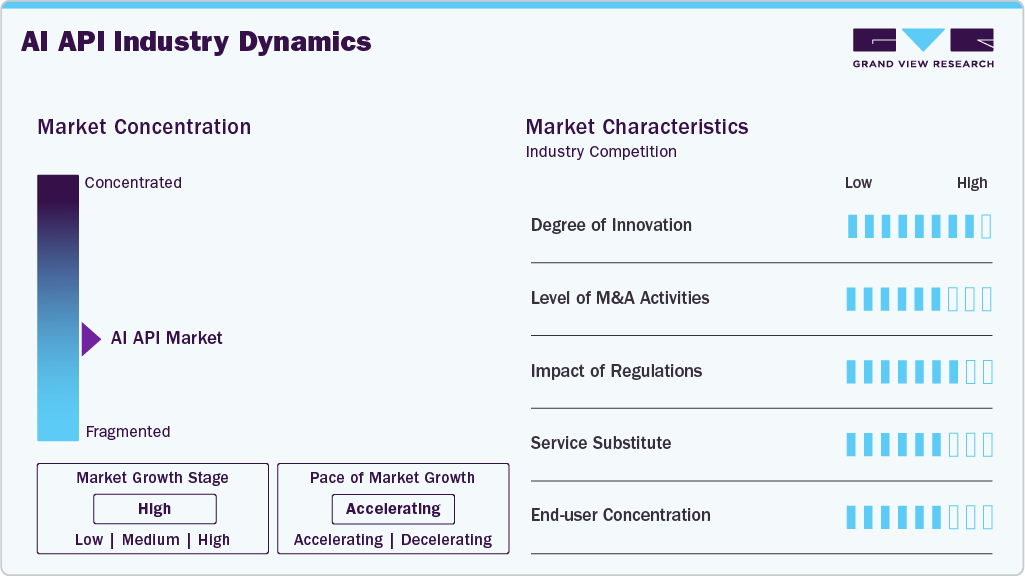
The AI API market is moderately fragmented in nature, with many participants operating across different layers of the ecosystem. It includes global technology companies, cloud service providers, and emerging AI-focused startups offering a wide range of API-based solutions. Competition is distributed across multiple AI use cases such as language processing, computer vision, automation, and analytics. No single player dominates all application areas, which supports a diversified competitive structure. This results in continuous entry of new providers and solution innovations.
 To learn more about this report, Download Free Sample Report
 The presence of both established firms and niche players contributes to a dynamic and competitive environment. Large companies provide broad platform-based AI API offerings, while smaller firms focus on specialized or industry-specific capabilities. Customer demand across varied industries further supports this distributed structure. Interoperability and ease of integration also enable multiple vendors to coexist in the market. Overall, these factors reinforce a moderately fragmented market landscape.
Analyst Perspective
The AI API market is becoming a core enabler of digital product development rather than a standalone technology segment. Demand is increasingly shaped by the need to integrate intelligence capabilities quickly into existing software systems and business workflows. Enterprises are adopting API-based models to reduce implementation time and improve scalability of AI adoption. Competition is intensifying as providers differentiate through performance, reliability, pricing, and ecosystem integration. The market is expected to expand steadily as AI APIs become more embedded in enterprise architecture and application design.
Functionality Insights
Based on functionality, the generative AI APIs segment led the market with the significant revenue share of 36.6% in 2025. Generative AI APIs are rapidly expanding within the AI API market, driven by advancements in large language models and growing enterprise adoption. Businesses leverage these APIs for content generation, chatbots, code automation, and personalized customer interactions. For example, OpenAI’s GPT APIs power virtual assistants and automated writing tools, while Stability AI’s image-generation API fuels creative industries. Companies such as Adobe integrate generative AI into design tools, enhancing productivity. The market’s growth is fueled by demand for scalable AI solutions, reducing operational costs. However, challenges such as ethical concerns and data security require responsible AI development to sustain long-term adoption.
Speech/Voice APIs in AI API are evolving rapidly to meet the growing demands. The growth is driven by the advancements in natural language processing and increasing adoption across industries. OpenAI has launched new tools that allow developers to create AI voice applications, improving accessibility and automation. Otter.ai’s AI avatars can now attend online meetings on behalf of users, transcribing conversations and extracting insights. In customer service, voice bots powered by AI, such as Google’s Dialogflow, enhance customer interactions by handling inquiries efficiently. These innovations are driving adoption in sectors such as healthcare, finance, and retail, transforming business operations and improving user experiences with seamless voice-enabled interactions.
Deployment Insights
Based on deployment, the Cloud-Based APIs segment led the market with the largest revenue share of 63.1% in 2025. The Cloud-based AI API market is experiencing rapid growth due to increasing demand for scalable, cost-efficient, and easily deployable AI solutions. Major providers such as AWS, Google Cloud, and Microsoft Azure dominate the sector, offering APIs for natural language processing, computer vision, and machine learning. Businesses prefer cloud-based AI APIs for their flexibility, reduced infrastructure costs, and seamless integration with existing systems. The rise of generative AI and automation further fuels adoption across industries, including healthcare, finance, and e-commerce. As enterprises prioritize digital transformation, the cloud-based AI API market is projected to expand significantly in the forecast years.
The Edge API segment is expanding in the AI API market, driven by demand for low-latency processing and real-time decision-making. Businesses are integrating edge computing to enhance AI capabilities without relying on centralized cloud infrastructure. This shift supports industries that require fast, localized data processing, including IoT, autonomous systems, and cybersecurity. Companies developing AI APIs for edge environments focus on efficiency, security, and scalability. The market is seeing increased investments in edge AI solutions to optimize performance and reduce reliance on cloud resources. This trend is expected to accelerate as enterprises prioritize speed and data privacy.
End Use Insights
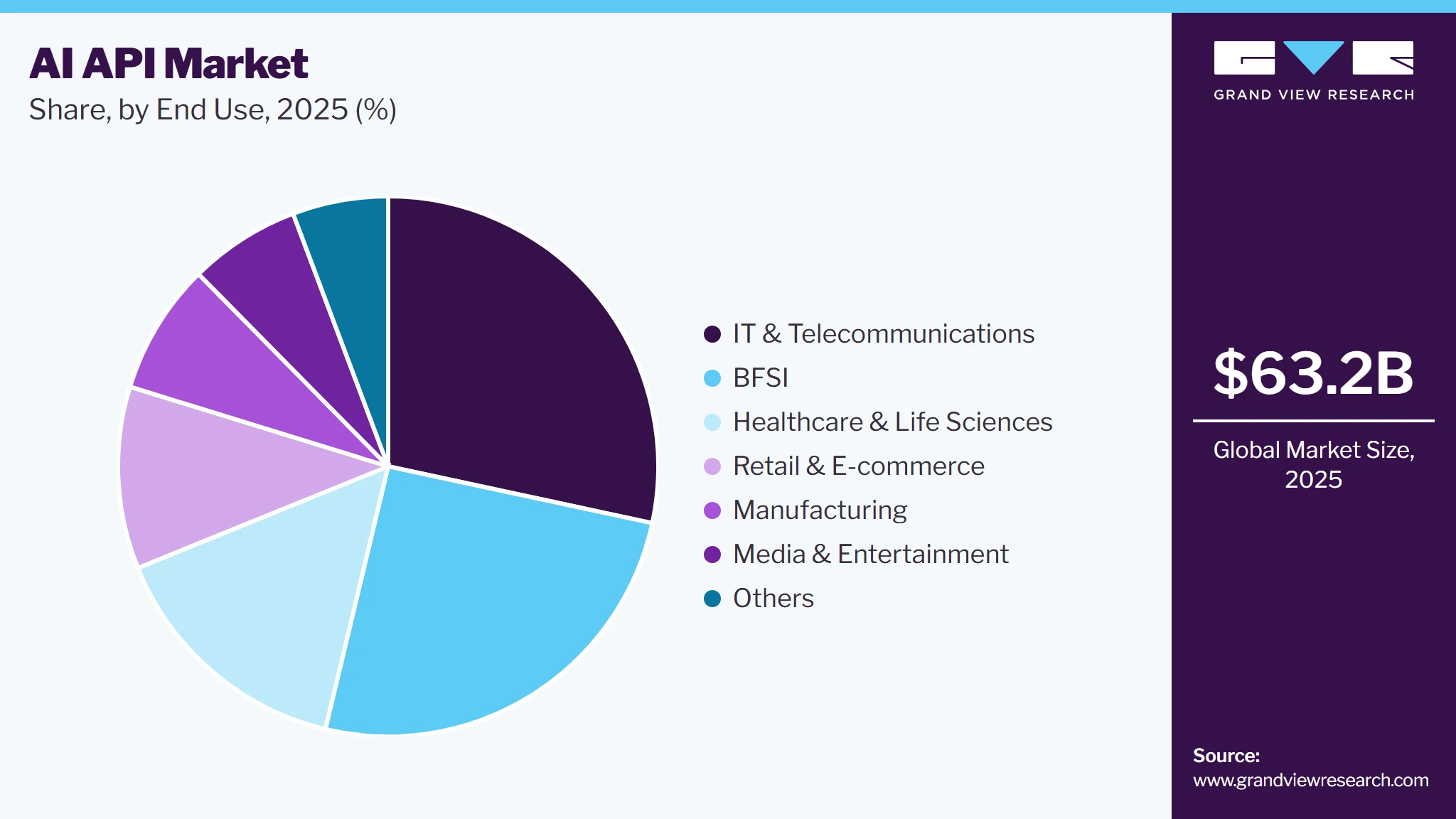
Based on end use, the IT & telecommunications segment led the market with the largest revenue share of 28.4% in 2025. The IT & Telecommunications sector is experiencing rapid growth in the AI API market due to increasing demand for automation, predictive analytics, and enhanced customer experiences. AI-driven APIs are being integrated into network management, cybersecurity, chatbots, and personalized services. The rise of 5G, IoT, and cloud computing further accelerates adoption, enabling real-time data processing and intelligent automation. Telecom companies leverage AI APIs for fraud detection, predictive maintenance, and virtual assistants. With global digital transformation initiatives and the expansion of AI-driven infrastructure, the IT & Telecommunications sector is expected to remain a key driver of AI API market growth.
 To learn more about this report, Download Free Sample Report
 BFSI is going to register significant CAGR growth over the forecast period. Healthcare & Life Sciences are experiencing significant growth in the AI computer market, driven by the integration of specialized hardware and software designed to handle complex AI tasks efficiently. These systems are equipped with powerful processors and AI accelerators, such as Neural Processing Units (NPUs), which enhance performance and energy efficiency. This integration enables AI PCs to perform tasks such as data analysis, machine learning, and real-time decision-making directly on the device, reducing reliance on cloud computing.
Regional Insights
North America dominated the AI API market with the largest revenue share of 38.9% in 2025. North America's market is expanding rapidly due to strong investments, technological advancements, and increasing adoption across industries. Companies are leveraging AI APIs for automation, data analytics, and customer engagement. Amazon is investing over $100 billion in 2025, focusing heavily on AI advancements within AWS. OpenAI and Bain & Company have expanded their partnership to integrate AI-powered tools into retail and life sciences. Moreover, AI startup Anthropic is launching enterprise-focused features, such as AI-powered pre-meeting reports. These developments highlight North America's leadership in AI innovation, driving significant growth in the AI API market.
 To learn more about this report, Download Free Sample Report
 U.S. AI API Market Trends
The AI API market in the U.S. held the largest share in the North America region in 2025. The AI API market in U.S. is expanding rapidly, fueled by innovation and major corporate investments. Adobe recently introduced AI-powered tools at the Adobe Summit 2025, including the Adobe Experience Platform Agent Orchestrator and new Firefly features for video editing and translation. Moreover, AI startup Anthropic is rolling out enterprise-focused capabilities, such as AI-driven pre-meeting reports that analyze calendars and external data. These developments highlight how U.S. companies are integrating AI APIs into business processes, creative industries, and enterprise solutions, reinforcing the country’s position as a leader in AI adoption and development.
Asia Pacific AI API Market Trends
The AI API industry in the Asia Pacific is anticipated to grow at the fastest CAGR from 2026 to 2033. The Asia Pacific AI API market is witnessing rapid growth, driven by increasing adoption across industries such as healthcare, e-commerce, fintech, and manufacturing. Key countries such as China, Japan, India, and South Korea are leading innovation through government support and investments in AI research and development. For instance, China’s "Next Generation Artificial Intelligence Development Plan" has positioned AI as a strategic priority.
Key AI API Company Insights
Some key companies in the AI API market include Google, Microsoft, IBM, and OpenAI, along with other key players such as AssemblyAI, Hugging Face, DeepSeek, and Cohere and others. Organizations are focusing on increasing customer base to gain a competitive edge in the industry. Therefore, key players are taking several strategic initiatives, such as mergers and acquisitions, and partnerships with other major companies.
-
IBM Corporation empowers businesses with advanced AI API offerings to accelerate development and integration. Through its API Assistant in IBM API Connect, powered by watsonx.ai, IBM simplifies API documentation by validating specifications, detecting errors, and providing real-time suggestions. This streamlines workflows, reduces development time, and enhances code quality. IBM also offers an AI Gateway, a centralized solution for secure access and management of AI services via APIs, ensuring seamless integration across applications. The company’s watsonx.ai platform further supports developers with advanced tools and APIs for building robust AI applications. It provides access to pre-trained models, a collaborative environment for generative AI solutions, and resources to innovate efficiently.
-
Eden AI is a comprehensive platform that simplifies the integration of artificial intelligence through a unified API, offering access to over 100 AI models from various leading providers. The platform supports a wide range of functionalities, including text-to-speech, language detection, sentiment analysis, face recognition, and more. By aggregating multiple AI technologies into one accessible interface, Eden AI enables businesses to optimize performance and reduce costs while managing diverse AI capabilities seamlessly.
Key AI API Companies:
The following key companies have been profiled for this study on the AI API market.
-
Google LLC
-
Microsoft
-
IBM Corporation
-
OpenAI
-
AssemblyAI
-
Hugging Face
-
DeepSeek
-
Cohere
-
Eden AI
-
Imagga
Competitive Benchmarking
Operating Strategies
Competitive Edge
Weaknesses
Mature Players: Google LLC, Microsoft, IBM Corporation
- Matured players focus on scaling AI API ecosystems through strong cloud infrastructure, continuous model upgrades, and enterprise integration. They emphasize reliability, global reach, and long-term customer relationships through bundled and subscription-based offerings.
- Matured players compete through large-scale AI API ecosystems, strong brand positioning, and deep integration across enterprise workflows. They focus on continuous model improvements, global cloud distribution, and bundled service offerings to strengthen customer retention and lock-in.
- Matured players face higher cost structures due to large-scale operations and complex platform ecosystems. They often experience slower customization for niche or industry-specific requirements. They also face scalability limits due to constrained infrastructure and resources.
Emerging Players: AssemblyAI, DeepSeek, Eden AI, Imagga
- Emerging players focus on niche AI API capabilities, rapid innovation, and developer-friendly platforms. They rely on partnerships, flexible pricing, and specialization to expand adoption and market presence.
- Emerging players compete through specialized AI API solutions, faster innovation cycles, and targeted use cases. They emphasize flexibility, developer adoption, and strategic partnerships to gain visibility and expand market share.
- Emerging players face limitations in global reach and brand recognition compared to established providers. Their enterprise penetration remains relatively smaller, restricting large-scale adoption.
Recent Developments
-
In February 2025, Confluent and Databricks, a U.S.-based data, analytics, and artificial intelligence company, expanded their partnership to enhance real-time AI data processing by integrating Confluent’s data streaming with Databricks’ analytics platform. This collaboration improves scalability, performance, and data availability, enabling faster and more informed decision-making. Organizations can leverage real-time data more effectively while eliminating silos that slow down AI-driven insights.
-
In January 2025, Microsoft and OpenAI, a U.S.-based artificial intelligence company, extended their partnership, securing exclusive rights to OpenAI’s API on Azure and continuing their revenue-sharing agreement through 2033. OpenAI also committed to increased Azure usage while gaining approval to build additional capacity for model research and training.
-
In January 2025, Microsoft released DeepSeek R1, making it available on Azure AI Foundry and GitHub for businesses and developers. This product delivers cost-efficient AI reasoning, enterprise-grade security, and seamless deployment, allowing users to integrate advanced AI capabilities with minimal infrastructure investment.
AI API Market Report Scope
Report Attribute
Details
Market size in 2025
USD 63.2 Billion
Estimated market size in 2026
USD 82.6 Billion
Projected market size by 2033
USD 575.7 Billion
Growth rate
CAGR of 32.0% from 2026 to 2033
Base year for estimation
2025
Historical data
2021 - 2024
Forecast period
2026 - 2033
Quantitative units
Revenue in USD million/billion and CAGR from 2026 to 2033
Report coverage
Revenue forecast, company ranking, competitive landscape, growth factors, and trends
Segments covered
Functionality, deployment, end use, region
Regional scope
North America; Europe; Asia Pacific; Latin America; MEA
Country scope
U.S.; Canada; Mexico; Germany; UK; France; China; Japan; India; Australia; South Korea; Brazil; KSA; UAE; South Africa
Key companies profiled
Google LLC; Microsoft; IBM Corporation; OpenAI; AssemblyAI; Hugging Face; DeepSeek; Cohere; Eden AI; Imagga
Customization scope
Free report customization (equivalent up to 8 analysts' working days) with purchase. Addition or alteration to country, regional & segment scope.
Pricing and purchase options
Avail customized purchase options to meet your exact research needs. Explore purchase options
Global AI API Market Report Segmentation
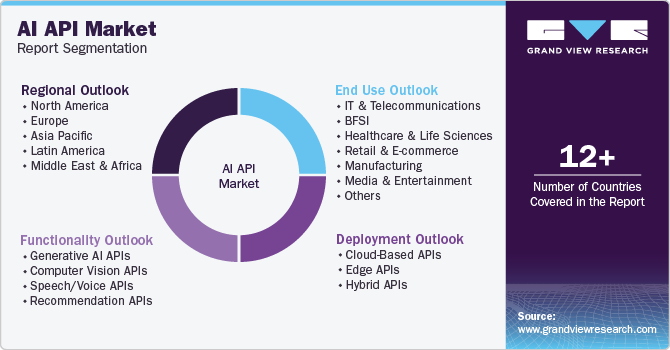
This report forecasts revenue growth at global, regional, and country levels and provides an analysis of the latest industry trends and opportunities in each of the sub-segments from 2021 to 2033. For this study, Grand View Research has segmented the global AI API market report based on functionality, deployment, end use, and region:
 To learn more about this report, Download Free Sample Report
 -
Functionality Outlook (Revenue, USD Million, 2021 - 2033)
-
Generative AI APIs
-
Computer Vision APIs
-
Speech/Voice APIs
-
Recommendation APIs
-
-
Deployment Outlook (Revenue, USD Million, 2021 - 2033)
-
Cloud-Based APIs
-
Edge APIs
-
Hybrid APIs
-
-
End Use Outlook (Revenue, USD Million, 2021 - 2033)
-
IT & Telecommunications
-
BFSI
-
Healthcare & Life Sciences
-
Retail & E-commerce
-
Manufacturing
-
Media & Entertainment
-
Others
-
-
Regional Outlook (Revenue, USD Million, 2021 - 2033)
-
North America
-
U.S.
-
Canada
-
Mexico
-
-
Europe
-
UK
-
Germany
-
France
-
-
Asia Pacific
-
China
-
Japan
-
India
-
Australia
-
South Korea
-
-
Latin America
-
Brazil
-
-
Middle East & Africa (MEA)
-
KSA
-
UAE
-
South Africa
-
-
Research Methodology
The AI API market figures in this report are based on a proven research process that combines executive interviews with secondary research from proprietary databases, company filings, and recognized regulatory and institutional sources. Market size is built through value-chain sizing - reconciling supply-side and demand-side estimates - and triangulated with bottom-up and top-down approaches. Every estimate passes multiple levels of expert validation before publication, with each AI API segment quantified using the revenue-capture definitions in the table below.
Segment Definition
Segment - Functionality
Revenue Capture Definition
Generative AI APIs
This category captures spending on APIs that enable text generation, image creation, code generation, summarization, conversational AI, and other generative AI capabilities within software applications.
Computer Vision APIs
This category includes revenue from APIs used for image recognition, object detection, facial recognition, optical character recognition (OCR), video analysis, and other computer vision applications.
Speech/Voice APIs
Revenue in this category is derived from APIs that support speech recognition, speech-to-text, text-to-speech, voice authentication, voice assistants, and multilingual voice processing.
Recommendation APIs
This category comprises spending on APIs that deliver personalized recommendations for products, content, advertisements, and services using AI-driven analytics and user behavior insights.
Segment- Deployment
Revenue Capture Definition
Cloud-Based APIs
This segment represents revenue from AI APIs delivered through cloud platforms, enabling scalable, on-demand access to AI capabilities without requiring dedicated on-premises infrastructure.
Edge APIs
This segment covers revenue from AI APIs deployed on edge devices or local computing environments to support low-latency processing, offline functionality, and real-time decision-making.
Hybrid APIs
Revenue under this segment includes AI APIs deployed across both cloud and edge environments, allowing organizations to balance scalability, performance, and data processing requirements.
Segment- End Use
Revenue Capture Definition
IT & Telecommunications
This segment includes spending by IT service providers, software companies, cloud providers, and telecommunications operators on AI APIs for application development, automation, network optimization, and customer engagement.
BFSI
This segment represents revenue generated from AI APIs adopted by banks, financial institutions, insurance companies, and fintech firms for fraud detection, risk analysis, customer service, and process automation.
Healthcare & Life Sciences
This category covers spending on AI APIs by healthcare providers, pharmaceutical companies, biotechnology firms, and life sciences organizations for diagnostics, clinical workflows, medical imaging, and research.
Retail & E-commerce
Revenue in this segment is generated from AI API adoption by retailers, online marketplaces, and e-commerce platforms for personalization, recommendation engines, demand forecasting, and customer support.
Manufacturing
This segment captures spending by manufacturing companies on AI APIs for quality inspection, predictive maintenance, production optimization, and intelligent automation.
Media & Entertainment
This category includes revenue from AI APIs used by media companies, streaming platforms, gaming companies, and content creators for content generation, personalization, moderation, and audience analytics.
Others
This segment covers revenue from AI APIs deployed across industries such as education, transportation, energy, government, agriculture, and other commercial sectors not included in the above categories.
Estimation Model
Layer Name
Key Question
Description
Enterprise Adoption Layer
Who creates demand for AI APIs?
Identifies the total population of enterprises, software developers, digital platforms, cloud-native businesses, and public sector organizations adopting AI APIs across industries.
Implementation Activity Layer
Who actively deploys AI APIs?
Filters the addressable user base based on AI investment levels, digital transformation initiatives, API integration activity, cloud adoption, and active AI implementation projects.
Functionality Consumption Layer
Which AI API functionalities are deployed?
Estimates adoption across generative AI APIs, computer vision APIs, speech/voice APIs, recommendation APIs, and other AI API categories deployed through cloud, edge, or hybrid environments.
Revenue Capture Layer
How is revenue generated in the AI API ecosystem?
Calculates revenue from AI API subscriptions, usage-based API consumption, licensing, enterprise API access, managed API services, implementation, integration, customization, maintenance, and technical support across end-user industries.
Delivered Customizations
This report has been delivered with the following In-depth customizations
Client Objective
Custom Research Modules Delivered
Strategic Value / Business Impact
Market Entry & Expansion Assessment
- Regional demand sizing and forecasting
- Customer segmentation and buying behavior analysis
- Competitive landscape benchmarking
- Regulatory and distribution channel assessment
- Identified high-growth market opportunities
- Supported go-to-market strategy development
- Highlighted investment priorities and risks
- Enabled data-driven expansion planning
Product Positioning & Competitive Intelligence
- Product benchmarking and feature comparison
- Pricing and value proposition analysis
- Brand perception and customer preference study
- Competitor strategy evaluation
- Improved product differentiation strategy
- Supported pricing optimization
- Identified unmet customer needs
- Enhanced competitive positioning
Technology & Innovation Assessment
- Emerging technology trend analysis• Innovation pipeline
- Technology adoption readiness assessment
- Ecosystem and partnership mapping
- Identified future growth areas
- Supported innovation roadmap planning
- Evaluated commercialization potential
- Strengthened strategic partnership decisions
Frequently Asked Questions About This Report
The Generative AI APIs segment led with a 36.6% revenue share in 2025 and Speech/Voice APIs is also the fastest-growing segment.
Asia Pacific is the fastest-growing region over the forecast period.
The Cloud-based APIs segment led with a 63.1% revenue share in 2025, and edge APIs is the fastest-growing segment.
The IT & Telecommunications segment accounted for the largest share of 28.4% in 2025. This growth is driven by the increasing integration of AI APIs into cloud platforms, software applications, customer service systems, and enterprise IT infrastructure.
North America dominated with a revenue share of 38.9% in 2025, attributable to the strong presence of AI technology providers, widespread enterprise adoption of AI APIs, and advanced cloud infrastructure across the region.
The global AI API market size was valued at USD 63.2 billion in 2025 and is estimated at USD 82.6 billion in 2026.
Some key players operating in the AI API market include Google LLC, Microsoft, IBM Corporation, OpenAI, AssemblyAI, Hugging Face, DeepSeek, Cohere, Eden AI, and Imagga.
Key factors that are driving the market growth include by the rise of automation, widespread AI adoption, and the growing demand for real-time decision-making, AI APIs help in digital transformation by seamlessly integrating intelligent solutions.
The global AI API market is expected to grow at a CAGR of 32.0% from 2026 to 2033, reaching USD 575.7 billion by 2033.
About the Author(s)
Next Generation Technologies Research Team
Technology · Next Generation TechnologiesThis report was authored by the next generation technologies research team at Grand View Research - comprising two research analysts, one senior research analyst, and one industry expert - with specialized expertise in the next generation technologies segment of the technology industry. All findings are based on proprietary technology databases, executive interviews, and regulatory analysis, subject to internal peer review prior to publication.
Last Updated:
Speak to Analyst

Customize this report to your needs - add regions, segments, or data points, with 20% free customization.
Or view our licence options:


ISO 9001:2015 & 27001:2022 Certified
We are GDPR and CCPA compliant! Your transaction & personal information is safe and secure. For more details, please read our privacy policy.


