
- Home
- »
- Next Generation Technologies
- »
-
AI Automation Market Size And Share Report, 2026-2033GVR Report cover

AI Automation Market (2026 - 2033)
Size, Share & Trend Analysis Report By Automation Type (Intelligent Process Automation, Conversational AI Automation), By Deployment (Cloud, Hybrid), By Enterprise Size, By Integration Mode, By Vertical, By Region, And Segment Forecasts
Market Size, 2025
$129.9BMarket Estimate, 2026
$169.5BMarket Forecast, 2033
$1,144.8BCAGR, 2026–2033
31.4%AI Automation Market Summary
The global AI automation market size was valued at USD 129.9 billion in 2025 and is projected to grow from USD 169.5 billion in 2026 to USD 1,144.8 billion by 2033, at a CAGR of 31.4% from 2026 to 2033. The North America held the largest share of 32.7% of the global market in 2025. The market is driven by the enterprises that deploy AI automation for optimized resource utilization as intelligent automation systems support real-time monitoring of energy consumption and operational footprints, enabling organizations to align business performance with environmental compliance objectives.
 Source: Grand View Research, IR Documents, Primary Interviews, Paid DatabasesTo learn more about this report,
 Download Free Sample Report
 Key Market Trends & Insights
- By automation type: Intelligent process automation segment held the largest revenue share of 33.8% in 2025.
- By enterprise size: Large enterprise segment held the largest market share of 67.5% in 2025.
- By vertical: Healthcare segment is expected to grow at the fastest CAGR of 36.0% from 2026 to 2033.
Regional Highlights
- Largest regional market: North America (32.7% revenue share, 2025)
- Fastest-growing regional market: Asia Pacific (highest CAGR, 2026-2033)
- By country: The U.S. led the North America market in 2025.
Market Size & Forecast
- Market size in 2025: USD 129.9 Billion
- Estimated market size in 2026: USD 169.5 Billion
- Projected market size by 2033: USD 1,144.8 Billion
- CAGR (2026-2033): 31.4%
Three ways to get this report
Buy it, customize it, or ask a question.Ask an Analyst
Analyst response in 1 business day
- AccessReport author, directly
- Reply timeWithin 1 working day
- No sales callDirect answer only
- FormatEmail reply
- CostFree, no cost
Get the Full Report
What the study covers
- FormatsPDF · Excel · Dashboard
- Timeline2026–2033 annual, 2025 base
- Coverage20+ countries, 5 regions
- Companies10+ key players profiled
Customize the Report
20% free customization
- IncludeCountries, segments, points
- TailorTo your product definition
- ExtendDeeper competitor detail
- OrA fully bespoke study
- Turnaround5–10 working days
Organizations are accelerating digital transformation initiatives to improve process efficiency and reduce operational costs, driving demand for AI-enabled automation across core business functions. Increasing volumes of enterprise data require intelligent systems capable of real-time analysis and autonomous decision-making due to rising pressure to enhance productivity after skilled labor shortages is further supporting deployment of AI-driven workflow automation. In addition, enterprises are integrating automation with existing ERP and CRM platforms to streamline cross-departmental operations and minimize manual intervention.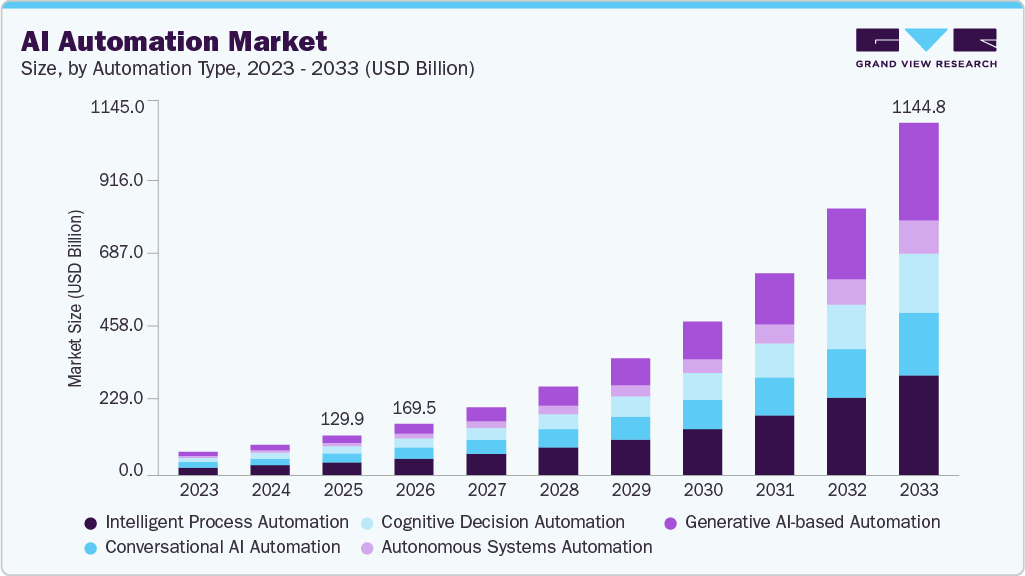 To learn more about this report, Download Free Sample Report
 Moreover, the growing adoption of cloud computing and scalable infrastructure is enabling faster implementation of AI automation solutions across enterprises of all sizes. Advancements in technologies such as machine learning, natural language processing, and computer vision are expanding automation use cases beyond rule-based tasks into cognitive processes, and the regulatory requirements by organizations for accuracy, compliance monitoring, and auditability are encouraging the deployment of intelligent monitoring systems.
Industry-specific adoption across manufacturing, healthcare, BFSI, retail, and logistics sectors is strengthening market expansion through targeted automation applications due as the integration of AI automation with IoT ecosystems is improving predictive maintenance and asset performance management. Rising cybersecurity concerns are encouraging automated threat detection and incident response capabilities. Strategic investments by technology providers in AI platforms and automation frameworks are accelerating innovation cycles and enterprise adoption rates.
Automation Type Insights
The intelligent process automation segment led the market and accounted for 33.8% of the global revenue in 2025, due to rising demand for end-to-end business process optimization is driving adoption of IPA across finance, HR, procurement, and supply chain functions. Enterprises are combining robotic process automation with AI capabilities to enable exception handling, contextual decision-making, and continuous process improvement, driven by increasing compliance requirements and the need for audit trails, which are further encouraging deployment in highly regulated industries.
The generative AI-based automation segment is predicted to foresee significant growth in the forecast period. The market is driven by the use of AI-generated content and contextual data combination, which is accelerating the adoption of generative AI-based automation in customer service, marketing, software development, and knowledge management. Organizations are utilizing generative models to automate document creation, code generation, and personalized communication at scale. The need for faster innovation cycles and reduced content production costs is supporting enterprise investments in generative automation tools.
Deployment Insights
The cloud segment accounted for the largest market share in 2025, driven by scalability, flexible pricing structures, and reduced upfront infrastructure requirements, as companies adopt cloud environments to enable rapid deployment of intelligent workflows across distributed operations. Regular updates, centralized data access, and integrated AI services enhance performance optimization and system interoperability, as there is a growing preference for subscription-based models further support adoption among small and mid-sized enterprises seeking cost-efficient automation capabilities.
The hybrid segment is predicted to foresee significant growth in the forecast period. Hybrid deployment is expanding as organizations seek to balance data security with operational flexibility, as enterprises handling sensitive or regulated data prefer hybrid control. This approach supports phased modernization of legacy systems without disrupting existing IT architecture, with increasing focus on business continuity and data control is further strengthening demand for hybrid AI automation frameworks.
Enterprise Size Insights
The large enterprise segment accounted for the largest market revenue share in 2025. Large enterprises are deploying AI automation to manage complex, multi-location operations and high transaction volumes across value chains. The need for enterprise-wide standardization, process visibility, and centralized governance is accelerating the adoption of intelligent automation platforms. Additionally, large organizations are prioritizing automation to enhance risk management, compliance monitoring, and strategic decision-making capabilities.
The SME segment is predicted to foresee significant growth in the forecast period. SMEs adopting AI automation to improve operational efficiency and remain competitive in dynamic market environments. The availability of cloud-based, subscription-driven AI solutions is reducing upfront capital requirements and simplifying deployment, which makes it easy for small organizations to use AI automation. SMEs are also implementing automation to enhance responsiveness, reduce turnaround times, and improve overall business agility.
Integration Mode Insights
The API-based / modular integration segment holds the highest market share of the global revenue in 2025. The market is growing because of the demand for flexible and scalable automation frameworks, which is accelerating the adoption of API-based and modular integration models. Enterprises prefer interoperable solutions that connect seamlessly with existing enterprise systems, reducing disruption to legacy infrastructure as the modular architectures enable phased deployment, faster customization, and efficient upgrades without full system replacement.
The embedded AI automation segment is predicted to foresee significant growth in the forecast period. The market is driven by the increasing demand for embedded AI automation solutions as organizations are integrating AI capabilities directly into enterprise software, industrial equipment, and digital platforms to enhance responsiveness and operational precision as these solutions reduce latency, improve data security, and enable contextual automation at the point of execution. Industry-specific digital transformation initiatives are further strengthening adoption across manufacturing systems, financial platforms, and healthcare technologies.
Vertical Insights
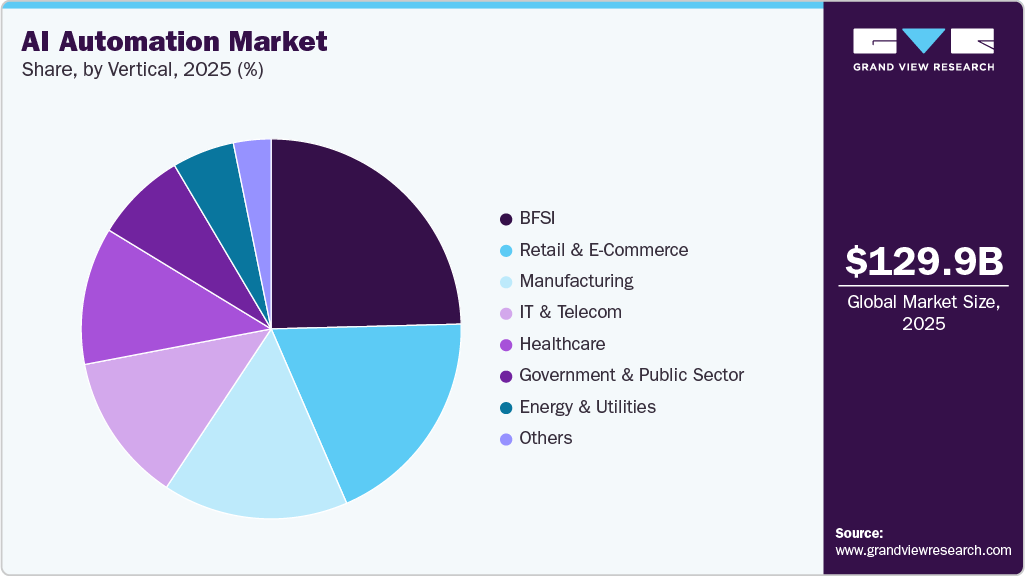
The BFSI segment accounted for the largest market revenue share in 2025. Financial institutions are implementing AI automation to improve transaction processing speed, risk assessment accuracy, and fraud detection efficiency as the growing digital banking adoption is increasing demand for automated customer onboarding, credit scoring, and compliance verification processes. Cost optimization pressures and the need for real-time data-driven decision-making are further supporting large-scale deployment of AI automation across banking and insurance operations.
 To learn more about this report, Download Free Sample Report
 The healthcare segment is projected to grow significantly over the forecast period. The market is anticipated by the rising patient volumes and administrative complexity are accelerating adoption of AI automation to streamline scheduling, claims processing, and medical documentation due to increasing demand for accuracy in diagnostics and treatment planning is driving the need of intelligent systems for data analysis and clinical decision support. Healthcare providers are integrating automation to enhance electronic health record management and reduce manual errors.
Regional Insights
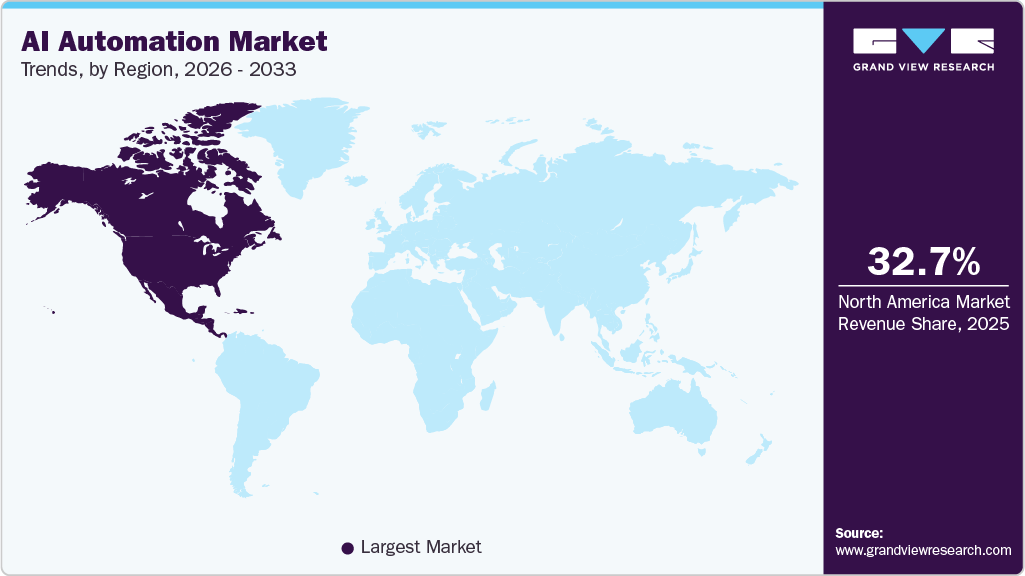
North America dominated the market by 32.7% revenue share in 2025, due to high enterprise spending on advanced digital infrastructure which is accelerating integration of AI automation across large corporations and mid-sized firms as they are prioritizing intelligent automation to enhance operational resilience and business continuity strategies. Increasing focus on data-driven governance frameworks is further driving adoption across regulated industries.
 To learn more about this report, Download Free Sample Report
 U.S. AI Automation Market Trends
The U.S. market is progressing due to strong venture capital investment in AI startups is accelerating innovation in advanced automation technologies. High adoption of remote and hybrid work models is increasing demand for automated IT service management and workflow orchestration tools in the top companies in the country. Competitive pressure to enhance customer engagement analytics is further driving implementation across service-oriented industries.
Europe AI Automation Market Trends
In Europe, the stringent data protection and compliance frameworks are encouraging adoption of AI automation solutions with transparent and auditable processes. Industrial modernization initiatives across manufacturing hubs are supporting deployment of intelligent production and quality control systems in the region. Cross-border trade operations are increasing demand for automated documentation and logistics management. Public sector digital transformation programs are also contributing to steady market expansion.
Asia Pacific AI Automation Market Trends
Asia Pacific has the highest CAGR for the forecasted period, due to significant demand for cost-efficient AI automation platforms in e-commerce and digital payment systems is accelerating automation of supply chain and transaction management processes. Governments across the region are promoting smart city and digital economy initiatives, supporting broader technology integration and the rising need for scalable cloud-based automation solutions is further strengthening regional adoption.
Key AI Automation Company Insights
Some key companies in the AI automation industry are UiPath, Accenture, Google, Microsoft
-
Accenture is a services and consulting organization that assists enterprises in addressing complex business challenges through a broad array of services spanning strategy, consulting, digital, technology, and operations. The company integrates advanced technologies into client engagements to improve operational performance, transform business models, and support digital innovation. It serve clients across differnet industry sectors, helping them modernize processes, optimize technology landscapes, and implement data-driven solutions.
-
UiPath specializes in complete automation software that combines artificial intelligence, workflow orchestration, and software robots to streamline enterprise operations and reduce manual effort. Its platform supports automation across knowledge work by enabling AI agents and bots to execute complex workflows across multiple systems, improving accuracy and process throughput. The company’s solutions integrate with existing business applications, facilitating seamless data handling and process execution across departments.
Key AI Automation Companies:
The following key companies have been profiled for this study on the AI automation market.
- Accenture
- AWS
- C3.ai
- DataRobot
- IBM
- Microsoft
- ServiceNow
- UiPath
- Workato
Recent Developments
-
In February 2026, UiPath launched agentic AI solutions for healthcare providers and payers. These tools are designed to summarize medical records, prevent and resolve claim denials, and manage prior authorizations. With agentic automation, business orchestration, and compliant agents, the solutions connect data across systems, streamline administrative work, and improve revenue cycle management.
-
In February 2026, Workato launched production-ready Model Context Protocol (MCP) servers to enable enterprise AI adoption. These eight initial servers cover communication, productivity, sales, and IT operations, with over 100 more planned for the year, allowing AI agents like Claude and ChatGPT to integrate securely with enterprise systems. The servers deploy in minutes, include enterprise-grade security and role-based access control, and support complete business workflows without custom coding.
-
In January 2026, Microsoft announced agentic AI solutions that integrate intelligent automation across retail functions including merchandising, marketing, store operations, and fulfillment. These capabilities deliver context-aware tools to coordinate workflows, enabling retailers to enhance shopper relevance, operational efficiency, and market resilience.
AI Automation Market Report Scope
Report Attribute
Details
Market size in 2025
USD 129.9 billion
Market size value in 2026
USD 169.5 billion
Revenue forecast in 2033
USD 1,144.8 billion
Growth rate
CAGR of 31.4% from 2026 to 2033
Base year for estimation
2025
Actual data
2021 - 2024
Forecast period
2026 - 2033
Quantitative units
Revenue in USD billion/billion and CAGR from 2026 to 2033
Report coverage
Revenue forecast, company ranking, competitive landscape, growth factors, and trends
Segments covered
Automation type, deployment, enterprise size, integration mode, vertical, region
Regional scope
North America; Europe; Asia Pacific; Latin America; MEA
Country scope
U.S.; Canada; Europe; UK; Germany; France; China; Japan; India; South Korea; Australia; Brazil; KSA; UAE; South Africa
Key companies profiled
Accenture; AWS; C3.ai; DataRobot; Google; IBM,;Microsoft; ServiceNow; UiPath, Workato
Customization scope
Free report customization (equivalent up to 8 analysts working days) with purchase. Addition or alteration to country, regional & segment scope.
Pricing and purchase options
Avail customized purchase options to meet your exact research needs. Explore purchase options
Global AI Automation Market Report Segmentation
This report forecasts revenue growth at global, regional, and country levels and provides an analysis of the latest industry trends in each of the sub-segments from 2021 to 2033. For this study, Grand View Research has segmented the global AI automation market report based on automation type, deployment, enterprise size, integration mode, vertical, and region:
-
Automation Type Outlook (Revenue, USD Billion, 2021 - 2033)
-
Intelligent Process Automation
-
Conversational AI Automation
-
Cognitive Decision Automation
-
Autonomous Systems Automation
-
Generative AI-based Automation
-
-
Deployment Outlook (Revenue, USD Billion, 2021 - 2033)
-
Cloud
-
Hybrid
-
On-premises
-
-
Enterprise Size Outlook (Revenue, USD Billion, 2021 - 2033)
-
Large enterprise
-
SMEs
-
-
Integration Mode Outlook (Revenue, USD Billion, 2021 - 2033)
-
API-Based / Modular Integration
-
Embedded AI Automation
-
Standalone Intelligent Platforms
-
-
Vertical Outlook (Revenue, USD Billion, 2021 - 2033)
-
BFSI
-
Healthcare
-
Retail & E-Commerce
-
Manufacturing
-
IT & Telecom
-
Government & Public Sector
-
Energy & Utilities
-
Others
-
-
Regional Outlook (Revenue, USD Billion, 2021 - 2033)
-
North America
-
U.S.
-
Canada
-
Mexico
-
-
Europe
-
UK
-
Germany
-
France
-
-
Asia Pacific
-
China
-
Japan
-
India
-
South Korea
-
Australia
-
-
Latin America
-
Brazil
-
-
Middle East and Africa (MEA)
-
KSA
-
UAE
-
South Africa
-
-
Frequently Asked Questions About This Report
Asia Pacific is the fastest-growing region over the forecast period.
The intelligent process automation segment led with a 33.8% revenue share in 2025.
Large enterprise segment held the largest share (over 67.0%) in 2025.
The API-based / modular integration segment held the largest revenue share in 2025.
Cloud segment dominated the market in 2025 and accounted for the largest share.
Key factors that are driving the market growth include the enterprises that deploy AI automation for optimized resource utilization as intelligent automation systems support real-time monitoring of energy consumption and operational footprints.
The global AI automation market size was valued at USD 129.9 billion in 2025 and is estimated at USD 169.5 billion for 2026.
The global AI automation market is expected to grow at a CAGR of 31.4% from 2026 to 2033, reaching USD 1,144.8 billion by 2033.
North America dominated the AI automation market with a share of 32.7% in 2025. This is attributable due to high enterprise spending on advanced digital infrastructure which is accelerating integration of AI automation across large corporations and mid-sized firms as they are prioritizing intelligent automation to enhance operational resilience and business continuity strategies.
Key players include Accenture; AWS; C3.ai; DataRobot; Google; IBM,;Microsoft; ServiceNow; UiPath, Workato.
About the Author(s)
Next Generation Technologies Research Team
Technology · Next Generation TechnologiesThis report was authored by the next generation technologies research team at Grand View Research - comprising two research analysts, one senior research analyst, and one industry expert - with specialized expertise in the next generation technologies segment of the technology industry. All findings are based on proprietary technology databases, executive interviews, and regulatory analysis, subject to internal peer review prior to publication.
Last Updated:
Speak to Analyst

Customize this report to your needs - add regions, segments, or data points, with 20% free customization.
Or view our licence options:


ISO 9001:2015 & 27001:2022 Certified
We are GDPR and CCPA compliant! Your transaction & personal information is safe and secure. For more details, please read our privacy policy.


