
- Home
- »
- Next Generation Technologies
- »
-
AI-Based Climate Modelling Market Size Report, 2025-2033GVR Report cover

AI-Based Climate Modelling Market (2025 - 2033)
Size, Share & Trends Analysis Report By Component (Software, Services), By Technology (Machine Learning, Deep Learning, Computer Vision), By Application, By Region, And Segment Forecasts
Market Size, 2024
$343.2MMarket Estimate, 2026
$491.5MMarket Forecast, 2033
$1,992.1MCAGR, 2025–2033
21.9%AI-Based Climate Modelling Market Summary
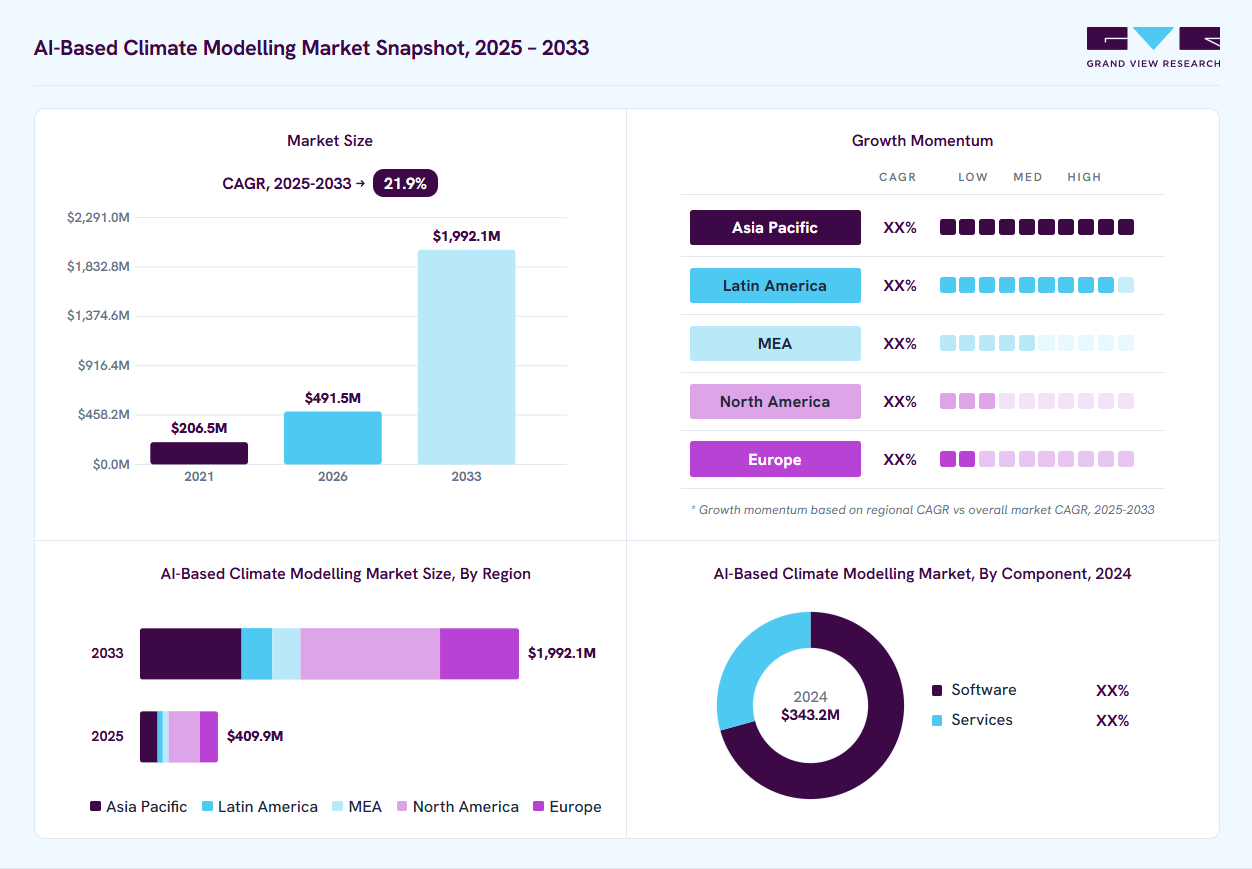
The global AI-Based climate modelling market size was valued at USD 343.2 million in 2024 and is projected to grow from USD 491.5 million in 2026 to USD 1,992.1 million by 2033, at a CAGR of 21.9% from 2025 to 2033. North America dominated the market, accounting for a revenue share of 40.5% in 2024. The market growth is anticipated to be significantly accelerated by the growing need for AI-based technologies that enhance the accuracy of forecasting climate events like heatwaves, droughts, and cyclones, enabling timely actions that help protect the lives of humans, animals, and conserve the resources of the Earth.
 Source: Grand View Research, IR Documents, Primary Interviews, Paid DatabasesTo learn more about this report,
 Download Free Sample Report
 Key Market Trends & Insights
- The AI-based climate modelling market in the U.S. led the North America market and held the largest revenue share in 2024.
- By component, the software segment led the market, holding the largest revenue share of 70.7% in 2024.
- By application, the weather forecasting segment accounted for the largest revenue share of the AI-based climate modelling industry in 2024.
Market Size & Forecast
- 2024 Market Size: USD 343.2 Million
- 2033 Projected Market Size: USD 1,992.1 Million
- CAGR (2025-2033): 21.9%
- North America: Largest market in 2024
Three ways to get this report
Buy it, customize it, or ask a question.Ask an Analyst
Analyst response in 1 business day
- AccessReport author, directly
- Reply timeWithin 1 working day
- No sales callDirect answer only
- FormatEmail reply
- CostFree, no cost
Get the Full Report
What the study covers
- FormatsPDF · Excel · Dashboard
- Timeline2025–2033 annual, 2024 base
- Coverage20+ countries, 5 regions
- Companies10+ key players profiled
Customize the Report
20% free customization
- IncludeCountries, segments, points
- TailorTo your product definition
- ExtendDeeper competitor detail
- OrA fully bespoke study
- Turnaround5–10 working days
Additionally, AI analyzes real-time data, which is the crucial step in tracking climate-related changes as they can happen at any time and anywhere in the world. The AI-based climate modelling industry’s growth is mainly driven due to its capability to handle, understand, and analyze vast, complex datasets from sources like satellites, Internet of Things (IoT) sensors, and historical climate records. It detects minute patterns and nonlinear connections that basic and traditional models might miss, which results in more accurate and detailed climate forecasts. By automating data collection and seamlessly integrating diverse data streams in real time, AI speeds up climate risk analyzes and improves predictions of extreme weather events such as hurricanes, floods, and heat waves.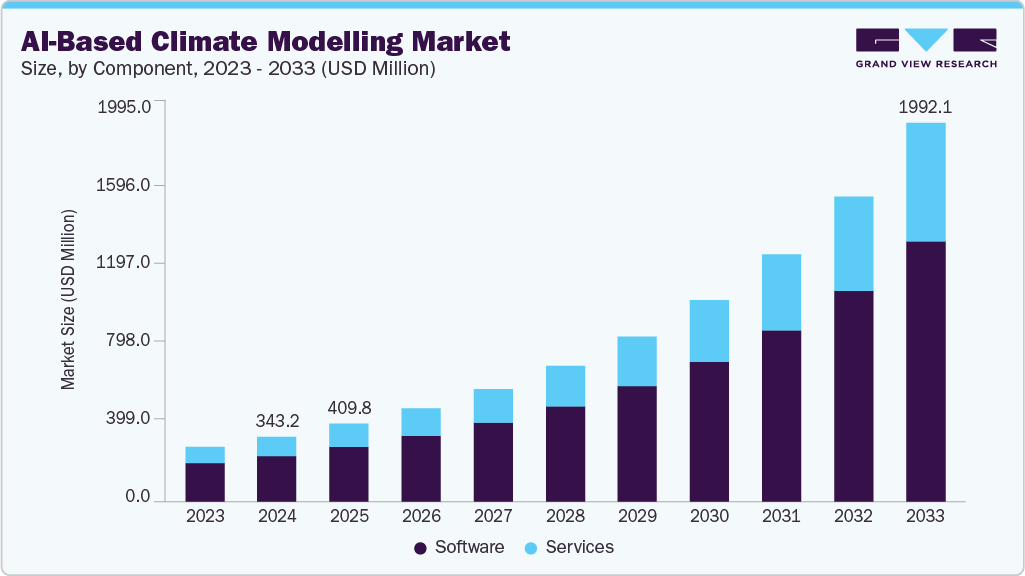 To learn more about this report, Download Free Sample Report
 The other factor driving the market growth is the advantage of AI for its ability to model subgrid-scale processes and analyze any biases in traditional climate simulations. AI-enhanced parameterizations and hybrid methods that combine both physical principles with data-driven insights help improve the realism and accuracy of these models. Furthermore, artificial intelligence (AI) improves the efficiency of computer functions through substitute modeling and optimization, enabling quicker testing of the climate and more responsive climate risk management.
Climate AI also has a unique role by offering explainability and causal analysis of the climate, allowing scientists to better understand complex climate interactions and the reasons for extreme events occurring. This helps make more informed decisions in areas like climate adaptation, urban planning, and policy-making. Once the model output is received then they are evaluated in practical life for making informed strategies. AI is responsible for sustainable resource management and disaster preparedness. Its integration into climate science is enhancing how we forecast, interpret, and address climate change across various scales of temperature.
Component Insights
The software segment led the AI-based climate modelling market in 2024, with a revenue share of 70.7% in 2024. This is due to the rising need for advanced AI tools that deliver real-time, high-resolution climate forecasts by integrating large and varied environmental datasets. These software platforms support complex data analysis, improve forecasting accuracy, and boost computational efficiency, which are essential elements for reliable climate simulations, predictions, and risk evaluation. The adoption of cloud-based, scalable systems further drives the growth by offering accessible, collaborative software for researchers, governments, and businesses. Ongoing progress in AI and machine learning, along with expanding digital infrastructure, continues to strengthen the software segment by enabling more intelligent, adaptive, and user-friendly climate modeling software.
The services segment is expected to grow at the fastest CAGR during the forecast period, driven by rising demand for customized model development, data integration, and expert consulting to address specific organizational and regulatory requirements. With the growing focus on climate regulations by the government and ESG goals, organizations are turning to specialized advisory and analytics services to effectively interpret complex AI model outputs for better climate risk management. Moreover, regular system maintenance and model updates are essential to maintain accuracy as climate data and conditions evolve. This need for focused software and ongoing support is driving the rapid growth of the services segment across both public and private sectors.
Technology Insights
The machine learning segment accounted for the largest revenue share of the AI-based climate modelling industry in 2024, due to its ability to process large, different datasets with diverse data types to identify climate signals, allowing for accurate and real-time climate prediction. By integrating machine learning in the business, it enhances the understanding of complex climate events, enabling AI systems to respond with greater empathy and awareness in the public and private sectors for safety. Moreover, machine learning’s ability to continuously improve the algorithm through different data available in the environment makes it essential for developing scalable, refined climate forecast intelligence in AI applications.
The deep learning segment is expected to grow at the fastest CAGR over the forecast period. This growth is driven by its crucial role in AI-based climate modeling by effectively capturing complex and nonlinear climate phenomena, such as cloud dynamics and turbulence, which are difficult for traditional models to simulate accurately. Utilizing architectures like convolutional and recurrent neural networks, it processes large spatio-temporal datasets to deliver more precise and high-resolution forecasts of extreme weather and precipitation. Deep learning also accelerates simulations by acting as replacement models for intensive processes of computers, helping to reduce uncertainty in climate predictions.
Application Insights
The weather forecasting segment accounted for the largest revenue share of the AI-based climate modelling industry in 2024, driven by its ability to quickly process massive and varied meteorological data from satellites, radar, and ground-based sensors, enabling precise and localized short- to medium-term forecasts. This allows for real-time forecasting of sudden severe weather events such as thunderstorms and flash floods, providing vital early warnings and alerts that strengthen public safety and disaster prevention. AI models also significantly save time by generating forecasts up to 10 days in advance within minutes, making high-level predictions available even on personal devices. By using physics-based models with machine learning, AI enhances the analysis of complex atmospheric dynamics, increasing the accuracy and reliability of forecasts.
 To learn more about this report, Download Free Sample Report
 The climate risk assessment segment is anticipated to grow at the fastest CAGR during the forecast period, driven by its ability to combine and analyze high-resolution climate and socioeconomic data, analyzing and delivering detailed, asset-level insights that are crucial for industries like finance, insurance, and urban development. This enables accurate assessments of physical risks such as flooding, drought, and urban heat stress. Advanced AI methods like deep learning and reinforcement learning further improve scenario analysis and help optimize adaptation strategies. AI also speeds up the risk evaluation process, making real-time stress testing and regulatory compliance more efficient, essential for timely decisions in an era of growing climate uncertainty. Moreover, AI supports a comprehensive view of interconnected and cascading risks, minimizing human bias and enabling data-driven, adaptive risk management of the climate.
Regional Insights
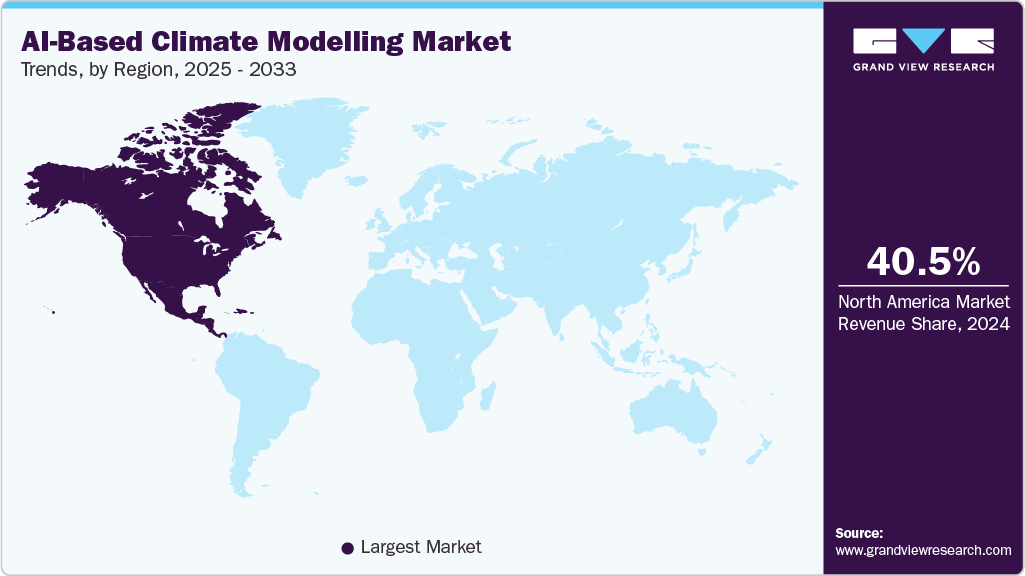
North America dominated the AI-based climate modelling industry with a revenue share of over 40.5% in 2024, driven by its technological ecosystem and strong governmental support and initiatives, which together promote innovation and large-scale implementation of AI software. The region is supported by the presence of major tech firms and top research institutions, which is beneficial for the region, such as collaborations among NASA, IBM, and national labs, which accelerate the development of advanced AI models for high-resolution, accurate climate and weather forecasting. Moreover, the region’s exposure to severe climate threats, including hurricanes, wildfires, and heat waves, drives the demand for better and fast AI-powered forecasting and disaster response tools.
 To learn more about this report, Download Free Sample Report
 U.S. AI-Based Climate Modelling Market Trends
The U.S. AI-based climate modelling industry is expected to grow significantly in 2024, driven using updated data analytics and real-time inputs from satellites, IoT sensors, and weather stations to boost forecast accuracy and minimize delays, especially for extreme events like hurricanes and wildfires. Substantial investments from both government bodies and the private sector are directed toward AI-driven disaster risk management and climate resilience, supporting proactive planning across agriculture, energy, and supply chain industries. Furthermore, cross-sector partnerships and supportive policy frameworks encourage the development of scalable AI software that aligns climate science with broader economic and social goals, promoting innovation in sustainable infrastructure and emergency response systems.
Europe AI-Based Climate Modelling Market Trends
The Europe AI-based climate modelling industry is witnessing steady growth over the forecast period,due to the European Commission’s flagship initiative, Destination Earth (DestinE), which aims to create highly detailed digital twins of the planet for simulating and monitoring climate and environmental systems with exceptional resolution and speed. DestinE supports complex scenario analysis for climate adaptation and disaster prevention, reinforcing policy-making aligned with the EU Green Deal and climate targets.
Asia Pacific AI-Based Climate Modelling Market Trends
The AI-based climate modelling industry in Asia Pacific is anticipated to register the fastest CAGR over the forecast period, led by drivers for AI-based climate modeling in its high exposure to climate change impacts, such as rising sea levels, extreme weather, and frequent flooding, particularly affecting Small Island Developing States and densely populated nations like India and Bangladesh. The region is home to some of the most dynamic AI ecosystems, with countries like China, Singapore, South Korea, and India ranking among the global leaders in AI capabilities. Strong collaborations among startups, telecom providers, climate finance organizations, and governments are anticipating AI-driven climate initiatives. Additionally, government-led programs, rapid advancements in digital infrastructure, and widespread 5G expansion are enabling the deployment of AI technologies for disaster risk reduction and climate forecasting across the region’s diverse socio-economic landscapes.
Key AI-Based Climate Modelling Company Insights
Some key companies in the AI-based climate modelling industry include AccuWeather, Realeyes, Microsoft, IBM, and Tobii.
-
AccuWeather operates in weather intelligence, combining advanced technology, comprehensive data, and expert analysis to deliver highly accurate forecasts and climate insights to over 1.5 billion users worldwide. The company leverages vast weather datasets, cutting-edge AI and machine learning models, and a skilled team of meteorologists to offer precise and actionable information. Its AI-powered software support businesses and governments in managing climate risks, enhancing operational efficiency, and improving safety by integrating real-time weather data with analytics on scalable platforms like Databricks and Snowflake.
-
NVIDIA is at the forefront of AI-based climate modeling innovation with its Earth-2 platform, which integrates AI, GPU acceleration, and physical simulations to deliver high-resolution, energy-efficient climate and weather forecasts at remarkable speed and scale. Leveraging generative AI models like CorrDiff, Earth-2 produces climate simulations that are 12.5 times more detailed and thousands of times faster than traditional models, enabling rapid and interactive forecasting and visualization. NVIDIA’s partnerships with organizations such as G42 and prominent climate research institutions reflect its strong commitment to advancing climate science through AI, aiming to reduce economic losses and support sustainable, data-driven decision-making around the world.
Key AI-Based Climate Modelling Companies:
The following are the leading companies in the AI-based climate modelling market. These companies collectively hold the largest market share and dictate industry trends.
- IBM
- Microsoft
- AWS
- NVIDIA Corporation
- AccuWeather
- ClimateAI
- Atmos AI
- Open Climate Fix
- Meteomatics AG
Recent Developments
-
In June 2025, NVIDIA introduced Earth-2, a cutting-edge generative AI foundation model named cBottle, designed to simulate global climate at kilometer-scale resolution with exceptional speed and energy efficiency. This platform enables the creation of detailed, interactive digital twins of Earth’s climate, allowing scientists to more accurately forecast and analyze complex weather systems and climate change effects. Through collaborations with top research organizations such as the Max Planck Institute and the Allen Institute for AI, Earth-2 is pushing the boundaries of high-resolution climate modeling and enhancing accessibility to climate data.
-
In June 2025, AccuWeather partnered with Perplexity to provide real-time, AI-powered weather updates and severe weather alerts. By integrating AccuWeather’s hyperlocal forecasts and proprietary features such as MinuteCast and RealFeel temperature, Perplexity will enhance its AI-generated weather responses with highly accurate, up-to-date data. The collaboration is designed to support better decision-making, safety, and convenience for users navigating daily plans or extreme weather conditions. This alliance merges AccuWeather’s renowned superior accuracy with Perplexity’s cutting-edge AI capabilities, setting a new benchmark in weather information delivery.
-
In January 2025, Meteomatics introduced its US1k weather model, delivering street-level forecasts across the contiguous United States at an impressive 1 km resolution and nine times finer than existing top U.S. models. The model is updated hourly from 110 data sources, including drones, satellites, and ground-based sensors, to provide highly accurate predictions of localized weather events such as storms, hail, and fog. US1k offers real-time, hyperlocal insights that help industries like energy, insurance, aviation, and agriculture optimize operations and manage risks in the face of increasingly unpredictable weather.
AI-Based Climate Modelling Market Report Scope
Report Attribute
Details
Market size in 2024
USD 343.2 million
Estimated market size in 2026
USD 491.5 million
Projected market size by 2033
USD 1,992.1 million
Growth rate
CAGR of 21.9% from 2025 to 2033
Base year for estimation
2024
Actual data
2021 - 2023
Forecast period
2025 - 2033
Quantitative units
Market revenue in USD Million & CAGR from 2023 to 2033
Report coverage
Revenue forecast, company ranking, competitive landscape, growth factors, and trends
Segments covered
Component, technology, application, and regional
Regional scope
North America; Europe; Asia Pacific; Latin America; MEA
Country scope
U.S.; Canada; UK; Germany; France; China; India; Japan; South Korea; Australia; Brazil; Mexico; KSA; UAE; South Africa
Key companies profiled
IBM; Google; Microsoft; AWS; NVIDIA Corporation; AccuWeather; ClimateAI; Atmos AI; Open Climate Fix; Meteomatics AG
Customization scope
Free report customization (equivalent up to 8 analysts working days) with purchase. Addition or alteration to the country, regional, and segment scope.
Pricing and purchase options
Avail customized purchase options to meet your exact research needs. Explore purchase options
Global AI-Based Climate Modelling Market Report Segmentation
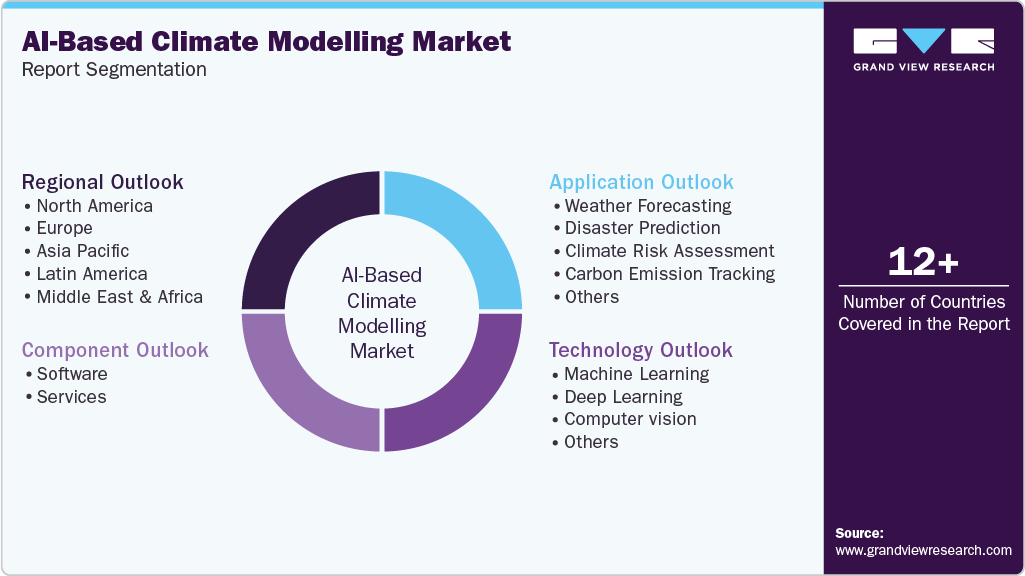
This report forecasts revenue growth at the global, regional, and country levels and provides an analysis of the industry trends in each of the sub-segments from 2021 to 2033. For this study, Grand View Research has segmented the global AI-based climate modelling market report based on the component, technology, application, and region:
 To learn more about this report, Download Free Sample Report
 -
Component Outlook (Revenue, USD Million, 2021 - 2033)
-
Software
-
Services
-
-
Technology Outlook (Revenue, USD Million, 2021 - 2033)
-
Machine Learning
-
Deep Learning
-
Computer vision
-
Others
-
-
Application Outlook (Revenue, USD Million, 2021 - 2033)
-
Weather Forecasting
-
Disaster Prediction
-
Climate Risk Assessment
-
Carbon Emission Tracking
-
Others
-
-
Regional Outlook (Revenue, USD Million, 2021 - 2033)
-
North America
-
U.S.
-
Canada
-
Mexico
-
-
Europe
-
UK
-
Germany
-
France
-
-
Asia Pacific
-
China
-
India
-
Japan
-
South Korea
-
Australia
-
-
Latin America
-
Brazil
-
-
Middle East and Africa
-
KSA
-
UAE
-
South Africa
-
-
Frequently Asked Questions About This Report
The global AI-Based climate modelling market is expected to grow at a CAGR of 21.9% from 2025 to 2033, reaching USD 1,992.1 million by 2033.
North America dominated the AI-based climate modelling market with a share of 40.5% in 2024. driven by its technological ecosystem and strong governmental support and initiatives, which together promote innovation and large-scale implementation of AI software.
Some key players operating in the AI-based climate modelling market include IBM; Google; Microsoft; AWS; NVIDIA Corporation; AccuWeather; ClimateAI; Atmos AI; Open Climate Fix; Meteomatics AG
Key factors that are driven due to its capability to handle, understand and analyze vast, complex datasets from sources like satellites, IoT sensors, and historical climate records.
The global AI-Based climate modelling market size was valued at USD 343.2 million in 2024 and is estimated at USD 491.5 million for 2026.
About the Author(s)
Next Generation Technologies Research Team
Technology · Next Generation TechnologiesThis report was authored by the next generation technologies research team at Grand View Research - comprising two research analysts, one senior research analyst, and one industry expert - with specialized expertise in the next generation technologies segment of the technology industry. All findings are based on proprietary technology databases, executive interviews, and regulatory analysis, subject to internal peer review prior to publication.
Last Updated:
Speak to Analyst

Customize this report to your needs - add regions, segments, or data points, with 20% free customization.
Or view our licence options:


ISO 9001:2015 & 27001:2022 Certified
We are GDPR and CCPA compliant! Your transaction & personal information is safe and secure. For more details, please read our privacy policy.


