
- Home
- »
- Next Generation Technologies
- »
-
AI In Material Discovery Market Size & Share Report, 2033GVR Report cover

AI In Material Discovery Market (2026 - 2033)
Size, Share & Trends Analysis Report By Component (Hardware, Software, Services), By Material Type (Chemicals, Nanomaterials, Semiconductors, Biomaterials), By Technology, By Application, By End-use, By Region, And Segment Forecasts
Market Size, 2025
$741.3MMarket Estimate, 2026
$968.4MMarket Forecast, 2033
$6,388.5MCAGR, 2026–2033
30.9%AI in Material Discovery Market Summary
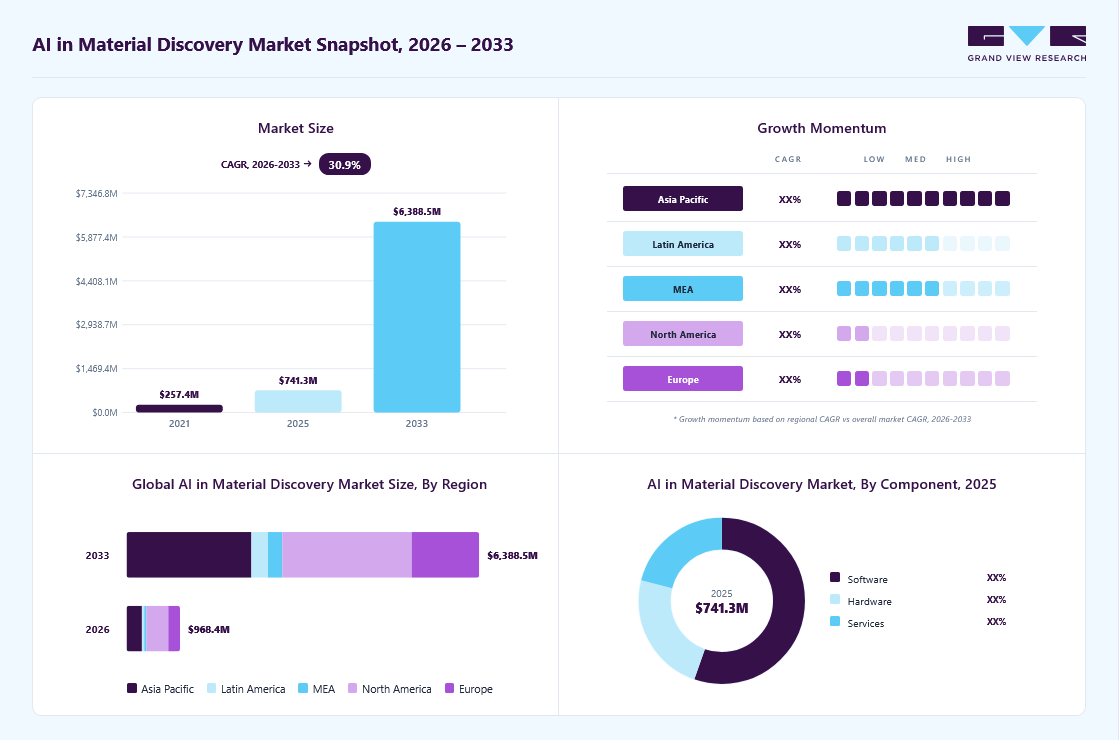
The global AI in material discovery market size was valued at USD 741.3 million in 2025 and is projected to grow from USD 968.4 million in 2026 to USD 6,388.5 million by 2033, at a CAGR of 30.9% from 2026 to 2033. North America dominated the market, with a revenue share of over 41.0% in 2025. The market is driven by the growing adoption of AI in materials discovery and research across the pharmaceutical, chemical, and semiconductor industries.
 Source: Grand View Research, IR Documents, Primary Interviews, Paid DatabasesTo learn more about this report,
 Download Free Sample Report
 Key Market Trends & Insights
- By component: The software segment dominated the market, with a revenue share of 55.0% in 2025.
- By material type: The chemicals segment dominated the market, with a revenue share of 30.0% in 2025.
- By technology: The machine learning segment dominated the market, with a revenue share of 36.0% in 2025.
- By application: The material property prediction segment held the largest revenue share in 2025.
- By end use: The pharmaceuticals & biotechnology segment held the largest revenue share in 2025.
Regional Highlights
- Largest regional market: North America (over 41.0% revenue share, 2025)
- Fastest growing regional market: Asia Pacific (highest CAGR, 2026–2033)
- By country: The U.S. held the largest market share in 2025.
Market Size & Forecast
- Market size in 2025: USD 741.3 Million
- Estimated market size in 2026: USD 968.4 Million
- Projected market size by 2033: USD 6,388.5 Million
- CAGR (2026–2033): 30.9%
Three ways to get this report
Buy it, customize it, or ask a question.Ask an Analyst
A direct answer, usually in 1 working day
- AccessReport author, directly
- Reply timeWithin 1 working day
- No sales callDirect answer only
- FormatEmail reply
- CostFree, no cost
Get the Full Report
What the study covers
- FormatsPDF · Excel · Dashboard
- Timeline2026–2033 annual, 2025 base
- Coverage20+ countries, 5 regions
- Companies10+ key players profiled
Customize the Report
20% free customization
- IncludeCountries, segments, points
- TailorTo your product definition
- ExtendDeeper competitor detail
- OrA fully bespoke study
- Turnaround5–10 working days
Growing investments in high-performance computing (HPC), cloud computing, and AI infrastructure are significantly advancing the market. Organizations are leveraging AI-driven material discovery, machine learning, and deep learning models to analyze massive materials datasets and perform complex molecular simulations at scale. The integration of cloud-based AI platforms with computational materials science is improving research efficiency, accelerating material screening, and reducing computational costs. Increasing adoption of digital R&D platforms enables global collaboration among research institutions, technology providers, and industrial manufacturers. This trend is driving the adoption of AI in material discovery across the pharmaceutical, chemical, advanced manufacturing, and semiconductor industries.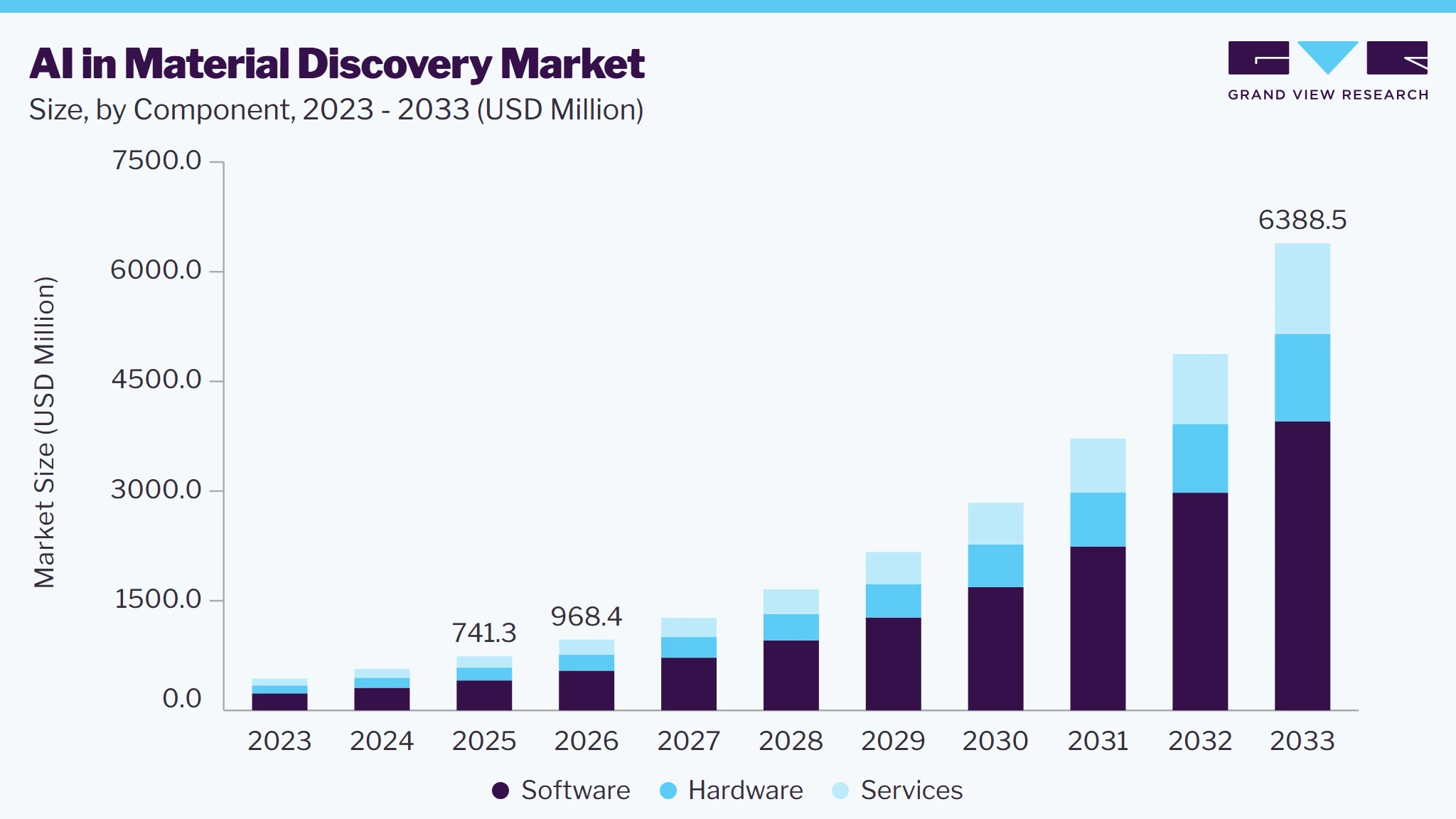 To learn more about this report, Download Free Sample Report
 The integration of autonomous laboratories, digital twins, robotics, and artificial intelligence is transforming the market by automating complex research workflows. AI-powered materials research platforms combine Machine Learning, Computer Vision, and laboratory automation to perform rapid experimentation and real-time material validation. The adoption of digital twin technology allows researchers to simulate material behavior before physical testing, significantly reducing development time and improving research accuracy. The increasing deployment of AI-driven laboratory automation is enhancing productivity while reducing operational costs across research organizations. This trend is accelerating innovation and strengthening the commercialization of advanced materials across multiple high-growth industries.
The growing demand for sustainable materials is creating significant market growth opportunities. Organizations utilize artificial intelligence, machine learning, and AI-powered materials research to develop battery materials, hydrogen storage materials, carbon capture materials, lightweight composites, and recyclable polymers. Increasing investments in clean energy, EVs, renewable energy technologies, and advanced manufacturing are accelerating the adoption of AI-driven material discovery solutions worldwide. AI-enabled predictive modeling improves material performance while minimizing laboratory experimentation, energy consumption, and R&D costs. This trend is positioning AI in material discovery as a critical technology for sustainable innovation and the development of next-generation materials.
Market Dynamics
The market is being driven by the increasing adoption of AI, ML, and generative AI to accelerate materials research, improve prediction accuracy, and reduce product development timelines. Rising investments in computational materials science, High-Performance Computing (HPC), cloud-based research infrastructure, and AI-powered materials research are enabling organizations to optimize R&D processes and accelerate the commercialization of advanced materials. Growing demand for innovative materials across the pharmaceuticals, chemicals, semiconductors, electronics, automotive, and clean energy industries is further supporting market expansion. Strategic collaborations among AI technology providers, research institutions, and industrial manufacturers are strengthening AI-driven material discovery capabilities while expanding access to high-quality materials datasets and advanced simulation technologies. As digital transformation continues to reshape scientific research, the market is expected to sustain growth, driven by ongoing advancements in AI algorithms, automation, and data-driven materials innovation.
The rapid adoption of Generative AI, foundation models, and ML is emerging as a key market driver. Organizations are increasingly using AI-driven materials discovery platforms to predict material properties, identify novel compounds, and significantly shorten research and development timelines. The integration of AI with computational materials science, high-performance computing (HPC), and large-scale materials databases is improving research accuracy while reducing experimental costs. Industries including pharmaceuticals, chemicals, battery materials, semiconductors, and electronics are accelerating investments in AI-powered materials research to strengthen product innovation and maintain competitive advantage. This growing adoption of advanced AI technologies is driving market expansion by enabling faster commercialization of high-performance and sustainable materials.
The market continues to face challenges due to the limited availability of high-quality, standardized, and interoperable materials datasets. Many organizations struggle with fragmented experimental data, inconsistent data formats, and insufficient labeled datasets, which reduce the accuracy and reliability of machine learning and artificial intelligence models. Validating AI-generated material predictions through laboratory testing remains time-consuming and resource-intensive, slowing commercialization. Data privacy concerns and restricted access to proprietary research data further limit collaborative AI model development across the materials ecosystem. These challenges may restrain the broader adoption of AI-driven material discovery, particularly among organizations with limited digital research infrastructure.
The growing global focus on clean energy, electric vehicles (EVs), and sustainable manufacturing is creating significant market opportunities. Organizations are increasingly leveraging AI, machine learning, and AI-powered materials research to accelerate the development of advanced battery materials, hydrogen storage materials, recyclable polymers, and carbon capture materials. Rising government funding, private investment, and corporate sustainability initiatives are driving the adoption of AI-driven material discovery across the energy, automotive, and industrial sectors. The ability of AI to rapidly identify high-performance and environmentally sustainable materials reduces development costs while accelerating innovation cycles. This expanding demand for sustainable materials is expected to unlock substantial long-term market growth opportunities.
Market Concentration & Characteristics
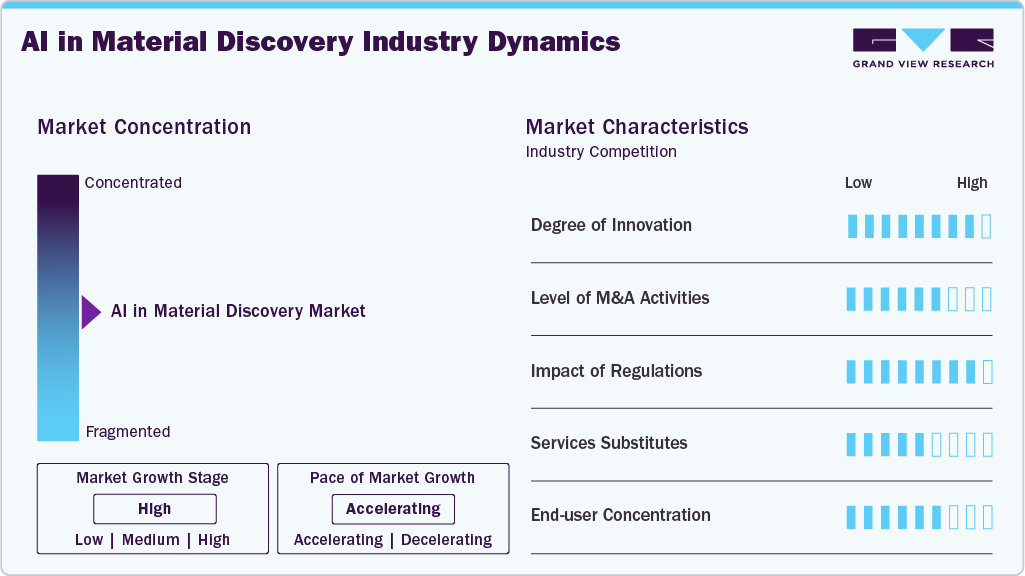
The AI in material discovery industry exhibits a moderately concentrated competitive landscape, where leading providers of materials informatics, scientific AI, molecular modeling platforms, and materials discovery software account for a significant share of industry revenue. Competition is increasingly centered on proprietary materials, data analytics, advanced computational chemistry, and predictive materials modeling capabilities rather than conventional software offerings. Market participants are investing in digital materials engineering, virtual material screening, and AI-assisted molecular design to strengthen product differentiation and improve scientific outcomes. Strategic collaborations among technology vendors, research institutes, life sciences companies, and specialty chemical manufacturers are accelerating innovation while expanding commercialization opportunities. As enterprises continue to modernize research environments through digital science platforms and intelligent automation, the market is expected to remain highly competitive, with continuous technology-led differentiation.
 To learn more about this report, Download Free Sample Report
 The market is characterized by a high degree of innovation, supported by rapid advancements in scientific foundation models, graph neural networks (GNNs), physics-informed AI, and materials genome technologies, which enhance material prediction accuracy and accelerate discovery workflows. Organizations are increasingly adopting research automation software, digital chemistry platforms, and autonomous experimentation to reduce laboratory dependency and improve R&D productivity. The level of mergers, acquisitions, and strategic partnerships is steadily increasing as companies expand expertise in inverse materials design, polymer informatics, and molecular optimization. The impact of regulations remains moderate, with growing emphasis on research data governance, intellectual property protection, and responsible AI deployment in scientific computing. Limited substitution from conventional material research methods and rising demand from pharmaceuticals, energy storage, electronics, and advanced manufacturing continue to reinforce the long-term growth trajectory of the AI-enabled materials research market.
Analyst Perspective
The market is being driven by increasing R&D requirements for faster identification, prediction, and optimization of advanced materials across key industries. The growing adoption of machine learning, generative AI, materials informatics, and molecular simulation is enabling researchers to evaluate larger material design spaces while reducing reliance on conventional trial-and-error methods. Rising investments in HPC, AI accelerators, scientific computing, and digital laboratory infrastructure are further supporting scalable computational material discovery. Demand for improved battery materials, sustainable chemicals, semiconductor materials, biomaterials, and high-performance composites is accelerating the integration of AI across material development workflows. Increasing collaboration among technology providers, research institutions, and industrial R&D organizations is expected to strengthen commercialization and expand the application base of AI-enabled material discovery solutions.
Component Insights
The software segment dominated the market, accounting for over 55.0% of global revenue in 2025, driven by the increasing adoption of materials informatics, AI-powered materials research, and materials discovery software across research-intensive industries. Organizations are leveraging computational chemistry software, predictive materials modeling, molecular simulation platforms, and scientific AI to accelerate material screening, optimize compound design, and reduce product development timelines. Growing investments in digital science platforms, research automation software, cloud-based R&D platforms, and digital materials engineering are further strengthening software adoption by improving collaboration, data management, and computational efficiency. Continuous advancements in AI-assisted molecular design, virtual material screening, GNNs, physics-informed AI, and scientific foundation models are enhancing prediction accuracy while enabling faster commercialization of next-generation materials. As industries increasingly prioritize advanced materials innovation, data-driven materials engineering, and digital transformation in R&D, the software segment is expected to retain its market leadership throughout the forecast period.
The hardware segment is projected to grow significantly during the forecast period, driven by rising investments in HPC infrastructure, AI accelerators, GPU-enabled computing, and scientific computing hardware that support complex materials informatics and computational chemistry workloads. Increasing demand for AI chips, advanced processors, edge AI hardware, and high-performance servers is enabling faster molecular simulations, large-scale materials modeling, and real-time data processing for research-intensive applications. The growing deployment of GPU clusters, AI workstations, and supercomputing infrastructure across pharmaceutical, semiconductor, chemical, and advanced manufacturing industries is further accelerating hardware adoption. Continuous advancements in quantum computing hardware, specialized AI processors, and high-speed networking infrastructure are enhancing computational performance while enabling the discovery of next-generation materials with greater precision. As organizations continue to expand digital R&D capabilities and invest in AI infrastructure for materials research, the hardware segment is expected to record robust growth throughout the forecast period.
Material Type Insights
The chemicals segment accounted for over 30.0% of market revenue in 2025, driven by the growing adoption of AI-powered materials research, materials informatics, and computational chemistry to accelerate the development of specialty chemicals and advanced chemical compounds. Chemical manufacturers are increasingly leveraging predictive materials modeling, molecular simulation, and AI-assisted molecular design to optimize formulations, improve process efficiency, and reduce product development timelines. Rising investments in digital chemistry platforms, scientific computing, and research automation software are enabling faster identification of high-performance materials while lowering experimental costs. The integration of data-driven materials engineering, virtual materials screening, and scientific AI is driving innovation in catalysts, polymers, coatings, adhesives, and industrial chemicals. As demand for sustainable chemicals and high-performance materials continues to increase, the chemicals segment is expected to maintain its leading position throughout the forecast period.
The biomaterials segment is projected to grow significantly over the forecast period, driven by the increasing adoption of AI-enabled biomaterials research, bioinformatics, and materials informatics to accelerate the discovery of advanced materials for healthcare and life sciences. Growing demand for tissue engineering, regenerative medicine, medical implants, drug delivery systems, and biocompatible materials is encouraging researchers to leverage AI-assisted molecular design, computational biology, and molecular simulation to improve material performance and reduce development timelines. Rising investments in digital biology platforms, computational life sciences, and scientific AI are enabling faster identification and optimization of novel biomaterials with enhanced safety and functionality. The integration of predictive biomaterials modeling, virtual material screening, and data-driven biomedical engineering is improving research efficiency while supporting precision healthcare innovations. As healthcare organizations continue to prioritize personalized medicine, advanced medical devices, and sustainable biomaterial development, the biomaterials segment is expected to register the fastest growth during the forecast period.
Technology Insights
The machine learning segment accounted for over 36.0% of revenue in 2025, driven by the widespread adoption of ML, materials informatics, and predictive materials modeling to accelerate material design and optimize research outcomes. Organizations are increasingly leveraging supervised, unsupervised, and deep learning algorithms to analyze complex material datasets, predict material properties, and identify high-performance compounds with greater accuracy. Growing investments in scientific machine learning, computational materials science, molecular simulation, and data-driven materials engineering are enabling researchers to reduce experimental iterations while improving innovation efficiency. The integration of AI-powered material screening, digital chemistry platforms, and research automation software is further strengthening the adoption of machine learning across the pharmaceutical, chemical, semiconductor, and advanced manufacturing industries. As demand for intelligent, data-driven research continues to rise, the machine learning segment is expected to maintain its leading position throughout the forecast period.
The generative AI segment is projected to experience substantial growth over the forecast period, owing to the increasing adoption of Generative AI, foundation models, and LLMs for accelerating AI-powered material discovery and advanced materials innovation. Organizations are leveraging generative design, AI-assisted molecular design, and inverse materials design to create novel compounds, optimize material properties, and significantly reduce research and development timelines. Growing investments in scientific foundation models, multimodal AI, computational chemistry, and digital materials engineering are enabling researchers to rapidly explore vast chemical and materials spaces with improved prediction accuracy. The integration of Generative AI with materials informatics, molecular simulation, and digital science platforms is enhancing research productivity while supporting the discovery of next-generation materials for pharmaceuticals, energy storage, electronics, and specialty chemicals. As enterprises continue to invest in intelligent R&D and autonomous scientific research, the Generative AI segment is expected to witness the fastest growth throughout the forecast period.
Application Insights
The material property prediction segment accounted for over 28.0% of market revenue in 2025, driven by the increasing adoption of AI-based property estimation, computational material intelligence, and digital material characterization to accelerate material evaluation. Organizations are leveraging neural network models, feature engineering, and scientific data analytics to accurately assess material behavior and optimize product performance before physical testing. Growing deployment of intelligent modeling platforms, virtual prototyping, and advanced material analytics is reducing development risks while improving research productivity. The integration of algorithm-driven material optimization, physics-based simulations, and digital research ecosystems is enabling faster validation across healthcare, energy, electronics, and industrial manufacturing applications. As demand for rapid material qualification and intelligent product development continues to increase, the material property prediction segment is expected to retain its market leadership throughout the forecast period.
The battery & energy storage segment is projected to experience substantial growth over the forecast period, driven by rising demand for next-generation battery materials, solid-state batteries, and energy storage materials that enhance energy density, safety, and lifecycle performance. Organizations are increasingly utilizing AI-enabled materials optimization, electrochemical modeling, and battery materials engineering to accelerate the development of advanced cathode, anode, electrolyte, and separator materials. Growing investments in electric vehicles (EVs), grid-scale energy storage systems, renewable energy integration, and battery innovation are driving the adoption of intelligent materials discovery platforms. The use of digital battery research, electrode material optimization, and AI-driven electrochemical analysis enables faster validation of high-performance materials while reducing development costs and commercialization timelines. As global demand for clean energy technologies and long-duration energy storage continues to increase, the battery & energy storage segment is expected to register significant growth throughout the forecast period.
End-use Insights
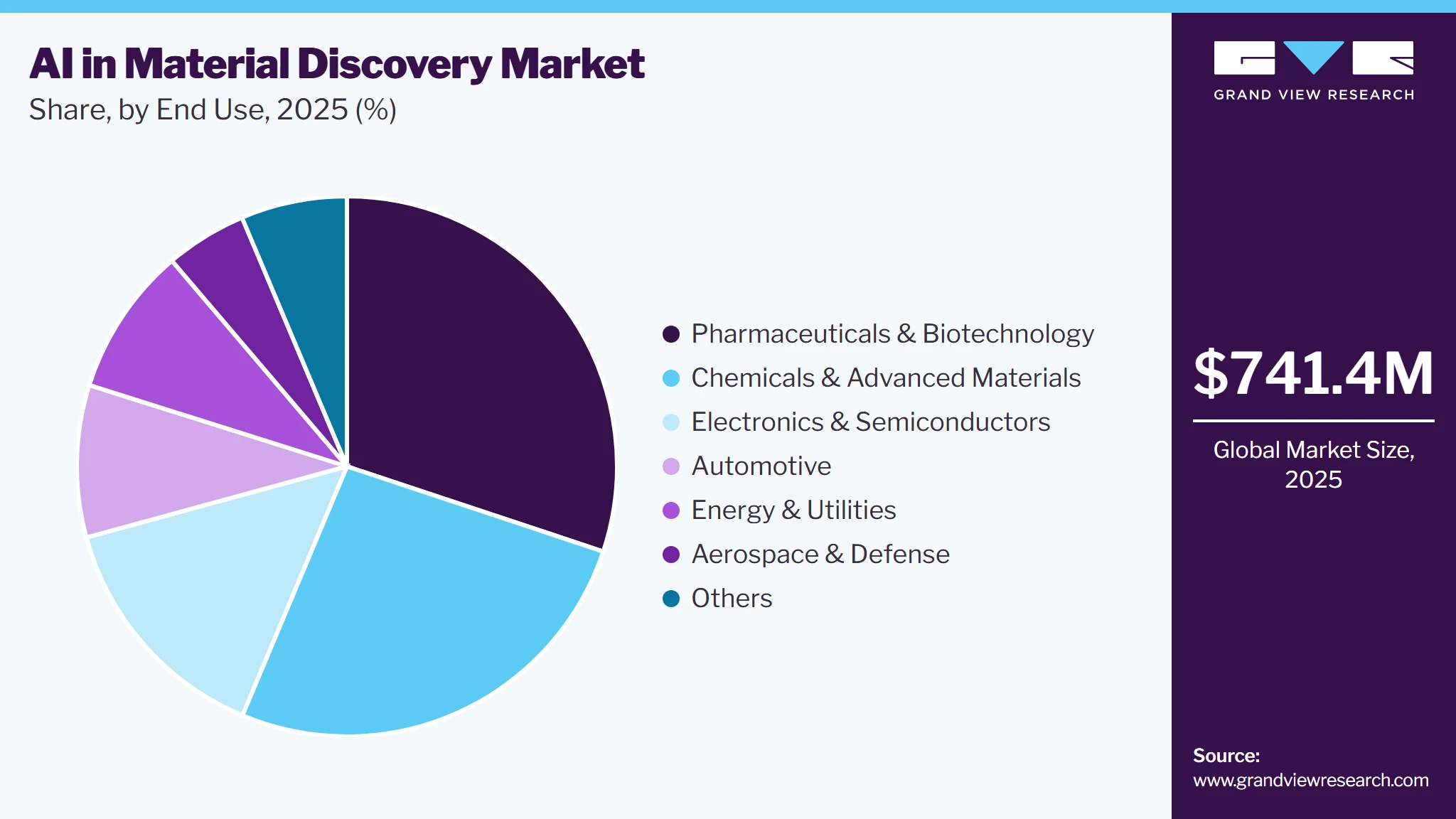
The pharmaceuticals & biotechnology segment accounted for the largest market revenue share of over 30.0% in 2025, driven by the increasing adoption of AI-enabled drug discovery, biomolecular modeling, and computational life sciences to accelerate therapeutic innovation. Pharmaceutical and biotechnology companies are leveraging protein structure prediction, molecular engineering, and in silico research to identify novel drug candidates and advanced biomaterials with greater speed and precision. Rising investments in precision medicine, biopharmaceutical R&D, digital drug development, and clinical research technologies are further strengthening the adoption of AI-driven discovery platforms. The integration of bioinformatics, scientific data intelligence, and predictive biological modeling is improving research productivity while reducing development costs and time-to-market. As demand for personalized therapies, biologics, and next-generation healthcare solutions continues to grow, the pharmaceuticals & biotechnology segment is expected to maintain its market leadership throughout the forecast period.
 To learn more about this report, Download Free Sample Report
 The energy & utilities segment is expected to experience substantial growth during the forecast period, primarily due to the increasing adoption of AI-enabled energy materials, grid modernization technologies, and advanced energy storage research to support the global transition toward clean energy. Utilities and energy companies are leveraging electrode materials optimization, electrochemical materials engineering, and renewable energy materials to enhance battery efficiency, grid reliability, and power system performance. Rising investments in smart grid infrastructure, hydrogen energy technologies, carbon-neutral materials, and next-generation power systems are accelerating the deployment of intelligent material discovery solutions. The integration of digital energy innovation, energy materials analytics, and scientific computing platforms is enabling faster development of high-performance materials for solar, wind, hydrogen, and battery storage applications. As governments and utilities continue to invest in energy transition and decarbonization initiatives, the energy & utilities segment is expected to witness robust growth throughout the forecast period.
Regional Insights
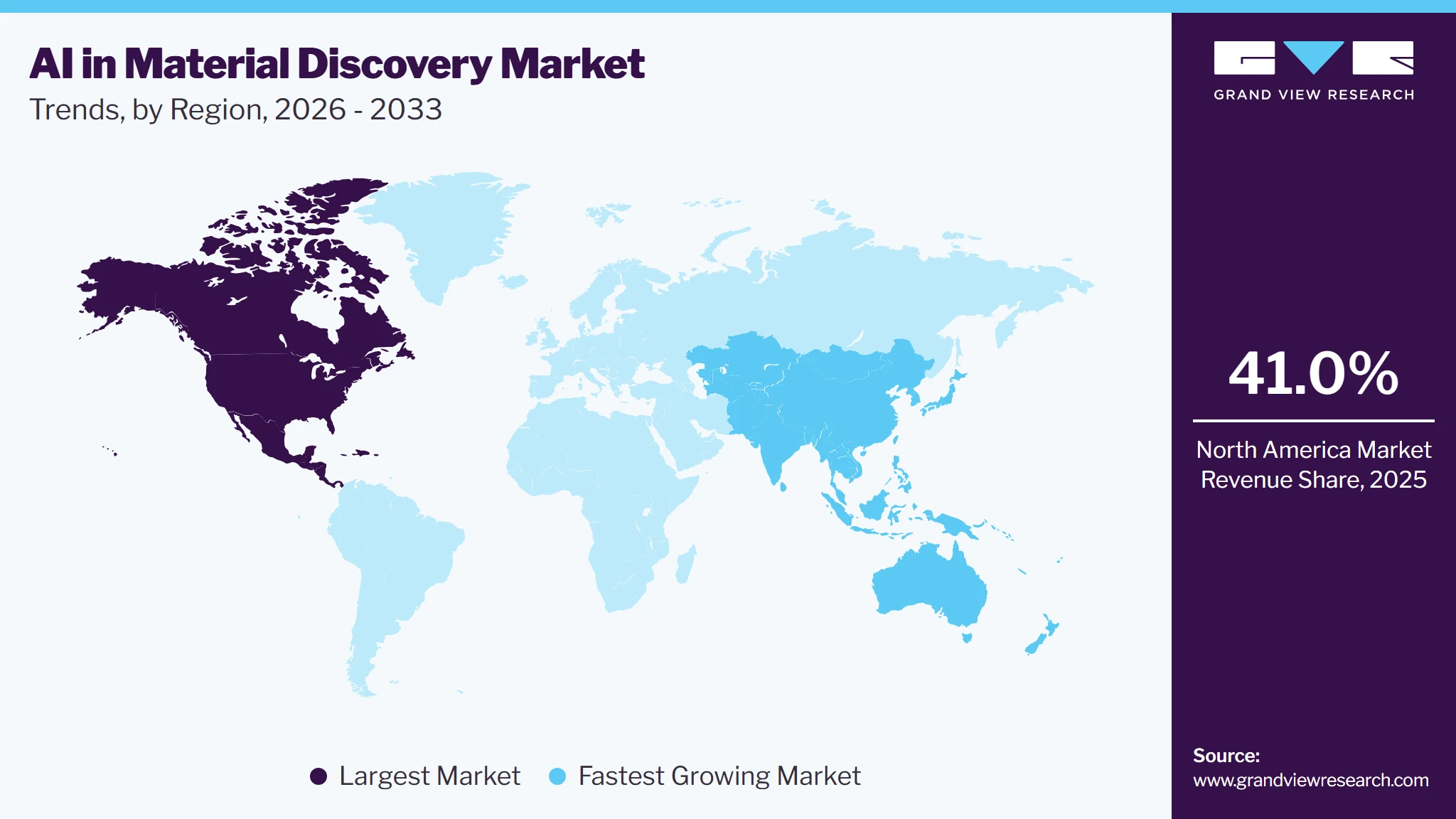
The North America AI in material discovery market accounted for the largest revenue share of over 41.0% in 2025, driven by robust investments in scientific AI, advanced materials research, and digital R&D infrastructure across the U.S. and Canada. The region benefits from the strong presence of AI technology providers, world-class research institutions, and extensive collaboration between academia, government, and industry, accelerating innovation in computational materials science and next-generation materials. Continuous advancements in research capabilities, combined with increasing commercialization of AI-enabled materials innovation across pharmaceuticals, semiconductors, aerospace, and clean energy, continue to reinforce North America's dominant position in the global market.
 To learn more about this report, Download Free Sample Report
 U.S. AI in Material Discovery Market Trends
The AI in material discovery market in the U.S. is gaining momentum, driven by increasing investments in AI-powered scientific research, advanced materials innovation, and digital laboratory technologies across the pharmaceutical, semiconductor, aerospace, and clean energy sectors. Strong funding for research automation, high-performance scientific computing, and intelligent materials design is enabling organizations to accelerate product development while improving research efficiency. The expanding ecosystem of technology companies, national laboratories, universities, and industrial R&D centers continues to position the U.S. as a global hub for next-generation materials innovation and AI-enabled scientific discovery.
Europe AI in Material Discovery Market Trends
The AI in material discovery market in Europe is witnessing robust growth, driven by increasing investments in sustainable materials innovation, green chemistry, and digital materials engineering to support the region's industrial and environmental objectives. Strong collaboration between research institutes, universities, technology companies, and manufacturing enterprises is accelerating the adoption of AI-enabled materials development, advanced simulation platforms, and smart manufacturing technologies. The growing emphasis on circular economy initiatives, low-carbon materials, and next-generation industrial applications continues to strengthen Europe's position as a key innovation hub for AI-driven materials research.
Asia Pacific AI in Material Discovery Market Trends
The AI in material discovery market in the Asia Pacific is growing rapidly, driven by rising investments in advanced manufacturing, smart materials research, and AI-enabled innovation across key countries. The region is witnessing increasing adoption of digital research platforms, materials data intelligence, and industrial AI solutions to accelerate the development of high-performance materials for electronics, electric vehicles, energy storage, and specialty chemicals. Expanding government support for scientific research, coupled with the strong presence of manufacturing ecosystems and technology innovation centers, continues to establish the Asia Pacific as a major growth engine for AI-driven materials discovery.
Key AI in Material Discovery Company Insights
Some key companies in the AI in material discovery industry are Schrödinger Inc., IBM, Google, Microsoft, MaterialsZone, and others.
-
Schrödinger Inc. is a leading provider of computational chemistry and AI-powered materials discovery solutions for scientific research and industrial innovation. The company develops advanced molecular modeling and simulation software that enables researchers to predict material behavior with high accuracy. Its platform supports material design across the pharmaceutical, chemical, semiconductor, battery, and advanced materials sectors. Schrödinger specializes in integrating physics-based simulations, machine learning, and molecular modeling to accelerate next-generation material development.
-
IBM is a prominent market participant, leveraging its expertise in Artificial Intelligence, scientific computing, and foundation models to advance materials research. The company develops AI-driven platforms that enable rapid material screening and predictive scientific analysis. IBM supports innovation through quantum computing, AI chemistry, and high-performance computing technologies. Its solutions help accelerate the development of sustainable materials and digital transformation across industrial research environments.
Key AI in Material Discovery Companies
The following key companies have been profiled for this study on the AI in material discovery market:
-
Schrödinger Inc.
-
IBM
-
Google
-
Microsoft
-
MaterialsZone
-
Citrine Informatics
-
Mat3ra (formerly Exabyte Inc.)
-
Orbital Materials
-
Dassault Systèmes (BIOVIA)
-
Aionics Inc.
-
Enthought
-
XtalPi
Competitive Benchmarking
Operating Strategies
Competitive Edge
Weaknesses
Mature Players: IBM, Google, Microsoft, Dassault Systèmes (BIOVIA), Schrödinger Inc.
- Mature players focus on expanding AI-powered materials discovery, materials informatics, scientific computing, and digital R&D platforms through continuous investments in AI, cloud infrastructure, simulation technologies, and strategic collaborations with research institutions and industrial enterprises.
- Their competitive advantage lies in extensive scientific software portfolios, advanced AI capabilities, global customer networks, proprietary research platforms, and strong expertise in computational chemistry, molecular modeling, and materials simulation.
- These companies face challenges related to high R&D investments, lengthy enterprise adoption cycles, complex integration with legacy research environments, and increasing competition from specialized AI materials startups.
Emerging Players: MaterialsZone, Citrine Informatics, Mat3ra, Orbital Materials, Aionics Inc., Enthought, XtalPi
- Emerging players focus on developing specialized materials informatics platforms, AI-assisted materials design, computational materials engineering, battery materials optimization, and cloud-native scientific research solutions to accelerate materials innovation across industry verticals.
- Their strength lies in domain-specific AI expertise, agile product innovation, advanced data analytics, flexible deployment models, and strong specialization in materials science, digital laboratories, and AI-driven research workflows.
- Limited global market presence, smaller customer bases, dependence on strategic partnerships and funding, and lower brand recognition compared to established technology companies may limit large-scale commercial expansion.
Recent Developments:
-
In July 2026, CuspAI launched the AI Materials Foundry, bringing together more than 45 organizations to accelerate the discovery and development of advanced materials through AI-driven design and validation. The initiative combines CuspAI’s AI capabilities with computing, materials data, laboratory infrastructure, and industry expertise to support applications across semiconductors, clean energy, and advanced materials. The launch is expected to accelerate material innovation by connecting AI-generated material candidates with simulation, synthesis, and experimental validation, reducing the time and resources required for conventional materials discovery.
-
In May 2026, Tata Elxsi and Viridium AI launched ViTel, a Material Intelligence solution for medical-device manufacturers that integrates AI, materials, suppliers, sourcing, and compliance data to support faster engineering and materials-related decisions. Powered by Viridium AI’s Knowledge Cloud, Chemical Digital Twin, and science-constrained AI models, the platform creates a connected product-material knowledge graph linking products, materials, chemicals, suppliers, regulations, and supporting evidence. The launch is expected to drive the adoption of AI in material intelligence by enabling manufacturers to identify material and supplier dependencies, evaluate alternatives, and assess material-related risks across cost, supply continuity, and regulatory compliance.
-
In April 2026, Perstorp partnered with Citrine Informatics to deploy AI-driven formulation tools for its Alkyd Emulsion Project, enabling scientists to rapidly model and evaluate thousands of formulation possibilities. By combining Perstorp’s specialty-chemicals expertise with Citrine’s AI capabilities, the collaboration aims to identify optimal compositions faster while reducing experimental cycles, material usage, and development costs. The partnership is expected to accelerate the development of next-generation surfactant chemistries and high-performance alkyd emulsions, thereby supporting faster, more tailored materials innovation for customers.
AI in Material Discovery Market Report Scope
Report Attribute
Details
Market size in 2025
USD 741.3 million
Estimated market size in 2026
USD 968.4 million
Projected market size by 2033
USD 6,388.5 million
Growth rate
CAGR of 30.9% from 2026 to 2033
Actual data
2021 – 2025
Forecast period
2026 – 2033
Quantitative units
Revenue in USD million, and CAGR from 2026 to 2033
Report coverage
Revenue forecast, company ranking, competitive landscape, growth factors, and trends
Segments covered
Component, material type, technology, application, end-use, region
Regional scope
North America, Europe, Asia Pacific, Latin America, MEA
Country scope
U.S.; Canada; Mexico; UK; Germany; France; China; Japan; India; South Korea; Australia; Brazil; KSA; UAE; South Africa
Key companies profiled
Schrödinger Inc.; IBM; Google; Microsoft; MaterialsZone; Citrine Informatics; Mat3ra (formerly Exabyte Inc.); Orbital Materials; Dassault Systèmes (BIOVIA); Aionics Inc.; Enthought; XtalPi
Customization scope
Free report customization (equivalent up to 8 analysts working days) with purchase. Addition or alteration to country, regional & segment scope.
Pricing and purchase options
Avail customized purchase options to meet your exact research needs. Explore purchase options
Global AI in Material Discovery Market Report Segmentation
This report forecasts revenue growth at global, regional, and country levels and provides an analysis of the latest industry trends in each of the sub-segments from 2021 to 2033. For this study, Grand View Research has segmented the global AI in material discovery market report based on component, material type, technology, application, end-use, and region:
-
Component Outlook (Revenue, USD Million, 2021-2033)
-
Hardware
-
Software
-
Services
-
-
Material Type Outlook (Revenue, USD Million, 2021-2033)
-
Chemicals
-
Nanomaterials
-
Semiconductors
-
Biomaterials
-
Others
-
-
Technology Outlook (Revenue, USD Million, 2021-2033)
-
Machine Learning
-
Deep Learning
-
Generative AI
-
Predictive Analytics
-
Others
-
-
Application Outlook (Revenue, USD Million, 2021-2033)
-
Material Property Prediction
-
Molecular Modeling & Simulation
-
Drug & Pharmaceutical
-
Battery & Energy Storage
-
Others
-
-
End-use Outlook (Revenue, USD Million, 2021 - 2033)
-
Pharmaceuticals & Biotechnology
-
Chemicals & Advanced Materials
-
Electronics & Semiconductors
-
Automotive
-
Energy & Utilities
-
Aerospace & Defense
-
Others
-
-
Regional Outlook (Revenue, USD Million, 2021-2033)
-
North America
-
U.S.
-
Canada
-
Mexico
-
-
Europe
-
UK
-
Germany
-
France
-
-
Asia Pacific
-
China
-
Japan
-
India
-
South Korea
-
Australia
-
-
Latin America
-
Brazil
-
-
Middle East and Africa (MEA)
-
-
KSA
-
UAE
-
South Africa
-
-
Research Methodology
The AI in material discovery market figures in this report are based on a proven research process that combines executive interviews with secondary research from proprietary databases, company filings, and recognized regulatory and institutional sources. Market size is built through value-chain sizing—reconciling supply-side and demand-side estimates—and triangulated with bottom-up and top-down approaches. Every estimate passes multiple levels of expert validation before publication, with each AI in material discovery segment quantified using the revenue-capture definitions in the table below.
Segment Definition
Segment – Component
Revenue capture definition
Hardware
This segment includes physical computing and laboratory infrastructure used to support AI-enabled material discovery, including GPUs, AI accelerators, high-performance computing systems, and specialized research hardware. It covers hardware deployed for computational modeling, simulation, data processing, and automated experimentation.
Software
This segment includes software platforms and applications used for AI-driven material discovery, including materials informatics, molecular modeling, simulation, data analytics, and AI-assisted design tools. It covers licenses, subscriptions, and platform usage supporting material prediction, optimization, screening, and research workflows.
Services
This segment includes professional, technical, consulting, implementation, integration, customization, and managed services supporting AI-based material discovery solutions. It covers activities related to platform deployment, data management, model development, system integration, training, and technical support.
Segment – Material Type
Revenue capture definition
Chemicals
This segment includes chemical compounds and specialty materials whose composition, properties, formulations, and performance are analyzed or optimized using AI-based discovery technologies. It covers specialty chemicals, catalysts, polymers, coatings, adhesives, and other industrial chemical materials.
Nanomaterials
This segment includes materials engineered at the nanoscale whose structural, physical, chemical, or functional properties are evaluated using AI-enabled discovery approaches. It covers nanoparticles, nanocomposites, nanotubes, nanowires, and other engineered nanoscale materials.
Semiconductors
This segment includes semiconductor materials and compounds analyzed or developed using computational modeling, AI-based screening, and material optimization techniques. It covers materials used in integrated circuits, power electronics, sensors, photovoltaic devices, and other semiconductor applications.
Biomaterials
This segment includes natural or synthetic materials designed to interact with biological systems and evaluated through AI-enabled material discovery and optimization. It covers materials used in medical implants, tissue engineering, drug delivery, regenerative medicine, and other biomedical applications.
Others
This segment includes material categories that do not fall within chemicals, nanomaterials, semiconductors, or biomaterials. It covers metals, alloys, ceramics, composites, advanced polymers, and other engineered materials subjected to AI-assisted discovery or optimization.
Segment – Technology
Revenue capture definition
Machine Learning
This segment includes machine learning algorithms that identify patterns in materials datasets and support material property prediction, classification, screening, and optimization. It covers supervised, unsupervised, and reinforcement learning techniques applied to material research and discovery.
Deep Learning
This segment includes neural-network-based computational techniques capable of processing complex and high-dimensional materials, molecular, and scientific datasets. It covers applications such as material property estimation, molecular representation, pattern recognition, and prediction of material behavior.
Generative AI
This segment includes AI technologies capable of generating new molecular structures, material compositions, formulations, and design candidates based on defined performance requirements. It covers generative models, foundation models, and AI-assisted design systems used to explore material design spaces.
Predictive Analytics
This segment includes analytical techniques used to forecast material properties, performance characteristics, compatibility, stability, and potential application outcomes. It combines historical research data, computational models, and statistical methods to support material selection and development decisions.
Others
This segment includes AI and computational technologies beyond the specified categories that support material discovery, analysis, and optimization. It covers natural language processing, computer vision, knowledge graphs, physics-informed models, and hybrid computational approaches.
Segment – Application
Revenue capture definition
Material Property Prediction
This segment includes AI-based tools used to estimate physical, chemical, thermal, mechanical, electrical, and other properties of materials before extensive laboratory testing. It helps researchers evaluate material performance and narrow potential candidates during development.
Molecular Modeling & Simulation
This segment includes computational techniques used to model molecular structures, interactions, material behavior, and chemical processes through virtual experimentation. It supports molecular design, structural analysis, simulation, and optimization of prospective materials.
Drug & Pharmaceutical Material Discovery
This segment includes AI-enabled discovery and optimization of materials, compounds, excipients, formulations, and molecular candidates used in pharmaceutical development. It supports drug formulation, biomaterial development, molecular screening, and identification of materials with desired therapeutic or functional characteristics.
Battery & Energy Storage Material Discovery
This segment includes AI-based approaches used to identify and optimize materials for batteries and other energy storage technologies. It covers cathode, anode, electrolyte, separator, and related material development aimed at improving energy density, safety, durability, and charging performance.
Others
This segment includes AI-enabled material discovery applications outside the specified categories, including catalyst discovery, polymer development, coating optimization, carbon capture, hydrogen materials, and advanced manufacturing materials. It uses computational analysis and AI-based methods to accelerate material selection and development.
Segment – End Use
Revenue capture definition
Pharmaceuticals & Biotechnology
This segment includes pharmaceutical companies, biotechnology firms, research organizations, and life sciences institutions using AI-based material discovery for drug development, biomaterials, formulations, and related research. It covers molecular discovery, pharmaceutical materials optimization, and the development of materials for biomedical applications.
Chemicals & Advanced Materials
This segment includes chemical manufacturers and advanced materials companies using AI to discover, formulate, optimize, and characterize new chemical and engineered materials. It covers specialty chemicals, polymers, composites, coatings, catalysts, and other performance-oriented materials.
Electronics & Semiconductors
This segment includes electronics manufacturers, semiconductor companies, and component developers applying AI to discover and optimize materials used in electronic devices and semiconductor technologies. It covers semiconductor compounds, conductive materials, dielectric materials, sensors, and electronic components.
Automotive
This segment includes automotive manufacturers and suppliers using AI-based material discovery to develop lightweight, durable, energy-efficient, and functional materials. It covers battery materials, lightweight composites, coatings, polymers, metals, and materials for electric and conventional vehicles.
Energy & Utilities
This segment includes energy companies, utilities, and technology providers applying AI to develop and optimize materials for energy generation, storage, transmission, and related infrastructure. It covers battery materials, hydrogen technologies, renewable energy materials, grid components, and carbon-management solutions.
Aerospace & Defense
This segment includes aerospace manufacturers, defense organizations, and specialized suppliers using AI to develop materials with high strength, thermal resistance, durability, and specialized performance characteristics. It covers aerospace alloys, composites, coatings, propulsion materials, and materials designed for demanding defense environments.
Others
This segment includes end-use industries outside the specified sectors that apply AI-enabled material discovery to research, product development, and process optimization. It covers construction, industrial manufacturing, consumer goods, environmental technologies, and other emerging applications.
Estimation Model
Layer No.
Layer Name
Key Questions
Description
01
Material Discovery R&D Demand Layer
Who creates demand for AI in Material Discovery?
Identifies industries, research institutions, and organizations investing in AI-enabled material discovery and R&D.
02
Materials Data, Compute & Laboratory Infrastructure Investment Layer
Who invests in AI material discovery infrastructure?
Assesses investments in HPC, AI accelerators, cloud computing, materials databases, simulations, and laboratory automation.
03
AI Materials Discovery Technology Adoption Layer
Who deploys AI technologies for material discovery?
Measures adoption of ML, deep learning, generative AI, predictive analytics, materials informatics, and molecular modeling platforms.
04
AI in Material Discovery Market Revenue Realization Layer
How much revenue is generated from AI-enabled material discovery?
Estimates revenue from AI hardware, software, platforms, services, implementation, data solutions, and technical support.
Delivered Customizations
This report has been delivered with the following In-depth customizations
Client Request
Customization Delivered
Value Adds
AI in Material Discovery Infrastructure & Computing Capability Assessment
Analyzed investments in HPC, AI accelerators, cloud computing, materials databases, molecular simulation infrastructure, and automated laboratories supporting AI-enabled material discovery across key markets.
Helps identify computing infrastructure requirements, investment priorities, technology gaps, and growth opportunities supporting AI-based material discovery.
Industry-Specific AI in Material Discovery Adoption Analysis
Assessed adoption of AI in material discovery across pharmaceuticals & biotechnology, chemicals & advanced materials, electronics & semiconductors, automotive, energy & utilities, and aerospace & defense.
Provides insights into industry-specific adoption patterns, R&D priorities, material requirements, and commercialization opportunities.
AI Materials Discovery Technology & Application Opportunity Assessment
Evaluated the adoption of machine learning, deep learning, generative AI, predictive analytics, materials informatics, molecular modeling, and simulation across key material discovery applications.
Supports technology roadmap development, application prioritization, product innovation, and investment decisions across high-growth AI material discovery opportunities.
Advanced Materials & Sustainable Discovery Opportunity Assessment
Assessed AI applications in the discovery of battery materials, semiconductors, biomaterials, specialty chemicals, catalysts, polymers, and other advanced materials.
Identify emerging material opportunities, sustainability-driven R&D priorities, and areas for AI-enabled discovery expansion.
About the Author(s)
Next Generation Technologies Research Team
Technology · Next Generation TechnologiesThis report was authored by the next generation technologies research team at Grand View Research - comprising two research analysts, one senior research analyst, and one industry expert - with specialized expertise in the next generation technologies segment of the technology industry. All findings are based on proprietary technology databases, executive interviews, and regulatory analysis, subject to internal peer review prior to publication.
Last Updated:
Speak to Analyst

Customize this report to your needs - add regions, segments, or data points, with 20% free customization.
Or view our licence options:


ISO 9001:2015 & 27001:2022 Certified
We are GDPR and CCPA compliant! Your transaction & personal information is safe and secure. For more details, please read our privacy policy.


