
- Home
- »
- Next Generation Technologies
- »
-
AI Accelerator Market Size And Share Report, 2026-2033GVR Report cover

AI Accelerator Market (2026 - 2033)
Size, Share & Trends Analysis Report By AI Accelerator Types (Graphics Processing Units, Tensor Processing Units), By Technology Integration, By End-use (IT & Telecom, Healthcare, Automotive, Retails), By Region, And Segment Forecasts
Market Size, 2025
$32.8BMarket Estimate, 2026
$42.1BMarket Forecast, 2033
$256.8BCAGR, 2026–2033
29.5%AI Accelerator Market Summary
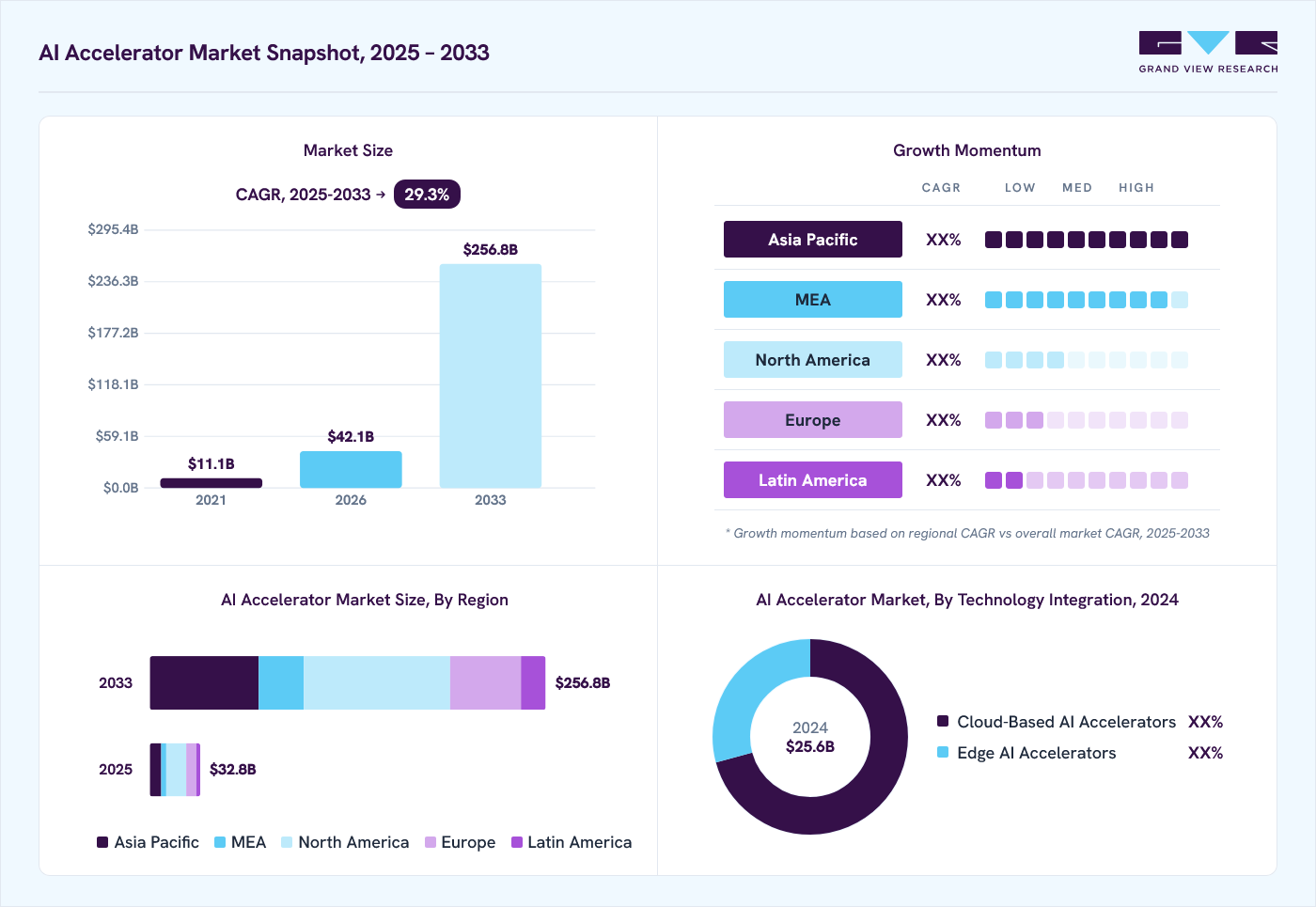
The global AI accelerator market size was valued at USD 32.8 billion in 2025 and is projected to grow from USD 42.1 billion in 2026 to USD 256.8 billion by 2033, at a CAGR of 29.5% from 2026 to 2033. North America dominated the market, accounting for a revenue share of 39.6% in 2025. The market is driven by AI accelerator vendors increasingly integrating high-bandwidth memory, chiplet-based architectures, and energy-efficient designs to support larger AI models and faster inference.
 Source: Grand View Research, IR Documents, Primary Interviews, Paid DatabasesTo learn more about this report,
 Download Free Sample Report
 Key Market Trends & Insights
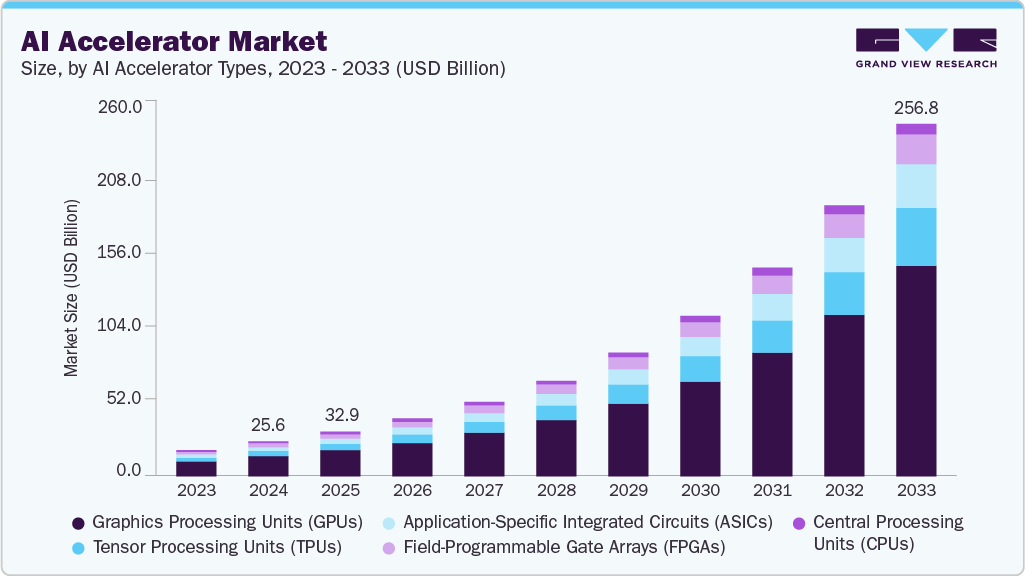
- By AI accelerator type: The graphics processing units (GPUs) segment dominated the market, with a revenue share of 58.7% in 2025.
- By technology integration: The cloud-based AI accelerators segment held the largest market share of 70.3% in 2025.
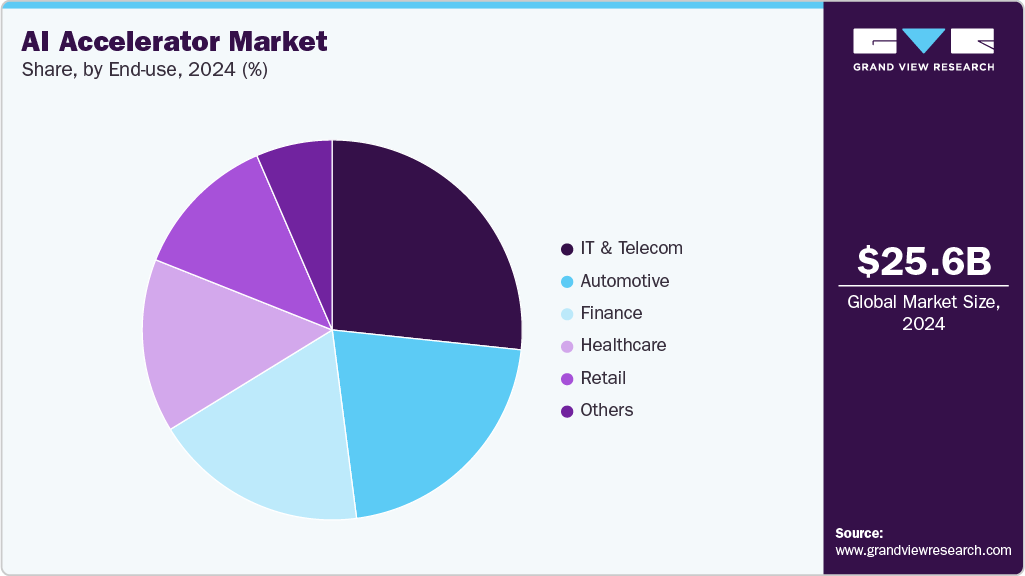
- By end use: The IT & telecom segment held the largest market share of 27.0% in 2025.
Regional Highlights
- Largest regional market: North America (39.6% revenue share, 2025)
- Fastest-growing regional market: Asia Pacific (highest CAGR, 2026-2033)
- By country: The U.S. held the largest market share in 2025.
Market Size & Forecast
- Market size in 2025: USD 32.8 billion
- Estimated market size in 2026: USD 42.1 billion
- Projected market size by 2033: USD 256.8 billion
- CAGR (2026-2033): 29.5%
Three ways to get this report
Buy it, customize it, or ask a question.Ask an Analyst
A direct answer, usually in 1 working day
- AccessReport author, directly
- Reply timeWithin 1 working day
- No sales callDirect answer only
- FormatEmail reply
- CostFree, no cost
Get the Full Report
What the study covers
- FormatsPDF · Excel · Dashboard
- Timeline2026–2033 annual, 2025 base
- Coverage20+ countries, 5 regions
- Companies10+ key players profiled
Customize the Report
20% free customization
- IncludeCountries, segments, points
- TailorTo your product definition
- ExtendDeeper competitor detail
- OrA fully bespoke study
- Turnaround5–10 working days
The market is growing rapidly, driven by a surge in demand for high-performance computing in artificial intelligence (AI) applications. As businesses and industries integrate AI for tasks like machine learning, predictive analytics, and real-time decision-making, there is a pressing need for specialized hardware that can handle these intensive computations efficiently. AI accelerators, such as Graphics Processing Units (GPUs), Tensor Processing Units (TPUs), and Field-Programmable Gate Arrays (FPGAs), are becoming essential due to their superior processing capabilities compared to traditional CPUs. The expansion of AI applications across various sectors, including healthcare, automotive, and finance, has created a substantial market for these advanced accelerators. Companies are investing heavily in developing new and improved AI accelerator technologies to meet the growing demands. The increasing use of AI in everyday technology further propels the need for efficient and powerful computing solutions. As a result, the market is witnessing a significant uptrend in both growth and investment.Technological advancements are a key driver of market expansion. Leading technology companies such as NVIDIA Corporation, Google LLC, and Intel Corporation are at the forefront of innovation, continuously developing new generations of accelerators that offer enhanced performance and efficiency. These advancements are crucial for supporting complex AI tasks such as deep learning model training and real-time data processing. Moreover, the advent of edge computing is amplifying the demand for AI accelerators, as businesses seek to process data closer to its source to minimize latency and maximize efficiency. This shift fosters the development of edge-optimized accelerators, which complement traditional data center solutions. The growing complexity of AI applications necessitates the constant evolution of hardware to keep pace with increasing computational needs. Consequently, technological progress is driving substantial market growth.
 To learn more about this report, Download Free Sample Report
 The market is rapidly evolving, with major tech companies and innovative startups competing for dominance. Significant investments in AI research and development fuel innovation, leading to diverse accelerator solutions tailored for different applications and industries. This increased competition is accelerating technological advancements and broadening the range of available products, making AI accelerators more accessible. As AI technology becomes more integral to various sectors, the need for specialized hardware solutions continues to rise. The market's expansion is supported by increasing partnerships and collaborations to advance AI capabilities and optimize hardware performance. This dynamic environment indicates a robust market growth trajectory in the coming years. As AI becomes more ubiquitous, the role of accelerators in driving technological progress will only become more critical.
Market Dynamics
The AI accelerator market is driven by the rapid expansion of generative AI, large language models, and high-performance AI workloads that require significantly greater computing efficiency than conventional processors. Enterprises and cloud service providers are increasing investments in dedicated AI hardware to accelerate model training and inference while reducing power consumption and operational costs. Growing AI adoption across data centers, edge computing, automotive, healthcare, and industrial automation is further increasing demand for specialized accelerators.
The rapid adoption of generative AI and large language models is increasing demand for specialized AI accelerators capable of processing complex training and inference workloads with high computational efficiency. Traditional CPUs are unable to meet the performance and latency requirements of these AI models, encouraging enterprises and cloud providers to deploy GPUs, TPUs, NPUs, and other dedicated AI processors. As organizations integrate AI into search, software development, content generation, customer support, and enterprise automation, the volume of AI computations continues to grow. This expanding workload is driving investments in advanced accelerator architectures that deliver higher parallel processing capability, greater memory bandwidth, and improved energy efficiency.
The development of AI accelerators requires substantial investment in advanced semiconductor design, fabrication technologies, and high-performance packaging, increasing overall production costs. Organizations deploying AI accelerators must also invest in supporting infrastructure, including high-capacity memory, cooling systems, and power-efficient data center environments. These capital requirements can limit adoption among small and medium-sized enterprises with constrained technology budgets.
In addition, frequent advancements in AI hardware shorten product lifecycles, requiring organizations to upgrade infrastructure to maintain competitive performance. The combination of high acquisition costs, integration expenses, and ongoing hardware refresh cycles increases the total cost of ownership, slowing broader adoption across cost-sensitive industries.
Sectors such as healthcare, automotive, manufacturing, financial services, and telecommunications require hardware optimized for applications including medical imaging, autonomous driving, predictive maintenance, fraud detection, and network optimization. These workload-specific accelerators deliver higher processing efficiency, lower latency, and improved energy utilization, making them suitable for production-scale AI deployments As enterprises expand AI implementation, demand is shifting toward customized accelerator architectures that align with industry-specific performance and compliance requirements. Semiconductor companies and system vendors are developing specialized AI chips for targeted applications, enabling organizations to improve inference speed while reducing infrastructure costs.
Market Concentration & Characteristics
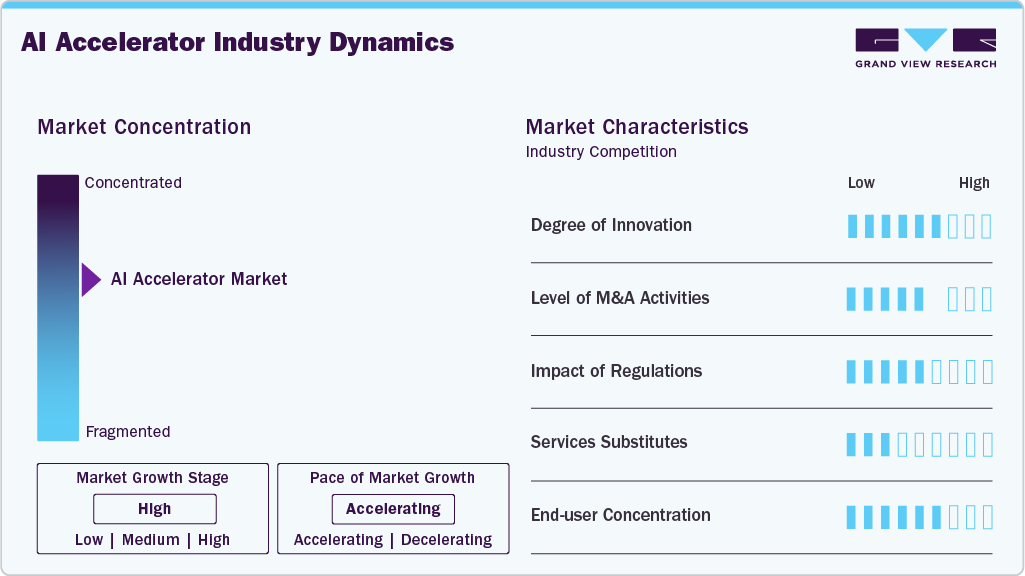
The market is witnessing steady merger, acquisition, and strategic investment activity as semiconductor companies expand AI capabilities and strengthen product portfolios. Technology partnerships between chip manufacturers, cloud providers, and system integrators are also increasing to accelerate AI infrastructure deployment. These transactions primarily focus on acquiring specialized AI technologies, engineering expertise, and software optimization capabilities.
 To learn more about this report, Download Free Sample Report
 Demand for AI accelerators is concentrated among hyperscale cloud providers, large enterprises, research organizations, and government agencies that operate compute-intensive AI workloads. These organizations account for a significant share of investments in AI infrastructure due to their large-scale model training and inference requirements. As AI adoption expands across healthcare, manufacturing, automotive, and financial services, the customer base is gradually becoming more diversified while remaining dominated by high-volume enterprise buyers.
Analyst Perspective
The AI accelerator market is entering a phase where competitive advantage is increasingly determined by computing efficiency rather than raw processing power. The rapid adoption of generative AI, foundation models, and edge intelligence is expanding demand for specialized hardware capable of delivering higher throughput, lower latency, and improved energy efficiency across cloud and enterprise environments. The defining competitive advantage, however, belongs to vendors that combine advanced accelerator architectures with a mature software ecosystem, scalable deployment capabilities, and seamless integration across data centers, edge devices, and AI frameworks. As enterprises move from AI experimentation to large-scale production, the market is shifting toward platform-based AI infrastructure that delivers consistent performance across diverse workloads while optimizing total cost of ownership.
AI Accelerator Types Insights
Based on AI accelerator types, the graphics processing units (GPUs) segment led the market with the largest revenue share of 58.7% in 2025 and is expected to grow at a significant CAGR over the forecast period. This is due to their superior parallel processing capabilities, essential for handling the large-scale computations required for AI and deep learning tasks. Originally designed for rendering graphics, GPUs have proven highly effective for the matrix operations and tensor calculations common in machine learning. Their architecture allows them to perform thousands of simultaneous operations, making them ideal for training complex neural networks efficiently. Companies such as NVIDIA Corporation have further optimized GPUs with software and hardware customized specifically for AI, solidifying their leadership in the market. The broad adoption of GPUs across various industries for AI applications has established them as the primary choice for high-performance computing tasks.
Tensor processing units (TPUs) is predicted to foresee significant growth in the forecast period due to their design, which is specifically optimized for the tensor computations used in deep learning. Developed by Google LLC, TPUs offer high performance for training and inference tasks, providing significant speed and efficiency improvements over general-purpose processors. The integration of TPUs into Google Cloud services has driven their adoption by enterprises and researchers needing scalable AI solutions. As AI applications become more complex and data-intensive, TPUs are increasingly favored for efficiently handling large-scale computations. Continued innovation and the expanding availability of TPUs contribute to their growing presence and influence in the market.
Technology Integration Insights
Based on technology integration, the cloud-based AI accelerators segment led the market with the largest revenue share of 70.3% in 2025. This is due to its scalability and flexibility in managing large-scale AI workloads. These solutions enable organizations to access powerful AI hardware without significant upfront investments, utilizing cloud infrastructure to handle computational demands. The ability to scale resources up or down based on needs makes cloud-based accelerators attractive to enterprises and researchers. The cost-effective pay-as-you-go model associated with cloud services further enhances their appeal. Major cloud providers, such as AWS, Google Cloud, and Microsoft Azure, have heavily invested in AI accelerators, cementing their dominance in the market.
Edge AI accelerators is predicted to foresee significant growth in the forecast period. The Edge AI Accelerators segment is growing rapidly due to the increasing need for real-time data processing at the source. These accelerators enable AI computations directly on devices like smartphones, IoT gadgets, and autonomous vehicles, minimizing latency and reducing bandwidth usage. This localized processing is essential for applications requiring immediate responses, such as real-time analytics and facial recognition. The rise of the Internet of Things (IoT) and advancements in edge computing technology are fueling this growth. Enhanced performance and efficiency in remote or mobile scenarios drive the demand for edge AI accelerators.
End-use Insights
Based on end use, the IT & telecom segment led the market with the largest revenue share of 27.0% in 2025 and is expected to grow at a significant CAGR over the forecast period due to its extensive use of AI for managing and optimizing network infrastructure and services. AI accelerators enhance the performance of data centers and cloud computing platforms, critical for telecommunications companies handling vast amounts of data. Moreover, telecom operators utilize AI for network management, predictive maintenance, and improving customer experiences, all of which require high-performance computing power that AI accelerators provide. The rapid growth of cloud-based services and the increasing complexity of IT infrastructures drive the demand for these specialized accelerators.
 To learn more about this report, Download Free Sample Report
 Automotive is projected to grow significantly over the forecast period due to the increasing integration of AI technologies in vehicles. AI accelerators enable advanced driver-assistance systems (ADAS), autonomous driving, and real-time vehicle-to-everything (V2X) communication. As vehicles become more intelligent, with features such as object detection, lane-keeping assistance, and automated parking, the need for high-performance accelerators to process data quickly and accurately grows. Automakers invest heavily in AI to enhance safety, efficiency, and user experience, driving the demand for specialized accelerators. The rise of electric and autonomous vehicles further accelerates the adoption of AI technologies in the automotive industry.
Regional Insights
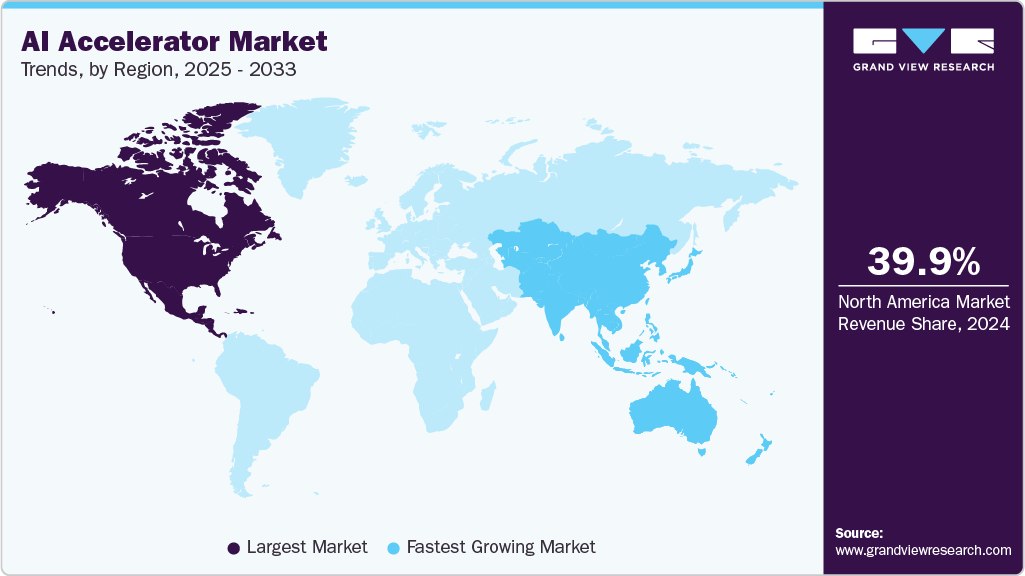
North America dominated the AI accelerator market with the largest revenue share of 39.6% in 2025. North America is experiencing significant market growth due to its strong technological infrastructure and innovation ecosystem. The region is home to leading tech companies, research institutions, and startups at the forefront of AI development, driving demand for advanced accelerators. Heavy investments by major tech giants and cloud service providers in AI infrastructure contribute to this growth. Moreover, the high adoption rate of AI technologies across various sectors, including IT, telecom, and healthcare, fuels the need for powerful accelerators.
 To learn more about this report, Download Free Sample Report
 U.S. AI Accelerator Market Trends
The AI accelerator market in the U.S. held the largest share in the North America region in 2025. With major tech companies such as NVIDIA Corporation, Google LLC, and Intel Corporation leading the charge, the U.S. remains at the forefront of AI hardware development. Significant investments from private sector firms and government initiatives propel AI accelerator advancements. The broad adoption of AI technologies across various industries, including finance, healthcare, and automotive, heightens the demand for specialized hardware.
Europe AI Accelerator Market Trends
The AI accelerator market in Europe is witnessing increasing growth driven by a rising focus on digital transformation and technological advancements. The region is investing heavily in AI research and development, with several countries prioritizing AI as part of their national strategies. Europe’s robust automotive and industrial sectors significantly contribute to the demand for AI accelerators, particularly for applications like autonomous driving and smart manufacturing. Moreover, European tech companies and startups are developing and deploying AI solutions, driving the need for high-performance accelerators.
Asia Pacific AI Accelerator Trends
The AI accelerator market in Asia Pacific is anticipated to register the fastest CAGR over the forecast period. The Asia Pacific market is rapidly growing due to its expanding technology sector and increasing AI adoption across various industries. The region is home to major tech hubs in countries such as China, Japan, and South Korea, which heavily invest in AI research and development. The growing demand for AI in sectors such as consumer electronics, automotive, and finance drives the need for advanced accelerators. Moreover, significant government support and funding for AI initiatives in countries such as China bolster the market.
Key AI Accelerator Company Insights
Prominent firms have used product launches and developments, followed by expansions, mergers and acquisitions, contracts, agreements, partnerships, and collaborations as their primary business strategy to increase their market share. The companies have used various techniques to enhance market penetration and boost their position in the competitive industry. For instance, in April 2024, Microsoft, collaborating with Seedrs, an online equity crowdfunding company in the UK, launched SERIES AI, an innovative accelerator to advance the growth of UK startups integrating AI into their products and services. The initiative seeks to provide essential resources and mentorship to help these early-stage companies refine their AI solutions and enhance their business strategies.
Key AI Accelerator Companies:
The following key companies have been profiled for this study on the AI accelerator market.
-
Amazon Web Services, Inc.
-
Google Inc.
-
Graphcore
-
IBM Corporation
-
Intel Corporation
-
Micron Technology
-
Microsoft Corporation
-
NVIDIA Corporation
-
Qualcomm Technologies
-
Xilinx Inc.
Competitive Benchmarking
Category
Operating Strategies
Competitive Edge
Weakness
Established Players (Amazon Web Services, Inc.; Google Inc.; IBM Corporation; Intel Corporation; Microsoft Corporation; NVIDIA Corporation)
- Focus on expanding AI accelerator portfolios through continuous product innovation and advanced semiconductor technologies.
- Strengthen market presence through cloud ecosystem integration, strategic partnerships, and large-scale enterprise deployments.
- Established software ecosystems, global distribution networks, and extensive R&D capabilities support large-scale commercialization.
- Strong financial resources and manufacturing partnerships enable rapid product development and broad customer adoption.
- Large product portfolios can extend product development cycles and reduce flexibility in responding to niche AI workloads.
- High dependence on advanced semiconductor fabrication and global supply chains exposes operations to production constraints.
Emerging Players (Graphcore; Qualcomm Technologies)
- Focus on developing workload-specific AI accelerators optimized for inference, edge AI, and generative AI applications.
- Differentiate through specialized chip architectures and collaborations with cloud providers, research institutions, and enterprise customers.
- Agile product development enables rapid innovation in performance, power efficiency, and application-specific optimization.
- The ability to target underserved AI workloads with customized accelerator designs creates differentiation from established vendors.
- Limited commercial scale and smaller software ecosystems restrict enterprise adoption.
- Lower brand recognition and constrained financial resources present challenges in expanding global market presence.
Recent Developments
-
In September 2024, Intel Corporation and IBM Corporation collaborated to deploy Intel’s Gaudi 3 AI accelerators on the IBM Cloud platform. This collaboration focuses on improving enterprise AI capabilities with more secure and cost-effective solutions. It is designed to integrate Gaudi 3 with IBM’s Watsonx AI and data platform, providing both hybrid and on-premise options to enhance cost performance and drive innovation..
-
In August 2024, IBM Corporation introduced its Spyre accelerator chip for IBM Z, designed to scale enterprise AI workloads with advanced capabilities and high performance. The Spyre accelerator, featuring 32 cores and 25.6 billion transistors, enhances AI inferencing and integrates with IBM’s Watsonx platform, providing businesses with improved AI processing power and security on IBM mainframes.
-
In June 2024, Google LLC launched an AI-first, equity-free accelerator in Australia as part of its $1 billion Digital Future Initiative. This program aims to support seed and Series A startups in AI and machine learning. It will help Australian entrepreneurs utilize AI technologies by providing mentorship, technical support, and access to Google's global networks.
-
In January 2024, Google Cloud and Hugging Face, a computer application corporation in the U.S., partnered to enable developers to utilize Google's infrastructure, including TPUs and GPUs, for training and deploying AI models, enhancing enterprises' ability to implement generative AI. This collaboration supports open-source innovation and offers enterprises flexible options for scaling AI workloads across cloud platforms.
AI Accelerator Market Report Scope
Report Attribute
Details
Market size in 2025
USD 32.8 billion
Estimated market size in 2026
USD 42.1 billion
Projected market size by 2033
USD 256.8 billion
Growth rate
CAGR of 29.5% from 2026 to 2033
Base year for estimation
2025
Historical data
2021 - 2024
Forecast period
2026 - 2033
Quantitative units
Revenue in USD million/billion and CAGR from 2026 to 2033
Report coverage
Revenue forecast, company ranking, competitive landscape, growth factors, and trends
Segments covered
AI accelerator types, technology integration, end use, region
Regional scope
North America, Asia Pacific; Europe; MEA; Latin America
Country scope
U.S.; Canada; Mexico; Germany; UK; France; China; Japan; India; South Korea; Australia; Brazil; Saudi Arabia; South Africa; UAE
Key companies profiled
Amazon Web Services, Inc.; Google Inc.; Graphcore; IBM Corporation; Intel Corporation; Micron Technology; Microsoft Corporation; NVIDIA Corporation; Qualcomm Technologies; Xilinx Inc.
Customization scope
Free report customization (equivalent up to 8 analysts' working days) with purchase. Addition or alteration to country, regional & segment scope.
Pricing and purchase options
Avail customized purchase options to meet your exact research needs. Explore purchase options
Global AI Accelerator Market Report Segmentation
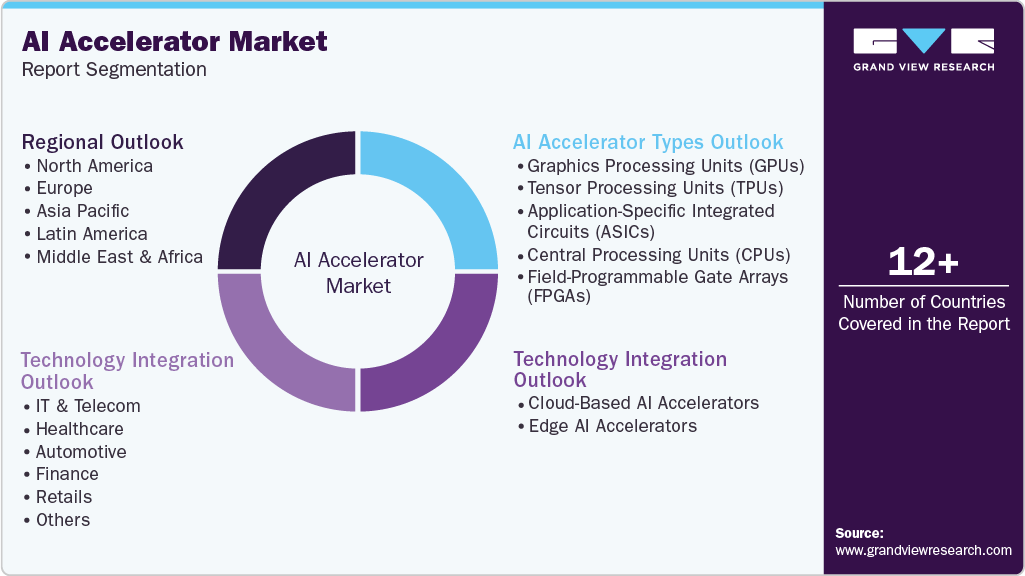
This report forecasts revenue growth at the global, regional, and country levels and provides an analysis of the latest industry trends in each of the sub-segments from 2021 to 2033. For this study, Grand View Research has segmented the global AI accelerator market report based on AI accelerator types, technology integration, end-use, and region:
 To learn more about this report, Download Free Sample Report
 -
AI Accelerator Types Outlook (Revenue, USD Million, 2021 - 2033)
-
Graphics Processing Units (GPUs)
-
Tensor Processing Units (TPUs)
-
Application-Specific Integrated Circuits (ASICs)
-
Central Processing Units (CPUs)
-
Field-Programmable Gate Arrays (FPGAs)
-
-
Technology Integration Outlook (Revenue, USD Million, 2021 - 2033)
-
Cloud-Based AI Accelerators
-
Edge AI Accelerators
-
-
End-use Outlook (Revenue, USD Million, 2021 - 2033)
-
IT & Telecom
-
Healthcare
-
Automotive
-
Finance
-
Retails
-
Others
-
-
Regional Outlook (Revenue, USD Million, 2021 - 2033)
-
North America
-
U.S.
-
Canada
-
Mexico
-
-
Europe
-
UK
-
Germany
-
France
-
-
Asia Pacific
-
China
-
Japan
-
India
-
South Korea
-
Australia
-
-
Latin America
-
Brazil
-
-
Middle East and Africa (MEA)
-
KSA
-
UAE
-
South Africa
-
-
Research Methodology
The AI accelerator market figures in this report are based on a proven research process that combines executive interviews with secondary research from proprietary databases, company filings, and recognized regulatory and institutional sources. Market size is built through value-chain sizing - reconciling supply-side and demand-side estimates - and triangulated with bottom-up and top-down approaches. Every estimate passes multiple levels of expert validation before publication, with each AI accelerator segment quantified using the revenue-capture definitions in the table below.
Segment Definition
Segment - AI Accelerator Types
Revenue capture definition
Graphics Processing Units (GPUs)
Revenue is captured from GPUs deployed for AI model training and high-throughput inference across cloud data centers, enterprise infrastructure, and supercomputing environments. Demand is supported by large-scale generative AI, deep learning, and high-performance computing applications.
Tensor Processing Units (TPUs)
Revenue includes TPUs used to accelerate machine learning workloads within cloud platforms and AI infrastructure. Adoption is driven by optimized performance for neural network training and inference with improved computational efficiency.
Application-Specific Integrated Circuits (ASICs)
Revenue is generated from ASICs designed for dedicated AI workloads across data centers, networking, edge computing, and industry-specific applications. Their application-specific architecture supports high processing efficiency and lower power consumption.
Central Processing Units (CPUs)
Revenue comprises CPUs supporting AI preprocessing, orchestration, and hybrid computing environments alongside dedicated accelerators. Enterprises continue to deploy advanced multi-core processors for AI-enabled servers and edge systems.
Field-Programmable Gate Arrays (FPGAs)
Revenue is derived from FPGAs deployed in configurable AI inference, telecommunications, industrial automation, and embedded systems. Their programmable architecture enables hardware customization for evolving AI workloads without redesigning the silicon.
Segment - Technology Integration
Revenue capture definition
Cloud-Based AI Accelerators
This segment captures revenue generated from AI accelerators deployed within cloud infrastructure to support AI model training, inference, and high-performance computing services. Revenue includes hardware integrated into hyperscale and enterprise cloud platforms, along with accelerator-enabled AI computing resources.
Edge AI Accelerators
This segment includes revenue from AI accelerators embedded in edge devices that perform AI inference close to the data source with low latency. It covers processors integrated into autonomous systems, industrial equipment, smart cameras, consumer electronics, and IoT devices.
Segment - Vertical
Revenue capture definition
IT & Telecom
Revenue from the IT & telecom segment includes AI accelerators deployed for cloud computing, hyperscale data centers, network optimization, virtualization, and AI-driven telecom infrastructure. Demand is supported by large-scale AI model training, inference workloads, and next-generation network operations.
Healthcare
This segment captures revenue generated from AI accelerators used in medical imaging, clinical diagnostics, drug discovery, genomics, and hospital AI systems. Growth is supported by increasing use of high-performance computing for data-intensive healthcare applications.
Automotive
Revenue includes AI accelerators integrated into advanced driver assistance systems (ADAS), autonomous driving platforms, in-vehicle AI processing, and intelligent cockpit solutions. Automotive manufacturers and Tier-1 suppliers deploy these processors for real-time decision-making and sensor fusion.
Finance
This segment comprises AI accelerator revenue from banking, insurance, and capital markets for fraud detection, algorithmic trading, risk analytics, and customer intelligence. Financial institutions deploy dedicated AI hardware to process large transaction volumes with low latency.
Retail
Revenue is derived from AI accelerators supporting recommendation engines, demand forecasting, inventory optimization, visual search, and automated checkout solutions. Retailers deploy these processors to enhance analytics and deliver faster AI-powered customer experiences.
Others
This segment includes AI accelerator deployments across education, agriculture, and manufacturing for intelligent learning platforms, precision farming, robotics, quality inspection, and predictive maintenance. Revenue is generated from industry-specific AI applications requiring accelerated data processing and inference.
Estimation Model
Layer Name
Key Questions
Description
Compute Infrastructure Layer
Where are AI accelerators deployed?
Estimate the installed base of AI infrastructure across hyperscale data centers, enterprise servers, edge devices, automotive platforms, and HPC systems. This establishes the addressable hardware base requiring AI accelerator deployment.
AI Adoption Layer
How many systems integrate AI accelerators?
Apply AI workload penetration and accelerator adoption rates across cloud providers, enterprises, and industry verticals. This converts the installed compute base into active demand for AI accelerators.
Processor Configuration Layer
What type and volume of AI accelerators are deployed?
Measure the mix of GPUs, ASICs, FPGAs, NPUs, and other AI accelerators deployed across training and inference workloads. This reflects processor mix, deployment intensity, and unit demand across end-use industries.
Monetization Layer
How much revenue is generated?
Apply the average selling price (ASP) of AI accelerators across deployment categories and aggregate revenues from hardware shipments, integrated accelerator systems, and associated AI computing platforms to estimate total market revenue.
Delivered Customizations
This report has been delivered with the following In-depth customizations
Client Request
Customization Delivered
Value Adds
Market Entry & Expansion Assessment
Regional demand sizing and forecasting
Customer segmentation and buying behavior analysis
Competitive landscape benchmarking
Regulatory and distribution channel assessment
Identified high-growth market opportunities
Supported go-to-market strategy development
Highlighted investment priorities and risks
Enabled data-driven expansion planning
Technology & Innovation Assessment
Emerging technology trend analysis
Innovation pipeline
Technology adoption readiness assessment
Ecosystem and partnership mapping
Identified future growth areas
Supported roadmap planning innovation
Evaluated commercialization potential
Strengthened strategic partnership decisions
Customer & End-User Insights Study
Consumer awareness and adoption analysis
Purchase decision journey mapping
Satisfaction and loyalty assessment
Usage pattern and pain-point evaluation
Revealed key adoption drivers and barriers
Supported customer-centric product development
Improved targeting and engagement strategy
Identified opportunities for retention and upselling
Frequently Asked Questions About This Report
Some key players operating in the AI accelerator market include Amazon Web Services, Inc., Google Inc., Graphcore, IBM Corporation, Intel Corporation, Micron Technology, Microsoft Corporation, NVIDIA Corporation, Qualcomm Technologies, and Xilinx Inc.
Key factors driving market growth include a surge in demand for high-performance computing in artificial intelligence (AI) applications. The increasing use of AI in everyday technology further propels the need for efficient and powerful computing solutions.
The global AI accelerator market size was valued at USD 32.8 billion in 2025 and is estimated at USD 42.1 billion for 2026.
The global AI accelerator market is expected to grow at a CAGR of 29.3% from 2026 to 2033, reaching USD 256.8 billion by 2033.
North America dominated the market and had a 39.6% share in 2024. Due to its strong technological infrastructure and innovation ecosystem, North America is experiencing significant growth in the AI accelerator market.
About the Author(s)
Next Generation Technologies Research Team
Technology · Next Generation TechnologiesThis report was authored by the next generation technologies research team at Grand View Research - comprising two research analysts, one senior research analyst, and one industry expert - with specialized expertise in the next generation technologies segment of the technology industry. All findings are based on proprietary technology databases, executive interviews, and regulatory analysis, subject to internal peer review prior to publication.
Last Updated:
Speak to Analyst

Customize this report to your needs - add regions, segments, or data points, with 20% free customization.
Or view our licence options:


ISO 9001:2015 & 27001:2022 Certified
We are GDPR and CCPA compliant! Your transaction & personal information is safe and secure. For more details, please read our privacy policy.


