
- Home
- »
- Next Generation Technologies
- »
-
AI Personal Trainer Market Size & Share Report, 2026-2033GVR Report cover
![AI Personal Trainer Market (2026 - 2033)Report]()
AI Personal Trainer Market (2026 - 2033)
Size, Share & Trends Analysis Report By Component (Software, Service), By Device Type (Smartphones, Wearables), By Application (Fitness Training & Workout Coaching, Rehabilitation & Physiotherapy), By End Use, By Region, And Segment Forecasts
Market Size, 2025
$16.9BMarket Estimate, 2026
$19.9BMarket Forecast, 2033
$65.7BCAGR, 2026–2033
18.6%AI Personal Trainer Market Summary
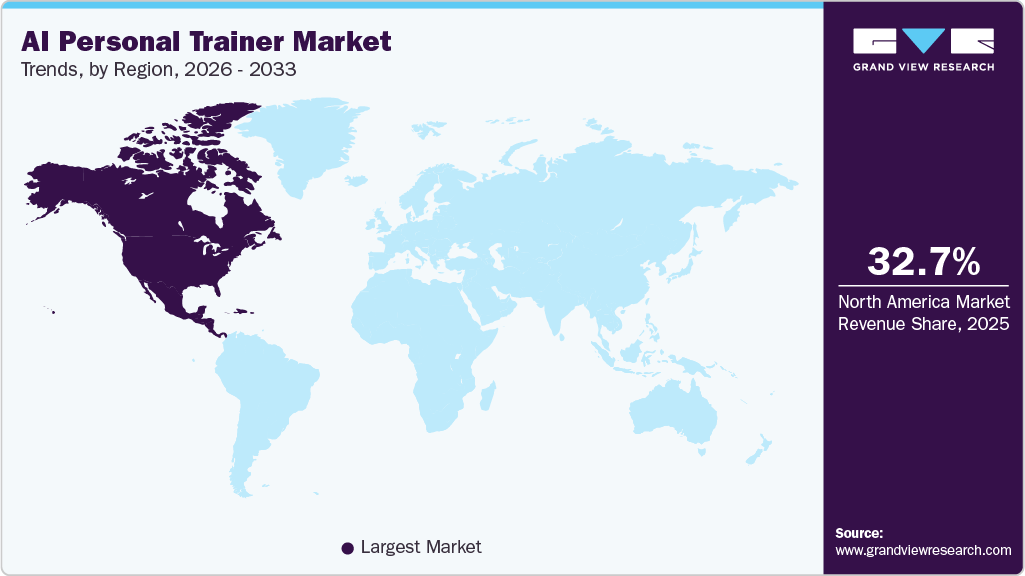
The global AI personal trainer market size was valued at USD 16.9 billion in 2025 and is projected to grow from USD 19.9 billion in 2026 to USD 65.7 billion by 2033, at a CAGR of 18.6% from 2026 to 2033. The market in North America dominated with a revenue share of 32.7% in 2025. The market is driven by the adoption of AI personal trainers among health-conscious consumers. These platforms combine fitness guidance with health monitoring and behavioral insights, supporting sustained engagement and proactive fitness management.

Key Market Trends & Insights
- By component: The software segment led the market with the largest revenue share of 66.8% in 2025.
- By device type: The smartphones segment led the market with the largest revenue share of 46.5% in 2025.
- By end use: The healthcare & rehabilitation centers segment is expected to grow at the fastest CAGR of 24.7% from 2026 to 2033.
Regional Highlights
- Largest regional market: North America (32.7% revenue share, 2025)
- The AI personal trainer industry in the U.S. held the largest revenue share in 2025.
Market Size & Forecast
- Market size in 2025: USD 16.9 Billion
- Estimated market size in 2026: USD 19.9 Billion
- Projected market size by 2033: USD 65.7 Billion
- CAGR (2026-2033): 18.6%
The AI personal trainer industry is driven by the growing demand for highly personalized and data-driven fitness solutions that adapt to individual goals, fitness levels, and preferences.AI systems analyze user data, performance metrics, and feedback to design customized workout routines and nutrition plans that evolve continuously, improving training effectiveness and user outcomes. Real-time tracking, adaptive workout modification, and intelligent performance analytics enhance training precision and safety, supporting consistent user engagement and measurable progress.
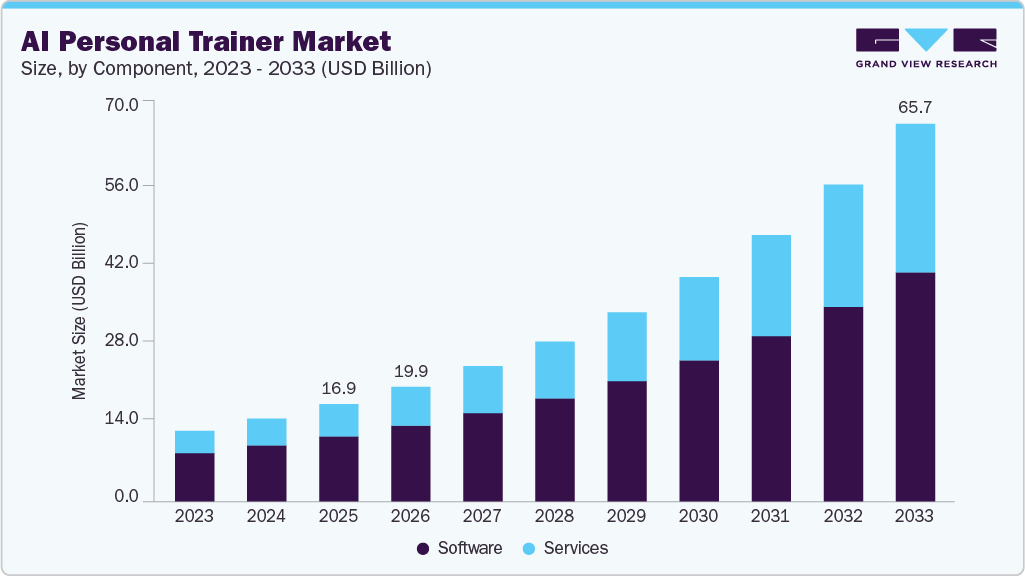
Another key driver is the increasing accessibility and affordability of virtual coaching compared to traditional personal training services. AI-powered trainers provide 24/7 guidance, automated communication, and remote coaching through mobile apps, wearables, and smart devices, enabling users to access fitness support anytime and anywhere. Integration with biometric sensors and connected platforms further strengthens user monitoring and personalized feedback, expanding the reach of digital fitness ecosystems.
In addition, the rising adoption of digital fitness platforms by gyms, studios, and individual trainers is accelerating market growth due to improved operational efficiency and enhanced client retention. AI tools automate progress tracking, form correction, and client management while delivering real-time feedback and injury prevention insights, leading to superior training experiences and scalable coaching models. The broader shift toward technology-enabled wellness, virtual training, and data-centric fitness engagement continues to support sustained demand for AI personal trainer solutions across consumer and commercial sectors.
Component Insights
The software segment led the market with the largest revenue share of 66.8% in 2025. The software segment is driven by the rising integration of AI algorithms, computer vision, and machine learning into fitness applications that deliver personalized workout planning and real-time performance analysis. For instance, in September 2024, FitnessAI, an AI-powered gym workout app owned by Appex Group Inc., launched its BodyScan feature for iOS devices. This technology enables users to perform detailed body composition scans using smartphone cameras, providing metrics such as body fat percentage and muscle mass comparable to medical-grade DEXA scans at a lower cost.
The service segment is predicted to foresee at the fastest CAGR during the forecast period. The subscription-based coaching services is driven by the integration of AI with mobile apps, wearables, and connected fitness ecosystems, which strengthens the value proposition of subscription-based coaching.For instance, in November 2025, Tough Coach launched an AI-powered fitness platform that delivers custom workout plans based on individual goals and preferences, alongside gamified features such as streaks, levels, and a global leaderboard. It operates on a tiered model with a free plan offering limited access and a premium subscription at $14.99 per month for unlimited AI interactions and advanced tools.
Device Type Insights
The smartphones segment accounted for the largest market revenue share in 2025. The widespread penetration of smartphones and high mobile app usage significantly drives the adoption of AI personal trainer solutions through accessible digital fitness platforms. Advanced mobile processors, integrated sensors, and seamless app ecosystems enable real-time workout tracking, AI-based coaching, and personalized training recommendations on a single device. Moreover, the continuous connectivity, user-friendly interfaces, and subscription-based fitness applications support consistent engagement and scalable delivery of AI-driven fitness services.
The wearables segment is predicted to foresee at the fastest CAGR during the forecast period. The rising adoption of smartwatches, fitness bands, and biometric tracking devices is a key driver for AI personal trainer integration due to continuous health and activity monitoring capabilities. For instance, in August 2025, Google introduced the Pixel Watch 4, a wearable device featuring a redesigned domed Actua 360 display, extended battery life up to 40 hours, and standalone satellite communication for emergency services. The smartwatch integrates Gemini AI for wrist-based assistance, enhanced fitness tracking with AI-powered workout recognition, and improved sleep insights via an upgraded skin temperature sensor.
Application Insights
The fitness training & workout coaching segment accounted for the largest market revenue share in 2025, due to the rising demand for personalized and adaptive workout programs supported by AI-based performance analytics and real-time feedback. Continuous tracking enables data-driven training optimization, improving user adherence and measurable fitness outcomes. For instance, in July 2024, Skimble launched AI Weekly Plans and 1:1 AI Trainer Chat within its Workout Trainer app for Android and iOS users. These AI-powered features deliver customized weekly training programs based on user goals, preferences, and progress, alongside direct chat interactions for fitness queries and in-app workout suggestions.
The rehabilitation & physiotherapy segment is predicted to foresee at the fastest CAGR during the forecast period. The market is driven by the increasing integration of AI in injury recovery, movement assessment, and guided therapeutic exercises. AI trainers assist in monitoring posture, mobility, and recovery progress, ensuring structured and consistent rehabilitation support outside clinical settings. For instance, in October 2025, AltrixLabs introduced KRIGAT, a UK-India AI platform that employs computer vision for real-time exercise detection, posture correction, and performance analysis in physiotherapy. The KRIGAT Physio module evaluates joint movements and alignment during rehabilitation routines, while providing clinicians with remote patient monitoring and progress reports.
End Use Insights
The individual/home users segment accounted for the largest market revenue share in 2025. This segment is driven by the rising preference for convenient, on-demand fitness solutions that fit flexible lifestyles and growing awareness of fitness as well as weight management. For instance, in February 2026, AEKE launched the AEKE 1 Smart Home Gym K1, an AI-powered that delivers professional-grade workouts, smart coaching, and posture correction in a compact, foldable design comparable to a doormat. This supports cardio, strength training, flexibility, and recovery exercises for individual users, replacing traditional gym equipment and trainers without subscription fees.
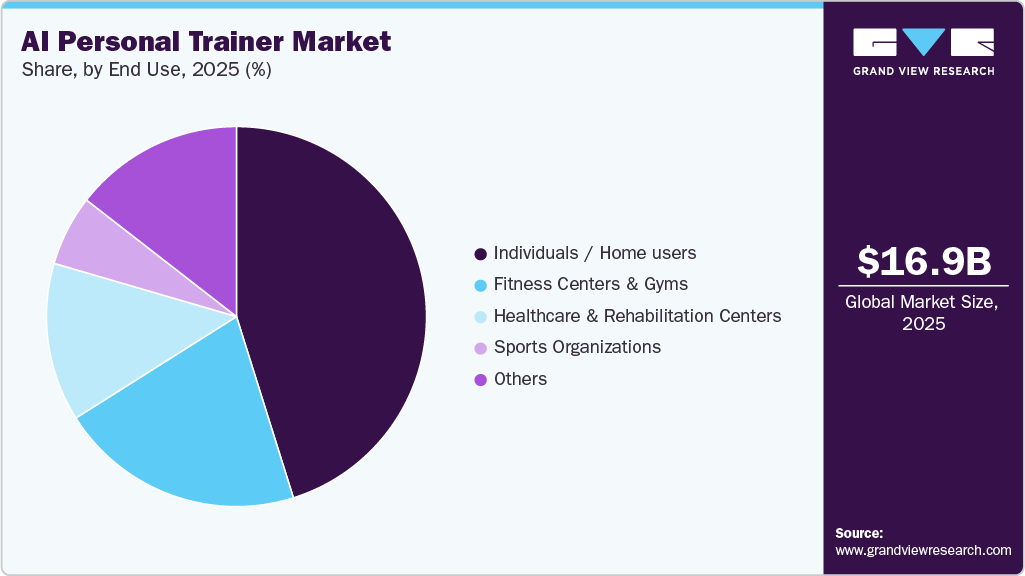
The healthcare & rehabilitation centers segment is projected to grow at the fastest CAGR over the forecast period. Healthcare and rehabilitation centers are adopting AI personal trainers to support structured recovery programs and patient-specific exercise regimens. AI-driven systems assist in monitoring movement patterns, tracking rehabilitation progress, and providing adaptive training aligned with medical guidelines. The integration of data analytics and remote monitoring enhances clinical oversight and improves therapy adherence among patients. Rising demand for technology-enabled rehabilitation, especially for chronic conditions and post-injury recovery, is reinforcing the use of AI-based training tools in healthcare settings.
Regional Insights
North America dominated the global AI personal trainer market with the largest revenue share of 32.7% in 2025. The North American market is driven by the high penetration of advanced fitness technologies and strong adoption of subscription-based digital health platforms. The presence of leading fitness app developers and AI innovators supports continuous product innovation and feature enhancement. Rising consumer demand on personalized wellness solutions and connected fitness ecosystems further strengthens market demand. In addition, the integration of AI with wearable devices and smart home fitness equipment supports sustained user engagement and data-driven training experiences.
U.S. AI Personal Trainer Market Trends
The AI personal trainer market in the U.S. benefits from a highly developed digital fitness industry and strong demand for premium, personalized training experiences. High adoption of wearable fitness trackers and AI-integrated health applications enhances real-time performance monitoring and customization. Corporate wellness programs and employer-sponsored digital fitness subscriptions also contribute to sustained usage. Furthermore, a strong culture of individualized fitness and performance optimization drives continuous adoption of AI-powered personal training platforms.
Europe AI Personal Trainer Market Trends
The AI personal trainer market in Europe is supported by increasing focus on preventive health, structured fitness routines, and government initiatives promoting active lifestyles. The growing popularity of hybrid fitness models, which combine in-person and virtual training, is driving the adoption of AI-enabled coaching platforms. Expanding digital health infrastructure and regulatory support for wellness technologies also contribute to market expansion. Moreover, the rising demand for personalized, privacy-focused fitness applications aligns with regional consumer preferences.
Asia Pacific AI Personal Trainer Market Trends
The AI personal trainer market in Asia Pacific is anticipated to grow at the fastest CAGR during the forecast period, as the market expansion is due to the rapid urbanization, growing middle-class population, and rising awareness of digital fitness solutions. Increasing smartphone usage and widespread availability of affordable fitness apps enable broader access to AI-based personal training. The expansion of online fitness communities and influencer-led digital fitness trends further accelerates adoption. In addition, the rising focus on self-care, weight management, and tech-enabled lifestyle management supports strong regional demand.
Key AI Personal Trainer Company Insights
Some key companies in the AI personal trainer industry are Freeletics GmbH, Whoop, Inc.,BodBot, LLC, Planfit Inc.
-
Freeletics GmbH is a digital fitness platform that provides AI-powered personal training through mobile applications designed for personalized and adaptive workout experiences. The platform uses artificial intelligence and sports science insights to generate customized training plans based on user goals, fitness levels, and feedback. It offers diverse training formats including HIIT, bodyweight exercises, strength training, running, and mobility sessions that can be performed at home or in gym settings.
-
Whoop, Inc. is a wearable technology and digital health company focused on continuous monitoring of physiological metrics to enhance fitness, recovery, and overall health insights. The company provides a screen-free wearable device integrated with a subscription-based platform that analyzes sleep, strain, stress, and recovery data to support performance optimization. Its ecosystem combines hardware, software, and analytics to deliver personalised health feedback and actionable recommendations based on real-time biometric data.
Key AI Personal Trainer Companies:
The following key companies have been profiled for this study on the AI personal trainer market.
- BodBot, LLC
- FitnessAI Inc.
- Freeletics GmbH
- iFIT Health & Fitness Inc.
- Peloton Interactive, Inc.
- Planfit Inc.
- Spur.fit
- Tempo
- Virtuagym
- Whoop, Inc.
Recent Developments
-
In October 2025, Peloton Interactive, Inc. introduced a product portfolio that introduced Peloton IQ, an AI and computer vision system delivering personalized coaching, form feedback, rep counting, and performance insights across its connected fitness equipment, including the new Peloton Cross Training Series of base and premium devices for cardio and strength training
-
In August 2025, Virtuagym introduced MAX AI Coach, an AI-powered solution integrated into its Coach mobile app that enables trainers to generate personalized workout plans in 20 seconds using a library of over 6,000 3D animated exercises and client data such as fitness levels, goals, equipment availability, and injuries. Trainers maintain full control to edit sets, reps, and exercise selections before assigning plans through Virtuagym’s ecosystem
-
In September 2024, iFIT launched an interactive AI Coach across its NordicTrack and ProForm brands, featuring a redesigned operating system and enhanced hardware like the X24 Treadmill and Bike. The AI Coach, in beta, recommends workouts from iFIT's library of over 10,000 sessions, communicates via text, and schedules sessions that sync automatically to users' iFIT-enabled equipment.
AI Personal Trainer Market Report Scope
Report Attribute
Details
Market size in 2025
USD 16.9 billion
Estimated market size in 2026
USD 19.9 billion
Projected market size by 2033
USD 65.7 billion
Growth rate
CAGR of 18.6% from 2026 to 2033
Base year for estimation
2025
Historical data
2021 - 2024
Forecast period
2026 - 2033
Quantitative units
Revenue in USD million/billion, and CAGR from 2026 to 2033
Report coverage
Revenue forecast, company ranking, competitive landscape, growth factors, and trends
Segments covered
Component, device type, application, end use, regional.
Regional scope
North America; Europe; Asia Pacific; Latin America; Middle East & Africa
Country scope
U.S.; Canada; Europe; UK; Germany; France; China; Japan; India; South Korea; Australia; Brazil; KSA; UAE; South Africa
Key companies profiled
BodBot, LLC; FitnessAI Inc.; Freeletics GmbH; iFIT Health & Fitness Inc.; Peloton Interactive, Inc.; Planfit Inc.; Spur.fit; Tempo; Virtuagym; Whoop, Inc.
Customization scope
Free report customization (equivalent up to 8 analysts working days) with purchase. Addition or alteration to country, regional & segment scope.
Pricing and purchase options
Avail customized purchase options to meet your exact research needs. Explore purchase options
Global AI Personal Trainer Market Report Segmentation
This report forecasts revenue growth at global, regional, and country levels and provides an analysis of the latest industry trends in each of the sub-segments from 2021 to 2033. For this study, Grand View Research has segmented the global AI personal trainer market report based on component, device type, application, End Use, and region:
-
Component Outlook (Revenue, USD Million, 2021 - 2033)
-
Software
-
Service
-
-
Device Type Outlook (Revenue, USD Million, 2021 - 2033)
-
Smartphones
-
Wearables
-
Smart fitness equipment
-
Tablets / Laptops
-
Others
-
-
Application Outlook (Revenue, USD Million, 2021 - 2033)
-
Fitness training & workout coaching
-
Rehabilitation & physiotherapy
-
Sports performance training
-
Nutrition & wellness coaching
-
Others
-
-
End Use Outlook (Revenue, USD Million, 2021 - 2033)
-
Individuals / Home users
-
Fitness centers & gyms
-
Healthcare & rehabilitation centers
-
Sports organizations
-
Others
-
-
Regional Outlook (Revenue, USD Million, 2021 - 2033)
-
North America
-
U.S.
-
Canada
-
Mexico
-
-
Europe
-
UK
-
Germany
-
France
-
-
Asia Pacific
-
China
-
Japan
-
India
-
South Korea
-
Australia
-
-
Latin America
-
Brazil
-
-
Middle East and Africa (MEA)
-
KSA
-
UAE
-
South Africa
-
-
Frequently Asked Questions About This Report
The software segment led with a 66.8% revenue share in 2025, while service is the fastest-growing segment.
Smartphones held the largest revenue share 46.5% in 2025, while wearables is the fastest-growing area.
Individual/home users held the largest share (over 24.7%) in 2025 and healthcare & rehabilitation centers is the fastest-growing market.
The global AI personal trainer market size was estimated at USD 16,929.6 million in 2025 and is expected to reach USD 19,936.5 million in 2026.
The global AI personal trainer market is expected to grow at a compound annual growth rate of 18.6% from 2026 to 2033 to reach USD 65.7 billion by 2033.
North America dominated the market with a share of 32.7% in 2025.
Some key players operating in the AI personal trainer market include BodBot, LLC; FitnessAI Inc.; Freeletics GmbH; iFIT Health & Fitness Inc.; Peloton Interactive, Inc.; Planfit Inc.; Spur.fit; Tempo; Virtuagym; Whoop, Inc.
Key factors that are driving the market growth include increasing adoption of AI personal trainers among health-conscious consumers, combine fitness guidance with health monitoring and behavioral insights, supporting sustained engagement and proactive fitness management.
About the Author(s)
Next Generation Technologies Research Team
Technology · Next Generation TechnologiesThis report was authored by the next generation technologies research team at Grand View Research - comprising two research analysts, one senior research analyst, and one industry expert - with specialized expertise in the next generation technologies segment of the technology industry. All findings are based on proprietary technology databases, executive interviews, and regulatory analysis, subject to internal peer review prior to publication.
Last Updated:
Speak to Analyst


Customize this report to your needs — add regions, segments, or data points, with 20% free customization.
Or view our licence options:


ISO 9001:2015 & 27001:2022 Certified
We are GDPR and CCPA compliant! Your transaction & personal information is safe and secure. For more details, please read our privacy policy.


