
- Home
- »
- Next Generation Technologies
- »
-
AI In Waste Management Market Size Report, 2026-2033GVR Report cover

AI In Waste Management Market (2026 - 2033)
Size, Share & Trends Analysis Report By Component (Software, Hardware, Services), By Technology (Machine Learning, Computer Vision), By Waste Type (Industrial Waste), By Application, By End-use, By Region, And Segment Forecasts
Market Size, 2025
$43.2BMarket Estimate, 2026
$52.4BMarket Forecast, 2033
$216.4BCAGR, 2026–2033
22.5%AI In Waste Management Market Summary
The global AI in waste management market size was valued at USD 43.2 billion in 2025 and is projected to grow from USD 52.4 billion in 2026 to USD 216.4 billion by 2033, at a CAGR of 22.5% from 2026 to 2033. The market in North America dominated with a revenue share of 27.3% in 2025. AI systems enable automated sorting, route optimization, and real-time monitoring to manage rising loads more efficiently.
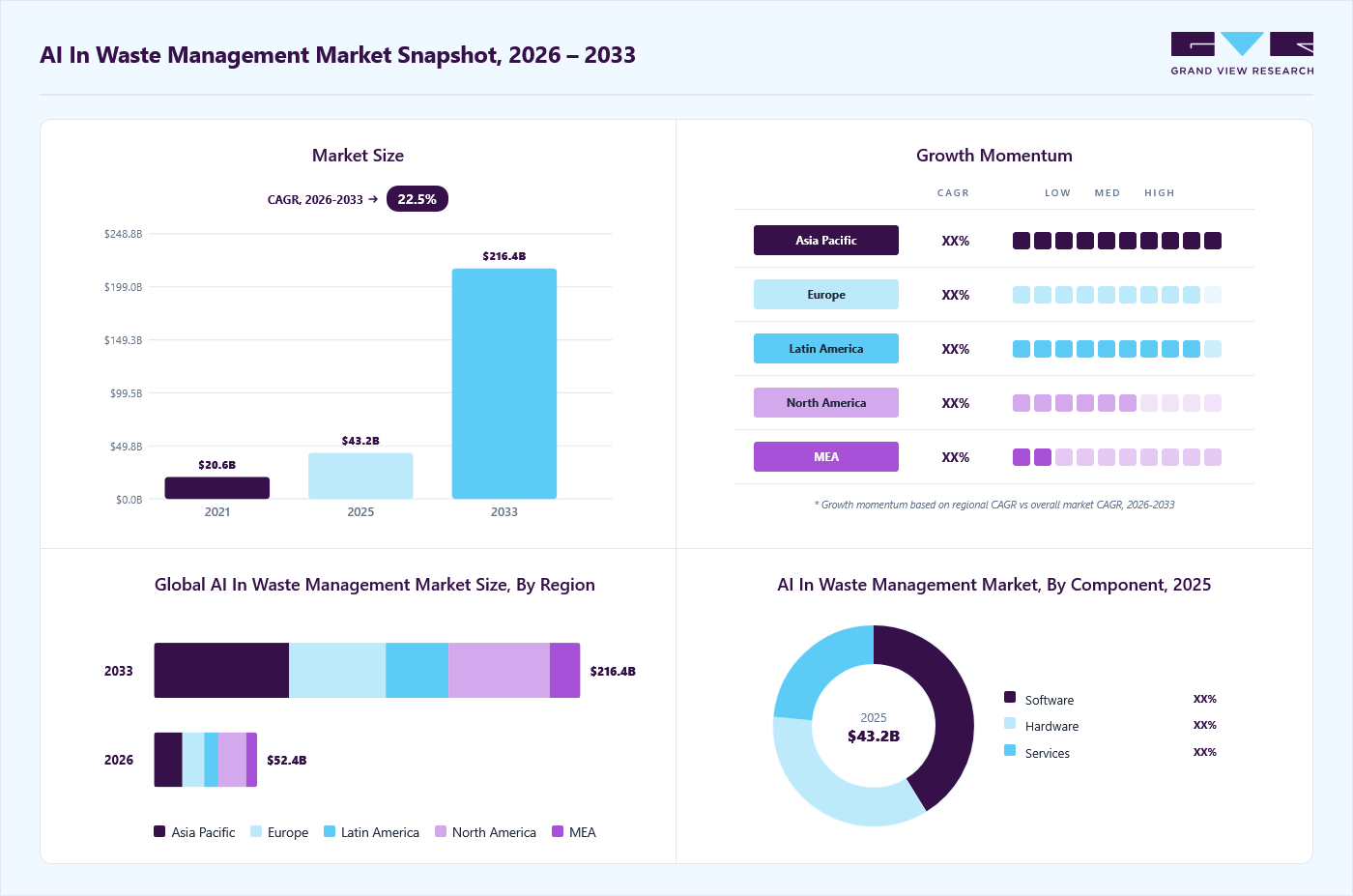 Source: Grand View Research, IR Documents, Primary Interviews, Paid DatabasesTo learn more about this report,
 Download Free Sample Report
 Key Market Trends & Insights
- By component: The software segment led the market and held the largest revenue share of 41.2% in 2025.
- By waste type: Industrial waste held the dominant position in the market and accounted for the leading revenue share of 34.7% in 2025.
- By end-use: The recycling companies / MRFs segment is expected to grow at the significant CAGR of 26.8% from 2026 to 2033.
Regional Highlights
- Largest regional market: North America (27.3% revenue share, 2025)
- Fastest-growing regional market: Asia Pacific (highest CAGR, 2026-2033)
- The AI in waste management industry in the U.S. held the largest revenue share in 2025.
Market Size & Forecast
- Market size in 2025: USD 43.2 Billion
- Estimated market size in 2026: USD 52.4 Billion
- Projected market size by 2033: USD 216.4 Billion
- CAGR (2026-2033): 22.5%
Three ways to get this report
Buy it, customize it, or ask a question.Ask an Analyst
Analyst response in 1 business day
- AccessReport author, directly
- Reply timeWithin 1 working day
- No sales callDirect answer only
- FormatEmail reply
- CostFree, no cost
Get the Full Report
What the study covers
- FormatsPDF · Excel · Dashboard
- Timeline2026–2033 annual, 2025 base
- Coverage20+ countries, 5 regions
- Companies10+ key players profiled
Customize the Report
20% free customization
- IncludeCountries, segments, points
- TailorTo your product definition
- ExtendDeeper competitor detail
- OrA fully bespoke study
- Turnaround5–10 working days
The global shift toward sustainable cities is encouraging municipalities to integrate automation and predictive analytics into their waste infrastructure. Automated robotics powered by computer vision significantly reduces contamination in recycling streams. AI-powered sorting robots supports this transition by enabling high-precision waste identification and sorting, which improves material recovery quality. These improvements make recycling more economically viable, encouraging further adoption of AI solutions. Extended Producer Responsibility (EPR) policies are increasing the need for accurate waste data and traceability, which AI tools deliver effectively. As circular economy programs expand globally, AI technologies become a core enabler of scalable recycling solutions.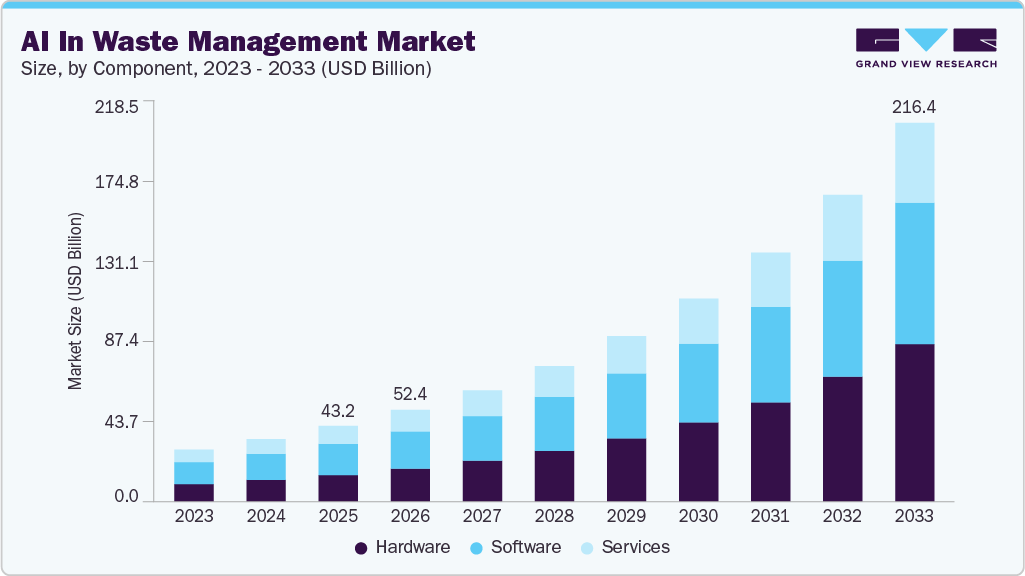 To learn more about this report, Download Free Sample Report
 Additionally, AI optimizes collection routes, reduces fuel consumption, and minimizes unplanned labor expenses. Predictive maintenance solutions help extend the lifespan of waste handling machinery and reduce downtime. Smart bin sensors integrated with AI analytics provide real-time insights that improve fleet performance and waste bin monitoring. These efficiencies translate into measurable cost savings, encouraging faster adoption of AI-driven platforms. Private contractors and municipal authorities increasingly rely on digital tools for budget management and operational planning.
Technological innovations are accelerating the adoption of AI in food waste management, making solutions more accurate, scalable, and affordable. Smart bin sensors embedded with IoT sensors provide continuous data streams for AI models to analyze and act upon. Improvements in cloud computing and edge AI allow real-time decision-making in field operations. As the cost of sensors and AI hardware declines, more municipalities and private operators can implement these technologies. Enhanced machine-learning models deliver deeper insights into waste composition and operational efficiency. These advancements drive rapid modernization of the AI in food waste management industry.
Component Insights
The software segment led the market and accounted for 41.2% of the global revenue in 2025. Waste tracking platforms are experiencing growth due to the need for precise data on waste generation, disposal routes, waste landfills and material recovery rates. For instance, in February 2025, BRE introduced SmartWaste Scan, an AI-powered waste management platform. This upgrade enables rapid extraction and verification of data from waste tickets and material notes using Optical Character Recognition and Machine Learning, resulting in a 24% reduction in document processing time, improved operational efficiency, enhanced compliance, and seamless integration for real-time updates and data sharing.
The hardware segment is predicted to foresee significant growth in the forecast period. The segment is driven by the cost reduction in sensors and IoT modules, making smart bin sensors installation more feasible across commercial and public spaces. Integrated sensors enable real-time fill-level detection, supporting data-driven scheduling and operational planning. For instance, in November 2025, Max-R partnered with Intuitive AI to launch an AI-driven smart bin sensors. This partnership enables Max-R to deploy Intuitive AI’s Oscar Sort technology across its sustainable bin infrastructure, enhancing waste sorting accuracy, increasing recycling rates, and expanding data-driven sustainability practices for properties such as airports, universities, and entertainment venues.
Technology Insights
The IoT + AI (AIoT) segment accounted for the largest market revenue share in 2025. The market is driven by the operators seeking continuous visibility into waste movement and facility performance. Sensor-enabled systems provide real-time data that supports predictive analytics, route optimization, and bin-level monitoring. Growing interest in digital waste infrastructure and wastelandfills is driving the integration of connected devices across municipal and industrial environments. Enhanced interoperability between sensors, cloud platforms, and AI models is improving the accuracy of decision-making across waste landfills. These capabilities encourage broader use of AIoT solutions for efficient and transparent waste operations.
The robotics & automation segment is predicted to foresee significant growth in the forecast period. The market is gaining traction due to rising labor shortages and the need for higher processing accuracy. AI-powered sorting robots improve throughput by identifying, sortingand segregating diverse waste types at high speed. For instance, in September 2024, Pudu Robotics launched the PUDU MT1, an AI-powered robotic sweeper designed for large-scale, professional-grade dry cleaning of areas up to 100,000 square meters. It offers a cleaning width of 70 cm, a 35-liter trash bin, and operates continuously with long runtime and fast charging.
Waste Type Insights
The industrial waste segment accounted for the largest market revenue share in 2025. The market is driven by the large adoption of AI-driven systems to manage rising waste volumes and comply with stricter regulatory standards. Integration of AI with on-site sensors enables continuous assessment of waste streams and faster response to anomalies. For instance, in October 2025, Diversys Software Inc. launched Diversys.ai, an AI waste data platform to support waste and resource recovery organizations. Diversys.ai features VERA, an AI assistant that helps forecast material volumes, optimize resource allocation, identify anomalies, and generate real-time reports ready for regulators and boards.
The E-waste segment is predicted to foresee significant growth in the forecast period. The market is gaining traction due to the rising need for AI-based sorting, which enhances the recovery of valuable metals and components that are difficult to identify through manual methods with the help of AI-powered sorting robots. Advanced detection technologies reduce contamination and improve extraction quality in recycling facilities. For instance, in September 2025, Taiwan collaborated with global partners to address challenges and promote circular economy principles in e-waste handling. The efforts included leveraging advanced recycling technologies and reinforcing policy frameworks to improve resource recovery and environmental sustainability.
Application Insights
The smart waste collection segment held the highest market share of the global revenue in 2025. Integration of sensors with cloud platforms enhances visibility across collection points and supports faster operational decisions. For instance, in August 2025, the City of Tacoma, Washington, partnered with Prairie Robotics to launch a two-year trial project aimed at reducing contamination in residential recycling streams through AI-enabled smart cameras mounted on recycling trucks and integrating with existing waste management technologies to enhance recycling accuracy and service efficiency.
The automated sorting & recycling segment is predicted to foresee significant growth in the forecast period. The market is driven by higher throughput and reduced material contamination. For instance, in November 2025, Max-AI and Danieli Centro Recycling partnered to advance automation in metal recycling and processing lines to enable real-time identification and separation of contaminants in metal scrap streams. This partnership improves material recovery rates, enhances scrap purity, and reduces manual handling, supporting cleaner, safer, and more efficient recycling operations.
End Use Insights
The municipal bodies/city authorities segment accounted for the largest revenue share in 2025. Municipal authorities are integrating AI to improve collection efficiency and manage rising urban waste volumes. Smart city programs are encouraging the adoption of digital systems that enhance visibility across public waste networks. For instance, in June 2025, AIRAWAT Research Foundation and eGov Foundation partnered to develop AI applications for city management and citizen services in India. The collaboration focuses on practical solutions, including faster processing of citizen complaints, predictive maintenance of infrastructure, optimization of waste collection routes, and improved decision-making using urban data.
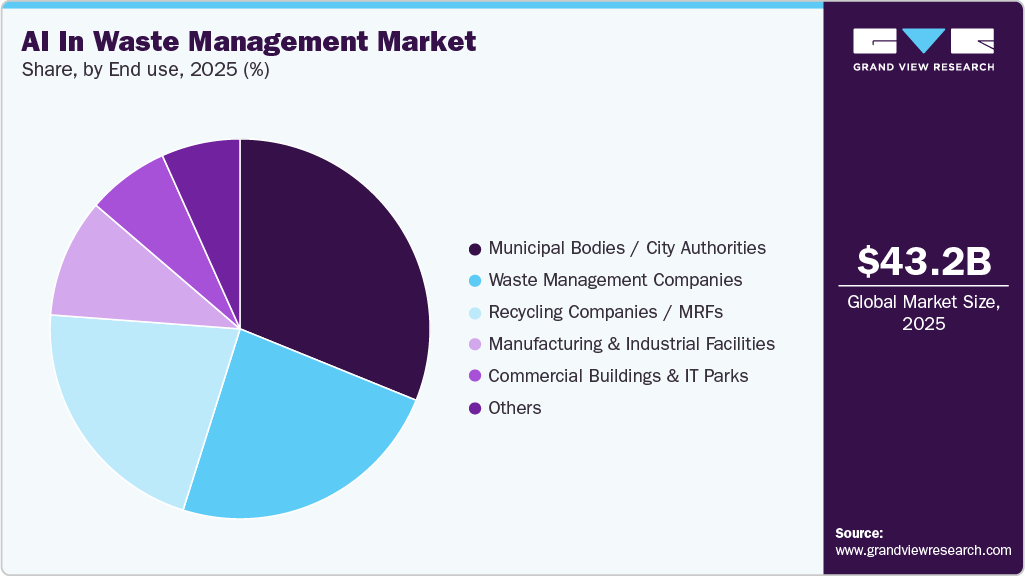 To learn more about this report, Download Free Sample Report
 The recycling companies / MRFs segment is projected to grow significantly over the forecast period. The segment is driven by the higher demand for consistent recyclate quality, which is driving investments in AI-powered sorting robots and quality control systems. For instance, in November 2025, Tetra Pak made an investment of USD 1.83 million in the U.K. to enhance food and beverage carton sorting across multiple materials recycling facilities (MRFs). The initiative included the installation of AI-driven optical sorting technology developed with Recycleye, which uses cameras and AI to identify and separate cartons from mixed waste streams, achieving over 98% purity.
Regional Insights
North America AI in waste management market dominated with 27.3% revenue share in 2025. North America is advancing AI adoption due to strong investment in digital infrastructure across municipal,industrial and food waste management. High waste generation per capita is increasing interest in automated monitoring and route optimization tools. Technology providers in the region are developing advanced computer vision and AI-powered robots for large-scale recycling plants. Regulatory pressure to improve waste landfills diversion rates is strengthening demand for data-centric waste operations. Public-private collaborations are also accelerating the rollout of connected waste platforms.
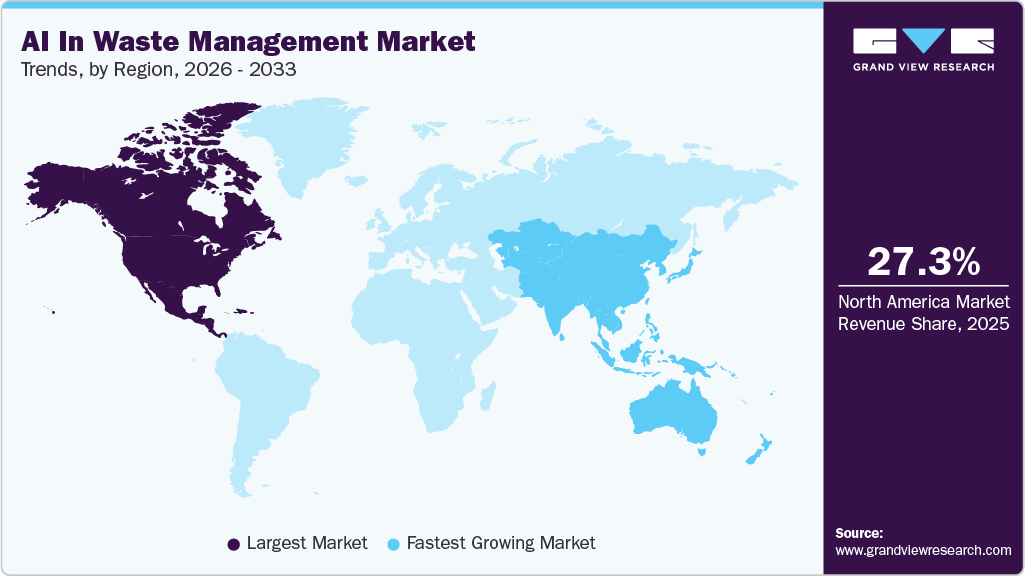 To learn more about this report, Download Free Sample Report
 U.S. AI In Waste Management Market Trends
The AI in waste management market in the U.S. is progressing due to strong demand for automation in recycling facilities facing labor shortages and rising processing costs. Municipal departments are integrating AI systems to modernize legacy collection networks and improve transparency in waste handling. Corporate sustainability commitments are encouraging enterprises to adopt advanced waste tracking and reporting tools majorly in AI in food waste management. Technology innovation from domestic AI, robotics, and IoT companies is accelerating the deployment of intelligent AI food waste management. State-level policies promoting waste landfill diversion and recycling efficiency are further influencing the market.
Europe AI In Waste Management Market Trends
The AI in waste management market in Europe is witnessing growth through stringent recycling directives and strict enforcement of circular economy policies. Member states are prioritizing AI-powered sorting robots to improve the purity levels of recyclate and reduce dependency on virgin materials. Strong government funding for sustainability programs is encouraging investment in AI in food waste management. Urban centers are adopting smart bin sensors and real-time tracking to enhance collection efficiency. A mature environmental compliance framework further supporting adoption of advanced waste analytics.
Asia Pacific AI In Waste Management Market Trends
The AI in waste management market in Asia Pacific is expected to witness the highest CAGR over the forecasted period, as the market expansion is due to the rapid expansion of AI-based waste solutions due to rising urban density and escalating waste volumes. Large cities are adopting intelligent routing and sensor-enabled collection models to manage growing operational burdens. Industrial zones in the region are integrating AI analytics to control hazardous and high-volume waste streams. Increasing emphasis on environmental monitoring is driving the uptake of automated sorting and contamination detection systems. Expansion of smart city initiatives is reinforcing demand for digital waste technologies such as smart bin sensors and AI in food waste management in the region.
Key AI In Waste Management Company Insights
Key players operating in the AI in waste management market are undertaking various initiatives to strengthen their presence and increase the reach of their products and services. Strategies such as expansion activities and partnerships are key in propelling the market growth. Some key companies in the industry are AMP Robotics, SUEZ, Waste Management, Inc., and Greyparrot.
-
AMP Robotics develops AI-driven automation systems that support material identification, sorting, and recovery across recycling facilities. The company focuses on applying computer vision and machine-learning models to classify complex waste streams with high accuracy. AMP offers modular robotic platforms designed for varied waste categories, including plastics, metals, and fiber. The company also provides software tools that deliver real-time performance data and operational insights. Its technology supports recycling operators seeking to enhance processing efficiency and material purity levels.
-
Waste Management, Inc. operates a large network of collection, waste landfill, recycling, and resource recovery facilities across residential, commercial, and industrial segments. The company focuses on integrating digital tools and AI-based solutions to enhance collection planning, operational visibility, and recycling performance. Its recycling division utilizes automated systems for material sorting and contamination reduction, supported by in-house technology initiatives. Waste Management also provides consultation services for waste reduction and compliance management.
Key AI In Waste Management Companies:
The following key companies have been profiled for this study on the AI in waste management market.
- AMP Robotics
- CleanRobotics Inc.
- Greyparrot
- Recycleye
- Republic Services, Inc.
- Rubicon Technology
- SUEZ
- Veolia
- Waste Management, Inc.
- ZenRobotics Ltd. (Terex)
Recent Developments
-
In April 2025, WM announced the opening of new modernized high-tech recycling and renewable natural gas (RNG) facilities across the U.S. as part of a $3 billion investment strategy spanning 2022 to 2026. The company completed eight out of 20 planned RNG facilities and 27 out of 39 planned recycling facilities, incorporating advanced technology including artificial intelligence and automation to enhance material recovery and processing capacities.
-
In February 2025, Veolia and Mistral AI partnered to transform the management and monitoring of industrial sites focused on water management, waste recycling, and local energy production. The partnership integrates Mistral's generative AI technology, including its Large Language Model, with Veolia’s extensive data and expertise to enable interactive, real-time communication with plant operations.
-
In May 2024, Waste Robotics collaborated with Greyparrot, to integrate Greyparrot's AI camera system, the Greyparrot Analyzer, to characterize waste streams and analyze the performance and cost of robotic sorting systems. This collaboration, called the Robot Validator, supports data-driven sorting solutions aimed at maximizing return on investment and operational efficiency across various waste management sectors.
-
In February 2024, Bollegraaf and Greyparrot partnered and made an investment of USD 12.8 million to acquire a non-controlling stake. The partnership aims to retrofit thousands of existing recycling facilities with advanced AI capabilities, enhancing recycling rates and enabling real-time, detailed insights into waste composition.
AI In Waste Management Market Report Scope
Report Attribute
Details
Market size in 2025
USD 43.2 Billion
Estimated market size in 2026
USD 52.4 billion
Projected market size by 2033
USD 216.4 billion
Growth rate
CAGR of 22.5% from 2026 to 2033
Base year for estimation
2025
Actual data
2021 - 2024
Forecast period
2026 - 2033
Quantitative units
Revenue in USD million/billion and CAGR from 2026 to 2033
Report coverage
Revenue forecast, company ranking, competitive landscape, growth factors, and trends
Segments covered
Component, technology, waste type, application, end-use, region
Regional scope
North America; Europe; Asia Pacific; Latin America; MEA
Country scope
U.S.; Canada; Mexico; UK; Germany; France; China; Japan; India; South Korea; Australia; Brazil; KSA; UAE; South Africa
Key companies profiled
AMP Robotics; CleanRobotics Inc.; Greyparrot; Recycleye; Republic Services, Inc.; Rubicon Technology; SUEZ; Veolia; Waste Management, Inc.; ZenRobotics Ltd. (Terex)
Customization scope
Free report customization (equivalent up to 8 analysts working days) with purchase. Addition or alteration to country, regional & segment scope.
Pricing and purchase options
Avail customized purchase options to meet your exact research needs. Explore purchase options
Global AI In Waste Management Market Report Segmentation
This report forecasts revenue growth at global, regional, and country levels and provides an analysis of the latest industry trends in each of the sub-segments from 2021 to 2033. For this study, Grand View Research has segmented the global AI in waste management market report based on component, technology, waste type, application, end use, and region:
-
Component Outlook (Revenue, USD Billion, 2021 - 2033)
-
Software
-
Hardware
-
Services
-
-
Technology Outlook (Revenue, USD Billion, 2021 - 2033)
-
Machine Learning
-
Computer Vision
-
IoT + AI (AIoT)
-
Robotics & Automation
-
Big Data Analytics
-
Others
-
-
Waste Type Outlook (Revenue, USD Billion, 2021 - 2033)
-
Industrial Waste
-
Plastic Waste
-
Hazardous Waste
-
E-waste
-
Others
-
-
Application Outlook (Revenue, USD Billion, 2021 - 2033)
-
Smart Waste Collection
-
Automated Sorting & Recycling
-
Waste Monitoring & Tracking
-
Waste Generation Forecasting
-
Others
-
-
End Use Outlook (Revenue, USD Billion, 2021 - 2033)
-
Municipal Bodies / City Authorities
-
Waste Management Companies
-
Recycling Companies / MRFs
-
Manufacturing & Industrial Facilities & Industrial Facilities
-
Commercial Buildings & IT Parks
-
Others
-
-
Regional Outlook (Revenue, USD Billion, 2021 - 2033)
-
North America
-
U.S.
-
Canada
-
Mexico
-
-
Europe
-
UK
-
Germany
-
France
-
-
Asia Pacific
-
China
-
Japan
-
India
-
South Korea
-
Australia
-
-
Latin America
-
Brazil
-
-
Middle East and Africa (MEA)
-
KSA
-
UAE
-
South Africa
-
-
Frequently Asked Questions About This Report
The global AI in waste management market is expected to grow at a compound annual growth rate of 22.5% from 2026 to 2033, reaching USD 216.4 billion by 2033.
Some key players operating in the AI in waste management market include AMP Robotics; CleanRobotics Inc.; Greyparrot; Recycleye; Republic Services, Inc.; Rubicon Technology; SUEZ; Veolia; Waste Management, Inc.; ZenRobotics Ltd. (Terex)
The global AI in waste management market size was estimated at USD 43.2 billion in 2025 and is expected to reach USD 52.4 billion in 2026.
North America dominated the market, accounting for over 27.3% in 2025.
Key factors driving the AI in waste management market growth include increasing waste generation, rising demand for operational efficiency, growing focus on sustainability, and advancements in AI-driven automation, while key trends include AI-powered waste sorting, predictive route optimization, IoT-enabled smart waste monitoring, and adoption of circular economy practices.
The software segment led with a revenue share 41.2% in 2025.
Industrial waste segment held the largest revenue share 34.7% in 2025.
Municipal bodies/city authorities segment held the largest share in 2025.
Asia Pacific is the fastest-growing region over the forecast period.
About the Author(s)
Next Generation Technologies Research Team
Technology · Next Generation TechnologiesThis report was authored by the next generation technologies research team at Grand View Research - comprising two research analysts, one senior research analyst, and one industry expert - with specialized expertise in the next generation technologies segment of the technology industry. All findings are based on proprietary technology databases, executive interviews, and regulatory analysis, subject to internal peer review prior to publication.
Last Updated:
Speak to Analyst

Customize this report to your needs - add regions, segments, or data points, with 20% free customization.
Or view our licence options:


ISO 9001:2015 & 27001:2022 Certified
We are GDPR and CCPA compliant! Your transaction & personal information is safe and secure. For more details, please read our privacy policy.


