
- Home
- »
- Advanced Interior Materials
- »
-
Air Conditioning And Ventilation System Market Report, 2026-2033GVR Report cover

Air Conditioning And Ventilation System Market (2026 - 2033)
Size, Share & Trends Analysis Report By Product (Air Conditioning System, Ventilation System), By Application (Commercial, Industrial), By Region (North America, Europe, APAC, MEA), And Segment Forecasts
Market Size, 2025
$30.2BMarket Estimate, 2026
$31.3BMarket Forecast, 2033
$43.4BCAGR, 2026–2033
4.8%Air Conditioning And Ventilation System Market Summary
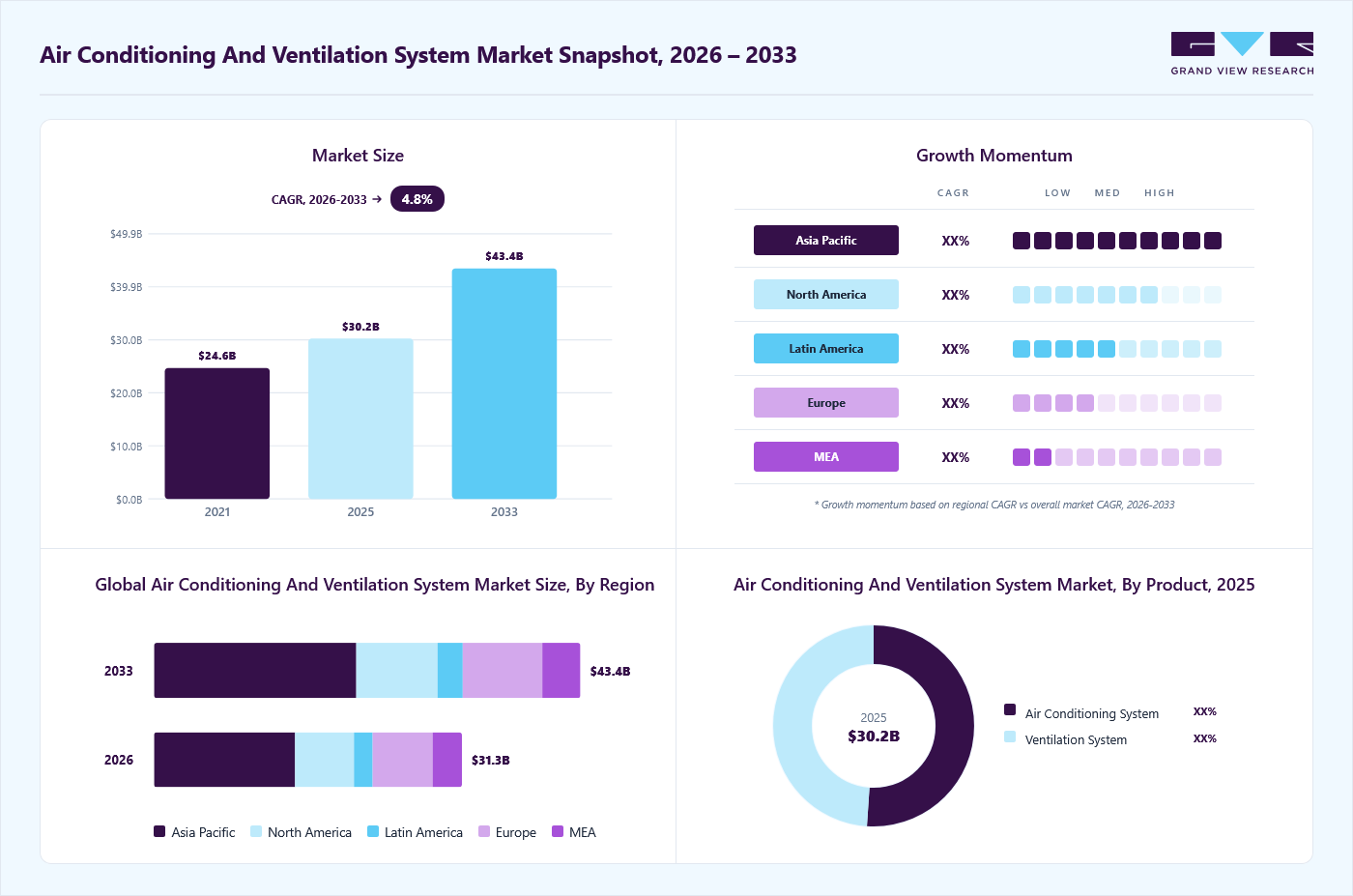
The global air conditioning and ventilation system market size was valued at USD 30.2 billion in 2025 and is projected to grow from USD 31.3 billion in 2026 to USD 43.4 billion by 2033, at a CAGR of 4.8% from 2026 to 2033. The market in Asia Pacific dominated with a revenue share of 45.6% in 2025. The market is being driven by rising temperatures and more frequent heatwaves, which are increasing the need for indoor cooling comfort.
 Source: Grand View Research, IR Documents, Primary Interviews, Paid DatabasesTo learn more about this report,
 Download Free Sample Report
 Key Market Trends & Insights
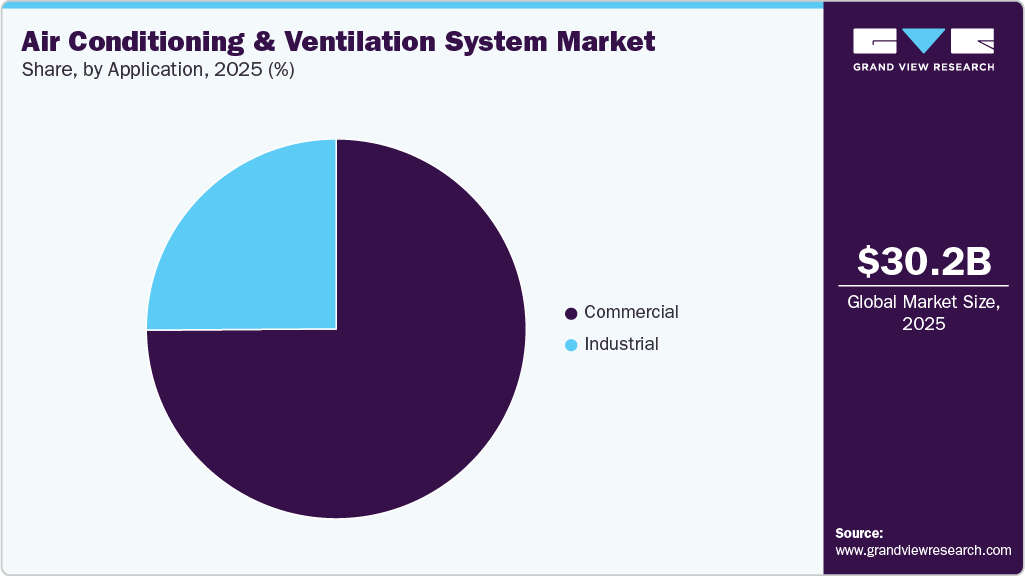
- By application: Commercial segment held the largest market share of 74.9% in 2025.
- By product: Air conditioning system segment held the largest market share of 51.0% in 2025.
Regional Highlights
- Largest regional market: Asia Pacific (45.6% revenue share, 2025)
- By country: China held the largest market share in 2025
Market Size & Forecast
- Market size in 2025: USD 30.2 Billion
- Estimated market size in 2026: USD 31.3 Billion
- Projected market size by 2033: USD 43.4 Billion
- CAGR (2026-2033): 4.8%
Three ways to get this report
Buy it, customize it, or ask a question.Ask an Analyst
Analyst response in 1 business day
- AccessReport author, directly
- Reply timeWithin 1 working day
- No sales callDirect answer only
- FormatEmail reply
- CostFree, no cost
Get the Full Report
What the study covers
- FormatsPDF · Excel · Dashboard
- Timeline2026–2033 annual, 2025 base
- Coverage20+ countries, 5 regions
- Companies10+ key players profiled
Customize the Report
20% free customization
- IncludeCountries, segments, points
- TailorTo your product definition
- ExtendDeeper competitor detail
- OrA fully bespoke study
- Turnaround5–10 working days
Rapid urbanization and the growth of residential, commercial, and industrial buildings are also boosting demand for efficient HVAC solutions. In addition, stricter energy-efficiency regulations and the shift toward smart, eco-friendly systems are encouraging the adoption of advanced air conditioning and ventilation technologies worldwide. To learn more about this report, Download Free Sample Report
 The shift toward sustainability and tighter environmental standards is driving higher investment in energy-efficient air conditioning and ventilation systems. Rising awareness of indoor air quality is also increasing the use of advanced ventilation solutions across commercial, institutional, and public spaces. After the pandemic, a greater focus on health and hygiene has driven wider adoption of fresh-air exchange systems, efficient filtration, and smart ventilation controls. This is particularly important in places such as hospitals, laboratories, airports, and large buildings, where maintaining clean, controlled air remains essential.
Market Concentration & Characteristics
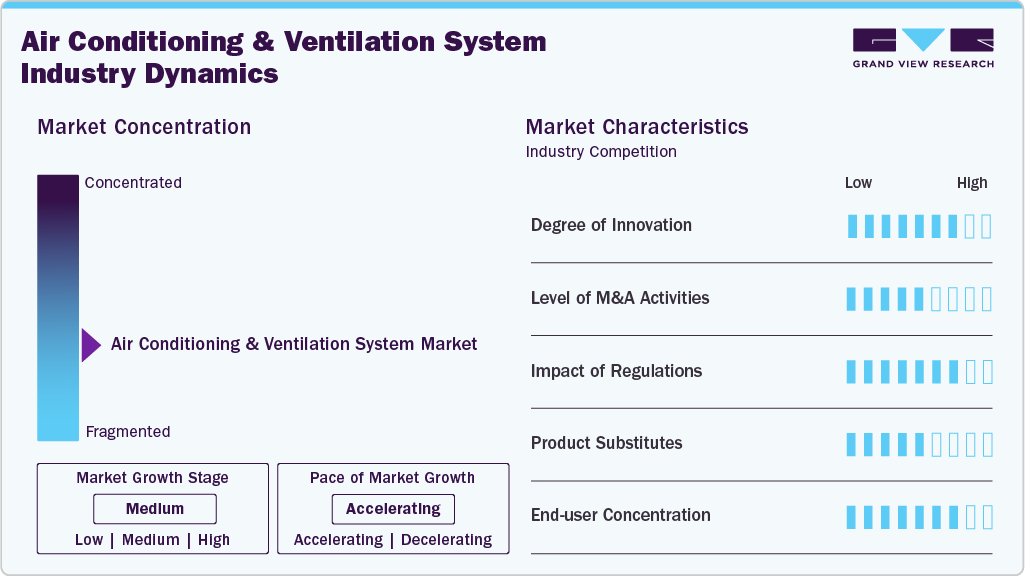
Market concentration in the air conditioning and ventilation industry reflects a consolidated structure, with a limited number of multinational corporations holding a significant share of the market. These companies benefit from strong technological capabilities, established global supply chains, and long-standing customer relationships across multiple end-use sectors. Their ability to operate at scale supports consistent product availability and reinforces their leadership position across both developed and emerging economies.
A sizeable presence of regional and mid-sized manufacturers contributes to competition across various geographies. These firms typically operate within defined markets, focusing on localized demand, pricing flexibility, and solutions adapted to regional climatic and construction requirements. While their individual market share is comparatively smaller, their collective role adds fragmentation and ensures competitive pricing across several segments of the industry. Growing urban development and infrastructure expansion in emerging economies are also creating more opportunities for these players to strengthen their position.
 To learn more about this report, Download Free Sample Report
 High entry barriers continue to shape the competitive landscape, driven by capital-intensive production processes, technical complexity, and strict compliance requirements. Sustained investment in research and development is necessary to meet evolving standards in energy efficiency, refrigerant usage, and system automation. This environment naturally supports established companies with strong engineering expertise and financial stability, limiting large-scale disruption from new entrants. In addition, the need for global supply chain integration and after-sales service capabilities further reinforces the advantage of incumbents.
Regulatory influence and sustainability expectations play a central role in shaping industry behavior. Policies related to energy conservation, emissions control, and indoor air quality are increasingly guiding product innovation and adoption. As a result, manufacturers are focusing on advanced system efficiency, environmentally compliant technologies, and improved air management solutions to align with long-term environmental and operational standards. Increasing emphasis on green buildings and smart infrastructure is further accelerating the shift toward next-generation HVAC systems.
Drivers, Opportunities & Restraints
Rising temperatures across regions and the growing intensity of heatwaves are steadily increasing the need for air conditioning and ventilation systems in homes, offices, and industrial facilities. Rapid urban expansion, large-scale construction, and infrastructure development are also driving the wider adoption of HVAC solutions in both developed and developing economies. In addition, rising awareness of indoor comfort and air quality, especially in densely populated cities, is further supporting market demand. The expansion of commercial spaces, such as shopping complexes, office buildings, and hospitality infrastructure, is also contributing to the sustained use of advanced cooling and ventilation systems.
Opportunities are emerging as the shift toward energy-efficient technologies and smarter building climate solutions gains momentum. Demand for inverter-based air conditioners, automated ventilation controls, and IoT-enabled monitoring systems is increasing as end users look to reduce energy consumption and improve operational efficiency. Growth in green building projects, sustainable construction practices, and modernization of older infrastructure is also creating space for advanced HVAC installations. Industrial sectors such as healthcare, pharmaceuticals, and data centers are increasingly adopting high-performance ventilation systems to maintain controlled environments, thereby broadening the application scope.
Market restraints are mainly linked to high upfront installation costs and ongoing maintenance requirements associated with advanced HVAC systems. Compliance with evolving energy-efficiency norms and environmental regulations adds further pressure on manufacturers, requiring continuous product upgrades and ongoing certification processes. Variability in raw material prices and supply chain disruptions can also affect production costs and pricing stability. In price-sensitive markets, these factors sometimes slow adoption, particularly among small-scale users and in developing regions, where budget constraints remain a key consideration.
Product Insights
The air conditioning systems segment led the market with the largest revenue share of 51.02% in 2025. This dominance is driven by strong demand across residential, commercial, and industrial spaces, supported by rising temperatures, rapid urbanization, and increasing focus on indoor comfort. Continuous upgrades in energy-efficient and smart cooling technologies are also reinforcing their widespread adoption across large infrastructure projects.
The ventilation systems segment is expected to record at the fastest CAGR over the forecast period, supported by growing attention to indoor air quality and healthy building environments. Increased usage in offices, hospitals, airports, and other public facilities is being driven by stricter building standards and rising awareness of air hygiene. Demand is further supported by the shift toward sustainable infrastructure and the need for better air circulation and filtration in modern spaces.
Application Insights
The commercial segment accounted for the largest market revenue share in 2025 and is projected to grow at the fastest CAGR during the forecast period, supported by widespread use across office buildings, retail spaces, shopping complexes, hotels, and educational institutions. These environments rely heavily on centralized HVAC systems to maintain consistent indoor temperatures, ensure occupant comfort, and support energy-efficient building operations. Growing commercial infrastructure and increasing emphasis on indoor air quality are further strengthening demand in this segment.
 To learn more about this report, Download Free Sample Report
 The industrial segment is anticipated to grow at a significant CAGR during the forecast period, driven by the growing need for temperature control, air quality management, and worker safety across manufacturing and processing facilities. Industries such as automotive, food & beverage, pharmaceuticals, chemicals, electronics, and heavy machinery increasingly rely on advanced HVAC and ventilation systems to maintain controlled operating environments and comply with workplace safety regulations.
Regional Insights
The North America is supported by mature infrastructure, high HVAC adoption levels, and a strong emphasis on energy-efficient building operations. Demand is consistently driven by varying climatic conditions across the region, which the air conditioning and ventilation system industry must meet with reliable cooling and ventilation systems in residential, commercial, and institutional spaces. The market is also witnessing a steady shift toward smart HVAC technologies, including automated controls, advanced air filtration systems, and integrated building management solutions aimed at improving energy performance and indoor comfort.
U.S. Air Conditioning And Ventilation System Market Trends
The air conditioning and ventilation system market in the U.S. accounted for a significant share of North America's market in 2025. Market trends are influenced by large-scale commercial construction, expanding data center capacity, and continuous replacement of aging HVAC systems. Regulatory pressure on energy efficiency and emissions reduction is driving the adoption of high-efficiency equipment and low-GWP refrigerants. In addition, growing focus on indoor air quality in offices, hospitals, and public infrastructure is accelerating demand for advanced ventilation systems and air purification technologies across end-use sectors.
The Mexico air conditioning and ventilation system market development is being supported by rapid urban expansion, rising residential construction, and increasing investments in commercial infrastructure such as retail centers, hospitality projects, and office spaces. Warm climatic conditions across many regions continue to drive strong reliance on air conditioning systems. At the same time, increasing awareness of energy consumption and indoor environmental quality is gradually promoting the adoption of modern, cost-efficient HVAC and ventilation solutions, particularly in urban developments and newly constructed buildings.
Europe Air Conditioning And Ventilation System Market Trends
The air conditioning and ventilation system market in Europe is shaped by strict environmental regulations, stringent energy-efficiency standards, and a gradual shift toward low-carbon building solutions. Demand is supported by rising focus on indoor air quality and controlled ventilation in commercial, residential, and institutional buildings. Ventilation systems hold a relatively stronger position in the region due to building design preferences and long-standing emphasis on energy conservation.
The Germany air conditioning and ventilation system market is highly regulated and technology-oriented, supported by a strong industrial base and the continuous modernization of building infrastructure. Policy focus on energy transition and emission reduction is encouraging adoption of heat pumps, high-efficiency HVAC systems, and advanced ventilation solutions. Industrial and commercial facilities are upgrading to integrated systems that improve energy performance while aligning with environmental compliance requirements.
The air conditioning and ventilation system market in the UK is driven by urban redevelopment, net-zero carbon targets, and increased investment in modern infrastructure. Demand is concentrated in commercial real estate, healthcare facilities, and data centers, where efficient cooling and air management are essential for operations. Greater attention to indoor air quality is also supporting wider installation of ventilation and air purification systems across public and private buildings.
Asia Pacific Air Conditioning And Ventilation System Market Trends
Asia Pacific dominated the global air conditioning and ventilation system market with the largest revenue share of 45.6% in 2025 and is projected to grow at the fastest CAGR during the forecast period, supported by rapid urban development, large-scale infrastructure expansion, and growing commercial construction activity. Demand is further influenced by rising population density in major cities and increasing requirements for indoor thermal comfort across residential and commercial buildings. At the same time, ventilation systems are gaining importance as awareness of indoor air quality and health-focused building design practices grows.
 To learn more about this report, Download Free Sample Report
 The China air conditioning and ventilation system market accounted for the largest market share in Asia Pacific in 2025, driven by large-scale urbanization, ongoing real estate development, and the extensive deployment of smart city projects. High-rise commercial buildings, industrial parks, and public infrastructure projects are creating sustained demand for centralized HVAC systems. The government focuses on energy efficiency and emission reduction, and is also encouraging the adoption of advanced air conditioning technologies, including intelligent climate control and low-energy consumption systems.
The air conditioning and ventilation system market in India is anticipated to grow at the fastest CAGR during the forecast period, supported by expanding urban housing, rising disposable income, and increasing construction of commercial spaces such as offices, retail centers, and hospitality projects. Hot climatic conditions across many regions continue to drive strong reliance on cooling systems. In addition, increased focus on sustainable construction practices and improved awareness of indoor air quality are supporting the gradual adoption of modern ventilation and energy-efficient HVAC solutions in both new and existing buildings.
Middle East & Africa Air Conditioning And Ventilation System Market Trends
The air conditioning and ventilation system market in the Middle East & Africa is largely shaped by extreme climatic conditions and ongoing infrastructure expansion across urban and semi-urban areas. Continuous development of residential communities, commercial districts, and public infrastructure is sustaining strong demand for cooling systems across the region. At the same time, ventilation systems are receiving greater attention as modern construction practices increasingly incorporate requirements for improved indoor air quality, energy efficiency, and effective airflow management.
The Saudi Arabia air conditioning and ventilation system market remains one of the most prominent contributors to regional demand, supported by large-scale development programs, tourism-oriented projects, and long-term urban transformation initiatives. High temperature conditions throughout the year maintain consistent dependence on air conditioning systems across residential, commercial, and industrial applications. Expanding construction activity in airports, hospitality projects, office developments, and mixed-use complexes is further encouraging the deployment of advanced HVAC systems, with growing integration of energy-efficient and digitally controlled technologies.
Latin America Air Conditioning And Ventilation System Market Trends
The air conditioning and ventilation system market in Latin America is supported by rising urban development, expanding construction activity, and increasing demand for indoor comfort across residential and commercial buildings. Warm, humid conditions across several parts of the region continue to drive steady adoption of air conditioning systems. At the same time, growing awareness of indoor air quality and energy efficiency is gradually encouraging the integration of modern ventilation systems in commercial spaces, healthcare facilities, and public infrastructure.
The Brazil air conditioning and ventilation system market accounts for a significant share in Latin America in 2025, driven by strong urban population growth, infrastructure expansion, and continuous development in residential and commercial construction. Persistent high temperatures across the country sustain reliance on air conditioning systems in multiple end-use sectors. Growth in retail, hospitality, and corporate infrastructure is further supporting HVAC installations, while increasing focus on energy-efficient solutions is encouraging a gradual transition toward advanced and cost-effective cooling and ventilation technologies.
Key Air Conditioning And Ventilation System Company Insights
Some of the key players operating in the market include Daikin Industries, Ltd., Carrier Global Corporation, Trane Technologies plc, MITSUBISHI ELECTRIC CORPORATION Holding A/S, Panasonic Holdings Corporation
-
Daikin Industries, Ltd. is one of the leading global manufacturers of air conditioning, ventilation, heating, refrigeration, and indoor air quality systems for residential, commercial, and industrial applications. The company offers a broad portfolio including VRF systems, chillers, heat pumps, air purifiers, and ventilation equipment. Daikin has a strong international presence across Asia Pacific, North America, Europe, and the Middle East, supported by extensive manufacturing and R&D operations. The company is widely recognized for its focus on energy-efficient HVAC technologies and sustainable cooling solutions.
-
Carrier Global Corporation is a major provider of HVAC, refrigeration, ventilation, and smart building technologies serving residential, commercial, industrial, and transportation sectors. Its product portfolio includes air conditioners, chillers, ventilation systems, transport refrigeration units, and automated building management solutions. Carrier focuses on advanced climate control, energy management, and sustainable cooling technologies, with its systems widely used in healthcare facilities, offices, retail spaces, warehouses, and industrial infrastructure projects globally.
Key Air Conditioning And Ventilation System Companies:
The following key companies have been profiled for this study on the air conditioning and ventilation system market.
- Daikin Industries, Ltd.
- Carrier Global Corporation
- Trane Technologies plc
- JOHNSON CONTROLS INTERNATIONAL PLC
- MITSUBISHI ELECTRIC CORPORATION
- Systemair AB
- Lennox International Inc
- Gree Electric Appliances Inc. of Zhuhai
- Midea Group Co., Ltd.
- Blue Star Limited
- Panasonic Holdings Corporation
- LG Electronics Inc.
- SAMSUNG ELECTRONICS CO., LTD
- Haier Smart Home Co., Ltd
Recent Developments
-
In February 2026, Trane Technologies plc launched the new all-electric Air-to-Water Thermafit Modular Heat Pump System designed for commercial and industrial buildings. The system was developed to deliver high energy efficiency and flexible performance across varying building requirements. Its modular configuration allows customers to optimize capacity based on present operational demands while also enabling easy scalability for future infrastructure expansion. The launch supports the growing industry focus on sustainable HVAC technologies, electrification, and low-emission heating and cooling solutions.
-
In January 2025, Panasonic Corporation introduced the OASYS Residential Central Air Conditioning System in the U.S. market to strengthen its integrated home HVAC portfolio. The system combines air conditioning, ventilation, and airflow control technologies to maintain comfortable indoor temperatures, improve air quality, and reduce overall energy consumption in residential buildings. Developed for modern, energy-efficient homes, the solution uses heat-recovery ventilation and optimized airflow management to improve comfort and reduce heating and cooling costs.
Air Conditioning And Ventilation System Market Report Scope
Report Attribute
Details
Market size in 2025
USD 30.2 billion
Estimated market size in 2026
USD 31.3 billion
Projected market size by 2033
USD 43.4 billion
Growth rate
CAGR of 4.8% from 2026 to 2033
Base year for estimation
2025
Historical data
2021 - 2024
Forecast period
2026 - 2033
Quantitative units
Revenue in USD million/billion, and CAGR from 2026 to 2033
Report coverage
Revenue forecast, company ranking, competitive landscape, growth factors, and trends
Segments covered
Product, application, region
Regional scope
North America; Europe; Asia Pacific; Latin America; Middle East & Africa
Country scope
U.S.; Canada; Mexico; UK; Germany; France; Italy; Spain; China; Japan; India; Australia; South Korea; Brazil; Argentina; UAE; Saudi Arabia; South Africa
Key companies profiled
Daikin Industries, Ltd.; Carrier Global Corporation; Trane Technologies plc; JOHNSON CONTROLS INTERNATIONAL PLC; MITSUBISHI ELECTRIC CORPORATION; Systemair AB; Lennox International Inc.; Gree Electric Appliances Inc. of Zhuhai; Midea Group Co., Ltd.; Blue Star Limited; Panasonic Holdings Corporation; LG Electronics Inc.; SAMSUNG ELECTRONICS CO., LTD; Haier Smart Home Co., Ltd
Customization scope
Free report customization (equivalent up to 8 analysts working days) with purchase. Addition or alteration to country, regional & segment scope.
Pricing and purchase options
Avail customized purchase options to meet your exact research needs. Explore purchase options
Global Air Conditioning And Ventilation System Market Report Segmentation
This report forecasts revenue growth at global, regional, and country levels and provides an analysis of the latest industry trends in each of the sub-segments from 2021 to 2033. For this study, Grand View Research has segmented the global air conditioning and ventilation system market report based on product, application, and region:
 To learn more about this report, Download Free Sample Report
 -
Product Outlook (Revenue, USD Billion, 2021 - 2033)
-
Air Conditioning System
-
Package Air Conditioners
-
Split Air Conditioning Systems
-
Window Unit Air Conditioning System
-
Ductless Mini-Split Systems
-
-
Ventilation System
-
Air Purifier
-
Standalone/Portable
-
In-duct/Fixed
-
-
Air Handling Units
-
Modular AHU
-
Packaged AHU
-
-
Axial Fans
-
Roof Vents
-
Centrifugal Fans
-
Dehumidifier
-
Refrigerative Dehumidifier
-
Desiccant Dehumidifier
-
Electronic/Heat Pump Dehumidifier
-
-
-
-
Application Outlook (Revenue, USD Billion, 2021 - 2033)
-
Commercial
-
Retail Shops
-
Offices
-
Healthcare Facilities
-
Hospitality
-
Schools & Educational Institutions
-
Transport
-
Others
-
-
Industrial
-
Manufacturing
-
Data Centers
-
Others
-
-
-
Regional Outlook (Revenue, USD Billion, 2021 - 2033)
-
North America
-
U.S.
-
Canada
-
Mexico
-
-
Europe
-
Germany
-
France
-
Italy
-
UK
-
-
Asia Pacific
-
China
-
India
-
Japan
-
Australia
-
South Korea
-
-
Latin America
-
Brazil
-
Argentina
-
-
Middle East and Africa
-
Saudi Arabia
-
UAE
-
South Africa
-
-
Frequently Asked Questions About This Report
Asia Pacific dominated with a 45.6% revenue share in 2025.
The commercial segment led with a 74.9% revenue share in 2025, and is the fastest-growing application.
The global air conditioning and ventilation system market size was valued at USD 30.2 billion in 2025 and is estimated at USD 31.3 billion for 2026.
The global air conditioning and ventilation system market is expected to grow at a CAGR of 4.8% from 2026 to 2033, reaching USD 43.4 billion by 2033.
The air conditioning system segment led with a 51.0% revenue share in 2025, while ventilation system is the fastest-growing product.
Key players include Daikin Industries, Ltd.; Carrier Global Corporation; Trane Technologies plc; JOHNSON CONTROLS INTERNATIONAL PLC; MITSUBISHI ELECTRIC CORPORATION; Systemair AB; Lennox International Inc.; Gree Electric Appliances Inc. of Zhuhai; Midea Group Co., Ltd.; Blue Star Limited; Panasonic Holdings Corporation; LG Electronics Inc.; SAMSUNG ELECTRONICS CO., LTD; Haier Smart Home Co., Ltd.
Key factors driving the global air conditioning and ventilation system market include rapid urbanization, rising temperatures, and increasing demand for energy-efficient cooling systems. Government regulations promoting sustainability and reduced carbon emissions support adoption. Growth in commercial infrastructure and smart cities also contributes.
About the Author(s)
Advanced Interior Materials Research Team
Advanced Materials · Advanced Interior MaterialsThis report was authored by the advanced interior materials research team at Grand View Research - comprising two research analysts, one senior research analyst, and one industry expert - with specialized expertise in the advanced interior materials segment of the advanced materials industry. All findings are based on proprietary advanced materials databases, executive interviews, and regulatory analysis, subject to internal peer review prior to publication.
Last Updated:
Speak to Analyst

Customize this report to your needs - add regions, segments, or data points, with 20% free customization.
Or view our licence options:


ISO 9001:2015 & 27001:2022 Certified
We are GDPR and CCPA compliant! Your transaction & personal information is safe and secure. For more details, please read our privacy policy.


