
- Home
- »
- Next Generation Technologies
- »
-
Aircraft Health Monitoring Market Size Report, 2026-2033GVR Report cover

Aircraft Health Monitoring Market (2026 - 2033)
Size, Share & Trends Analysis Report By Solution (Hardware, Software, Services), By Platform (Civil Aviation, Military Aviation), By Fit (Line-Fit, Retrofit), By Technology, By Region, And Segment Forecasts
Market Size, 2025
$6.2BMarket Estimate, 2026
$6.6BMarket Forecast, 2033
$10.0BCAGR, 2026–2033
6.2%Aircraft Health Monitoring Market Summary
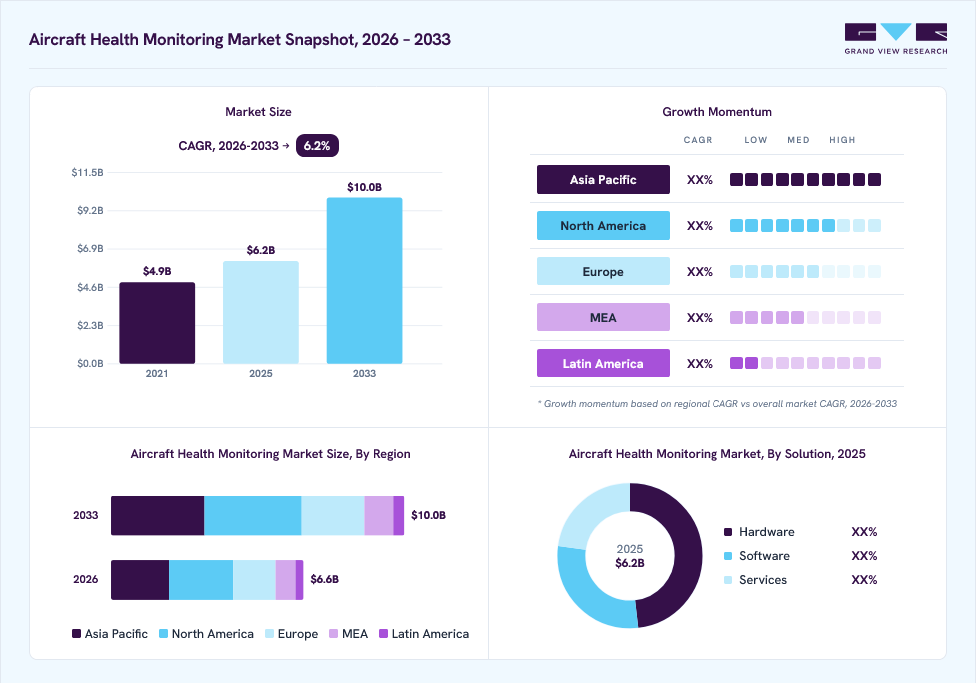
The global aircraft health monitoring market size was valued at USD 6.2 billion in 2025 and is projected to grow from USD 6.6 billion in 2026 to USD 10.0 billion by 2033, at a CAGR of 6.2% from 2026 to 2033. North America dominated the market, accounting for the largest revenue share 33.3% in 2025. The global Aircraft Health Monitoring Market is driven by rising adoption of real-time monitoring, diagnostic and prognostic systems, predictive maintenance, and condition-based maintenance solutions.
 Source: Grand View Research, IR Documents, Primary Interviews, Paid DatabasesTo learn more about this report,
 Download Free Sample Report
Key Market Trends & Insights
- By solution: Hardware segment led the market and held the largest revenue share of 48.1% in 2025.
- By platform: Civil aviation segment led the market and held the largest revenue share of 72.6% in 2025.
- By fit: Line-fit segment led the market and held the largest revenue share of 61.3% in 2025.
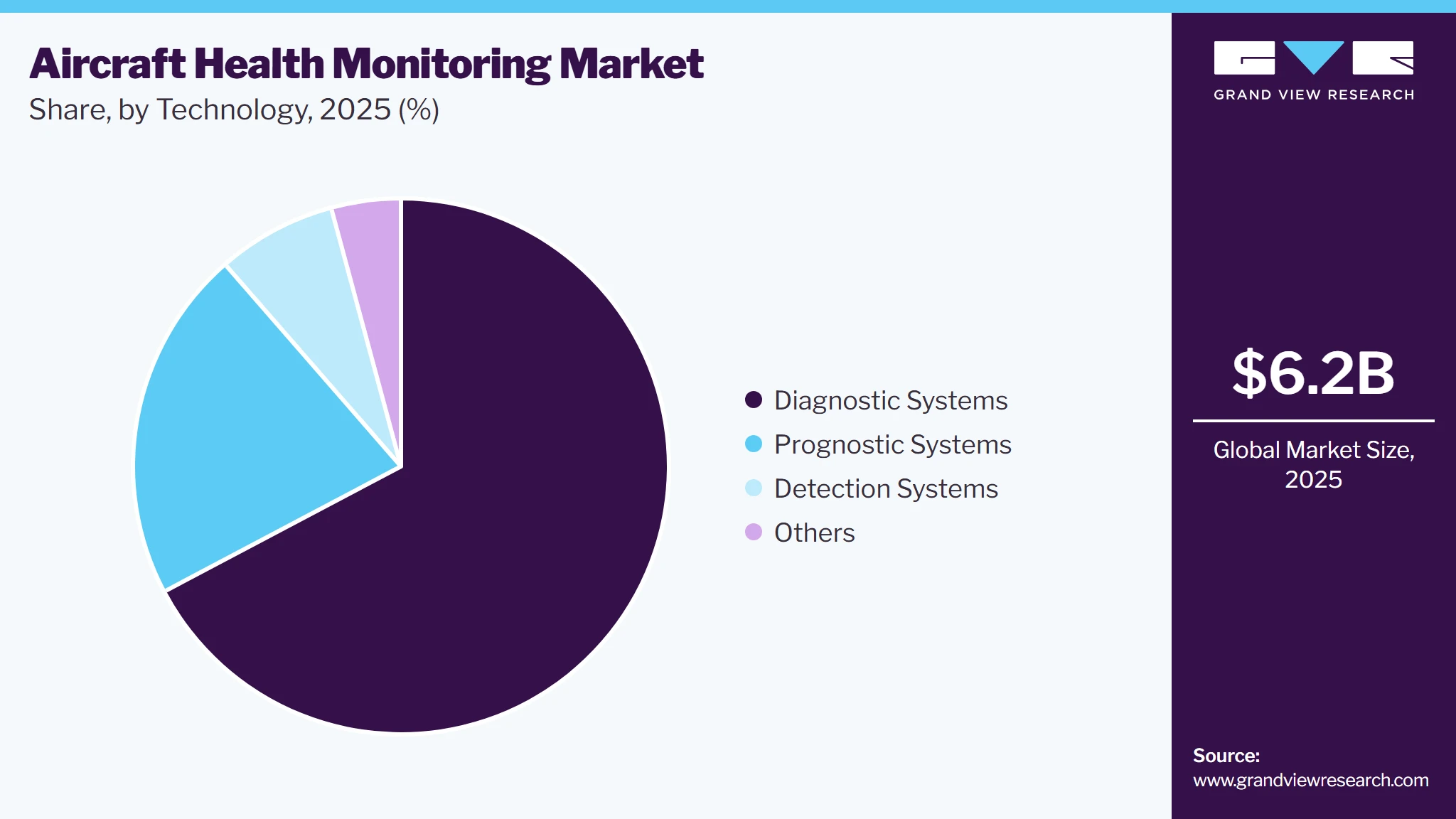
- By technology: Diagnostic systems segment held a largest revenue share of 67.3% in 2025.
Regional Highlights
- Largest regional market: North America (33.3% revenue share, 2025)
- Fastest-growing regional market: Asia Pacific (highest CAGR, 2026–2033)
- By country: The U.S. held the largest market share in 2025.
Market Size & Forecast
- Market Size in 2025: USD 6.2 Billion
- Estimated Market Size in 2026: USD 6.6 Billion
- Projected Market Size by 2033: USD 10.0 Billion
- CAGR (2026-2033): 6.2%
Prism AI by Grand View Research Free to tryAsk a question about the aircraft health monitoring marketTry asking✓Every figure cited from GVR research Prefer the report? Download free sample →
Furthermore, growing integration of AI, IoT, sensors, and advanced analytics, along with investments by airlines, OEMs, and MRO providers, is further enhancing aircraft safety, reliability, and fleet availability. The market for aircraft health monitoring is growing as airlines, aircraft operators, and MRO providers increasingly adopt aircraft health monitoring systems to improve aircraft reliability, safety, and maintenance efficiency. Rising deployment of commercial aircraft health monitoring solutions is driven by the growing need for real-time monitoring of engines, aircraft structures, and critical components, enabling early fault detection and reducing unplanned maintenance and aircraft downtime.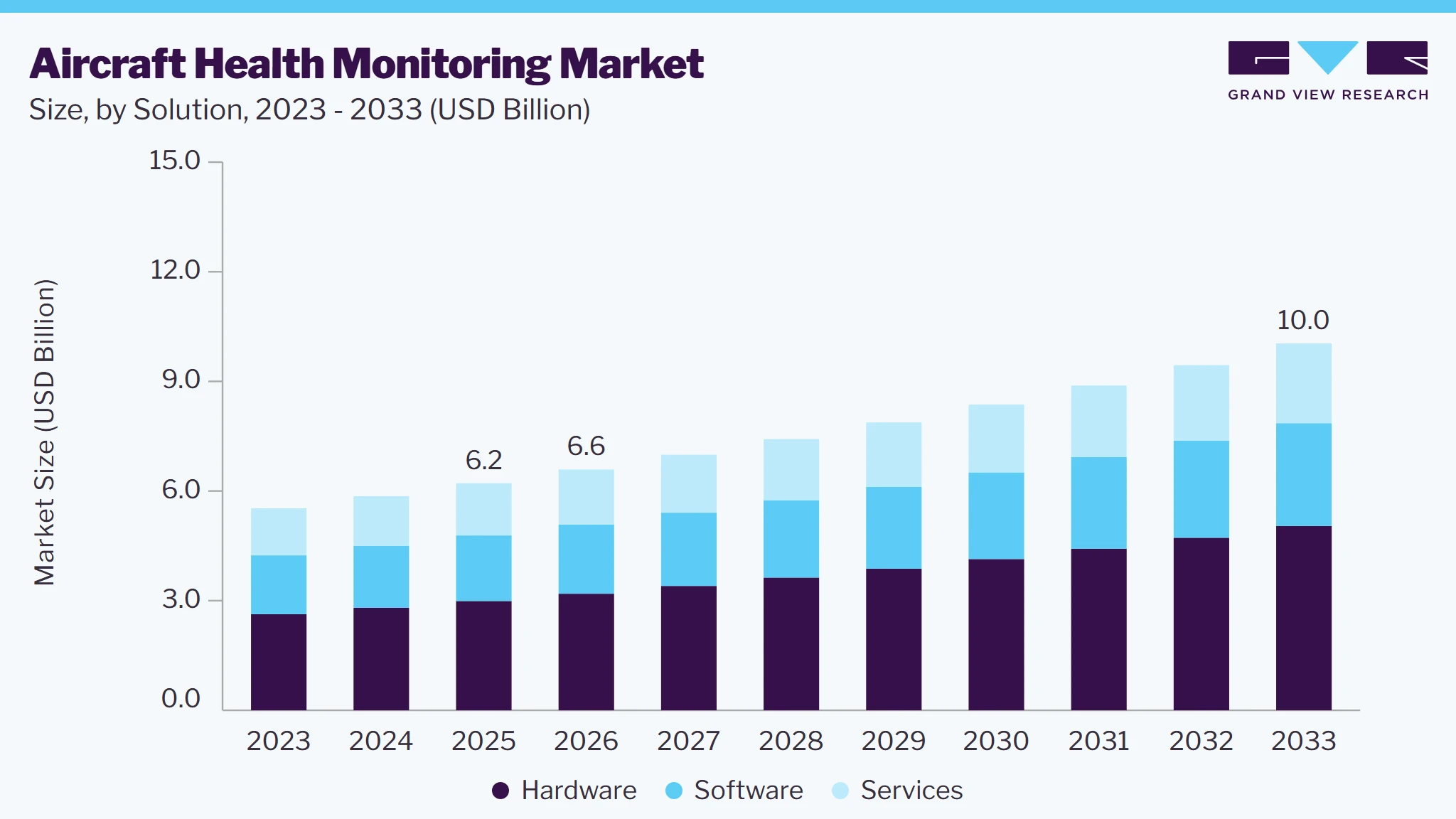 To learn more about this report, Download Free Sample Report
In parallel, increasing adoption of diagnostic and prognostic systems, onboard sensors, predictive analytics, AI, and connected aircraft data platforms is strengthening demand for continuous aircraft condition monitoring and predictive maintenance. The expansion of modern commercial aircraft fleets and increasing focus on condition-based maintenance and aircraft lifecycle optimization.
Market Dynamics
The aircraft health monitoring industry is experiencing significant growth, driven by increasing adoption of predictive maintenance, rising demand for real-time aircraft health data, growing investments in digital aviation infrastructure, and increasing integration of connected monitoring technologies across commercial, military, and business aircraft. Airlines, aircraft operators, OEMs, and MRO providers are deploying aircraft health monitoring systems, sensors, data acquisition systems, IoT-enabled components, cloud-based analytics, and real-time monitoring platforms to improve aircraft reliability, reduce unplanned maintenance, and optimize fleet operations. The growing adoption of AI, machine learning, predictive analytics, digital twins, and automated diagnostics is further strengthening market growth. However, high system installation and retrofit costs, cybersecurity risks, complex integration with existing avionics, certification requirements, and data interoperability challenges remain key restraints. At the same time, advancements in AI-enabled prognostics, edge computing, connected aircraft systems, digital twins, and real-time analytics are creating significant opportunities for market participants.
The aircraft health monitoring industry is primarily driven by increasing demand for reliable, high-speed platform and the digitalization of aircraft operations. Airlines and aircraft operators are deploying advanced in-flight Wi-Fi, SATCOM, air-to-ground platform, real-time aircraft data systems, and connected cabin technologies to improve passenger experience and operational visibility. The growing availability of low-Earth orbit (LEO) satellite networks is supporting higher-speed and lower-latency platform, enabling passengers to access streaming, cloud technology and other data-intensive services during flights. In parallel, connected aircraft systems enable airlines to monitor aircraft health, optimize flight operations, support predictive maintenance, and improve fuel and fleet management, further supporting market expansion.
Despite strong growth prospects, the aircraft health monitoring industry faces challenges associated with the high installation, retrofit, integration, and lifecycle costs of advanced monitoring systems. Aircraft health monitoring requires sensors, data acquisition units, processing systems, communication interfaces, analytics software, and supporting infrastructure, which can involve significant investment, particularly for older aircraft requiring extensive retrofits. Integrating monitoring systems with existing avionics, aircraft systems, MRO platforms, and airline IT infrastructure can also be technically complex. In addition, stringent aviation safety and certification requirements, cybersecurity risks, data interoperability issues, and the need for highly specialized technical expertise can increase implementation timelines and operational costs.
The increasing adoption of AI, machine learning, IoT, edge computing, digital twins, and advanced aircraft data analytics is creating substantial opportunities in the aircraft health monitoring industry. AI-enabled systems can analyze large volumes of real-time aircraft data to identify anomalies, predict component failures, assess aircraft health, and optimize maintenance schedules. Digital twins can further enable continuous simulation and condition assessment of aircraft components, supporting more accurate predictive maintenance and lifecycle management. The integration of aircraft health monitoring with cloud platforms, MRO systems, connected aircraft ecosystems, and automated maintenance workflows is also creating opportunities for OEMs, avionics manufacturers, MRO providers, software companies, and aviation technology providers.
Market Concentration & Characteristics
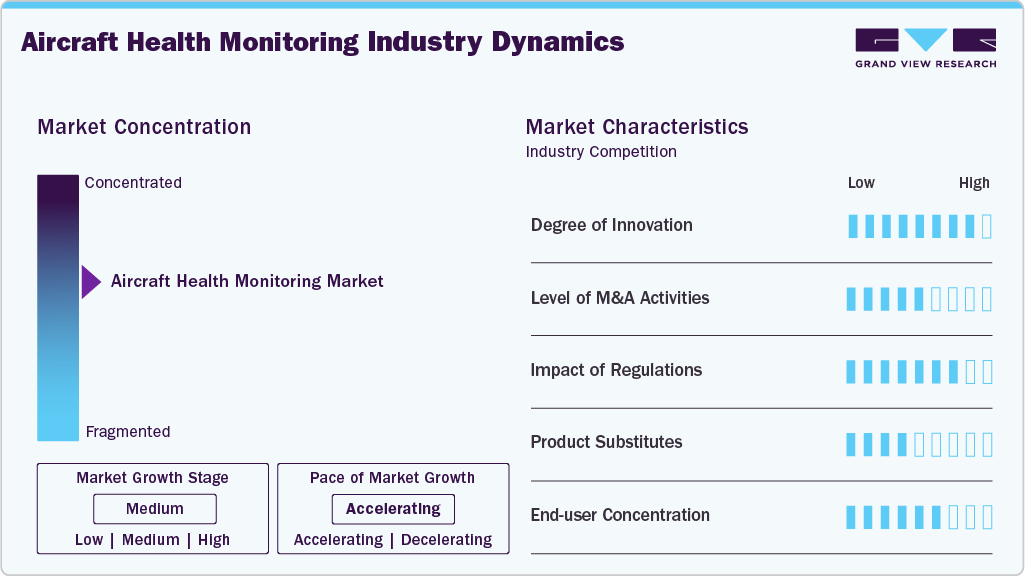
The aircraft health monitoring industry is moderately concentrated, with competition led by established aerospace, avionics, aircraft systems, MRO, and aviation technology companies. The market is characterized by continuous advancements in aircraft health monitoring systems, sensor technologies, real-time aircraft data acquisition, diagnostics and prognostics, predictive maintenance, AI and machine learning, cloud-based analytics, digital twins, and connected aircraft technologies. High technology development and certification costs, stringent aviation safety and regulatory requirements, complex integration with existing avionics and aircraft systems, cybersecurity considerations, and the need for reliable real-time data processing create significant barriers to entry. These factors enable established aviation technology providers to maintain strong competitive positions through technological innovation, strategic partnerships, aircraft fleet deployments, acquisitions, and long-term agreements with airlines, aircraft OEMs, and MRO providers.
 To learn more about this report, Download Free Sample Report
Major players such as Honeywell International Inc., Collins Aerospace, Thales, Safran, Lufthansa Technik, GE Aerospace, RTX, Airbus, The Boeing Company, and Rolls-Royce are strengthening their positions in the market through investments in aircraft health monitoring systems, engine monitoring, avionics, sensor technologies, aircraft data management, AI-enabled analytics, and predictive maintenance solutions. Companies are increasingly focused on improving real-time aircraft health assessment, fault detection, predictive analytics, maintenance optimization, and data integration across aircraft and MRO systems. As airlines and aircraft operators continue to prioritize aircraft safety, operational reliability, fleet availability, maintenance cost optimization, and predictive maintenance, the market is expected to witness sustained investment, strategic collaborations, technology development, and integration of advanced digital capabilities.
Analyst Perspective
The aircraft health monitoring industry is expected to witness strong growth, driven by increasing adoption of predictive maintenance, real-time aircraft health monitoring, and digital aircraft operations. Airlines, aircraft operators, OEMs, and MRO providers are investing in advanced sensors, aircraft data systems, AI, machine learning, IoT, predictive analytics, and digital twins to improve aircraft reliability, reduce maintenance costs, and minimize unplanned downtime. Despite challenges related to high installation costs, system integration, cybersecurity, and certification requirements, continued advancements in AI-enabled diagnostics, prognostics, and connected aircraft technologies are expected to support long-term market growth.
Solution Insights
The hardware segment held a significant share of 48.1% in 2025, driven by the widespread deployment of critical monitoring components, including aircraft sensors, data acquisition units, avionics interfaces, processing units, engine health monitoring systems, structural health monitoring systems, and onboard monitoring equipment across civil aviation, military aviation, and advanced air mobility platforms. These systems are essential for real-time aircraft condition monitoring, fault detection, diagnostics, prognostics, predictive maintenance, component health assessment, and overall aircraft reliability.
The software segment held a significant market share in 2025, driven by the increasing adoption of aircraft health monitoring platforms, diagnostic and prognostic software, AI and machine learning analytics, predictive maintenance applications, anomaly detection, and real-time aircraft data analysis. These software solutions are increasingly deployed across civil aviation, military aviation, and advanced air mobility platforms to analyze aircraft health data, identify potential faults, predict component failures, optimize maintenance schedules, reduce unplanned downtime, and improve overall aircraft reliability and operational efficiency.
Platform Insights
The civil aviation segment held a significant share of 72.6% in 2025, driven by the large global commercial aircraft fleet, increasing adoption of predictive maintenance, and growing demand for real-time aircraft health monitoring. Airlines are deploying aircraft health monitoring systems, advanced sensors, diagnostics, prognostics, and AI-enabled analytics to monitor aircraft condition, detect faults, predict component failures, and optimize maintenance schedules. The growing focus on improving aircraft availability, reducing unplanned downtime, enhancing operational safety, and lowering maintenance costs is further supporting the segment’s strong market position.
The military aviation segment is anticipated to witness significant growth over the forecast period, driven by increasing investments in defense aircraft modernization, rising demand for mission readiness, and the growing adoption of advanced aircraft health monitoring technologies. Military operators are deploying real-time sensors, engine and structural health monitoring systems, diagnostics, prognostics, and AI-enabled predictive maintenance to improve aircraft availability and detect potential component failures.
Fit Insights
The Line-Fit segment held a significant share of 61.3% in 2025, driven by the increasing integration of health monitoring systems during aircraft manufacturing and assembly. Aircraft OEMs are incorporating advanced sensors, data acquisition units, avionics interfaces, engine health monitoring, structural monitoring, and predictive maintenance technologies into new aircraft to enable real-time aircraft health assessment from the point of delivery.
The retrofit segment is anticipated to witness significant growth over the forecast period, driven by the need to modernize aging aircraft fleets and integrate advanced monitoring capabilities into in-service aircraft. Airlines, aircraft operators, and MRO providers are increasingly adopting retrofit solutions, including advanced sensors, data acquisition systems, avionics interfaces, real-time monitoring platforms, and predictive maintenance technologies, to improve aircraft reliability and maintenance efficiency.
Technology Insights
The diagnostic systems segment held a significant share of 67.3% in 2025, driven by the widespread adoption of technologies that enable real-time detection, identification, and assessment of faults across critical aircraft systems and components. Diagnostic systems analyze data from engines, avionics, flight controls, hydraulic systems, electrical systems, and other aircraft components to identify abnormalities and support root-cause analysis. Growing demand for early fault detection, faster troubleshooting, reduced maintenance downtime, improved maintenance accuracy, and enhanced aircraft reliability is further strengthening the segment’s market position.
 To learn more about this report, Download Free Sample Report
The prognostic systems segment is anticipated to witness significant growth over the forecast period, driven by the increasing adoption of predictive maintenance and the growing need to anticipate component failures before they occur. Prognostic systems use AI, machine learning, sensor data, historical maintenance records, and predictive analytics to estimate component condition and remaining useful life.
Regional Insights
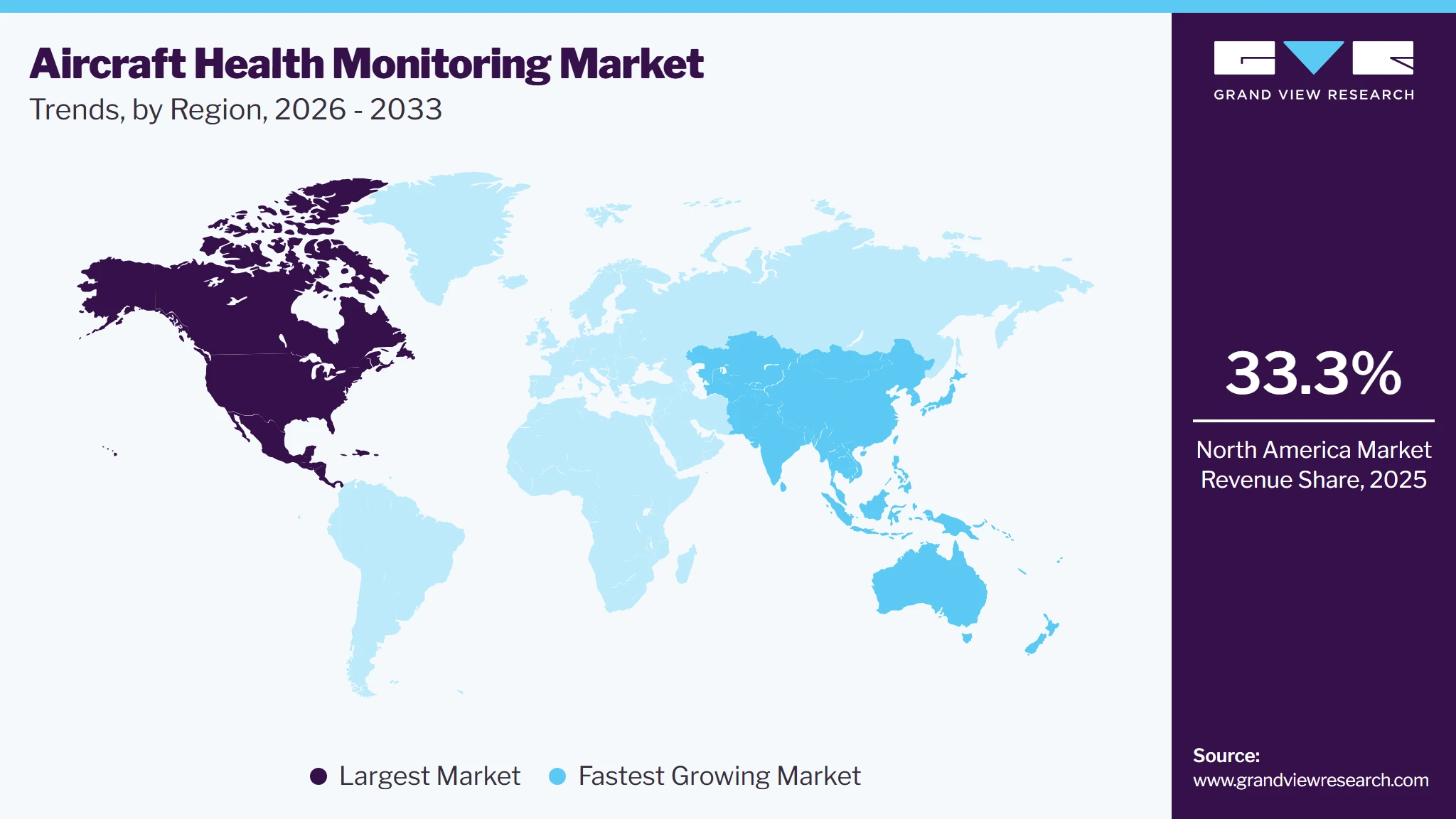
North America aircraft health monitoring industry leads the global market, accounting for 33.3% of the market share in 2025, driven by the high adoption of advanced aircraft health monitoring systems, extensive deployment of connected aircraft technologies, and continued investments in digital aviation infrastructure. The region, led by the United States, benefits from the presence of major aerospace, avionics, aircraft OEM, and MRO companies, along with a well-established aviation ecosystem. Increasing investments in real-time aircraft data monitoring, aircraft sensors, AI and machine learning, predictive maintenance, digital twins, and advanced analytics are strengthening the region’s aircraft health monitoring capabilities.
 To learn more about this report, Download Free Sample Report
U.S. Aircraft Health Monitoring Market Trends
The U.S. aircraft health monitoring industry leads the North American market, supported by a large commercial and business aircraft fleet, advanced aviation infrastructure, and continued investments in digital aircraft technologies. The country benefits from a strong ecosystem of aerospace companies, avionics manufacturers, aircraft OEMs, and MRO providers. Increasing deployment of aircraft health monitoring systems, advanced sensors, real-time aircraft data platforms, AI-enabled diagnostics, predictive maintenance, and aircraft analytics is strengthening U.S. market growth. The growing use of these technologies for real-time aircraft monitoring, fault detection, maintenance optimization, and fleet reliability is further supporting market expansion.
Europe Aircraft Health Monitoring Market Trends
The Europe aircraft health monitoring industry is witnessing steady growth, driven by increasing digitalization of aviation operations, growing adoption of predictive maintenance, and rising investments in advanced aircraft monitoring technologies. European airlines and aircraft operators are adopting aircraft health monitoring systems, advanced sensors, real-time aircraft data analytics, IoT-enabled systems, and AI-based diagnostics to improve aircraft reliability and operational efficiency. Increasing investments in predictive maintenance, cloud-based aviation platforms, digital twins, and connected aircraft technologies are further supporting the modernization of European aircraft fleets.
The UK aircraft health monitoring industry is witnessing steady growth, driven by increasing adoption of digital aircraft technologies, connected aviation systems, and predictive maintenance solutions. Airlines and aircraft operators are investing in aircraft health monitoring systems, advanced sensors, real-time aircraft data analytics, and AI-enabled diagnostics to improve aircraft reliability and fleet performance. Growing emphasis on real-time aircraft monitoring, predictive maintenance, cloud-based analytics, and integration of connected aircraft technologies is further supporting market growth.
The Germany aircraft health monitoring industry is experiencing significant growth, supported by a strong aviation ecosystem, increasing fleet digitalization, and investments in advanced aircraft monitoring and avionics technologies. Airlines and aircraft operators are expanding the use of aircraft health monitoring systems, IoT-enabled sensors, real-time data analytics, and predictive maintenance solutions to improve aircraft reliability and operational efficiency. Increasing adoption of AI-enabled analytics, connected aircraft platforms, and digital fleet management technologies is further strengthening the German market.
Asia-Pacific Aircraft Health Monitoring Market Trends
The Asia-Pacific aircraft health monitoring industry is witnessing rapid growth with projected fastest CAGR of 7.0% over the forecast period. The Asia Pacific market is driven by expanding commercial aircraft fleets, rising air passenger traffic, increasing fleet modernization, and growing adoption of digital aviation technologies across China, India, Japan, South Korea, and Australia. Airlines and aircraft operators are increasingly investing in aircraft health monitoring systems, advanced sensors, real-time data analytics, IoT-enabled systems, and predictive maintenance technologies to improve aircraft reliability and operational efficiency. Growing adoption of AI-enabled diagnostics, cloud-based analytics, digital fleet management, and connected aircraft technologies is further accelerating regional market growth.
The China aircraft health monitoring industry is expanding due to rapid growth in commercial aviation, increasing aircraft fleet modernization, and rising demand for advanced passenger platform and digital aviation services. Chinese airlines and aircraft operators are increasingly adopting in-flight Wi-Fi, SATCOM, connected cabin technologies, aircraft data analytics, and digital fleet management solutions to improve passenger experience and operational performance. The country’s growing focus on indigenous aerospace technologies, AI-enabled aircraft analytics, IoT, predictive maintenance, and next-generation Platform infrastructure is further strengthening its connected aircraft ecosystem. Increasing passenger demand for seamless digital services and continued expansion of domestic and international air travel are expected to sustain demand for connected aircraft solutions in China.
Key Aircraft Health Monitoring Company Insights
The aircraft health monitoring industry is characterized by the presence of established aerospace, avionics, aircraft systems, and MRO companies. Competition is driven by continuous innovation in aircraft health monitoring systems, advanced sensors, real-time aircraft data analytics, diagnostics and prognostics, predictive maintenance, AI-enabled analytics, and digital aircraft technologies. Established players maintain strong market positions through extensive R&D capabilities, aircraft integration expertise, strategic partnerships with airlines and aircraft manufacturers, and long-term service agreements.
-
Honeywell International Inc. is a leading provider of aerospace technologies, avionics, aircraft health monitoring, and connected aircraft solutions. Its portfolio supports airlines and aircraft operators through real-time aircraft data monitoring, predictive maintenance, aircraft diagnostics, and advanced avionics, helping improve aircraft reliability, operational efficiency, and maintenance planning.
-
Collins Aerospace is a major aerospace and avionics technology provider offering aircraft health monitoring, avionics, sensors, data management, and predictive maintenance solutions. Its technologies enable airlines and aircraft operators to monitor aircraft systems and components, identify potential faults, optimize maintenance activities, and improve overall aircraft availability and operational performance.
Key Aircraft Health Monitoring Companies:
The following key companies have been profiled for this study on the aircraft health monitoring market:
-
Honeywell International Inc.
-
Collins Aerospace
-
Thales
-
Safran
-
Lufthansa Technik
-
GE Aerospace
-
RTX Corporation
-
Airbus
-
The Boeing Company
-
Rolls-Royce
Competitive Benchmarking
Category
Operating Strategies
Competitive Edge
Weakness
Mature Players: Honeywell International Inc.; Collins Aerospace; Thales; Safran; Airbus; The Boeing Company; Rolls-Royce
- Invest in aircraft health monitoring, avionics, sensors, diagnostics, prognostics, predictive maintenance, and AI-enabled analytics.
- Expand solutions through aircraft OEM, airline, and MRO partnerships.
- Integrate health monitoring with connected aircraft and digital maintenance platforms.
- Strong aerospace and avionics expertise.
- Extensive R&D capabilities and aircraft integration experience.
- Established relationships with airlines and aircraft manufacturers.
- High R&D and certification costs.
- Complex aircraft integration and lengthy certification cycles
Emerging Players: Lufthansa Technik; GE Aerospace; RTX Corporation;
- Focus on aircraft health monitoring, digital MRO, predictive maintenance, aircraft data analytics, and condition-based maintenance solutions.
- Expand capabilities through airline partnerships, digital MRO platforms, and integration of advanced analytics into maintenance workflows.
- Strong MRO expertise and direct access to aircraft maintenance data.
- Specialized capabilities in aircraft maintenance, diagnostics, and digital aviation solutions.
- Smaller overall aerospace portfolio compared with diversified aerospace and aircraft OEM companies.
- Growth can depend on airline fleet activity, MRO demand, and adoption of digital maintenance solutions.
Recent Development
-
In January 2026, Honeywell highlighted the continued expansion of its Maintenance Service Plan (MSP) through digitalization and AI-enabled predictive maintenance. Its Honeywell Ensemble service uses real-time engine data and AI analytics to help operators anticipate engine issues, improve maintenance planning, and reduce unscheduled downtime, strengthening Honeywell’s health monitoring capabilities
-
In October 2025, Airbus announced that Korean Air selected its Skywise Fleet Performance+ (S.FP+) solution to support real-time aircraft monitoring, predictive maintenance, and maintenance prioritization across its fleet. The solution uses aircraft data and analytics to help anticipate unscheduled maintenance events and improve fleet availability.
Aircraft Health Monitoring Market Report Scope
Report Attribute
Details
Market size value in 2025
USD 6.2 billion
Estimated market size in 2026
USD 6.6 billion
Projected market size by 2033
USD 10.0 billion
Growth rate
CAGR of 6.2% from 2026 to 2033
Actual data
2021 – 2025
Forecast period
2026– 2033
Quantitative units
Revenue in USD billion and CAGR from 2026 to 2033
Report coverage
Revenue forecast, company ranking, competitive landscape, growth factors, and trends
Segments covered
Solution, platform, fit, technology & region
Regional scope
North America; Europe; Asia Pacific; Latin America; MEA
Country scope
U.S.; Canada; Mexico; Germany; UK; France; China; India; Japan; Australia; South Korea; Brazil; UAE; South Africa; KSA
Key companies profiled
Honeywell International Inc.; Collins Aerospace; Thales; Safran; Lufthansa Technik; GE Aerospace; RTX Corporation; Airbus; The Boeing Company; Rolls-Royce
Customization scope
Free report customization (equivalent up to 8 analysts working days) with purchase. Addition or alteration to country, regional & segment scope.
Pricing and purchase options
Avail customized purchase options to meet your exact research needs. Explore purchase options
Global Aircraft Health Monitoring Market Report Segmentation
This report forecasts revenue growth at global, regional, and country levels and provides an analysis of the latest industry trends in each of the sub-segments from 2021 to 2033. For this study, Grand View Research has segmented the global aircraft health monitoring market report based on solution, platform, fit, technology & region
-
Solution Outlook (Revenue, USD Billion, 2021 - 2033)
-
Hardware
-
Sensors
-
Data Acquisition Systems
-
Communication Equipment
-
-
Software
-
Service
-
-
Platform Outlook (Revenue, USD Billion, 2021 - 2033)
-
Civil Aviation
-
Military Aviation
-
Advanced Air Mobility
-
-
Fit Outlook (Revenue, USD Billion, 2021 - 2033)
-
Line-Fit
-
Retrofit
-
-
Technology Outlook (Revenue, USD Billion, 2021 - 2033)
-
Diagnostic Systems
-
Prognostic Systems
-
Detection Systems
-
Others
-
-
Regional Outlook (Revenue, USD Billion, 2021 - 2033)
-
North America
-
U.S.
-
Canada
-
Mexico
-
-
Europe
-
UK
-
Germany
-
France
-
-
Asia Pacific
-
China
-
Japan
-
India
-
Australia
-
South Korea
-
-
Latin America
-
Brazil
-
-
Middle East and Africa (MEA)
-
KSA
-
UAE
-
South Africa
-
-
Research Methodology
The aircraft health monitoring market figures in this report are based on a proven research process that combines executive interviews with secondary research from proprietary databases, company filings, and recognized regulatory and institutional sources. Market size is built through value-chain sizing—reconciling supply-side and demand-side estimates—and triangulated with bottom-up and top-down approaches. Every estimate passes multiple levels of expert validation before publication, with each aircraft health monitoring segment quantified using the revenue-capture definitions in the table below.
Segment Definition
Segment – Solution
Revenue capture definition
Hardware
Revenue in this segment is generated through the sale and installation of hardware components that enable aircraft health monitoring capabilities for airlines, aircraft operators, and MRO providers. These hardware components include aircraft sensors, data acquisition units, avionics systems, flight data recorders, processing units, health monitoring systems, communication interfaces, engine monitoring equipment, structural monitoring devices, and other onboard monitoring components.
Software
Revenue in this segment is generated through the provision of software solutions that analyze aircraft health and operational data to support airlines, aircraft operators, OEMs, and MRO providers. These solutions include aircraft health monitoring platforms, diagnostic and prognostic software, predictive maintenance analytics, AI and machine learning applications, real-time data analytics, fleet management software, anomaly detection, digital twin platforms, and maintenance planning tools.
Services
Revenue in this segment is generated through the provision of services that support the deployment, operation, maintenance, and optimization of aircraft health monitoring systems. These services include system integration, installation, technical support, maintenance and repair, data analytics, predictive maintenance services, aircraft health assessment, software updates, training, and consulting services. Service providers help airlines, aircraft operators, OEMs, and MRO organizations improve aircraft reliability, optimize maintenance activities, reduce downtime, and maximize the performance of health monitoring systems.
Segment – Platform
Revenue capture definition
Civil Aviation
Revenue in this segment is generated through the deployment of aircraft health monitoring systems across commercial passenger and cargo aircraft operated by airlines and aviation operators. These systems include aircraft sensors, engine health monitoring, structural health monitoring, real-time data analytics, diagnostics, prognostics, and predictive maintenance solutions.
Military Aviation
Revenue in this segment is generated through the deployment of aircraft health monitoring systems across military aircraft, including fighter aircraft, transport aircraft, helicopters, surveillance aircraft, and other defense platforms. These systems include engine and component monitoring, structural health monitoring, onboard diagnostics, prognostics, real-time aircraft data analytics, and predictive maintenance solutions.
Advanced Air Mobility
Revenue in this segment is generated through the deployment of aircraft health monitoring technologies across emerging advanced air mobility platforms, including electric vertical takeoff and landing (eVTOL) aircraft, autonomous aircraft, air taxis, and electric aircraft. These systems include battery and propulsion monitoring, structural health monitoring, sensor-based diagnostics, real-time data analytics, fault detection, prognostics, and predictive maintenance solutions.
Segment – Fit
Revenue capture definition
Line-Fit
Revenue in this segment is generated through the installation of aircraft health monitoring systems during the manufacturing and assembly of new aircraft. Line-fit solutions include integrated sensors, data acquisition systems, avionics, engine health monitoring, structural health monitoring, onboard processing units, and predictive maintenance software.
Retrofit
Revenue in this segment is generated through the installation and upgrading of aircraft health monitoring systems on existing aircraft fleets. Retrofit solutions include the integration of advanced sensors, data acquisition units, health monitoring systems, avionics, real-time data analytics, and predictive maintenance technologies into in-service aircraft.
Segment – Technology
Revenue capture definition
Diagnostic Systems
Revenue in this segment is generated through the deployment of diagnostic systems that detect, identify, and assess faults or abnormal conditions across aircraft systems and components. These systems analyze data from engines, avionics, flight controls, hydraulic systems, electrical systems, and other critical components to identify potential failures and determine their underlying causes.
Prognostic Systems
Revenue in this segment is generated through the deployment of prognostic systems that predict potential aircraft component failures and estimate remaining useful life (RUL). These systems use aircraft sensor data, historical maintenance records, AI, machine learning, and predictive analytics to assess the future condition of engines, avionics, structural components, and other critical systems.
Detection Systems
Revenue in this segment is generated through the deployment of detection systems that identify abnormal conditions, faults, and early signs of component degradation across aircraft systems. These systems use sensors, monitoring devices, data acquisition units, and real-time processing technologies to detect anomalies in engines, structures, avionics, electrical systems, and other critical components.
Others
Revenue in this segment is generated through the deployment of advanced aircraft health monitoring technologies and supporting systems that complement diagnostic, prognostic, and detection capabilities. These include adaptive monitoring systems, data visualization and reporting tools, health management software, aircraft data integration solutions, condition monitoring technologies, and specialized monitoring applications.
Estimation Model
Layer No
Layer Name
Key Question
Description
1
Addressable Aircraft Health Monitoring Base Layer
Which aircraft are equipped or require aircraft health monitoring capabilities?
Estimate the global installed base and annual deliveries of civil, military, business aviation, and advanced air mobility aircraft that are equipped or intended to be equipped with aircraft health monitoring capabilities. The assessment considers aircraft type, fleet size, age, utilization, maintenance requirements, aircraft modernization, and regional deployment.
2
Aircraft Health Monitoring Technology Adoption Layer
Which health monitoring technologies and systems are deployed across aircraft?
Apply adoption rates for diagnostic systems, prognostic systems, detection systems, and other health monitoring technologies based on aircraft type, application, maintenance strategy, operational requirements, aircraft age, OEM specifications, and MRO practices
3
System Content & Deployment Layer
What health monitoring systems and equipment are installed per aircraft?
Estimate aircraft health monitoring system value based on penetration and average content of sensors, data acquisition units, monitoring systems, processing units, avionics interfaces, engine monitoring systems, structural health monitoring systems, and aircraft data analytics platforms.
4
Revenue Generation Layer
How is revenue generated from aircraft health monitoring systems and services?
Estimate market revenue across hardware, software, and services by applying average selling prices, software licensing/subscription models, installation costs, maintenance contracts, data analytics services, system upgrades, and technical support.
5
Regional & End-User Allocation Layer
Where are aircraft health monitoring investments concentrated?
Allocate the estimated market value across North America, Europe, Asia-Pacific, Middle East & Africa, and Latin America, considering fleet size, aircraft deliveries, health monitoring adoption, aviation activity, MRO infrastructure, and investments by airlines, aircraft operators, OEMs, and MRO providers.
Delivered Customizations
This report has been delivered with the following In-depth customizations
Client Request
Customization Delivered
Value Adds
Aircraft Health Monitoring Market Entry & Growth Strategy
• Assessment of demand for aircraft health monitoring systems across civil aviation, military aviation, and advanced air mobility.
• Analysis of opportunities across diagnostic systems, prognostic systems, detection systems, engine health monitoring, structural health monitoring, predictive maintenance, and aircraft data analytics.
• Identified high-growth health monitoring technologies, aircraft platforms, end-use segments, and geographic markets.
• Supported market entry, product positioning, partnership identification, customer targeting, and long-term expansion strategies.
Next-Generation Aircraft Health Monitoring Technology & Capability Assessment
• Assessment of emerging technologies including AI/ML-enabled diagnostics and prognostics, IoT-enabled sensors, real-time aircraft monitoring, digital twins, edge computing, cloud-based analytics, automated fault detection, and predictive maintenance.
• Evaluation of aircraft health monitoring technology requirements across civil, military, business aviation, and advanced air mobility platforms.
• Identified technology gaps and high-potential innovation areas within the aircraft health monitoring ecosystem.
• Supported technology roadmap development, R&D prioritization, product development, and next-generation aircraft health monitoring solution strategies.
Frequently Asked Questions About This Report
The global aircraft health monitoring market size was estimated at USD 6.2 billion in 2025 and is expected to reach USD 6.6 billion in 2026.
The hardware segment dominated with a 48.1% revenue share in 2025.
North America dominated the aircraft health monitoring market with a share of 33.3% in 2025.
Key factors that are driving the market growth include growing adoption of real-time aircraft health monitoring systems, increasing deployment of diagnostic and prognostic technologies, rising demand for predictive maintenance and condition-based maintenance, growing integration of AI, IoT, sensors, and advanced data analytics, increasing need for early fault detection and aircraft component monitoring, and strong investments by airlines, aircraft operators, OEMs, and MRO providers to improve aircraft safety, reliability, maintenance efficiency, and fleet availability.
Some key players operating in the aircraft health monitoring market include Honeywell International Inc., Collins Aerospace, Thales, Safran, Lufthansa Technik, GE Aerospace, RTX Corporation, Airbus, The Boeing Company, Rolls-Royce
The Asia Pacific is the fastest-growing region with a CAGR of over 7% from 2026 to 2033.
The civil aviation segment dominated with a 76.2% revenue share in 2025.
The diagnostic systems market with a share of 67.3% in 2025.
The global aircraft health monitoring market is expected to grow at a compound annual growth rate of 6.2% from 2026 to 2033 to reach USD 10.0 million by 2033.
About the Author(s)
Next Generation Technologies Research Team
Technology · Next Generation TechnologiesThis report was authored by the next generation technologies research team at Grand View Research - comprising two research analysts, one senior research analyst, and one industry expert - with specialized expertise in the next generation technologies segment of the technology industry. All findings are based on proprietary technology databases, executive interviews, and regulatory analysis, subject to internal peer review prior to publication.
Last Updated:
Speak to Analyst

Customize this report to your needs - add regions, segments, or data points, with 20% free customization.
Or view our licence options:


ISO 9001:2015 & 27001:2022 Certified
We are GDPR and CCPA compliant! Your transaction & personal information is safe and secure. For more details, please read our privacy policy.


