
- Home
- »
- Advanced Interior Materials
- »
-
Airless Tires Market Size, Share & Growth Report, 2026-2033GVR Report cover
![Airless Tires Market (2026 - 2033)Report]()
Airless Tires Market (2026 - 2033)
Size, Share & Trends Analysis Report By Vehicle Type (Passenger Vehicles, Commercial Vehicles), By Sales Channel (OEM, Aftermarket), By Region (North America, Asia Pacific, Europe, Central & South America, MEA), And Segment Forecasts
Market Size, 2025
$61.5BMarket Estimate, 2026
$64.5BMarket Forecast, 2033
$90.5BCAGR, 2026–2033
5.0%Airless Tires Market Size & Trends
The global airless tires market size was valued at USD 61.5 billion in 2025 and is projected to grow from USD 64.5 billion in 2026 to USD 90.5 billion by 2033, growing at a CAGR of 5.0% from 2026 to 2033. Asia Pacific dominated the airless tires market with the largest revenue share of 54.5% in 2025. Unlike traditional pneumatic tires, airless tires eliminate the risk of sudden deflation, reducing downtime and enhancing operational efficiency.

Key Market Trends & Insights
- By vehicle type: Passenger vehicles segment led the market with the largest revenue share of 38.3% in 2025 and is expected to grow at a CAGR of 5.3% over the forecast period.
- By sales channel: The OEM segment led the market with the largest revenue share of 63.1% in 2025 and is expected to grow at a CAGR of 5.2% over the forecast period.
Regional Highlights
- Largest regional market: Asia Pacific (54.5% revenue share, 2025)
- By country: The China held the largest market share in 2025.
Market Size & Forecast
- Market size in 2025: USD 61.5 Billion
- Estimated market size in 2026: USD 64.5 Billion
- Projected market size by 2033: USD 90.5 Billion
- CAGR (2026-2033): 5.0%
This advantage is particularly beneficial in heavy-duty applications such as agricultural and industrial machinery, where durability and reliability are critical. Additionally, the rising preference for airless tires in military vehicles due to their ability to withstand extreme conditions and resist damage from sharp objects is further propelling market growth. Technological advancements and innovations in tire manufacturing have also contributed to the expansion of the airless tires market. Companies are increasingly investing in research and development to enhance tire performance, improve load-bearing capacity, and extend lifespan. The adoption of advanced materials such as high-strength polymers and composite rubber compounds has led to the production of lightweight, energy-efficient airless tires that offer better traction and stability. Moreover, the integration of 3D printing technology in tire manufacturing has enabled the production of customized and cost-effective airless tire designs, driving market growth.
Environmental concerns and sustainability initiatives are further driving the demand for airless tires. Traditional pneumatic tires contribute significantly to landfill waste due to frequent replacements and disposal issues. In contrast, airless tires, with their longer lifespan and recyclability, align with global sustainability efforts and regulatory mandates aimed at reducing carbon footprints. Government policies promoting eco-friendly and durable tire solutions are encouraging manufacturers to develop and commercialize airless tires, particularly in electric and autonomous vehicles, where efficiency and longevity are paramount.
Market Dynamics
The airless tires market is experiencing significant growth due to increasing demand for durable mobility solutions, rising adoption of maintenance-free tire technologies, growing focus on vehicle uptime and operational efficiency, and continuous advancements in advanced polymer and composite materials. Airless tires are gaining traction for their ability to eliminate punctures, reduce maintenance requirements, and provide enhanced durability across off-road, military, industrial, agricultural, and commercial vehicle applications. The expansion of construction and mining activities, increasing mechanization in agriculture, and growing deployment of autonomous and utility vehicles are further supporting market growth. Additionally, advancements in non-pneumatic tire designs, high-strength thermoplastic materials, additive manufacturing technologies, and energy-efficient tire structures are enabling improved load-bearing capacity, ride performance, and scalability for large-scale commercial applications.
The growing demand for highly durable and maintenance-free tire solutions is a major driver of the airless tires market. Fleet operators, industrial equipment manufacturers, defense organizations, and agricultural users are increasingly seeking alternatives to conventional pneumatic tires that are susceptible to punctures, pressure loss, and frequent maintenance requirements. Airless tires offer significant advantages through puncture-proof performance, extended service life, reduced downtime, and enhanced operational reliability, making them attractive for demanding operating environments. The increasing focus on productivity optimization, fleet efficiency, and equipment uptime is driving strong demand for advanced airless tire technologies.
Furthermore, rising infrastructure development activities, expansion of construction and mining operations, and increasing use of utility and autonomous vehicles are encouraging the adoption of non-pneumatic tire systems. Growing emphasis on reducing maintenance costs, improving workplace safety, and enhancing equipment performance in harsh operating conditions is further accelerating the commercialization and deployment of airless tire solutions globally.
The airless tires market faces challenges, including high manufacturing costs, complex engineering requirements, and performance limitations in certain high-speed applications. Producing advanced airless tires often requires specialized materials, sophisticated design architectures, precision manufacturing processes, and extensive testing to achieve desired durability, comfort, and load-carrying characteristics. Compared to conventional pneumatic tires, airless alternatives may involve higher production expenses and longer product development cycles.
The growing adoption of autonomous vehicles, industrial machinery, and off-road mobility solutions is creating substantial growth opportunities for the airless tires market. Increasing demand for reliable, low-maintenance tire systems across agriculture, construction, mining, defense, and logistics applications is driving significant interest in technologies that enhance operational continuity while reducing lifecycle maintenance costs. Airless tires offer opportunities to improve fleet productivity, eliminate tire-related failures, and support uninterrupted operation in challenging environments.
Market Concentration & Characteristics
The global airless tires market exhibits a moderate to high level of market concentration, with key players such as Michelin, Bridgestone, and Goodyear leading the industry through continuous innovation. The degree of innovation is significant, as manufacturers focus on advanced materials, 3D printing, and smart tire technology to enhance durability, fuel efficiency, and environmental sustainability. While new entrants face high barriers due to substantial R&D costs and stringent testing requirements, established companies are leveraging partnerships and acquisitions to strengthen their market presence. The market has witnessed a rising trend in mergers and collaborations, as tire manufacturers align with automotive OEMs to accelerate commercialization and scale production. These strategic alliances contribute to a more consolidated industry, limiting the influence of smaller players while enhancing technological advancements.
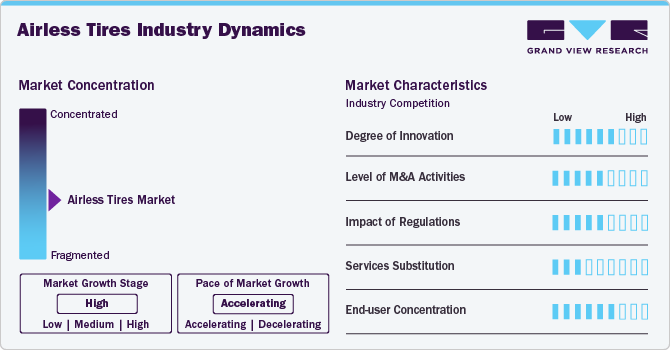
Regulatory frameworks significantly shape the market landscape, with governments implementing stringent safety and environmental standards that impact product development and commercialization timelines. Regulations surrounding fuel efficiency, vehicle safety, and recyclability play a crucial role in driving innovation and adoption. Service substitutes for airless tires remain limited, as traditional pneumatic tires dominate the market; however, run-flat and self-sealing tires pose potential competition. End-use concentration is primarily high in defense, off-road, and commercial vehicle applications, where durability and puncture resistance are critical. While passenger vehicle adoption is in its early stages, increasing focus on sustainability and reduced maintenance costs is expected to drive wider acceptance in the long term.
Analyst Perspective
The airless tires market is evolving from a niche industrial tire segment into a technology-driven market centered on puncture-proof performance, maintenance-free operation, durability enhancement, operational efficiency, and next-generation mobility solutions. The strongest growth opportunities are emerging from construction and mining equipment, agricultural machinery, military and defense vehicles, autonomous ground vehicles, material handling equipment, and specialty utility vehicles. The key differentiator for companies will not be tire manufacturing capability alone, but their ability to develop scalable, high-performance airless tire solutions that deliver superior load-bearing capacity, ride comfort, durability, safety, and lifecycle cost advantages while maintaining regulatory compliance and operational reliability. Players with proprietary non-pneumatic tire architectures, expertise in advanced polymer and composite materials, strong relationships with OEMs and fleet operators, diversified application portfolios, and scalable manufacturing capabilities are likely to capture premium margins and long-term growth opportunities.
Vehicle Type Insights
Based on vehicle type, the passenger vehicles segment led the market with the largest revenue share of 38.3% in 2025 and is expected to grow at a CAGR of 5.3% over the forecast period, driven by the increasing demand for durable and low-maintenance tire solutions, particularly in electric and autonomous vehicles. Airless tires eliminate the risk of punctures and blowouts, enhancing vehicle safety and reliability, which is a key factor driving their adoption in passenger cars. Additionally, rising consumer awareness regarding sustainable mobility has encouraged automakers to explore innovative tire technologies that reduce environmental impact.

The commercial vehicles segment is expected to grow significantly at CAGR of 5.2% over the forecast period, the commercial vehicles segment in the global airless tires market is primarily driven by the increasing demand for durability, reduced maintenance costs, and enhanced operational efficiency. Fleet operators and logistics companies are increasingly adopting airless tires due to their resistance to punctures, eliminating downtime associated with tire blowouts and frequent replacements. This is particularly beneficial for industries reliant on heavy-duty trucks, buses, and construction vehicles, where operational efficiency is critical.
Sales Channel Insights
Based on sales channel, the OEM segment led the market with the largest revenue share of 63.1% in 2025 and is expected to grow at a CAGR of 5.2% over the forecast period, driven by increasing collaborations between tire manufacturers and automotive companies to integrate advanced tire technologies into next-generation vehicles. As automakers strive to enhance vehicle durability, reduce maintenance costs, and improve fuel efficiency, the adoption of airless tires is gaining traction. OEMs are increasingly incorporating airless tire solutions in military, construction, and agricultural vehicles where puncture resistance and longevity are critical.
Aftermarket segment is expected to grow significantly at CAGR of 4.7% over the forecast period, driven by increasing demand for durable and maintenance-free tire solutions, particularly in commercial and off-road vehicle applications. Airless tires eliminate common issues such as punctures, blowouts, and air pressure maintenance, making them an attractive choice for fleet operators, agricultural machinery, and military vehicles.
Regional Insights
Asia Pacific dominated the airless tires market with the largest revenue share of 54.5% in 2025, driven by rapid industrialization and the growing adoption of advanced automotive technologies. The region's expanding construction and agricultural sectors are fueling demand for durable, low-maintenance tires that can withstand harsh terrains and heavy-duty applications. Additionally, increasing government investments in smart mobility solutions, particularly in countries such as Japan and South Korea, are accelerating the development and commercialization of airless tires. With rising consumer awareness regarding sustainable transportation and reduced vehicle maintenance costs, the market is witnessing a growing interest in alternative tire solutions across various end-use industries.

The airless tires market in China held the largest share in the Asia Pacific region in 2025. China’s airless tires market is primarily driven by the country’s booming electric vehicle (EV) industry and its aggressive push for sustainable mobility solutions. As the world’s largest EV market, China is at the forefront of adopting innovative tire technologies that enhance efficiency and longevity while reducing environmental impact. The government's strict emissions regulations and incentives for green mobility are encouraging automakers to explore airless tires as a viable alternative. Additionally, the country’s strong manufacturing capabilities and advancements in 3D printing technology are enabling local companies to develop and mass-produce airless tires at competitive prices, further driving market growth.
North America Airless Tires Market Trends
In North America, the demand for airless tires is driven by their increasing adoption in military, defense, and off-road applications. The U.S. Department of Defense and other security agencies are investing in airless tire technology to enhance vehicle performance in rugged and unpredictable terrains, reducing the risk of tire-related failures in critical operations. Furthermore, North America's strong automotive aftermarket sector is contributing to market expansion, as fleet operators and logistics companies seek maintenance-free tire solutions to optimize vehicle uptime and operational efficiency. The region's focus on technological advancements, including smart tire integration, is also propelling innovation in the sector.
The U.S. airless tires market is primarily driven by the rising demand for sustainable and fuel-efficient mobility solutions. With a growing emphasis on reducing carbon emissions, airless tires are being explored as an eco-friendly alternative that minimizes waste and extends vehicle lifespan. The country’s well-established automotive and aerospace industries are also contributing to increased research and development efforts in tire technology. Additionally, strategic collaborations between tire manufacturers and major automotive OEMs are accelerating the commercialization of airless tires, particularly for electric and autonomous vehicle applications.
Europe Airless Tires Market Trends
The European airless tires market is shaped by stringent environmental regulations and the region’s strong commitment to sustainable transportation. The European Union’s policies promoting green mobility and circular economy initiatives are encouraging the adoption of durable, recyclable, and maintenance-free tire solutions. Additionally, the presence of leading automotive manufacturers in countries such as France and Italy is fostering innovation in airless tire design and production. The region's growing electric vehicle market and its focus on reducing dependence on traditional petroleum-based products are further driving the demand for airless tires across various applications.
Airless Tires Market in Germany is witnessing growth due to being a hub for automotive engineering and technological innovation in the field of vehicle safety and efficiency. The country's world-renowned automotive industry, led by companies such as BMW, Mercedes-Benz, and Volkswagen, is actively exploring next-generation tire technologies to enhance vehicle performance. Additionally, Germany’s advancements in material science and additive manufacturing are playing a crucial role in the development of high-performance airless tires. The government's support for research initiatives focused on sustainable mobility solutions is further reinforcing market growth in the region.
Latin America Airless Tires Market Trends
The Latin American airless tires market is primarily driven by efforts to combat organized crime, drug trafficking, and border security threats. While defense budgets in the region remain relatively low compared to North America and Europe, investments in advanced OEM technologies are steadily increasing. Several countries, including Brazil and Mexico, are seeking to modernize their armed forces by incorporating precision-Passenger Vehicles into their defense strategies. Additionally, collaborations with international defense manufacturers and technology transfers are supporting the growth of the Airless Tires market in the region.
Middle East & Africa Airless Tires Market Trends
The airless tires market in the Middle East & Africa is primarily driven by the need for durable and puncture-resistant tires in extreme climatic conditions. With high temperatures and rugged terrains posing challenges for conventional pneumatic tires, airless tires are gaining popularity, particularly in the mining, construction, and defense sectors. Additionally, increasing infrastructure development projects in the Gulf Cooperation Council (GCC) countries are creating demand for heavy-duty vehicles equipped with low-maintenance, long-lasting tire solutions.
Key Airless Tires Company Insights
Some of the key players operating in market include Bridgestone Corporation, Michelin Group
-
Bridgestone Corporation has been actively developing airless tire technology to enhance vehicle safety and reduce maintenance costs. Bridgestone’s key offering in this segment is the Air-Free Concept Tire, which features a unique spoke structure that eliminates the need for air while providing high shock absorption and durability. These tires are designed for applications in bicycles, industrial vehicles, and future mobility solutions, aligning with the company's vision for sustainable transportation.
-
Michelin Group, a France-based tire manufacturer, has been at the forefront of airless tire innovation, focusing on sustainable and high-performance mobility solutions. The company’s flagship airless tire product, the Michelin Uptis (Unique Puncture-Proof Tire System), is designed for passenger vehicles and aims to eliminate flat tires, reduce waste, and extend tire lifespan.
Goodyear Tire and Rubber Company, Continental AG are some of the emerging market participants in airless tires market.
-
Goodyear Tire and Rubber Company, an American multinational tire manufacturer, has been investing in airless tire technology to meet the growing demand for maintenance-free and durable tire solutions. The company's Goodyear Non-Pneumatic Tire (NPT) is primarily designed for autonomous and off-road applications, offering enhanced resilience and longevity.
-
Continental AG, a German automotive and tire manufacturer, has been developing airless tire solutions to support sustainable and smart mobility trends. The company’s ContiSense and ContiAdapt concepts integrate airless technology with intelligent sensors, enabling real-time performance monitoring and adaptive capabilities. Continental is also working on innovative designs for electric vehicles and autonomous transport, focusing on reducing rolling resistance and enhancing energy efficiency.
Key Airless Tires Companies
The following key companies have been profiled for this study on the airless tires market.
-
Bridgestone Corporation
-
Michelin Group
-
Goodyear Tire and Rubber Company
-
Continental AG
-
Hankook Tire & Technology Group
-
Amerityre Corporation
-
Tannus Ltd
-
Toyo Tire & Rubber Co. Ltd
-
Sumitomo Rubber Industries Ltd
-
Pirelli
Competitive Benchmarking
Category
Operating Strategies
Competitive Edge
Weakness
Established Players (Bridgestone Corporation, Michelin Group, Goodyear Tire and Rubber Company, Continental AG)
- Invest heavily in R&D for advanced non-pneumatic tire technologies and proprietary spoke designs.
- Establish long-term partnerships with OEMs, defense organizations, and industrial equipment manufacturers.
- Leverage global manufacturing and distribution networks to accelerate commercialization and market penetration.
- Strong brand recognition, extensive patent portfolios, and large-scale production capabilities.
- Significant financial resources enabling continuous innovation, testing, and product development.
- Established customer relationships across automotive, commercial, industrial, and defense sectors.
- Higher organizational complexity can slow commercialization of new technologies.
- Significant capital investment requirements for scaling airless tire production facilities.
- Dependence on regulatory approvals and OEM adoption timelines for market expansion.
Emerging Players (Amerityre Corporation, Tannus Ltd)
- Focus on niche applications such as bicycles, lawn equipment, utility vehicles, and specialty mobility solutions.
- Utilize flexible manufacturing approaches to rapidly commercialize innovative airless tire concepts.
- Collaborate with technology developers and specialty vehicle manufacturers to expand market reach.
- High degree of innovation and specialization in airless tire technologies.
- Faster product development cycles and ability to address niche customer requirements.
- Strong focus on lightweight designs, customization, and emerging mobility applications.
- Limited production capacity and smaller distribution networks compared to global tire manufacturers.
- Lower brand awareness and restricted access to large OEM contracts.
- Greater vulnerability to raw material price fluctuations and funding constraints.
Recent Developments
-
In January 2025, Hyundai Motor Company and Kia Corporation’s global open innovation platforms, ZER01NE and Hyundai CRADLE, will participate in CES 2025 from January 7 to 10. This joint exhibition highlights Hyundai Motor and Kia’s commitment to advancing next-generation mobility solutions, including airless tire technology. Through ZER01NE and Hyundai CRADLE, Hyundai and Kia collaborate with global startups to accelerate innovation in airless tires, enhancing durability, sustainability, and vehicle efficiency.
Airless Tires Market Report Scope
Report Attribute
Details
Market size in 2025
USD 61.5 billion
Estimated market size in 2026
USD 64.5 billion
Projected market size by 2033
USD 90.5 billion
Growth rate
CAGR of 5.0% from 2026 to 2033
Base year for estimation
2025
Historical data
2021 - 2024
Forecast period
2026 - 2033
Quantitative units
Revenue in USD million/billion and CAGR from 2026 to 2033
Report coverage
Revenue forecast, company ranking, competitive landscape, growth factors, and trends
Segments covered
Vehicle type, sales channel, region
Regional scope
North America; Europe; Asia Pacific; Central & South America; Middle East & Africa
Country scope
U.S.; Canada; Mexico; U.K.; Germany; France; Italy; Spain; China; India; Japan; South Korea
Key companies profiled
Bridgestone Corporation; Michelin Group; Goodyear Tire and Rubber Company; Continental AG; Hankook Tire & Technology Group; Amerityre Corporation; Tannus Ltd; Toyo Tire & Rubber Co. Ltd; Sumitomo Rubber Industries Ltd; and Pirelli.
Customization scope
Free report customization (equivalent up to 8 analysts' working days) with purchase. Addition or alteration to country, regional & segment scope.
Pricing and purchase options
Avail customized purchase options to meet your exact research needs. Explore purchase options
Global Airless Tires Market Report Segmentation
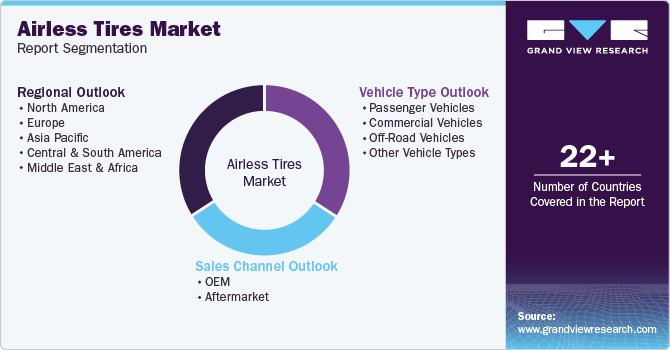
This report forecasts revenue growth at global, regional, and country levels and provides an analysis of the latest industry trends in each of the sub-segments from 2021 to 2033. For this study, Grand View Research has segmented the global airless tires market report based on vehicle type, sales channel, and region.
-
Vehicle Type Outlook (Revenue, USD Million, 2021 - 2033)
-
Passenger Vehicles
-
Commercial Vehicles
-
Off-Road Vehicles
-
Other Vehicle Types
-
-
Sales Channel Outlook (Revenue, USD Million, 2021 - 2033)
-
OEM
-
Aftermarket
-
-
Regional Outlook (Revenue, USD Million, 2021 - 2033)
-
North America
-
U.S.
-
Canada
-
Mexico
-
-
Europe
-
Germany
-
UK
-
France
-
Italy
-
Spain
-
-
Asia Pacific
-
China
-
Japan
-
India
-
South Korea
-
-
Central & South America
-
Middle East & Africa
-
Research Methodology
The airless tires market figures in this report are based on a proven research process that combines executive interviews with secondary research from proprietary databases, company filings, and recognized regulatory and institutional sources. Market size is built through value-chain sizing - reconciling supply-side and demand-side estimates - and triangulated with bottom-up and top-down approaches. Every estimate passes multiple levels of expert validation before publication, with each airless tires segment quantified using the revenue-capture definitions in the table below.
Segment Definition
Segment - Vehicle Type
Revenue capture definition
Passenger Vehicles
Revenue generated from airless tires installed in passenger cars, electric vehicles, personal mobility vehicles, and urban transportation applications. This segment captures revenues from manufacturers and suppliers providing non-pneumatic tire solutions designed to eliminate punctures, reduce maintenance requirements, enhance durability, and improve vehicle reliability for personal and consumer transportation use.
Commercial Vehicles
Revenue generated from airless tires used in commercial transportation fleets, delivery vehicles, logistics vehicles, buses, and utility vehicles. This segment captures revenues from manufacturers and suppliers offering durable tire solutions that minimize downtime, lower maintenance costs, improve fleet productivity, and support continuous operation in demanding commercial environments.
Off-Road Vehicles
Revenue generated from airless tires deployed in construction equipment, agricultural machinery, mining vehicles, military vehicles, all-terrain vehicles (ATVs), utility task vehicles (UTVs), and other heavy-duty off-road applications. This segment captures revenues from manufacturers and suppliers providing puncture-resistant, high-load-bearing tire solutions designed to withstand harsh terrains, extreme operating conditions, and intensive industrial usage.
Other Vehicle Types
Revenue generated from airless tires utilized in specialty vehicles, golf carts, lawn and garden equipment, industrial material-handling vehicles, autonomous mobile robots, and recreational vehicles. This segment captures revenues from manufacturers and suppliers serving niche mobility applications requiring maintenance-free performance, operational reliability, and extended service life.
Segment - Sales Channel
Revenue capture definition
OEM
Revenue generated from airless tires supplied directly to vehicle manufacturers and equipment producers for installation on new vehicles and machinery during the production process. This segment captures revenues from long-term supply agreements, factory-fit tire installations, and partnerships with automotive, industrial equipment, agricultural machinery, defense vehicle, and specialty vehicle manufacturers.
Aftermarket
Revenue generated from replacement airless tires sold through distributors, dealers, retailers, e-commerce platforms, fleet service providers, and maintenance channels after the original vehicle purchase. This segment captures revenues from tire replacement, fleet upgrades, retrofitting projects, maintenance-driven purchases, and performance enhancement requirements across commercial, industrial, agricultural, and consumer vehicle applications.
Estimation Model
Layer Name
Key Question
Description
Global Tire Market
What is the overall size of the global tire industry?
Represents the total revenue generated from the production and sale of tires across passenger vehicles, commercial vehicles, off-road vehicles, industrial equipment, and specialty mobility applications worldwide. This serves as the parent market from which airless tire revenues are derived.
Non-Pneumatic / Specialty Tire Market
What portion of the tire market consists of non-pneumatic and specialty tire solutions?
Narrows the analysis to advanced tire technologies including airless tires, solid tires, resilient tires, and other puncture-resistant tire solutions designed for enhanced durability, reduced maintenance, and operation in demanding environments.
Airless Tire Market
What share of the non-pneumatic tire market is generated specifically by airless tire products?
Focuses on revenues generated from airless (non-pneumatic) tires that utilize advanced spoke structures, polymer composites, and engineered load-bearing designs to eliminate the need for compressed air while maintaining vehicle performance and reliability.
Application & Channel-Based Airless Tire Revenue
How is airless tire revenue distributed across vehicle types and sales channels?
Captures revenue generated from airless tires across passenger vehicles, commercial vehicles, off-road vehicles, and other vehicle types through OEM and aftermarket sales channels. This layer forms the final market sizing output by aggregating revenues from all key end-use applications and distribution channels.
Delivered Customizations
This report has been delivered with the following In-depth customizations
Client Request
Customization Delivered
Value Adds
Regional Demand & Infrastructure Equipment Analysis
Comprehensive assessment of regional demand patterns across major regions, including analysis of construction equipment, mining machinery, agricultural vehicles, material handling equipment, and industrial fleet deployment, driving airless tire adoption
Enables clients to identify high-growth regional markets, prioritize investment strategies, evaluate infrastructure development impacts, and align product offerings with region-specific equipment demand trends
Competitive Landscape Assessment
Detailed evaluation of key market participants based on product portfolio strength, technological capabilities, airless tire innovation pipeline, manufacturing footprint, strategic partnerships, OEM relationships, patent activity, pricing strategies, and market positioning across end-use industries
Provides actionable intelligence on competitive strengths and weaknesses, helps benchmark market position, identifies potential acquisition or partnership targets, and supports strategic decision-making in a rapidly evolving market
Aftermarket Opportunity Assessment
In-depth analysis of replacement tire demand, retrofit opportunities for existing equipment fleets, distributor and dealer networks, maintenance cost savings, fleet modernization initiatives, and purchasing behavior across industrial, agricultural, construction, and utility vehicle segments
Helps quantify recurring revenue opportunities, identify high-potential aftermarket channels, evaluate customer replacement cycles, and develop targeted go-to-market strategies to maximize long-term revenue generation beyond OEM sales
Frequently Asked Questions About This Report
The global airless tires market size was valued at USD 61.5 billion in 2025 and is estimated at USD 64.5 billion for 2026.
The global airless tires market is expected to grow at a CAGR of 5.0% from 2026 to 2033, reaching USD 90.5 billion by 2033.
Passenger vehicles segment led the airless tires market with a 24.5% revenue share in 2025, driven by the increasing demand for durable and low-maintenance tire solutions, particularly in electric and autonomous vehicles.
Key players in the airless tires market include Bridgestone Corporation; Michelin Group; Goodyear Tire and Rubber Company; Continental AG; Hankook Tire & Technology Group; Amerityre Corporation; Tannus Ltd; Toyo Tire & Rubber Co. Ltd; Sumitomo Rubber Industries Ltd; and Pirelli.
The key factors driving the airless tires market include demand for maintenance-free durability, sustainability initiatives, advancements in materials, and growing adoption in electric, autonomous, and fleet vehicles.
Asia Pacific dominated the airless tires market with a 54.5% revenue share in 2025.
North America is the fastest-growing region in the airless tires market with a CAGR of 5.2% over the forecast period.
The aftermarket segment led the airless tires market with a 74.4% revenue share in 2025.
Key players in the airless tires market include Bridgestone Corporation; Michelin Group; Goodyear Tire and Rubber Company; Continental AG; Hankook Tire & Technology Group; Amerityre Corporation; Tannus Ltd; Toyo Tire & Rubber Co. Ltd; Sumitomo Rubber Industries Ltd; and Pirelli.
About the Author(s)
Advanced Interior Materials Research Team
Advanced Materials · Advanced Interior MaterialsThis report was authored by the advanced interior materials research team at Grand View Research - comprising two research analysts, one senior research analyst, and one industry expert - with specialized expertise in the advanced interior materials segment of the advanced materials industry. All findings are based on proprietary advanced materials databases, executive interviews, and regulatory analysis, subject to internal peer review prior to publication.
Last Updated:
Speak to Analyst


Customize this report to your needs — add regions, segments, or data points, with 20% free customization.
Or view our licence options:


ISO 9001:2015 & 27001:2022 Certified
We are GDPR and CCPA compliant! Your transaction & personal information is safe and secure. For more details, please read our privacy policy.


